
Life, 1902-05-22 · page 8 of 22
Life — May 22, 1902 — page 8: what you’re looking at
What you’re looking at
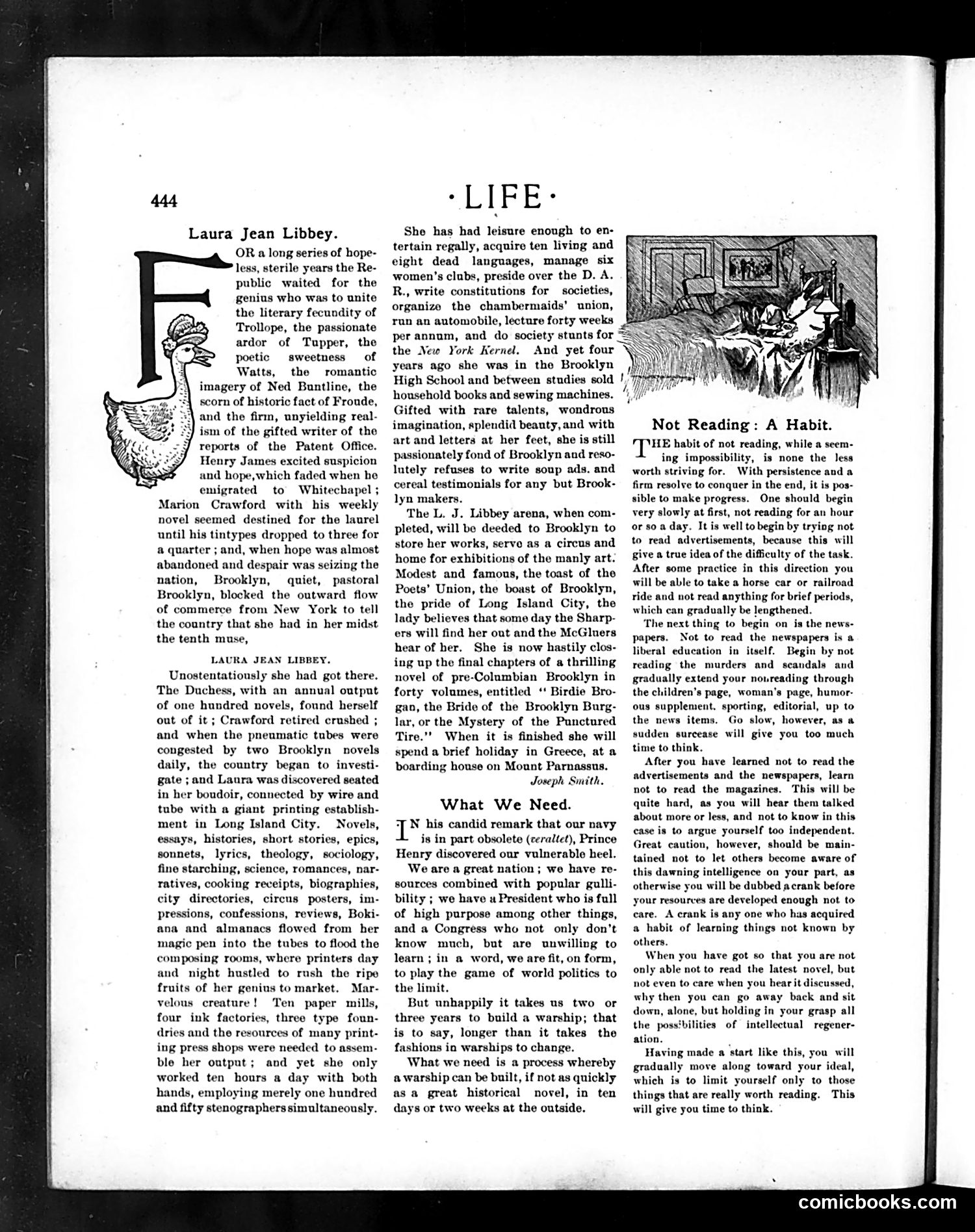
This page contains three distinct sections: a profile of writer **Laura Jean Libbey**, a satirical piece titled **"What We Need,"** and an illustration labeled **"Not Reading: A Habit."** The Libbey profile celebrates a prolific Brooklyn-based novelist known for serialized dime novels and romantic fiction. The satire mocks her extraordinary productivity—she reportedly employed 150 stenographers simultaneously and operated multiple ink factories to meet publishing demands. "What We Need" critiques American naval obsolescence and political incompetence, arguing the nation needs a rapid warship-building program rather than another historical novel (likely referencing Libbey's output). The right illustration satirizes reading avoidance as a social habit, advocating gradual newspaper and intellectual engagement over complete ignorance of current events.
📄 Transcribed text from this page (OCR, searchable)
Machine-transcribed from the original scan — historical spelling and the odd misread are preserved.
444 Laura Jean Libbey. OR a long series of hope- less, sterile years the Re- public waited for the genius who was to unite the literary fecundity of Trollope, the passionate ardor of Tupper, the poetic sweetness of Watts, the romantic imagery of Ned Buntline, the scorn of historic fact of Froude, and the firm, unyielding real- ism of the gifted writer of the reports of the Patent Office. Henry James excited suspicion and hope,which faded when he emigrated to Whitechapel ; Marion Crawford with his weekly novel seemed destined for the laurel until his tintypes dropped to three for a quarter ; and, when hope was almost abandoned and despair was seizing the nation, Brooklyn, quiet, pastoral Brooklyn, blocked the outward flow of commerce from New York to tell the country that she had in her midst the tenth muse, LAURA JEAN LIBBEY. ostentatiously she had got there. The Duchess, with an annual output of one hundred novels, found herself out of it; Crawford retired crushed ; and when the pneumatic tubes were congested by two Brooklyn novels daily, the country began to investi- gate ; and Laura was discovered seated in her boudoir, connected by wire and tube with a giant printing establish- ment in Long Island City. Novels, essays, histories, short stories, epics, sonnets, lyrics, theology, sociology, fine starching, science, romances, nar- ratives, cooking receipts, biographies, city directories, circus posters, im- pressions, confessions, reviews, Boki- ana and almanacs flowed from her magic pen into the tubes to flood the composing rooms, where printers day and night hustled to rush the ripe fruits of her genius to market. Mar- velous creature! Ten paper mills, four ink factories, three type foun- dries and the resources of many print- ing press shops were needed to assem- ble her output; and yet she only worked ten hours a day with both hands, employing merely one hundred and fifty stenographers simultaneously. - LIFE: She has had leisure enough to en- tertain regally, acquire ten living and eight dead languages, manage six women’s clubs, preside over the D. A. R., write constitutions for societies, organizo the chambermaids’ union, run an automobile, lecture forty weeks per annum, and do society stunts for = the New York Kernel. And yet four years ago she was in the Brooklyn High School and between studies sold / household books and sewing machines. Gifted with rare talents, wondrous imagination, splendid beauty, and with art and letters at her feet, she is still passionately fond of Brooklyn and reso- lutely refuses to write soup ads. and cereal testimonials for any but Brook- lyn makers. The L. J. Libbey arena, when com- pleted, will be deeded to Brooklyn to store her works, serve as a circus and home for exhibitions of the manly art. Modest and famous, the toast of the Poets’ Union, the boast of Brooklyn, the pride of Long Island City, the lady believes that some day the Sharp- ers will find her out and the McGluers hear of her. She is now hastily clos- ing up the final chapters of a thrilling novel of pre-Columbian Brooklyn in forty volumes, entitled ‘' Birdie Bro- gan, the Bride of the Brooklyn Burg- lar, or the Mystery of the Punctured Tire."" When it is finished she will spend a brief holiday in Greece, at a boarding house on Mount Parnassus, Joseph Smith. What We Need. Ty his candid remark that our navy is in part obsolete (ceraltet), Prince Henry discovered our vulnerable heel. We are a great nation ; we have re- sources combined with popular gulli- bility ; we have a President who is full of high purpose among other things, and a Congress who not only don’t know much, but are unwilling to learn ; in a word, we are fit, on form, to play the game of world politics to the limit. But unhappily it takes us two or three years to build a warship; that is to say, longer than it takes the fashions in warships to change. What we need is a process whereby a warship can be built, if not as quickly asa great historical novel, in ten days or two weeks at the outside. Not Reading: A Habit. TH habit of not reading, while a seem- ing impossibility, is none the less worth striving for. With persistence and a firm resolve to conquer in the end, it is pos- sible to make progress. One should begin very slowly at first, not reading for an hour or soa day. It is well to begin by trying not. to read advertisements, because this will give a true idea of the difficulty of the task. After some practice in this direction you will be able to take a horse car or railroad ride and not read anything for brief periods, which can gradually be lengthened. The next thing to begin on is the news- apers. Not to read the newspapers is a liberal education in itself. Begin by not reading the murders and scandals and gradually extend your noureading through the children’s page, woman's page, humor- ous supplement. sporting, editorial, up to the news items. Go slow, however, as a sudden surcease will give you too much time to think. After you have learned not to read the advertisements and the newspapers, learn not to read the magazines. This will be quite hard, as you will hear them talked about more or less, and not to know in this case is to argue yourself too independent. Great caution, however, should be main- tained not to let others become aware of this dawning intelligence on your part, as otherwise you will be dubbed acrank before your resources are developed enough not to care. A crank is any one who has acquired a habit of learning things not known by others. When you have got so that you are not only able not to read the latest novel, but not even to care when you hear it discussed, why then you can go away back and sit down, alone, but holding in your grasp all the poss'bilities of intellectual regener- ation. Having made a start like this, you will gradually move along toward your ideal, which is to limit yourself only to those things that are really worth reading. This will give you time to think. comicbooks.com