
A complete issue · 22 pages · 1902
Life — May 1, 1902
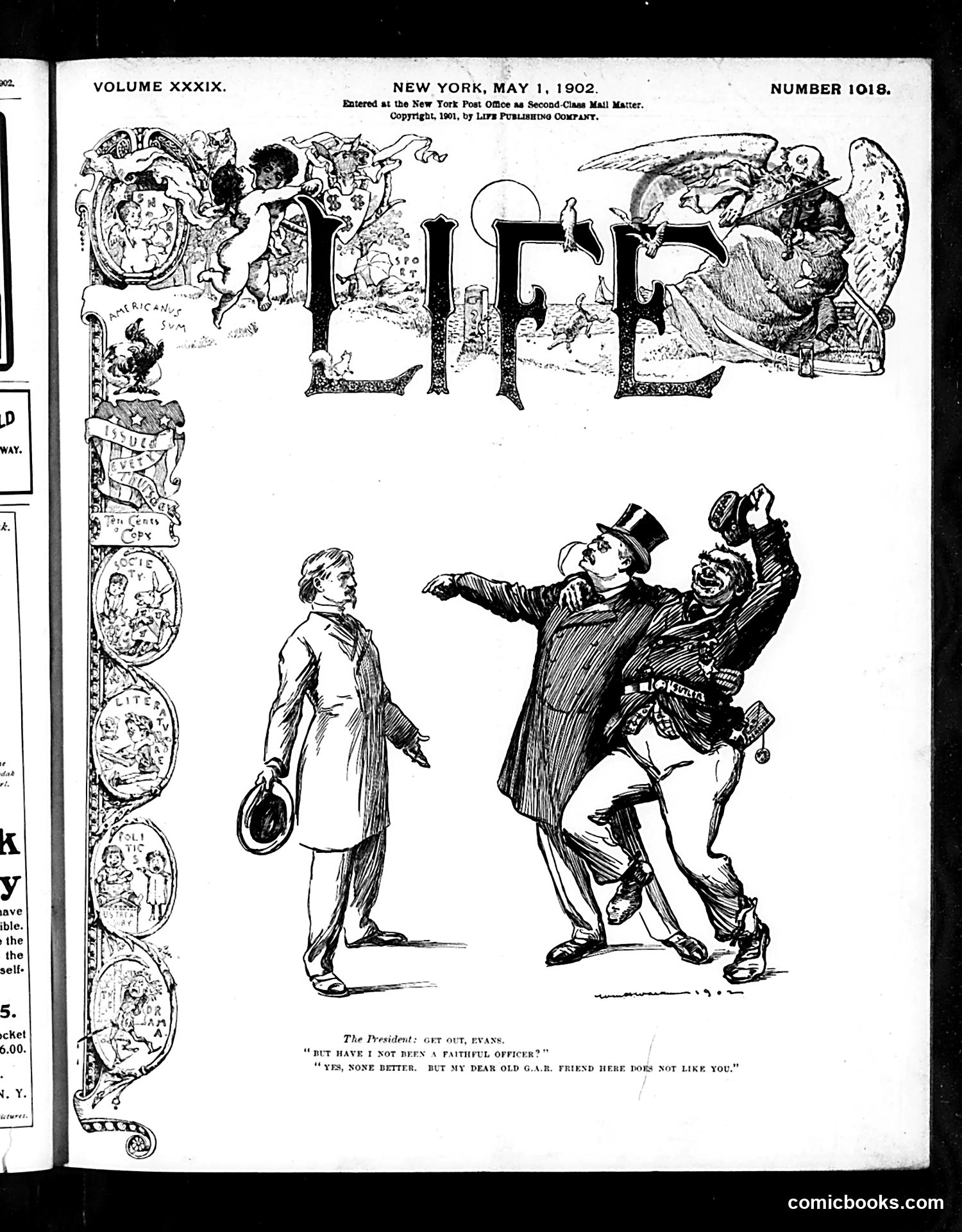
This political cartoon depicts a confrontation between two figures. The dialogue indicates "The President" is speaking to someone about being "a faithful officer," with a retort that "my dear old G.A.R. friend here does not like you." G.A.R. refers to the Grand Army of the Republic, a veterans' organization of Civil War Union soldiers—a politically influential constituency in the early 1900s. The cartoon appears to satirize a conflict within President Theodore Roosevelt's administration regarding military appointments or loyalty. The elderly G.A.R. veteran figure suggests tension between honoring Civil War veterans' political influence and modern administrative needs. The specific officers or incident referenced are unclear without additional historical context, but the satire targets competing political pressures on Roosevelt.
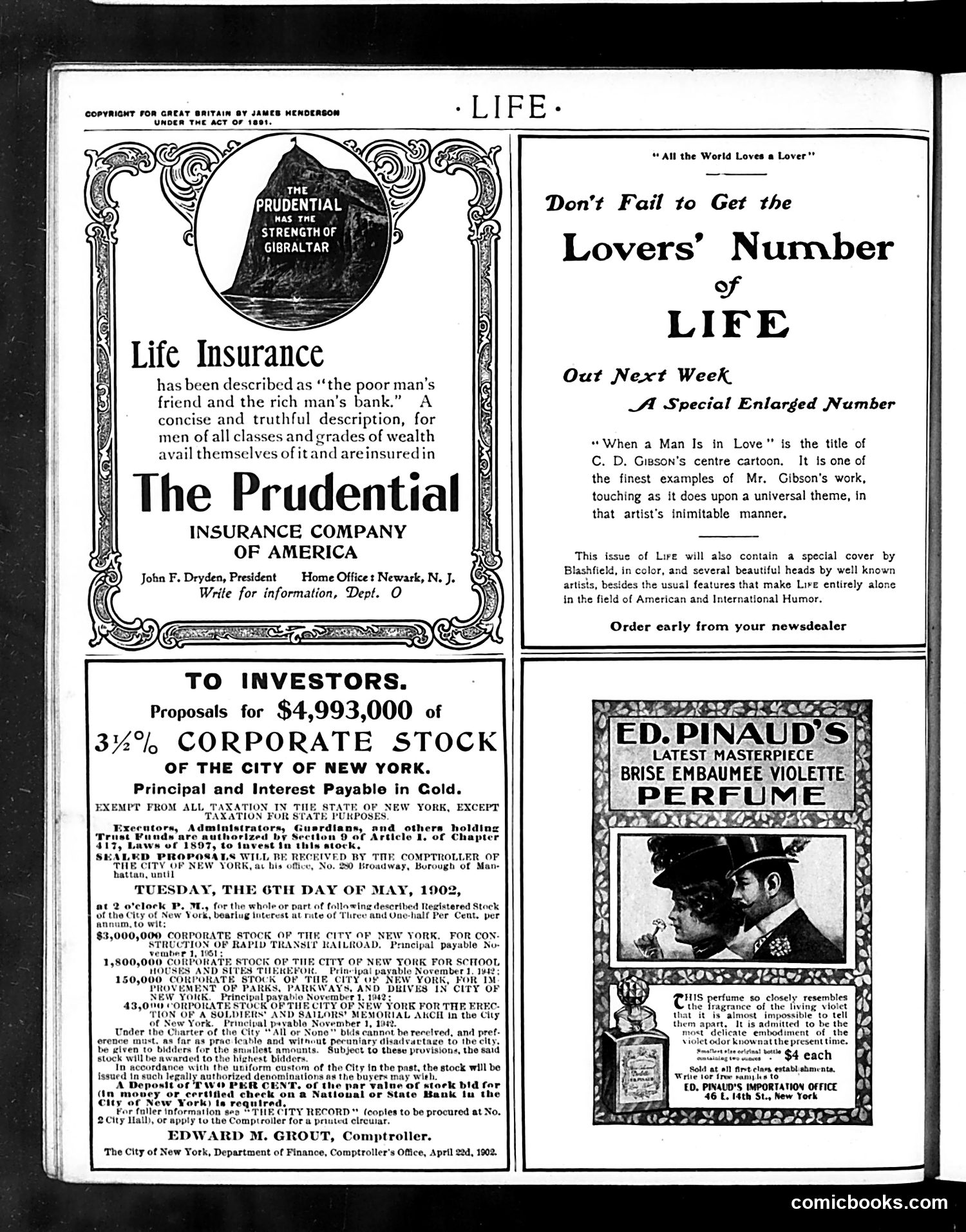
This page consists primarily of **advertisements rather than editorial cartoons**. The main content includes: 1. **The Prudential Insurance Company ad** featuring Gibraltar's Rock, using the tagline "the poor man's friend and the rich man's bank" — a corporate image-building advertisement. 2. **City of New York corporate stock offering** — a municipal bond notice for $4,993,000 in 3½% stock, issued by Comptroller Edward M. Grout (dated April 1902). 3. **Ed. Pinaud's Perfume advertisement** featuring a fashionable man in formal dress with top hat, promoting "Brise Embaumée Violette." The page reflects early 1900s advertising strategies: financial instruments marketed to investors, insurance sold through respectability claims, and luxury goods targeted at wealthy consumers. No political satire is evident on this particular page.
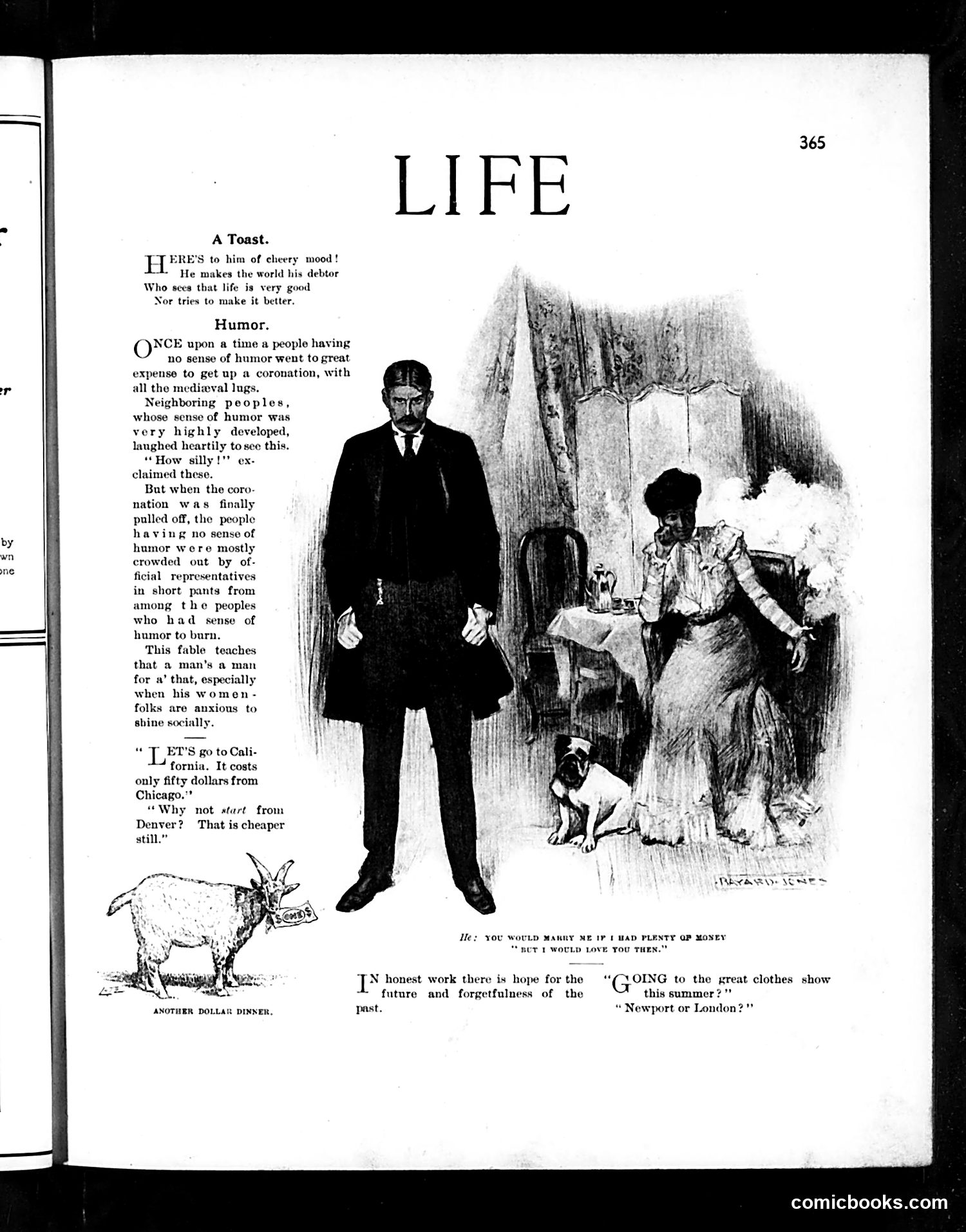
This page contains two satirical pieces about wealth and social aspiration: **"A Toast"** mocks people with "no sense of humor" who spent lavishly on coronation ceremonies, contrasting them with neighboring peoples who laughed at such extravagance. The fable teaches that "a man's a man for a' that"—a reference to Robert Burns's famous poem suggesting character matters more than wealth. **"Humor" section** features a dialogue about travel costs, with a cartoon of a goat labeled "Another Dollar Dinner," satirizing the absurd expense of wealthy people's dining habits. The main illustration shows a wealthy couple, with a caption about marriage being conditional on financial security. The satire critiques American wealth-obsession and the pretensions of the wealthy class, likely from the early 1900s.
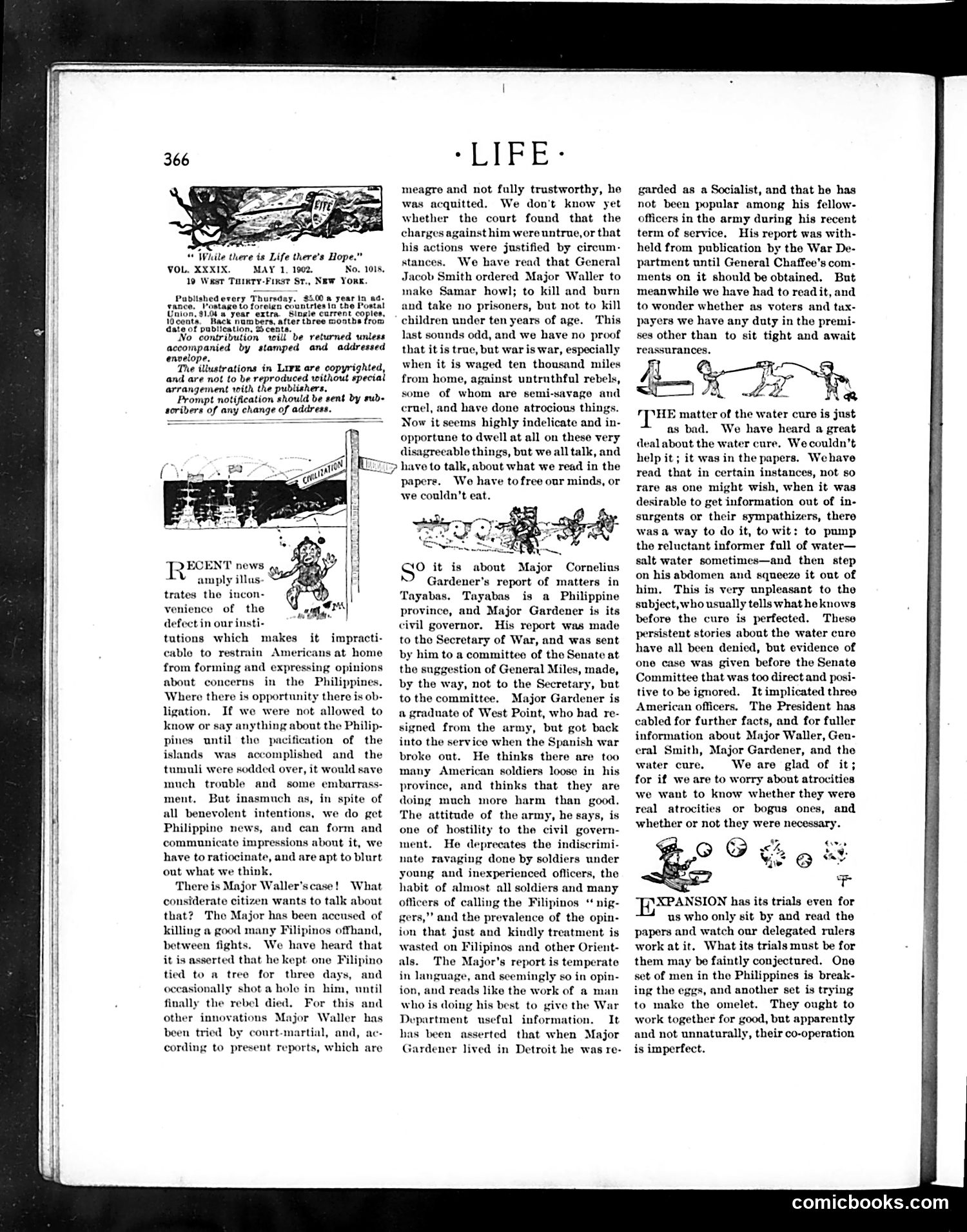
This page from *Life* magazine (May 1, 1902) contains editorial commentary rather than political cartoons. The main text discusses Major Cornelius Gardener's report on the Philippines and accusations against Major Waller regarding mistreatment of Filipinos. The small decorative illustrations appear to be generic vignettes rather than specific political satire—showing figures in casual poses, possibly relating to daily life or social commentary. The article's focus is on debating American military conduct in the Philippines during the ongoing insurgency. The author criticizes the difficulty of obtaining truthful information about the conflict while defending American intentions, and questions whether alleged abuses by soldiers were justified or necessary. The tone is earnest debate rather than humorous satire.
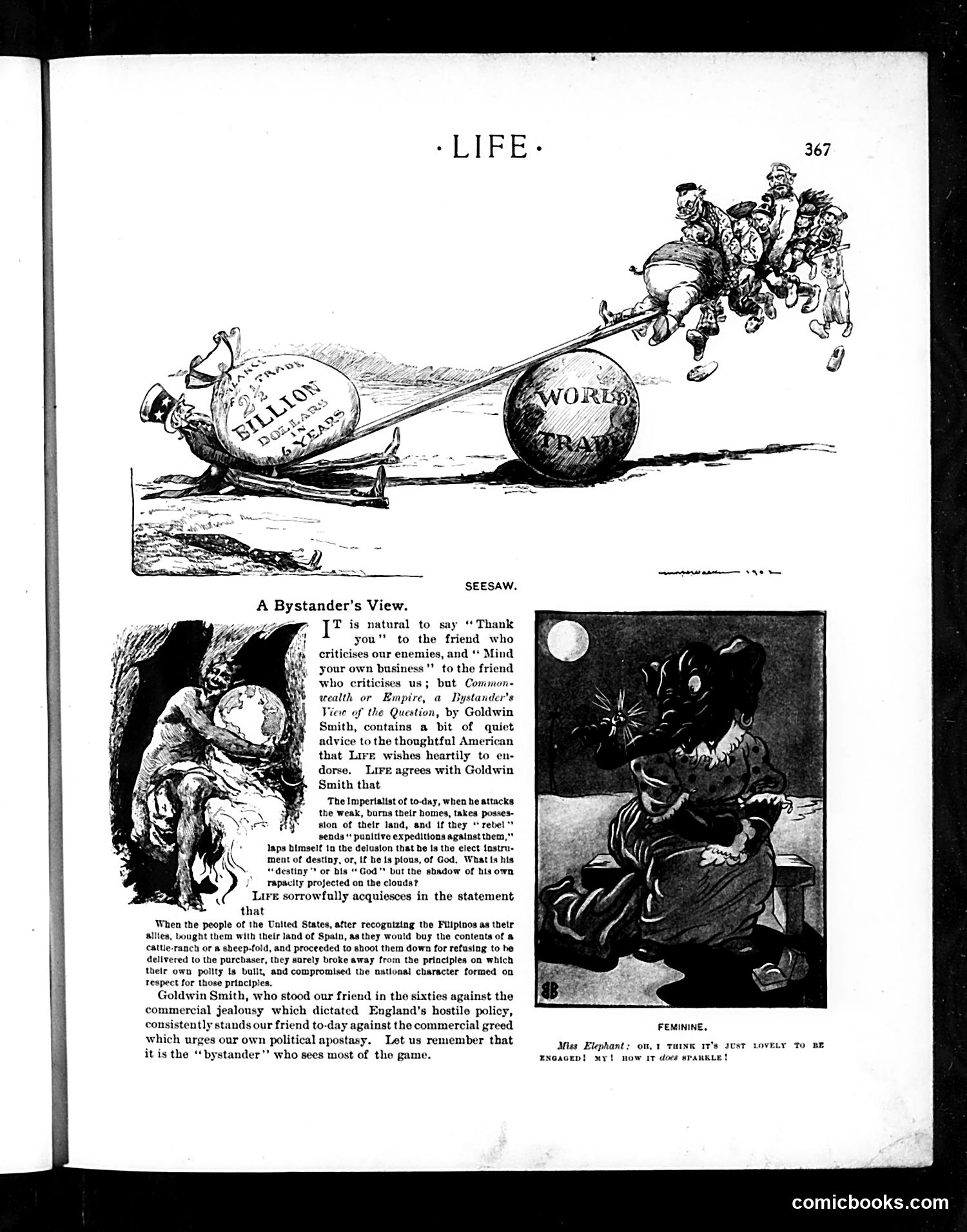
**Main Cartoon ("A Bystander's View"):** This seesaw cartoon depicts imperialism's imbalance. One side shows "Billionaires" (American businessmen) sitting heavily on a plank, while the opposite end labeled "World" rises up with diverse people. The artist critiques how American wealth concentration tilts global power dynamics unfairly. **Secondary Image ("Feminine"):** The dark illustration appears satirical, depicting a woman in an exaggerated pose with text suggesting mockery of feminine behavior or expectations. **Text Commentary:** The article references Goldwin Smith's critique of American imperialism and commercial greed, arguing that wealth-driven foreign policy compromises national principles. It criticizes American business interests' influence on international relations and suggests this "bystander" perspective exposes hypocrisy in American political claims.
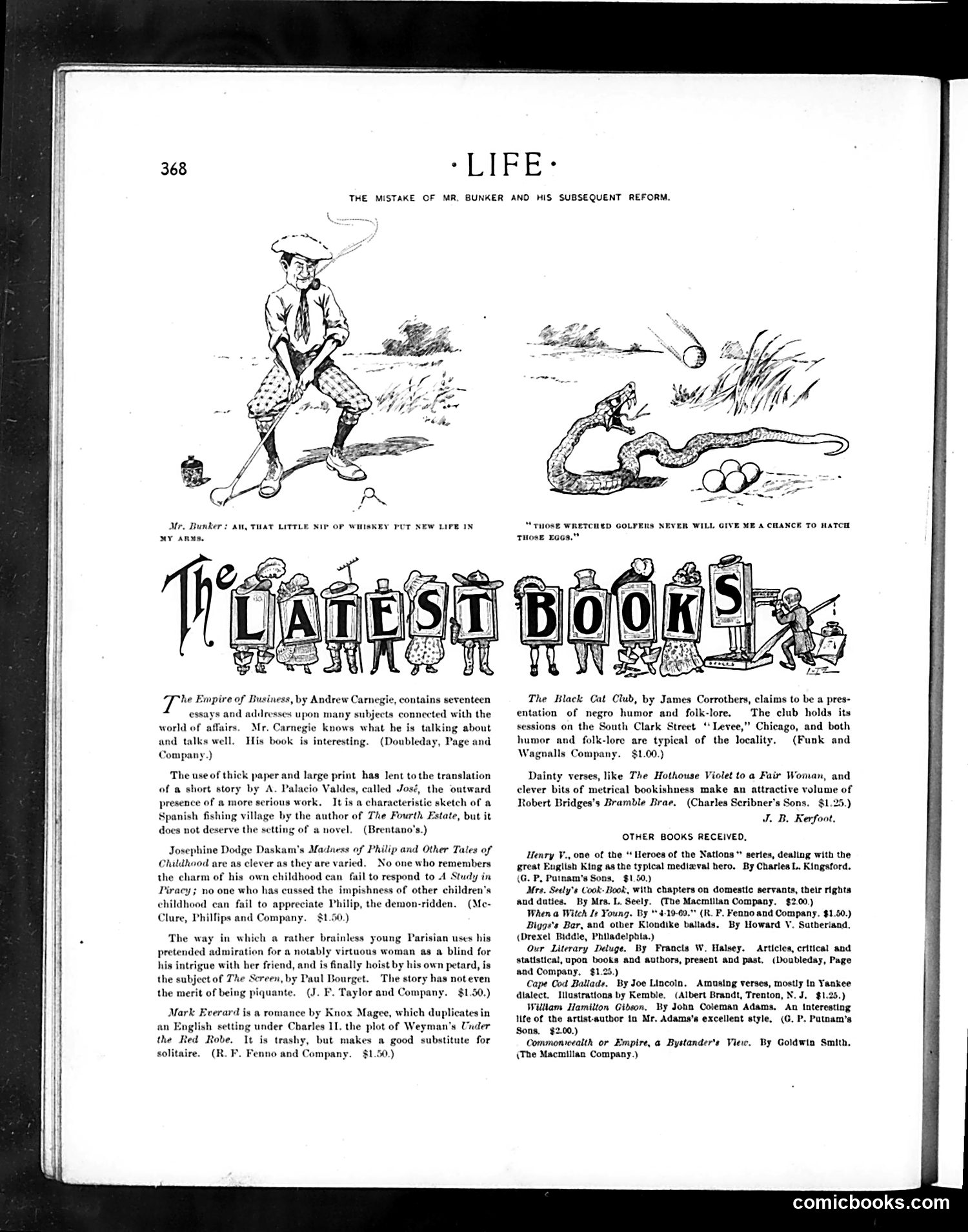
This satirical cartoon depicts a man named Mr. Bunker in two scenarios. On the left, he stands as a golfer claiming that whiskey has improved his game. On the right, a snake guards eggs with the caption: "Those wretched golfers never will give us a chance to hatch those eggs." The joke critiques Bunker's supposed "reform"—his claim that alcohol enhances his golf performance. The cartoon implies his drinking hasn't actually reformed him at all; rather, it's made him dangerously reckless (threatening wildlife). The satire mocks both excessive drinking and the self-deception of those who rationalize their alcohol consumption as beneficial, a relevant topic during America's temperance movement era.
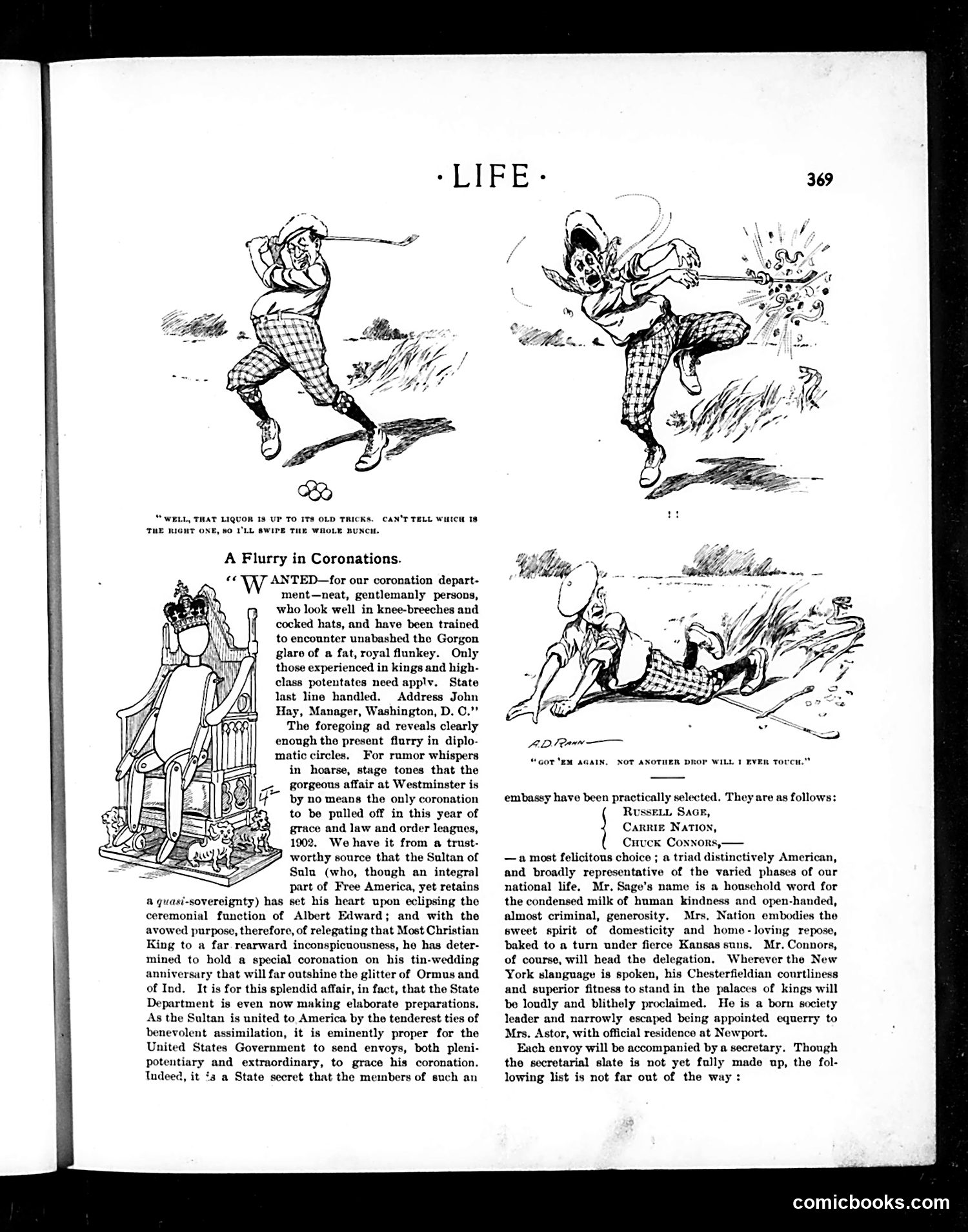
This satirical piece mocks diplomatic protocol surrounding coronations. The text describes a wanted ad for "neat, gentlemanly persons" to serve as envoys at a coronation ceremony, humorously suggesting the position requires training to "encounter unabashed" the "Gorgon glare" of royal authority. The cartoons depict comic chaos: figures in checkered clothing engage in slapstick mishaps—one swings a golf club wildly, another tumbles or falls. The caption "Got 'er again, not another drop will I ever touch" suggests drunken bungling. The satire targets the absurdity of formal diplomatic ceremonies and the often-inept individuals selected for ambassadorial roles. By naming specific envoys (Russell Sage, Chuck Connors), Life ridicules real or pretended diplomatic appointments as patronage rather than merit-based selections.
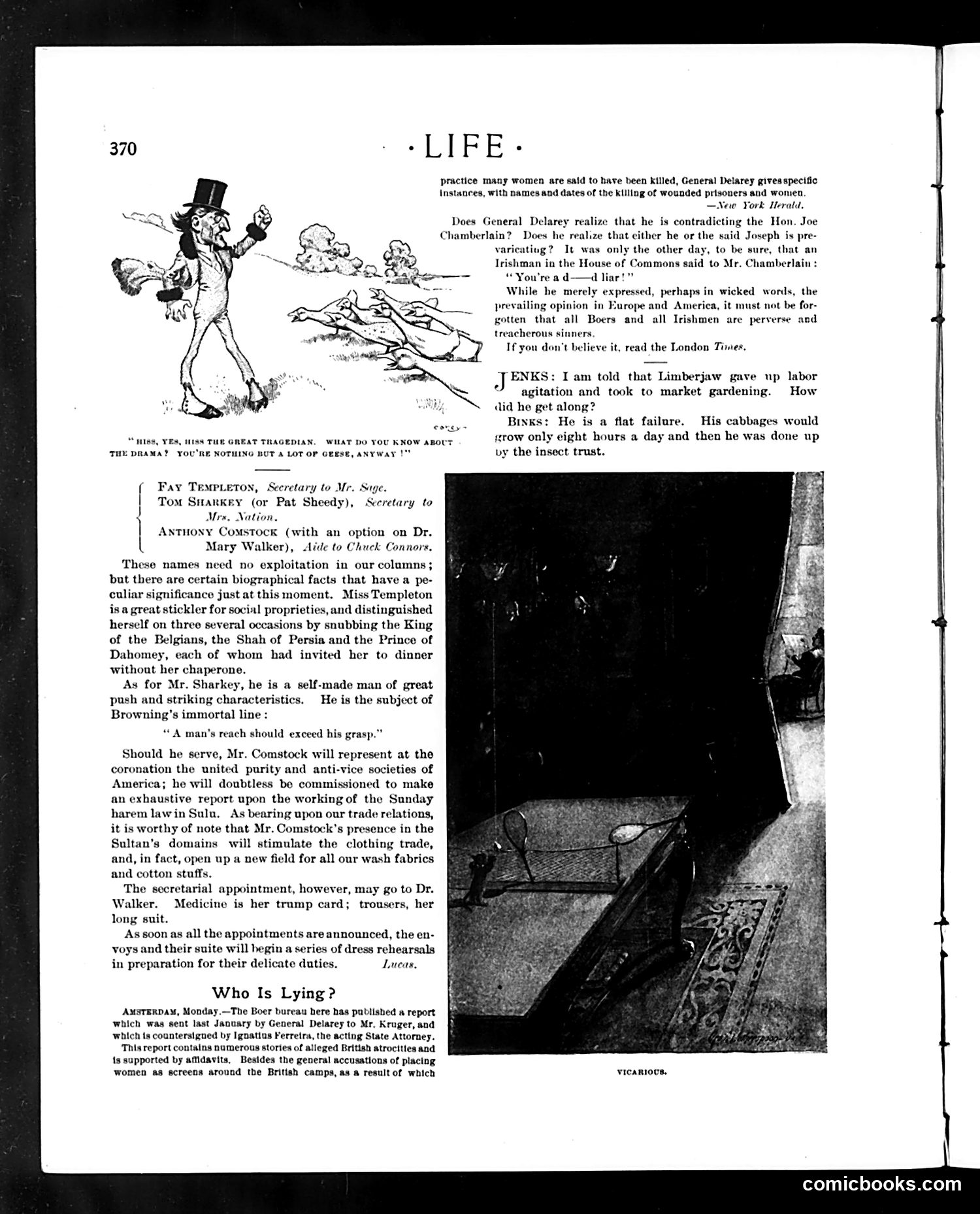
The main cartoon depicts a thin, caricatured figure (appearing to represent a political opponent) gesturing wildly while lying figures sprawl beneath him. The caption reads: "Miss, yes, this the great tragedian. What do you know about the drama? You're nothing but a lot of geese, anyway!" This appears to be satirizing someone's theatrical pomposity and dismissive attitude toward common people. The exaggerated posture and condescending dialogue suggest mockery of a public figure who speaks grandiosely while displaying contempt for ordinary citizens. The surrounding text discusses various political appointments and controversies, including references to trade relations and colonial matters, but without clearer context or dates visible, the specific political targets remain unclear from the image alone.
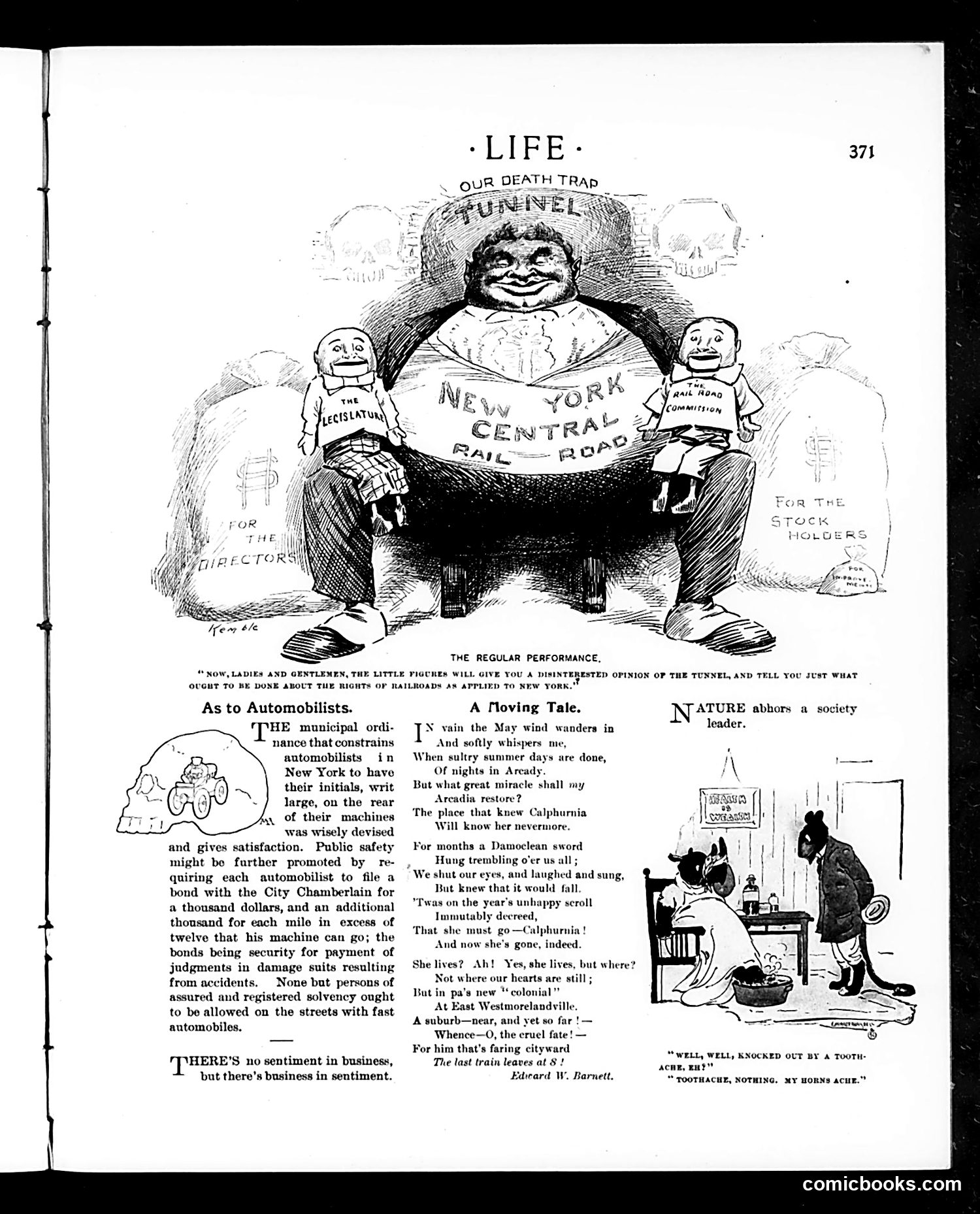
The top cartoon satirizes railroad corruption and corporate malfeasance. A grotesque fat figure labeled "New York Central Rail Road" sits atop a "Death Trap Tunnel," flanked by smaller figures representing "The Electrician" and "Rail Road Commission"—suggesting these entities profit from or enable dangerous conditions. The caption promises to show stockholders "just what ought to be done about the safety of railroads as applied to New York," implying public ignorance of railroad industry practices. Below, "As to Automobilists" mocks proposed municipal bond requirements for motorists—a thousand dollars plus additional fees per mile. The text sarcastically suggests this regulation, ostensibly for "public safety," actually amounts to extortion disguised as consumer protection. This reflects early 1900s skepticism toward both automobiles and government regulation.
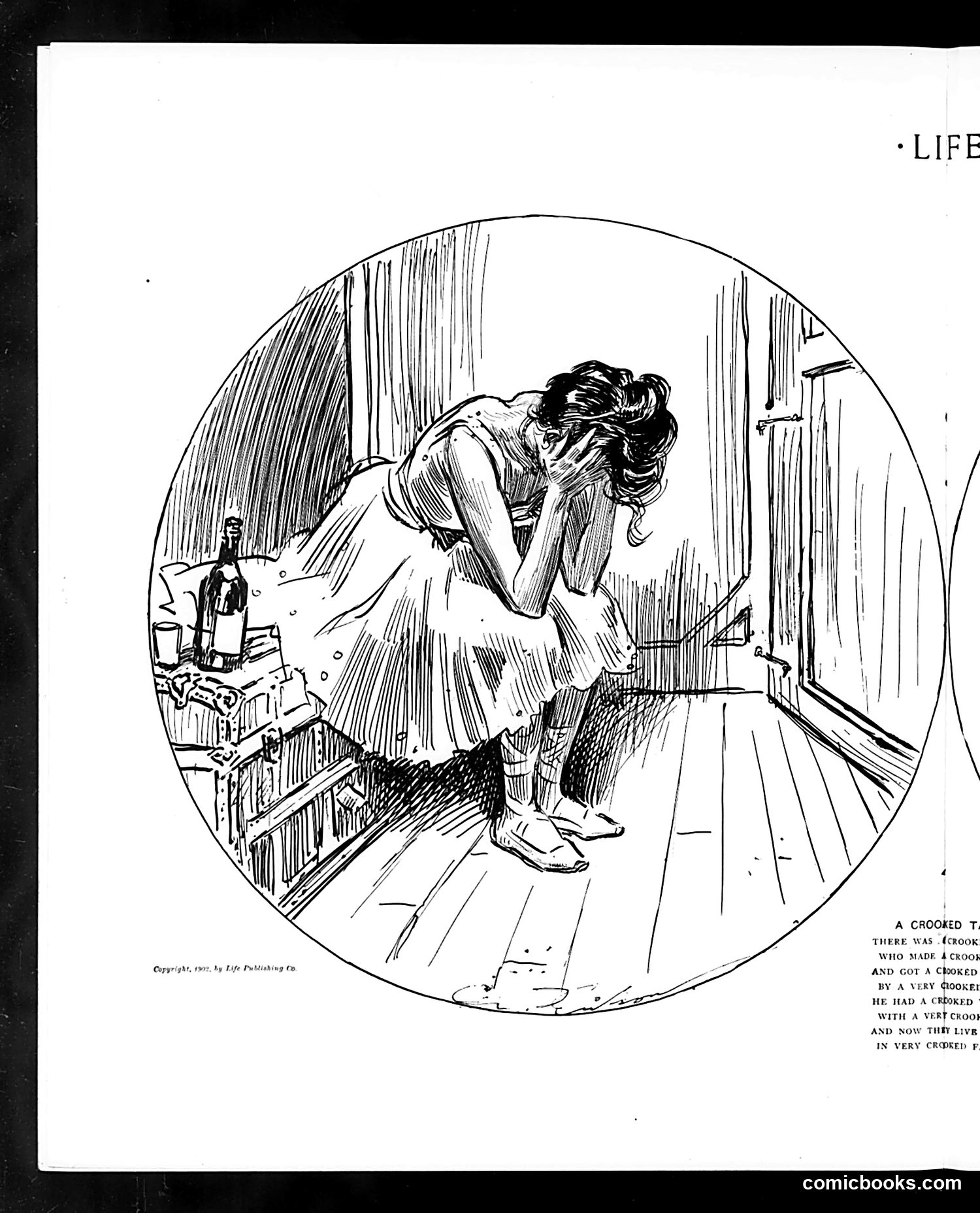
This illustration depicts a woman in a light dress looking into a mirror in what appears to be a bedroom or dressing room. The circular composition frames the scene with wooden wall paneling visible behind her. The partially legible text on the right references "a crooked [something]" and mentions someone who "made a crook" and "got a crooked [something]" through repetition of the word "crooked." The exact moral or satirical point is unclear from the fragmentary OCR text, though it appears to be a cautionary tale or humorous commentary, possibly about dishonesty or questionable character—suggested by the repeated emphasis on "crooked." Without complete legible text, the specific satire target cannot be definitively identified.
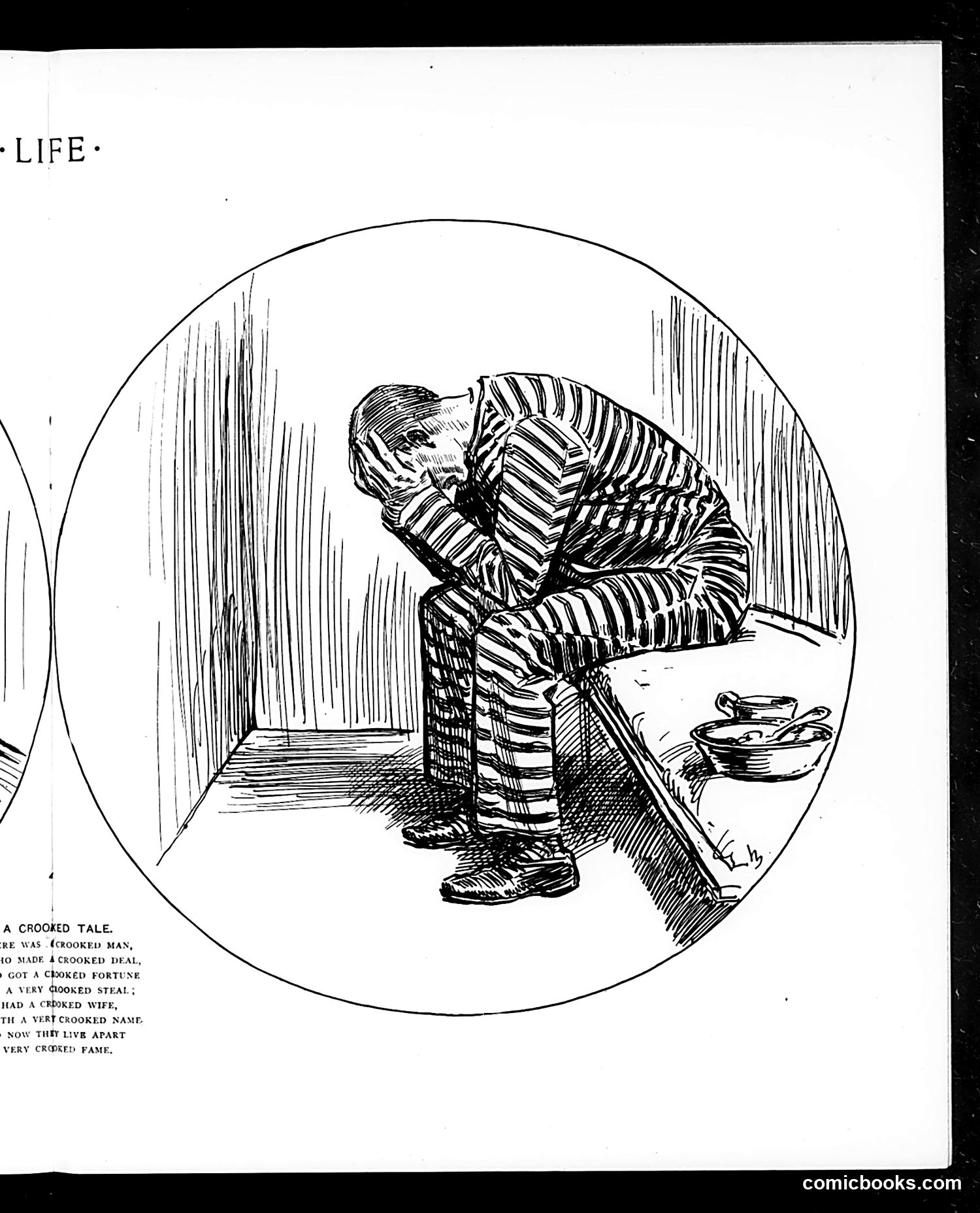
This Life magazine cartoon satirizes corruption through the nursery rhyme "There Was a Crooked Man." The illustration depicts a bent, skeletal figure in a prison cell, holding a bowl—visualizing the phrase "who made a crooked deal" and showing consequences of dishonest dealings. The accompanying verse parodies the original rhyme, replacing each line with corruption-related terms: "crooked man," "crooked deal," "crooked fortune," "crooked steal," "crooked wife," and "crooked name." The final line suggests social ostracism—"they live apart in very crooked fame." The cartoon functions as moral commentary on 19th/early 20th-century American corruption, using the familiar children's verse to mock crooked politicians or businessmen and their ultimate downfall and public shame.
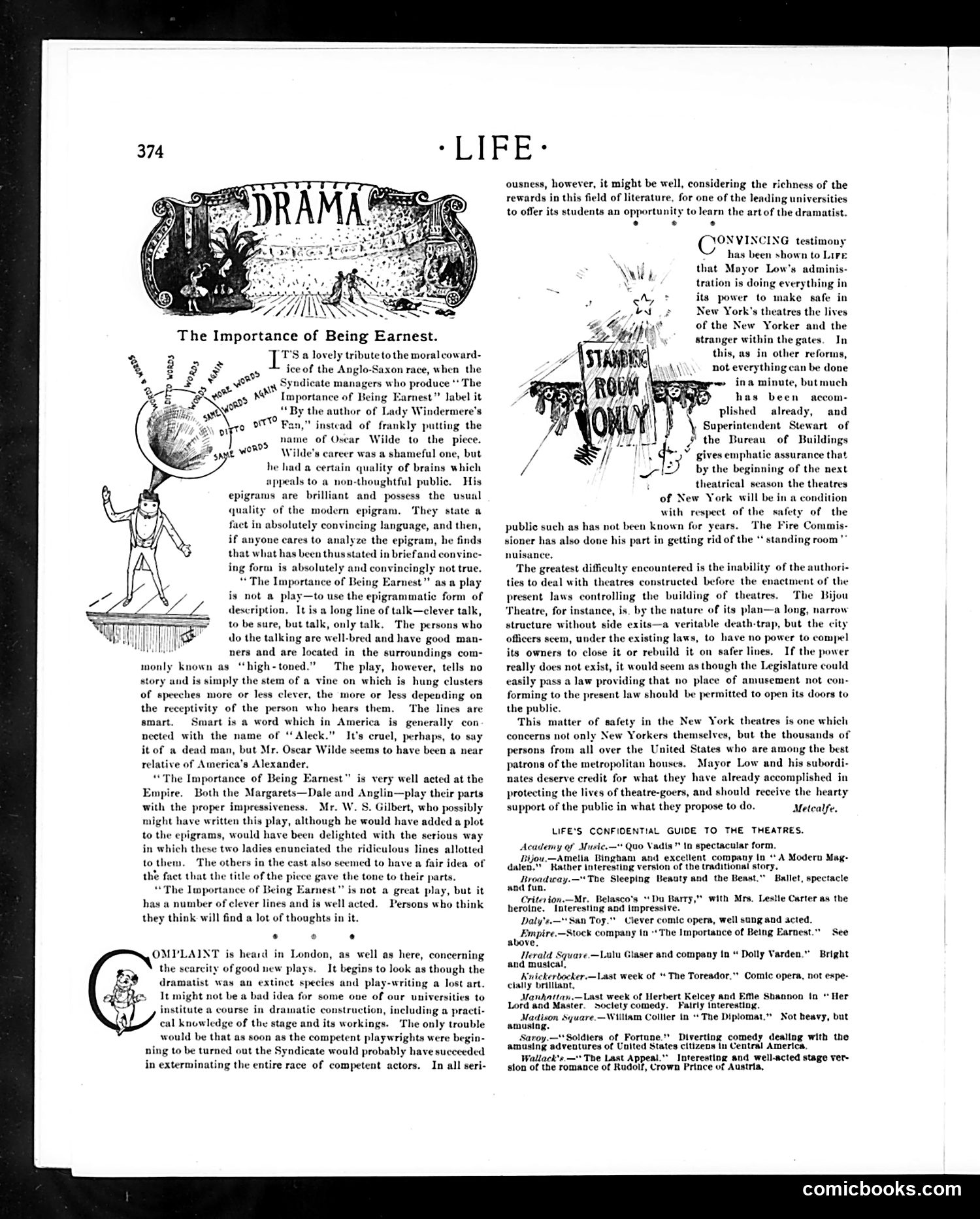
This page satirizes the theatrical production of Oscar Wilde's play "The Importance of Being Earnest," which is being presented as part of the Anglo-Saxon theatrical season. The illustration shows a figure balancing on a tightrope while juggling, depicting the precarious nature of theatrical management and the challenge of producing plays successfully. The accompanying text critiques epigrammatic theatre—plays relying heavily on clever wordplay and witty dialogue rather than substantial plot. The satire suggests such "epigrams" lack genuine theatrical substance, comparing them to a circus act. The text argues that while Wilde's clever lines are entertaining, they constitute "absolutely convincing language, and then, if anyone cares to analyze the epigram, he finds that what has been disguised is brief and convincing form is absolutely and convincingly not true."
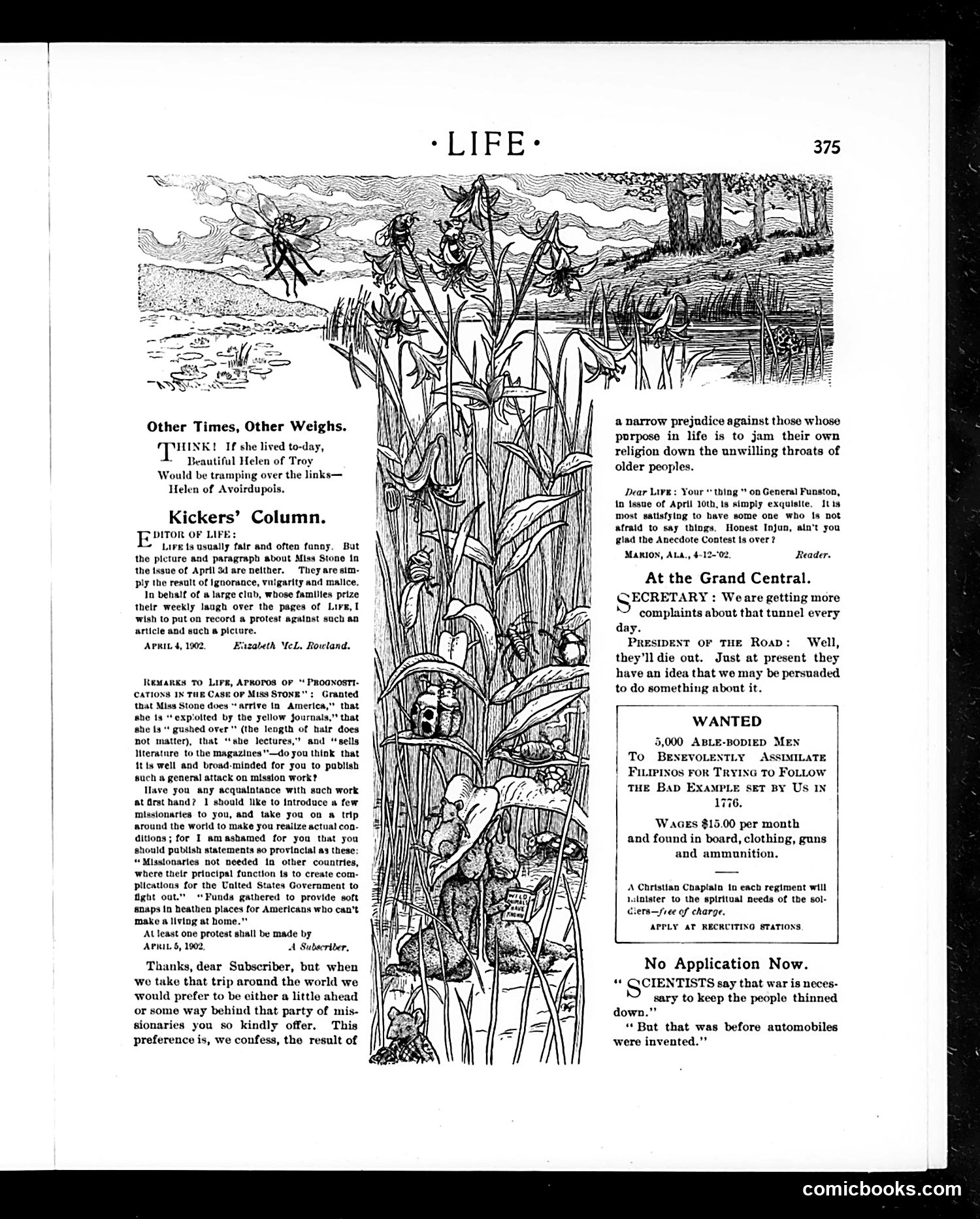
This page from *Life* magazine (April 1902) contains several satirical pieces critiquing American imperialism and missionary work: **"Other Times, Other Weighs"**: A brief joke about Helen of Troy, suggesting if she lived in modern times, she'd be a golfer rather than a beauty—"Avoirdupois" refers to her weight. **"Kickers' Column"**: Reader letters debate *Life*'s criticism of Miss Stone (an American missionary kidnapped in Bulgaria). One reader defends missionaries; *Life* responds with biting cynicism, dismissing missionary work as cultural imperialism that "jams" religion "down the unwilling throats of older peoples." **"Wanted" Advertisement**: The central satire mocks American military recruitment for the Philippine-American War (1899-1902). It sarcastically advertises for 5,000 men to "benevolently assimilate Filipinos" following America's "bad example," with wages of $15/month. The phrase "free of charge" chaplain service adds further irony about justifying imperial conquest through Christian rhetoric. The page satirizes American expansionism and the self-righteous justifications ("benevolent assimilation") used to mask it.
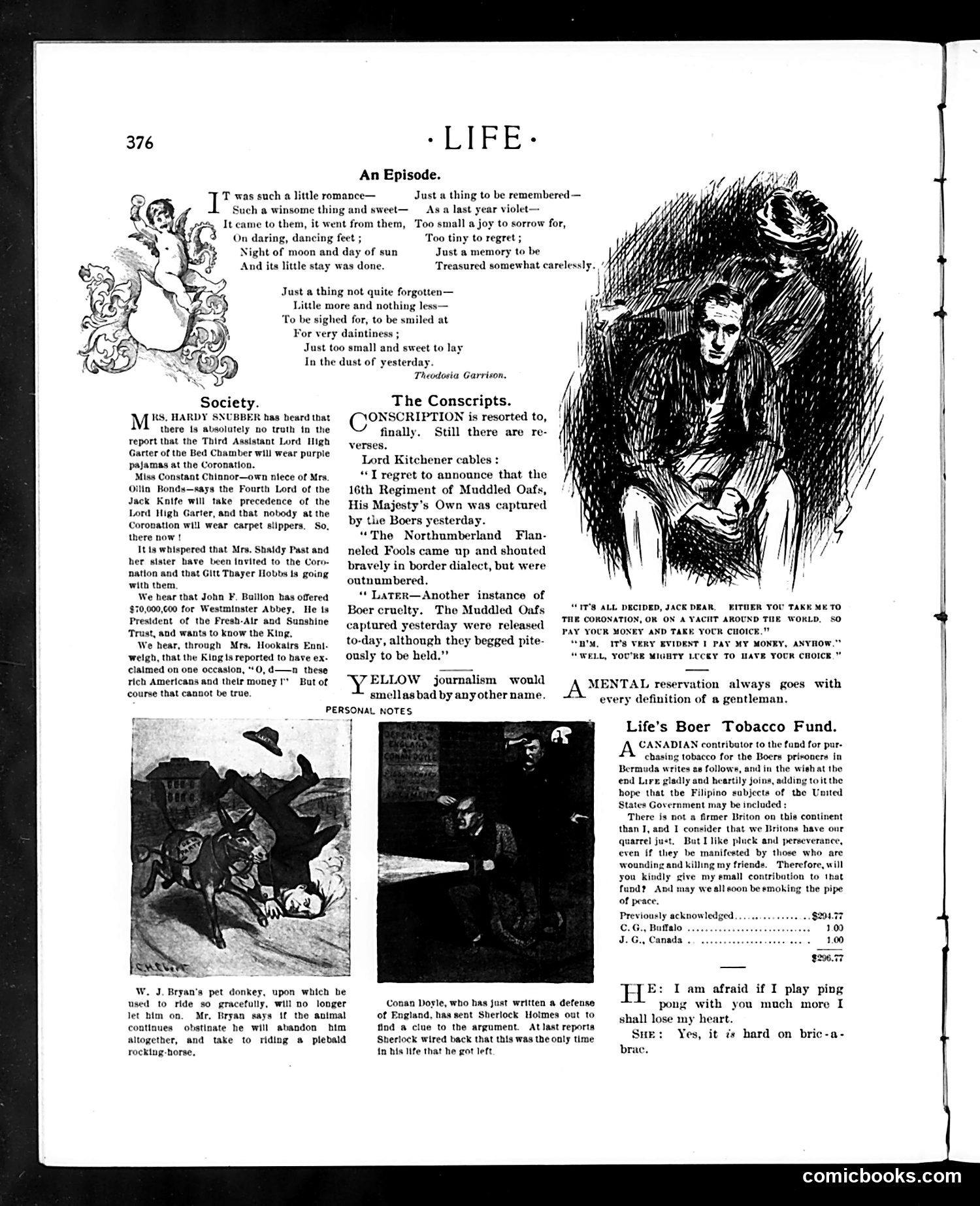
This page from Life magazine (appears to be early 1900s, likely during the Boer War era) contains several satirical pieces: **Society Column**: Mocks British aristocratic pretension through absurd gossip about ceremonial positions ("Third Assistant Lord High Garter") and a wealthy American (John F. Ballion) attempting to buy Westminster Abbey for $70 million to gain social access to the King. The joke targets both British class obsession and American wealth-throwing. **The Conscripts**: Satirizes British military incompetence in the Boer War, with "Lord Kitchener" reporting the capture of regiments mockingly named "Muddled Oafs," then their embarrassing release by the Boers. **W.J. Bryan reference**: A jab at the American politician, suggesting even his donkey won't tolerate him anymore. **Boer Tobacco Fund**: Life supports sending tobacco to Boer prisoners, sarcastically hoping American "Filipino subjects" receive similar humanitarian treatment—a dig at U.S. colonial policies. The page reflects turn-of-century American skepticism toward British imperialism and American wealth's social pretensions.
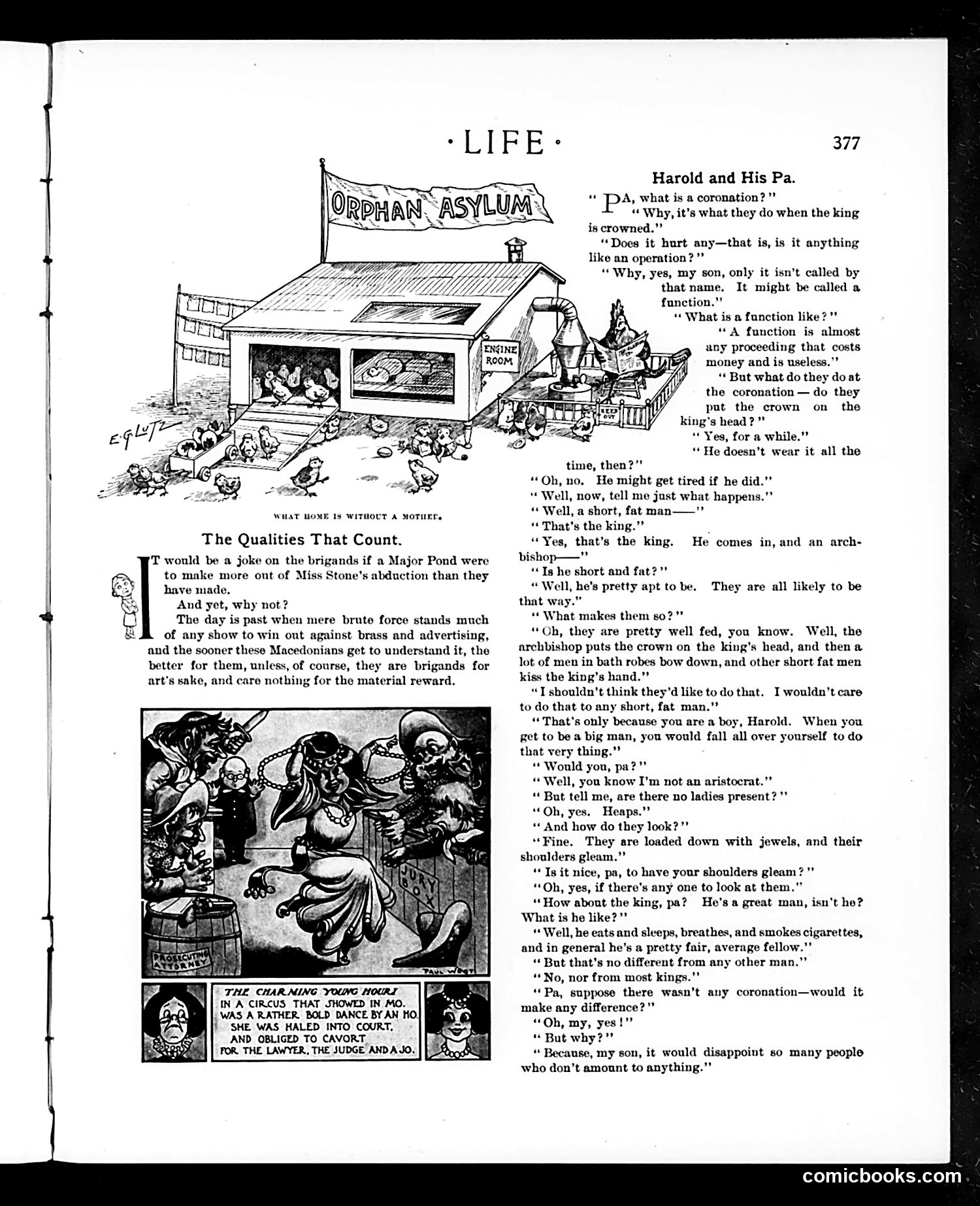
This page features a mock father-son conversation about what a coronation ceremony actually entails. The satire targets the pageantry and expense of royal coronations by having the father candidly admit that coronations are essentially "useless" proceedings that cost money. The joke deepens when the father describes the king as an ordinary man who "eats and sleeps, breathes, and smokes cigarettes"—no different from any other person. When Harold asks what difference a coronation makes, the father's punchline reveals the true purpose: it exists solely to impress "people who don't amount to anything." This is classic early-20th-century American satirical humor mocking aristocratic pretension and ceremonial excess. The accompanying cartoon about Miss Stone's abduction reinforces themes about what actually matters versus empty spectacle.
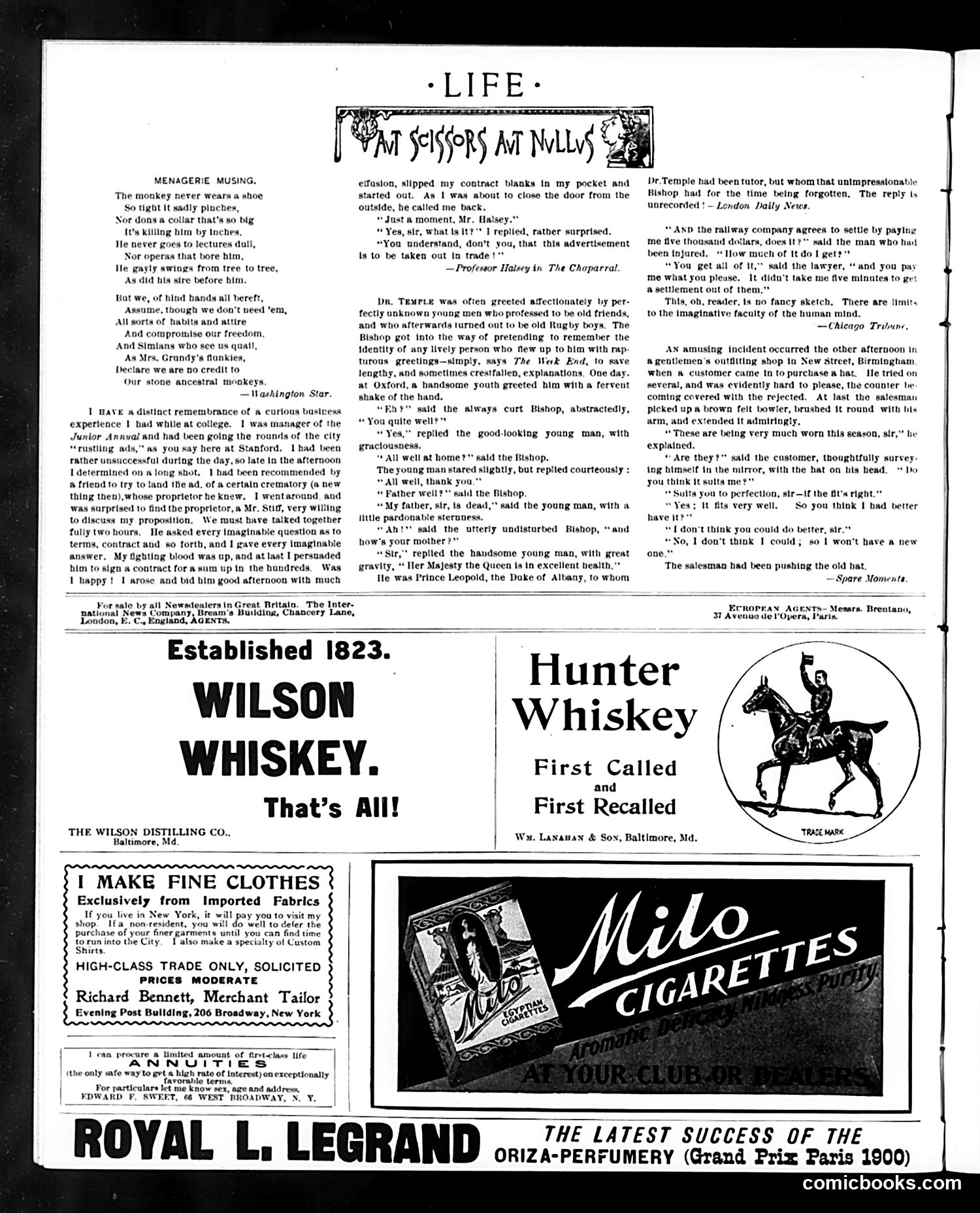
This page consists primarily of **humorous anecdotes and satirical stories** rather than political cartoons. The main content includes: 1. **"Menagerie Musing"** - A poem contrasting humans unfavorably with monkeys, suggesting we've compromised our freedom through artificial conventions (clothes, lectures, opera). It's social satire on Victorian propriety. 2. **College advertising story** - An anecdote about selling an ad to a crematory in trade (non-payment), poking fun at naive salesmanship. 3. **Bishop anecdote** - A humorous story where an absentminded Bishop asks a young man about his deceased father and living mother, not realizing he's speaking to Prince Leopold (the Duke of Albany). The joke: the Prince's deadpan reply identifying the Queen as his mother. 4. **Lawyer joke** - Brief satire on a lawyer's quick settlement and ambiguous payment terms. 5. **Hat shop story** - Incomplete anecdote about a difficult customer. The page is **mostly advertising** (Wilson Whiskey, Hunter Whiskey, Milo Cigarettes, clothing, etc.). The humor is genteel, targeted at educated readers familiar with British society and Victorian social conventions.
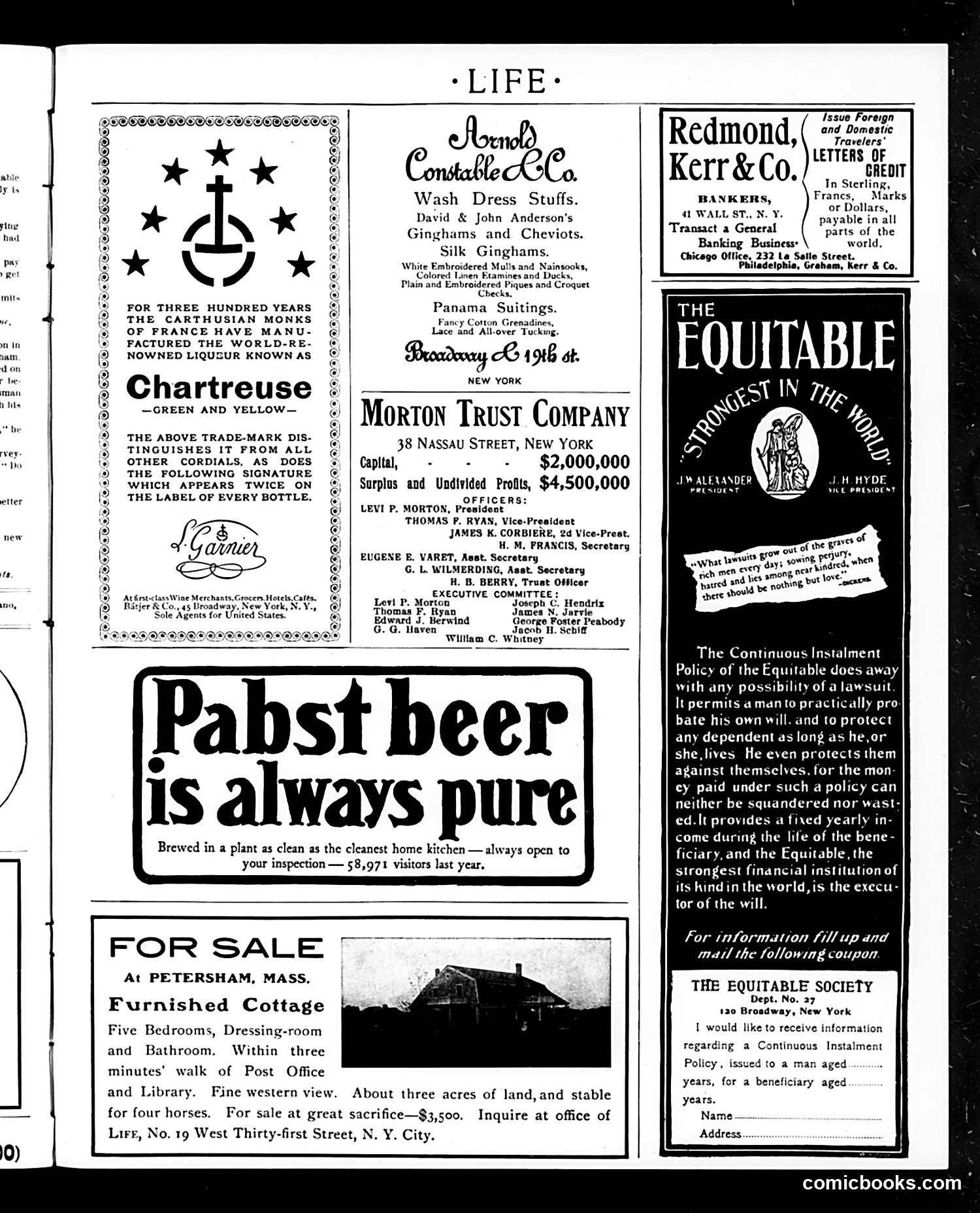
This is primarily an **advertising page** from Life magazine, not a satirical cartoon. It contains various commercial advertisements typical of early 20th-century American publications. The page features ads for: - **Chartreuse liqueur** — emphasizing its 300-year monastic French heritage and authenticity via trademark - **Arnold Constable & Co.** — fabric/clothing merchant advertising dress materials - **Morton Trust Company** — banking services with capital of $2 million - **Pabst Beer** — claiming purity and openness to public inspection (58,971 visitors annually) - **Real estate** — a furnished cottage in Petersham, Massachusetts for $3,500 - **Financial services** — Redmond, Kerr & Co. (bankers) and The Equitable Society (life insurance) There is **no political satire or cartoon content** visible. The page reflects early 1900s consumer culture, emphasizing trust, purity, heritage, and financial security as marketing appeals.
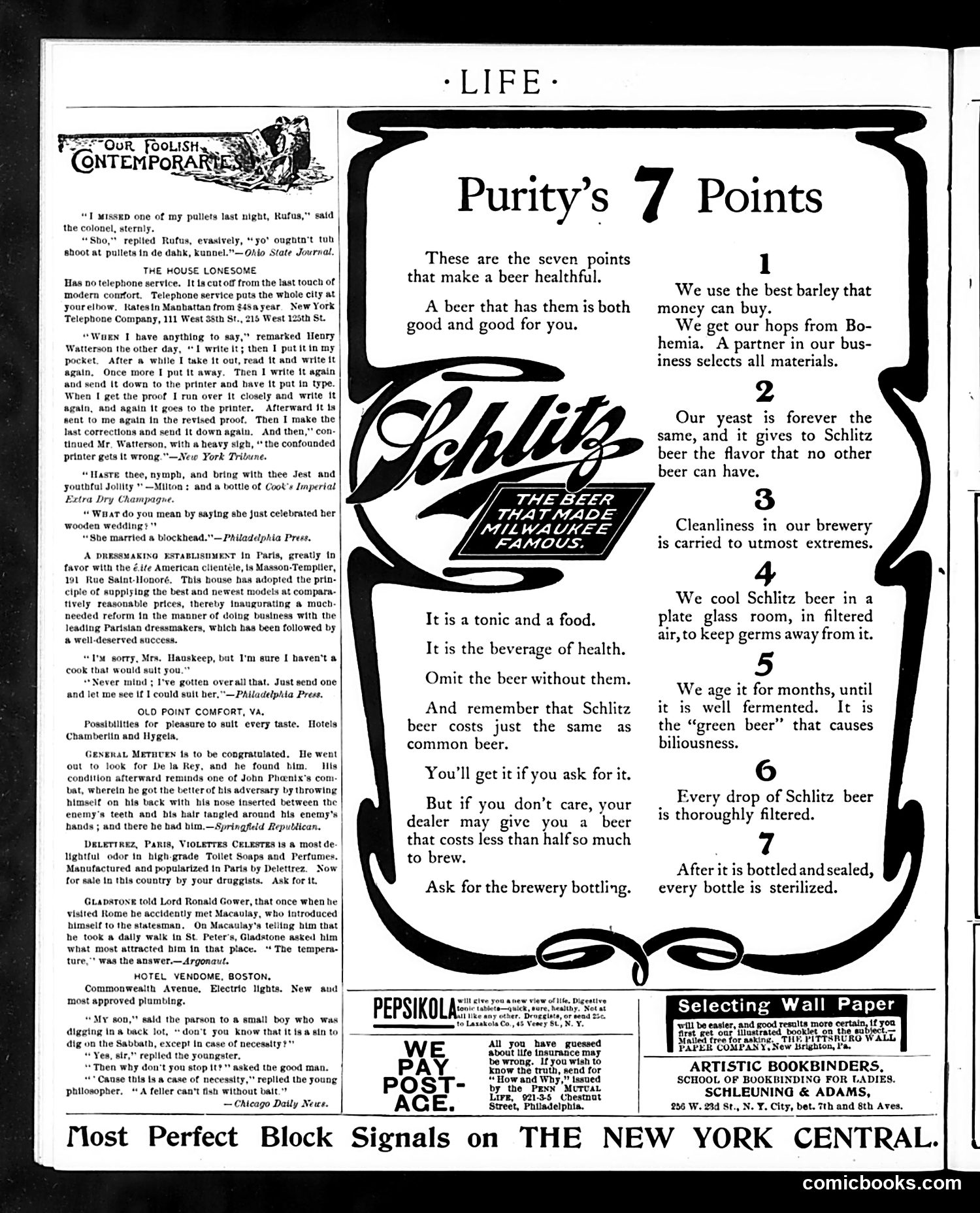
This page is primarily a **Schlitz beer advertisement** presenting seven claimed health benefits of their product. The central image shows the Schlitz logo with text emphasizing that their beer is "the beverage of health." The seven points claim Schlitz beer's superiority through: superior barley, consistent yeast, extreme cleanliness in brewing, specialized cooling in filtered air, extended fermentation to prevent "biliousness," thorough filtration, and sterilization after bottling. This reflects **early 1900s advertising culture** when beer was marketed as healthful and restorative—a claim that would be illegal today. The surrounding page contains miscellaneous humorous anecdotes and advertisements typical of *Life* magazine's satirical format. The advertisement exploits contemporary anxieties about food safety and purity (relevant post-1906 Food and Drug Act) to position Schlitz as scientifically superior.
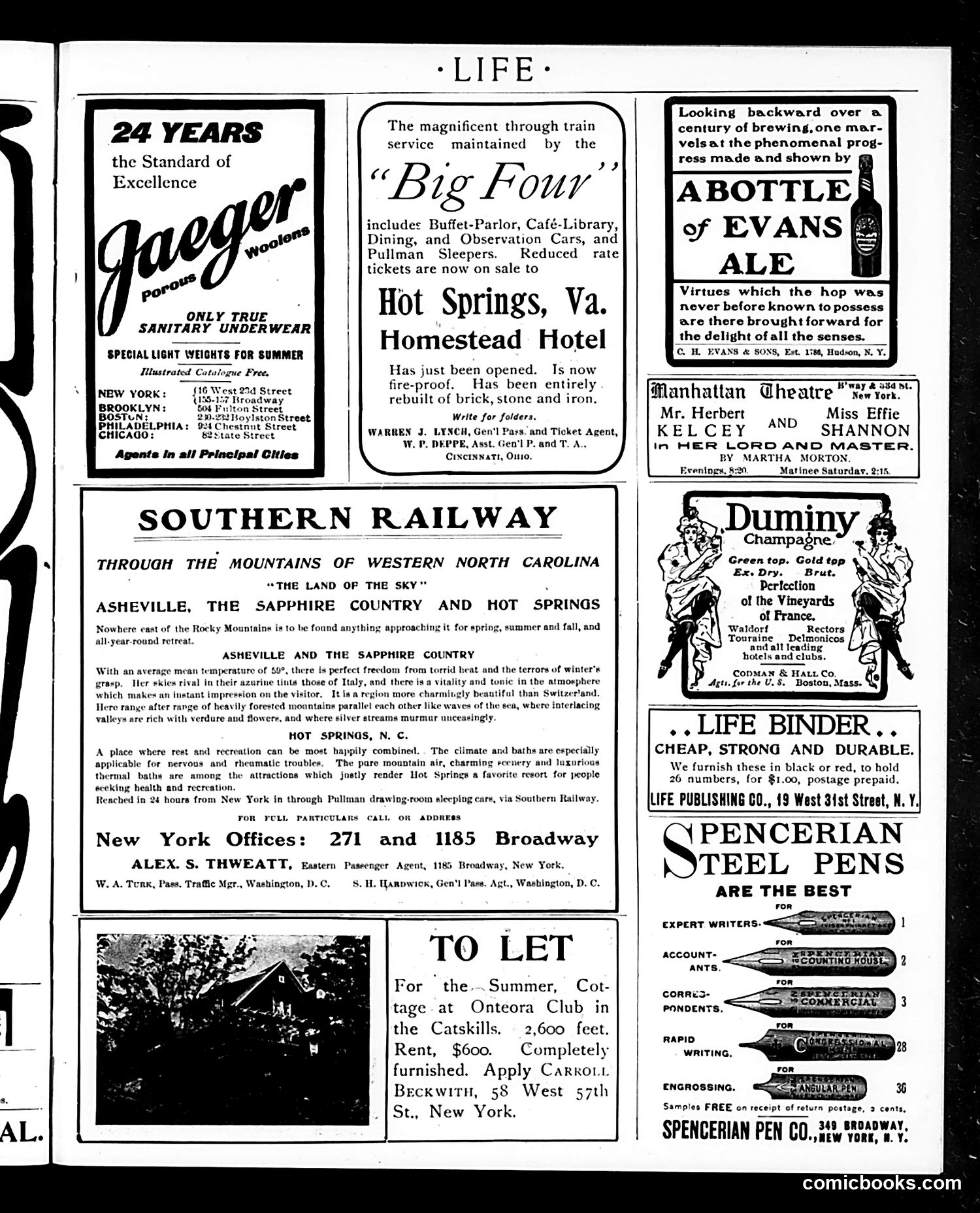
This is primarily an **advertising page** from Life magazine, not a satirical cartoon page. It contains commercial advertisements typical of early 20th-century publications. The visible content includes: - **Jaeger Porous Woolens** (underwear), emphasizing "sanitary" wear—a health concern of the era - **Southern Railway** ads promoting Asheville, North Carolina and Hot Springs as health resorts, reflecting the period's belief in curative climates for nervous and rheumatic conditions - **Evans Ale** advertisement celebrating a century of brewing - A theater listing for "Her Lord and Master" at the Manhattan Theatre - **Dummy Champagne**, **Life Binder**, and **Spencerian Steel Pens** ads The page reflects early 1900s consumer culture and advertising priorities: health/wellness products, travel infrastructure, theatrical entertainment, and office supplies. Modern readers would note the emphasis on "sanitary" underwear and medicinal travel—concerns that dominated advertising of this era but seem quaint today.
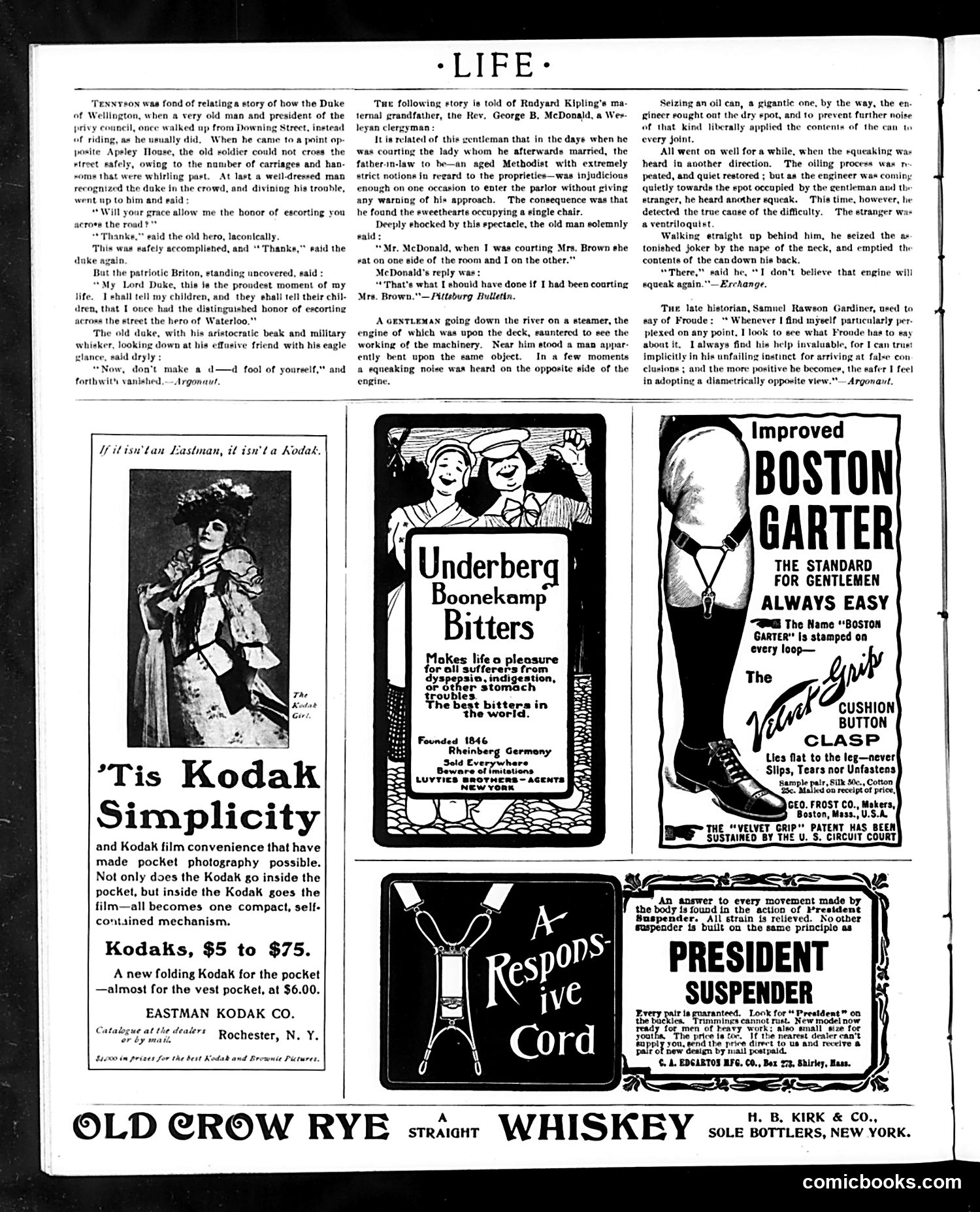
This page consists primarily of **humorous anecdotes** rather than political cartoons. The content includes three historical stories: 1. **Duke of Wellington anecdote**: An aristocratic officer rebuffs an overly effusive commoner who helped him cross a street, telling him bluntly not to make a fool of himself. The satire mocks excessive deference and pomposity. 2. **Rudyard Kipling's grandfather story**: A Methodist clergyman courting a woman sits across the room from her (proper Victorian behavior), but when his future father-in-law interrupts them sitting together, the young man quips he wouldn't have done so if courting the older man's wife—a cheeky comeback about propriety. 3. **Steamship engineer story**: An engineer deals with a ventriloquist prankster creating fake squeaking sounds by pouring oil down his back—workplace practical joke humor. The surrounding **advertisements** (Kodak cameras, Boston Garter, President Suspender, etc.) are period commercial content, not satirical commentary.
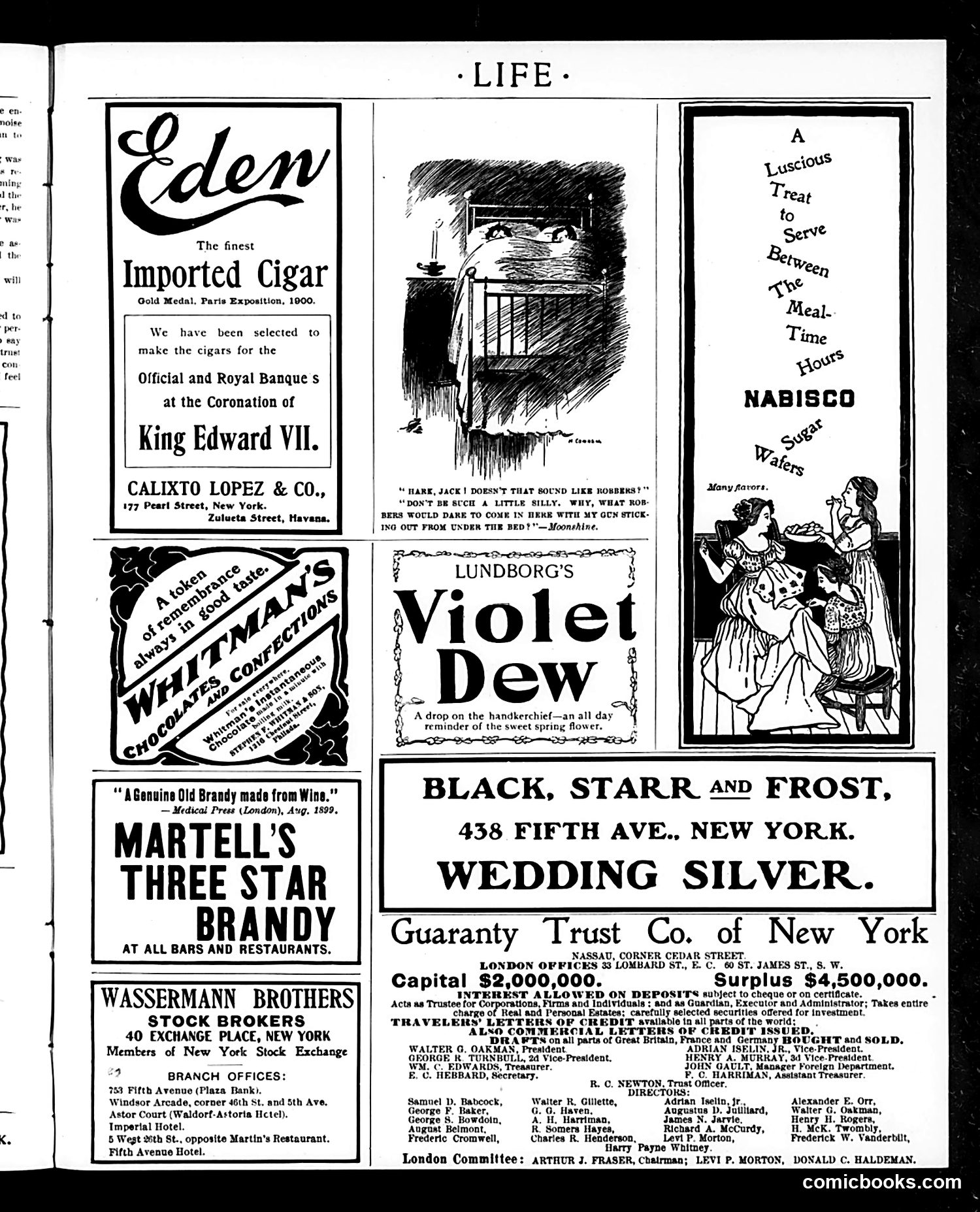
This page is primarily **advertising**, not a political cartoon, though it includes one small humorous cartoon sketch. The main content features high-end product advertisements from the early 1900s: Eden cigars (promoted as official choice for King Edward VII's coronation), Whitman's chocolates, Martell's brandy, Lundborg's Violet Dew perfume, and Nabisco wafers. These reflect the luxury consumer goods marketed to wealthy Americans. The **single cartoon** in the center depicts a child claiming his father's gun under the bed would deter robbers—a satirical joke about false parental confidence in household safety measures (labeled "Moonshine," meaning nonsense). Additional space is devoted to financial services advertisements: stock brokers Wassermann Brothers and the Guaranty Trust Co. of New York, reflecting this magazine's affluent readership. The overall page targets wealthy readers through luxury goods and investment opportunities.
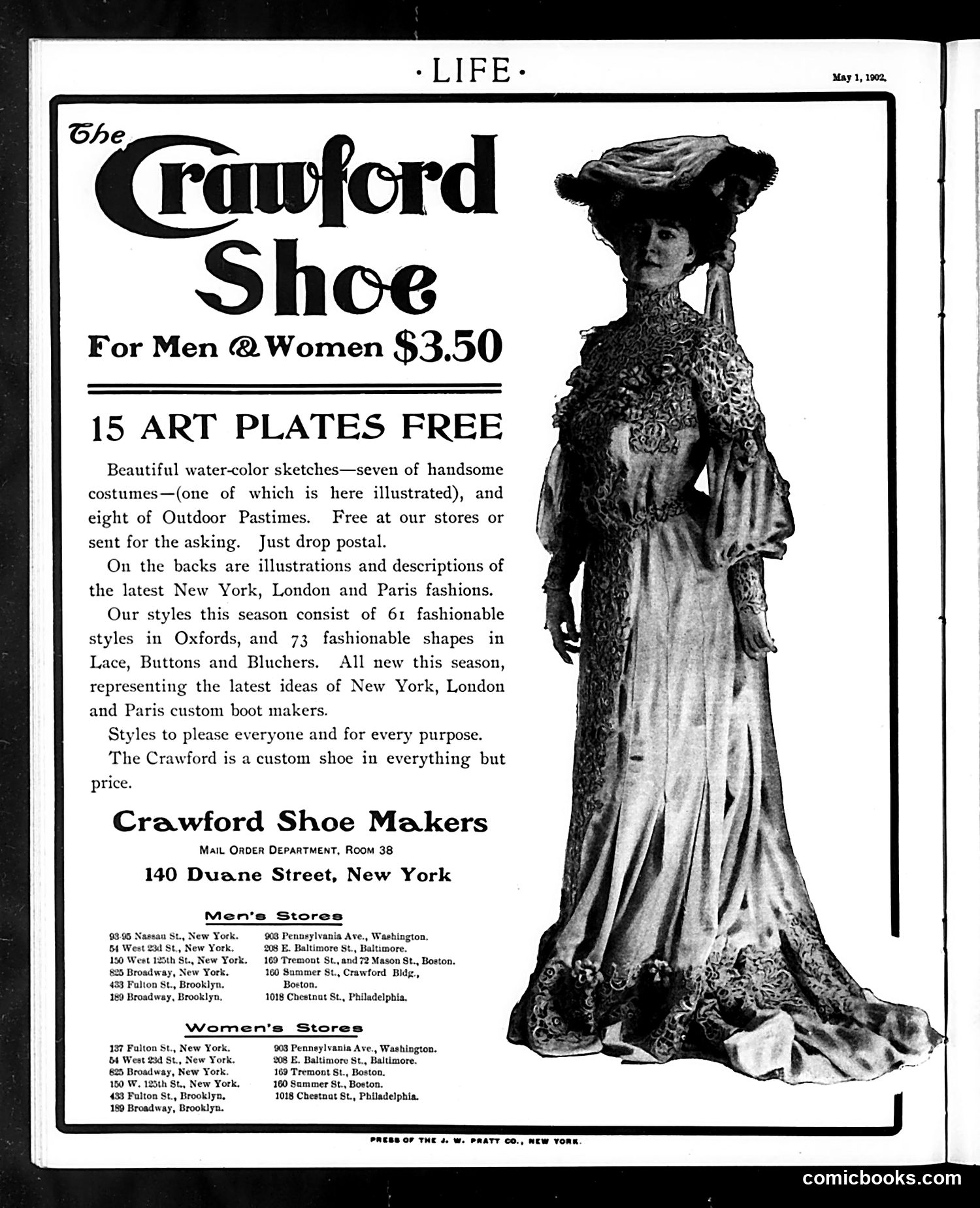
This page is **not a political cartoon or satire**—it's a straightforward advertisement for Crawford Shoe Makers, published in *Life* magazine on May 1, 1902. The content is a mail-order shoe advertisement promoting women's and men's footwear priced at $3.50. The illustration shows a fashionably dressed Edwardian-era woman modeling the shoe style, wearing period-appropriate clothing including a elaborate feathered hat and long dress with lace detail. The ad's promotional hook is "15 Art Plates Free"—water-color fashion illustrations (seven showing costume designs, eight showing outdoor activities) available free by mail. This was a common early 20th-century marketing tactic: offering collectible art to incentivize purchases. The company emphasizes their styles reflect "latest New York, London and Paris" fashion, positioning Crawford shoes as fashionable and cosmopolitan. They list numerous retail locations across major American cities, indicating substantial national distribution for the era.