
Life, 1902-05-01 · page 12 of 22
Life — May 1, 1902 — page 12: what you’re looking at
What you’re looking at
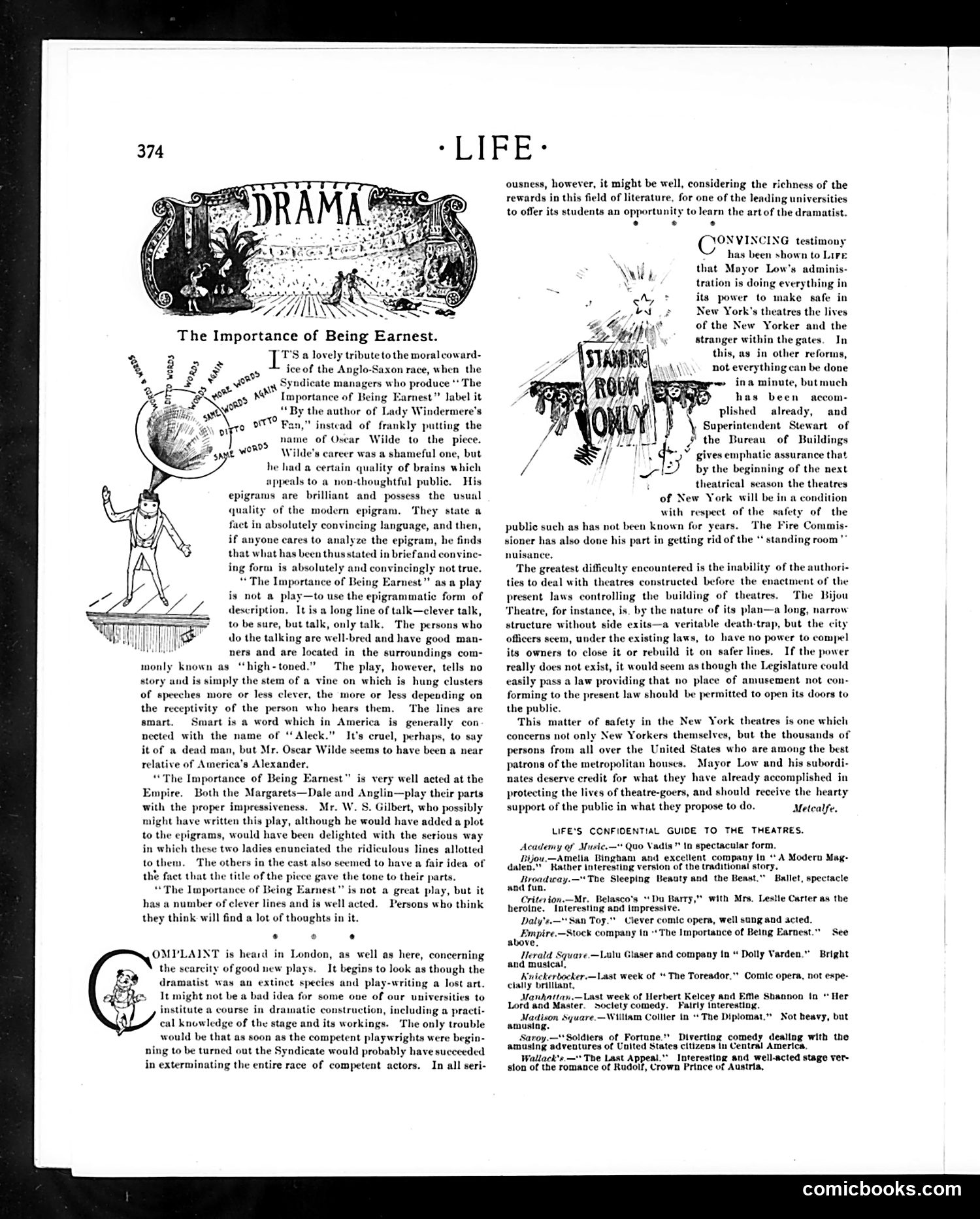
This page satirizes the theatrical production of Oscar Wilde's play "The Importance of Being Earnest," which is being presented as part of the Anglo-Saxon theatrical season. The illustration shows a figure balancing on a tightrope while juggling, depicting the precarious nature of theatrical management and the challenge of producing plays successfully. The accompanying text critiques epigrammatic theatre—plays relying heavily on clever wordplay and witty dialogue rather than substantial plot. The satire suggests such "epigrams" lack genuine theatrical substance, comparing them to a circus act. The text argues that while Wilde's clever lines are entertaining, they constitute "absolutely convincing language, and then, if anyone cares to analyze the epigram, he finds that what has been disguised is brief and convincing form is absolutely and convincingly not true."
📄 Transcribed text from this page (OCR, searchable)
Machine-transcribed from the original scan — historical spelling and the odd misread are preserved.
The Importance of Being Earnest. [18 8 lovely tributeto the moralcoward- ice of the Anglo-Saxon race, when the Syndicate managers who produce ‘* The > MY" Importance of Being Earnest” label it ay 9 BY the author of Lady Windermere's ir oT? Fan,” instead of frankly putting the words co? ne of Osear Wilde to the piece. Wilde's career was a shameful one, but he had a certain quality of brains which appeals to a non-thoughtful public. His epigrams are brilliant and possess the usual quality of the modern epigram. They state a fact in absolutely convincing language, and then, if anyone cares to analyze the epigram, he finds that what has been thus stated in briefand convine- ing form is absolutely and convincingly not true. “ The Importance of Being Earnest” as a play is not a play—to use the epigrammatic form of description. It is a long line of talk—clever talk, to be sure, but talk, only talk. The persons who do the talking are well-bred and have good man- ners and are located in the surroundings com- monly known as “high-toned.” The play, however, tells no story and is simply the stem of a vine on which is hung clusters of speeches more or less clever, the more or less depending on the receptivity of the person who hears them. ‘The smart. Smart is a word which in America is generally con nected with the name of ‘ Aleck.” It’s cruel, perhaps, to say it of a dead man, but Mr. Oscar Wilde seems to have been a near relative of America’s Alexander, “The Importance of Being Earnest” is very well acted at the Empire. Both the Margarets—Dale and Anglin—play their parts with the proper impressiveness. Mr. W. S. Gilbert, who possibly might have written this play, although he would have added a plot to the epigrams, would have been delighted with the serious way in which these two ladies enunciated the ridiculous lines allotted to them. The others in the cast also seemed to have a fair idea of act that the title of the piece gave the tone to their parts. The Importance of Being Earnest” is not a great play, but it has a number of clever lines and is well acted. Persons who think they think will find a lot of thoughts in it. ines are . ° . OMPLAINT is heard in London, as well as here, concerning the scarcity of good new plays. It begins to look as though the dramatist was an extinct species and play-writing a lost art. It might not be a bad id me one of our universities t institute a course in dramatic construction, including a practi cal knowledge of the stage and its workings. ‘The only trouble would be that as soon as the competent playwrights were begit ning to be turned out the Syndicate would probably have succeeded in exterminating the entire race of competent actors. In all seri- ‘LIFE: ousness, however, it might be well, considering the richness of the rewards in this field of literature, for one of the leading universities to offer its students an opportunity to Jearn the art of the dramatist. . ONVINCING testimony has been shown to Lire that Moyor Low's adminis- tration is doing everything in » its. power to make safe in New York's theatres the lives. of the New Yorker and the stranger within the gates. In this, as in other reforms, {ya not everything can be done ~~» ina minute, butmuch has been accom- plished already, and \ Superintendent Stewart of § the Bureau of Buildings =, gives emphatic assurance that 712) _ by the beginning of the next theatrical season the theatres of New York will be ina condition with respect of the safety of the public such as has not been known for years. The Fire Commis- sioner has also done his part in getting rid of the “ standing room" nuisance. The greatest difficulty encountered is the inability of the authori- ties to deal with theatres constructed before the enactment of the present laws controlling the building of theatres. The Bijou Theatre, for instance, is. by the nature of its plan—a long, narrow structure without side exits—a veritable death-trap, but the city officers seem, under the existing laws, to have no power to compel its owners to close it or rebuild it on safer lines, If the power really does not exist, it would seem as though the Legislature could casily pass a law providing that no place of amusement not con- forming to the present law should be permitted to open its doors to the public. This matter of safety in the New York theatres is one which concerns not only New Yorkers themselves, but the thousands of persons from all over the United States who are among the best patrons of the metropolitan houses. Mayor Low and his subordi- nates deserve credit for what they have already accomplished in protecting the lives of theatre-goers, and should receive the hearty support of the public in what they propose to do. Metcalfe. LIFE'S CONFIDENTIAL GUIDE TO THE THEATRES. Academy of Music.— Quo Vadis" tn spectacular form. pijou.—Amella Bingham and excellent company In “A Moderu Mag- dalen."” Rather interesting version of the traditional story. Broadway. The Sleeping Beauty and the Beast.” Ballet, spectacle and fun, Criterion.—Mr. Belasco’s “Du Barry," with Mrs. Lestle Carter as the heroine. Interesting and impressive. Daly's.—"'San Toy." Clever comic opera, well sung and acted. Stock company in The Importance of Being Earnest." See Herald Square. —Lulu Glaser and company tn“ Dolly Varden." Bright and musical, Knickerbocker.—Last week of “ The Toreador.” Comic opera, not expe- cially brilliant, Manhattan.—Last week of Herbert Kelcey and EMe Shannon tn “Her Lord and Master. soctety comedy. Fairly interesting. Madison Square.—Wiiltam Colller in ‘The Diplomat.” Not heavy, but amusing. Saroy.—*Soldiers of Fortune."” Diverting comedy dealing with the amusing adventures of Uuited States citizens iu Central America, Wallack's —* The Last Appeal.’ Interesting and well-acted stage ver~ ston of the romance of Rudolf, Crown Prince of Austria, comicbooks.com