
A complete issue · 22 pages · 1902
Life — April 17, 1902
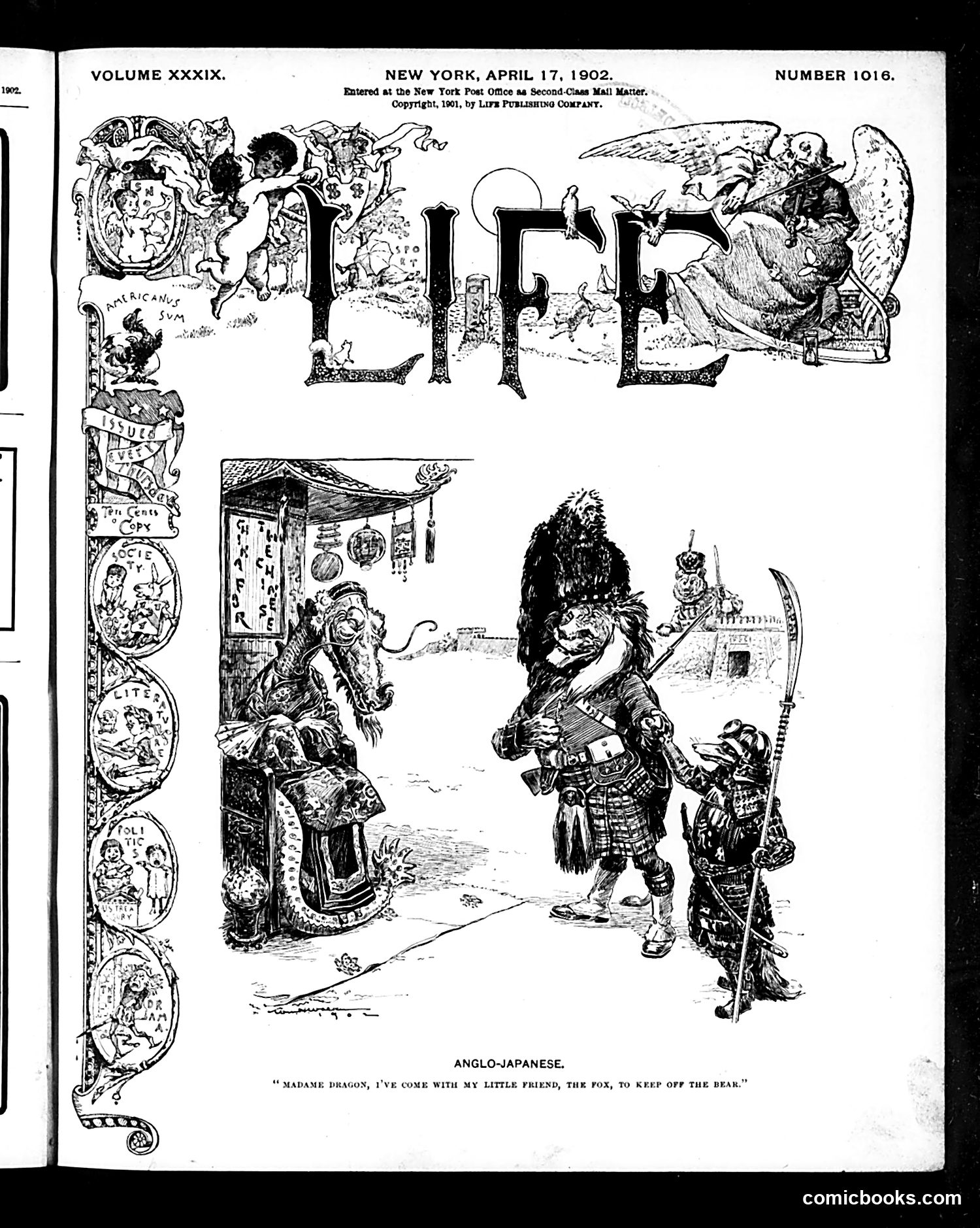
This 1902 *Life* magazine cartoon satirizes Anglo-Japanese diplomatic relations, likely referencing the Anglo-Japanese Alliance signed in January 1902. The caption reads: "Madame Dragon, I've come with my little friend, the Fox, to keep off the Bear." The cartoon depicts a figure (likely representing Britain or "Madame Dragon") meeting with Japanese representatives. The "Fox" references Japan's cunning diplomacy, while the "Bear" alludes to Russian imperial expansion—a major threat both Britain and Japan faced in Asia, particularly regarding Manchuria and Korea. The satire mocks the strategic partnership as a mutual defense pact driven by shared fears of Russian aggression rather than genuine friendship. The elaborate decorative border with Asian-influenced designs emphasizes the exotic "Oriental" context of the alliance.
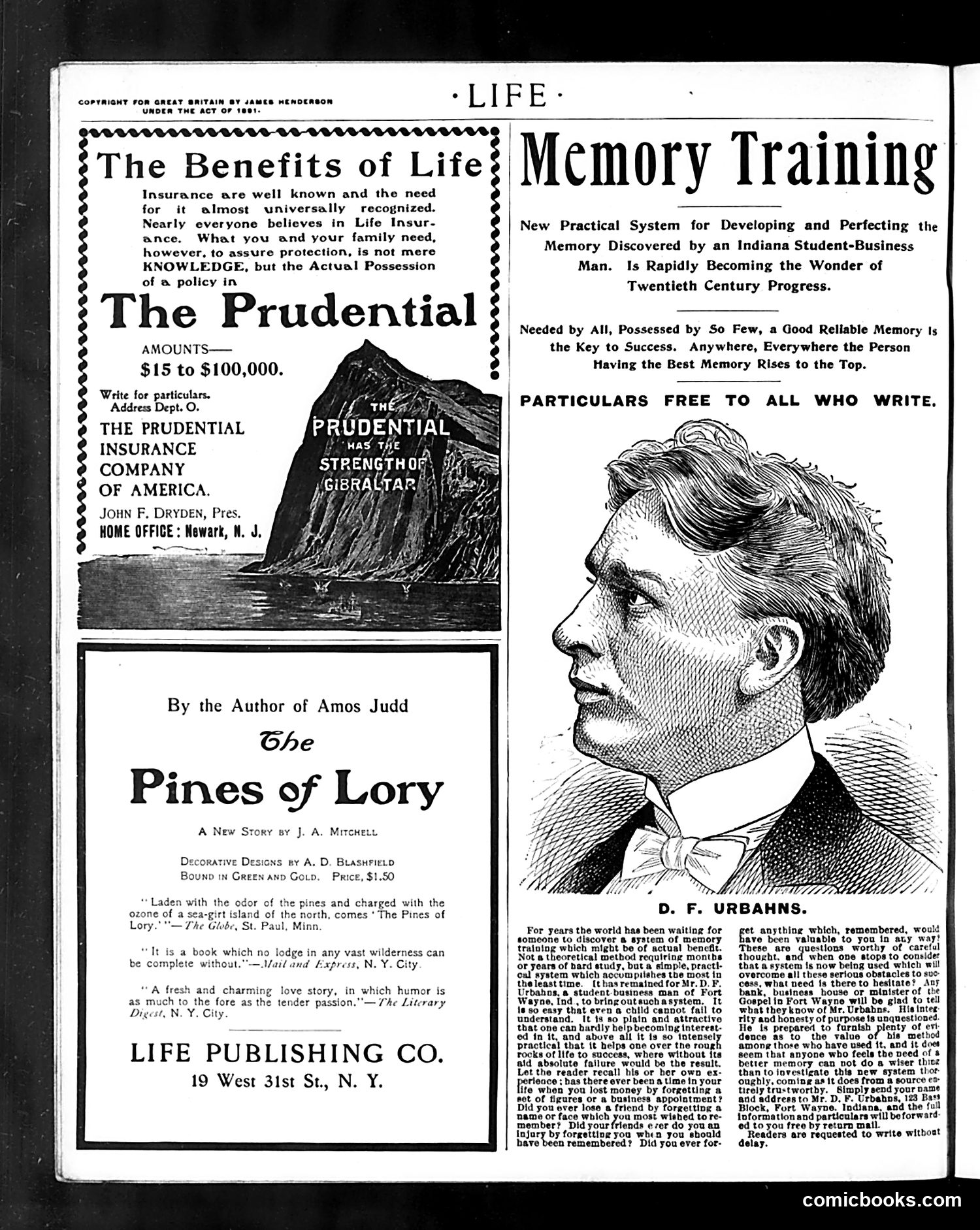
This page is primarily **advertising rather than political satire**. The left side advertises *The Prudential Insurance Company* (emphasizing life insurance protection of $15-$100,000) and *The Pines of Lory*, a book by Amos Judd. The right side promotes a "Memory Training" course by D.F. Urbahns, with his portrait shown. The ad claims his practical memory system helps students and businessmen succeed, positioning good memory as key to "Twentieth Century Progress." It promises free particulars to interested readers. There is **no political cartoon here**—this is a commercial page typical of early 20th-century magazines, where ads subsidized publication. The memory training pitch represents period-typical self-improvement marketing.
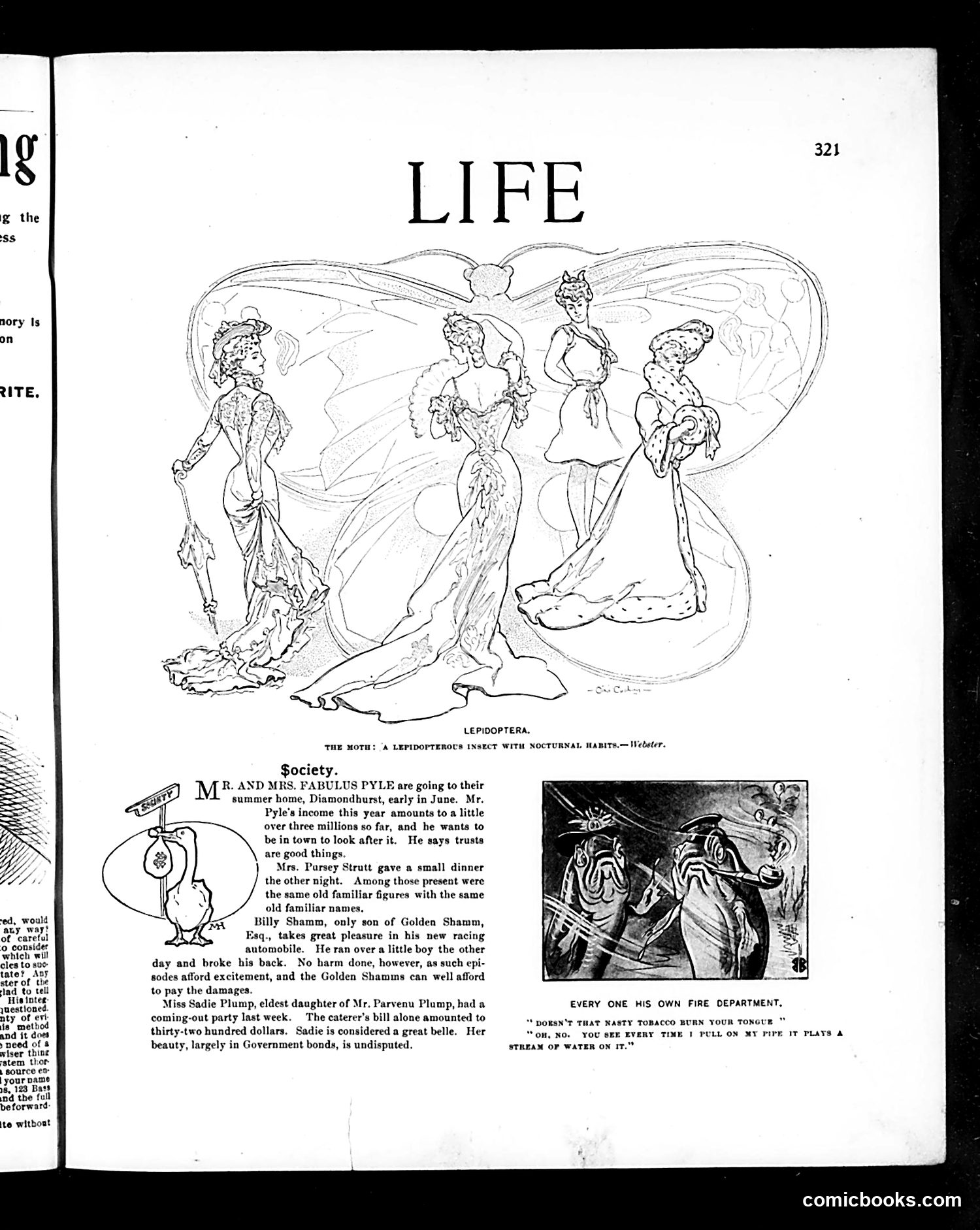
The top illustration, "The Moth: A Lepidopteran Insect with Nocturnal Habits," depicts five women with moth-like wings emerging from their backs. This is a satirical visual metaphor about women's nightlife and evening entertainment during the Jazz Age era. The "Society" section below reports on wealthy New Yorkers—Mr. and Mrs. Fabulous Pyle planning a summer trip, Mrs. Forney Strutt's dinner party, and Billy Shanum's racing incident. The final item mentions Miss Sadie Plumb's expensive coming-out party costing thirty-two hundred dollars. The right cartoon mocks tobacco smoking, showing a man defending his smoking habit with crude justifications about fire departments and water pipes—satirizing weak arguments smokers used to defend the habit.
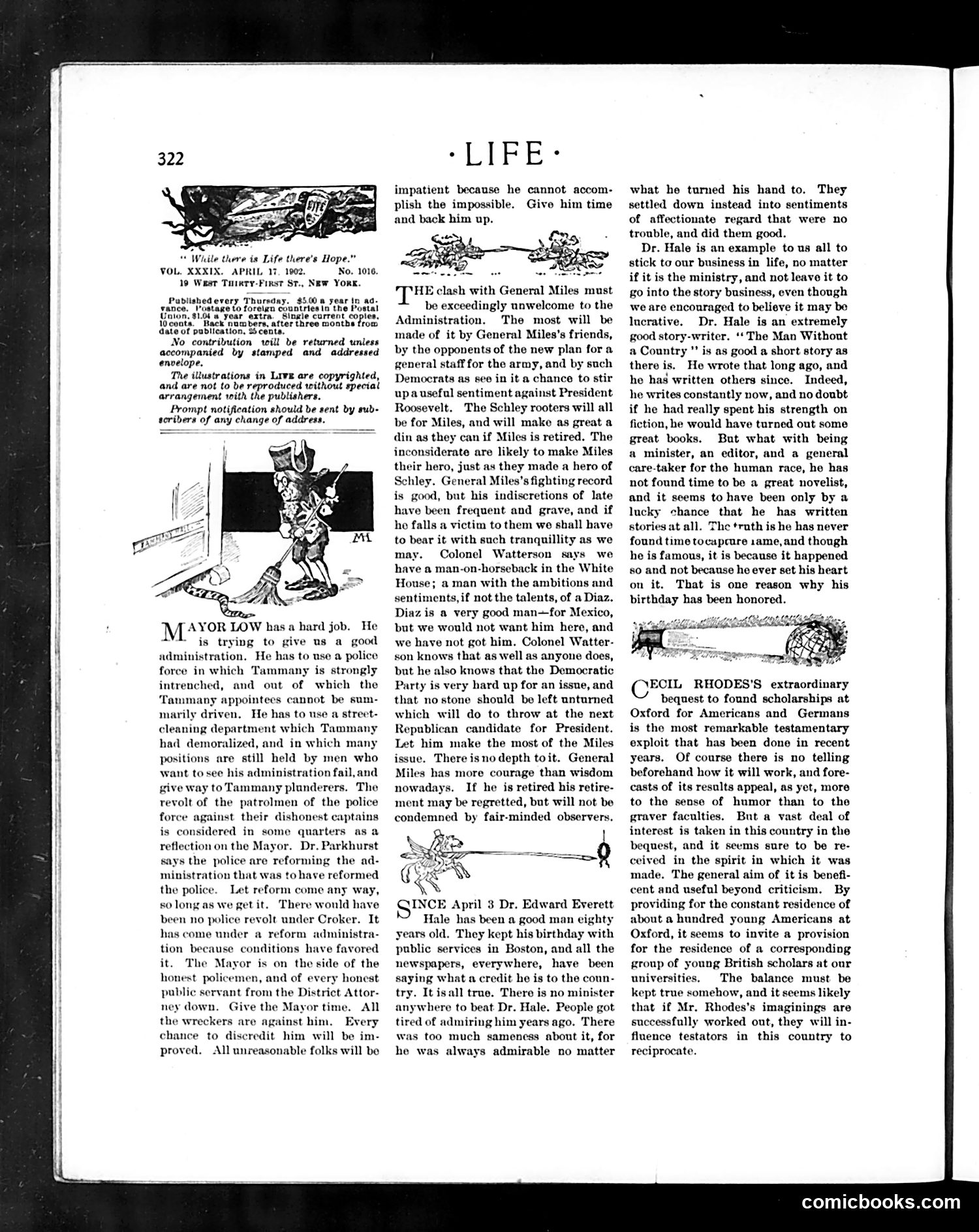
The page contains **political commentary** rather than traditional cartoons. The text discusses **General Nelson Miles** and upcoming military administration conflicts, mentioning opposition from "Schley rooters" and Democratic Party resistance to a Republican presidential candidate. A notable illustration shows a figure in military/official dress, though the specific identity isn't entirely clear from the image alone. The commentary also discusses **Dr. Edward Everett Hale**, praising his longevity and character, and **Cecil Rhodes's scholarship bequest**, endorsing its benefits for Anglo-American relations among young scholars. The overall tone is **editorial and opinion-driven**, typical of Life's satirical approach to American politics and international affairs during the Progressive Era.
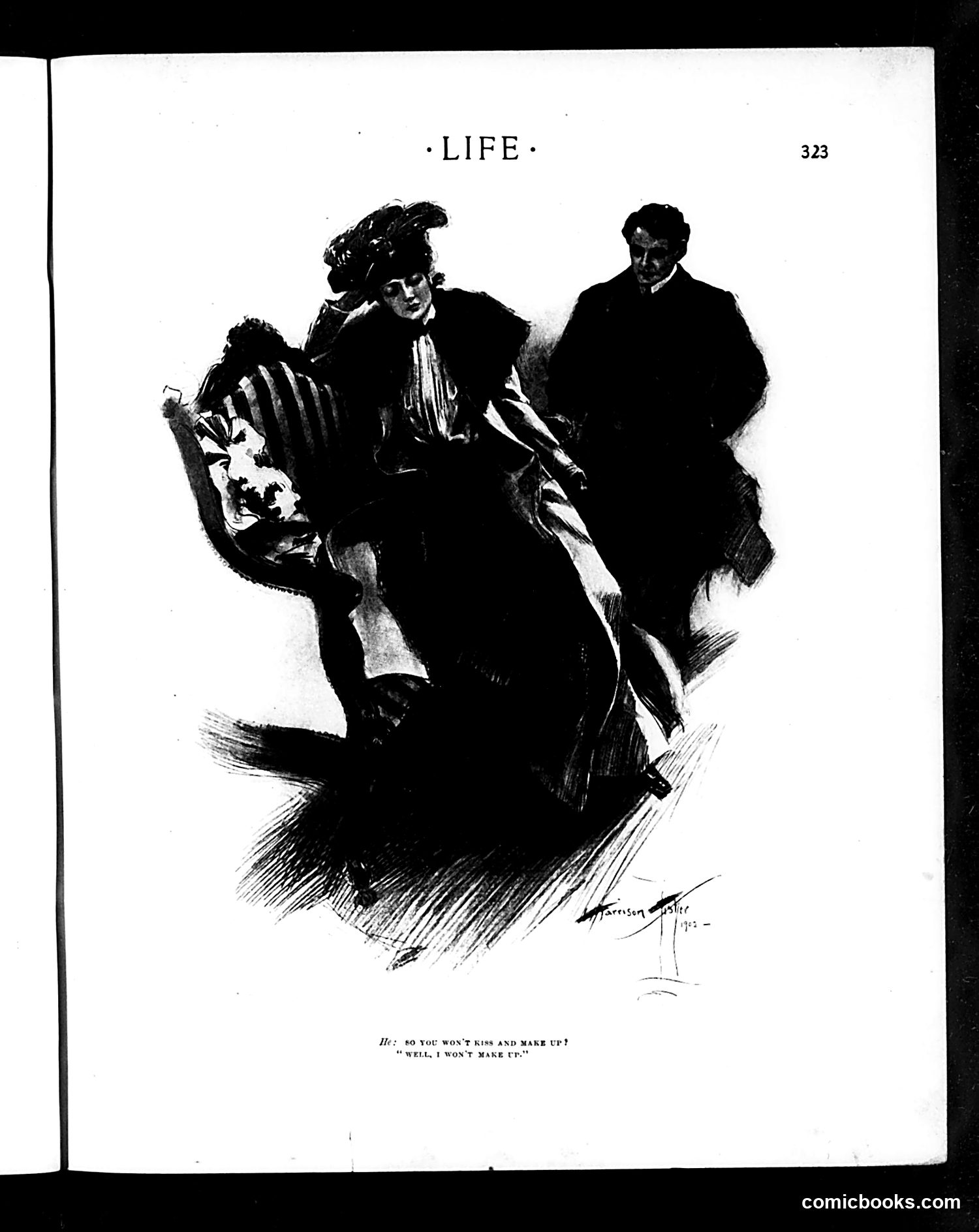
This sketch depicts three figures in what appears to be a domestic scene. The caption reads: "He: 'So you won't kiss and make up?' / 'Well, I won't make up.'" The cartoon illustrates a relationship conflict, likely satirizing early 20th-century courtship or marital dynamics. The woman (center) appears defiant or obstinate, while the man (left) seeks reconciliation. A third figure observes on the right. The humor targets gender relations and stubbornness in romance—specifically, a woman's refusal to forgive or compromise after an argument. The "make up" pun (both reconcile and apply cosmetics) adds wordplay typical of Life's satirical style during this period. Without additional context or identification of the artist's intent regarding specific political figures, this appears to be general social satire rather than political commentary.
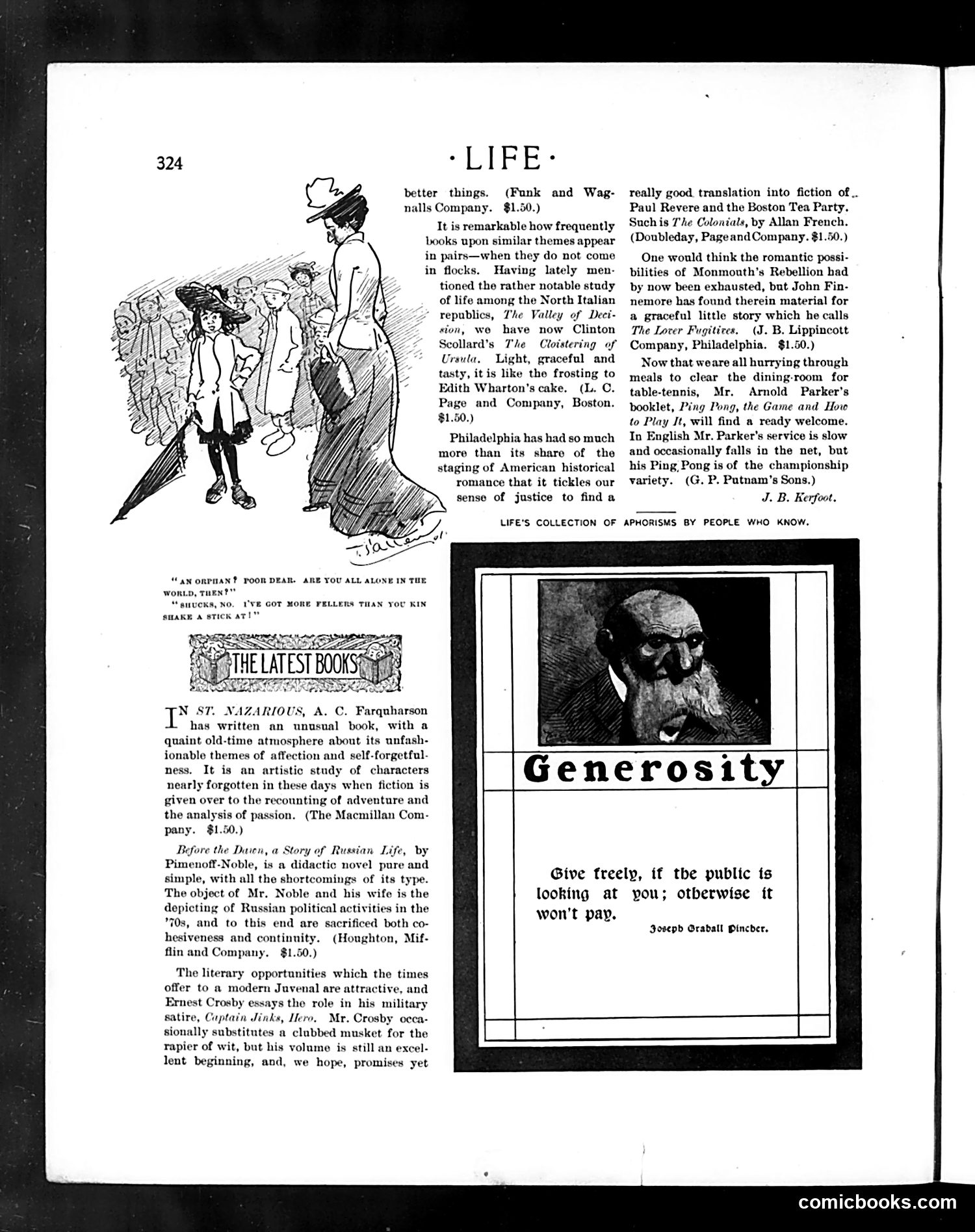
The top cartoon depicts an interaction between a well-dressed adult (likely a wealthy or upper-class figure) and a ragged street child. The child's caption reads: "An orphan? Poor dear. Are you all alone in the world, then?" The orphan responds: "Shucks, no. I've got more fellers than you kin shake a stick at!" This is social satire about urban poverty and street gangs. The joke exposes the contrast between the adult's sentimental, patronizing view of orphans versus street children's harsh reality: they survive through loose affiliations with other impoverished kids ("fellers"), not isolated innocence. The satire mocks both naive sympathy from the wealthy and the grim circumstances forcing children into gang-like survival structures. The page also reviews literary works; the advertisement features an aphorism on "Generosity" by Joseph Orball Pincher.
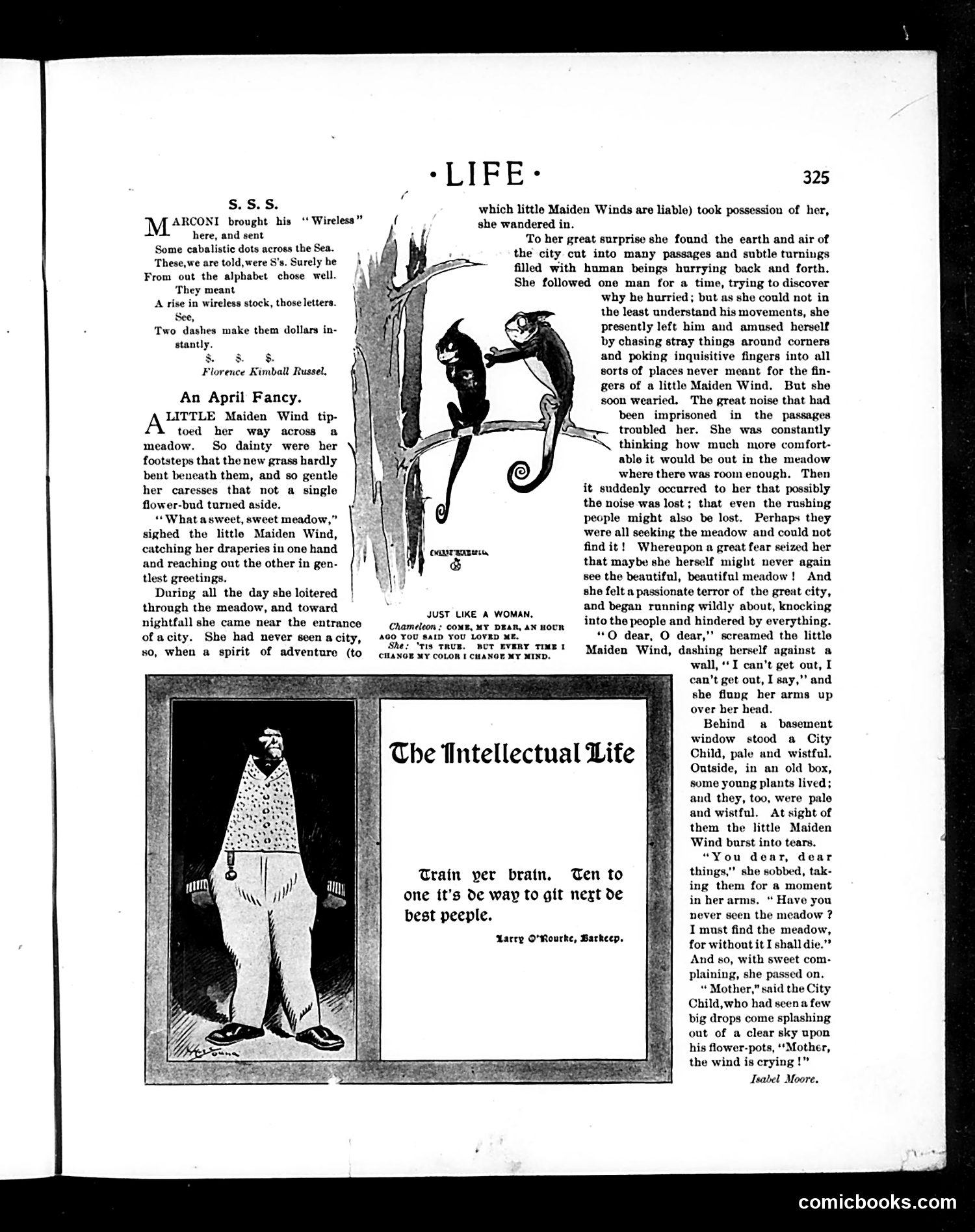
This page contains literary content rather than political satire. The main elements are: **"An April Fancy"** — A children's story about a delicate "Maiden Wind" who wanders through a city, becoming distressed by urban chaos and noise. She seeks a peaceful meadow but cannot escape the bustling crowds. The narrative is sentimental, personifying wind as a sensitive being. **"The Intellectual Life"** — A boxed quote attributing a satirical observation to "Larry O'Rourke, Hackney" (likely a fictional or working-class character name): "Train per braint. Ten to one it's de way to git next de best people." This appears to mock pretentious intellectual circles through dialect humor. **Illustrations** include whimsical drawings of animals and a figure representing "The Intellectual Life." This is primarily literary/humor content rather than political commentary.
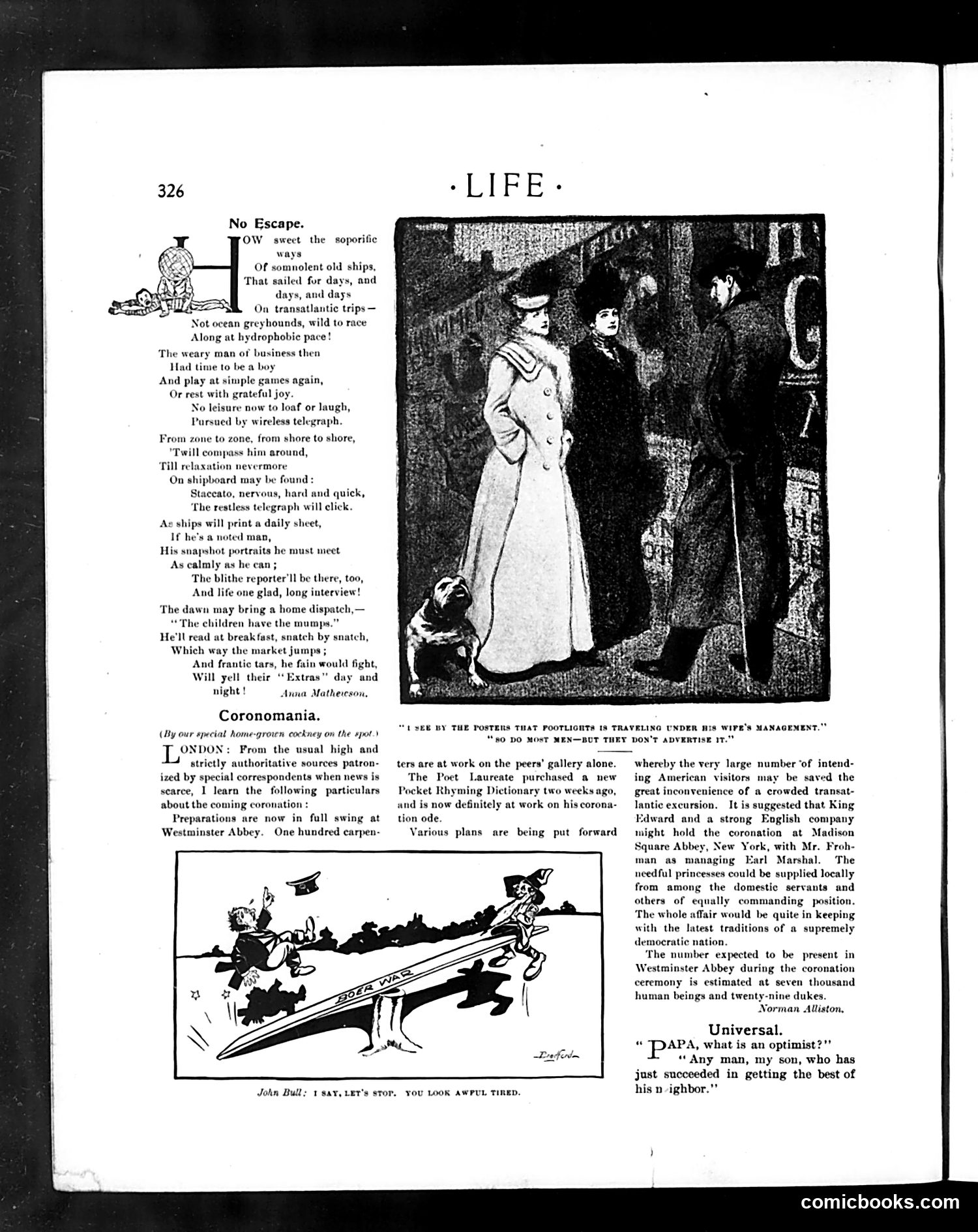
This page contains three distinct elements: **Top illustration**: A woman in a long coat stands with a small dog, captioned "I see by the footers that footlights is traveling under his wife's management." This appears to satirize a theatrical performer whose wife now manages his career—a commentary on shifting power dynamics in show business. **Middle cartoon** (signed "Latour"): Depicts figures on what appears to be a ship or boat with text "John Bull: I say, let's stop. You look awful tired." This likely references British colonial or maritime concerns, though the specific political context remains unclear. **Bottom section**: Contains unrelated content about Westminster Abbey coronation preparations and a joke about optimism. The page's overall tone suggests satirizing theatrical life, marriage dynamics, and possibly British imperial affairs circa early 20th century.
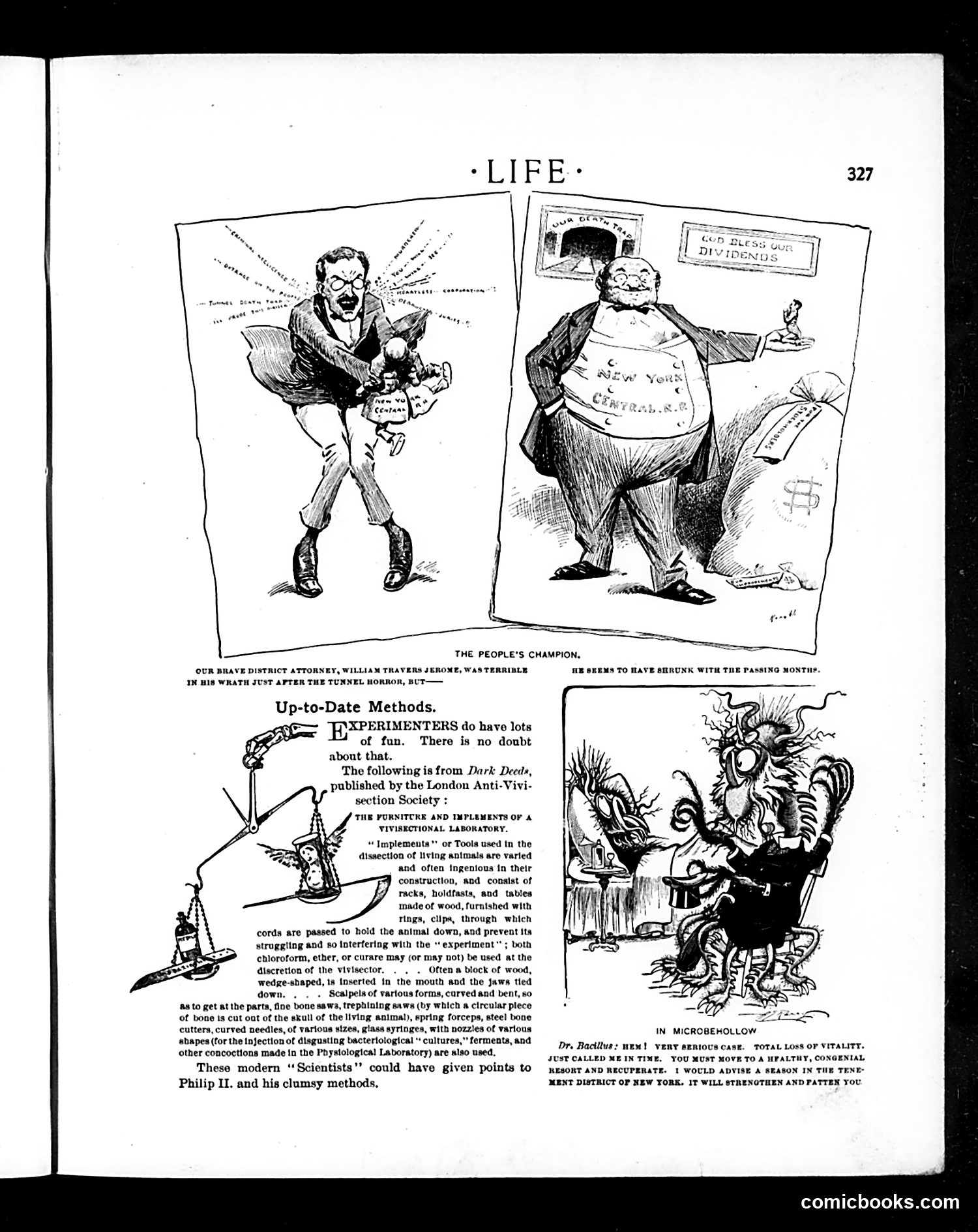
This page satirizes anti-vivisection debates and medical ethics. The top cartoons mock "The People's Champion"—a district attorney (William Travers Jerome, based on caption) who opposed animal experimentation. The left cartoon shows him theatrically crusading against vivisection; the right depicts him as corpulent and self-satisfied, suggesting hypocrisy. The lower section, titled "Up-to-Date Methods," details laboratory equipment used in animal research, appearing to vindicate experimental practices. The final cartoon labeled "In Microbehallow" mocks Jerome's case against Dr. Bachiller, suggesting his crusade caused undue suffering and died needlessly—implying anti-vivisectionists prioritize animals over human medical progress. The satire argues that animal testing advances medicine and that opposing it is foolish sentimentality.
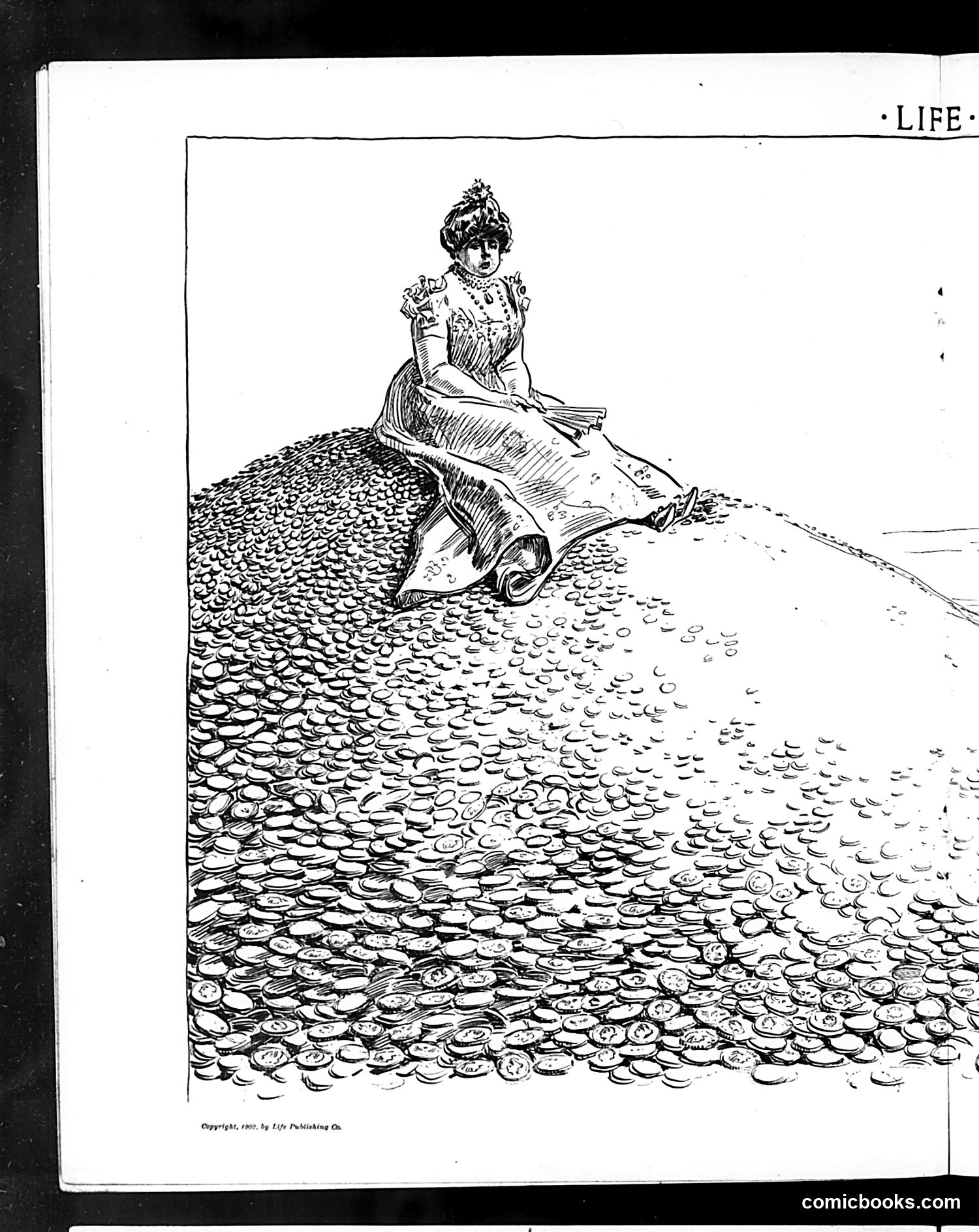
This illustration depicts a well-dressed woman sitting atop an enormous pile of coins, with her dress trailing across the scattered money. The image is a satirical commentary on **wealth inequality and materialism**, likely from the early 1900s based on the clothing style and "Life" magazine publication. The cartoon critiques **wealthy women** and their relationship to money and conspicuous consumption. The woman's elaborate dress and jewelry contrast with her literally sitting upon a fortune, suggesting either: 1. The absurdity of female wealth hoarding 2. Criticism of women's frivolous spending habits 3. Commentary on how wealth accumulates through questionable means The specific social commentary target remains unclear without additional context, but the overall message concerns the gap between extravagant personal display and underlying financial excess during the Gilded Age/Progressive Era.
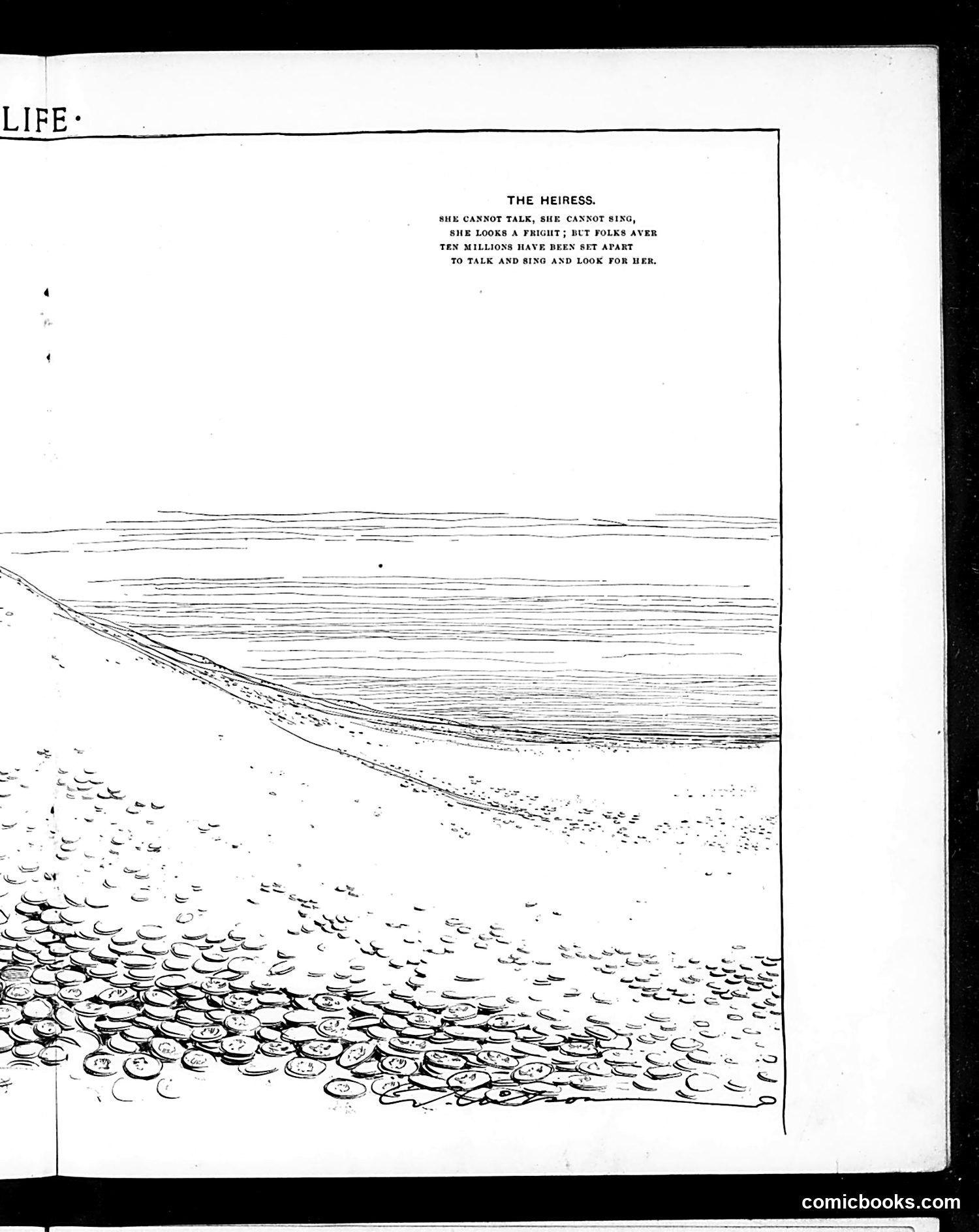
This cartoon satirizes a wealthy heiress who is silent and frightened ("cannot talk, cannot sing"), yet her financial status makes her intensely sought after. The illustration shows a beach scene where the shoreline is literally covered with coins—depicting how her wealth attracts crowds of suitors. The satire mocks both the heiress (rendered powerless by her muteness and fear despite her riches) and the mercenary men pursuing her (represented by the sea of currency). The joke critiques how wealth, particularly inherited wealth, can overshadow a woman's actual character or abilities, reducing her to an object of pursuit based solely on financial value rather than personal merit. This reflects early 20th-century anxieties about wealth, marriage, and gender.
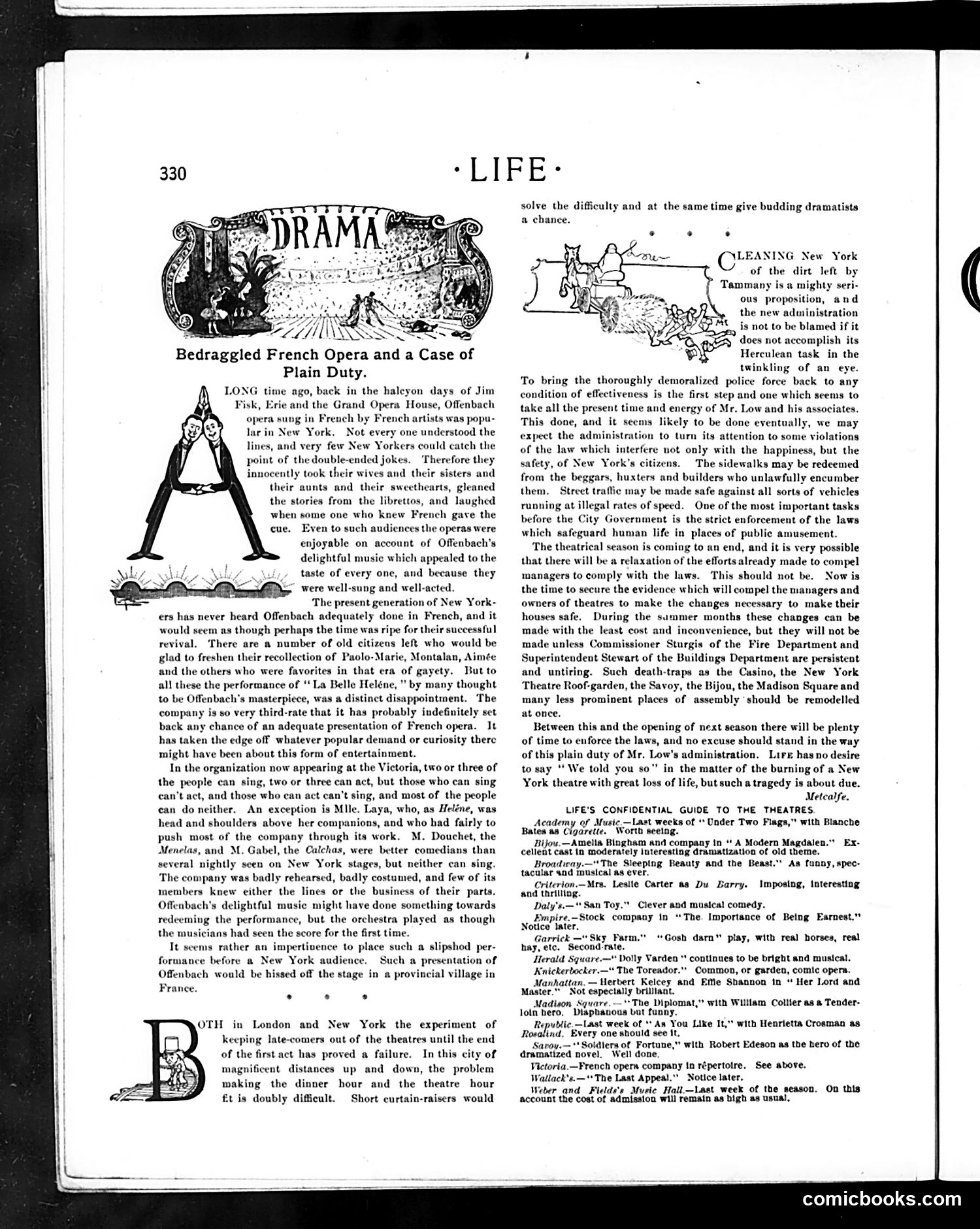
This page contains theater reviews and commentary rather than political cartoons. The main illustration depicts a French opera performer in period costume, accompanying an article titled "Bedraggled French Opera and a Case of Plain Duty." The text discusses the challenges of presenting French opera in New York, referencing Offenbach's work and noting that contemporary New Yorkers have never adequately experienced French opera. The article critiques both the performance quality and the broader issue of theater safety and management in New York City. A secondary discussion addresses the problem of late-night theater closures and their impact on the dinner hour, suggesting this was a practical concern for New York's theater district at the time of publication. The content reflects early 20th-century theatrical criticism and urban management issues rather than political satire.
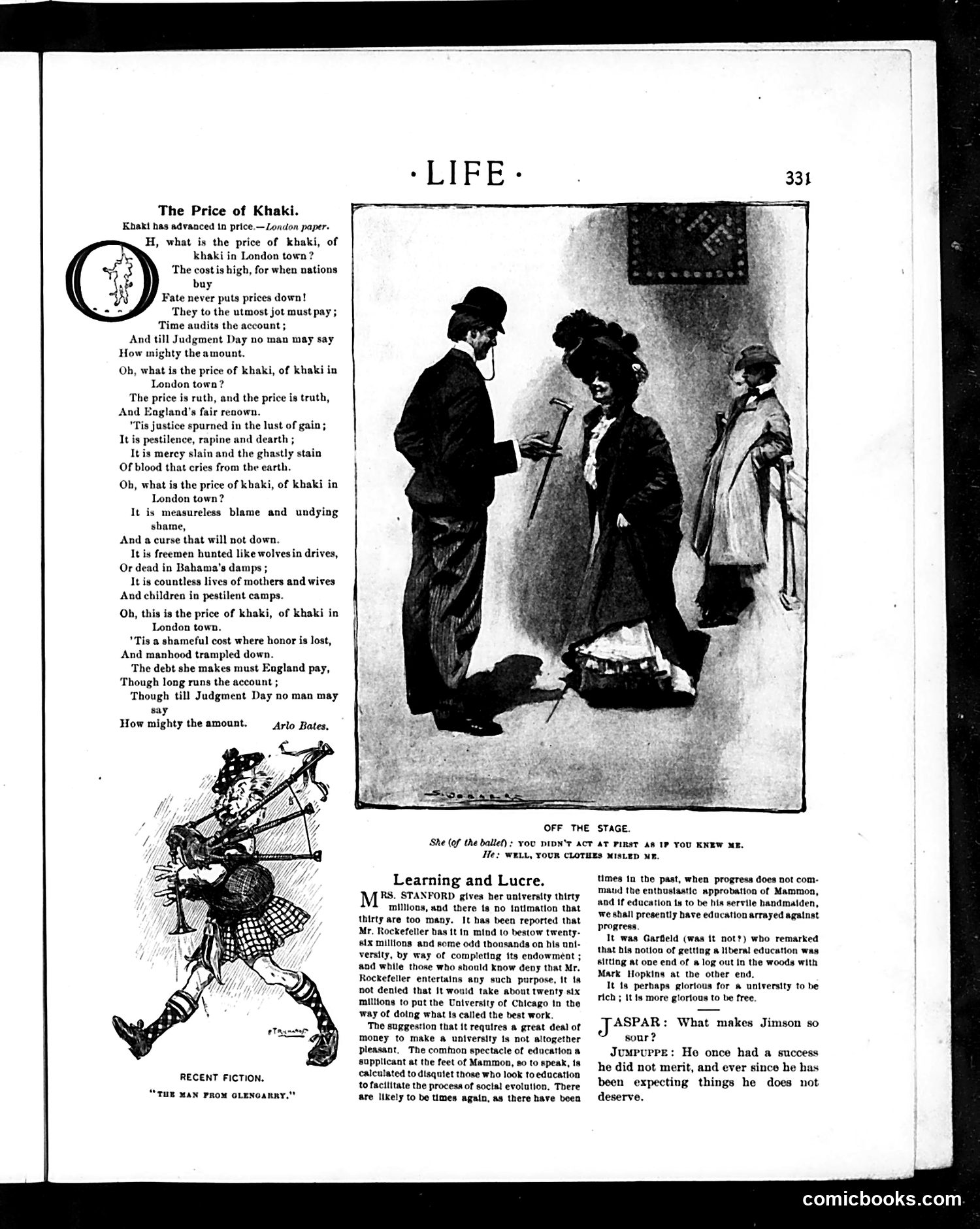
**"The Price of Khaki"** is a protest poem (credited to Arlo Rates) against British military spending, likely referencing the Boer War (1899-1902). "Khaki" refers to the uniform color and, by extension, militarism itself. The poem argues that warfare's true cost isn't financial but moral—lost honor, dead soldiers, bereaved families, and concentration camp victims ("pestilent camps" likely references British camps in South Africa). The satire condemns how nations rationalize these human costs as necessary expenses. **"Off the Stage"** is a brief theatrical joke: an actress performed poorly until her costumes improved, then succeeded—suggesting appearance matters more than talent. **"Learning and Lucre"** discusses wealthy industrialists (Mrs. Stanford, Rockefeller) endowing universities. The author worries that when education depends on wealthy donors' approval, universities become servants to money rather than engines of genuine social progress. The anecdote about Garfield suggests authentic education needs only a great teacher, not vast wealth.
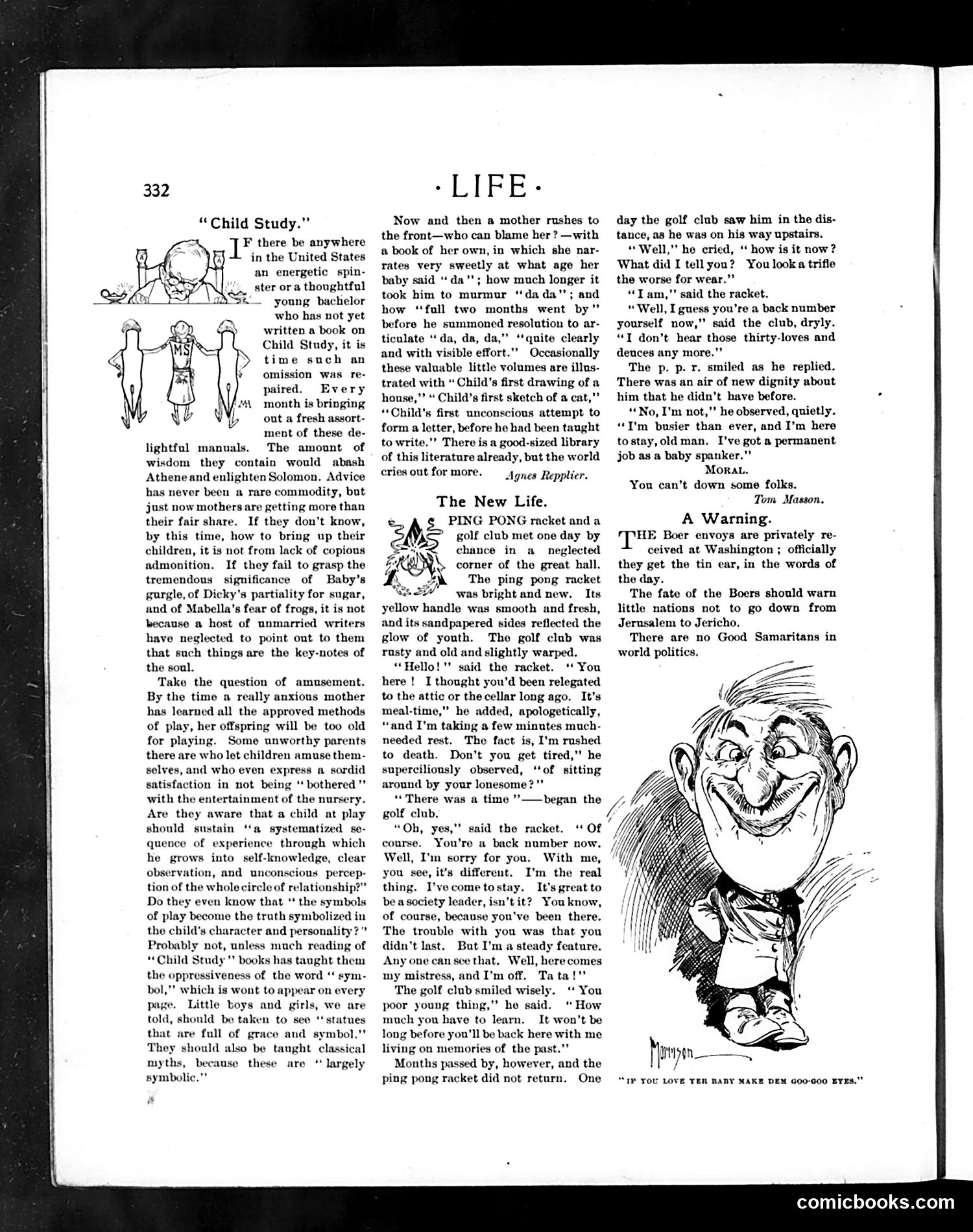
This page contains two satirical pieces about early 20th-century trends: **"Child Study"** (left column) mocks the explosion of parenting advice books by unmarried authors and spinsters. The satire targets how mothers are overwhelmed with instructions on child-rearing, including pseudo-intellectual concepts about "symbols" in play and childhood development. The author (Agnes Repplier) ridicules both the authors' presumptuousness and mothers who obsessively follow such advice, suggesting the books are filled with jargon and impractical theory. **"The New Life"** (right, with cartoon) is an allegorical dialogue between a new ping-pong racket and an old, discarded golf club. The racket represents modern fads and fashionable pursuits gaining popularity, while the golf club represents outdated pastimes. The racket's smugness about being "the real thing" and a "society leader" satirizes how people adopt trendy activities while dismissing older entertainments as obsolete—a commentary on the fickleness of fashionable society. The cartoon illustrates the arrogant, nouveau-riche attitude of the ping-pong racket toward the forgotten golf club.
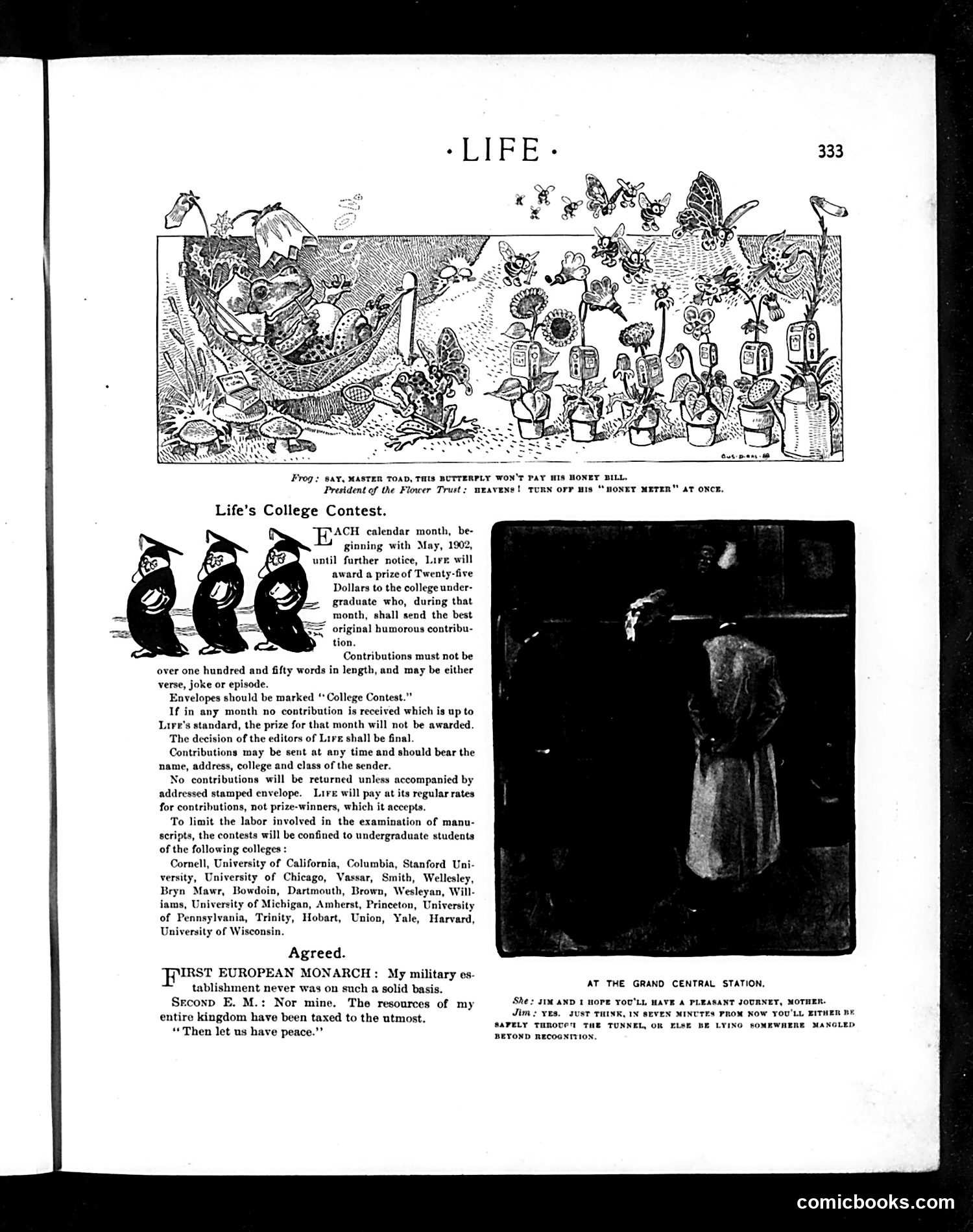
**Top Cartoon:** A "Flower Trust" satire. A toad (representing a monopoly controller) demands a frog turn off a butterfly's "honey meter" because the insect won't pay its bill. This mocks real-world monopolies and corporate trusts—then a major political concern—by depicting them in nature, suggesting these business practices are predatory and absurd. **Middle Section:** Life announces a college humor contest offering $25 monthly prizes to undergraduates from elite schools (Cornell, Yale, Harvard, etc.). Submissions must be original, under 150 words, and humorous. **Bottom Cartoons:** Two brief sketches. The first shows European monarchs agreeing that their military spending has exhausted their kingdoms' resources, satirizing arms races and militarism. The second depicts a mother and son at Grand Central Station—likely a sentimental domestic scene, possibly with dark humor about train travel risks implied by "either be" (text cuts off).
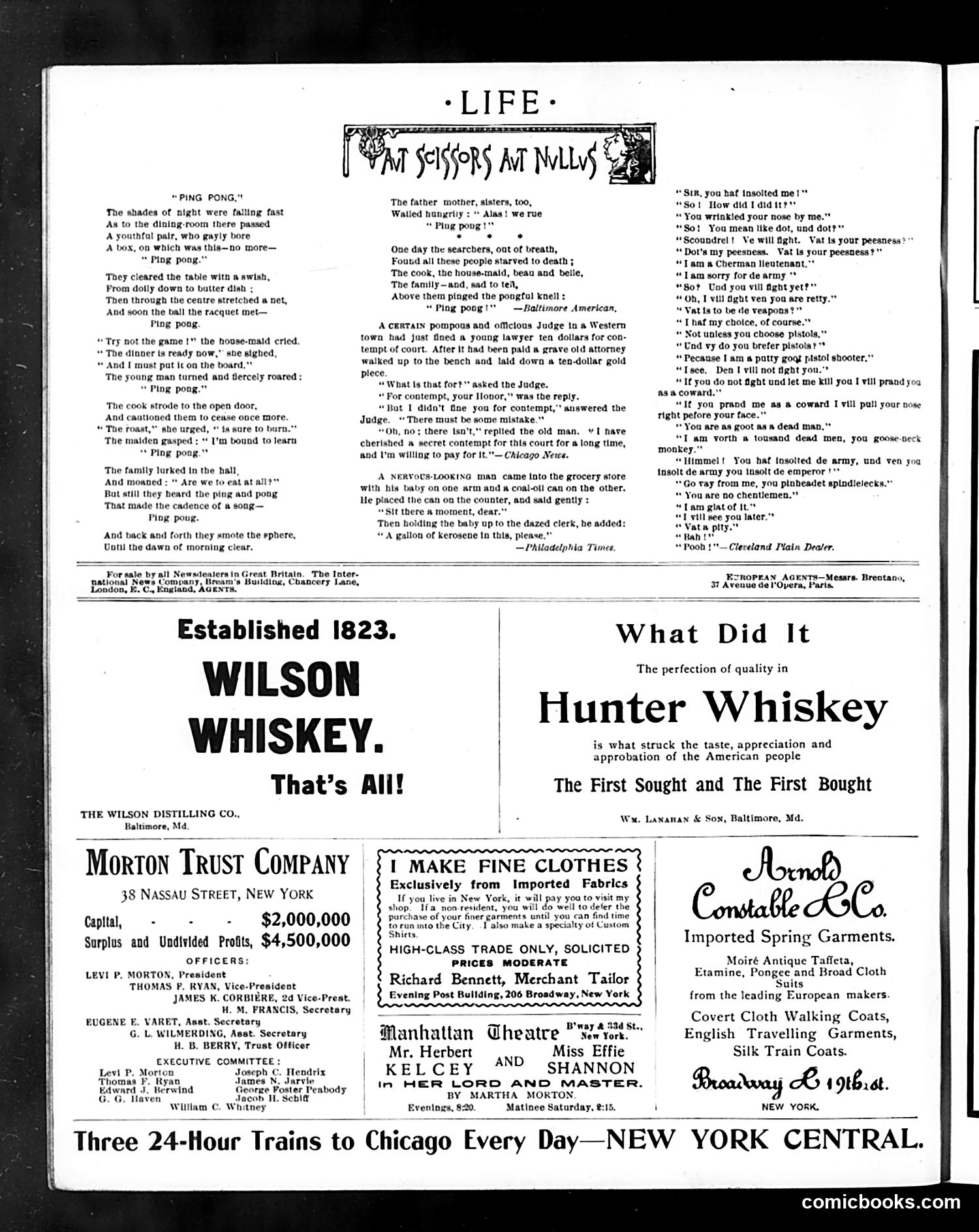
This page features a humorous poem mocking the craze for ping pong—a newly fashionable parlor game. The poem depicts a young couple so obsessed with playing that they neglect dinner preparations, ignoring pleas from housemaids and cooks. The joke escalates absurdly: the family starves to death while the couple continues playing through the night, with the "ping pong" sound persisting like a death knell. The satire ridicules the era's faddish enthusiasms and the couple's self-absorption at the expense of household duties and family care. Below appear period jokes involving a judge and legal contempt, and a German officer debate—typical of Life's comedic format. The remainder is advertising: whiskey, banking services, and clothing merchants.
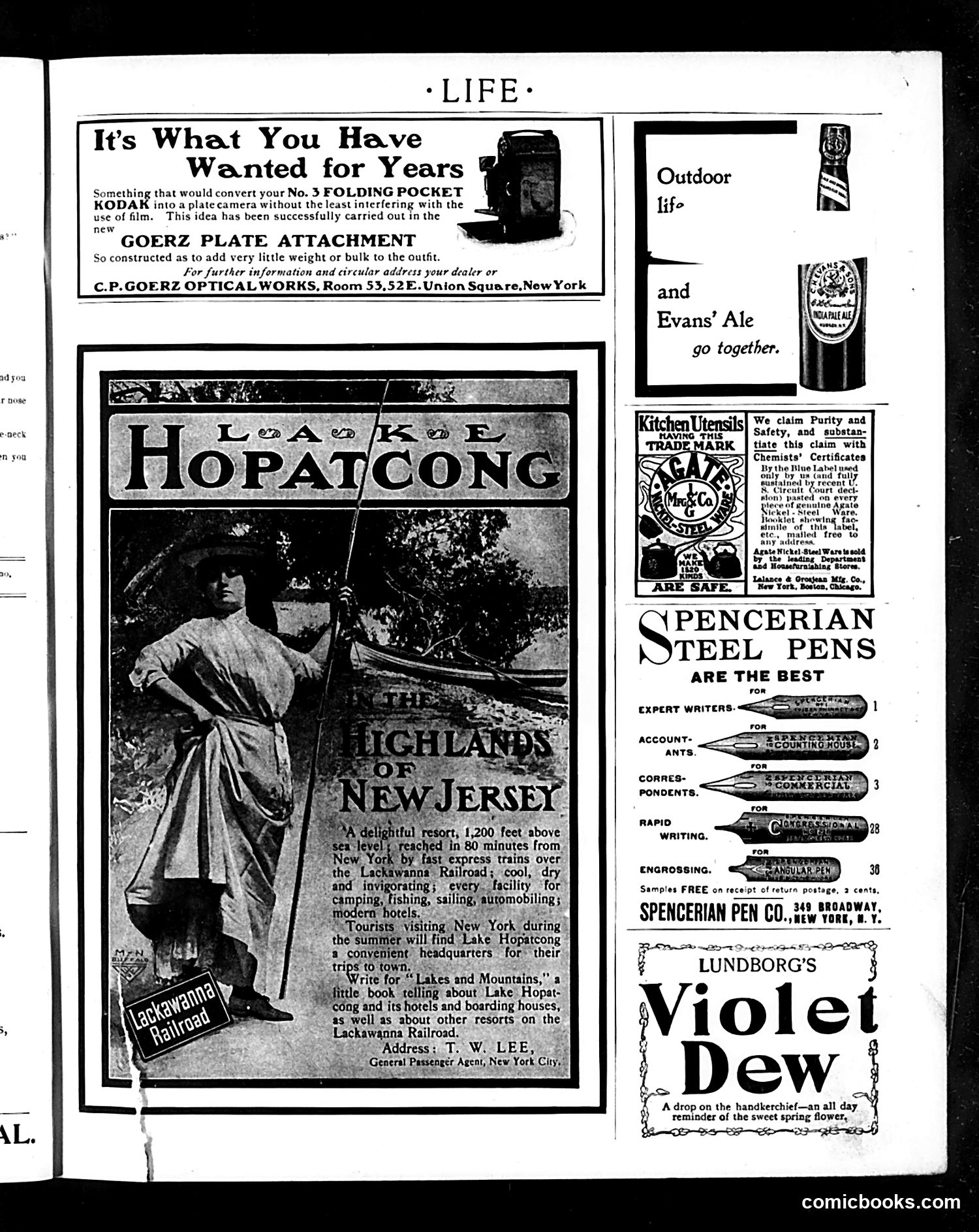
This page is **primarily advertisements**, not political satire or comics. The main content includes: **Large Advertisement**: Lake Hopatcong, New Jersey resort promotion featuring an illustration of a woman fishing. The ad highlights the location as a vacation destination accessible by train from New York City, offering camping, fishing, sailing, and "modern hotels." **Smaller Ads** (right side): Various products typical of the era—camera attachments, ale, kitchen utensils, steel pens for different professional purposes (accountants, correspondents, writers), and perfume. **No Political Satire**: Unlike some Life magazine content, this page contains no caricatures, political commentary, or satirical cartoons. It's a straightforward commercial page from what appears to be an early 20th-century magazine, reflecting period consumer goods and leisure destinations marketed to affluent readers.
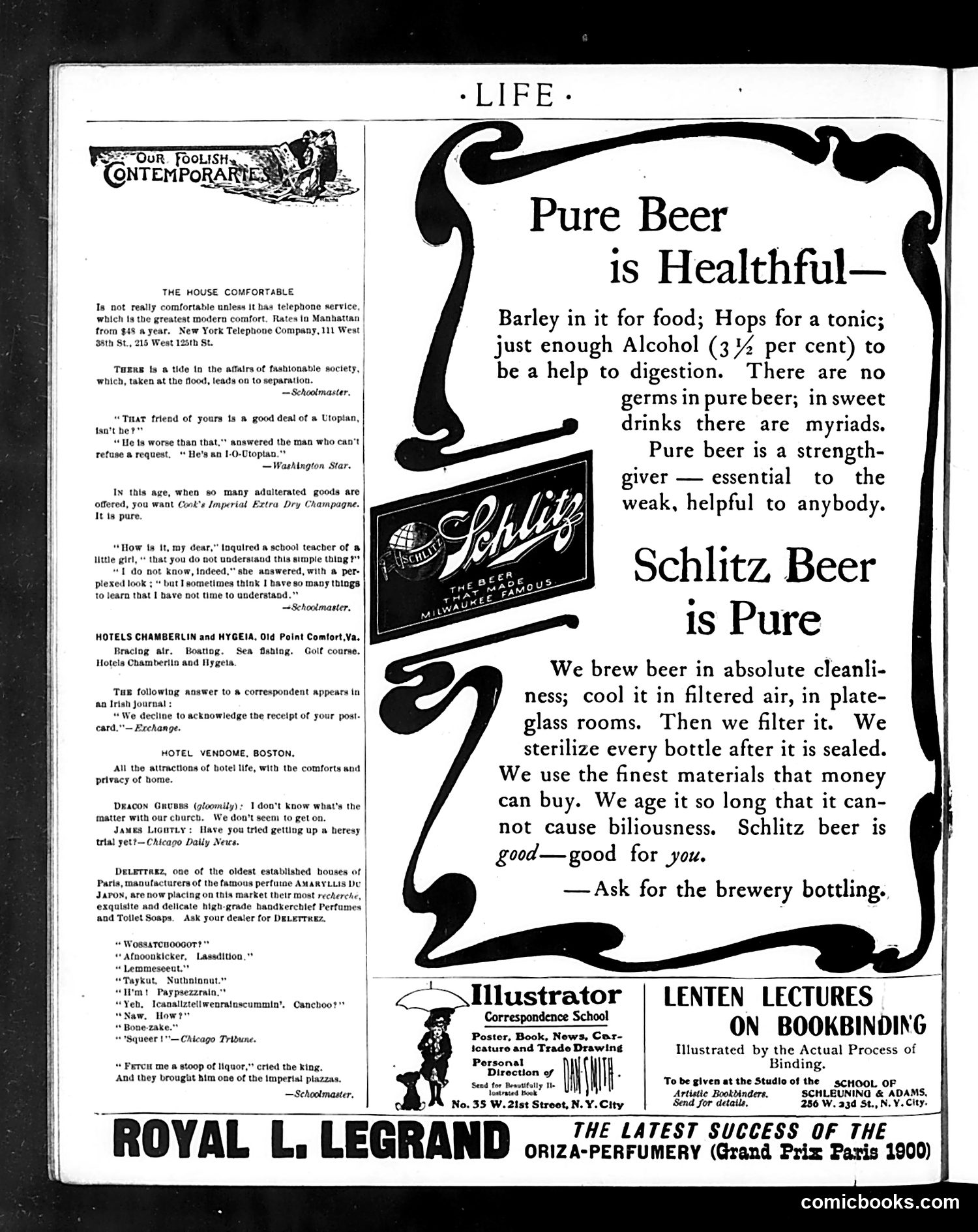
This page is primarily **advertising and miscellaneous content** rather than political satire. The dominant feature is a large Schlitz Beer advertisement claiming beer is "healthful" — containing barley for food, hops as tonic, and only 3½% alcohol to aid digestion. The ad emphasizes purity through sterilization and filtering. The left column contains **humorous short anecdotes** typical of Life's "Our Foolish Contemporaries" section, mocking social pretension: a joke about "Utopians," a school child overwhelmed by learning, a church deacon's struggles, and dialect humor about rural speech patterns. **The satire is gentle and social rather than political**: it targets fashionable society's affectations, advertising claims of purity (ironic given this is beer marketing "healthfulness"), and generational misunderstandings. The remaining space fills with hotel advertisements and notices for correspondence schools and perfume products — standard early-1900s magazine filler.
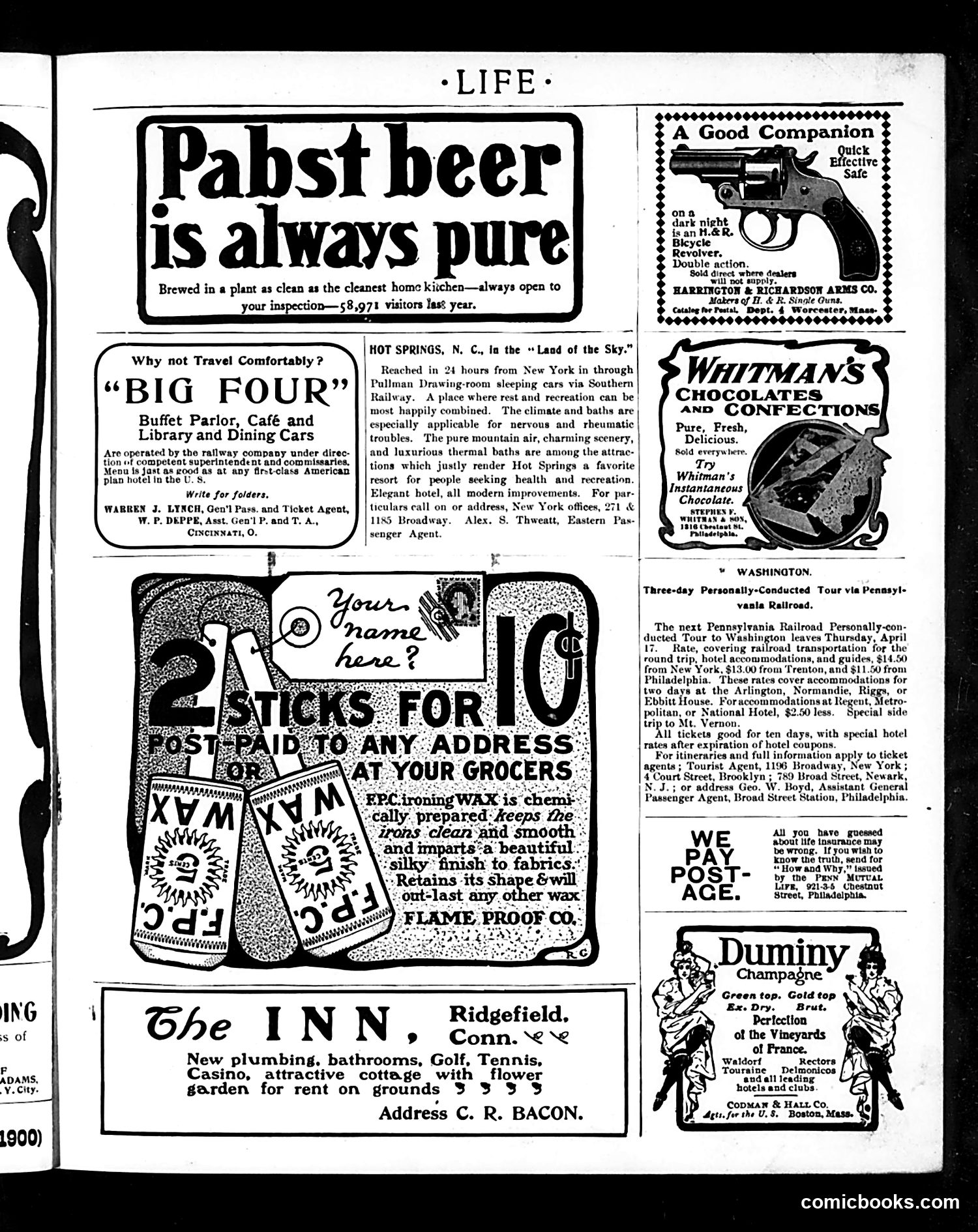
This page is primarily **advertising**, not political satire or editorial cartooning. It contains commercial advertisements typical of early 1900s Life magazine: **Key ads visible:** - Pabst Beer (emphasizing purity and cleanliness) - H&R Bicycle Revolver (a handgun marketed as reliable) - "Big Four" railroad buffet cars (comfortable travel) - KVM Ironing Wax (household product) - Whitman's Chocolates - Hot Springs, North Carolina resort (promoting health benefits) - The Inn in Ridgefield, Connecticut (vacation destination) - Pennsylvania Railroad tour to Washington - Dummy Champagne The largest visual element is the KVM Ironing Wax advertisement with its decorative product boxes and sun illustrations—a straightforward commercial pitch. This reflects Life's era when the magazine subsidized editorial content through extensive advertising rather than relying primarily on subscriptions. The ads themselves target middle-to-upper class readers interested in consumer goods, travel, and leisure.
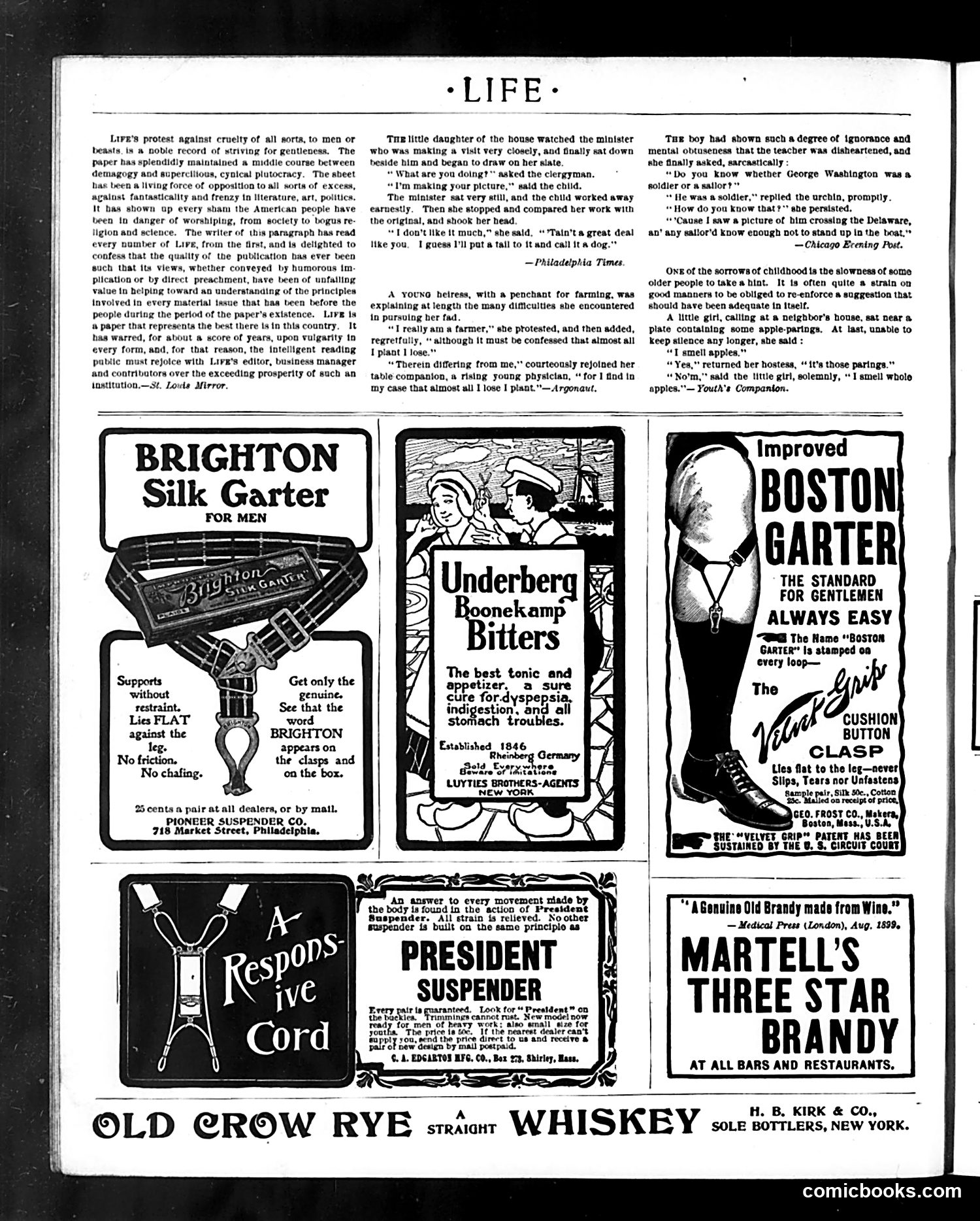
This page consists primarily of **advertisements and humorous anecdotes** rather than political cartoons. The text at top is an editorial endorsement of *Life* magazine itself, praising its two-decade record of satirizing American excess and hypocrisy across society, religion, and politics. Below are four brief jokes typical of early-20th-century humor magazines: - A child drawing a minister's portrait badly - A female farmer and doctor's wordplay about what they "plant" and "lose" - A boy's (accidental) clever reasoning about George Washington crossing the Delaware - A girl hinting heavily about apple smell to her host The advertisements feature men's accessories (garters, suspenders) and alcohol (bitters, brandy, whiskey)—common period products. The "President Suspender" ad references the same engineering principle as presidential suspension systems. **This is primarily a commercial/entertainment page** with minimal satirical content, representing how early *Life* balanced editorial voice with revenue from ads and light humor.
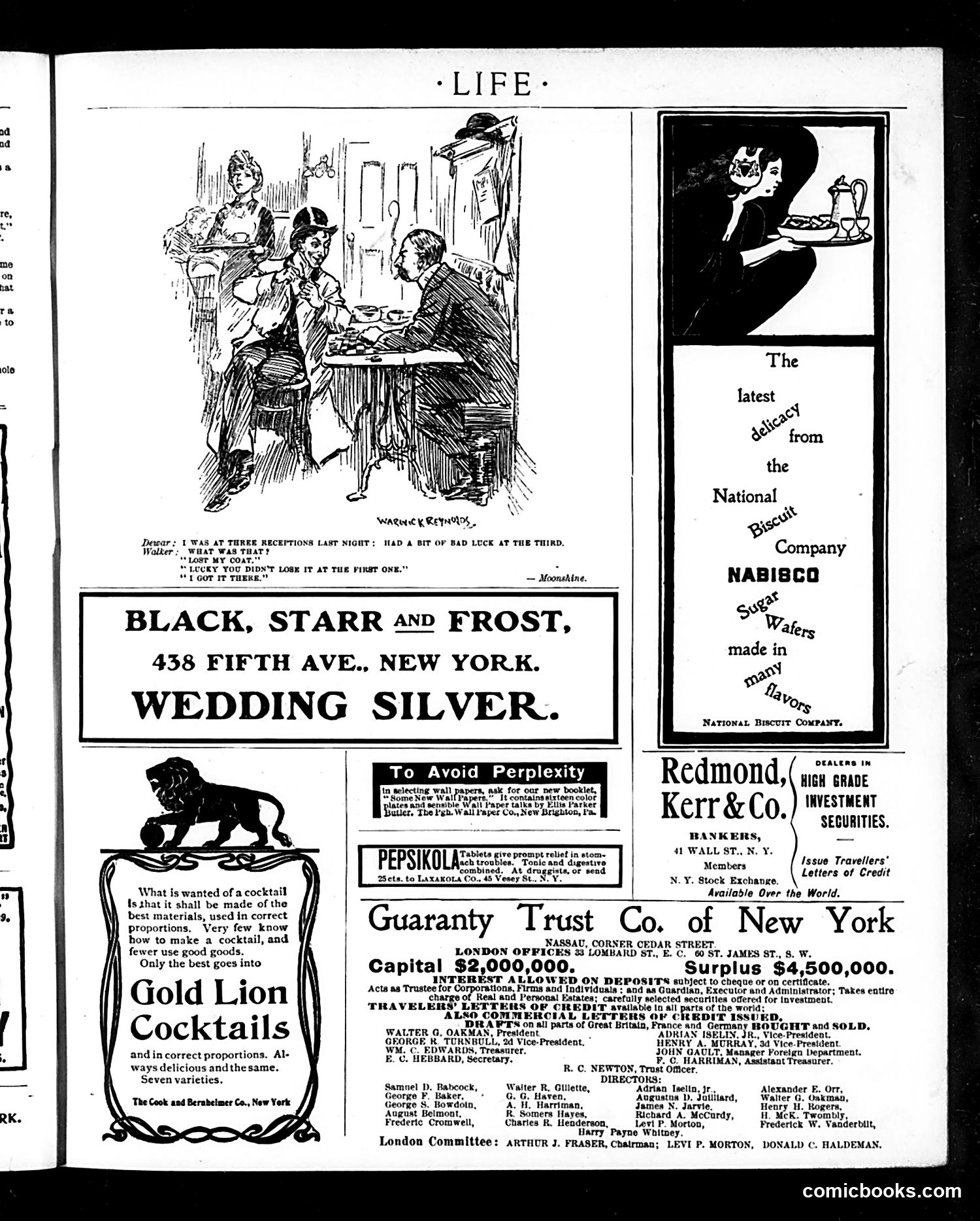
The main cartoon depicts a social commentary on wealthy New Yorkers' social climbing and carelessness. A man recounts attending three receptions in one evening, mentioning he lost his coat at the third event. When asked what bad luck occurred, he reveals he actually lost the coat at the *first* reception but only noticed at the third—implying he was too preoccupied or intoxicated to notice initially. The satire targets the upper class's frivolous social circuit: attending multiple formal events in a single night, the casual attitude toward expensive possessions (losing a coat without immediate concern), and the implicit suggestion of excessive drinking at these gatherings. The artist, Warner Kellogg Reynolds, mocks the obliviousness and excess of wealthy Manhattan society during what appears to be the early 20th century. The page is otherwise dominated by advertisements targeting this same affluent demographic: luxury goods, banking services, and fine dining establishments.
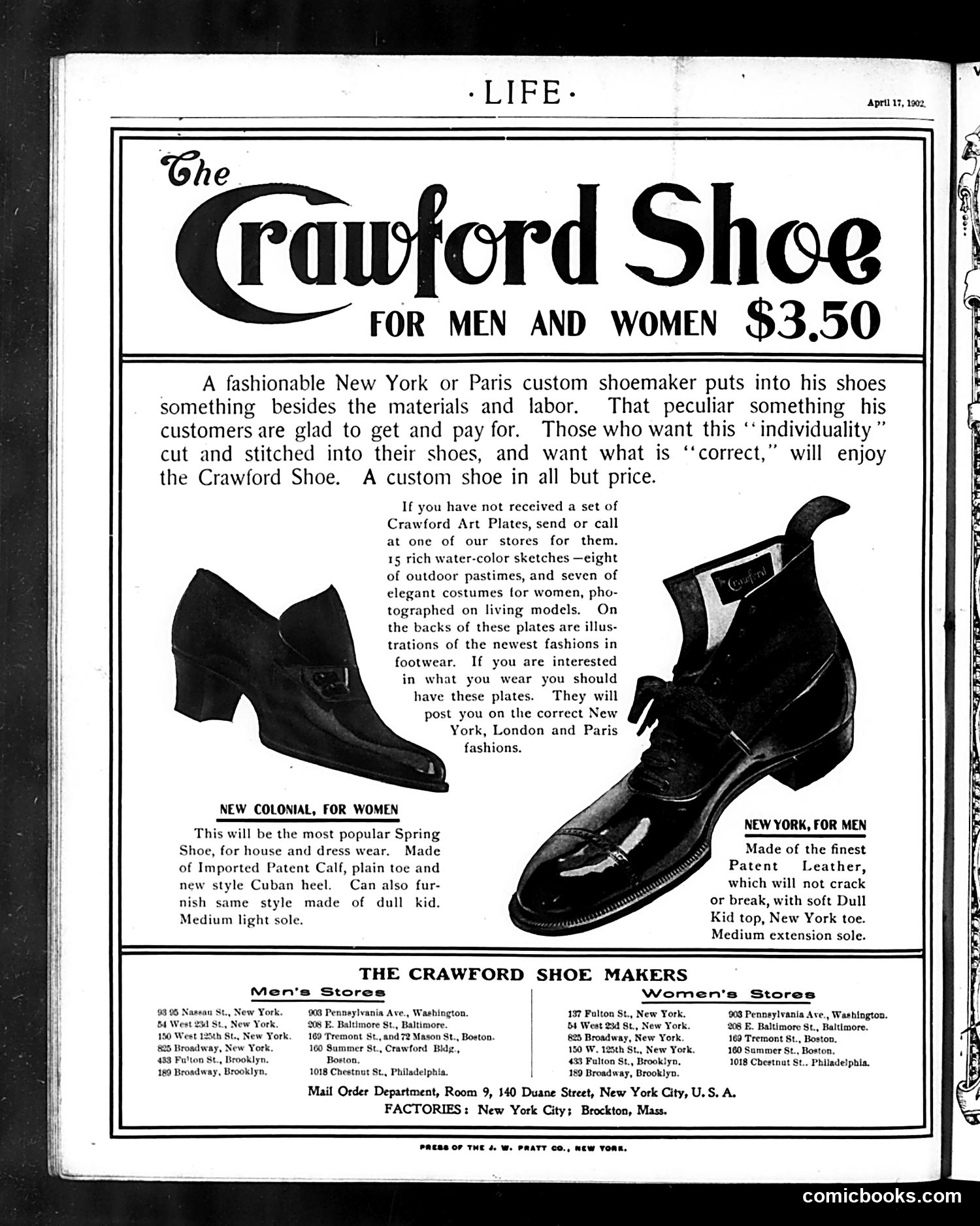
This is **not a cartoon or satirical content**—it's a full-page advertisement for Crawford Shoes from April 17, 1902. The ad markets shoes priced at $3.50 (substantial for the era) by appealing to consumers' desire for fashion "individuality" and correctness according to New York, London, and Paris standards. Two shoe styles are featured: the "New Colonial" for women (made of imported patent calf with Cuban heel) and the "New York" for men (patent leather with dull kid top). The marketing pitch emphasizes that Crawford shoes offer custom-shoemaker quality at ready-made prices. The company offered free "Art Plates"—15 watercolor sketches showing fashionable footwear and elegant clothing on living models—as promotional material to educate consumers about proper fashion. This reflects early 1900s consumer culture, where mail-order departments and mass production allowed middle-class Americans to access fashion aspirations previously limited to wealthy custom clients.