
Life, 1902-04-17 · page 7 of 22
Life — April 17, 1902 — page 7: what you’re looking at
What you’re looking at
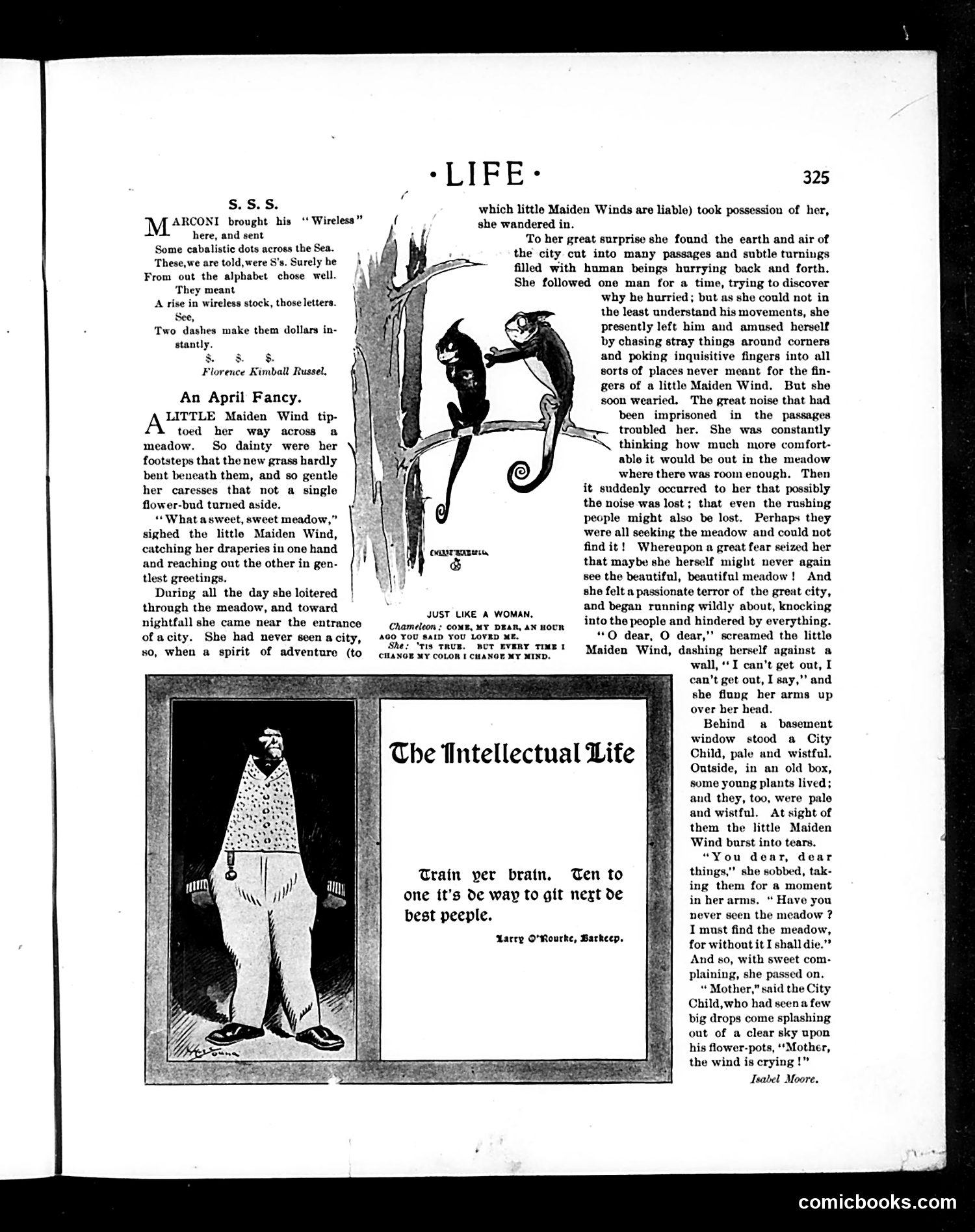
This page contains literary content rather than political satire. The main elements are: **"An April Fancy"** — A children's story about a delicate "Maiden Wind" who wanders through a city, becoming distressed by urban chaos and noise. She seeks a peaceful meadow but cannot escape the bustling crowds. The narrative is sentimental, personifying wind as a sensitive being. **"The Intellectual Life"** — A boxed quote attributing a satirical observation to "Larry O'Rourke, Hackney" (likely a fictional or working-class character name): "Train per braint. Ten to one it's de way to git next de best people." This appears to mock pretentious intellectual circles through dialect humor. **Illustrations** include whimsical drawings of animals and a figure representing "The Intellectual Life." This is primarily literary/humor content rather than political commentary.
📄 Transcribed text from this page (OCR, searchable)
Machine-transcribed from the original scan — historical spelling and the odd misread are preserved.
_ + LIFE* 325 S.S.S. which little Maiden Winds are liable) took possession of her, MARCOS! brought his“ Wireless” she waidered ti. here, and sent } { To her great surprise she found the earth and air of Sean cael Sanday Sa wy the city cut into many passages and subtle turnings ‘i . ere 5 s— filled with human beings hurrying back and forth. From out the alphabet chose well. ; J She tol : ; ‘They meant e followed one man for a time, trying to discover ‘A rise in wireless stock, those letters. why he hurried; but as she could not in See, 3 the least understand his movements, she Two dashes make them dollars in- [pag presently left him and amused herself stantly. f ‘ by chasing stray things around corners Se 8 & 5 5 and poking inquisitive fingers into all Florence Kimball Russel. Vie sorts of places never meant for the fin- . ; gers of a little Maiden Wind. But she An April Fancy. 3 soon wearied. The great noise that had LITTLE Maiden Wind tip- i been imprisoned in the passages toed her way across a s 2 troubled her. She was constantly meadow. So dainty were her = thinking how much more comfort- footsteps that the new grass hardly able it would be out in the meadow bent beneath them, and so gentle |» where there was room enough, Then her caresses that not a single & it suddenly occurred to her that possibly flower-bud turned aside. “ , the noise was lost; that even the rushing «What asweet, sweet meadow,” - people might also be lost. Perhaps they sighed the little Maiden Wind, |» r were all seeking the meadow and could not catching her draperies in one hand find it! Whereupon a great fear seized her and reaching out the other in gen- | & that maybe she herself might never again tlest greetings. ' see the beautiful, beautiful meadow! And During all the day she loitered she felt a passionate terror of the great city, through the meadow, and toward e justiemea WoW, and began running wildly about, knocking nightfall she came near the entrance —Cnameleon: cout, x Dean, ax uocn _18to the people and hindered by everything. ofacity. She had never seen acity, 490 You saip you LovEp xe. “‘O dear, O dear,” screamed the little so, when a spirit of adventare (to cotfi, TH TUE. MCT EVERY TET Maiden Wind, dashing herself against a CHANGE MY COLOR I CHANGE MY MIND. wall, ‘I can’t get out, I can’t get out, I say,”’ and she flung her arms up over her head. Behind a basement window stood a City Child, pale and wistfal. Ontside, in an old box, some young plants lived; and they, too, were pale and wistful. At sight of them the little Maiden Wind burst into tears. “You dear, dear Train yer brain, Ten to z =] things,” she sobbed, tak- S| ing them for a moment one it’s de way to git next de £ in her arms. “ Have you best peeple. iy] never seen the meadow ? I must find the meadow, for without it I shall die.” And so, with sweet com- plaining, she passed on. “ Mother,” said the City Child, who had seena few big drops come splashing out of a clear sky upon his flower-pots, ‘‘Mother, the wind is crying!" Isabel Moore. ‘Larry O'Rourke, Barkeep, comicbooks.com