
Life, 1902-04-17 · page 6 of 22
Life — April 17, 1902 — page 6: what you’re looking at
What you’re looking at
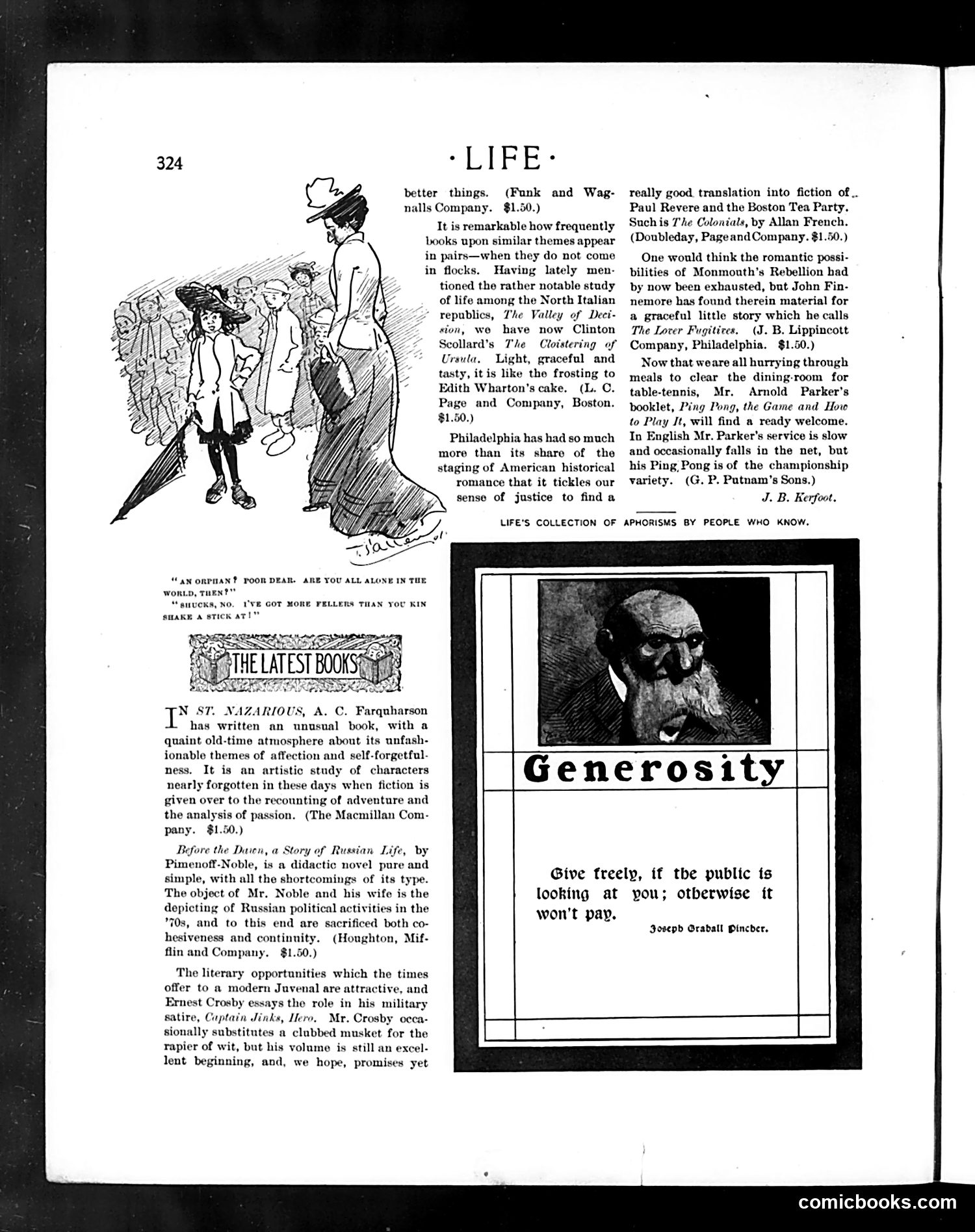
The top cartoon depicts an interaction between a well-dressed adult (likely a wealthy or upper-class figure) and a ragged street child. The child's caption reads: "An orphan? Poor dear. Are you all alone in the world, then?" The orphan responds: "Shucks, no. I've got more fellers than you kin shake a stick at!" This is social satire about urban poverty and street gangs. The joke exposes the contrast between the adult's sentimental, patronizing view of orphans versus street children's harsh reality: they survive through loose affiliations with other impoverished kids ("fellers"), not isolated innocence. The satire mocks both naive sympathy from the wealthy and the grim circumstances forcing children into gang-like survival structures. The page also reviews literary works; the advertisement features an aphorism on "Generosity" by Joseph Orball Pincher.
📄 Transcribed text from this page (OCR, searchable)
Machine-transcribed from the original scan — historical spelling and the odd misread are preserved.
better -LIFE- things. (Funk and Wag- nalls Company. $1.50.) It is remarkable how frequently books upon similar themes appear in pairs—when they do not come in flocks. “ano WORLD, * suven: SHAKE A STICK AT! N ST. NAZARIOUS, A, C. Farquharson has written an unusual book, with a quaint old-time atmosphere about its unfash- ionable themes of affection and self-forgetful- ness. It is an artistic study of characters nearly forgotten in these days when fiction is given over to the recounting of adventure and the analysis of passion. (The Macmillan Com- pany. $1.50.) Before the Duin, a Story of Russian Life, by Pimenoff-Noble, is a didactic novel pure and simple, with all the shortcomings of its type. The object of Mr. Noble and his wife is the depicting of Russian political activities in the '703, and to this end are sacrificed both co- hesiveness and continuity. (Houghton, Mif- flin and Company. $1.50.) The literary opportunities which the times offer to a modern Juvenal are attractive, and Ernest Crosby essays the role in his military satire, Captain Jinks, Hero, Mr. Crosby occa- sionally substitutes a clubbed musket for the rapier of wit, but his volume is still an excel- lent beginning, and, we hope, promises yet Having lately men- tioned the rather notable study of life among the North Italian republics, The Valley of Deci- sion, we have now Clinton Scollard’s The Cloistering of Ursula, Light, graceful and tasty, it is like the frosting to Edith Wharton's cake, (L. C. Page and Company, Boston. $1.50.) Philadelphia has had so much more than its share of the staging of American historical romance that it tickles our sense of justice to find a LIFE'S COLLECTION OF really good translation into fiction of .. Paul Revere and the Boston Tea Party, Such is The Colonials, by Allan French. (Doubleday, Pageand Company. $1.50.) One would think the romantic possi- bilities of Monmonth’s Rebellion had by now been exhausted, but John Fin- nemore has found therein material for a graceful little story which he calls The Lover Fugitices. (J. B. Lippincott Company, Philadelphia. $1.50.) Now that weare all hurrying through meals to clear the dining-room for table-tennis, Mr. Arnold Parker's booklet, Ping Pong, the Game and How to Play It, will find a ready welcome. In English Mr. Parker's service is slow and occasionally falls in the net, but his Ping Pong is of the championship variety. (G. P. Putnam's Sons.) J.B. Kerfoot. APHORISMS BY PEOPLE WHO KNOW. Generosity won't pay. Give freely, if tbe public is looking at pou; otberwise it Sosepb Gradall Pincber. comicbooks.com