
Life, 1902-04-17 · page 12 of 22
Life — April 17, 1902 — page 12: what you’re looking at
What you’re looking at
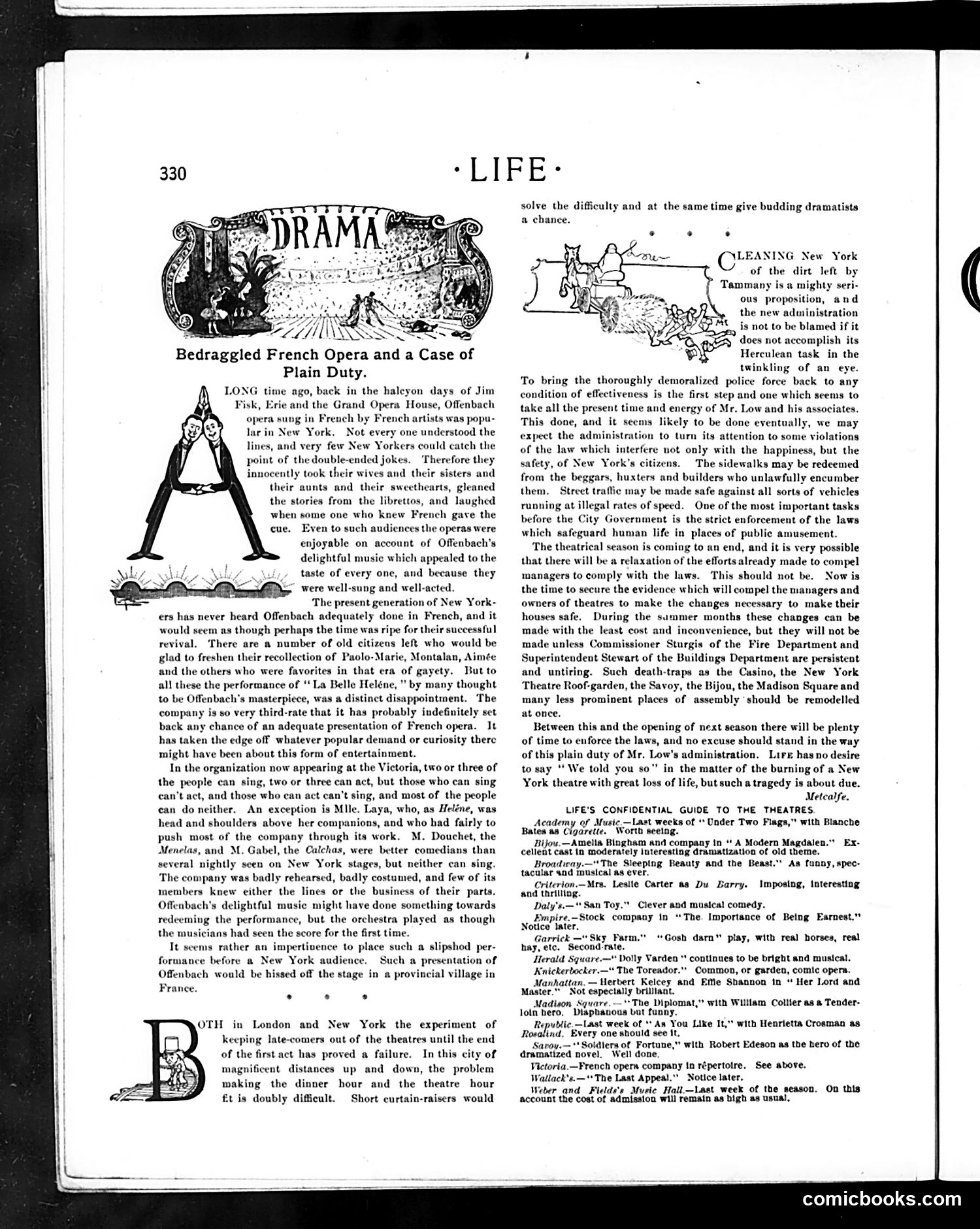
This page contains theater reviews and commentary rather than political cartoons. The main illustration depicts a French opera performer in period costume, accompanying an article titled "Bedraggled French Opera and a Case of Plain Duty." The text discusses the challenges of presenting French opera in New York, referencing Offenbach's work and noting that contemporary New Yorkers have never adequately experienced French opera. The article critiques both the performance quality and the broader issue of theater safety and management in New York City. A secondary discussion addresses the problem of late-night theater closures and their impact on the dinner hour, suggesting this was a practical concern for New York's theater district at the time of publication. The content reflects early 20th-century theatrical criticism and urban management issues rather than political satire.
📄 Transcribed text from this page (OCR, searchable)
Machine-transcribed from the original scan — historical spelling and the odd misread are preserved.
LIFE Bedraggled French Opera and a Case of Plain Duty. time ago, back in the haleyon days of Jim Erie and the Grand Opera House, Offenbach opera sung in French by French artists was popu- lar in New York. Not every one understood the es, and very few New Yorkers could catch the point of thedouble-ended jokes. ‘Therefore they innocently took their wives and their sisters and their aunts and their sweethearts, gleaned the stories from the librettos, and laughed when some one who knew French gave the cue. Even to such audiences the operas were enjoyable on account of Offenbach's delightful music which appealed to the taste of every one, and because they were well-sung and well-acted. ‘The present generation of New York- ers has never heard Offenbach adequately done in French, and it would seem as though perhaps the time was ripe for their successful revival. There are a number of old citizens left who would be glad to freshen their recollection of Paolo-Marie, Montalan, Aimée and the others who were favorites in that era of gayety. But to all these the performance of “La Belle Heléne, ” by many thought to be Offenbach’s masterpiece, was a distinct disappointment. The company is so very third-rate that it has probably indefinitely set back any chance of an adequate presentation of French opera. It has taken the edge off whatever popular demand or curiosity there might have been about this form of entertainment. In the organization now appearing at the two or three of the people can sing, two or three can act, but those who can sing can't act, and those who can act can’t sing, and most of the people can doneither. An exception is Mlle. Laya, who, as Heléne, was head and shoulders above her companions, and who had fairly to push most of the company through its work. M. Douchet, the Menelas, and M. Gabel, the Calchas, were better comedians than several nightly seen on New York stages, but neither can sing. ‘The company was badly rehearsed, badly costumed, and few of its members knew either the lines or the business of their parts. Offenbach’s delightful music might have done something towards redeeming the performan but the orchestra played as though the musicians had seen the score for the first time. It seems rather an impertivence to place such a slipshod per- formance before a New York audience. Such a presentation of Offenbach would be hissed off the stage in a provincial village in Fran OTH in London and New York the experiment of keeping late-comers out of the theatres until the end of the first act has proved a failure. In this city of magnificent distances up and down, the problem making the dinner hour and the theatre hour fit is doubly difficult. Short curtain-raisers would solve the difficulty and at the same time give budding dramatists a chance. ou ‘ING New York of the dirt left by Tammany is a mighty seri- ous proposition, and the new administration is not to be blamed if it does not accomplish its Herculean task in the twinkling of an eye. To bring the thoroughly demoralized police force back to any condition of effectiveness is the first step and one which seems to take all the present time and energy of Mr. Low and his associates. This done, and it seems likely to be done eventually, we may expect the administration to turn its attention to some violations of the law which interfere not only with the happiness, but the safety, of New York's citizens. The sidewalks may be redeemed from the beggars, huxters and builders who unlawfully encumber them, Street trafic may be made safe against all sorts of vehicles running at illegal rates of speed. One of the most important tasks before the City Government is the strict enforcement of the laws which safeguard human life in places of public amusement. The theatrical season is coming to an end, and it is very possible that there will be a relaxation of the efforts already made to compel managers to comply with the laws. This should not be. Now is the time to secure the evidence which will compel the managers and owners of theatres to make the changes necessary to make their houses safe. During the sammer months these changes can be made with the least cost and inconvenience, but they will not be made unless Commissioner Sturgis of the Fire Department and Superintendent Stewart of the Buildings Department are persistent and untiring. Such death-traps as the Cusino, the New York Theatre Roof-garden, the Savoy, the Bijou, the Madison Square and many less prominent places of assembly ‘should be remodelled at once. Between this and the opening of next season there will be plenty of time to enforce the laws, and no excuse should stand in the way of this plain duty of Mr. Low's administration. Lire has no desire to say “We told you so” in the matter of the burning of a New York theatre with great loss of life, but such a tragedy is about due. Metcalfe. LIFE’S CONFIDENTIAL GUIDE TO THE THEATRES. Academy of Muste—Last weeks of Under Two Fiags,"* with Blanche Bates as Cigarette. Worth seeing. Bijou.—Amelia Bingham and company in “A Modern Magdalen.” Ex- cellent cast in moderately Interesting dramatization of old theme. Broadiay.—"'The Sleeping Beauty and the Beast." As fanny, spec- tacular and musical as ever. Criterion.—Mra. Lesite Carter as Du Barry. and thrilling. Daly's.— San Toy.” Clever and muatea! comedy. tock company In “The. Importance of Being Earnest." Imposing, toteresting ky Farm. hay, etc. Second-rate. Herald Square.—" Dolly Varden “ continues to be bright and musical. Knickerbocker. The Toreador.” Common, oF garden, comic opera. Manhattan. —Werbert Kelcey and EMe Sbannon tn “ Her Lord and Master." Not espectally brilliant. Madison Square.—*The Diplomat,” with William Collier as a Tender- Join hero, Diaphanous but funny. Republic.—Last week of * As You Like It," with Henrietta Crosman as lind. Every one should see it. Savoy.—** Soldiers of Fortune,” with Robert Edeson as the hero of the dramatized novel. Well done. Victoria.—French opera company In répertotre. See above. Watlack's.—"*The Last Appeal.” Notice later. Weber and Fields's Music Hall—Last week of the season, On this account the cost of admission will remain as bigh as usual, “Gosh darn” play, with real horses, real comicbooks.com