
Life, 1902-04-17 · page 4 of 22
Life — April 17, 1902 — page 4: what you’re looking at
What you’re looking at
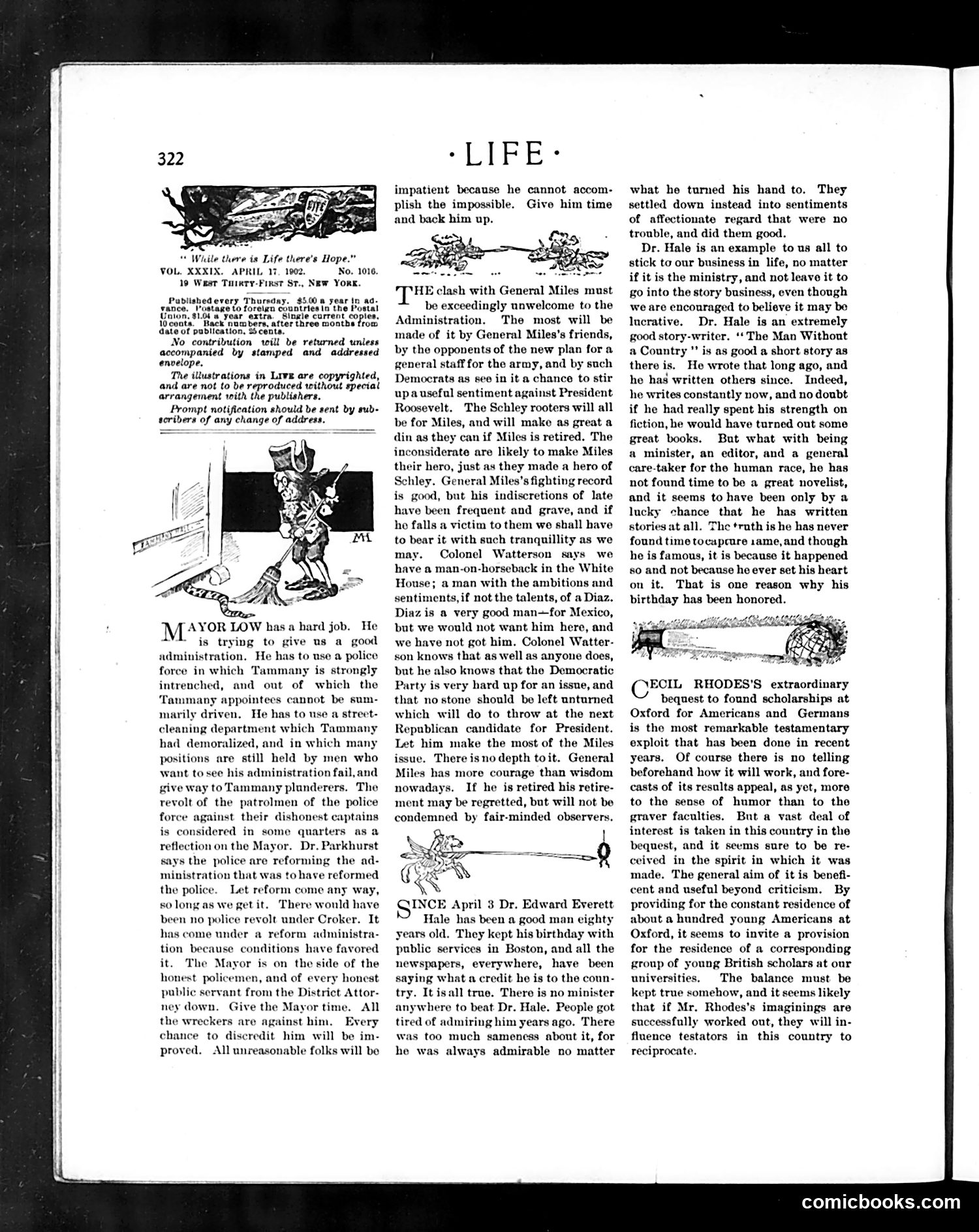
The page contains **political commentary** rather than traditional cartoons. The text discusses **General Nelson Miles** and upcoming military administration conflicts, mentioning opposition from "Schley rooters" and Democratic Party resistance to a Republican presidential candidate. A notable illustration shows a figure in military/official dress, though the specific identity isn't entirely clear from the image alone. The commentary also discusses **Dr. Edward Everett Hale**, praising his longevity and character, and **Cecil Rhodes's scholarship bequest**, endorsing its benefits for Anglo-American relations among young scholars. The overall tone is **editorial and opinion-driven**, typical of Life's satirical approach to American politics and international affairs during the Progressive Era.
📄 Transcribed text from this page (OCR, searchable)
Machine-transcribed from the original scan — historical spelling and the odd misread are preserved.
“While there is Life there's Hope.” XXXIX. APRIL 17, 1902. 19 Waar Turety-Finst S1 vo. Padlished every 7 hursday. $5.00 a year tn ad. stage to foreign countries in the Postal Union, $1.01 a year extra. Single current coples, Ieonts. Back numbers, after three months frow date of publication, Scents. No contribution will be returned unless accompanied by stamped and addressed envelope. The illustrations in Lrve are copyrighted, and are not to be reproduced without special arrangement with the publishers. Prompt notification should b scribers of any change of address. M AYOR LOW has a hard job. He - is trying to give us a good administration. He has to use a police force in which Tammany is strongly intrenched, and out of which the ‘Tammany appointees cannot be sum- marily driven. He has to use a street- cleaning department which Tammany had demoralized, and in which many positions are still held by men who want to see his administration fail, and sive way toTammany plunderers. The revolt of the patrolmen of the police force against their dishonest captains is considered in some quarters as a reflection on the Mayor. Dr. Parkhurst says the police are reforming the ad- ministration that was tohave reformed the police. Let reform come any way, so long as we get it. There would have been no police revolt under Croker. It has come under a reform administra- tion because conditions have favored it. The Mayor is on the side of the honest policemen, and of every honest public servant from the District Attor- ney down. Give the Mayor time. All the wreckers are against him. Every chance to discredit him will be im- proved. All unreasonable folks will be LIFE impatient because he cannot accom- plish the impossible. Give him time and back him up. &5 HE clash with General Miles must be exceedingly unwelcome to the Administration. The most will be made of it by General Miles’s friends, by the opponents of the new plan for a general staff for the army, and by such Democrats as see in it a chance to stir upa useful sentiment against President Roosevelt. The Schley rooters will all be for Miles, and will make as great a din as they can if Miles is retired. The inconsiderate are likely to make Miles their hero, just as they made a hero of Schley. General Miles’s fighting record is good, but his indiscretions of late have been frequent and grave, and if he falls a victim to them we shall have to bear it with such tranquillity as we may. Colonel Watterson says we have a man-on-horseback in the White House; a man with the ambitions and sentiments, if not the talents, of a Diaz. Diaz is a very good man—for Mexico, but we would not want him here, and we have not got him. Colonel Watter- son knows that as well as anyone does, but he also knows that the Democratic Party is very hard up for an issue, and that no stone should be left unturned which will do to throw at the next Republican candidate for President. Let him make the most of the Miles issue. There is no depth toit. General Miles has more courage than wisdom nowadays. If he is retired his retire- ment may be regretted, but will not be condemned by fair-minded observers. INCE April 3 Dr, Edward Everett Hale has been a good man eighty years old. They kept his birthday with public services in Boston, and all the newspapers, everywhere, have been saying what a credit he is to the coun- try. Itisall true. There is no minister anywhere to beat Dr. Hale. People got tired of admiring him years ago. There was too much sameness about it, for he was always admirable no matter what he turned his hand to. They settled down instead into sentiments of affectionate regard that were no trouble, and did them good. Dr. Hale is an example to us all to stick to our business in life, no matter if it is the ministry, and not leave it to go into the story business, even though we are encouraged to believe it may be lucrative. Dr. Hale is an extremely good story-writer. ‘The Man Without a Country "" is as good a short story as there is. He wrote that long ago, and he has written others since. Indeed, he writes constantly now, and no doubt if he had really spent his strength on fiction, he would have turned out some great books. But what with being a minister, an editor, and a general care-taker for tho human race, he has not found time to be a great novelist, and it seems to have been only by a lucky chance that he has written stories at all. The truth is he has never found time tocupcure 1ame, and though he is famous, it is because it happened so and not because he ever set his heart on it, That is one reason why his birthday has been honored. Aaah LES @tom: RHODES'S extraordinary bequest to found scholarships at Oxford for Americans and Germans is the most remarkable testamentary exploit that has been done in recent years. Of course there is no telling beforehand how it will work, and fore- casts of its results appeal, as yet, more to the sense of humor than to the graver faculties. But a vast deal of interest is taken in this country in the bequest, and it seems sure to be re- ceived in the spirit in which it was made. The general aim of it is benefi- cent and useful beyond criticism. By providing for the constant residence of about a hundred young Americans at Oxford, it seems to invite a provision for the residence of a corresponding group of young British scholars at our universities The balance must be kept true somehow, and it seems likely that if Mr. Rhodes's imaginings are successfully worked out, they will in- fluence testators in this country to reciprocate. comicbooks.com