
A complete issue · 36 pages · 1902
Life — March 27, 1902
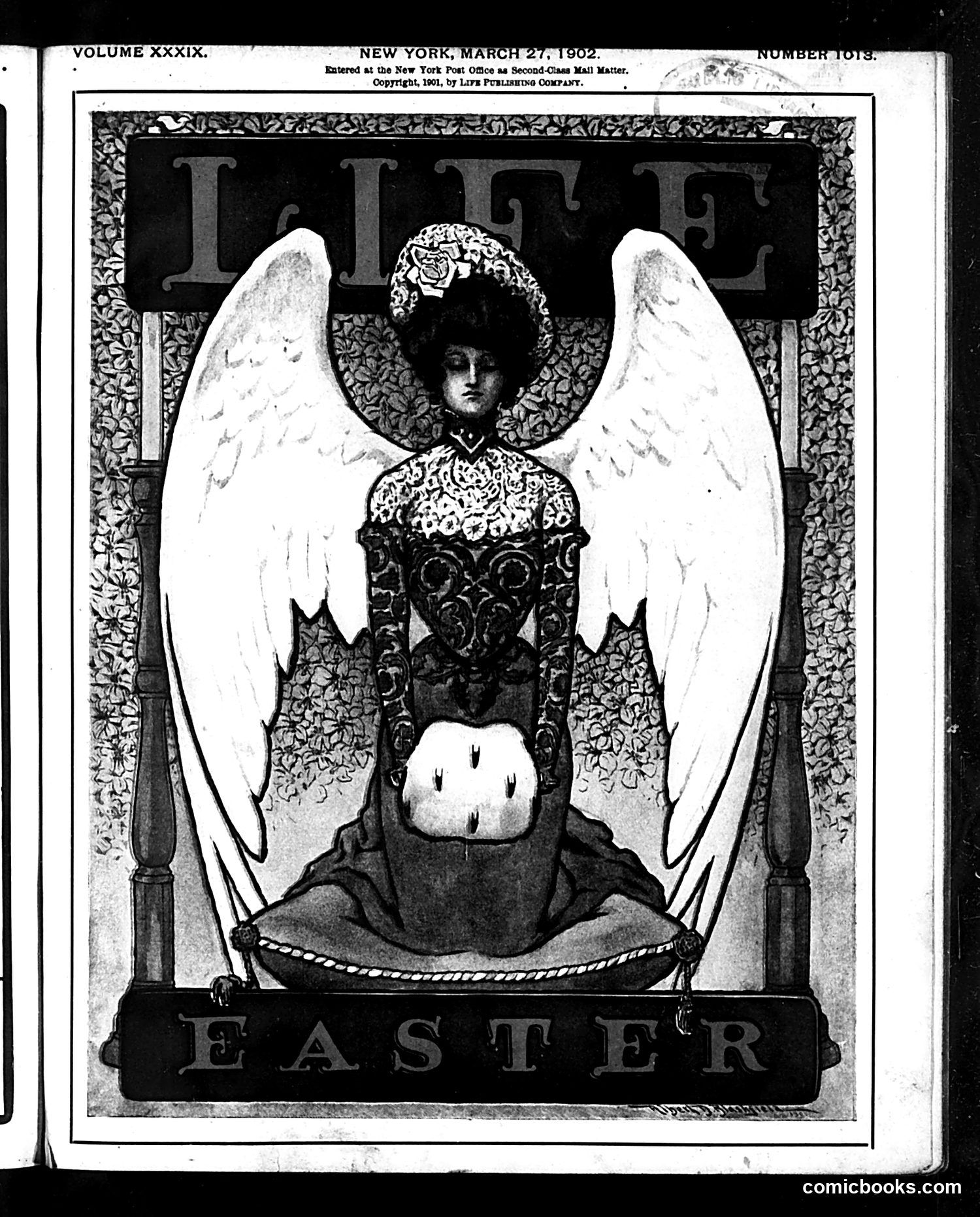
This is an Easter-themed cover illustration featuring a winged angelic figure in elaborate, ornate clothing seated in a chair. The figure has a halo and wears an intricately patterned dress or robe, positioned against a decorative damask background. The image appears to be a straightforward Easter artistic composition rather than political satire—using traditional religious symbolism (angel, halo, ethereal white wings) to celebrate the holiday. The ornate Victorian aesthetic and decorative framing were typical of Life's artistic covers from this era. Without accompanying text or caption on this page, the specific subject or satirical intent remains unclear. It may reference contemporary Easter fashions or simply serve as seasonal cover art.
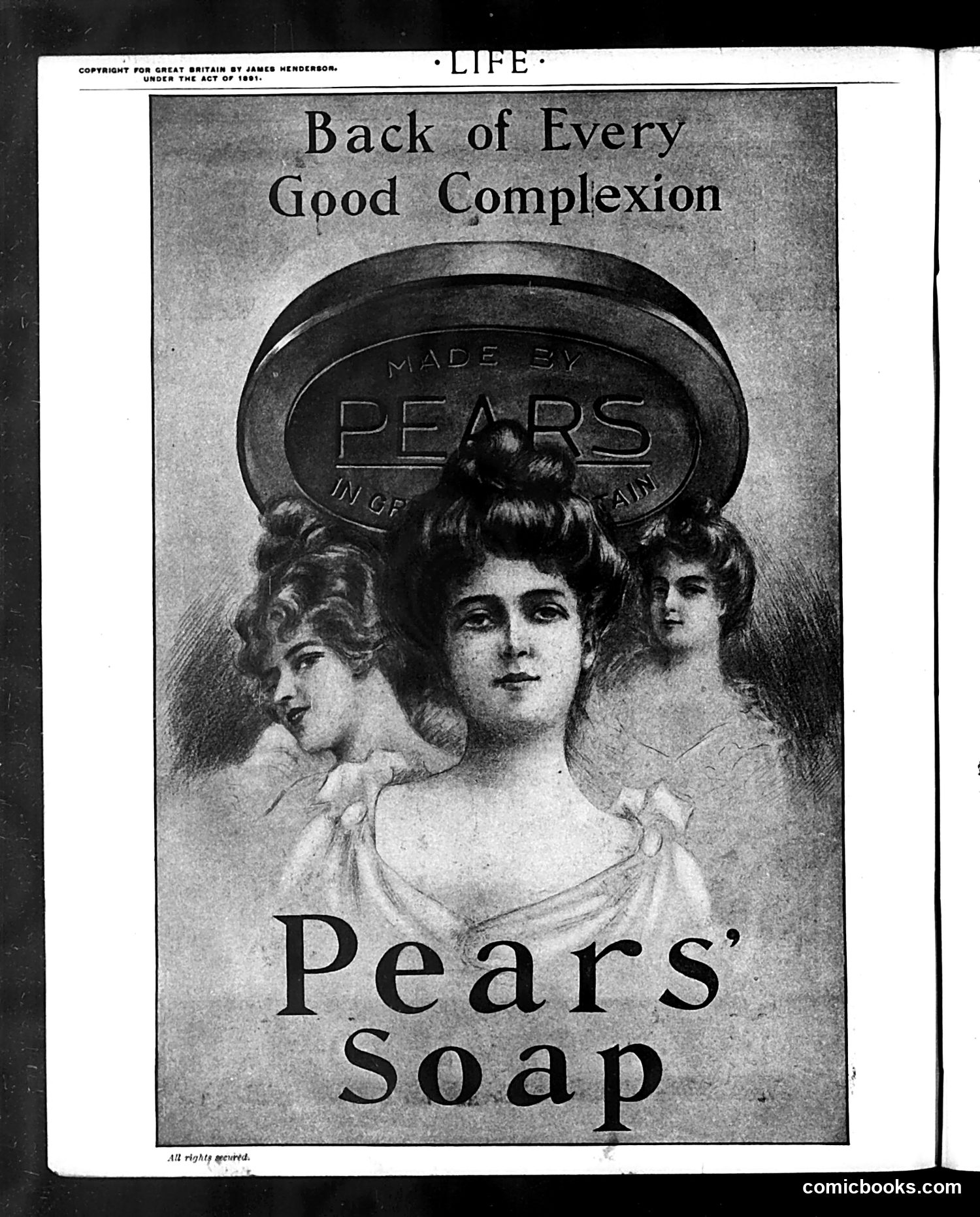
This page is **primarily an advertisement**, not satire or political commentary. It's a Pears' Soap ad from Life magazine, copyrighted by James Henderson under the 1881 Act. The advertisement uses the slogan "Back of Every Good Complexion" paired with an illustration of three elegant women with fashionable Edwardian-era hairstyles. The imagery appeals to beauty standards of the period—fair skin and refined appearance were marks of social status. The ad employs a common Victorian/Edwardian marketing strategy: associating a commercial product with beauty, femininity, and social respectability. There's no political satire here—this is straightforward cosmetic advertising leveraging period aesthetics to sell soap to aspirational consumers.
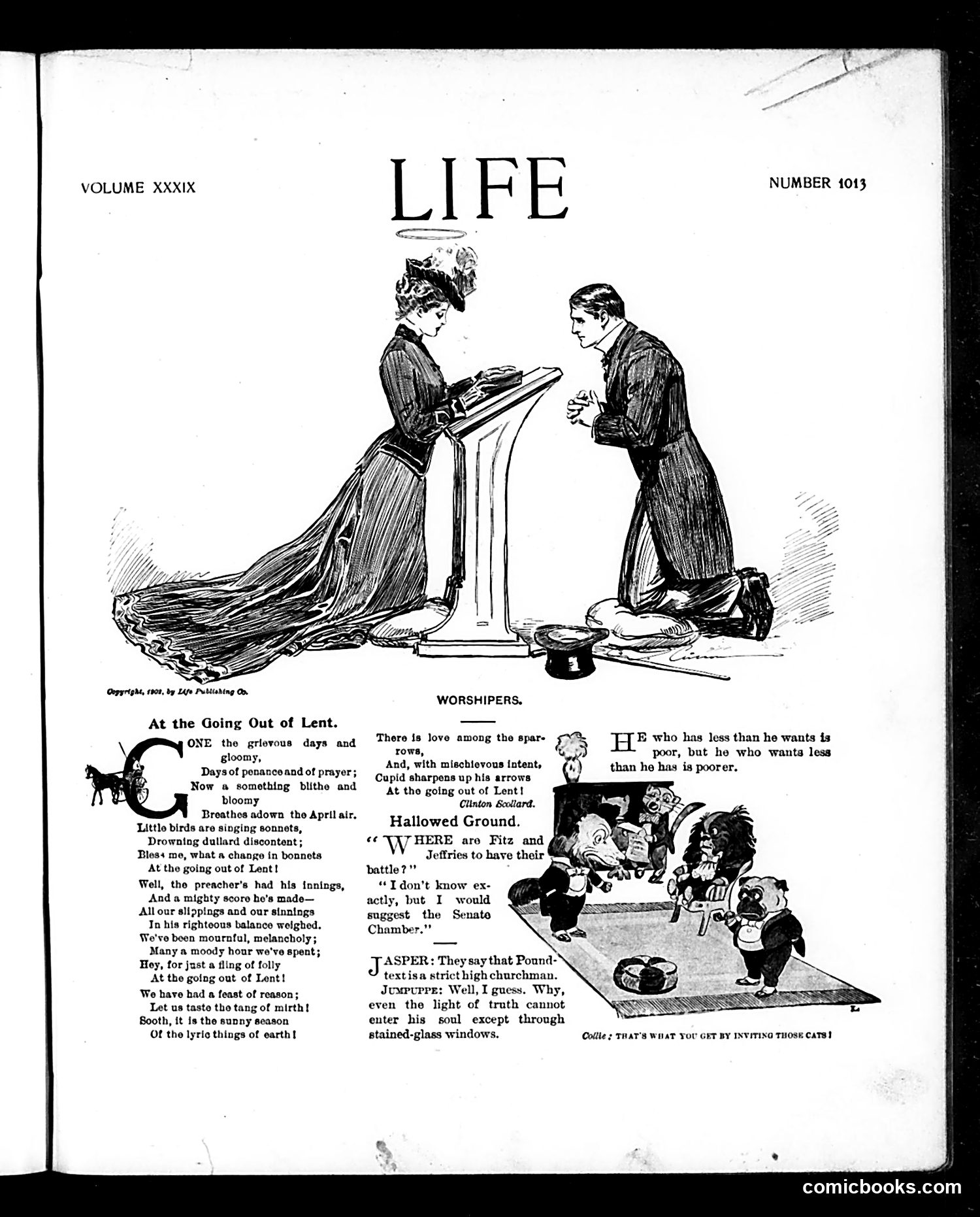
**Top Cartoon - "Worshippers":** A man kneels before a woman at what appears to be a shrine or altar. The satire mocks romantic devotion—the man is literally worshipping his female companion, treating courtship or marriage like religious practice. The caption's wordplay on "worship" suggests the page is satirizing how men idealize women. **"At the Going Out of Lent" Poem:** References the Christian calendar; likely satirizes spring behavior and romantic prospects returning after Lenten restraint. **"Hallowed Ground" Comic:** Features characters (likely Fitz and Jeffries, mentioned in dialogue) discussing church architecture. The joke appears to mock pretentious discussion about churches, with a punchline about stained glass being the only way truth enters souls—cynically suggesting churches themselves fail at spiritual enlightenment.
This page contains political commentary rather than a cartoon. The text critiques Lord Methuen's military leadership during the Boer War in South Africa, suggesting his fighting record doesn't qualify him for peacetime administrative roles. A separate section mocks British manufacturers' complaints about competition, using the phrase "ca'canny" (a labor slowdown tactic). The author argues that British workers' output limitations—not American competition—cause manufacturing difficulties. The final paragraph references Secretary Shaw's efforts to mitigate tariff disputes affecting travelers at ports, praising his diplomatic work. The small illustration shows a Frost brand product advertisement (likely alcohol or medicinal), unrelated to the political content.
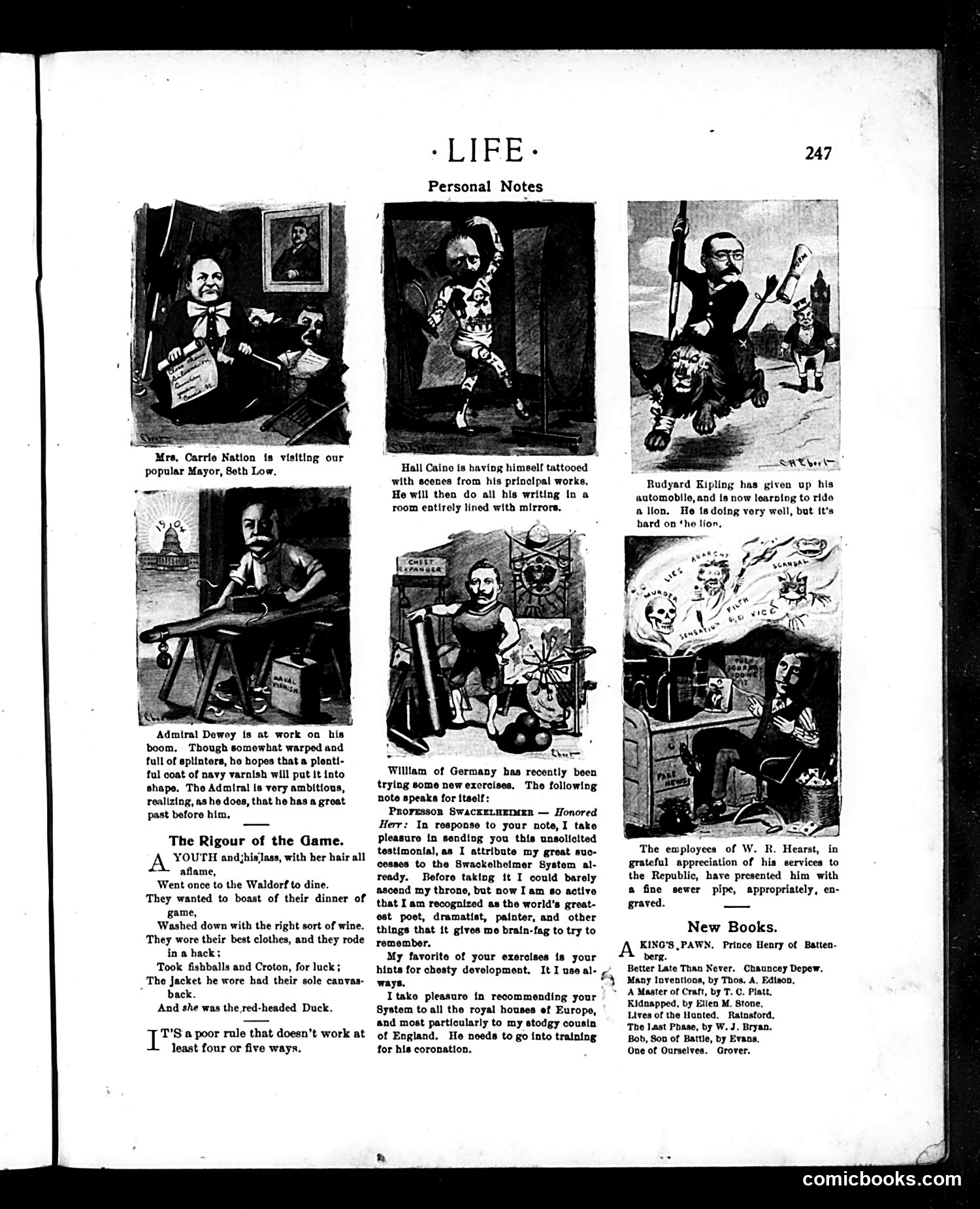
This page contains **satirical caricatures of contemporary literary and public figures**, presented as "Personal Notes." The captions identify: - **Mrs. Carrie Nation** visiting a prohibitionist publisher - **Hall Caine** having himself tattooed with scenes from his works - **Rudyard Kipling** giving up his motorcycle for lion-riding - **Admiral Dewey** working on his memoirs - **William of Germany** (Kaiser Wilhelm II) trying new exercises The humor relies on exaggeration of these figures' known characteristics or recent activities. For instance, Carrie Nation was famous for temperance activism; Kipling was a celebrated author; Admiral Dewey was a Spanish-American War hero. The page also includes "The Rigour of the Game," a humorous poem about dining etiquette, and a "New Books" section listing contemporary publications—typical Life magazine content mixing satire with literary coverage.
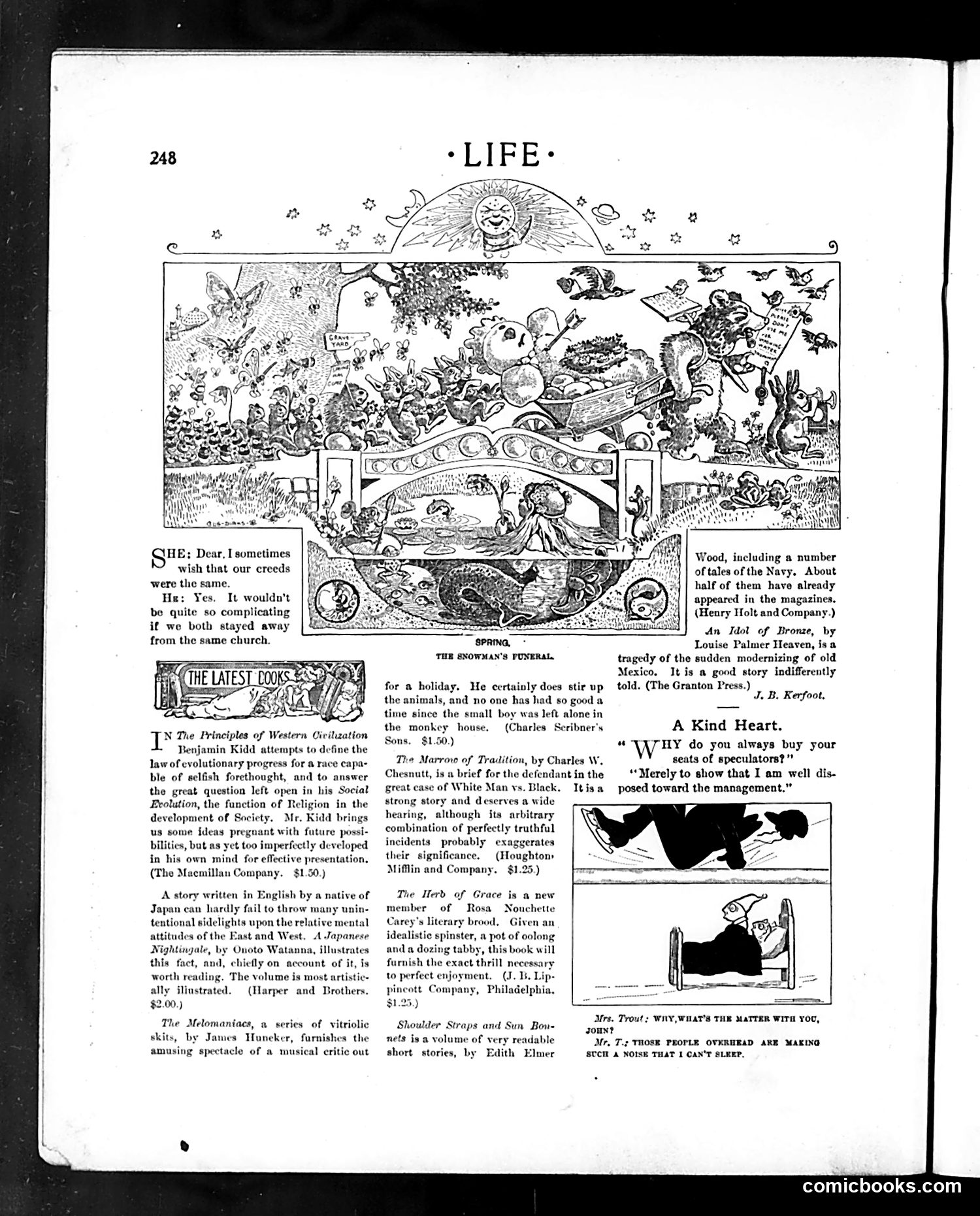
The main cartoon depicts "Spring" and "The Snowman's Funeral"—a satirical illustration showing winter's end. The detailed etching shows various figures and creatures celebrating around what appears to be a melting snowman, with spring activities (fishing, flying) depicted above and below a bridge structure. The page primarily contains **book reviews** rather than political satire. Reviews discuss titles like *The Principles of Western Civilization* and *The Mismomaniac*, alongside lighter fare. One small cartoon titled "A Kind Heart" shows a domestic scene with the caption about seat speculators, appearing to mock social pretension. The overall page focuses on literary criticism and entertainment rather than political commentary, typical of Life's satirical but culturally-focused content from this era.
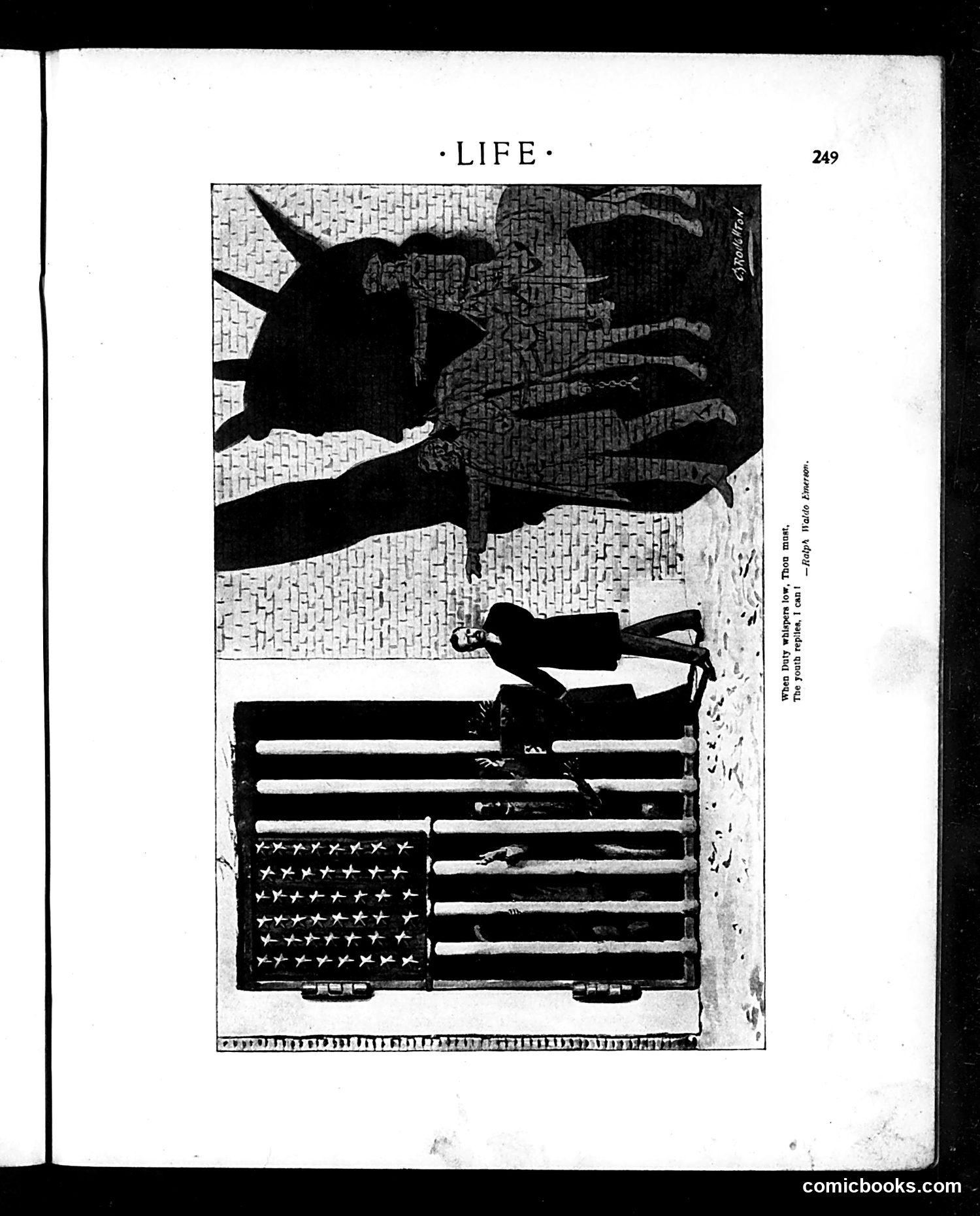
This page from *Life* magazine (page 249) contains a political cartoon showing a silhouetted figure at a typewriter with an American flag visible on the machine. Above the figure looms a large horned devil or demon head in shadow. The cartoon appears to satirize **wartime propaganda or censorship**, likely from the World War II era. The devil figure likely represents **fascism or an enemy power**, while the typewriter suggests the press or propaganda machine. The juxtaposition implies criticism of either American propaganda efforts or concerns that dark forces influence American media and communications. The exact historical moment and specific targets remain unclear from the visible text alone, but the imagery suggests anxiety about how power manipulates public information during wartime.
This page features a satirical story titled "An Earth Marriage" by Charlotte Becker, accompanied by a small illustration showing what appears to be a Boston street scene. The narrative mocks contemporary discussions about marriage and social philosophy. It satirizes the "New Thought Club" and intellectual debates about ideal unions, presenting three conceptual "marriages": between Intellect and Will, between Masculine and Feminine principles, and between Individual and Society. The satire targets early 20th-century progressive idealism—specifically philosophical movements emphasizing spiritual and intellectual harmony. The story pokes fun at pseudointellectual discourse, suggesting these abstract marital concepts are pretentious and disconnected from reality. A young woman named Miss Bergen represents the skeptical modern reader, ultimately questioning whether such idealized unions have practical value, particularly for "the higher Marriage with the State."
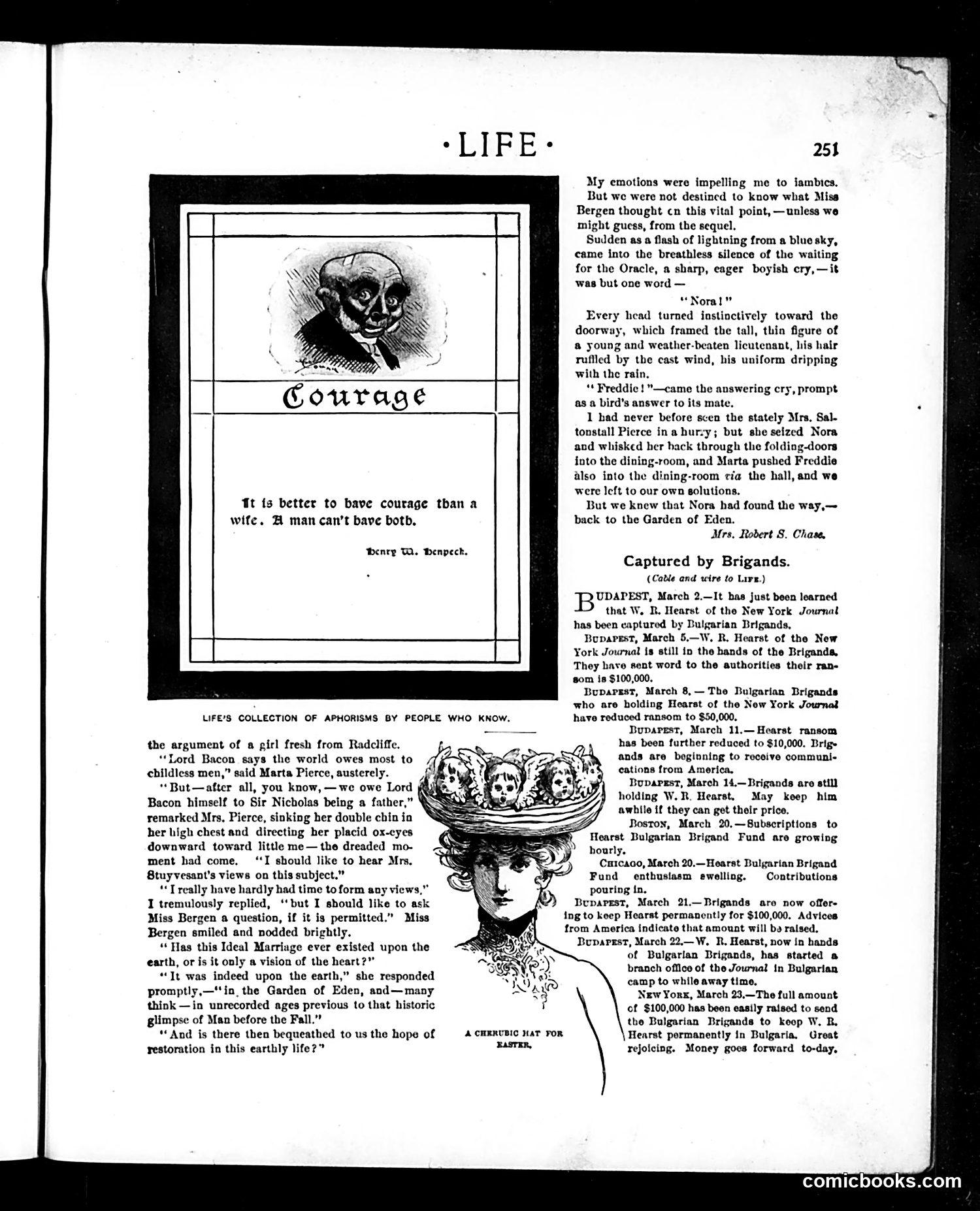
This page features an aphorism section titled "Courage" with a Henry W. Enesch quote: "It is better to have courage than a wife. A man can't have both." The accompanying sketch shows a stern-faced person, likely representing a nagging or demanding spouse. Below is a narrative section titled "Captured by Brigands" describing the kidnapping of W. B. Hearst of the New York *Journal* by Bulgarian brigands, with ransom demands of $100,000 later reduced to $10,000. The text documents ransom negotiations and fund-raising efforts across Budapest and America. A decorative illustration shows an elegant woman in an elaborate hat, labeled "A Changing Hat for Easter." The content satirizes both marriage and contemporary newspaper drama involving actual ransom negotiations.
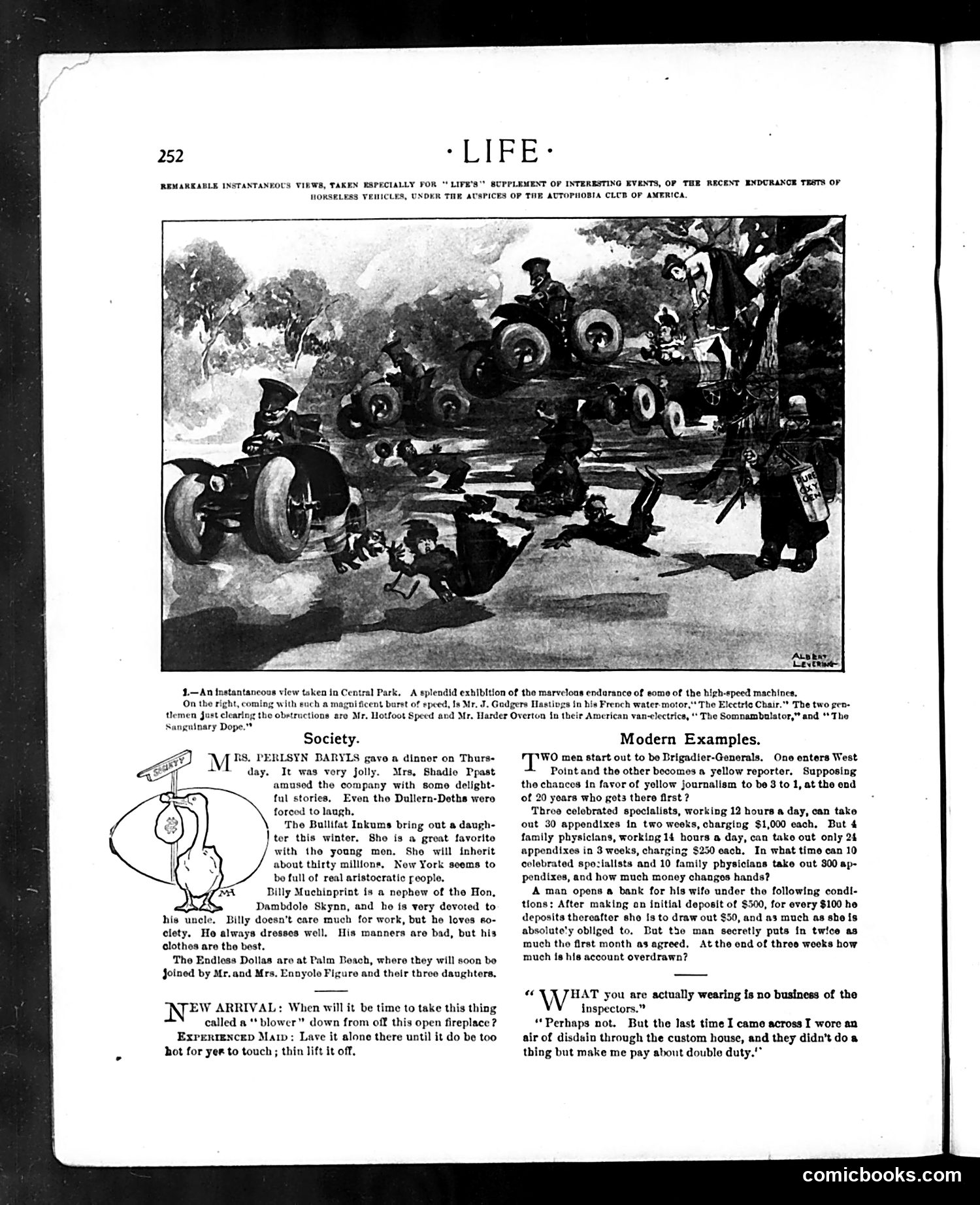
This page celebrates the novelty and spectacle of early horseless vehicles through a large photograph captioned as "An instantaneous view taken in Central Park" showing multiple automobiles and spectators gathered around them—suggesting these were still remarkable enough to draw crowds. The accompanying text pieces mock both the vehicles and their operators. "Society" section satirizes wealthy socialites like Mrs. Perlsyn Baryls adopting motorcar culture as fashionable. "Modern Examples" humorously depicts financial schemes and questionable business practices supposedly typical of automobile owners and operators. The smaller "New Arrival" joke mocks the sound of early engines. Overall, the page satirizes the automobile as a status symbol and the dubious characters it attracts in this emerging technological era.
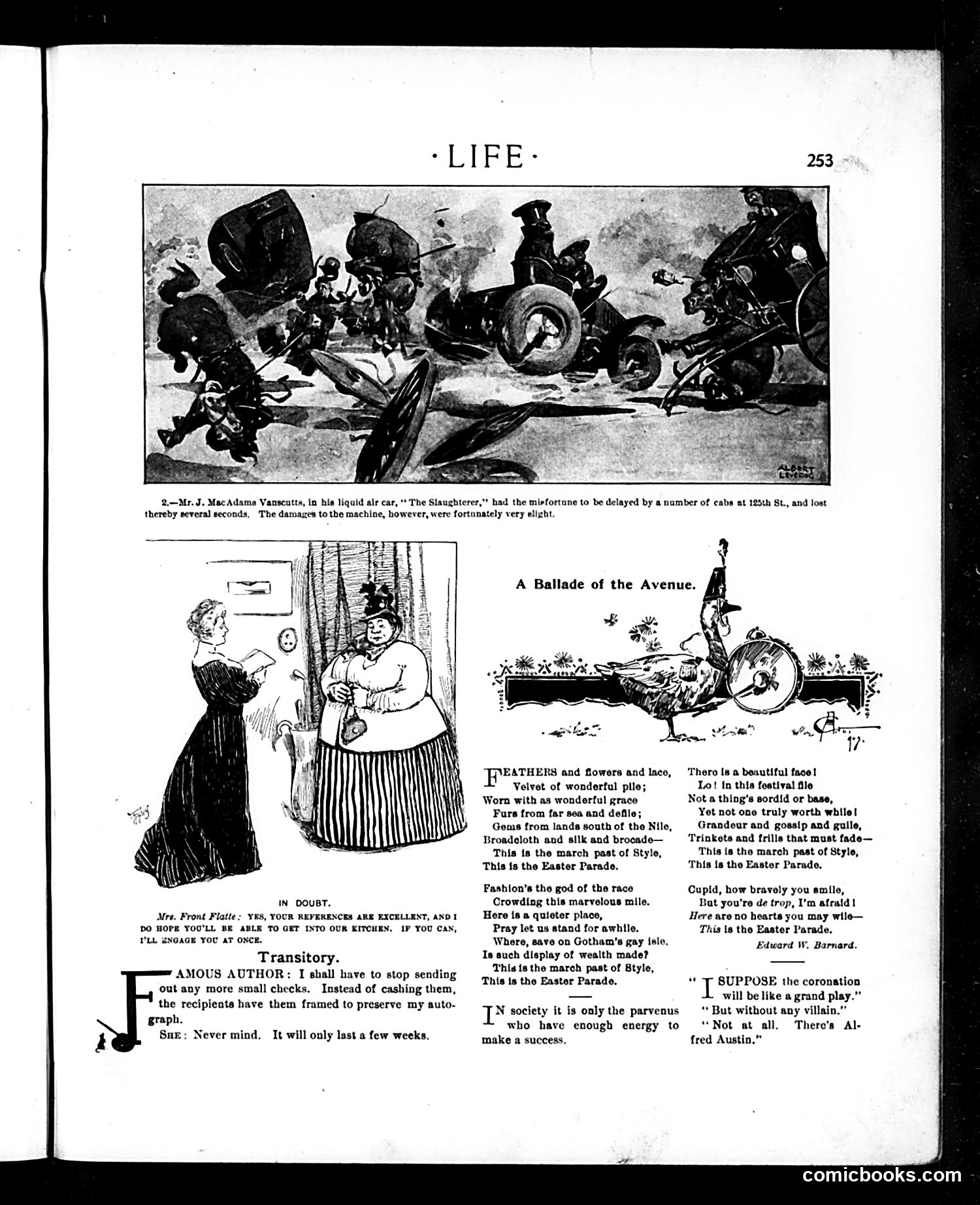
This Life magazine page contains three distinct pieces of humor: 1. **Top image**: Shows Mr. J. MacAdams Vanaetta's liquid airplane "The Slaughterer" damaged in a crash at 165th Street, with cabs involved. This appears to be early aviation-era satire about experimental aircraft and urban accidents. 2. **"In Doubt"**: A domestic comedy sketch where a woman asks her houseguest about getting into the kitchen. The guest declines, making it a brief joke about social awkwardness. 3. **"A Ballad of the Avenue"**: A poem celebrating Easter fashions on city streets—feathers, lace, silk—satirizing the extravagant display of wealth and materialism during the holiday parade. The verse mocks high society's ostentatious consumption. 4. **"Transitory"**: A brief joke about preserving cancelled checks rather than cashing them. The page reflects early 20th-century urban American culture and class commentary.
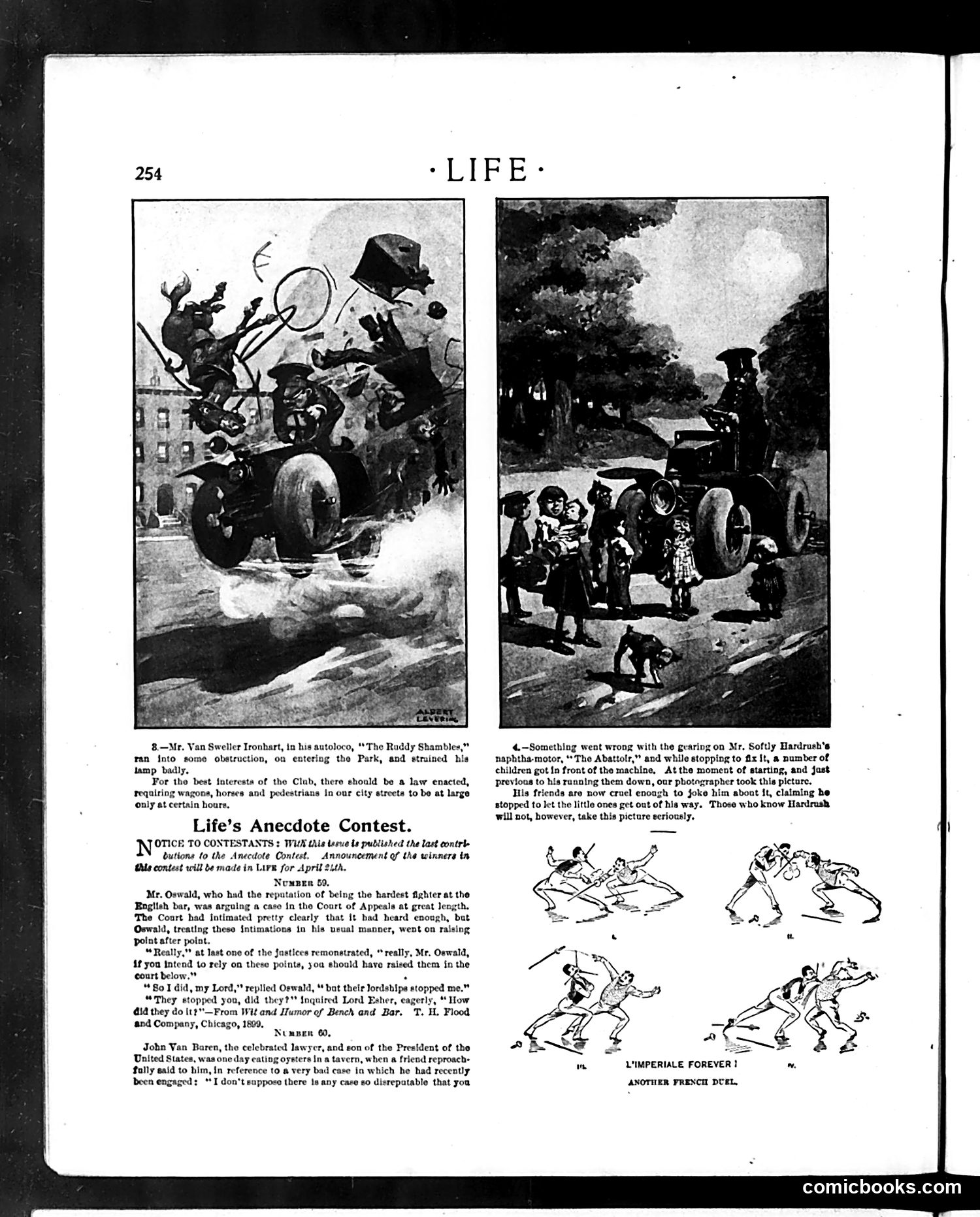
This page features two humorous photographs labeled as contest entries, plus comedic illustrations of a fencing duel. **Top left:** Shows Van Sweller Ironhurt's automobile mishap in a city park—apparently a comedic staging showing an auto accident with exaggerated chaos. **Top right:** Depicts children gathered around Mr. Sofily Hardcash's broken "naptha-motor" automobile, "The Abattoir," with the caption suggesting mechanical failure and children's amusement at his misfortune. **Bottom section:** Contains anecdotes about legal/social embarrassments—one involving an English barrister's court case, another about John Van Buren (son of a U.S. President) in a tavern argument. **Lower illustrations:** Show a fencing duel sequence titled "L'IMPÉRIALE FOREVER! ANOTHER FRENCH DUEL," satirizing French dueling culture with sequential action drawings. The page is essentially a humor/comedy compilation typical of Life's satirical format.
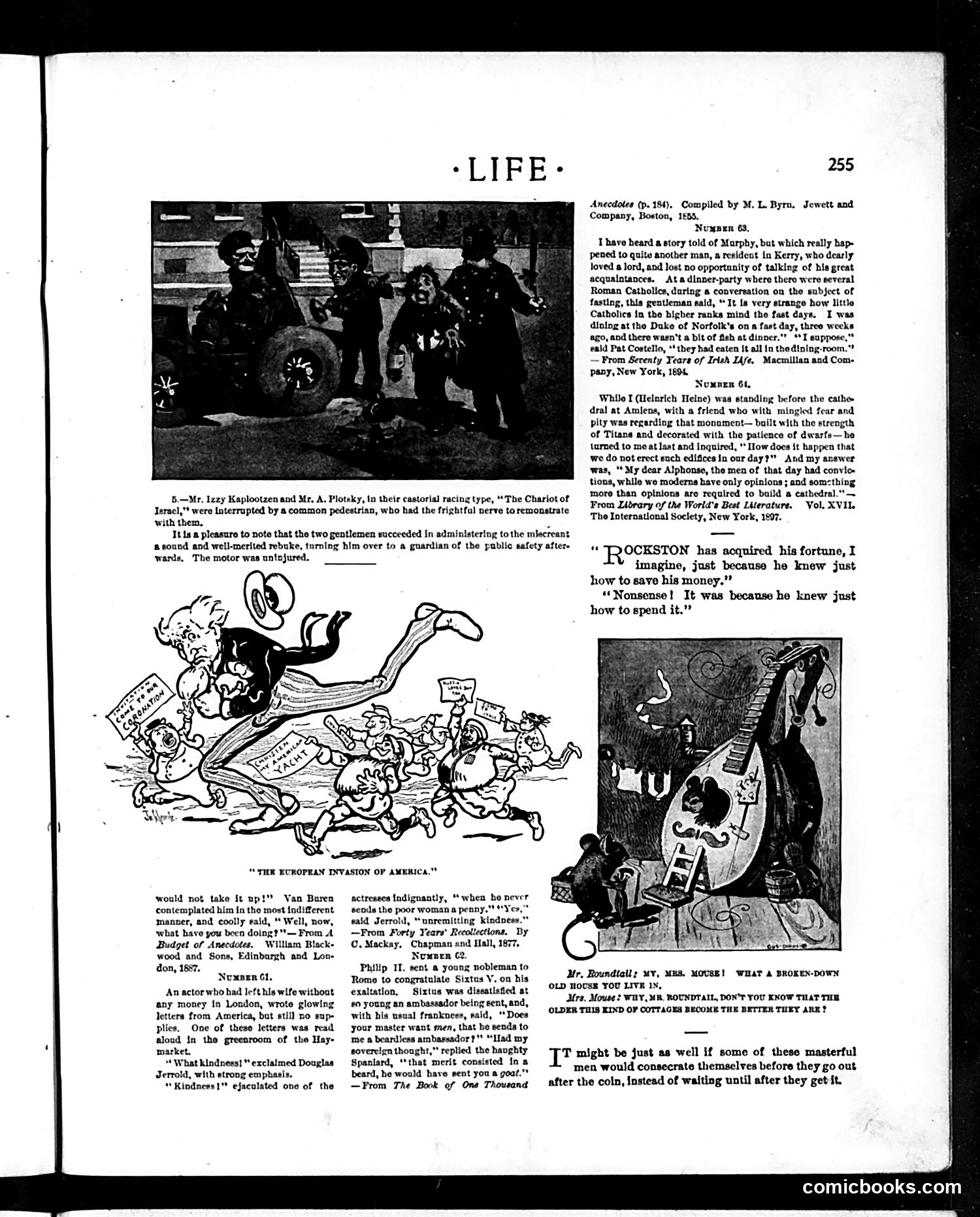
**The Political Cartoon ("The European Invasion of America"):** This satirical cartoon depicts wealthy Jewish immigrants or businessmen in a fancy automobile running over or confronting a common pedestrian. The caption indicates the two men (Kaplootzen and Ploteky, clearly Jewish names) harassed the pedestrian and faced no consequences—the "motor was uninjured." This reflects anti-immigrant and antisemitic sentiment common in early 20th-century American media, portraying Jewish newcomers as arrogant, lawless, and privileged despite their outsider status. **The Anecdotes Section:** The page also contains humorous historical stories about diplomatic exchanges, mistaken identity, and witty comebacks—standard satirical fare. These include a Spanish nobleman's retort about beards, a Catholic's excuse about fish at dinner, and commentary on modern society lacking conviction. The overall page reflects *Life*'s satirical approach to social observation, mixing ethnic caricature with genteel humor typical of the era.
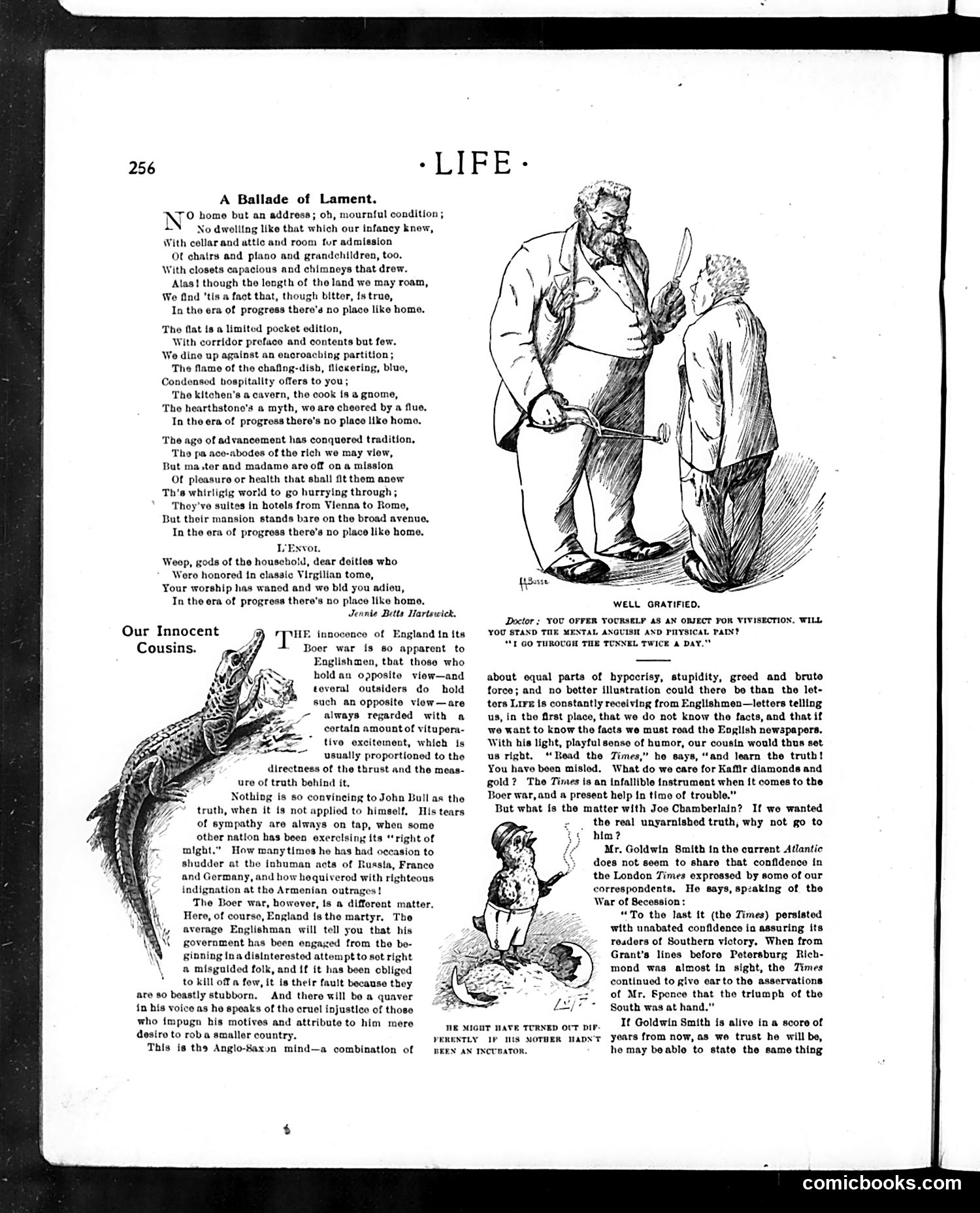
This page contains two distinct pieces of satire: **"A Ballade of Lament"** (poem with illustration): Nostalgic critique of modern urban apartment living versus spacious Victorian homes. The illustration shows a well-dressed man examining cramped quarters—satirizing "progress" that trades comfort for compact city flats with minimal amenities. **"Our Innocent Cousins"** (essay with cartoon): Sharp criticism of English hypocrisy regarding the Boer War. The author argues that England—which self-righteously judges other nations' brutality—conveniently ignores its own imperial violence in South Africa. The piece mocks the "Anglo-Saxon mind" as combining "hypocrisy, stupidity, greed and brute force," and ridicules English readers who insist their newspapers (particularly the *Times*) are infallible sources on the war's righteousness. The small cartoon shows a doctor/vivisectionist, sarcastically referencing how English readers should endure mental anguish hearing war criticism, just as the doctor's patient endures physical pain. The satire targets English self-deception about colonial warfare.
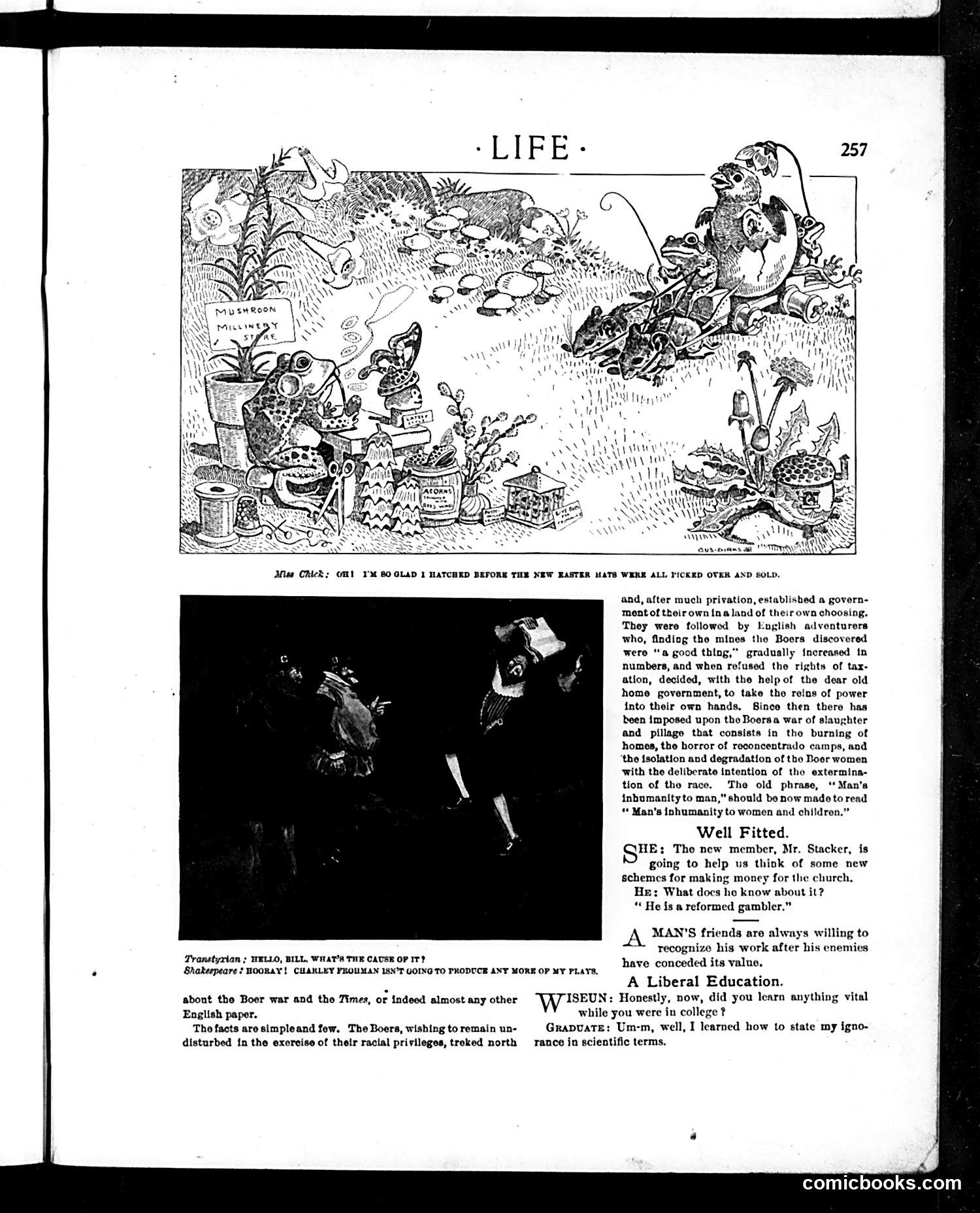
The top cartoon depicts anthropomorphized creatures (frogs or toads) celebrating Easter bonnets—a satirical comment on frivolous consumer fashion obsession among women. The middle photograph shows what appears to be a theatrical or social scene, accompanying a joke about "reformed gamblers" helping churches raise money—mocking both religious hypocrisy and the dubious credentials of converts. The lengthy text block discusses the **Boer War** (fought between British forces and Dutch settlers in South Africa, 1899-1902). Life presents a sympathetic view of the Boers' struggle against British colonialism, criticizing British tactics including concentration camps and attacks on Boer women and children. This reflects American anti-imperialist sentiment of the era. The lower jokes mock college education as superficial and a playwright's relief at his work being rejected. The overall page critiques wealth-driven society, false morality, and British imperialism—typical Progressive-era satire.
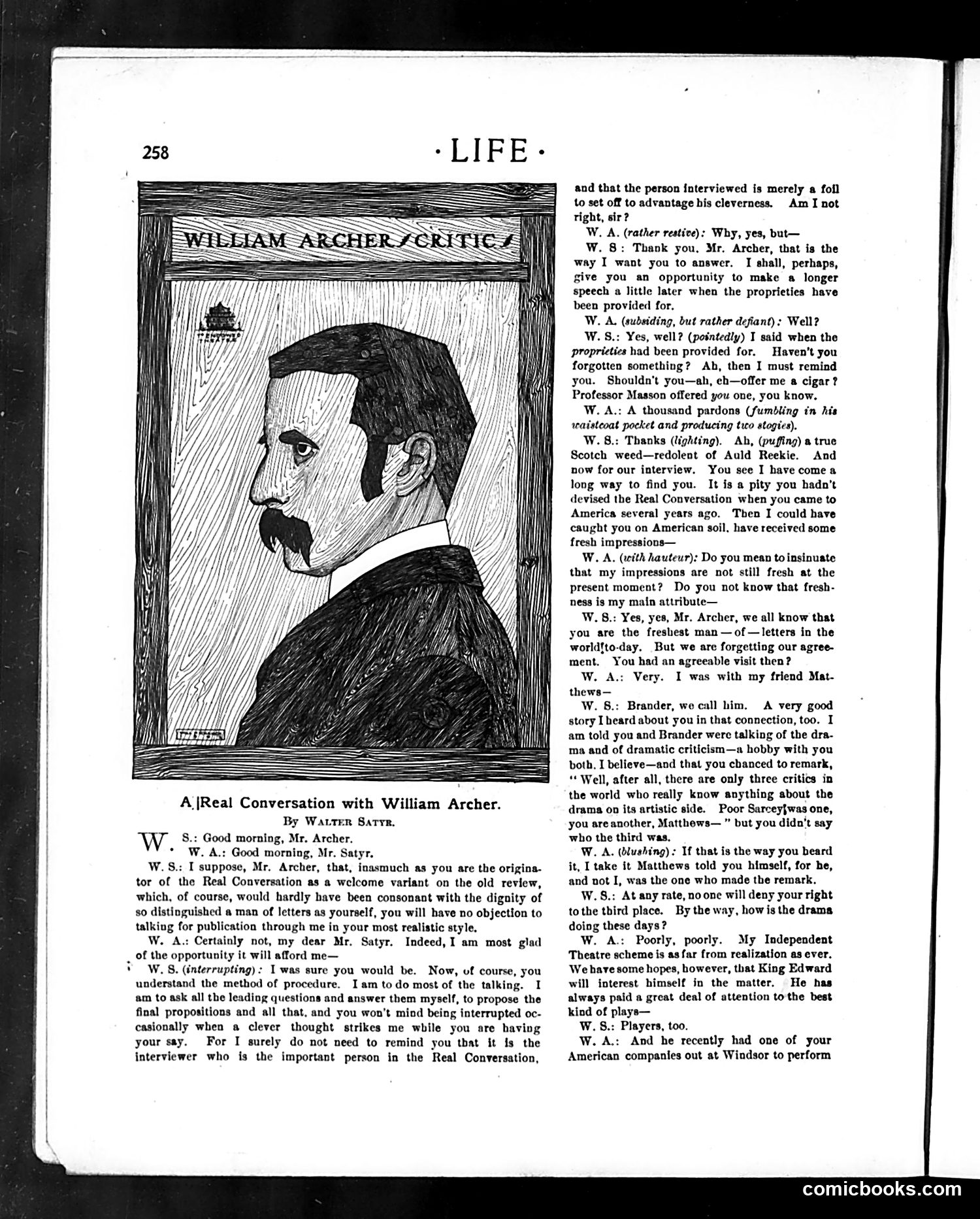
This is a satirical "interview" between Walter Saterye (a critic) and William Archer, a real Scottish dramatic critic and theater reformer. The satire mocks the pretentiousness of the "Real Conversation" format itself—a trendy interview style of the era. The joke: Saterye repeatedly interrupts and dominates, claiming the interviewer is the important person while the subject is merely a "foil." He demands cigars, corrects Archer's recollections, and steers the conversation. The satire exposes how self-important interviewers could be while supposedly documenting someone else's thoughts. References include Archer's failed "Independent Theatre" scheme (a real artistic venture) and mentions of dramatist Brander Matthews and critic Francisque Sarcey. The humor lies in Archer's growing frustration as he's systematically prevented from actually speaking—a clever critique of the interview format's inherent absurdity.
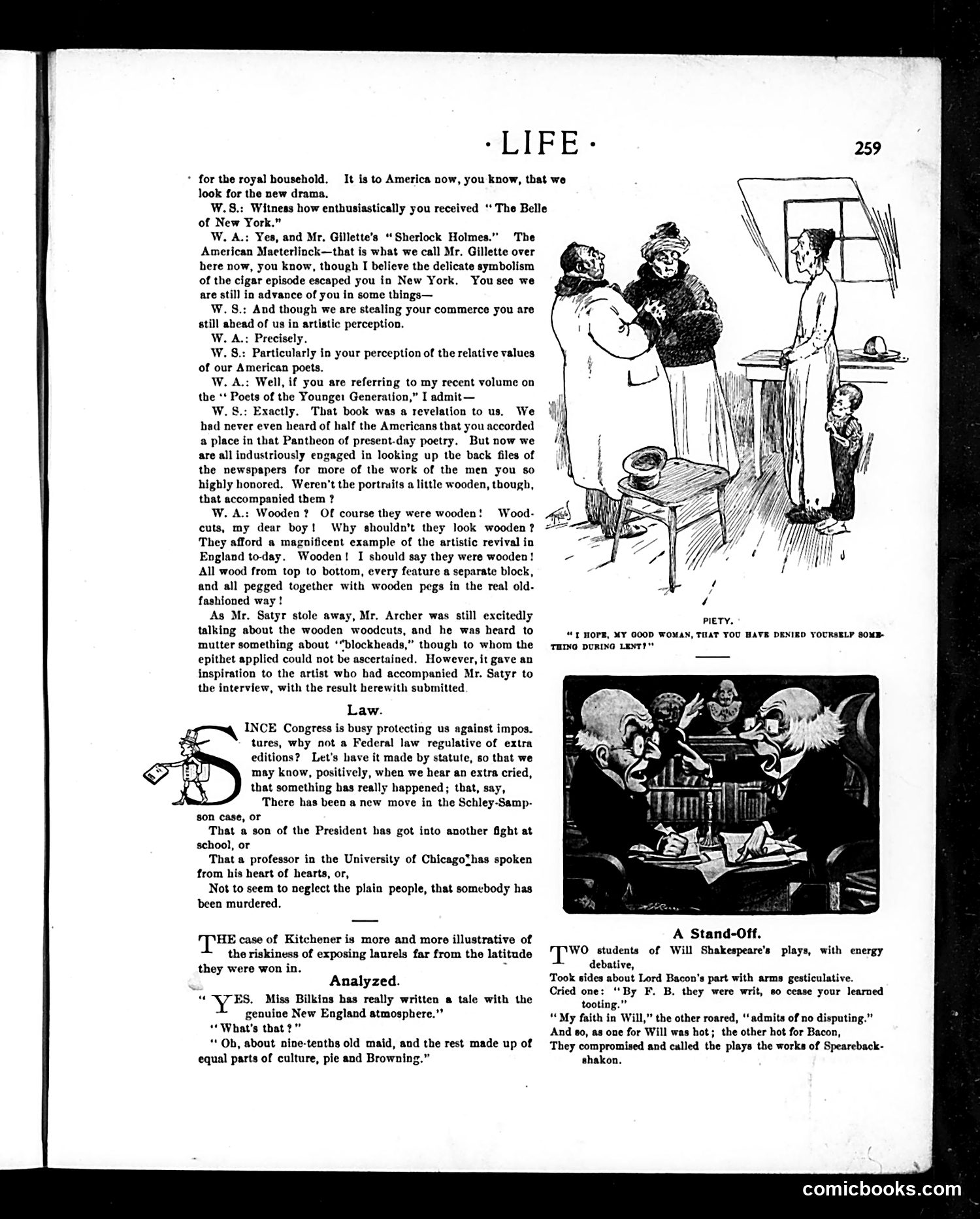
This page contains multiple satirical pieces mocking Anglo-American cultural pretensions and American naiveté. **Main dialogue**: A British critic (W.A., likely Oscar Wilde based on context) condescendingly praises American dramatic works while simultaneously insulting American taste. When questioned about wooden portrait woodcuts accompanying his book on American poets, he defensively claims woodcuts are an "artistic revival," though the satire suggests he's covering up poor craftsmanship. The accompanying cartoon depicts him as a pompous "Satyr"—a creature known for foolishness. **"Law" section**: Satirizes American newspaper sensationalism, proposing federal regulation so readers know when "extra" editions report genuine news versus fabricated stories. **"A Stand-Off"**: Mocks the Bacon-versus-Shakespeare authorship controversy by depicting two students arguing so fiercely that they compromise by attributing plays to "Spearbackshakton"—a ridiculous hybrid name, suggesting the entire debate is absurd. The overall tone attacks artistic pretension, yellow journalism, and American cultural insecurity toward Britain.
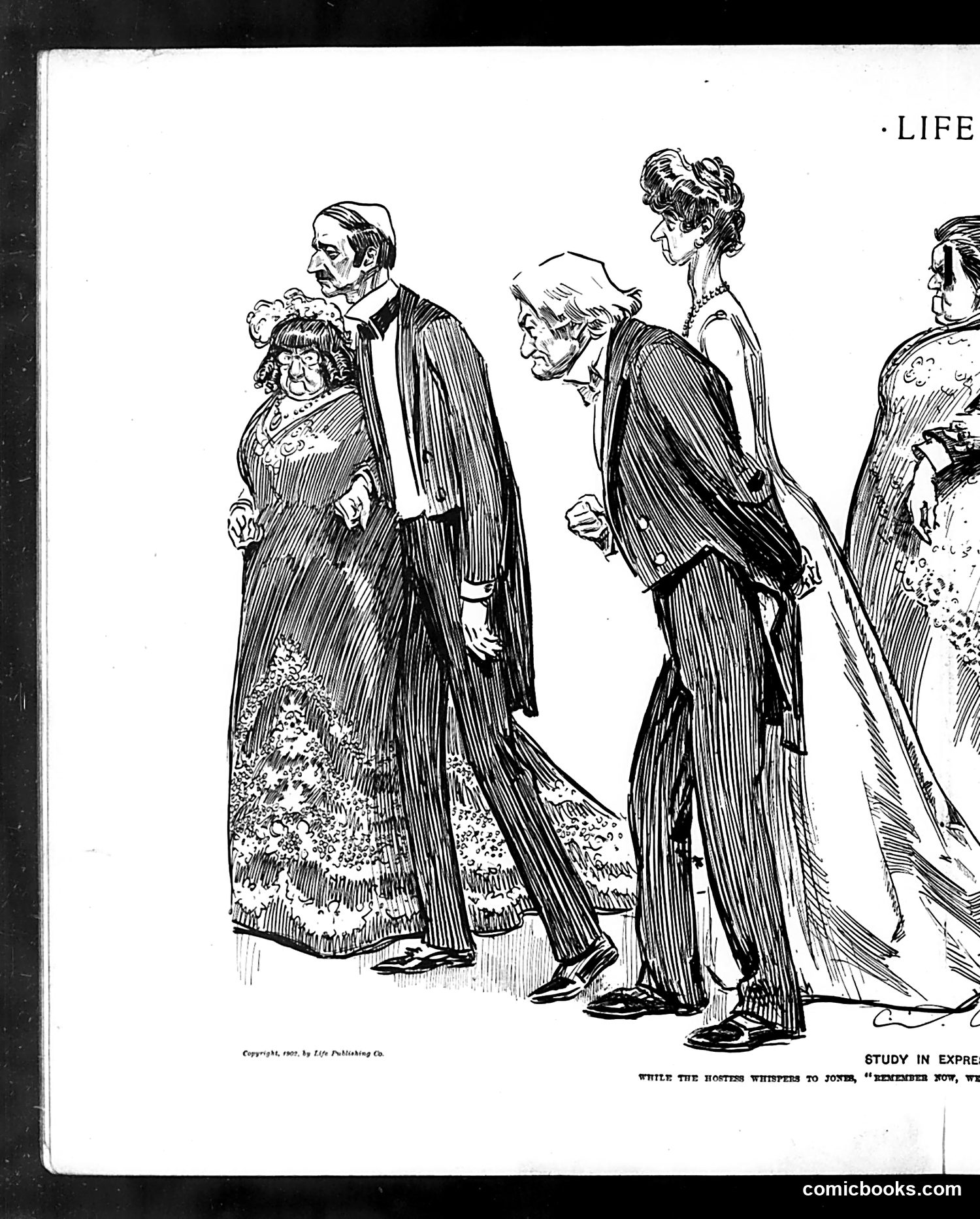
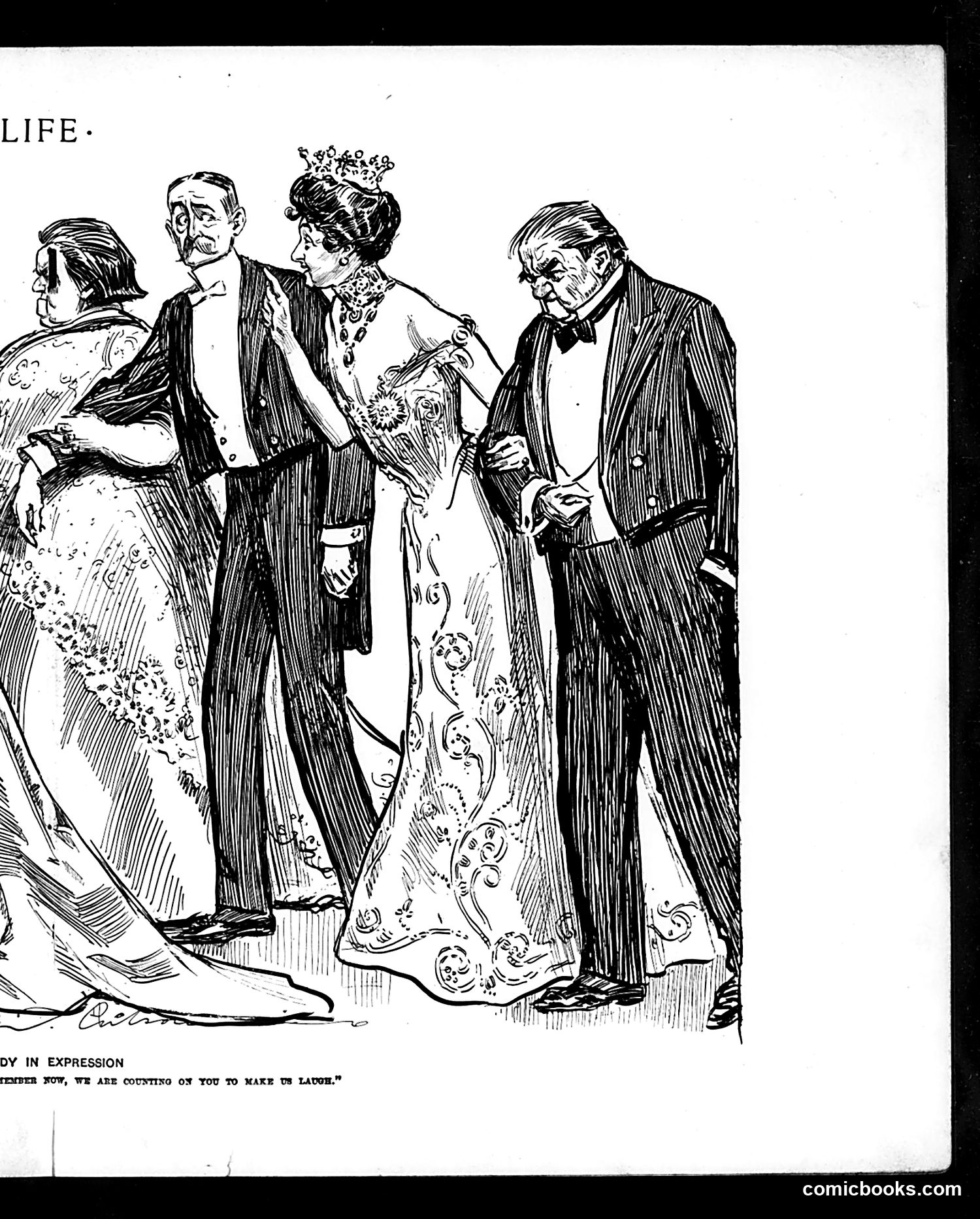
The OCR text is too corrupted to read clearly. However, the image shows a social scene with five figures in formal Edwardian-era dress. A couple on the left (a man and woman in evening wear) appear to be the focal point, while other figures observe them. The caption beneath references "STUDY IN EXPRES[SION]" and mentions a hostess whispering to "JOHN" about someone to "REMEMBER NOW, W[...]" (text cut off). This appears to be a satirical commentary on social etiquette or gossip at a high-society gathering—likely poking fun at how the wealthy discuss guests' backgrounds or reputations. The "study in expression" suggests the cartoon focuses on the revealing facial expressions of those gossiping versus those being discussed. Without legible caption text, I cannot identify the specific figures or social reference intended.
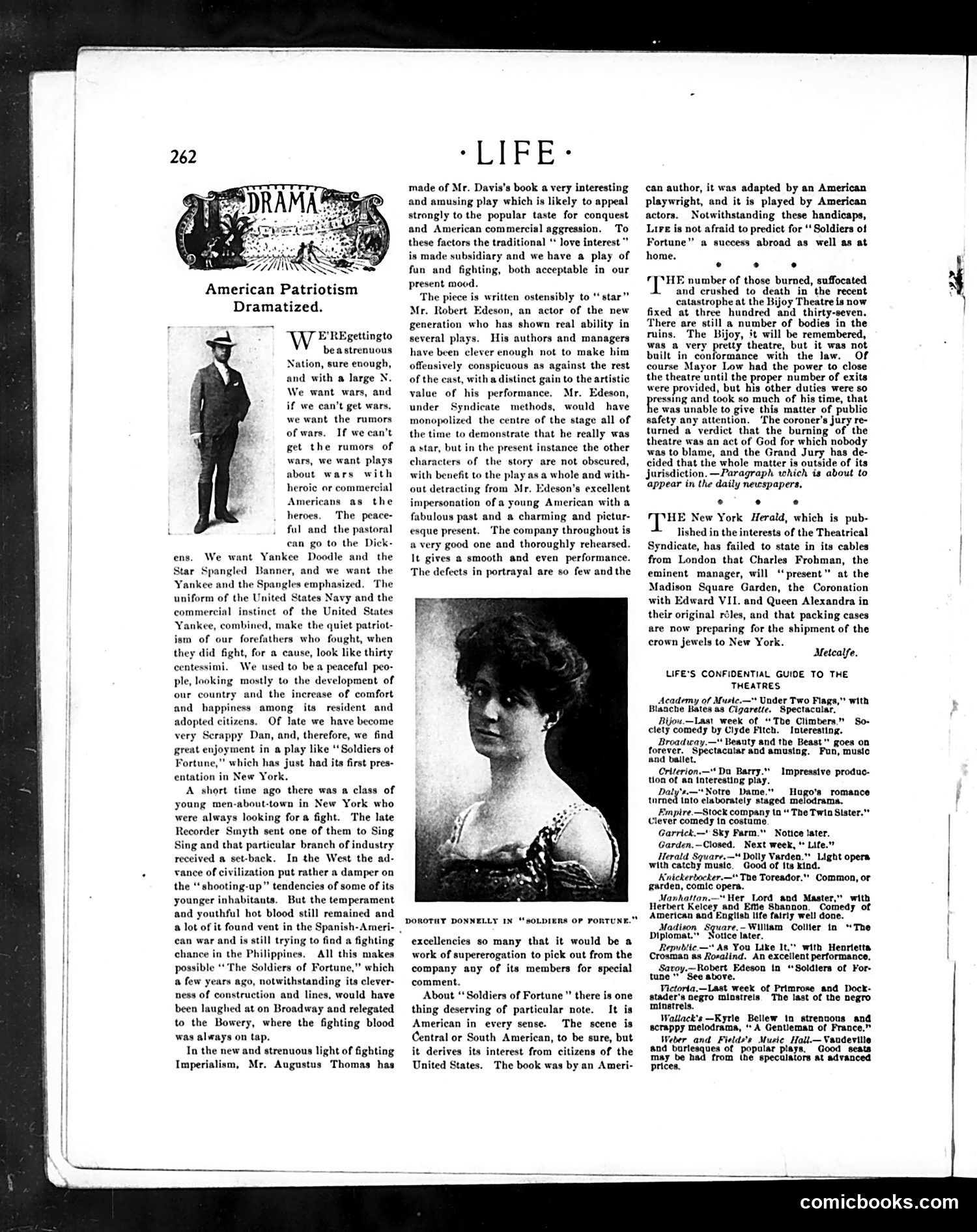
This satirical piece critiques America's embrace of militaristic entertainment. Life magazine ridicules how the nation has shifted from peaceful commerce to craving war stories—whether actual conflicts (Spanish-American War, Philippines) or theatrical dramatizations like "Soldiers of Fortune." The cartoon shows a figure in a US Navy uniform, representing the "Yankee" combined with "commercial instinct." The satire argues that Americans now demand patriotic plays featuring heroic military action, finding traditional peaceful values quaint and obsolete. The author sardonically notes this new "strenuous" mood has made militaristic dramas commercially viable where they'd have failed years earlier. The piece both reviews playwright Augustus Thomas's adaptation of Richard Harding Davis's novel and comments on American imperialism and the appetite for conquest narratives. It's fundamentally about how commercial entertainment reflects and amplifies nationalist fervor.
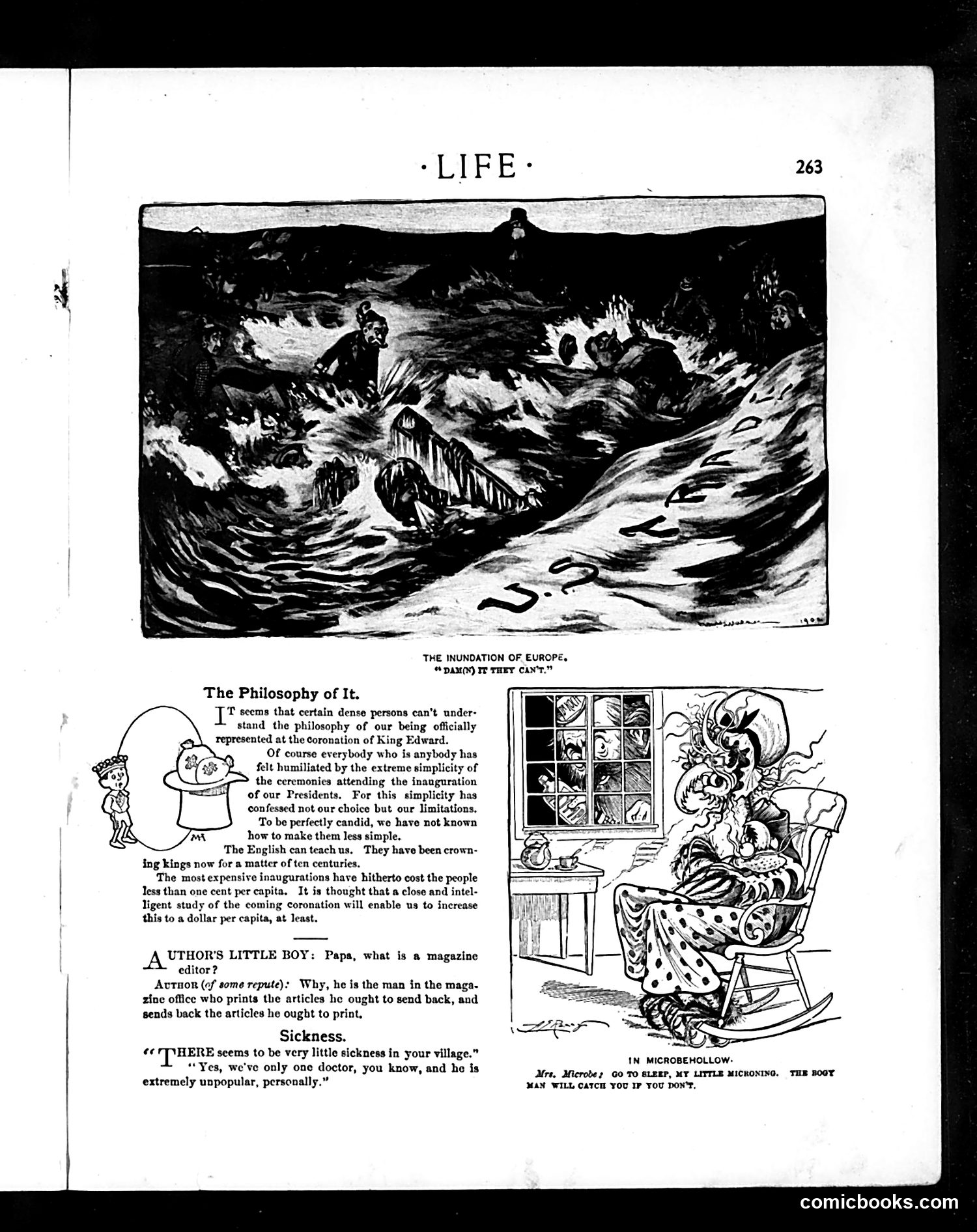
**"The Inundation of Europe"** (top illustration): This cartoon depicts European flooding or crisis, with the caption suggesting resigned acceptance ("Dammit if they can't"). The exact historical event is unclear without a date, but the imagery suggests a natural disaster or political upheaval in Europe. **"The Philosophy of It"**: This section mocks American admiration for King Edward's coronation. Life satirizes the pretension of studying British coronation ceremonies to make American presidential inaugurations more expensive and elaborate. The joke: Americans have long accepted simple inaugurations due to "limitations," not choice, and now want to copy British extravagance—spending a dollar per capita rather than one cent. **Other pieces**: Brief satirical vignettes about a magazine editor's backwards logic, and a doctor's unpopularity in a village with few sick people—the implication being no one trusts him. The overall tone mocks American social climbing and desire to imitate British formality.
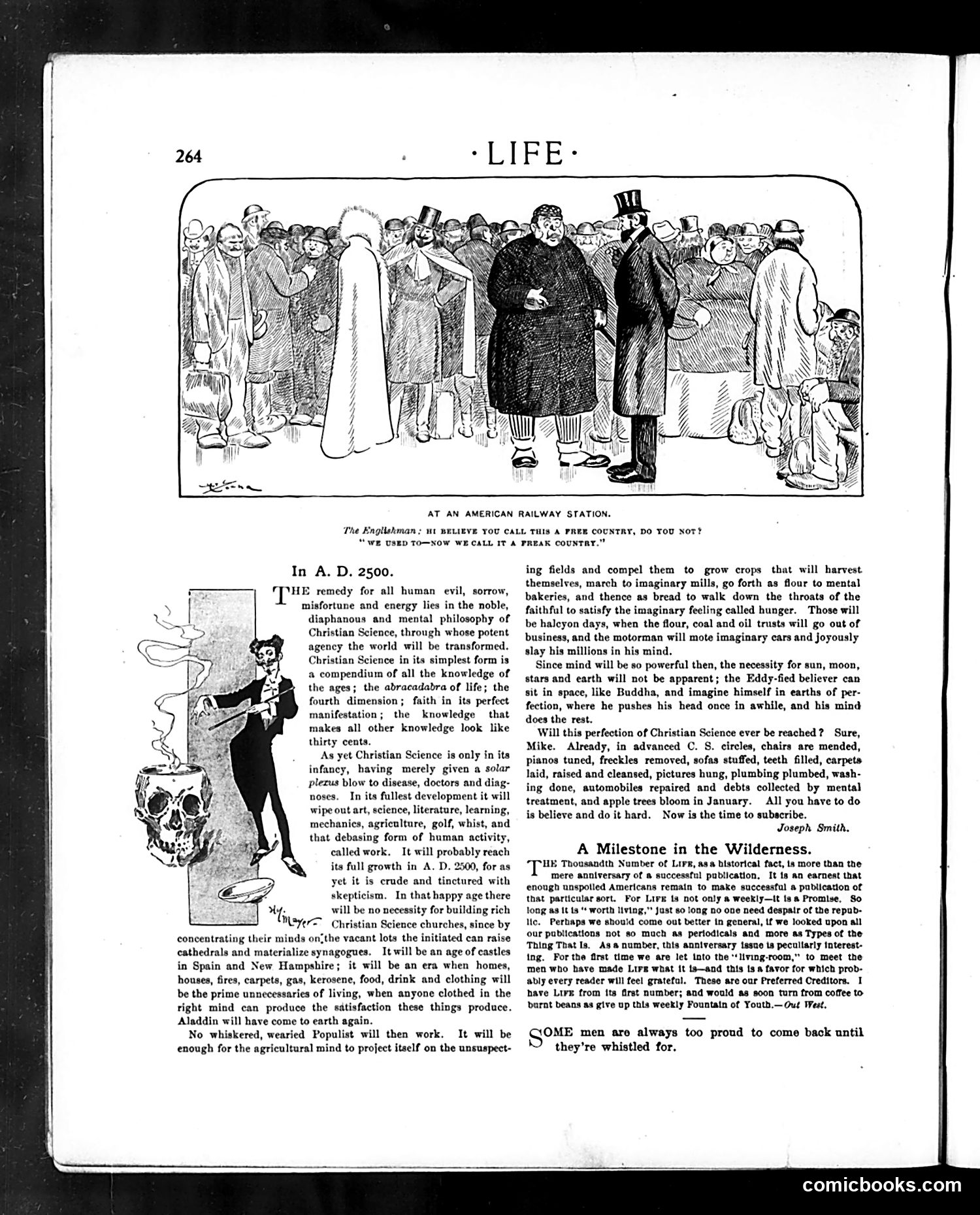
## The Railway Station Cartoon The top cartoon satirizes American freedom. An Englishman asks an American if they truly live in a "free country." The American responds they now call it a "freak country"—a pun suggesting that American liberty has become distorted or aberrant. The crowded railway station scene depicts ordinary citizens amid what appear to be social disorder or chaos, implying that American freedoms have devolved into something undesirable or ridiculous. ## The Christian Science Satire The lengthy article mocks Christian Science movement's claims through absurdist futurism. By projecting to A.D. 2500, the writer ridicules believers' faith that mental thought alone can manifest physical reality—crops harvesting themselves, pianos tuning through belief, debts disappearing via "mental treatment." The satire targets Christian Science's then-popular claim that disease, poverty, and material problems dissolve through correct thinking. References to "Eddy-fied" allude to Mary Baker Eddy, Christian Science's founder. The satirical tone suggests *Life* magazine opposed what it viewed as dangerous delusion masquerading as philosophy.
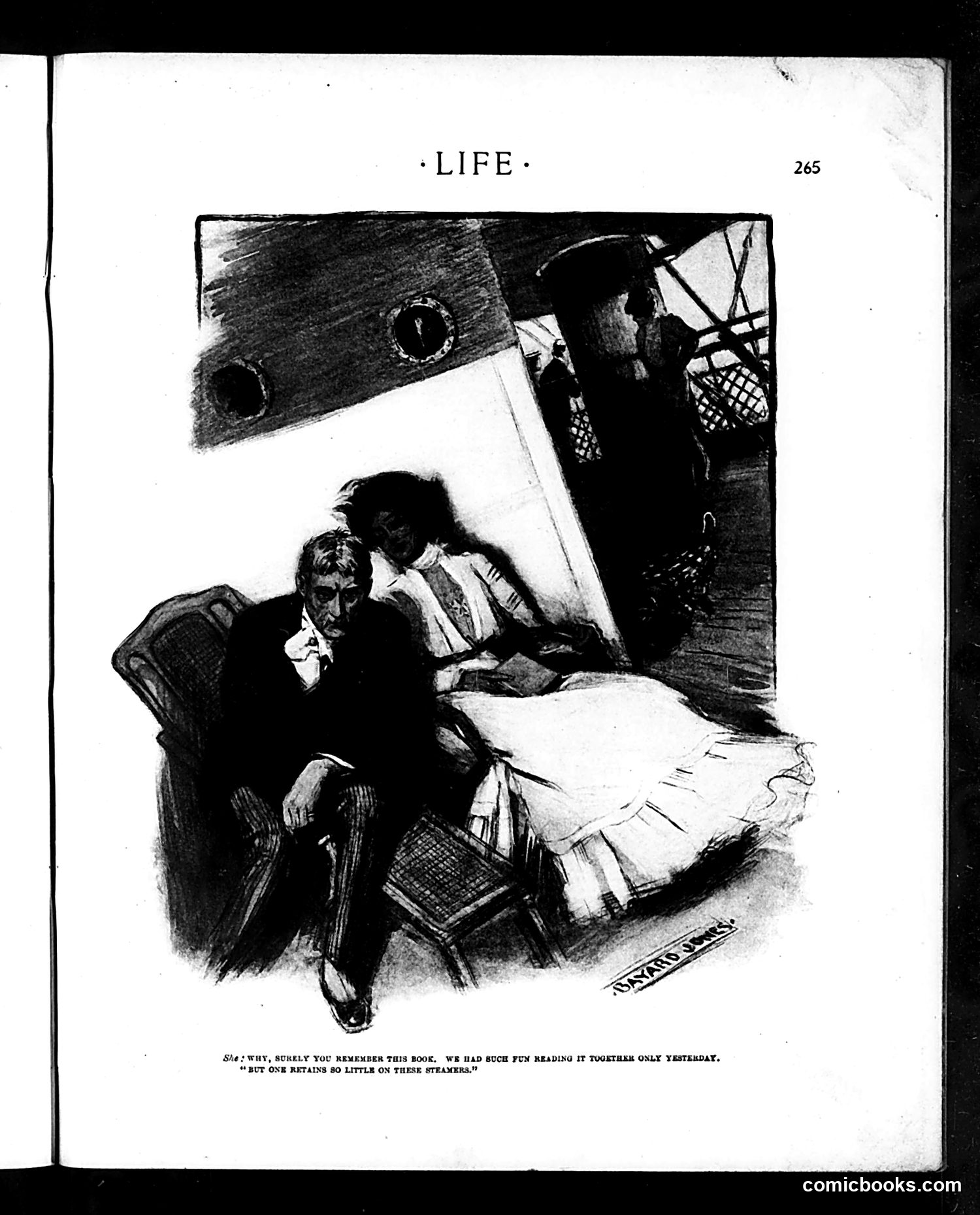
This cartoon depicts a man and woman in a ship's cabin (indicated by the porthole visible above). The woman holds a book, suggesting they shared reading material during their voyage. The man replies that he retains little from books read on steamers—implying the distraction and frivolity of shipboard life interferes with serious reading or memory retention. The satire likely targets the leisured classes who traveled by steamship, mocking their pretense of intellectual engagement while cruising. The joke suggests that despite claims of cultural refinement, passengers are too distracted by the social scene and comfort of ocean travel to genuinely absorb literature. This reflects early 20th-century satirical commentary on wealthy travelers' superficial engagement with culture.
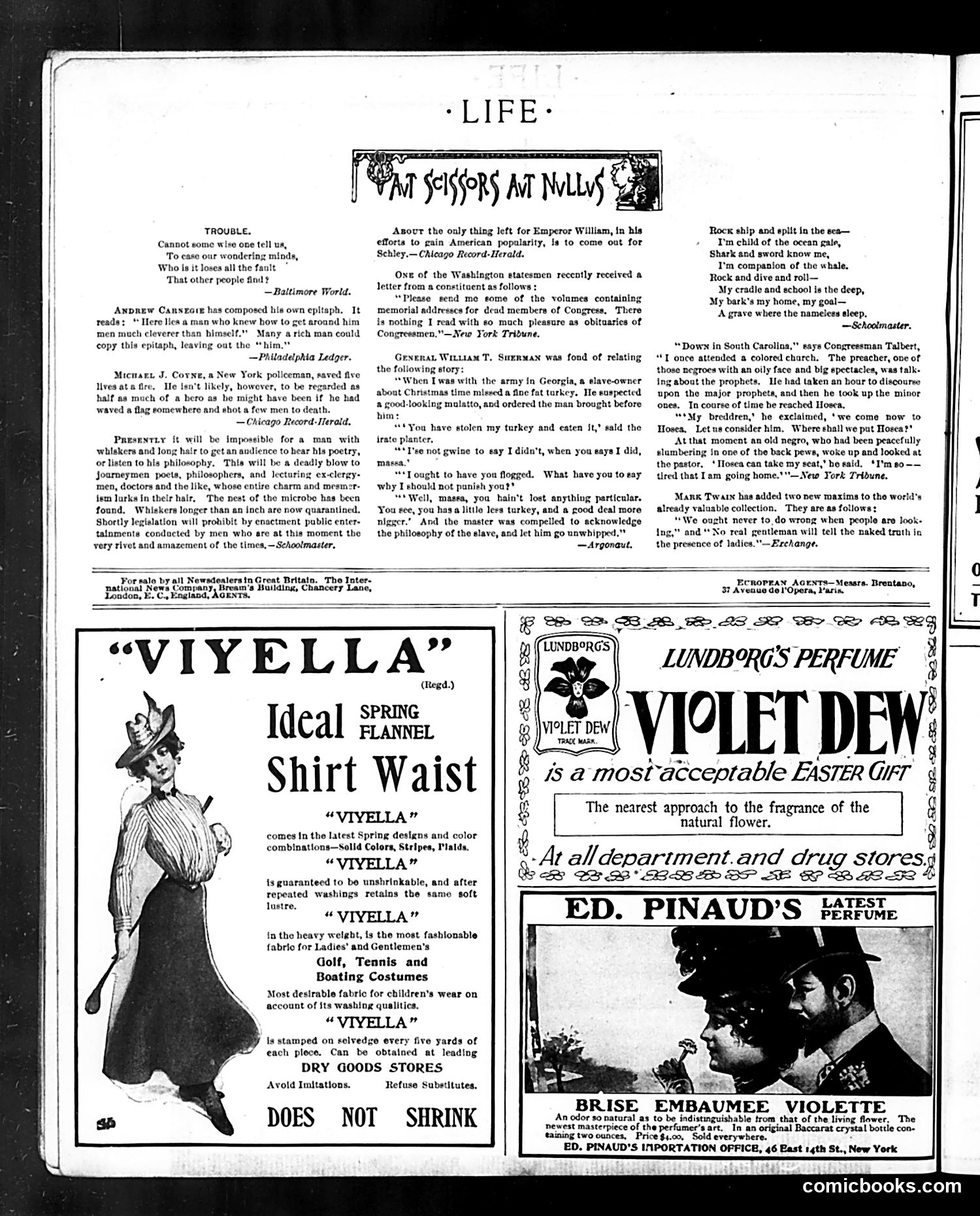
This page from *Life* magazine contains humorous short anecdotes and satirical commentary on contemporary American society, rather than a single cartoon. The pieces mock various targets: politicians who rely on appearance over substance (the Emperor William reference); the hypocrisy of valuing military aggression over firefighting heroics; and emerging social anxieties about hygiene and public health (the joke about quarantining long-haired men, reflecting early 20th-century germ theory concerns). A lengthy anecdote attributed to General Sherman depicts an enslaved person using clever logic to escape punishment—presented as humor, though it centers on slavery and racial exploitation. The Mark Twain "maxims" offer mild social satire about hypocrisy and propriety. The page is primarily **advertising**, featuring product promotions for "Viyella" fabric and perfumes alongside the editorial content—typical of *Life*'s mixed format during this era.
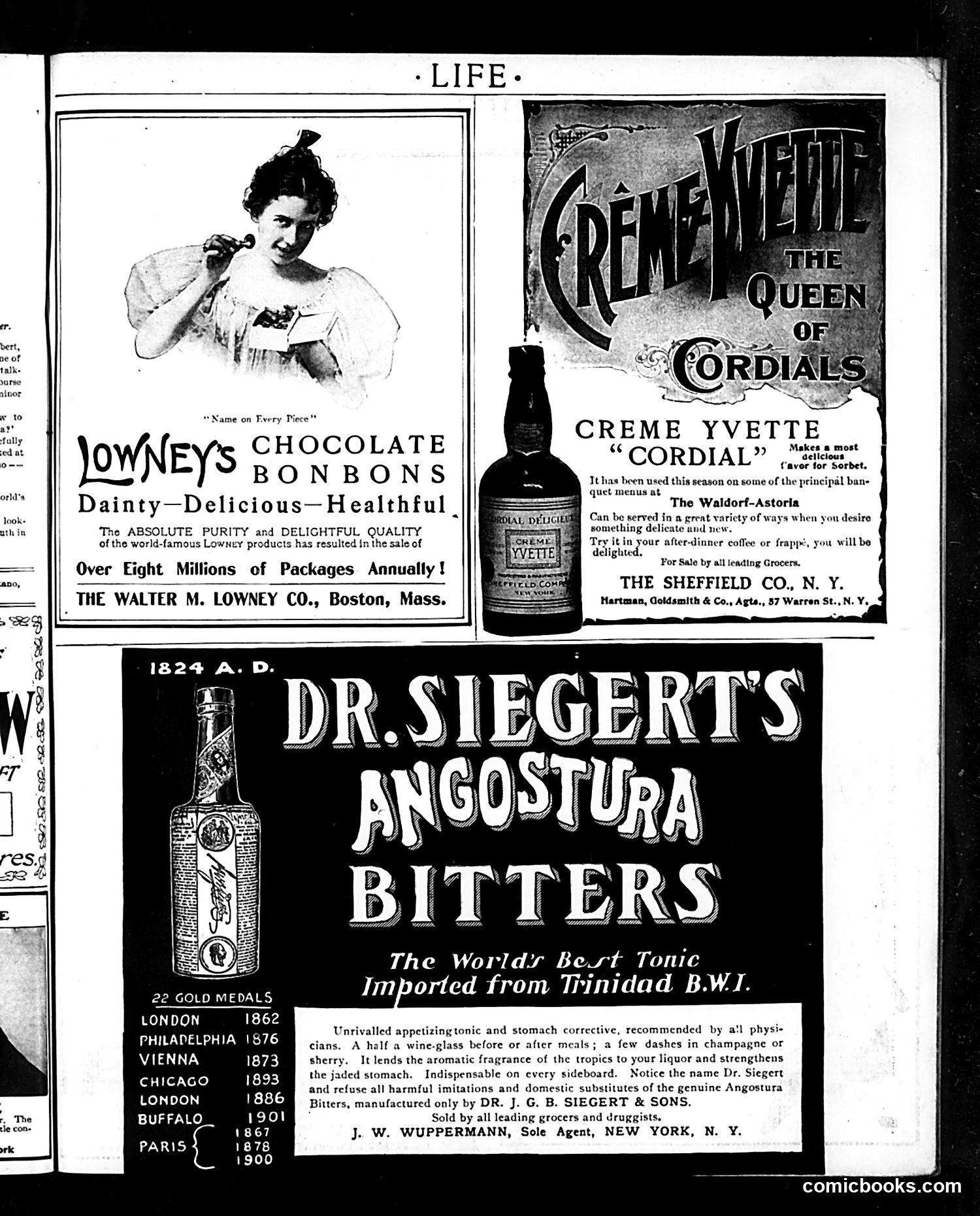
This is **primarily an advertising page**, not a satirical cartoon page. It contains three product advertisements typical of early 20th-century Life magazine: 1. **Lowney's Chocolate Bonbons** — emphasizes "absolute purity" and "delightful quality," claiming eight million packages sold annually. The image shows a refined woman, appealing to middle-class respectability. 2. **Crème Yvette Cordial** — a liqueur marketed as sophisticated, associated with the prestigious Waldorf-Astoria hotel. Suggests elegance and luxury. 3. **Dr. Siegert's Angostura Bitters** — positioned as a medicinal tonic "imported from Trinidad," recommended by physicians. Lists 22 gold medals from international exhibitions (1862-1900), establishing authority through prestige. All three advertisements target affluent consumers and emphasize quality, health benefits, and social status — typical marketing strategies of the era. There is **no apparent satire or political commentary** on this particular page.
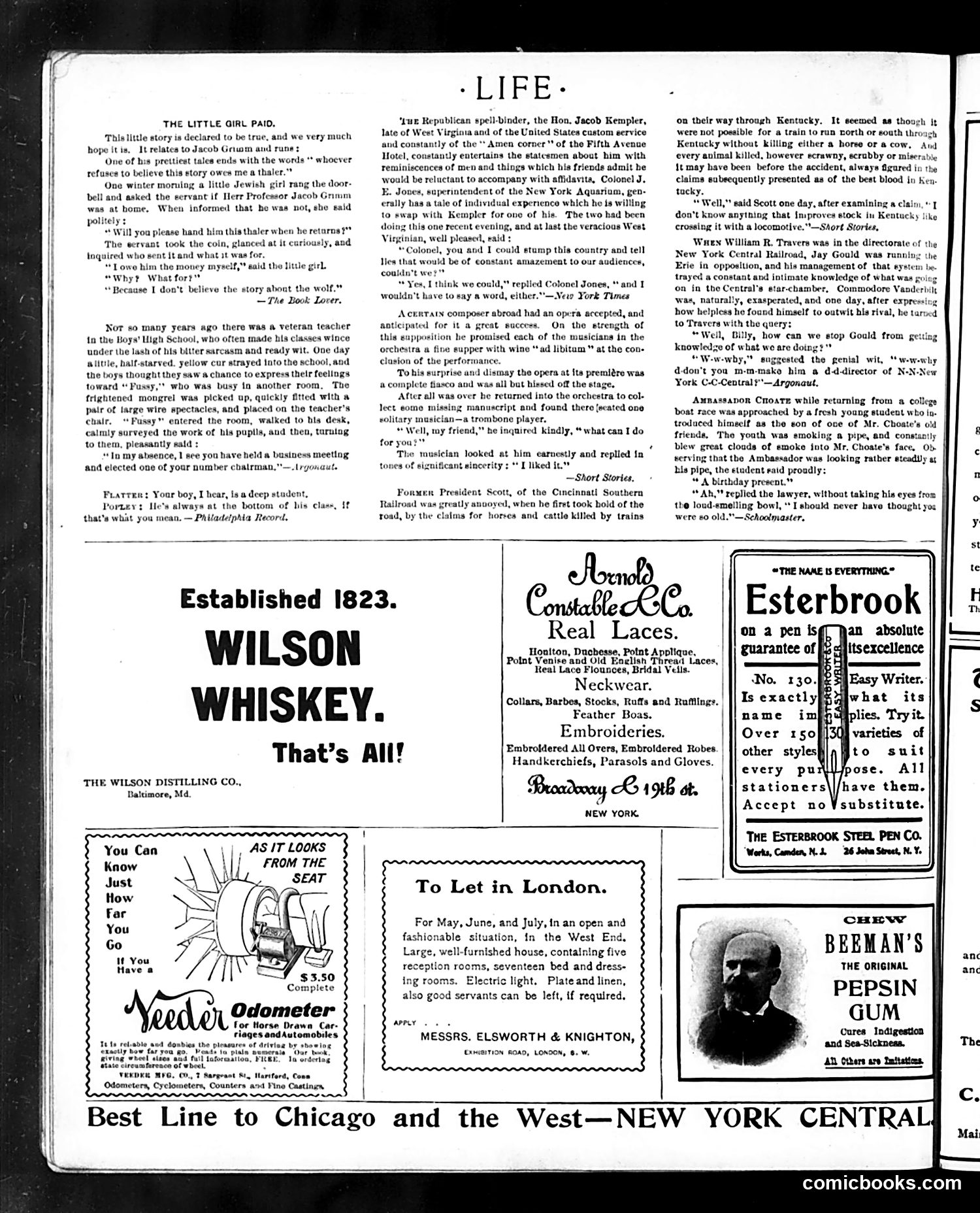
This page from *Life* magazine is primarily **advertisements and short humor pieces**, not political cartoons requiring historical context. The advertisements include Wilson Whiskey, Esterbrook pens, and Beeman's Pepsin Gum—typical early-20th-century commercial pitches. The text content consists of **brief anecdotes** meant to be humorous: - A story about a Jewish girl paying a professor because she doesn't believe his tall tale about a wolf - A joke about boys placing a dog in a teacher's chair while he's absent - Witty exchanges between politicians/railroad men competing to tell outrageous stories - An opera conductor's disappointment when only a trombonist appreciates his performance These are **genteel, conversational humor pieces**—the magazine's trademark style. They rely on wordplay, irony, and observations about human nature rather than political satire. The humor is mild by modern standards and requires no specific historical knowledge to understand their basic appeal about exaggeration and social awkwardness.
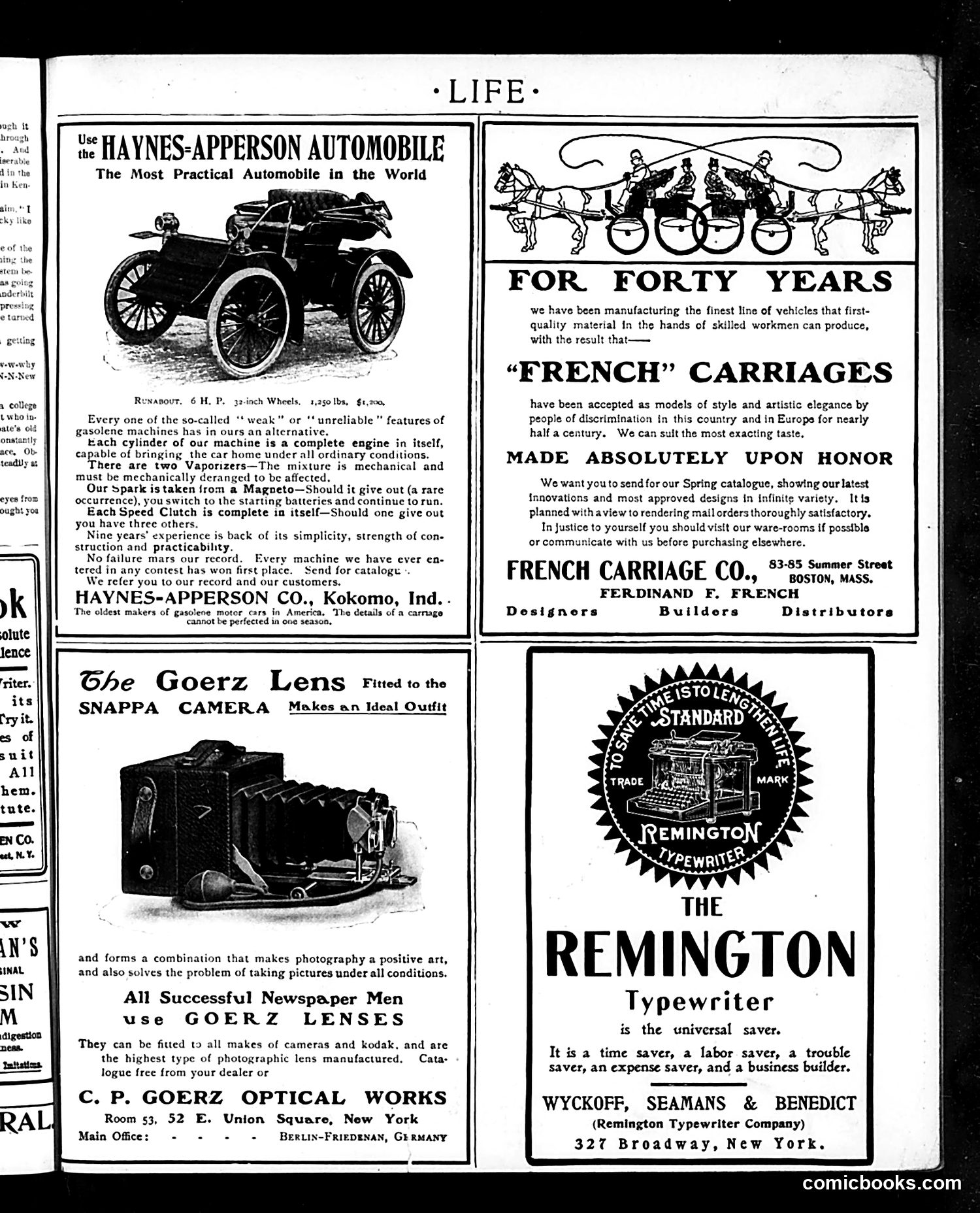
This is **not a political cartoon page** but rather an **advertisements section** from an early 1900s issue of Life magazine. The page contains four product advertisements: 1. **Haynes-Apperson Automobile** — emphasizes reliability and mechanical simplicity for early gasoline cars 2. **French Carriages** — traditional horse-drawn vehicles marketed as stylish alternatives, made in Boston 3. **Goerz Lens for Snappa Camera** — photography equipment aimed at newspaper professionals 4. **Remington Typewriter** — positioned as a business productivity tool The page reflects the **early automotive era's competing technologies**: gasoline-powered cars were still novel and unreliable, so traditional horse carriages remained viable luxury products. The juxtaposition of these two advertisements illustrates the **technological transition period** of the 1900s, when industries were shifting but older methods persisted among consumers who valued proven craftsmanship. The other ads target professional workers—photographers and typists—reflecting growing demands in journalism and business.
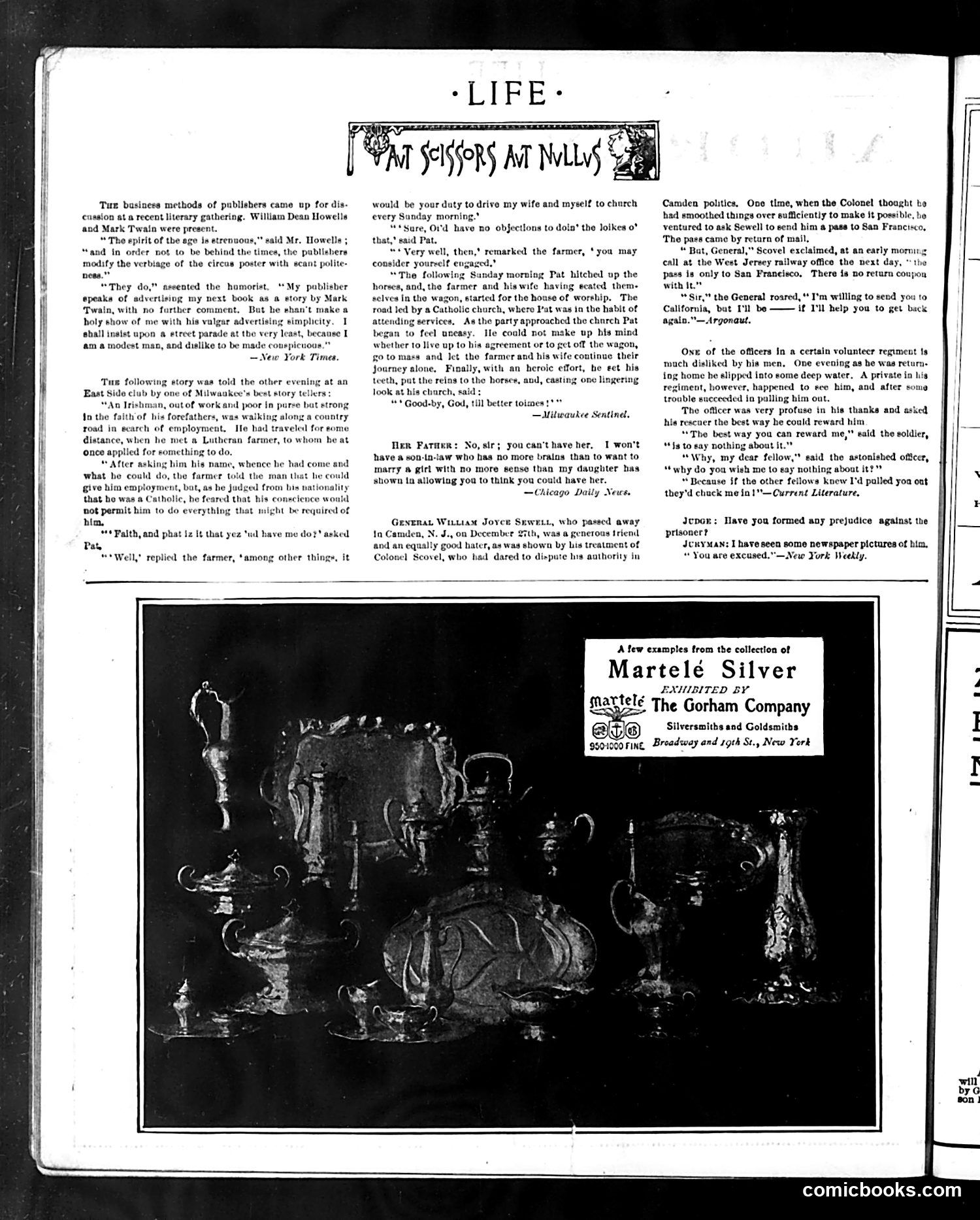
This page collects brief satirical anecdotes about American life, circa early 1900s. The humor targets several subjects: **Publishers & Authors**: Howells and Mark Twain mock publishers' vulgar advertising methods, with Twain joking he'd demand a street parade rather than cheap promotional tactics—satire on commercialized literature. **Religious Conflict**: An Irish Catholic laborer must choose between his new job (driving his Lutheran employer to church) and attending his own church. He chooses duty over faith—satirizing the immigrant's precarious economic position and religious compromise. **Political Grudges**: General Sewell's petty revenge on Colonel Scovel—sending him a one-way pass to California—mocks vindictive local politics and suggests wealthy men abuse power over perceived slights. **Class Humiliation**: A soldier rescues an officer from drowning but requests silence as payment, preferring the officer's dignity remain intact—subtle satire on class hierarchies and the working man's quiet dignity. The bottom section advertises Martelé silver from The Gorham Company, a luxury goods advertisement.
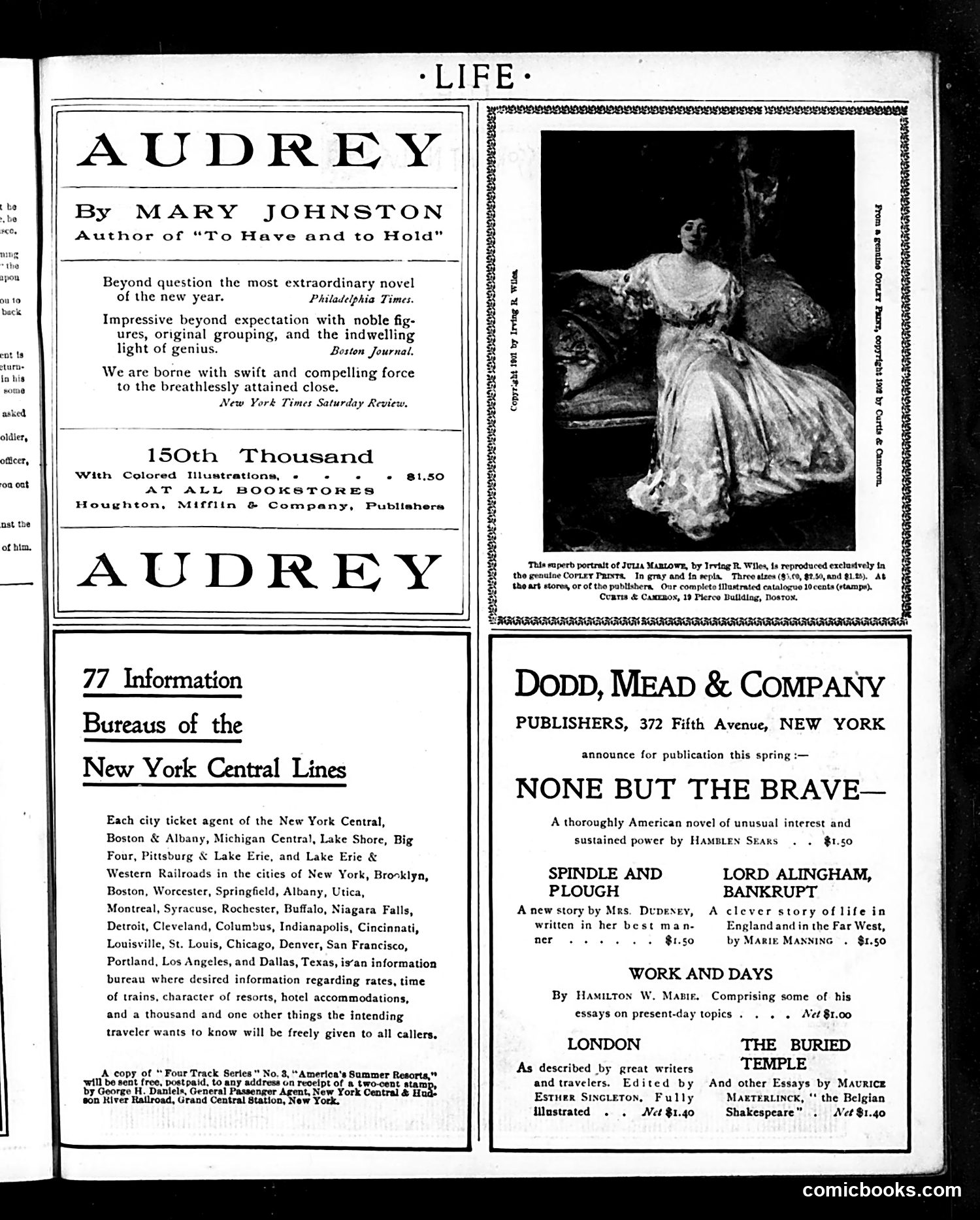
This is **not a cartoon or satire page**—it's primarily a **book advertisement section** from an early 1900s issue of Life magazine. The dominant content advertises *Audrey* by Mary Johnston, a bestselling novel (150th thousand copies printed) featuring a portrait of actress Jutta Mantowe by artist Irving R. Wiles. The page includes favorable reviews from major newspapers praising the novel's literary quality. Below are additional publisher advertisements for books including *None But the Brave* (a novel by Hamblen Sears), works by Mrs. Dudeney and Maurice Maeterlinck, and travel information from the New York Central Railroad. The portrait itself—a woman in an elegant, flowing white gown posed dramatically—appears designed to market the novel's romantic appeal to contemporary readers, typical of Edwardian-era book promotion strategies.
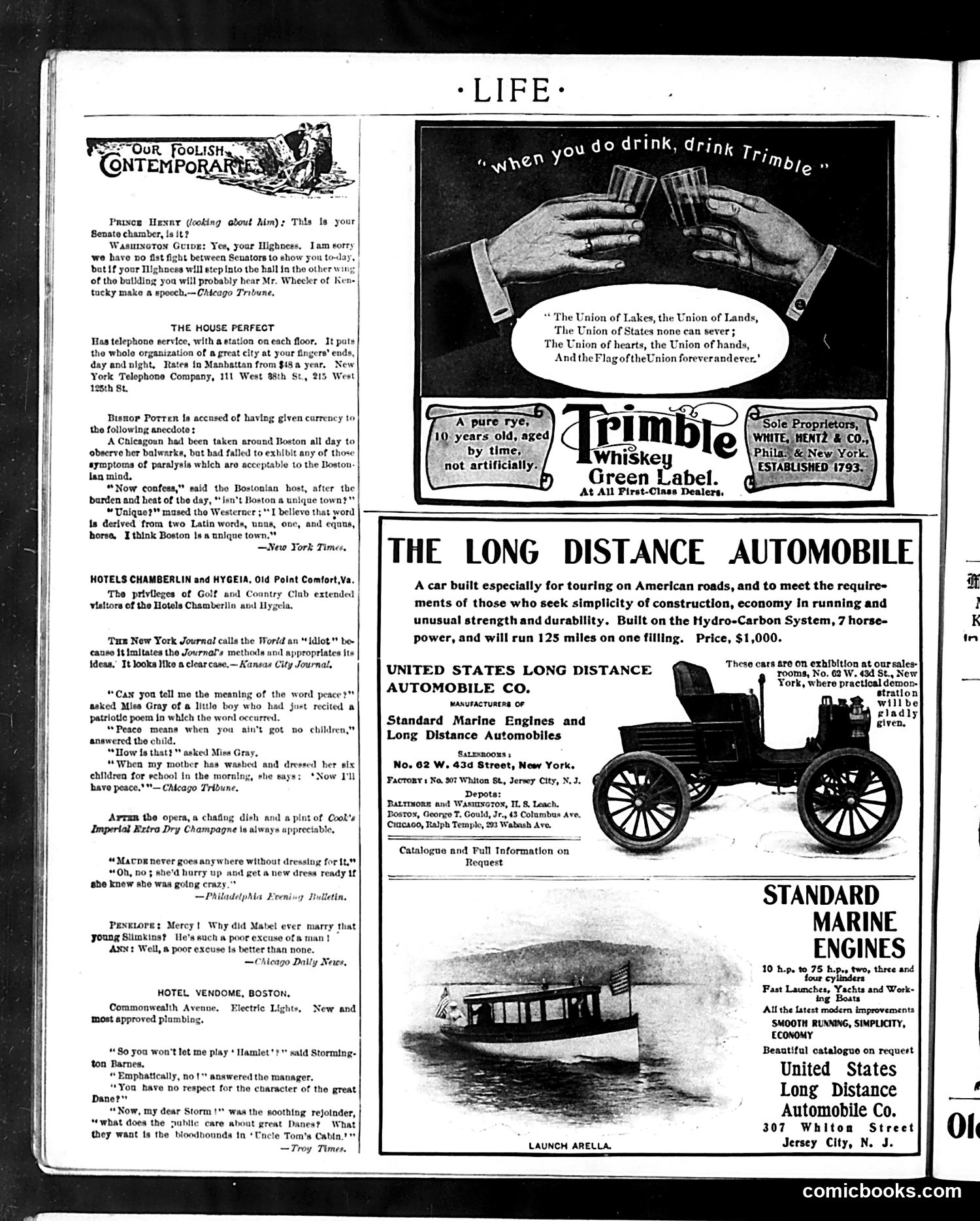
This page is primarily **advertising** with several brief satirical jokes interspersed. The main content includes: **"Our Foolish Contemporaries" Section**: Short humor pieces mocking various subjects—a visiting Prince Henry expressing disappointment that Congress isn't actively fighting (referencing Senate brawls as entertainment), a Chicago woman unimpressed by Boston's "uniqueness," and various domestic comedy snippets. **Key Satire**: The Prince Henry joke appears to reference a royal visit, suggesting American politics was characterized by physical violence and theatrical posturing rather than serious governance. The "unique/unns/eqns" Boston joke mocks regional pride as absurdly provincial. **Advertisements**: The page is dominated by ads for Trimble Whiskey, the "Long Distance Automobile," and Standard Marine Engines—reflecting early 1900s commercial interests. The tone throughout is lighthearted mockery of American social pretensions, regional rivalry, and contemporary politics, typical of Life's satirical voice during this period.
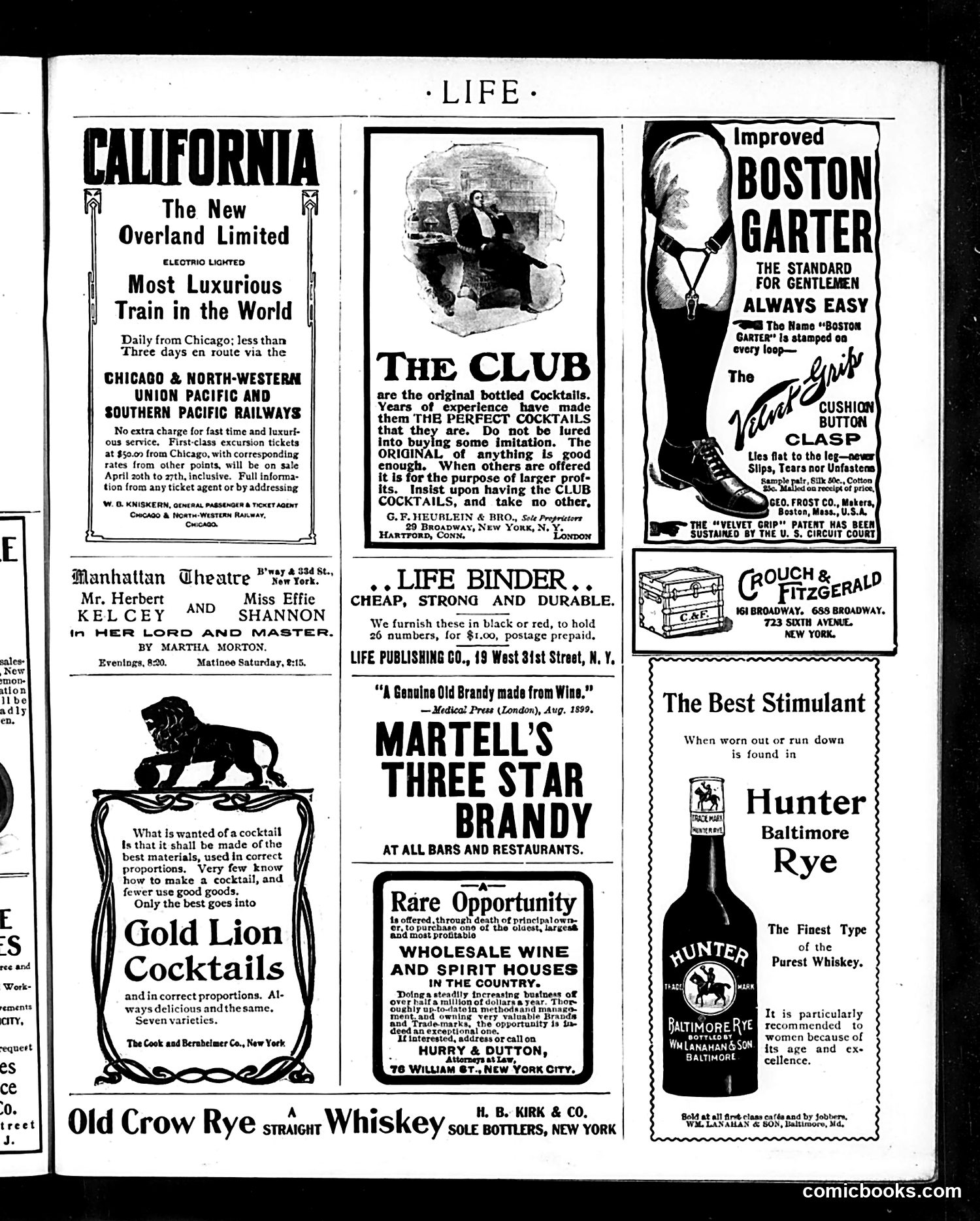
This is primarily an **advertising page** from Life magazine, likely from 1915 (based on the Manhattan Theatre ad dating). It contains minimal editorial content—mostly commercial advertisements for luxury goods and services aimed at affluent readers. Notable ads include: - **California train travel**: promoting the "Overland Limited," positioned as the world's most luxurious train - **Cocktail products**: Heublein's Club Cocktails and Gold Lion Cocktails compete for the "original" designation—a common early 20th-century advertising strategy claiming superiority through authenticity - **Spirits**: multiple whiskey and brandy advertisements (Hunter Baltimore Rye, Martell's Brandy, Old Crow Rye) - **Apparel**: Boston Garter for men, with patent litigation mentioned - **Theater**: a Broadway show featuring Herbert Kelcey and Effie Shannon The page reflects the **consumer culture and leisure pursuits of wealthy Americans** in the early 1900s. The repeated emphasis on "original" and "best" in liquor ads suggests competitive market saturation. No political cartoons or satire are present—this is straightforward commercial content.
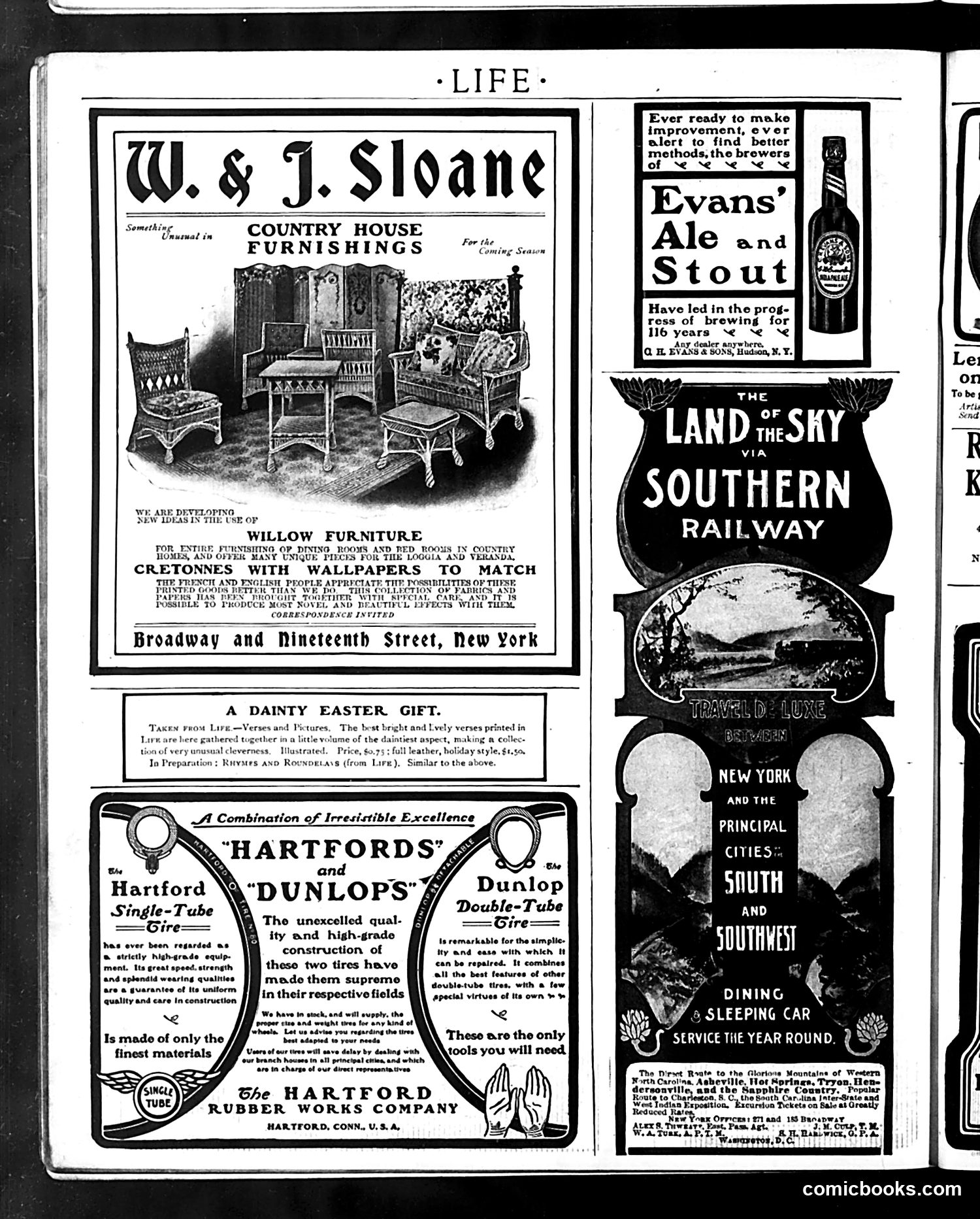
This page is primarily **advertising**, not satire or political commentary. It contains four distinct advertisements from circa 1910s America: 1. **W. & J. Sloane** (top): Furniture company advertising "Country House Furnishings," emphasizing willow furniture and coordinated cretonnes and wallpapers for wealthy homeowners' dining rooms, bedrooms, and verandas. 2. **Hartford Rubber Works**: Tire advertisement comparing their "Hartford" single-tube and "Dunlops" double-tube automobile tires, emphasizing quality and ease of repair. 3. **Evans' Ale and Stout** (right): Brewery advertisement claiming 116 years of brewing excellence. 4. **Southern Railway** (right): Travel advertisement promoting luxury "Dining & Sleeping Car" service connecting New York to southern cities. These ads target affluent readers—country estate owners, automobile owners, and leisure travelers—reflecting early 20th-century consumer culture and technological advancement (automobiles, rail travel).
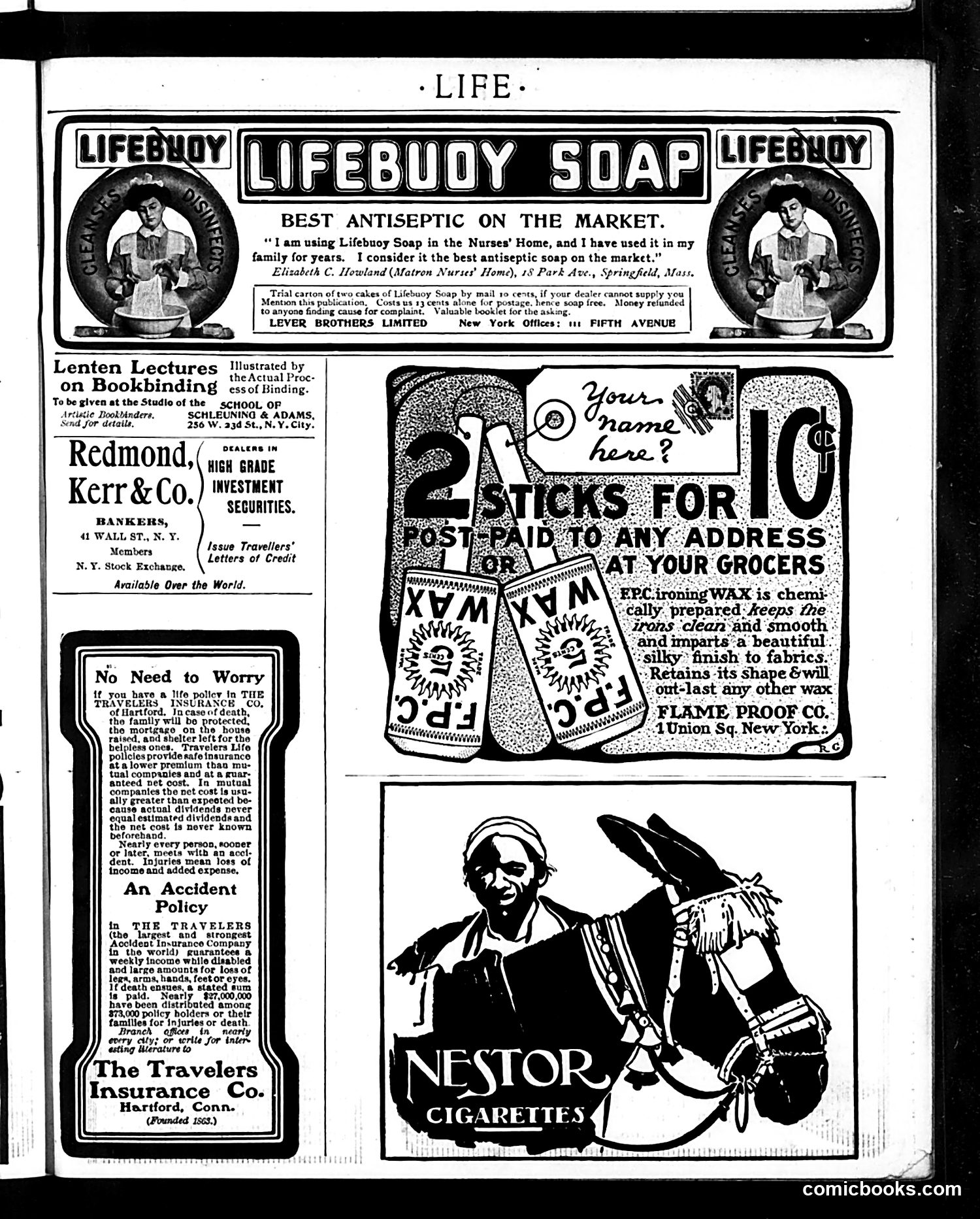
This page is primarily **advertising**, not satire or political commentary. It features several product and service ads typical of early 20th-century Life magazine: **Main ads:** - **Lifebuoy Soap**: Markets itself as "best antiseptic," using a testimonial from a nurse to establish medical credibility—reflecting early 1900s trust in healthcare professionals for product endorsement - **FEC Ironing Wax**: A household product sold at grocers - **Nestor Cigarettes**: Features a man with a donkey, though the specific appeal is unclear - **Travelers Insurance Co.**: Emphasizes life and accident insurance as family protection **Context for modern readers:** These ads reveal that Life magazine survived partly through advertising revenue. The emphasis on antiseptic properties, life insurance, and accident coverage reflects genuine period concerns about disease, mortality, and economic vulnerability before modern medicine and social safety nets existed.
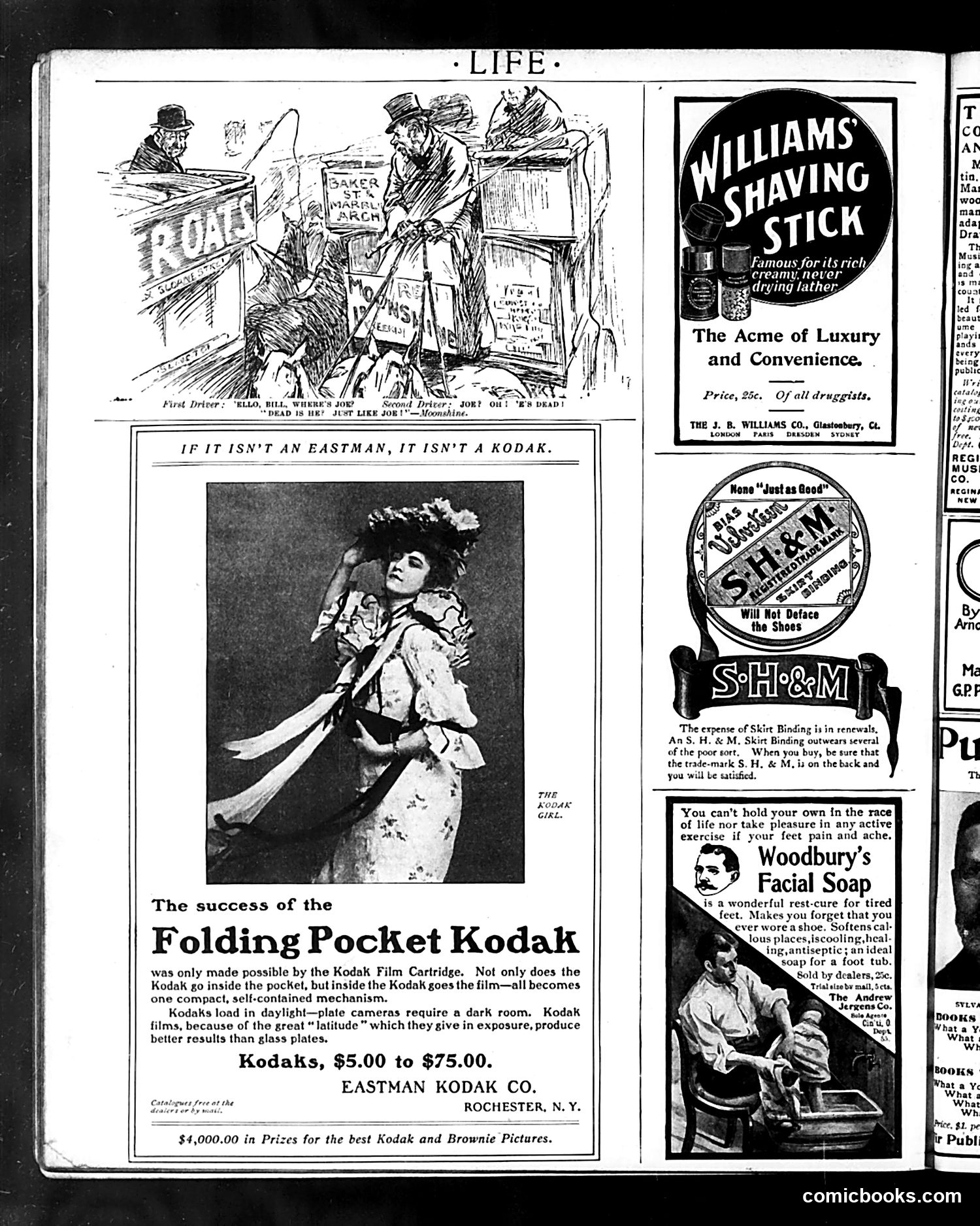
This page is primarily **advertising**, not editorial content. The single cartoon at top depicts two taxi drivers discussing a missing colleague named "Joe," with one suggesting he's off making illegal "moonshine" (whiskey during Prohibition). It's a light gag about the era's widespread bootlegging. The page's main focus is **product advertisements**: Kodak's new Folding Pocket camera (emphasizing its compact design and superior film cartridge technology), Williams Shaving Stick, S.H.&M skirt binding, and Woodbury's Facial Soap (marketed as relief for tired feet). These ads reflect early 20th-century consumer goods and gendered marketing—promoting photography as accessible leisure, grooming products for men, durable clothing components for women, and a soap brand positioned as a wellness solution. The competitive language ("If it isn't an Eastman, it isn't a Kodak") shows how established brands asserted dominance in emerging mass markets.
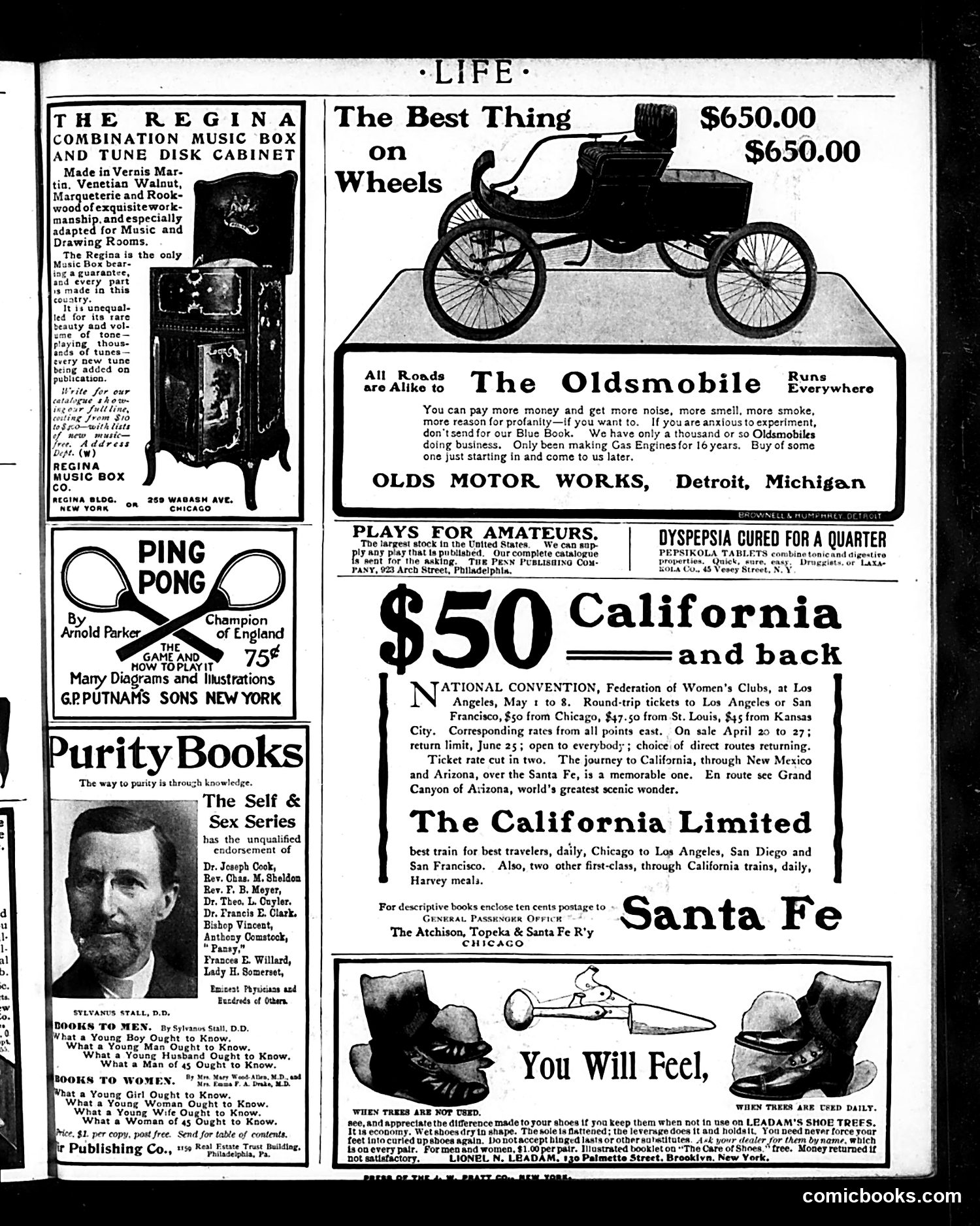
This is primarily an **advertising page** with no political cartoons or satirical content. The page showcases early 1900s consumer products and services: **Key Advertisements:** - **The Regina Music Box** ($650) — luxury furniture combining phonograph technology with fine woodwork - **The Oldsmobile** ($650) — positioned as reliable transportation versus experimental competitors, emphasizing 16 years of engine manufacturing experience - **Ping Pong** — a parlor game guide (75¢) - **Purity Books** — The "Self & Sex Series" by Sylvanus Stall, endorsed by religious and moral figures (Comstock, Willard, etc.), addressing sex education for young men and women - **Train travel to California** — Santa Fe Railway offering $50 round-trip tickets - **Shoe trees** — devices to preserve shoe shape The page reflects **Progressive Era values**: consumer goods, moral instruction through published books, and leisure activities. The heavy promotion of sex education books suggests contemporary debate over proper morality instruction for youth.
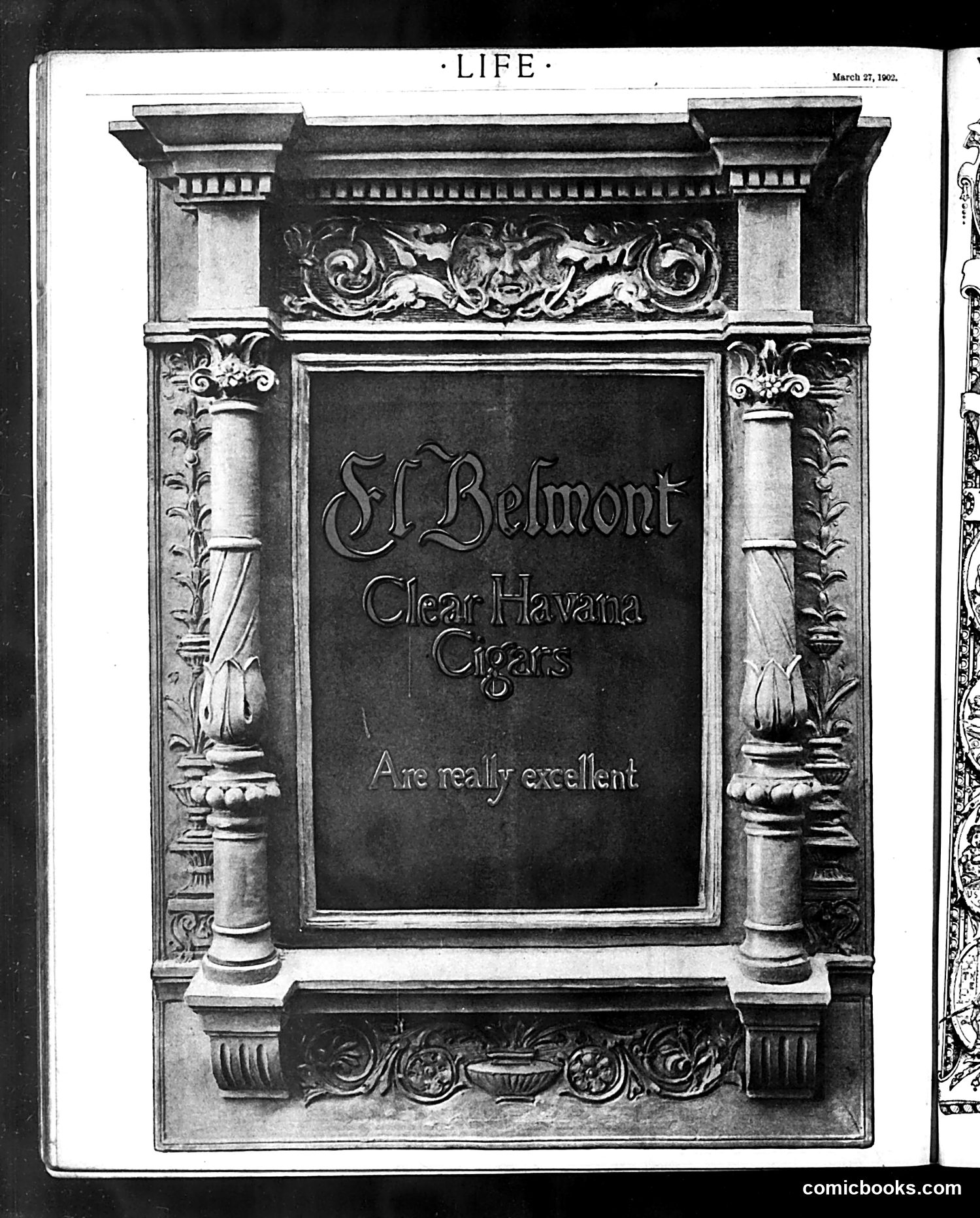
This page is primarily a **product advertisement** rather than political satire or editorial cartoon. It features an ornate classical architectural frame—with decorative columns, scrollwork, and ornamental details—containing text advertising "St. Belmont Clear Havana Cigars" with the tagline "Are really excellent." The elaborate neoclassical design is typical of early-1900s advertising aesthetics, using grandeur and sophistication to appeal to upscale consumers. There is no apparent political commentary, caricature, or satirical content visible. This appears to be a straightforward commercial placement in *Life* magazine from March 27, 1902.