
Life, 1902-03-27 · page 16 of 36
Life — March 27, 1902 — page 16: what you’re looking at
What you’re looking at
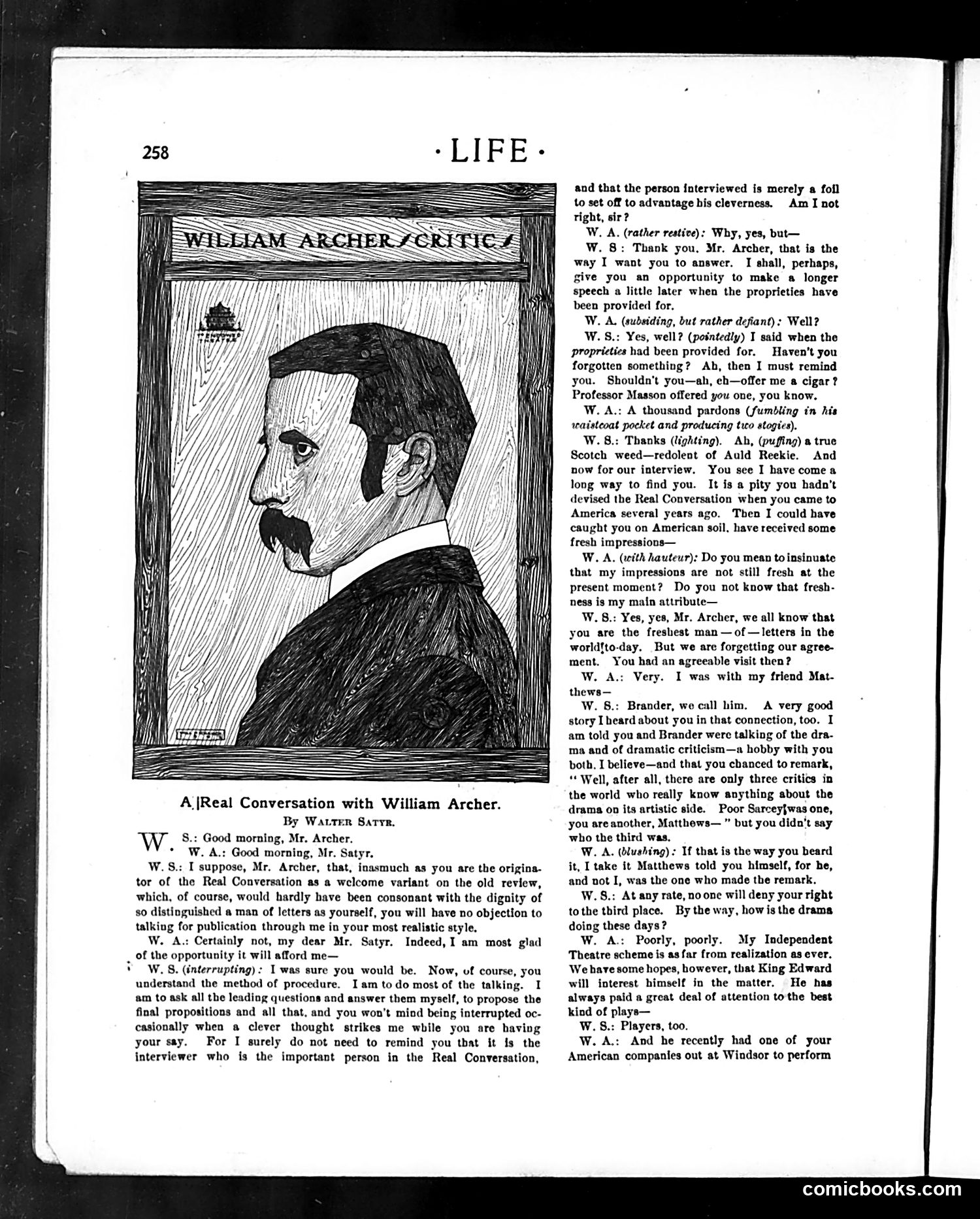
This is a satirical "interview" between Walter Saterye (a critic) and William Archer, a real Scottish dramatic critic and theater reformer. The satire mocks the pretentiousness of the "Real Conversation" format itself—a trendy interview style of the era. The joke: Saterye repeatedly interrupts and dominates, claiming the interviewer is the important person while the subject is merely a "foil." He demands cigars, corrects Archer's recollections, and steers the conversation. The satire exposes how self-important interviewers could be while supposedly documenting someone else's thoughts. References include Archer's failed "Independent Theatre" scheme (a real artistic venture) and mentions of dramatist Brander Matthews and critic Francisque Sarcey. The humor lies in Archer's growing frustration as he's systematically prevented from actually speaking—a clever critique of the interview format's inherent absurdity.
📄 Transcribed text from this page (OCR, searchable)
Machine-transcribed from the original scan — historical spelling and the odd misread are preserved.
A |Real Conversation with William Archer. By Watrter Sartre. VW, 8: Good morning, Mr. Archer. * W. A.: Good morning, Mr. Satyr. W.S.: I suppose, Mr. Archer, that, inasmuch as you are the origina- tor of the Real Conversation as a welcome variant on the old review, which, of course, would hardly have been consonant with the dignity of so distinguished a man of letters as yourself, you will have no objection to talking for publication through me in your most realistic style. W. A.: Certainly not, my dear Mr. Satyr. Indeed, I am most glad , of the opportunity it will afford me— W. 8. (interrupting): I was sure you would be. Now, of course, you understand the method of procedure. Iam to do most of the talking. I am to ask all the leading questions and answer them myself, to propose the final propositions and all that, and you won't mind being interrupted oc- casionally when a clever thought strikes me while you are having your say. For I surely do not need to remind you that it is the interviewer who is the important person in the Real Conversation, and that the person interviewed is merely a foil Lo set off to advantage his cleverness. Am I not right, sir? W. A. (rather restive): Why, yes, but— W. 8: Thank you. Mr. Archer, that is the way I want you to answer. I shall, perhaps, give you an opportunity to make a longer speech a little later when the proprieties have been provided for. W. A. (subsiding, but rather defiant): Well? W. S.: Yes, well? (pointedly) I said when the proprietics had been provided for. Haven't you forgotten something? Ab, then I must remind you. Shouldn't you—ah, eh—offer me a cigar? Professor Masson offered you one, you know. W. A.: A thousand pardons (fumbling in his waisteoat pocket and producing tuo stogies). W.8.: Thanks (lighting). Ah, (puffing) a true Scotch weed—redolent of Auld Reekie. And now for our interview. You see I have come a long way to find you. It is a pity you hadn't devised the Real Conversation when you came to America several years ago. Then I could have caught you on American soil, have received some fresh impressions— W.A. (with hauteur): Do you mean to insinuate that my impressions are not still fresh at the present moment? Do you not know that fresh- ness is my main attribute— W. 8.: Yes, yes, Mr. Archer, we all know that you are the freshest man —of—letters in the world{to-day. But we are forgetting our agree- ment. You had an agreeable visit then? W. A.: Very. I was with my friend Mat- thews— W. 8.: Brander, we call him. A very good story I heard about you in that connection, too. I am told you and Brander were talking of the dra- ma and of dramatic criticism—a hobby with you both, I believe—and that you chanced to remark, “ Well, after all, there are only three critics in the world who really know anything about the drama on its artistic side. Poor Sarcey{was one, you areanother, Matthews— ” but you didn’t say who the third was, W. A. (blushing): If that is the way you beard it, [take it Matthews told you himself, for he, and not I, was the one who made the remark. W.8.; At any rate, noone will deny your right tothe third place. By the way, how is the drama doing these days? W. A.: Poorly, poorly. My Independent Theatre scheme is as far from realization as ever. We hare some hopes, however, that King Edward will interest himself in the matter. He has always paid a great deal of attention tothe best kind of plays— W.S.: Players, too. W. A.: And he recently had one of your American companies out at Windsor to perform comicbooks.com