
A complete issue · 30 pages · 1902
Life — February 13, 1902
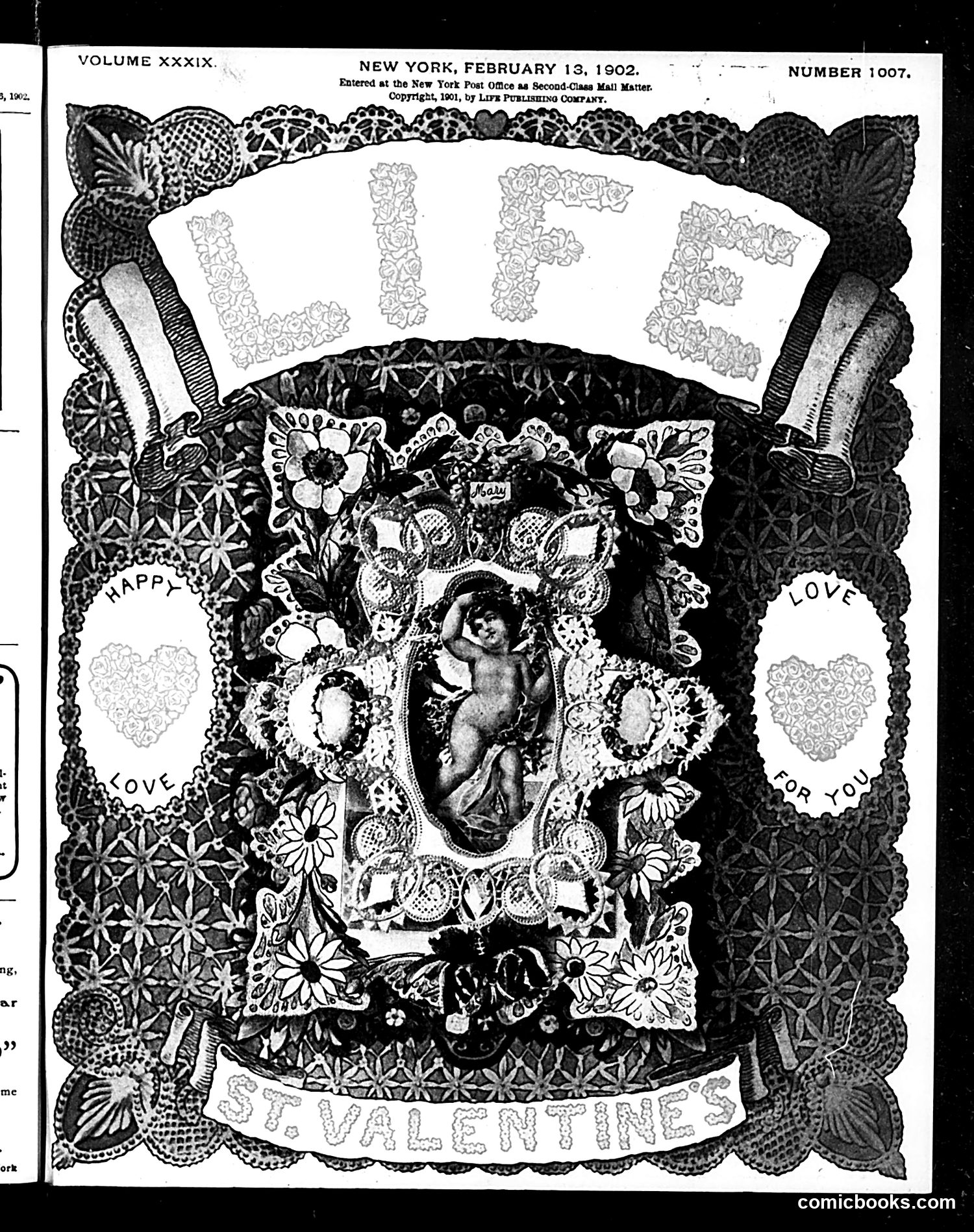
This is a Valentine's Day-themed cover page for *Life* magazine. The central image features a classical cupid surrounded by ornate lace doilies, flowers, and decorative hearts—typical Victorian Valentine imagery. The word "LIFE" appears at the top in floral lettering, while "ST. VALENTINE" is inscribed at the bottom. The sides display decorative lace patterns and text reading "HAPPY LOVE" and "LOVE FOR YOU," emphasizing the romantic theme. The elaborate, delicate ornamentation throughout reflects the sentimental Victorian aesthetic popular in early 1900s holiday celebrations. This appears to be a straightforward holiday-themed cover rather than political satire—simply celebrating Valentine's Day with period-appropriate romantic imagery and decoration.
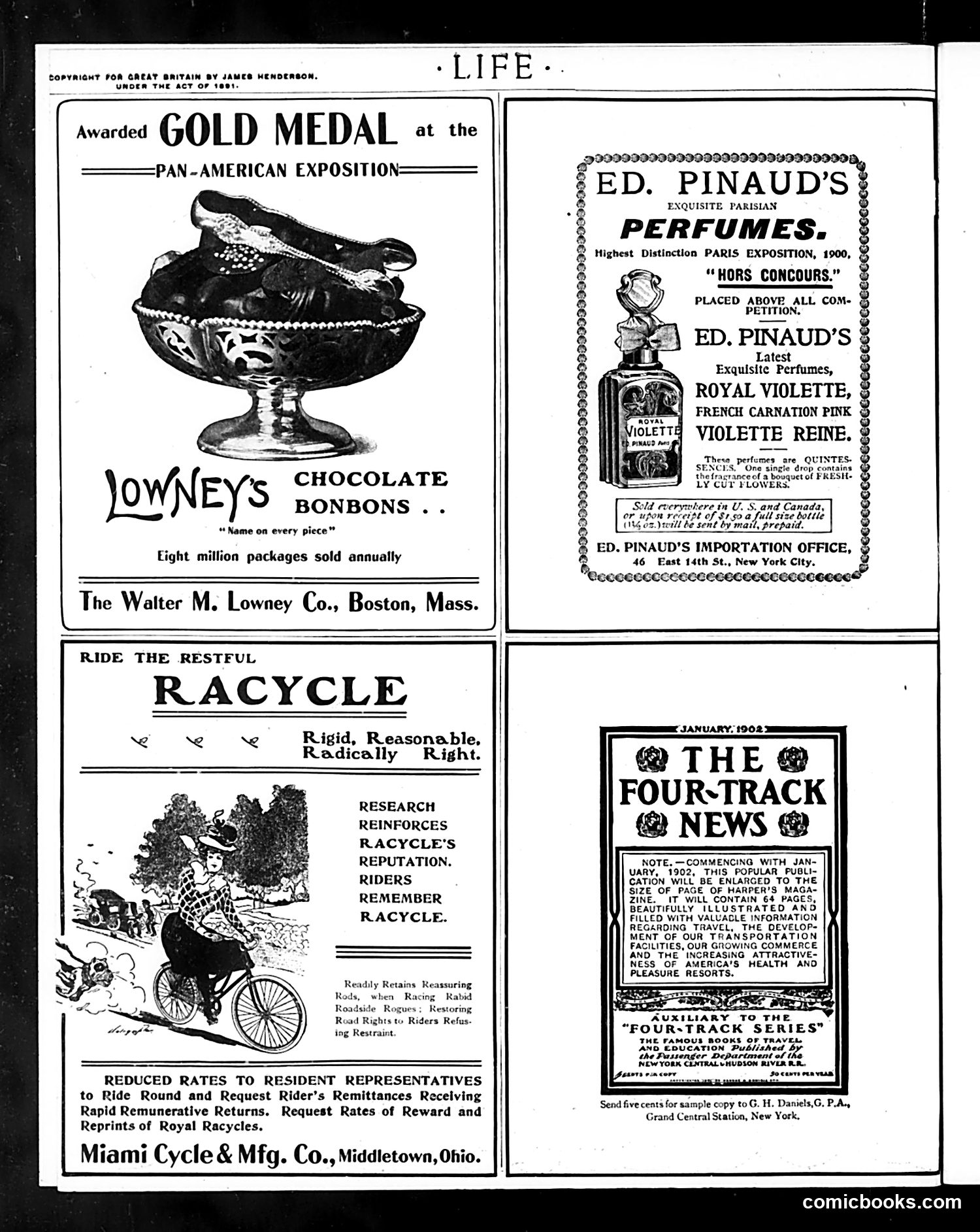
This page is primarily **advertising**, not political commentary or satire. It contains four product advertisements from the early 1900s: 1. **Lowney's Chocolate Bonbons** — emphasizes a gold medal award from the Pan-American Exposition, claiming eight million packages sold annually. 2. **Ed. Pinaud's Perfumes** — a Parisian luxury product highlighting awards from the 1900 Paris Exposition. 3. **Racycle Bicycles** — promotes their product as "rigid, reasonable, radically right," with illustrations of cyclists. 4. **The Four-Track News** — announces a new publication beginning January 1902, a travel and transportation magazine. There is no political satire visible. This represents typical *Life* magazine advertising from the period, targeting middle-class consumers with luxury and consumer goods.
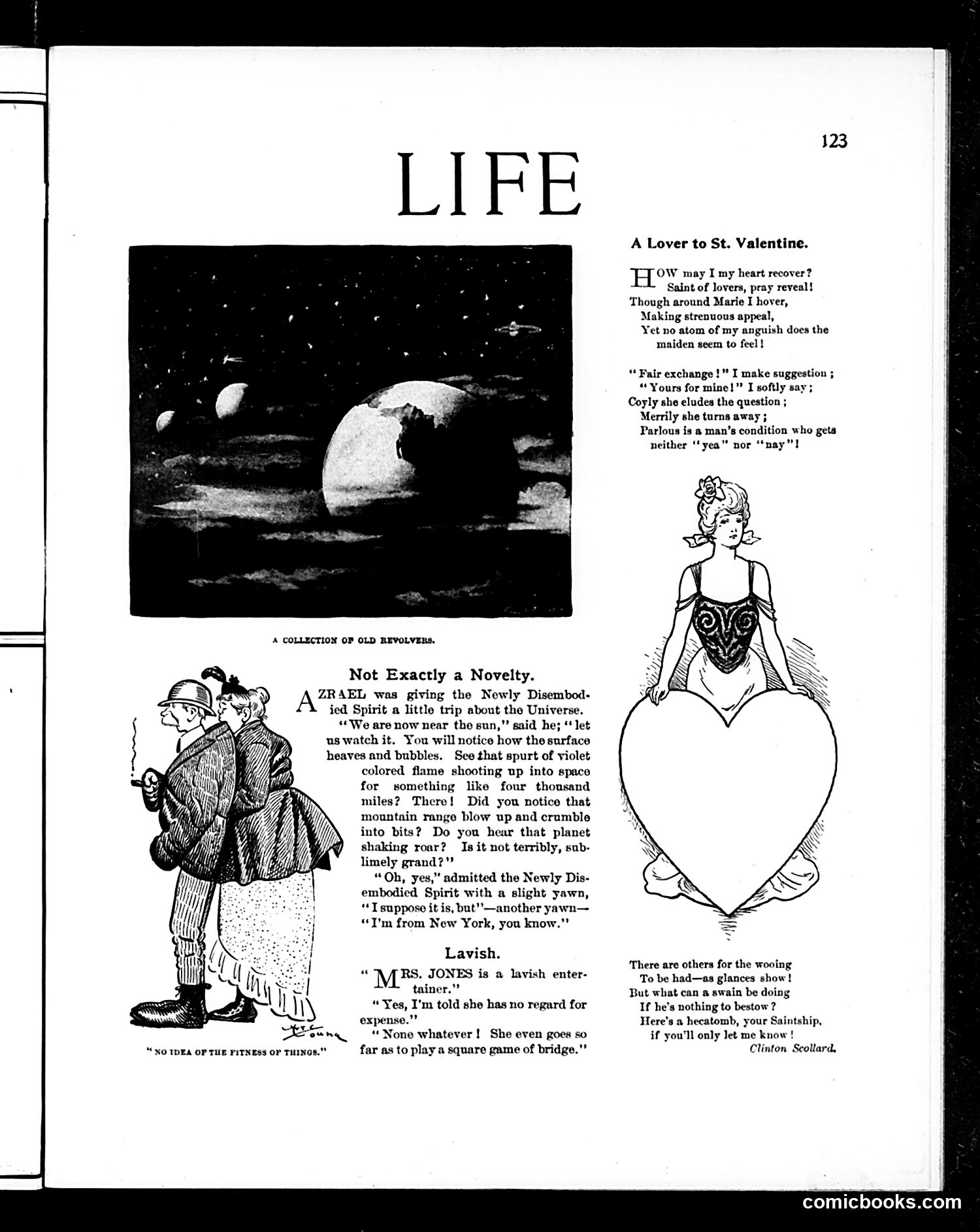
This page contains three separate humorous pieces typical of early 20th-century Life magazine: 1. **"A Collection of Old Revolvers"** (top): A surreal photograph showing what appears to be discarded revolver cylinders in a dark setting. 2. **"Not Exactly a Novelty"** (center): A comic dialogue between a "Newly Disembodied Spirit" and Azrael about cosmic wonders. The joke satirizes the spirit's blasé response—despite being shown the universe's grandeur, the spirit remains unimpressed, admitting he's merely "from New York." This is social commentary mocking New York sophistication and jaded attitudes. 3. **"A Lover to St. Valentine"** and **"Lavish"** (right): Two poems about love and relationships, with accompanying illustrations of a woman and a couple. These offer romantic and social commentary in verse form.
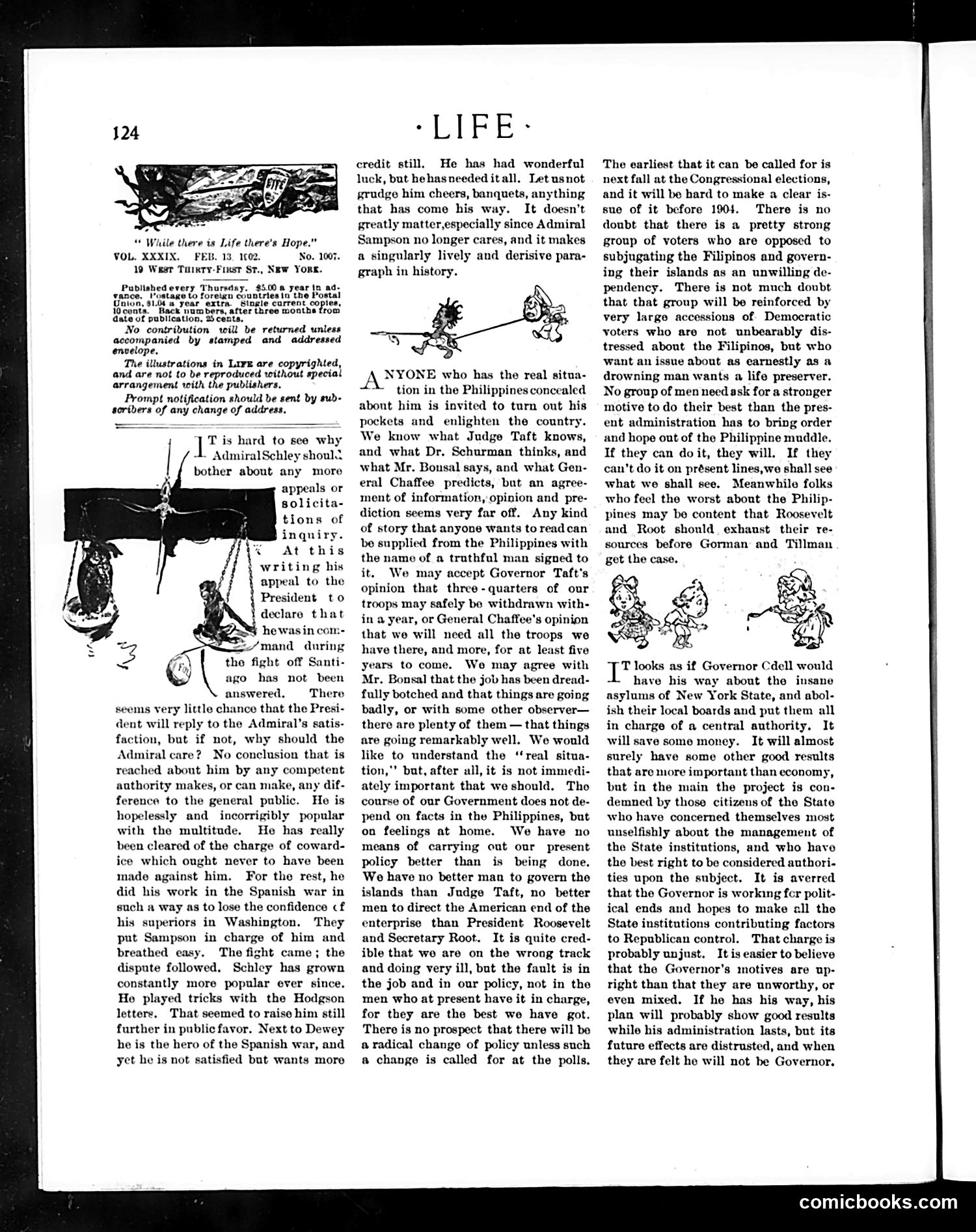
This page from *Life* magazine presents satirical commentary on American governance in the Philippines following the Spanish-American War. The text discusses Admiral Schley and various officials' contradictory statements about Philippine policy and troop requirements. The cartoons (though small and somewhat unclear) appear to illustrate the confusion and disagreement among government figures about how to manage the colonial administration. The satire targets the inconsistency between different leaders' public statements—President Roosevelt, Secretary Root, General Chaffee, and Governor Taft all allegedly offering conflicting assessments about Philippine pacification and governance needs. The underlying critique suggests the administration lacks coherent policy direction, with officials making contradictory claims about military necessity, administrative capability, and the actual situation on the ground in the Philippines.
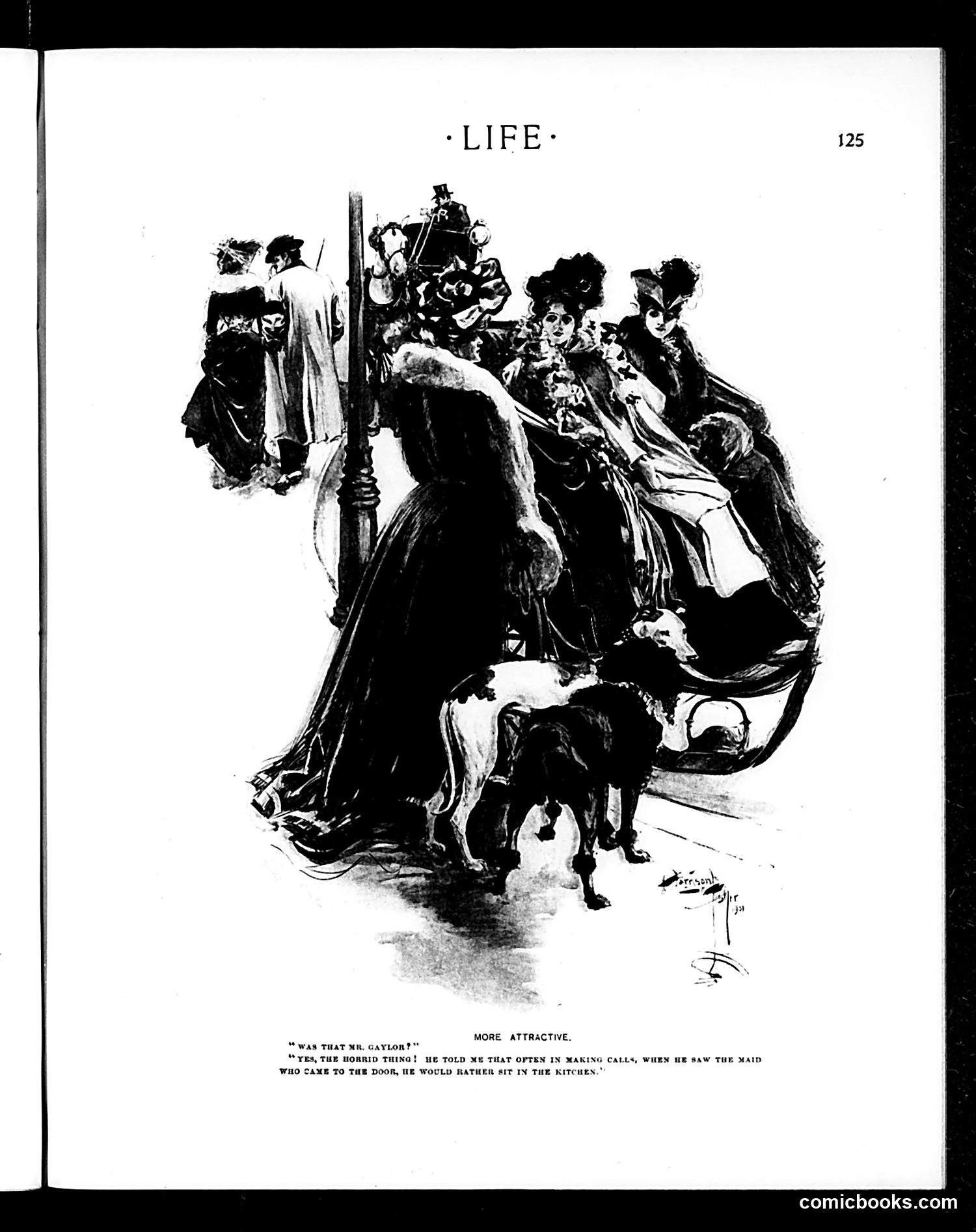
This illustration satirizes social pretension and servant management among the wealthy. The caption quotes Mr. Gaylor discussing a maid's behavior: he instructed the maid that when making calls, if she encountered the door-opener, "he would rather sit in the kitchen." The cartoon depicts an elegantly dressed woman in an elaborate gown and feathered hat, accompanied by her small dog, surrounded by fashionable society figures. The satire mocks the absurd class hierarchies of the period—the notion that a gentleman would prefer his maid sequester herself in the kitchen rather than be seen by domestic staff. It ridicules both the master's snobbish pretensions and the servant-class anxieties that enabled such ridiculous social conventions.
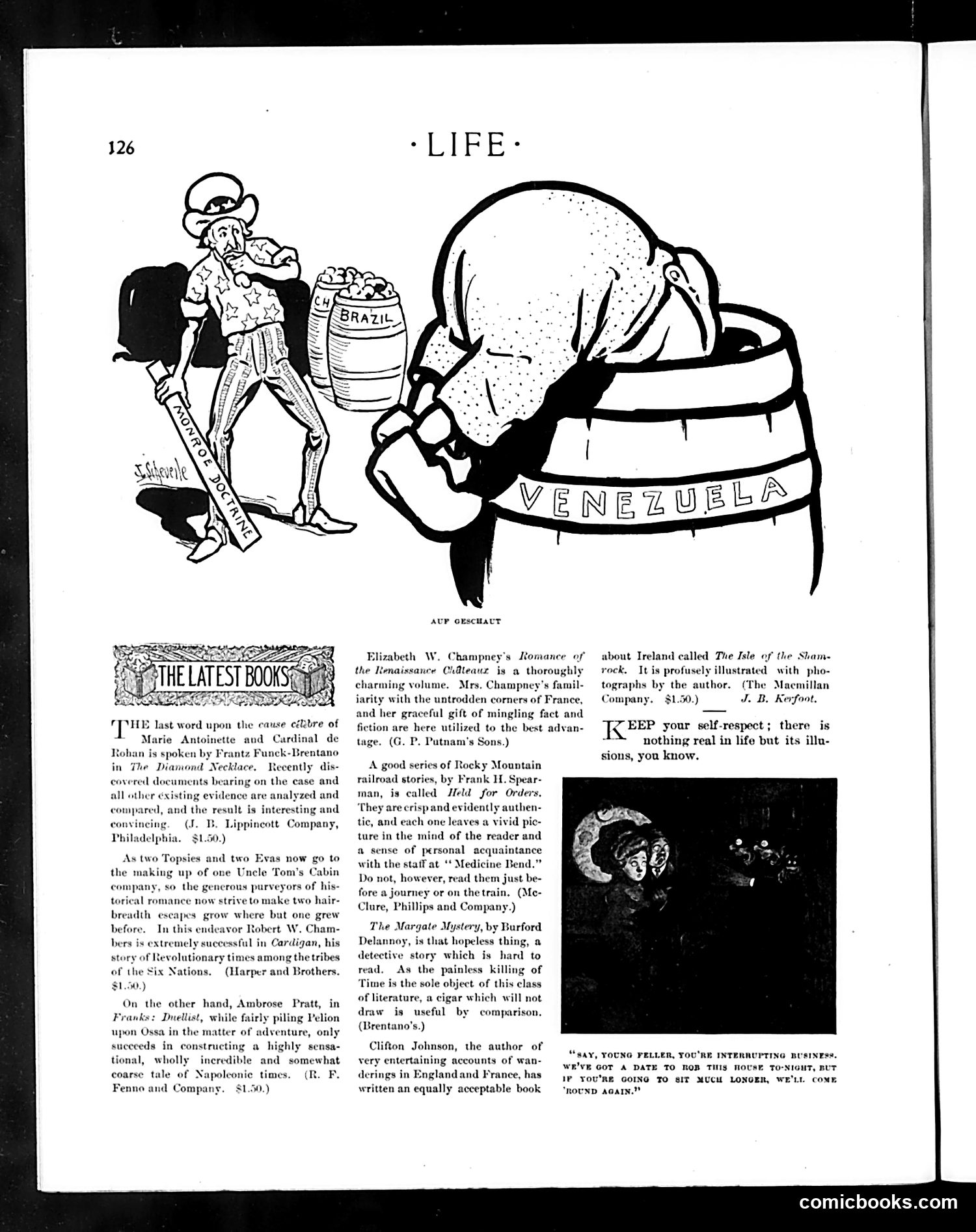
This cartoon by Auergescht satirizes **Venezuela's economic dependence on Brazil**. The skeleton figure labeled "Venezuela" is depicted being stuffed into a barrel, while a skeletal, elaborately dressed figure (representing Venezuela's leadership or the nation itself) stands nearby with a barrel labeled "Brazil." The imagery suggests Venezuela is being consumed or absorbed by Brazilian economic dominance—the skeleton represents a nation being hollowed out or impoverished. The exaggerated, skeletal portrayal emphasizes Venezuela's economic weakness compared to Brazil's apparent strength. This likely reflects early 20th-century Latin American economic tensions, when wealthier nations like Brazil dominated trade and commerce in the region, leaving smaller economies economically vulnerable and subordinate.
This page presents a serialized story rather than political satire. The narrative follows "Cholly Steal," a lawyer of British-Canadian descent living in North America, through his courtroom victory and subsequent domestic life. The illustration shows Cholly in court, confidently presenting his case. The story establishes him as a shrewd legal professional who wins cases through skill—he successfully defended Jean Crapaud, a disheveled *habitant* (French-Canadian farmer), securing acquittal despite weak evidence. The text emphasizes Cholly's respectability, his marriage to the "cold blonde" Kathleen, and his growing family troubles, including his brother Willie's moral failings. This appears to be entertainment fiction rather than political commentary, reflecting early 20th-century attitudes toward class, ethnicity, and respectability.
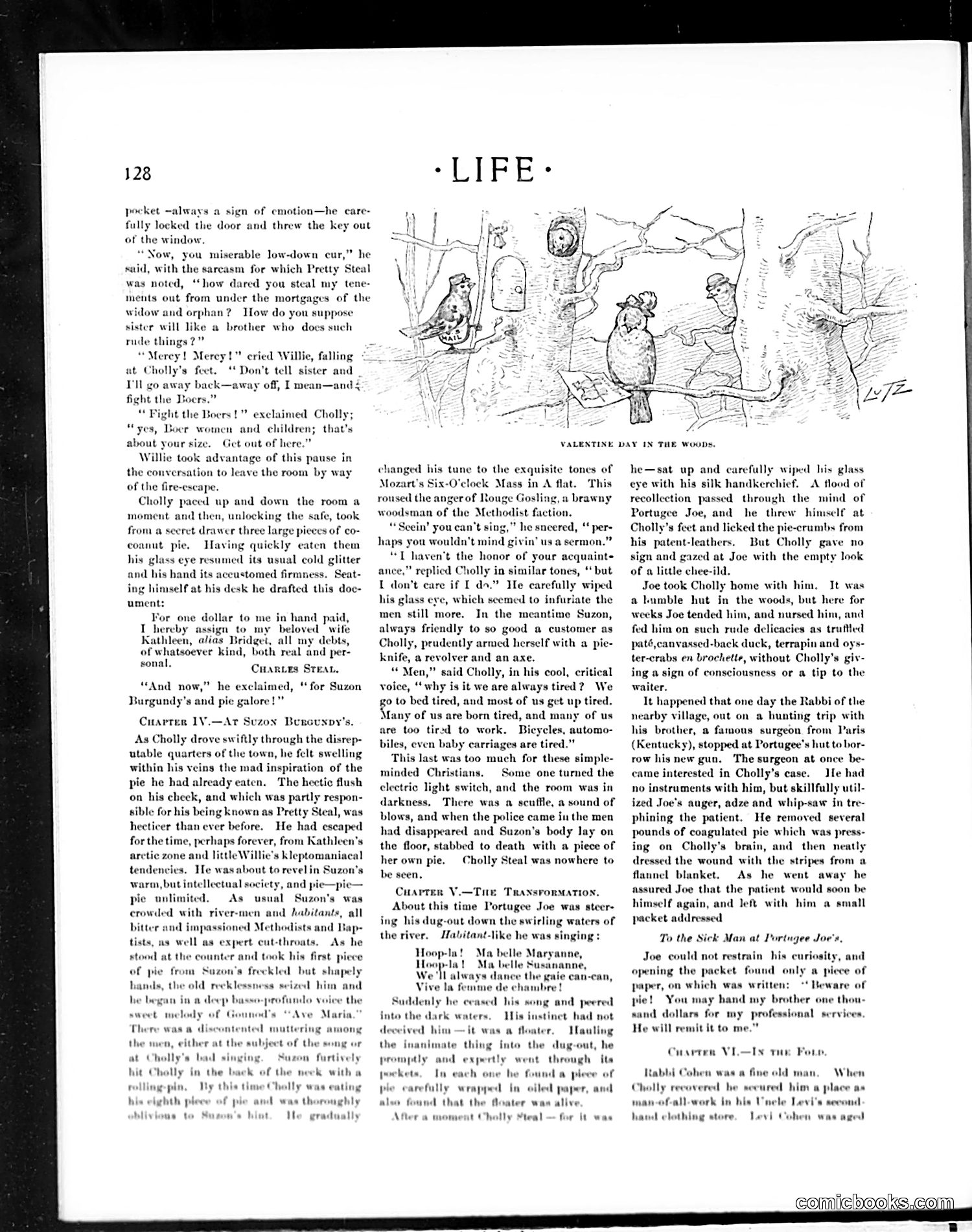
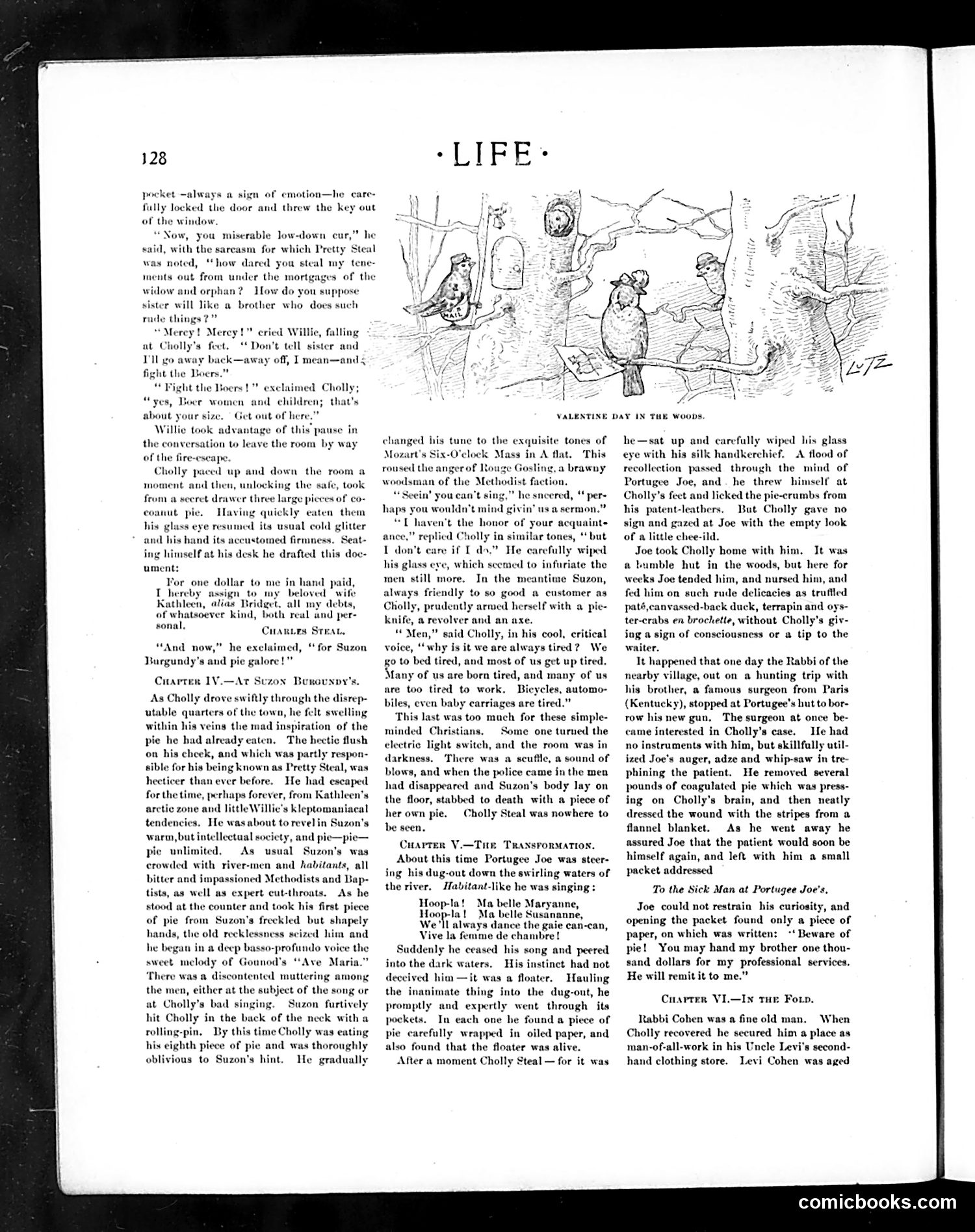
This cartoon depicts a romantic woodland scene where a couple exchanges affections. The sketch shows two figures among trees, apparently celebrating Valentine's Day in a natural setting. The surrounding text is a narrative story (not satirical commentary) about characters named Cholly, Willie, Joe, and others involved in domestic drama—discussing insults, fights with "Boers," and church disputes. The story mentions a Rabbi and surgeon from Paris, suggesting early 20th-century urban immigrant life. The cartoon itself appears straightforward romantic sentiment rather than political satire. It illustrates the magazine's mixed format: combining light social humor and domestic storytelling with simple illustrative art. The "satire" is gentle social observation about courtship rather than sharp political commentary.
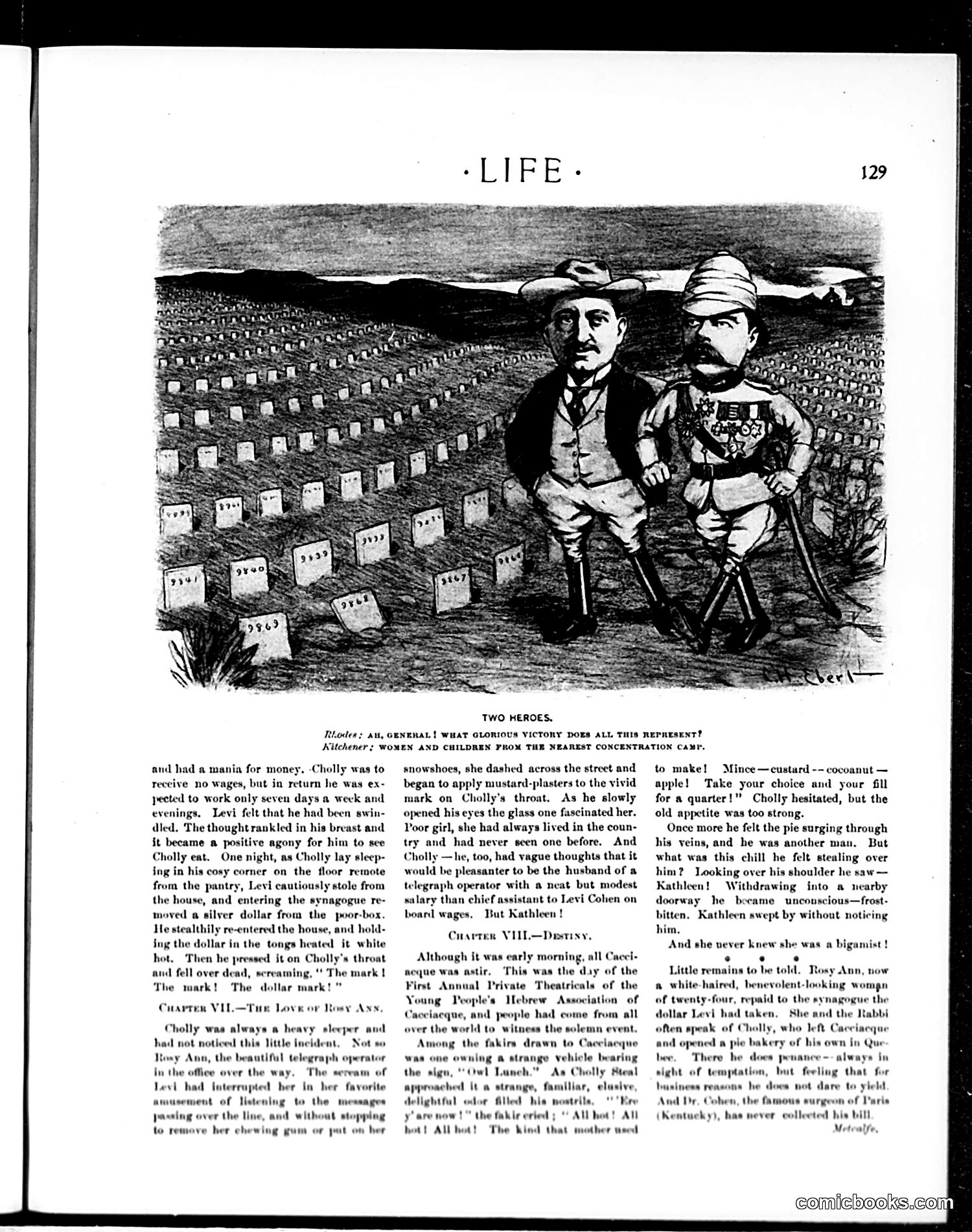
This satirical cartoon depicts two figures standing in a military cemetery filled with numbered grave markers. The left figure appears to be a civilian politician in a bowler hat; the right is a military officer in uniform with medals and a plumed hat. The caption reads: "Blodgett: 'Ah, General! What glorious victory does all this represent?' Kitchener: 'Women and children from the nearest concentration camp.'" This is anti-war satire condemning military conduct, likely referencing the Boer War (1899-1902) where British forces used concentration camps. The joke's dark irony: the "glorious victory" the politician celebrates actually represents civilian deaths—exposing the disconnect between political rhetoric about military glory and the humanitarian reality of warfare.
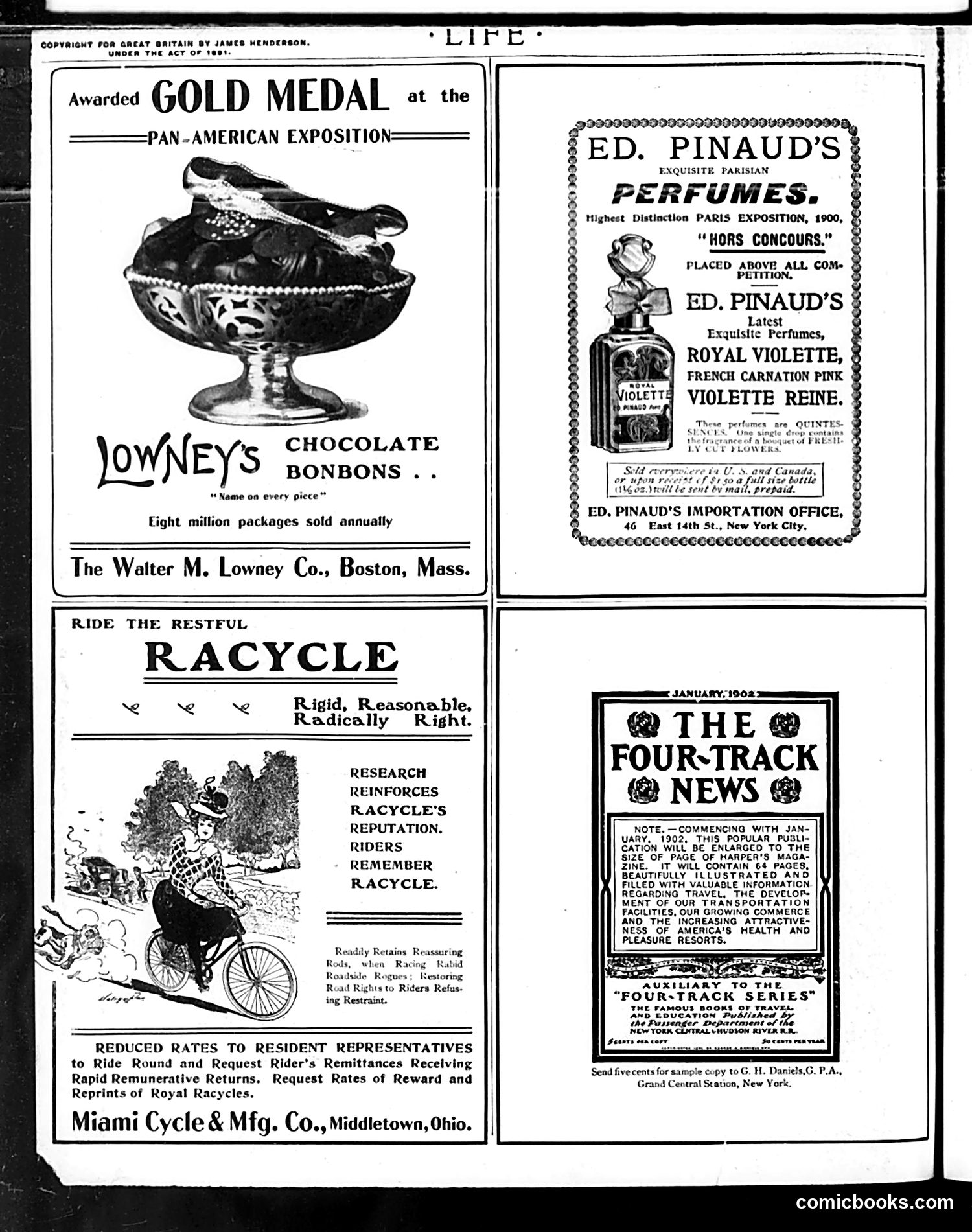
This page is primarily **advertising content** from Life magazine, not satirical cartoons. It contains four advertisements: 1. **Lowney's Chocolate Bonbons** - promoting a gold-medal-winning confection with decorative packaging imagery 2. **Ed. Pinaud's Perfumes** - a French luxury perfume company advertising their "Hors Concours" award-winning products 3. **Racycle bicycles** - promoting rigid, reasonable, "radically right" bicycles with safety features for riders 4. **The Four-Track News** - announcing an expanded railroad publication The Racycle ad includes illustrative imagery of a cyclist, but these are **product advertisements rather than political satire**. The page reflects early 1900s consumer marketing targeting middle and upper-class readers interested in luxury goods and modern technology.
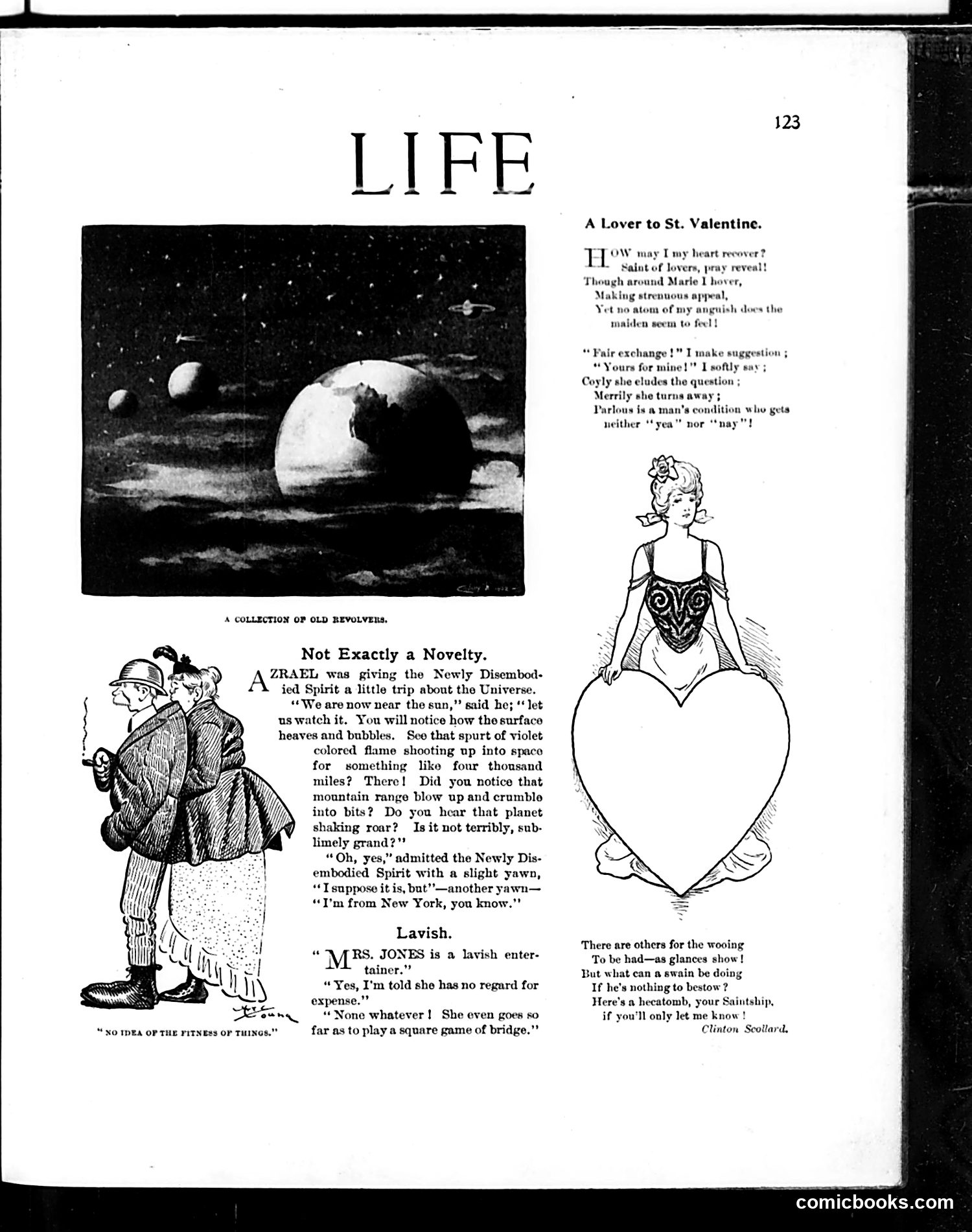
This page contains three distinct satirical pieces: 1. **"A Lover to St. Valentine"** — A poem mocking romantic uncertainty, illustrated with a woman in a heart-shaped frame. It jokes about courtship confusion and women's coy responses to romantic advances. 2. **"Not Exactly a Novelty"** — Features two figures discussing a tour of the universe. The satire targets pseudointellectual or pretentious discourse about cosmic wonders, with one character dismissing the spectacle as unremarkable ("I'm from New York, you know"). 3. **"Lavish"** — A brief joke about Mrs. Jones, a wasteful entertainer who doesn't care about expenses and refuses to play bridge—implying she's frivolous with money. All three pieces mock social pretension and romantic/social conventions of the era through gentle humor typical of early Life magazine's sophisticated satire.
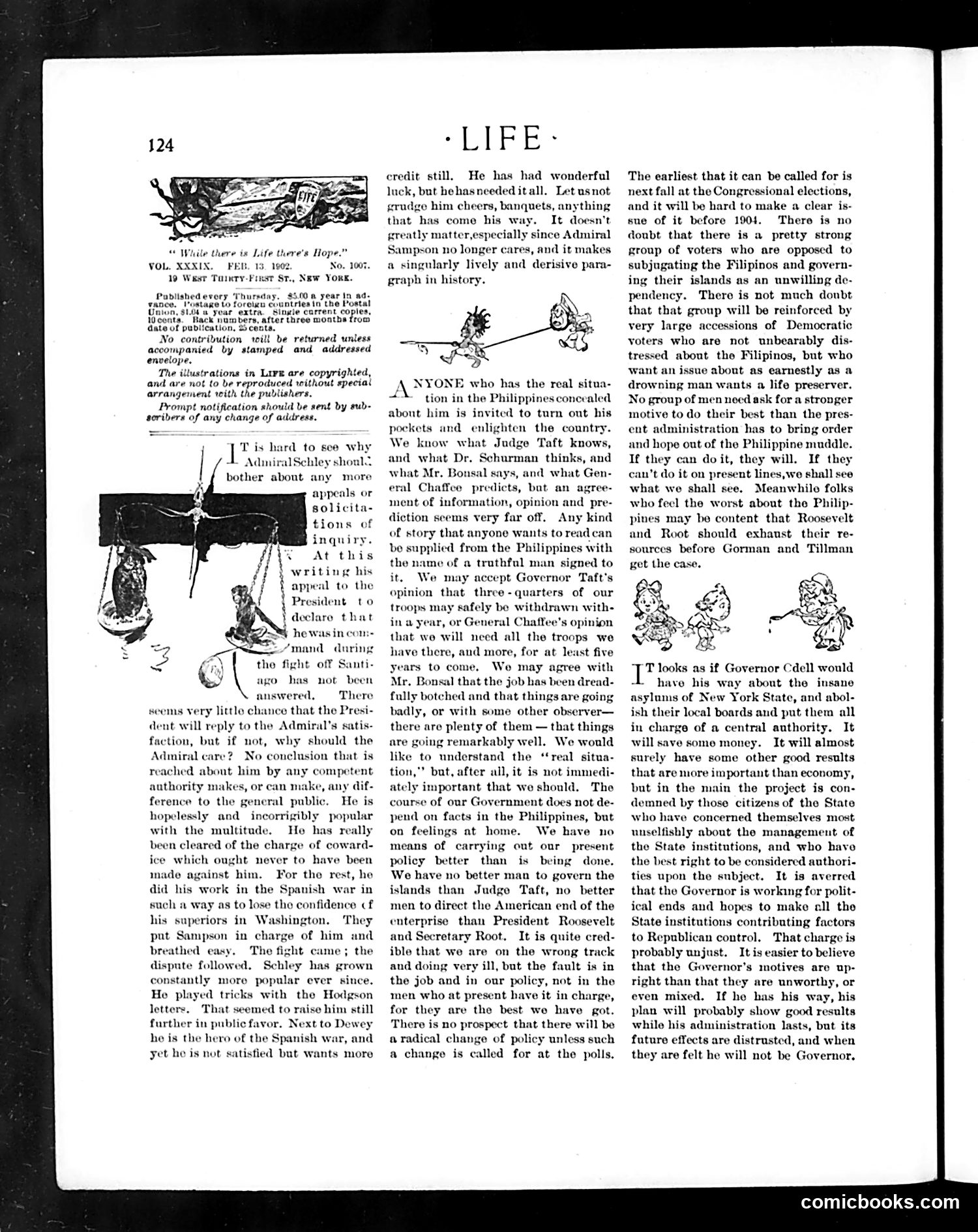
This page discusses Philippine governance during the American colonial period. The text debates whether Admiral Sampson should govern the Philippines, with the author arguing against his appointment despite acknowledging his "wonderful luck." The cartoon (left side) appears to show a figure at a desk or podium, likely depicting the administrative chaos of colonial governance—though the specific identity is unclear from the image alone. The satire criticizes those demanding change in Philippine policy while questioning whether current administrators (like Judge Taft) should be replaced. The author suggests that Governor Odell's proposed centralized authority for New York could serve as a model, arguing that state institutions need unified control rather than fragmented local boards. The piece reflects early 1900s American debates over imperial administration and good governance.
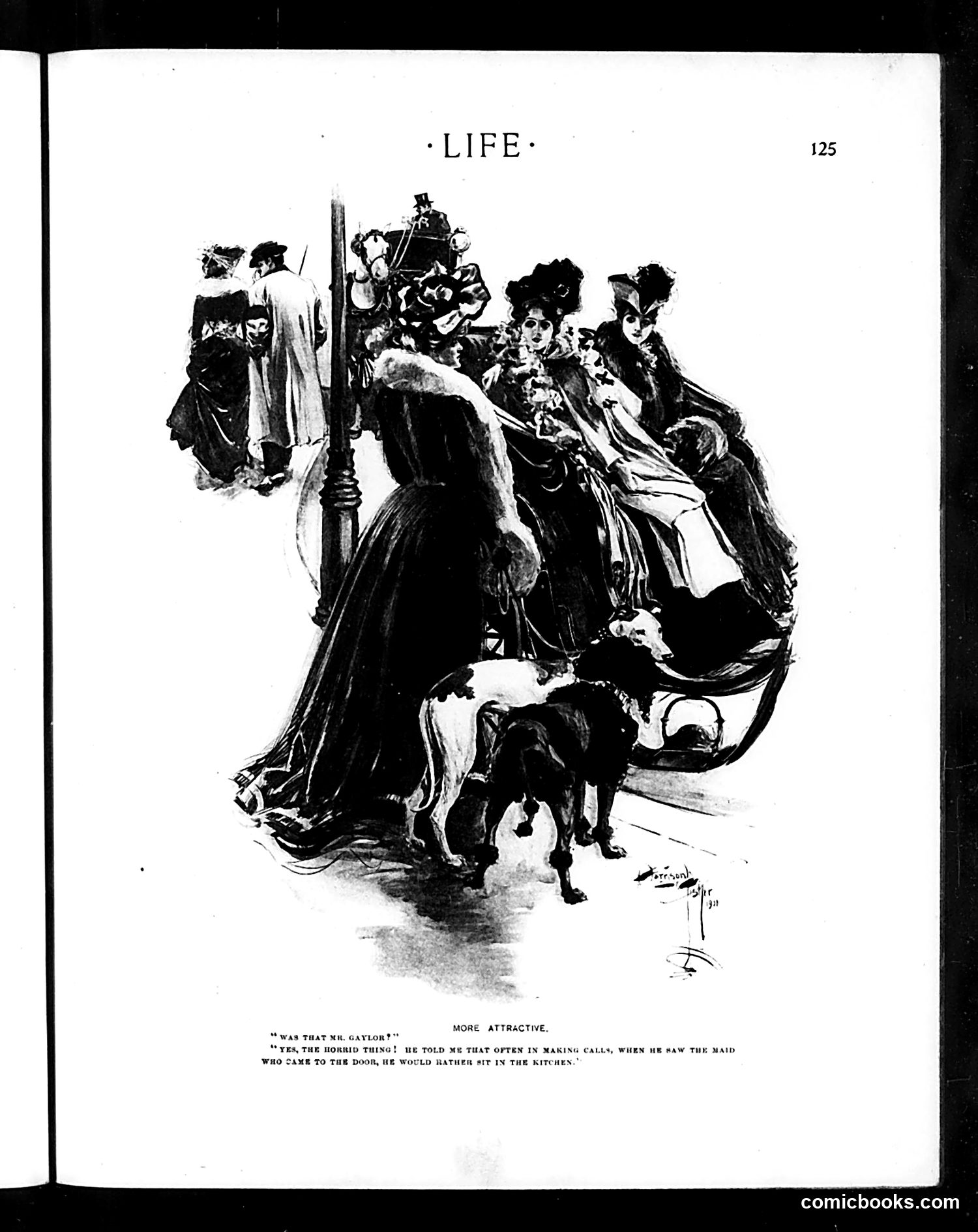
This Life magazine cartoon satirizes social pretension and servants. Two fashionably dressed women discuss a man's behavior: when making social calls, he preferred sitting in the kitchen with the maid rather than in the parlor with the ladies. The joke targets Victorian class hierarchies and gender conventions. The "horrid" revelation mocks the women's shock that a gentleman would find a servant more appealing company than society ladies. The cartoon implies the maid's genuine, unpretentious nature made her "more attractive" than the affected, snobbish socialites—undercutting both feminine vanity and class pretensions. The small dog observing the scene adds domestic humor, suggesting even pets witness such absurdities.
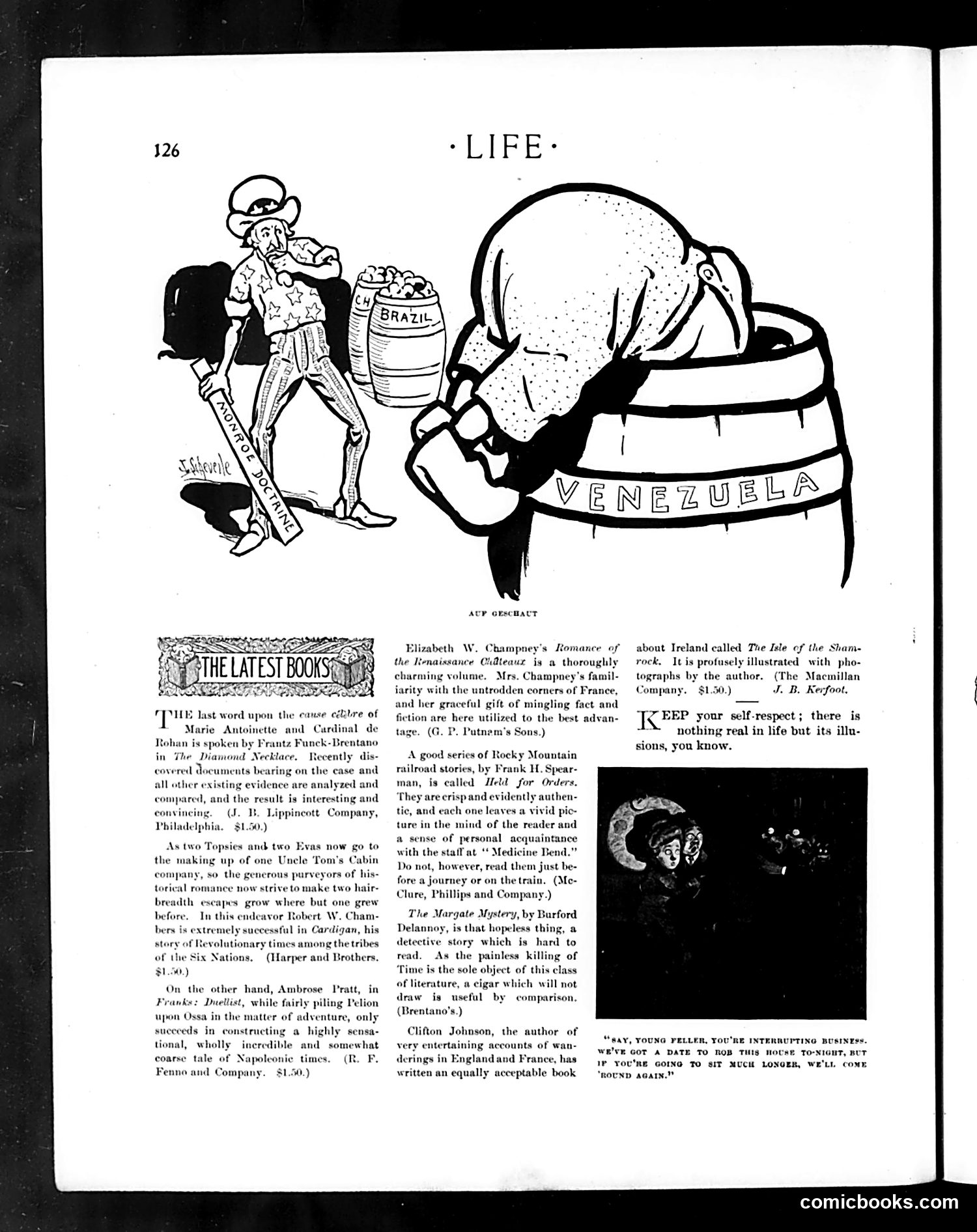
The main cartoon depicts a caricatured figure (likely representing a South American or Latin American nation, given the "Venezuela" label on the barrel) being squeezed or exploited by Uncle Sam (the tall American figure on the left, identifiable by his hat and clothing). A barrel labeled "Brazil" sits nearby. **The satire's point:** This appears to criticize American imperial or economic expansion in Latin America during the early 20th century—the "squeezing" suggests extracting resources or wealth from these nations. The artist (signed "Cesare") is satirizing U.S. foreign policy and intervention in the region. The page is primarily a book review section, with the cartoon serving as visual commentary on American foreign relations rather than directly related to the literary content being discussed.
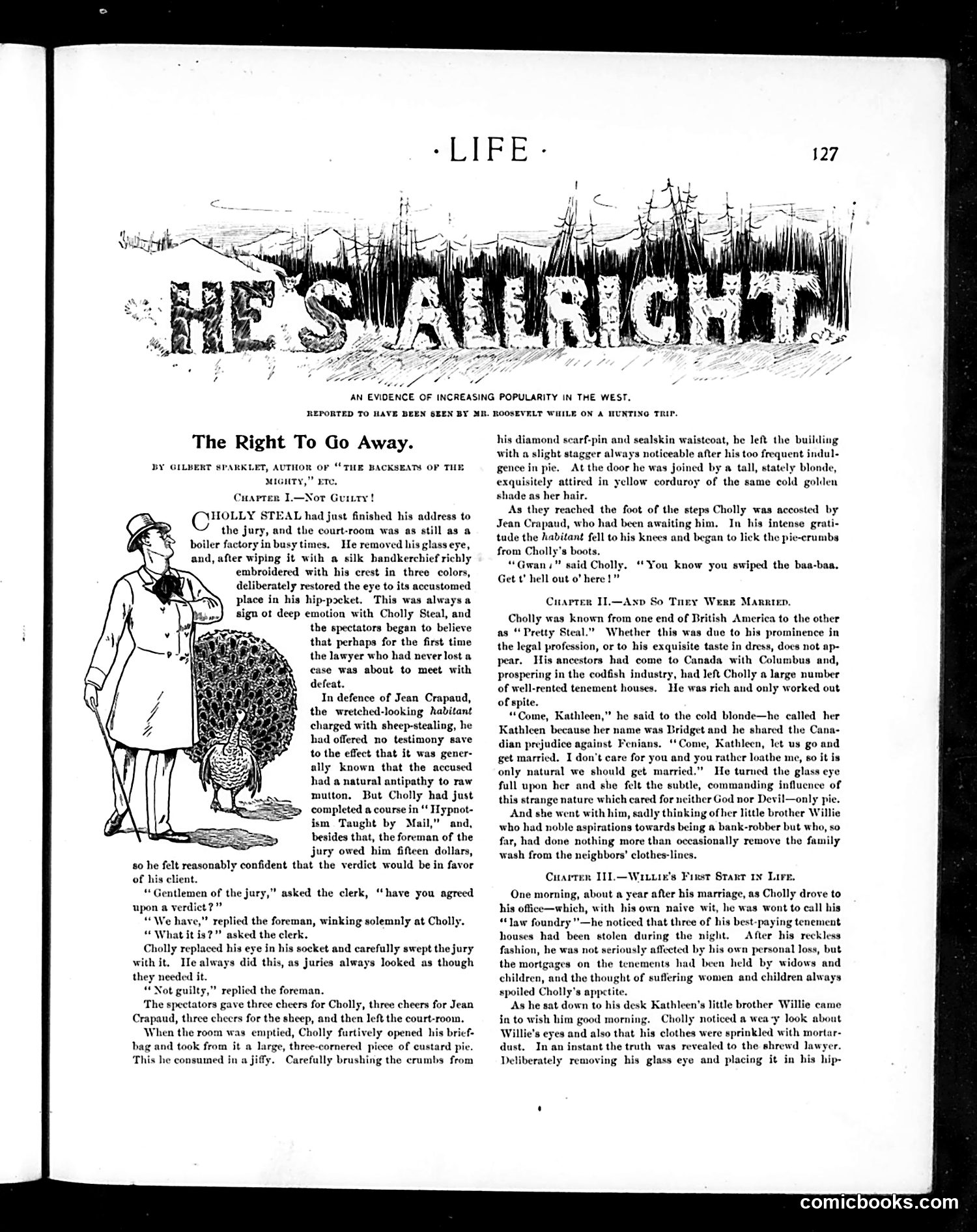
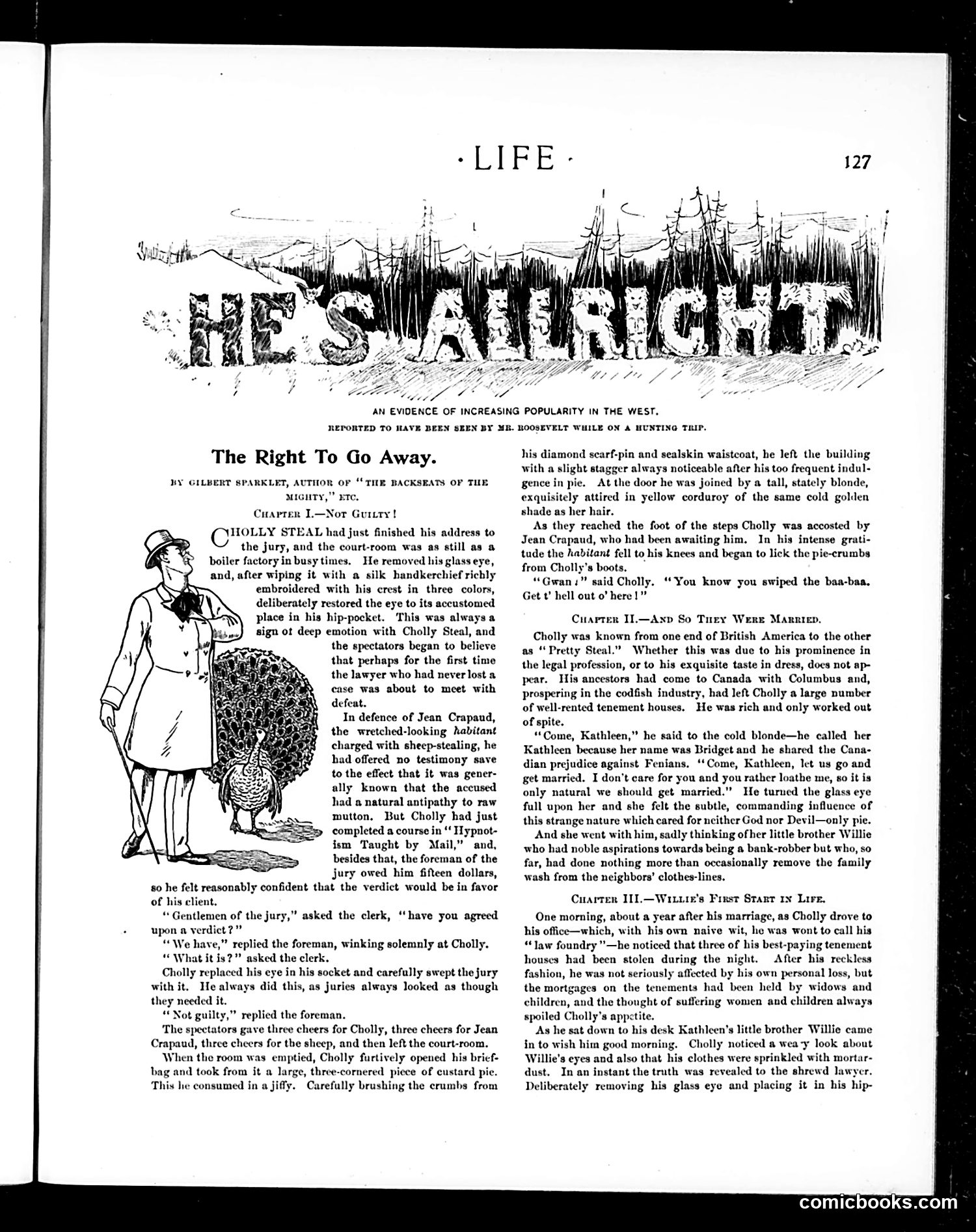
This page presents the opening chapters of a serialized satirical story by Gilbert Sparklet titled "The Right To Go Away," subtitled "An Evidence of Increasing Popularity in the West" and "Reported to have been seen by Mr. Roosevelt while on a hunting trip." The story mocks a corrupt Canadian lawyer named "Cholly Steal" (the name itself a joke) who wins a sheep-stealing case through bribery and hypnotism correspondence courses rather than legitimate defense. The humor relies on absurdist exaggeration: Steal removes his glass eye during emotional moments, eats custard pie constantly, and marries a woman named Kathleen (actually Bridget) whom he doesn't like—because "you rather loathe me, so it is only natural we should get married." The reference to Roosevelt's "hunting trip" suggests this satirizes frontier/western legal corruption and character. The illustration shows Steal as a portly, well-dressed figure—a caricature of the conniving lawyer type. The satire targets legal system corruption and the amoral wealthy through absurdist comedy.
This page contains a serialized story rather than political cartoons. The narrative follows "Pretty Steal" (Cholly), a kleptomaniac protagonist who steals from widows and orphans. When confronted by a character named Willie about his thievery, Cholly dismisses him by sarcastically suggesting Willie fight "the Boers"—a reference to the Second Boer War (1899-1902), implying the conflict was trivial or a way to dispose of troublemakers. The story satirizes turn-of-the-century American society through absurdist humor: Cholly's emotional eating of pie, his glass eye, his dramatic operatic singing in a working-class bar frequented by "bitter and impassioned Methodists and Baptists," and the eventual chaos. The social commentary targets class tensions, religious hypocrisy, and moral corruption among the wealthy and working poor alike. The Boers reference dates this to the early 1900s.
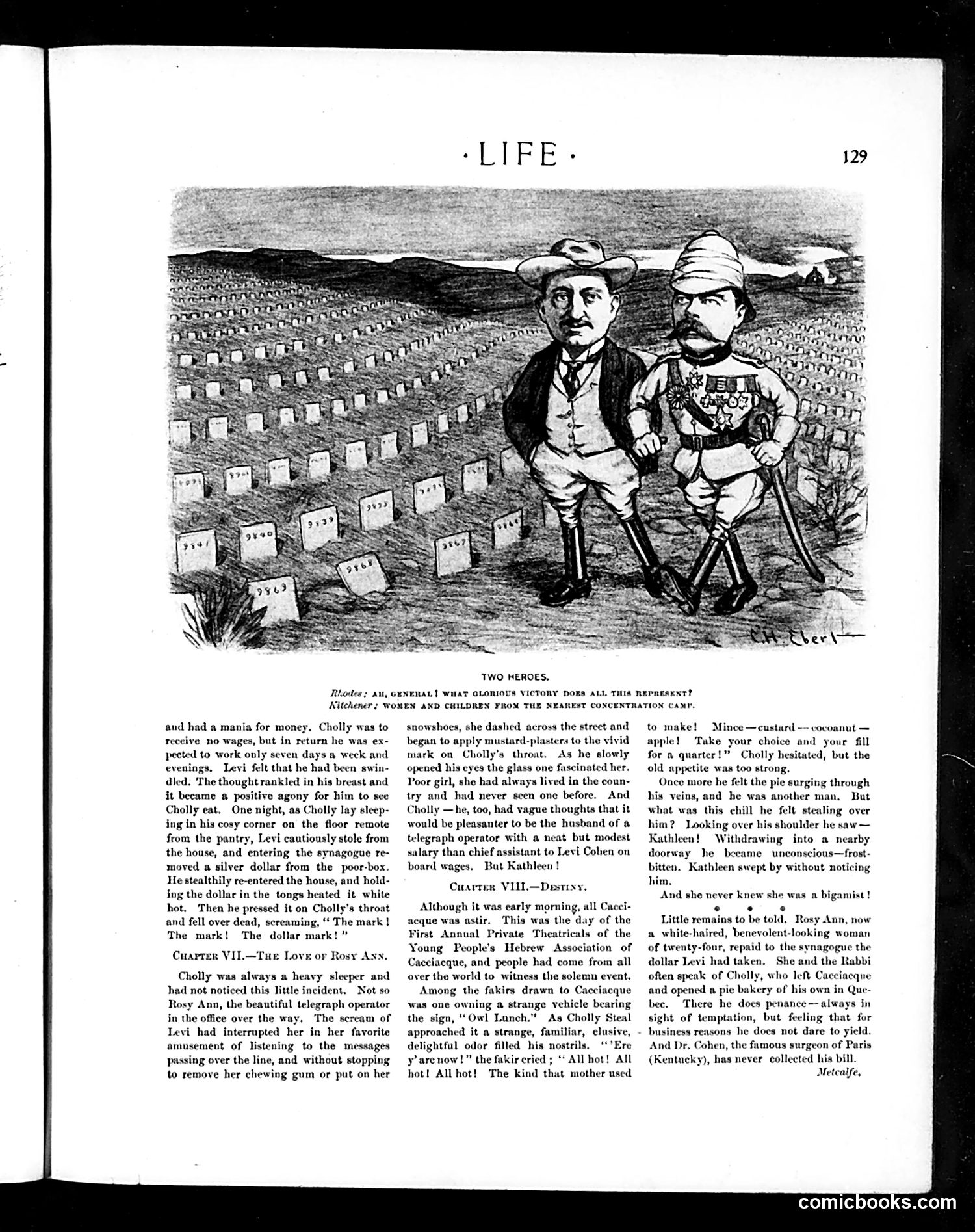
This political cartoon satirizes British imperial leadership during the Second Boer War (1899-1902). The two figures are **Cecil Rhodes** (left, civilian) and **Lord Kitchener** (right, military officer in uniform with medals), both prominent British figures in South Africa. The caption's bitter joke exposes the human cost of British victory: Rhodes asks what "glorious victory" the masses represent, and Kitchener responds they are "women and children from thy nearest concentration camp"—a direct reference to Britain's controversial internment camps where Boer civilians, including families, were imprisoned under harsh conditions, with high mortality rates. The cartoon criticizes how Rhodes and Kitchener celebrated military success while ignoring civilian suffering caused by British strategy. This was a genuine scandal in Britain and internationally; the camps became a symbol of imperial brutality and were widely condemned by anti-war activists. The remaining text on the page—a serialized humorous story about characters named Cholly and Levi—appears unrelated to the political cartoon above it.
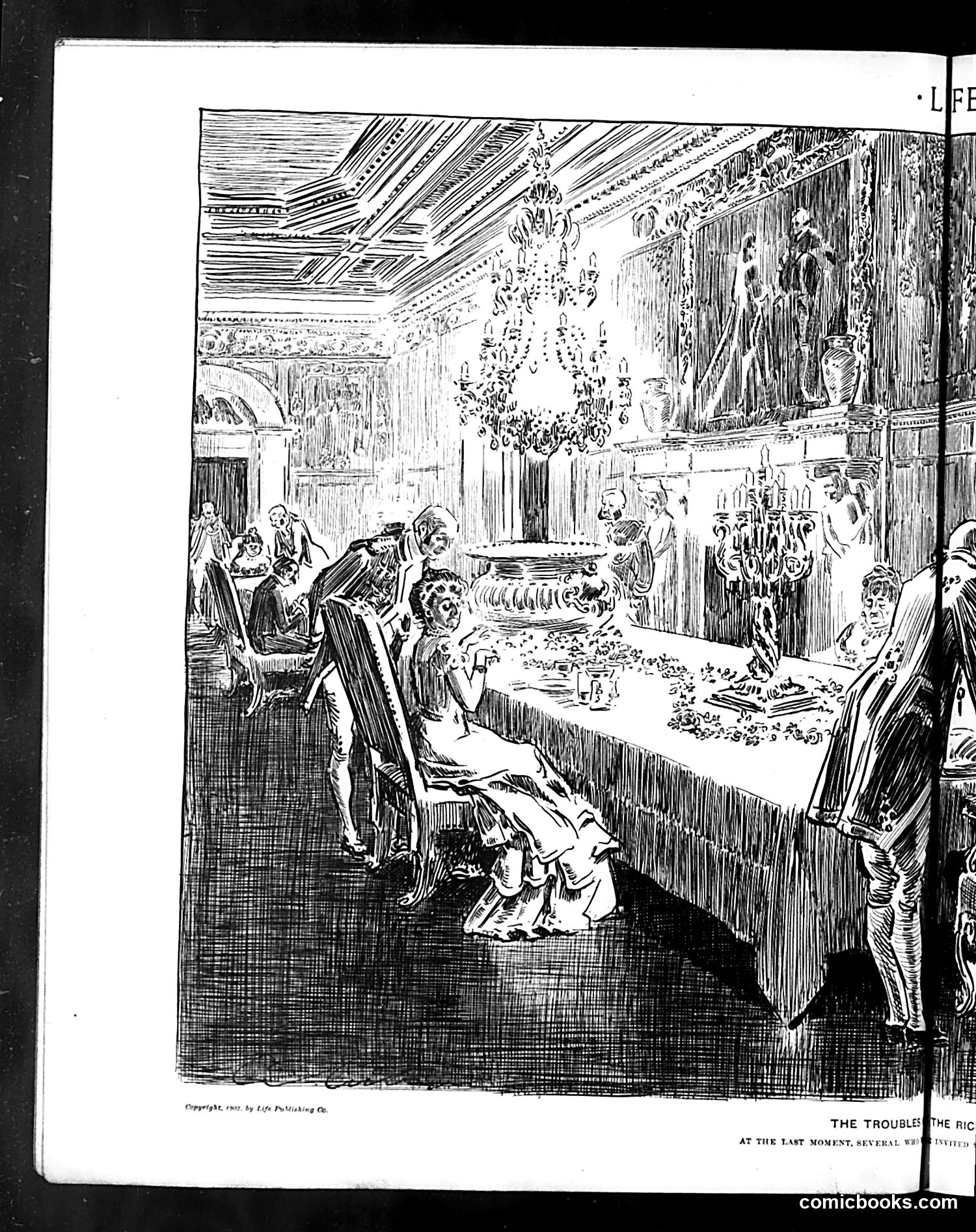
This is a black and white sketch from *Life* magazine (copyright noted at bottom) titled "THE TROUBLE AT THE LAST MOMENT, SEVERAL WERE DIVIDED" (visible at page bottom). The scene depicts an elegant formal dinner in a grand ballroom with chandeliers, ornate walls, and waiters. The satire focuses on social tension: well-dressed guests seated at a dining table appear awkward or uncomfortable, while a woman in the foreground kneels or crouches in an unusual posture—suggesting embarrassment, distress, or social impropriety at a formal event. The joke likely satirizes upper-class social pretension and how easily formal gatherings descend into awkwardness or conflict. The "trouble" and "divided" caption suggests guests disagreed about something, disrupting civility. Without additional context, the specific social or political reference remains unclear.
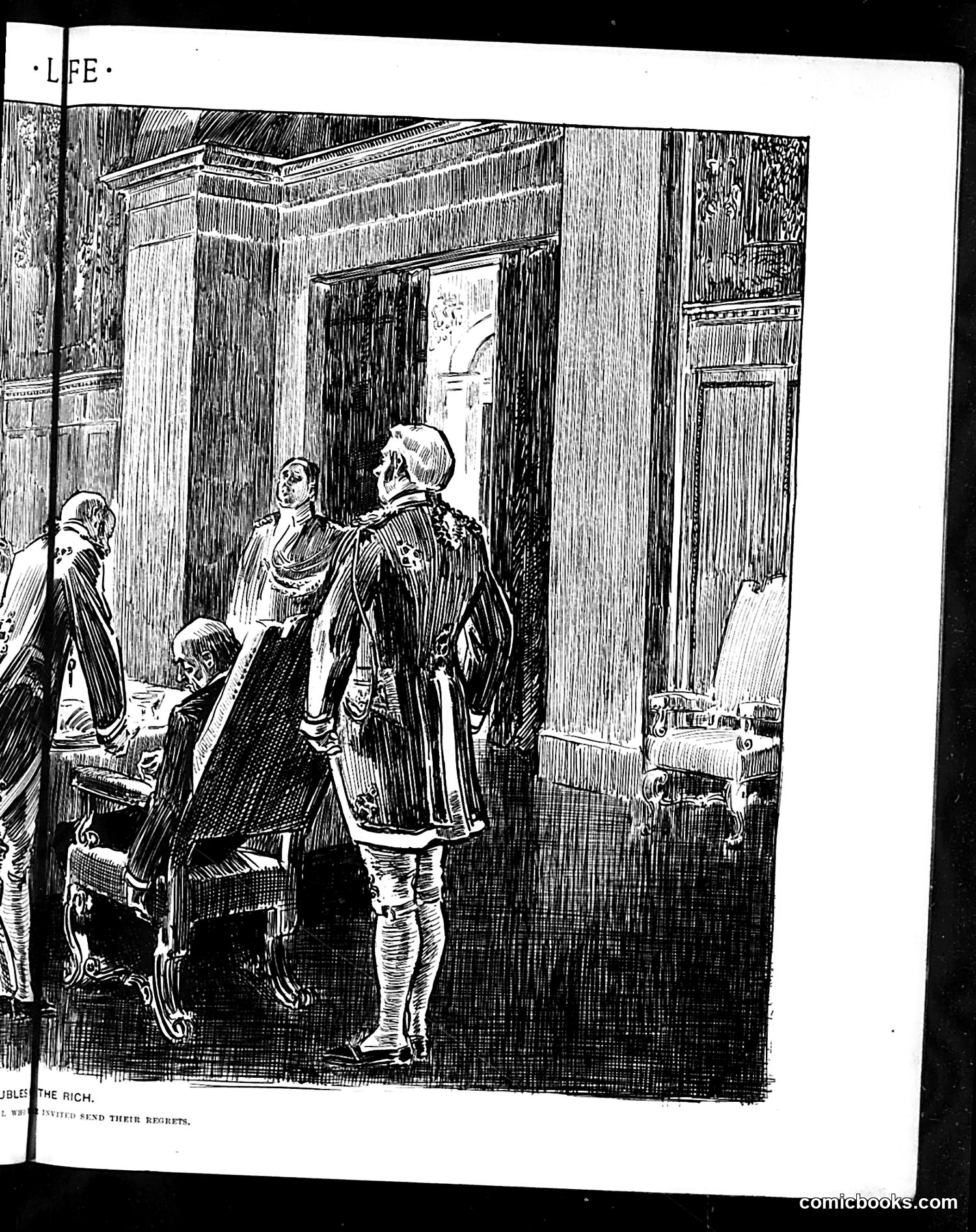
This appears to be a satirical scene from Life magazine depicting what the visible caption fragment suggests relates to "the rich" and regrets. The engraving shows an ornate interior (likely a palace or mansion) with several figures in formal 19th-century military dress and civilian clothing. A military officer in decorated uniform stands prominently, conversing with another figure, while additional attendants or courtiers are positioned around the room. The satire appears to critique wealthy or aristocratic figures and their social regrets, though the full context of the specific political or social commentary is unclear without the complete caption and surrounding articles. The formal setting and military uniforms suggest this may address themes of class, power, or institutional authority common to satirical publications of this era.
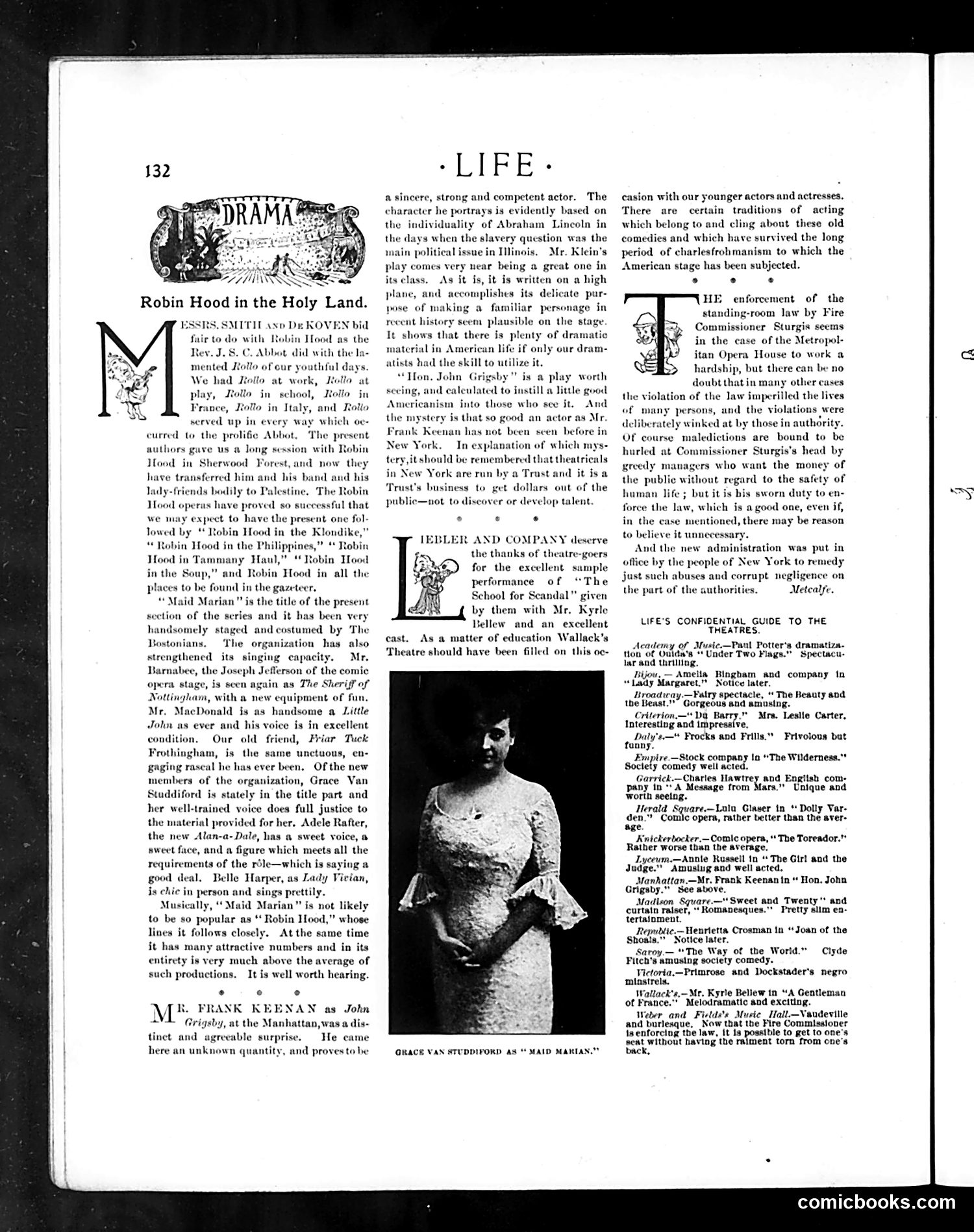
This page reviews theatrical productions, primarily focusing on comic operas and plays. The main content discusses "Maid Marian," a Robin Hood-themed operetta, noting it's less popular than the original "Robin Hood" but features strong performances by Grace Van Studdiford and other cast members. A second review covers a production of "The School for Scandal" at Wallack's Theatre, praising it as educational theater that preserves theatrical traditions. The photograph shows **Grace Van Studdiford as "Maid Marian."** A brief note criticizes the Trust's monopoly on New York theater, lamenting that talented unknown actors like Frank Keenan cannot gain prominence because theatrical management prioritizes profits over developing new talent. Finally, there's commentary on Fire Commissioner Sturgis's enforcement of standing-room capacity laws, noting they inconvenience the Metropolitan Opera House but protect public safety elsewhere. The piece is primarily theater criticism rather than satire or political commentary.
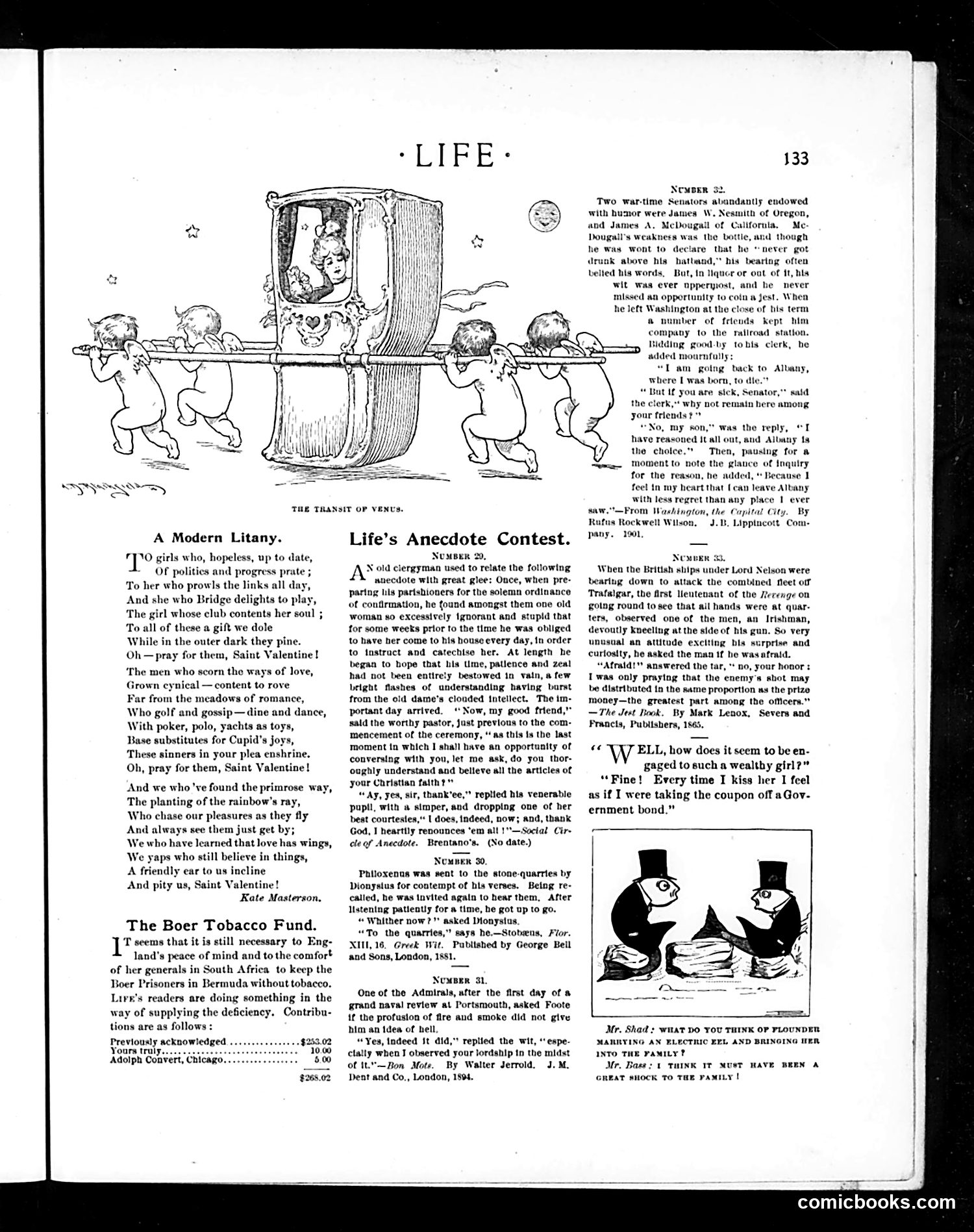
This page from *Life* magazine contains three distinct elements: **"The Transit of Venus" (A Modern Litany):** A satirical poem by Kate Masterson mocking contemporary leisure activities. It satirizes modern women ("girls hopeless, up to date") obsessed with golf, bridge clubs, and politics, and modern men who pursue polo, yachts, and poker instead of romance. The poem presents these pursuits as shallow substitutes for genuine love. **"The Boer Tobacco Fund":** References the Boer War (1899-1902) and British prisoners held in Bermuda. *Life* readers are contributing money to supply tobacco to these prisoners, suggesting sympathy for the Boer cause or humanitarian concerns about prisoner treatment. **"Life's Anecdote Contest":** Three numbered humorous anecdotes, including one about an elderly woman so ignorant she "heartily renounces" her Christian faith upon confirmation, and witty retorts involving Dionysus and British naval officers. The main cartoon, "The Transit of Venus," depicts cherubs carrying a classical female figure—satirizing pretentious cultural references or outdated romantic ideals.
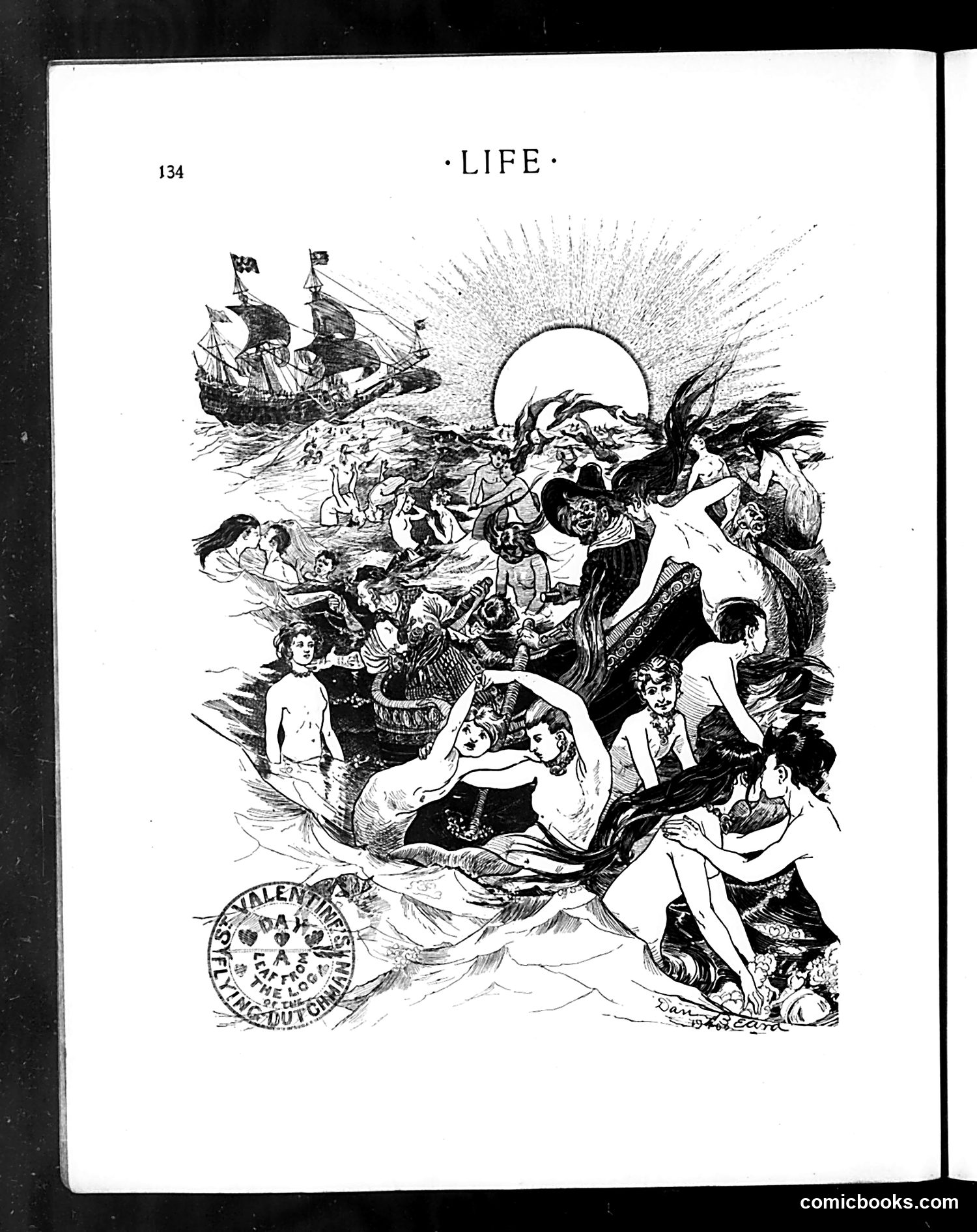
This is a title page or section divider for *Life* magazine (page 134), featuring an elaborate allegorical illustration rather than a specific political cartoon. The image depicts a fantastical seascape scene with a rising sun, classical figures, cherubs, and what appears to be a Renaissance-era sailing ship in the background. The central figures include nude or partially-draped women and putti (cherub-like children), arranged in a decorative composition typical of classical art allegory. A circular stamp or seal is visible in the lower left corner, though its text is not fully legible in this reproduction. Without additional OCR text or context, the specific satirical or political message remains unclear. This appears to be decorative/illustrative rather than a pointed commentary on contemporary events.
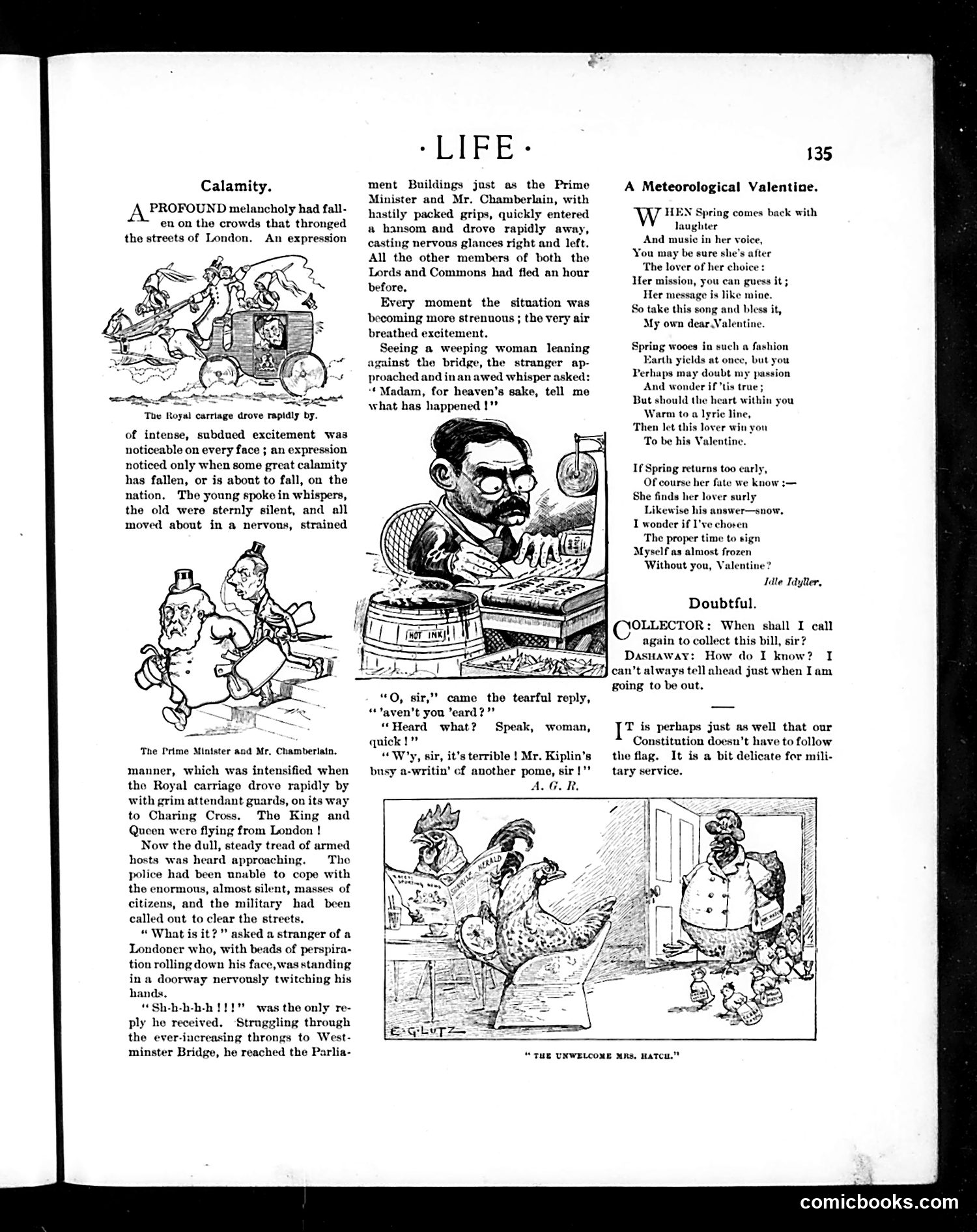
This page contains multiple pieces of satirical content: **"Calamity"** (left column): A fictional sketch depicting London in crisis—the King and Queen fleeing, Parliament evacuating, armed troops deployed. The punchline reveals the "disaster": Mr. Kipling is busy writing another poem. This satirizes Rudyard Kipling's prolific output and perhaps his tendency toward melodrama, treating his writing as a national emergency. **"A Meteorological Valentine"** (upper right): A sentimental poem about Spring wooing a lover, playing on meteorological language ("her fate we know—she finds her lover surly / Likewise his answer—snow"). Standard romantic verse with nature metaphors. **"Doubtful"** (middle right): A brief comic exchange between a bill collector and "Dashaway" about unpredictable payment schedules. **Bottom cartoon** ("The Unwelcome Mrs. Hatch"): Unclear without additional context, but appears to depict domestic/social discord involving a character named Mrs. Hatch. The page exemplifies Life's mix of political satire, light humor, and social commentary typical of early 20th-century American humor magazines.
This page from *Life* magazine contains humorous short stories rather than political cartoons. The main content includes: **"Scissors at Wully"** (top): A tall tale about a fakir selling a "magic pot" that supposedly turns stones to gold—but only if the buyer never thinks of a hippopotamus while using it. The joke: the psychological impossibility of the task makes the scheme foolproof for the charlatan. **Other anecdotes** include: - A cavalry recruit named Murphy who gets thrown from a horse and is punished for "dismounting without orders"—his reply "from hindquarters" is the punchline - A French princess attempting to infiltrate a monastery disguised as a boy, exposed when startled into grabbing her skirt - A clergyman's wedding story These are gentle, nonsensical humor pieces typical of early 20th-century American magazines—relying on wordplay, absurd situations, and ironic twists rather than political commentary. The page is primarily filled with period advertisements below the stories.
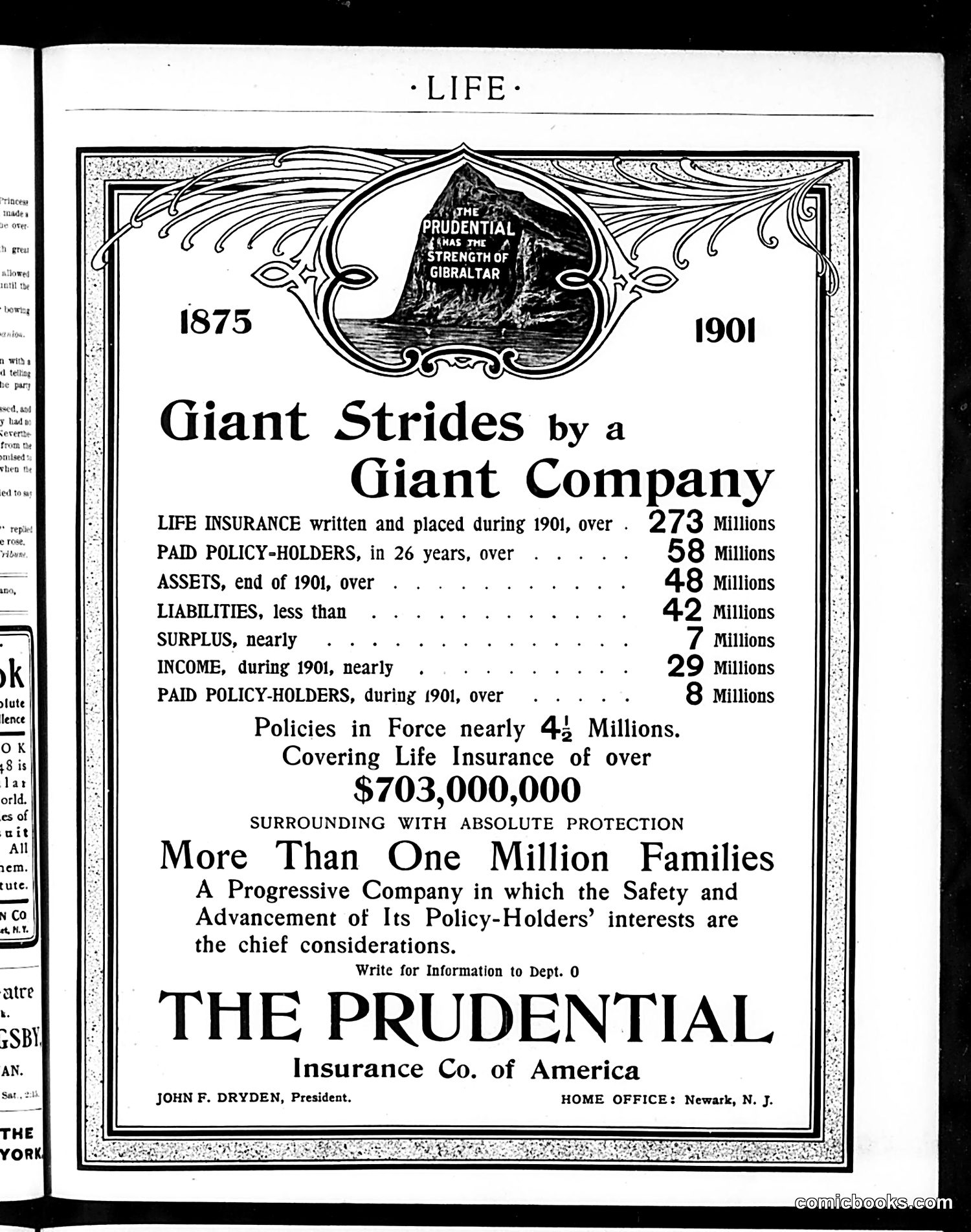
This page is **not satire or political commentary**—it is a straightforward **advertisement** for The Prudential Insurance Company of America, published in *Life* magazine around 1901. The page promotes Prudential's financial strength and growth, using the slogan "Giant Strides by a Giant Company." The Gibraltar imagery (top) symbolizes strength and stability. The advertisement lists impressive statistics: $703 million in life insurance coverage, nearly 4.5 million policies, and assets of 48 million dollars. The copy emphasizes that Prudential protects "More Than One Million Families" and positions itself as a "Progressive Company" prioritizing policyholders' safety. This was a common marketing approach for insurance firms in the early 1900s—establishing consumer confidence through numerical proof of solvency and growth. The page reflects the era's advertising style and Prudential's historical dominance in American life insurance.
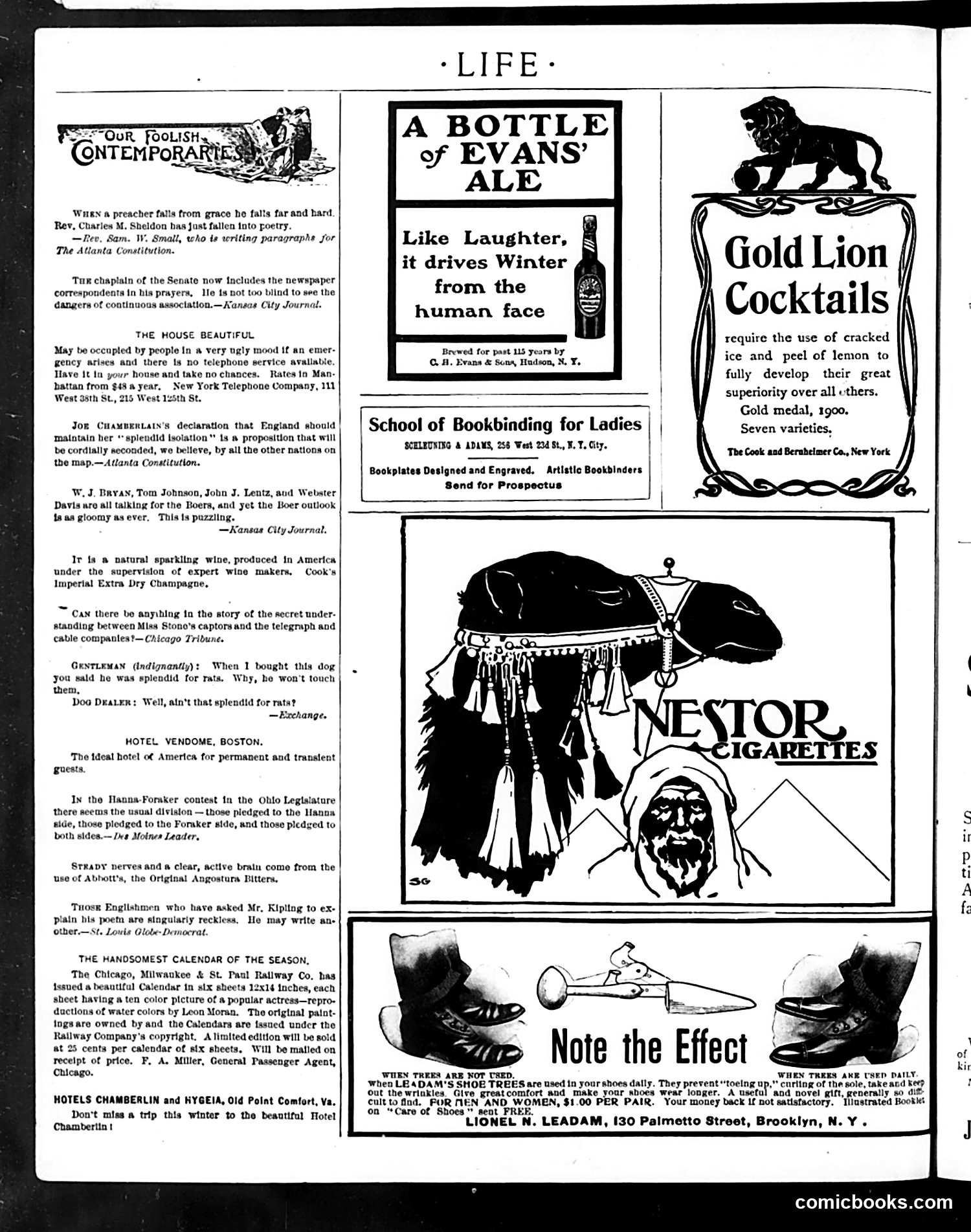
This page is primarily **advertisements and brief satirical commentary** typical of Life magazine's format. The main cartoon/image is the **Nestor Cigarettes advertisement** featuring a camel loaded with goods and a turbaned figure—a common orientalist marketing trope of the era playing on exotic mystique to sell cigarettes. Below that, **Leadam's Shoe Trees advertisement** uses before-and-after imagery showing shoe damage without the product versus preservation with it—a straightforward product demonstration. The text sections are short satirical quips mocking contemporary figures and events: Rev. Sheldon's "fall into poetry," Senate chaplains praying near journalists, Joseph Chamberlain's "splendid isolation" policy, and the Boer War's gloomy outlook. There's also a **dog dealer joke** playing on the ambiguity of "splendid for rats" (good at catching them vs. good because the dog won't harm them). The page reflects early 1900s advertising aesthetics and Life's role as a humor magazine mixing advertisements with topical social commentary.
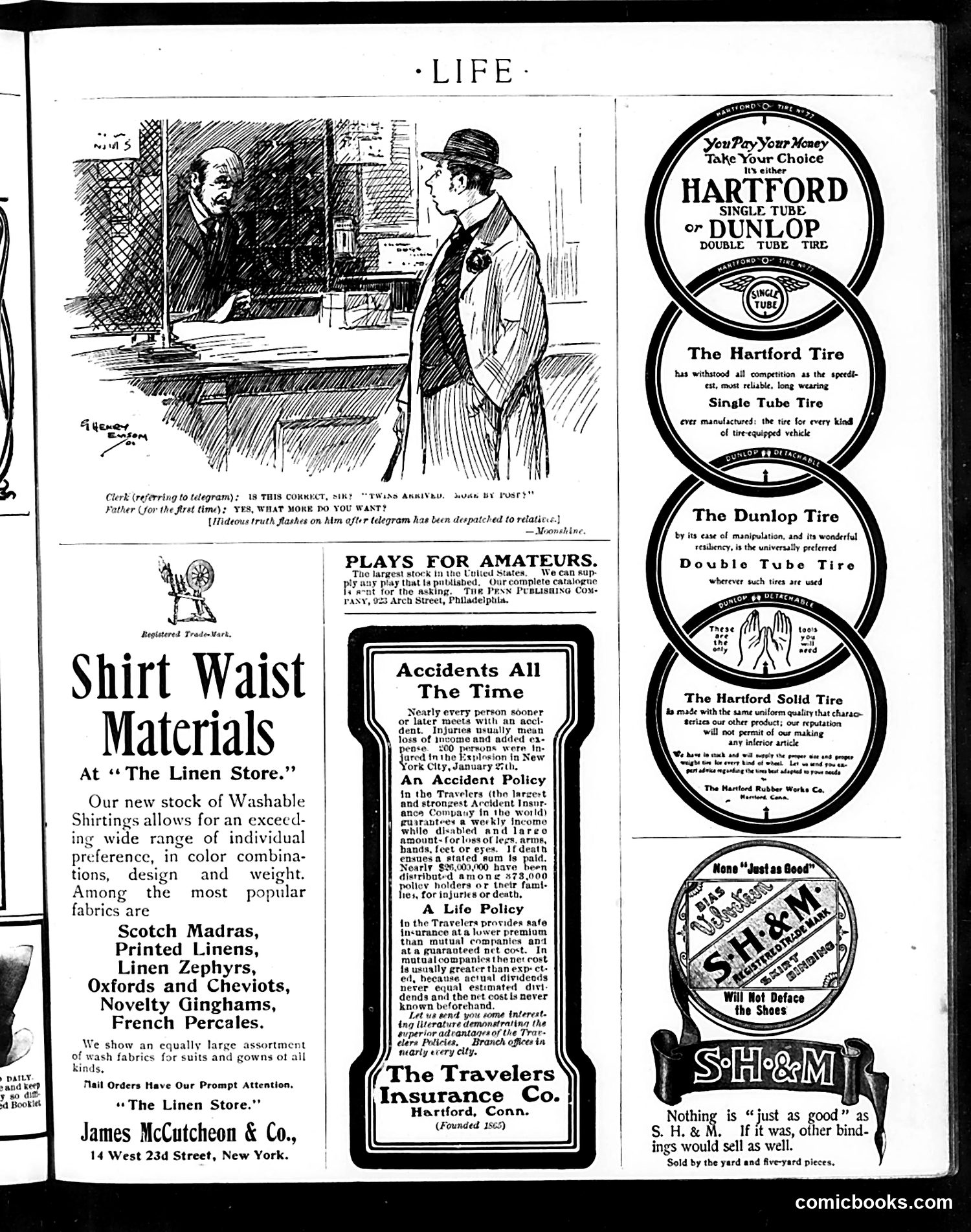
The main cartoon depicts a father receiving a telegram from a clerk at what appears to be a telegraph office. The father initially approves the message as correct, but the caption suggests he experiences sudden realization of bad news after sending it—"Hideous truth flashes on him after telegram has been despatched to relativ[e]." This is a common early-20th-century humor trope: the ironic moment when someone realizes they've made a mistake after it's too late. The joke relies on the contemporary reliance on telegrams for important communications—once sent, the message cannot be recalled, making any error permanent and immediately consequential. The rest of the page consists of period advertisements for shirt materials, plays, insurance policies, and automobile tires—typical Life magazine content from this era, with no satirical intent.
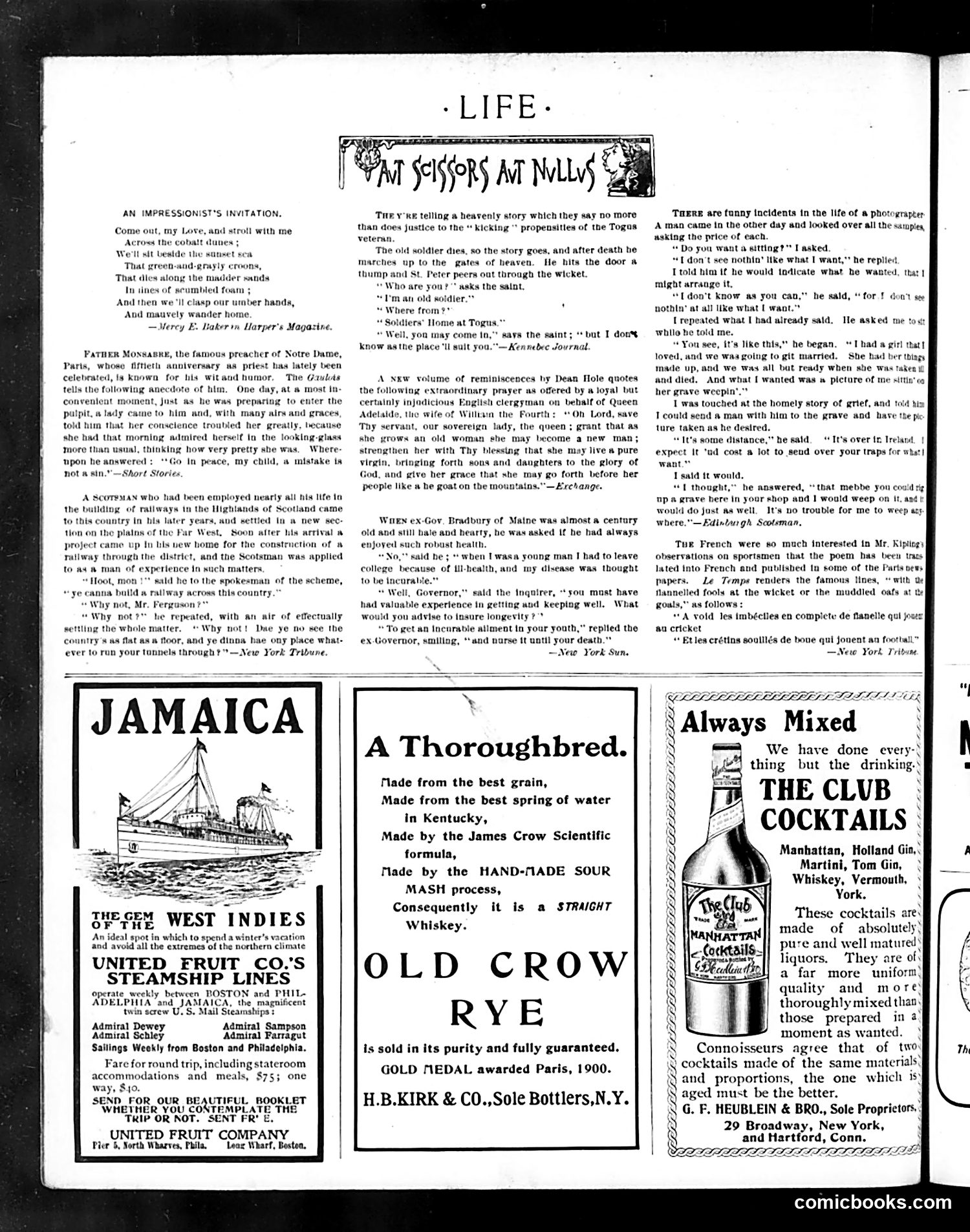
This page from *Life* magazine contains **humorous anecdotes and advertisements**, not political cartoons. The content reflects turn-of-the-century American humor: **The humor pieces** include light jokes about: - An Impressionist poet's affected language ("mauvely wander home") - A Scottish railroad engineer's practical objection to building railways in flat terrain - A soldier from the Soldiers' Home at Togus, Maine, whose rowdy reputation precedes him even in heaven - A prayer mishap by an English clergyman wishing Queen Adelaide would become "a new man" - An elderly Maine governor's longevity secret: contracting incurable illness young **The advertisements** promote: - Jamaica travel via steamship - Old Crow Rye whiskey (Gold Medal, Paris 1900) - Club Cocktails (Manhattan, Martini, Tom Gin varieties) The tone is genteel, anecdotal satire typical of *Life's* era—poking fun at pretension, regional types, and Victorian solemnity rather than attacking specific political targets. The humor depends on period dialect and social conventions now largely unfamiliar.
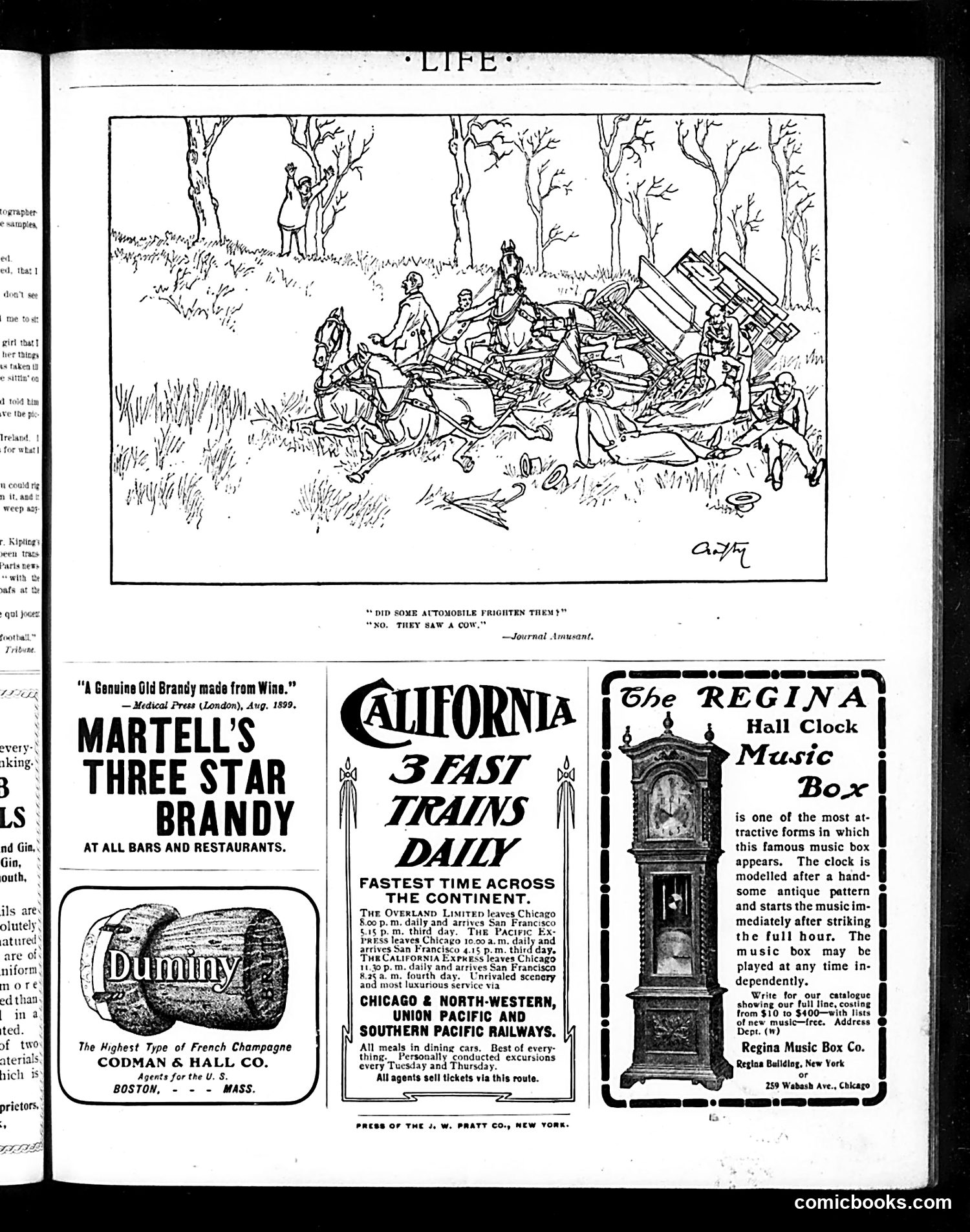
**Main Cartoon:** The cartoon depicts a chaotic rural scene where multiple people have been thrown from what appears to be an early automobile, lying scattered on the ground. When asked if an automobile frightened them, the caption replies "No. They saw a cow"—the joke being that the presence of livestock (not the vehicle itself) caused the accident. This satirizes the early automobile era's dangerous interactions with traditional rural life and farm animals, suggesting that old-fashioned cows pose more threat than modern motorized vehicles. The humor reflects early-1900s anxieties about technology disrupting established rural society. **Advertisements:** The page contains period product ads (Martell's brandy, California Fast Trains, Regina Hall Clock Music Box) typical of Life's revenue model. These are not satirical but straightforward commercial content. The cartoon appears sourced from *Journal Amusant*, a French publication.
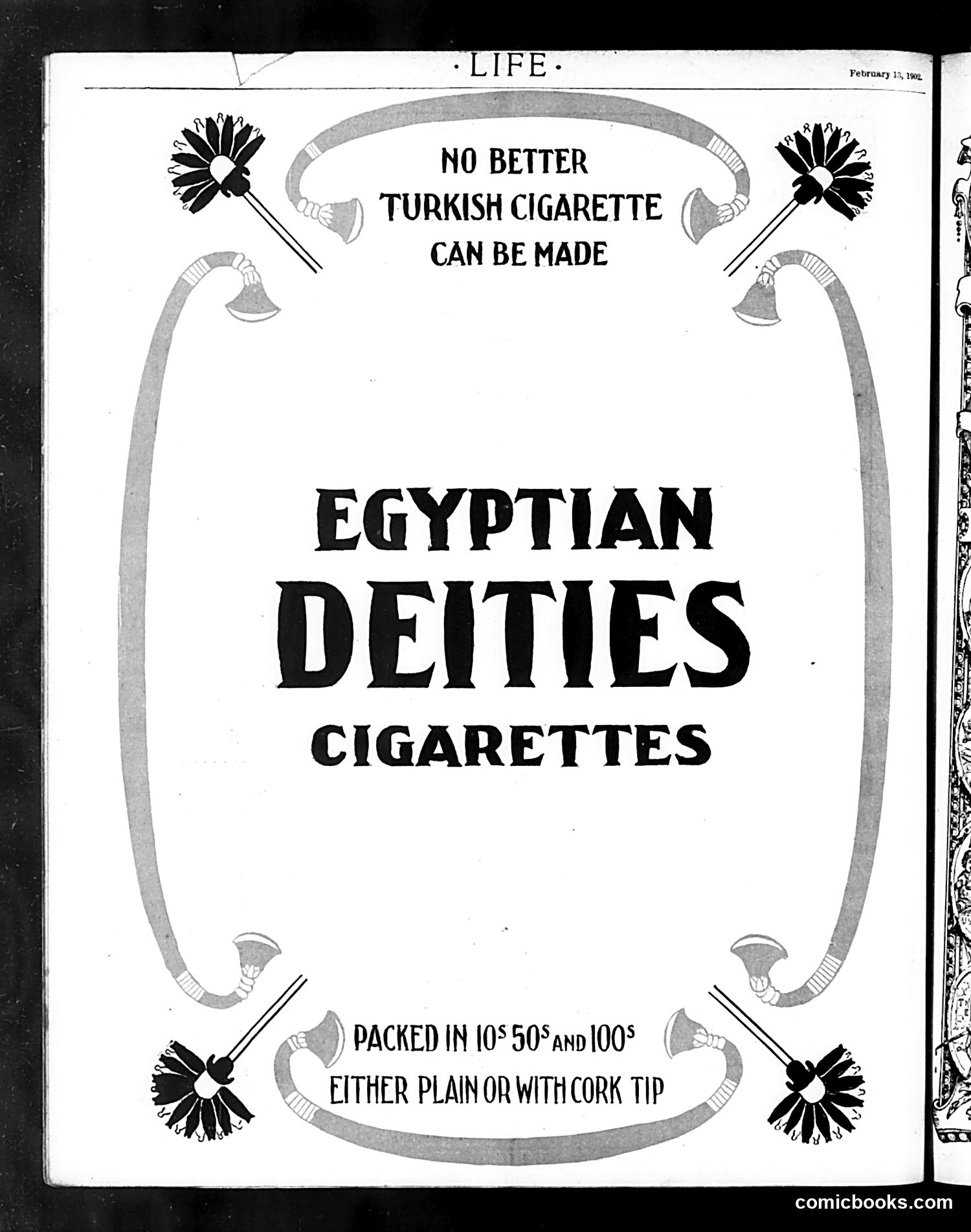
This is a cigarette advertisement from Life magazine (dated February 13, 1902). It promotes "Egyptian Deities Cigarettes" with the claim that "No Better Turkish Cigarette Can Be Made." The ad uses Egyptian aesthetic imagery—ornamental vessels and decorative borders with lotus-like flowers at the corners—to evoke exotic appeal and suggest quality. The brand name itself trades on popular fascination with ancient Egypt during the early 20th century. The advertisement specifies packaging options (10s, 50s, and 100s) and notes cigarettes come "either plain or with cork tip." This represents typical early tobacco marketing, which often employed orientalist imagery and made unsubstantiated quality claims. No specific political satire or cartoon commentary appears present—this is straightforward product advertising using period design conventions.