
Life, 1902-02-13 · page 12 of 30
Life — February 13, 1902 — page 12: what you’re looking at
What you’re looking at
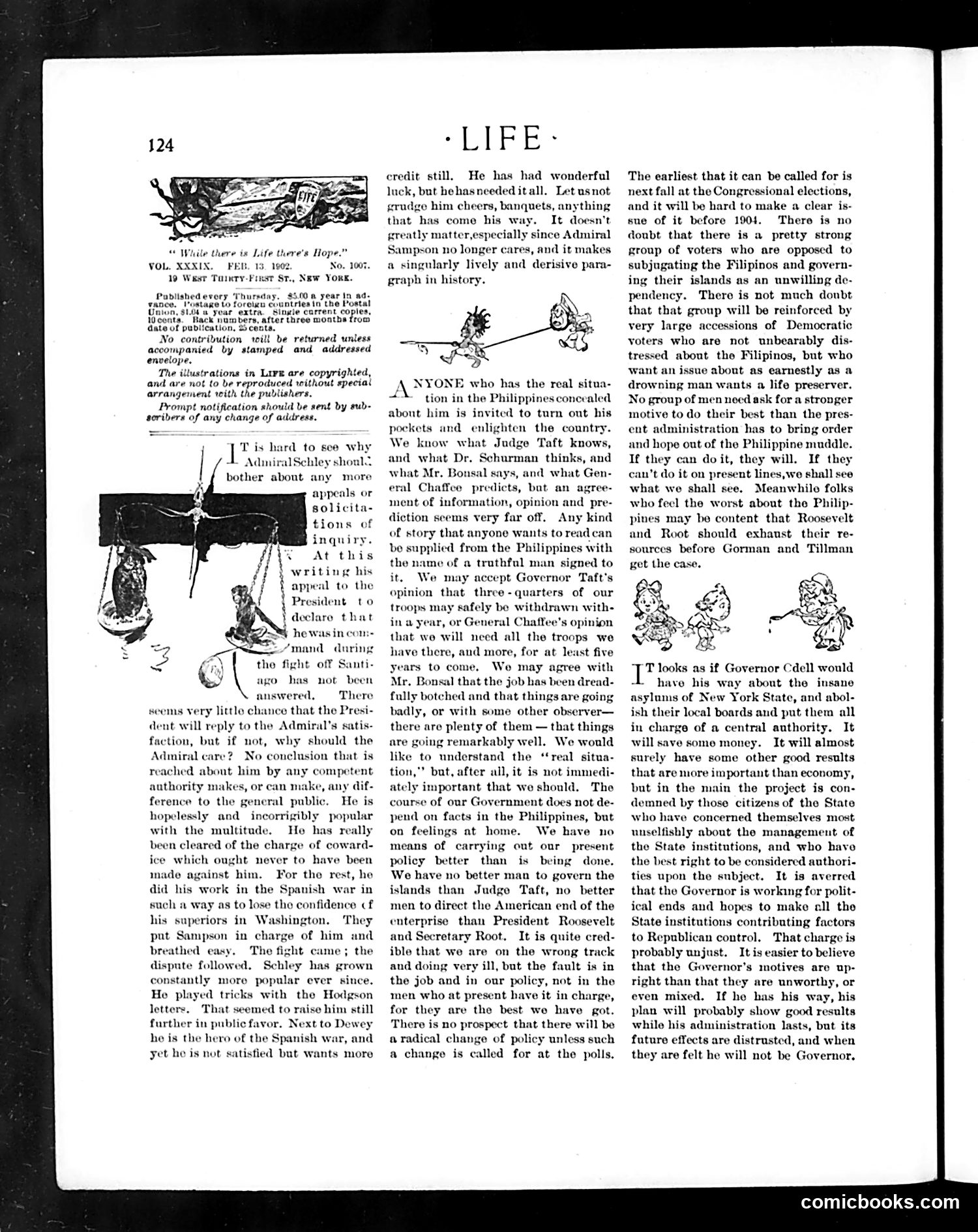
This page discusses Philippine governance during the American colonial period. The text debates whether Admiral Sampson should govern the Philippines, with the author arguing against his appointment despite acknowledging his "wonderful luck." The cartoon (left side) appears to show a figure at a desk or podium, likely depicting the administrative chaos of colonial governance—though the specific identity is unclear from the image alone. The satire criticizes those demanding change in Philippine policy while questioning whether current administrators (like Judge Taft) should be replaced. The author suggests that Governor Odell's proposed centralized authority for New York could serve as a model, arguing that state institutions need unified control rather than fragmented local boards. The piece reflects early 1900s American debates over imperial administration and good governance.
📄 Transcribed text from this page (OCR, searchable)
Machine-transcribed from the original scan — historical spelling and the odd misread are preserved.
ere is Life there's Hope.” VoL. X FEI 1902. No. 100%. 19 Was Tainty-Pinst St., NEw YORE. (0. year in ad. jes in the Postal ingle current coples, ter three months from dato of pul No con “be returned unless accompanied by stamped and addressed envelope. The illustrations in Lire are copyrighted, and are not to be reproduced without special arrangement with the publishers. Prompt notification should be sent by sub- soribers of any change of address. [7 is hard to sce why -L AdmiralSchley shoul. bother about any appeals or solicita tions inquiry. . At this more appeal to the Pres declaro that he was in com- mand the fight off Santi- ago has not answered, There seems very little chance that the Presi- dent will reply to the Admiral’s satis- faction, but if not, why should the Admiral care? No conclusion that is reached about him by any competent authority makes, or can make, any dif- ference to the general public. He is hopelessly and incorrigibly popular with the multitude. He has really been cleared of the charge of coward- ice which ought never to have been made against him. For the rest, he did his work in the Spanish war in such a way as to lose the confidence cf his superiors in Washington. They put Sampson in charge of him and breathed y. The fight came; the dispute followed. Schley has grown constantly more popular ever since. Ho played tricks with the Hodgson letters. That seemed to raise him still further in public favor. Next to Dewey he is the hero of the Spanish war, and yet he is not satisfied but wants more | writing his lent to \ } during been “LIFE + credit still, He has had wonderful luck, but hehasneededitall. Let usnot grudge him cheers, banquets, anything that has come his w: It doesn't greatly matter,especially since Admiral Sampson no longer cares, and it makes a singularly lively and derisive para- graph in histo A NYONE who has the real situa- +2 tion in the Philippines concealed about him is invited to turn out his pockets and enlighten the country. We know what Judge Taft knows, and what Dr. Schurman thinks, and what Mr. Bonsal says, and what Gen- eral Chaffee predicts, but an agree- ment of information, opinion and pre- diction seems very far off. Any kind of story that anyone wants to read can be supplied from the Philippines with the name of a truthfal man signed to it. We may accept Governor Taft's opinion that three-quarters of our troops may safely be withdrawn with- in a year, or General Chaffee's opinion that we will need all the troops we have there, aud more, for at least five years to come, We may agree with Mr. Bonsal that the job has been dread- fully botched and that things are going badly, or with some other observer— there are plenty of them — that things are going remarkably well. We would like to understand the ‘real situa- tion,’ but, after all, it is not immedi- ately important that we should, The course of our Government does not de- pend on facts in the Philippines, but on feelings at home. We have no means of carrying out our present policy better than is being done. We have no better man to govern the islands than Judge Taft, no better men to direct the American end of the enterprise than President Roosevelt and Secretary Root, It is quite cred- ible that we are on the wrong track and doing very ill, but the fault is in the job and in our policy, not in the men who at present have it in charge, for they are the best we have got. There is no prospect that there will be a radical change of policy unless such a change is called for at the polls. The earliest that it can be called for is next fall at the Congressional elections, and it will be hard to make a clear i: sue of it before 1904. There is no doubt that there is a pretty strong group of voters who are opposed to subjugating the Filipinos and govern- ing their islands as an unwilling de- pendency. There is not much doubt that that group will be reinforced by very large accessions of Democrat voters who are not unbearably dis- tressed about the Filipinos, but who want an issue about as earnestly as a drowning man wants a life preserver. No group of men need ask for a stronger motive to do their best than the pres- ent administration has to bring order and hope out of the Philippine muddle. If they can doit, they will. If they can’t do it on present lines, we shall see what we shall see. Meanwhile folks who fecl the worst about the Philip- pines may be content that Roosevelt and Root should exhaust their re- sources before Gorman and Tillman get the case. C xe Oe T looks as if Governor Cdell would -L have his way about the insane asylums of New York State, and abol- ish their local boards and put them all in charge of a central authority. It will save somo money. It will almost surely have some other good results that are more important than economy, but in the main the project is con- demned by those citizens of the State who have concerned themselves most unselfishly about the management of the State institutions, and who havo the best right to be considered authori- ties upon the subject. It is averred that the Governor is working for polit- ical ends and hopes to make ell the State institutions contributing factors to Republican control. That charge is probably unjust. It is easier to believe that the Governor's motives are up- right than that they are unworthy, or even mixed. If he has his way, his plan will probably show good results while his administration lasts, but its future effects are distrusted, and when they are felt he will not be Governor, comicbooks.com