
Life, 1902-02-13 · page 6 of 30
Life — February 13, 1902 — page 6: what you’re looking at
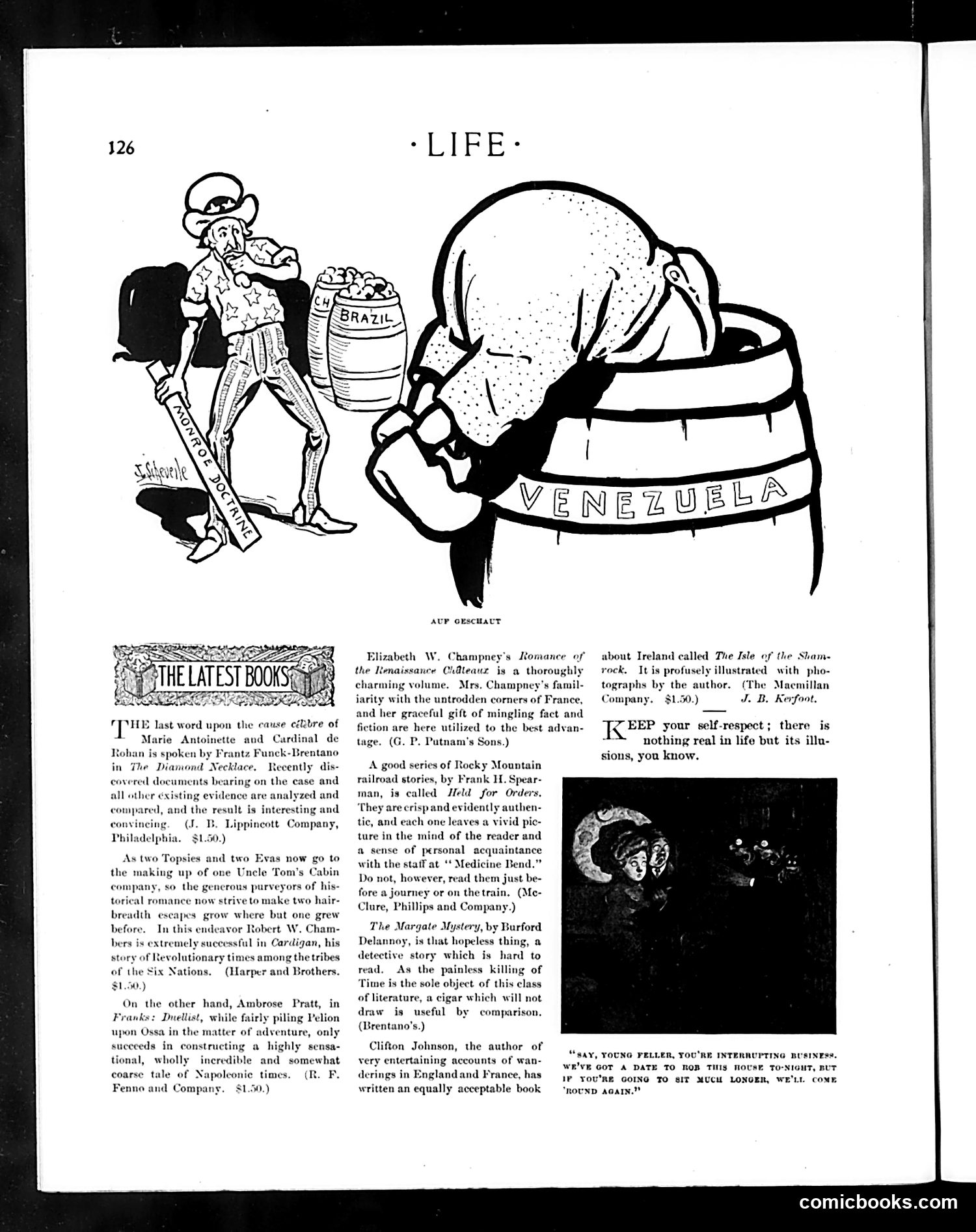
What you’re looking at
This cartoon by Auergescht satirizes **Venezuela's economic dependence on Brazil**. The skeleton figure labeled "Venezuela" is depicted being stuffed into a barrel, while a skeletal, elaborately dressed figure (representing Venezuela's leadership or the nation itself) stands nearby with a barrel labeled "Brazil." The imagery suggests Venezuela is being consumed or absorbed by Brazilian economic dominance—the skeleton represents a nation being hollowed out or impoverished. The exaggerated, skeletal portrayal emphasizes Venezuela's economic weakness compared to Brazil's apparent strength. This likely reflects early 20th-century Latin American economic tensions, when wealthier nations like Brazil dominated trade and commerce in the region, leaving smaller economies economically vulnerable and subordinate.
📄 Transcribed text from this page (OCR, searchable)
Machine-transcribed from the original scan — historical spelling and the odd misread are preserved.
TPE last word upon the cause edtbre of Marie Antoinette and Cardinal de Rohan is spoken by Frantz Funck-Brentano he Diamond Necklace. Recently dis- aring on the ease and Lippincott Company, Philadelphia. $1.50.) As two Topsies and two Evas now go to the making up of one Uncle Tom's Cabin company, so the gencrous purveyors of his- ical romance ake two hair- Ith escapes grow where but one grew before. In this endeavor Robert W. Cham- bers is extremely successful in Cardigan, his story of Revolutionary of the Six Nations. $1.50.) now strive ton mes among the tribes (Harper and Brothers. On the other hand, Ambrose Pratt, in Franks: Duellist, while fairly piling Pelion upon Ossa in the matter of adventure, only succeeds in constructing a highly sensa- tional, wholly and somewhat coarse tale of (R. F. nd Company. $1.50.) AUP OxSCHAUT Elizabeth W. Champney's Komance of the Renaissance Ch@teaut is a thoroughly ning volume. Mrs. Champne with the untrodden corners of France, and her graceful gift of mingling fact and fiction are here utilized to the best advan- tage. (G. P. Putnam's Sons.) y's famil- A good series of Rocky Mountain railroad stories, by Frank H. Spear- n, is called Held for Orders. ‘They are crisp and evidently authen- tic, and each one leaves a vivid pic- ture in the mind of the reader and a sense of personal acquaintance with the staff at ‘* Medicine Bend.” Do not, however, read them just be- or on thetrain, (Me- Clure, Phillips and Company.) fore a journe The Margate Mystery, by Burford Delannoy, is that hopeless thing, a detective story which is hard to read. As the painless killing of Time is the sole object of this class of literature, a cigar which will not draw is useful by comparison, (Brentano's.) Clifton Johnson, the author of entertaining accounts of wan- derings in England and France, has written an equally acceptable book wy about Ireland called The Isle of the rock. It is profusely illustrated with pho- tographs by the author. (The Macmillan 50.) KEEP your self-respect; there is nothing real in life but its illu- sions, you know. Sham- Company. §) “SAY, YOUNG FELLER, YOU'RE INTERRUPTING BUSINESS. B GOT A DATE TO NOB THIS NovaE TO-NIGHT, RUT ‘OU'RE GOING TO SIT MUCM LONGER, WE'LL. conr ‘ROUND agarN.” comicbooks.com