
Life, 1902-02-13 · page 7 of 30
Life — February 13, 1902 — page 7: what you’re looking at
What you’re looking at
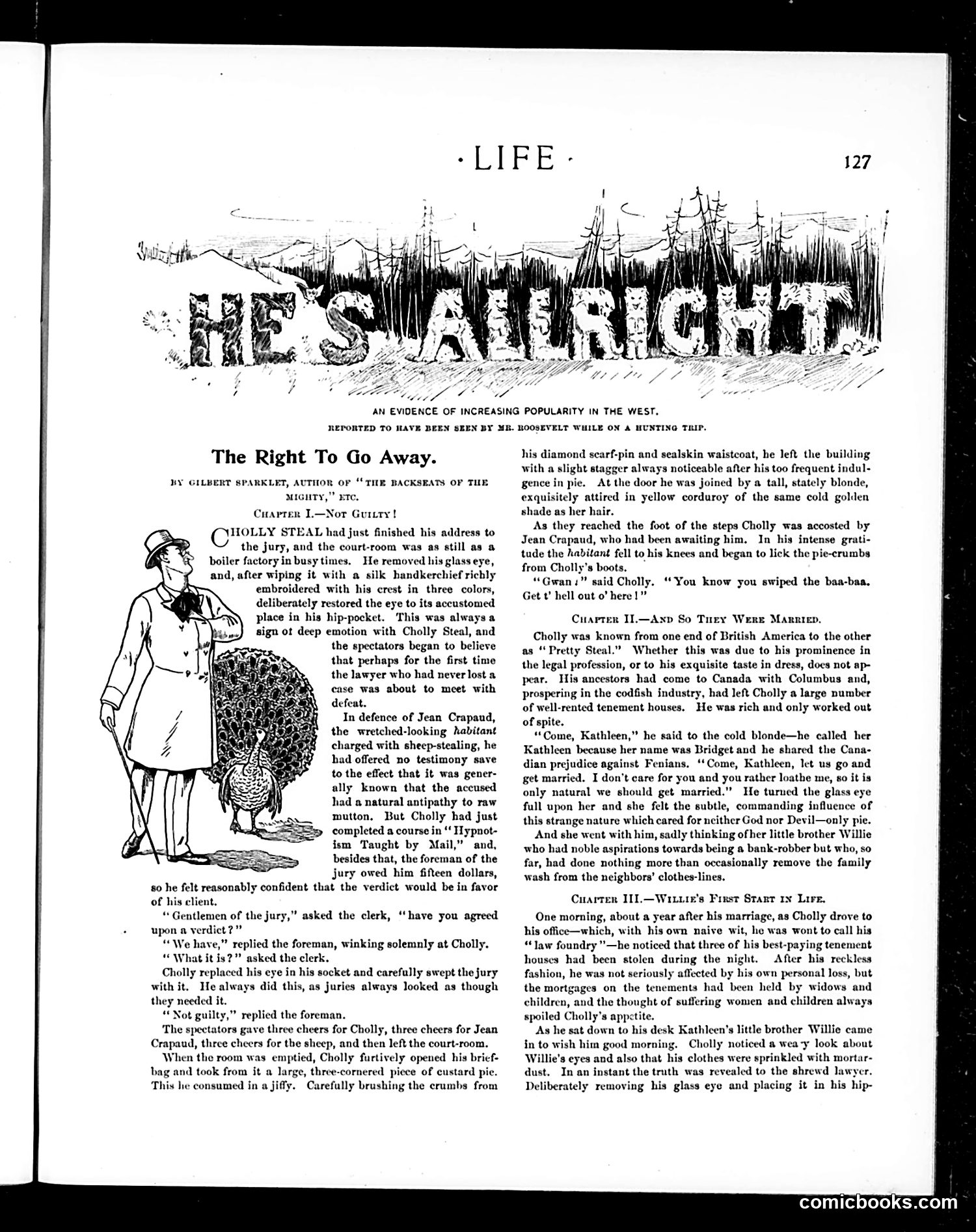
This page presents a serialized story rather than political satire. The narrative follows "Cholly Steal," a lawyer of British-Canadian descent living in North America, through his courtroom victory and subsequent domestic life. The illustration shows Cholly in court, confidently presenting his case. The story establishes him as a shrewd legal professional who wins cases through skill—he successfully defended Jean Crapaud, a disheveled *habitant* (French-Canadian farmer), securing acquittal despite weak evidence. The text emphasizes Cholly's respectability, his marriage to the "cold blonde" Kathleen, and his growing family troubles, including his brother Willie's moral failings. This appears to be entertainment fiction rather than political commentary, reflecting early 20th-century attitudes toward class, ethnicity, and respectability.
📄 Transcribed text from this page (OCR, searchable)
Machine-transcribed from the original scan — historical spelling and the odd misread are preserved.
AN EVIDENCE OF INCREASING POPULARITY IN THE WEST. REPORTED TO HAVE BEEN SEEN BY MB. ROOSEVELT WHILE ON A HUNTING TRIP. The Right To Go Away. HY GILBERT SPARKLET, AUTHOR OF ‘TIE BACKSEATS OF THE. COuoLLy STEAL had just finished his address to the jury, and the court-room was as still as a boiler factory in busy times. He removed his glass eye, and, after wiping it with a silk handkerchief richly embroidered with his crest in three colors, deliberately restored the eye to its accustomed place in his hip-pocket. ‘This was always a sign ot deep emotion with Cholly Steal, and the spectators began to believe that perhaps for the first time the lawyer who had never lost a case was about to meet with defeat. In defence of Jean Crapaud, the wretched-looking habitant charged with sheep-stealing, he had offered no testimony save to the effect that it was gener- ally known that the accused had a natural antipathy to raw mutton, But Cholly had just completed a course in “‘ Hypnot- ism Taught by Mail,” and, besides that, the foreman of the jury owed him fifteen dollars, 80 he felt reasonably confident that the verdict would be in favor of his client, “ Gentlemen of the jury,” asked the clerk, “have you agreed upon a verdict?” “We have,” replied the foreman, winking solemnly at Cholly. “What it is?” asked the clerk, Cholly replaced his eye in his socket and carefully swept the jury with it. He always did this, as juries always looked as though they needed it. “Not guilty,” replied the foreman. The spectators gave three cheers for Cholly, three cheers for Jean Crapaud, three cheers for the sheep, and then left the court-room. When the room was emptied, Cholly furtively opened his brief= bag and took from it a large, three-cornered piece of custard pie. This he consumed in a jiffy. Carefully brushing the crumbs from his diamond scarf-pin and sealskin waistcoat, he left the building with a slight stagger always noticeable after his too frequent indul- gence in pie. At the door he was joined by a tall, stately blonde, exquisitely attired in yellow corduroy of the same cold golden shade as her h: As they reached the foot of the steps Cholly was accosted by Jean Crapaud, who had been awaiting him. In his intense grati- tude the habitant fell to his knees and began to lick the pie-crumbs from Cholly’s boots. “Gwan i” said Cholly. “You know you swiped the baa-baa, Get t' hell out o’ here!” Cuarter II.—Axp So Tney Were Manrntep. Cholly was known from one end of British America to the other as ‘Pretty Steal.” Whether this was duc to his prominence in the legal profession, or to his exquisite taste in dress, docs not ap- pear. His ancestors had come to Canada with Columbus and, prospering in the codfish industry, had left Cholly a large number of well-rented tenement houses. He was rich and only worked out of spite. “Come, Kathleen,” he said to the cold blonde—he called her Kathleen because her name was Bridget and he shared the Cana- dian prejudice against Fenians. ‘Come, Kathleen, let us go and get married. I don’t care for you and you rather loathe me, so it is only natural we should get married.” He turued the glass eye full upon her and she felt the subtle, commanding influence of this strange nature which cared for neither God nor Devil—only pie. And she went with him, sadly thinking ofher little brother Willie who had noble aspirations towards being a bank-robber but who, so far, had done nothing more than occasionally remove the family wash from the neighbors’ clothes-lines. Cuarter I.—Wi1iie's First Start rx Lire, One morning, about a year after his marriage, as Cholly drove to his office—which, with his own naive wit, he was wont to call his “law foundry "—he noticed that three of his best-paying tenement houses had been stolen during the night. After his reckless fashion, he was not seriously affected by his own personal loss, but the mortgages on the tenements had been held by widows and children, and the thought of suffering women and children always spoiled Cholly’s appetite. As he sat down to his desk Kathleen's little brother Willie came in to wish him good morning, Cholly noticed a wea-y look about Willie's eyes and also that his clothes were sprinkled with mortar- dust. In an instant the truth was revealed to the shrewd la Deliberately removing his glass eye and placing it in his hip- comicbooks.com