
A complete issue · 20 pages · 1901
Life — December 5, 1901
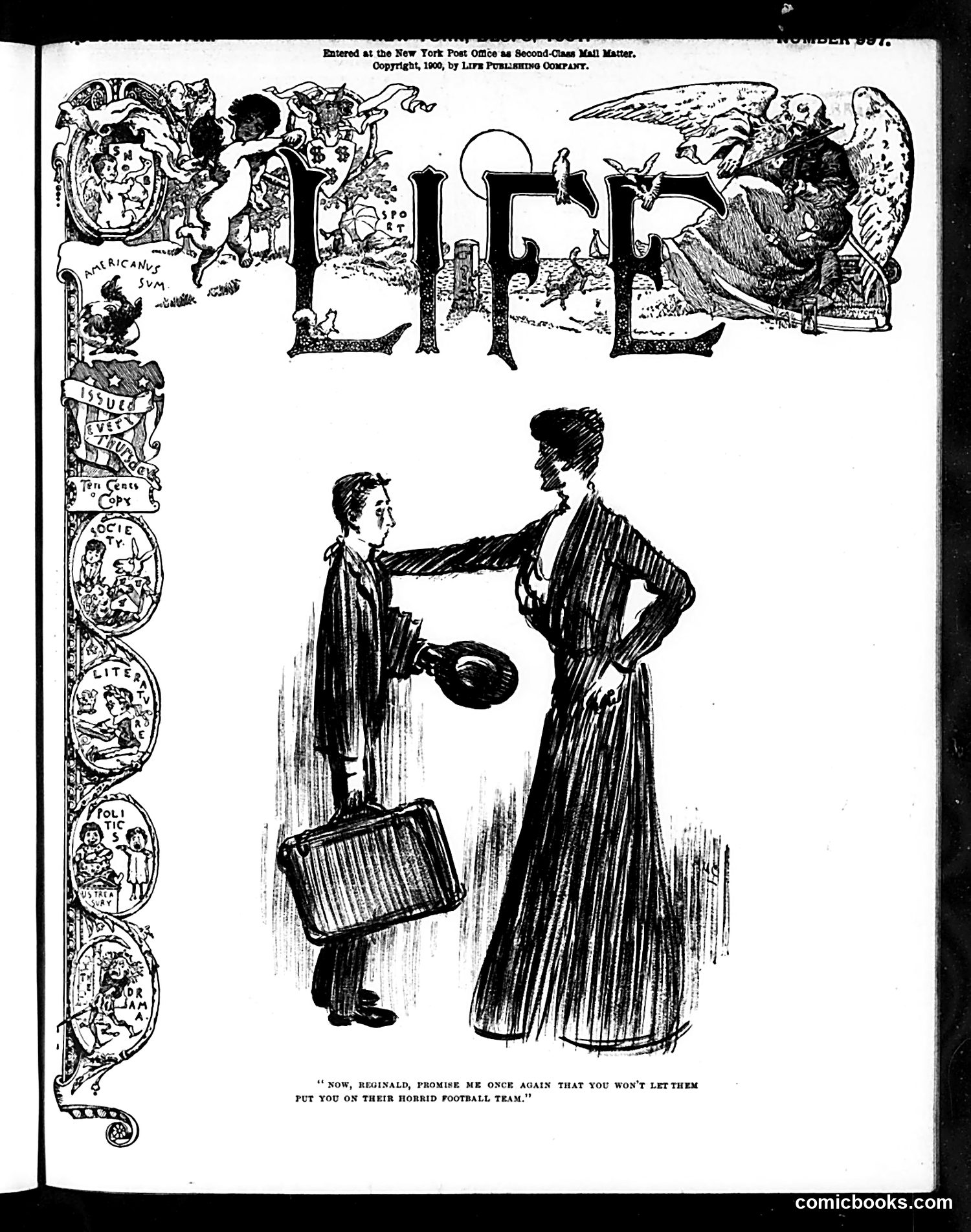
This appears to be a domestic comedy cartoon from early 1900s Life magazine. The main illustration shows a woman addressing a young man (identified as "Reginald" in the caption), who holds a suitcase and wears boxing gloves. The caption reads: "NOW, REGINALD, PROMISE ME ONCE AGAIN THAT YOU WON'T LET THEM PUT YOU ON THEIR HORRID FOOTBALL TEAM." The joke satirizes overprotective mothering of upper-class sons. The woman (likely his mother) is so concerned about her son's safety that she extracts promises to avoid football—a sport then gaining popularity but considered dangerous. The boxing gloves he's holding add ironic humor: she worries about football while he apparently boxes. The satire targets anxious parental attitudes toward young men's athletics and risk-taking.
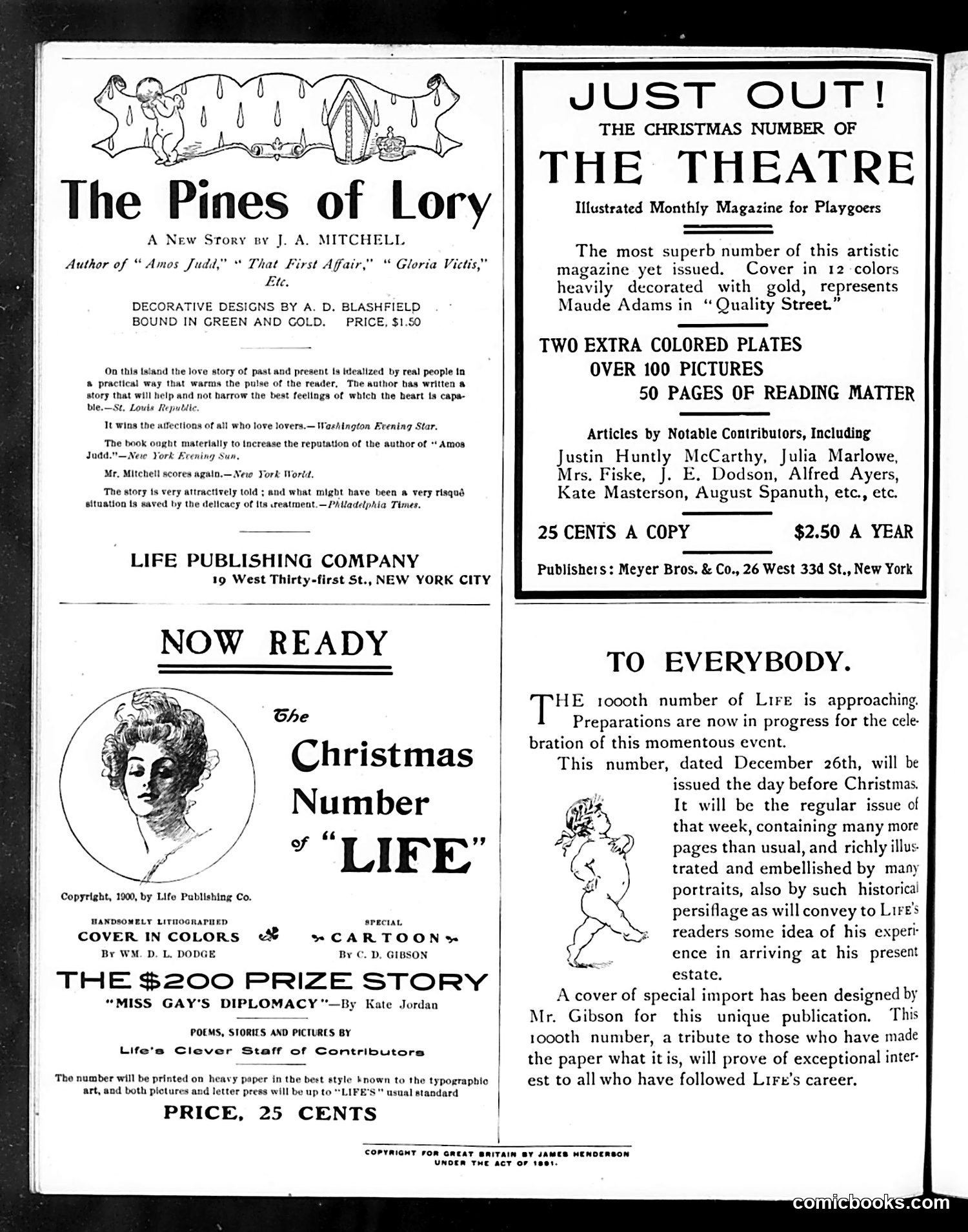
This page is primarily **advertising rather than editorial content**. It consists of three promotional notices for publications: 1. **"The Pines of Lory"** — a new story by J.A. Mitchell, published by Life Publishing Company ($1.50) 2. **"The Theatre" magazine** — Christmas issue advertisement featuring Maude Adams in "Quality Street," priced at 25 cents 3. **"Life" Christmas Number** — promoting the upcoming 100th issue (dated December 26th). The advertisement highlights it will be special, heavily illustrated, and feature contributions from notable writers. Priced at 25 cents. The decorative illustrations are generic period artwork — a cherub with rain, and a classical female portrait — used as ornamental design rather than satirical commentary. **No political satire or cartoon commentary appears on this page.** It represents typical early 1900s magazine advertising.
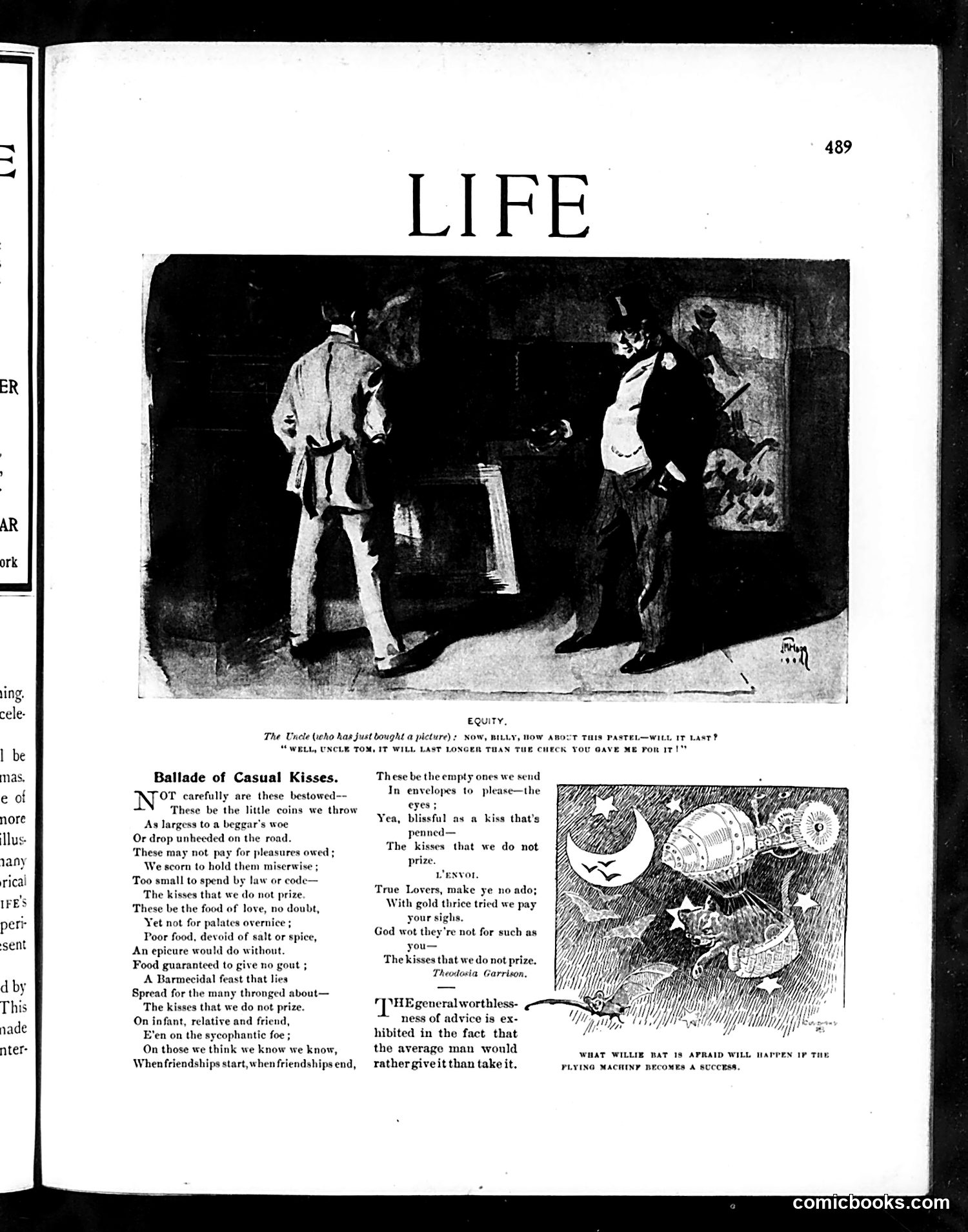
The top cartoon, titled "Equity," depicts an art dealer showing a purchased painting to a client. The humor plays on the phrase "how about this pastel—will it last?" with the dealer's response about the painting outlasting the client's marriage—a cynical jab at marital instability. The "Ballade of Casual Kisses" poem satirizes the transactional nature of romantic gestures, mocking insincere affection given without genuine feeling or cost. The bottom illustration, captioned about Willie Bat and flying machines, appears to be a humorous speculative cartoon about early aviation technology, though the specific reference remains unclear without additional context about contemporary aviation developments or a figure named Willie Bat.
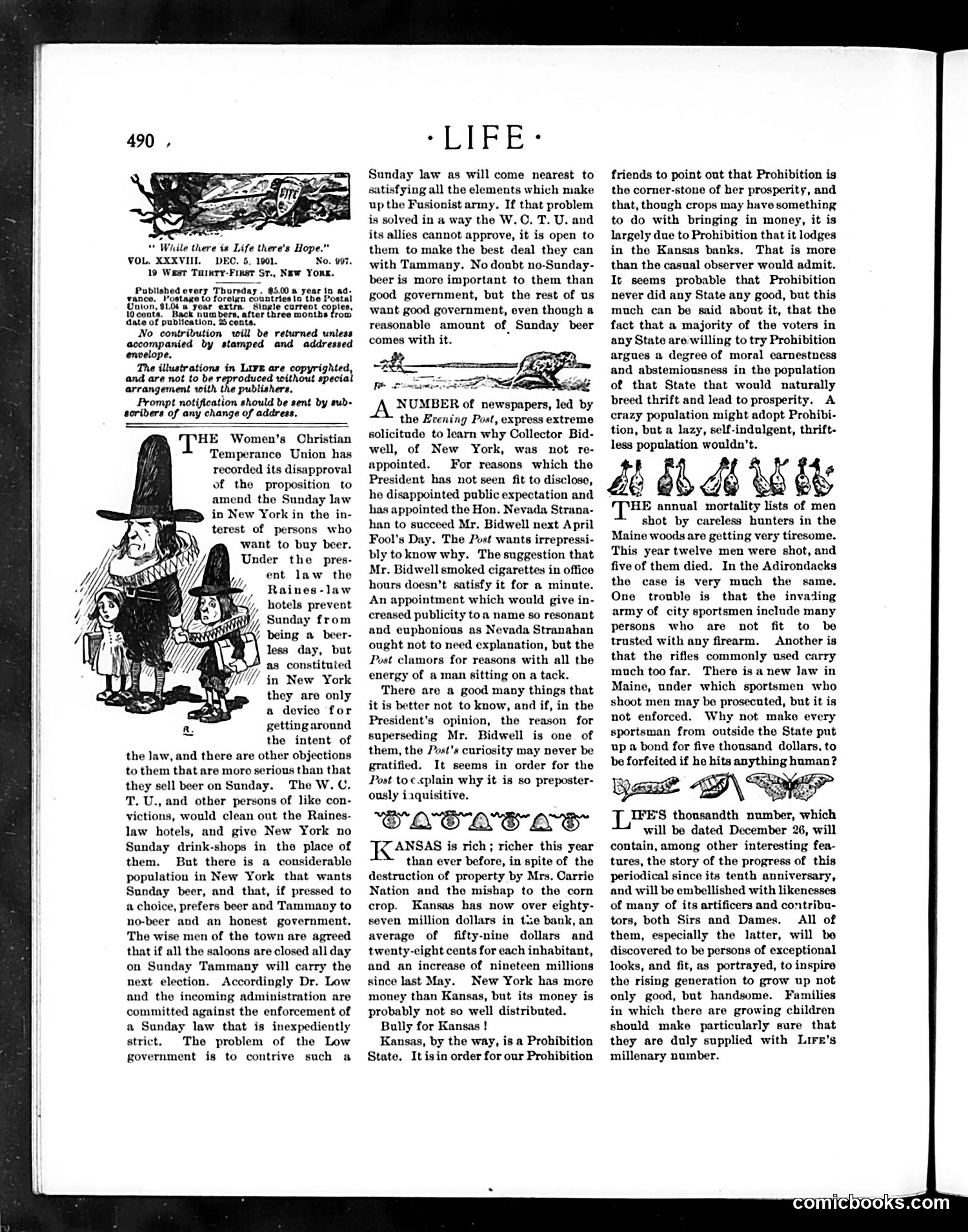
This page contains political commentary about Prohibition and American governance circa 1901. The left cartoon depicts a rotund figure in formal dress labeled as representing those opposed to Sunday beer laws—likely a politician or wealthy businessman. The satire criticizes the hypocrisy of elites who want to restrict working-class Sunday drinking while enjoying privileges themselves. The text discusses the Women's Christian Temperance Union's efforts to amend New York's Sunday laws, and debates whether Prohibition serves moral interests or class control. The piece sarcastically notes that closing saloons on Sundays while allowing other establishments remains inconsistent. The cartoon mocks wealthy interests claiming moral authority while actually pursuing economic or political advantage—a common Life magazine theme critiquing Progressive Era reform movements.
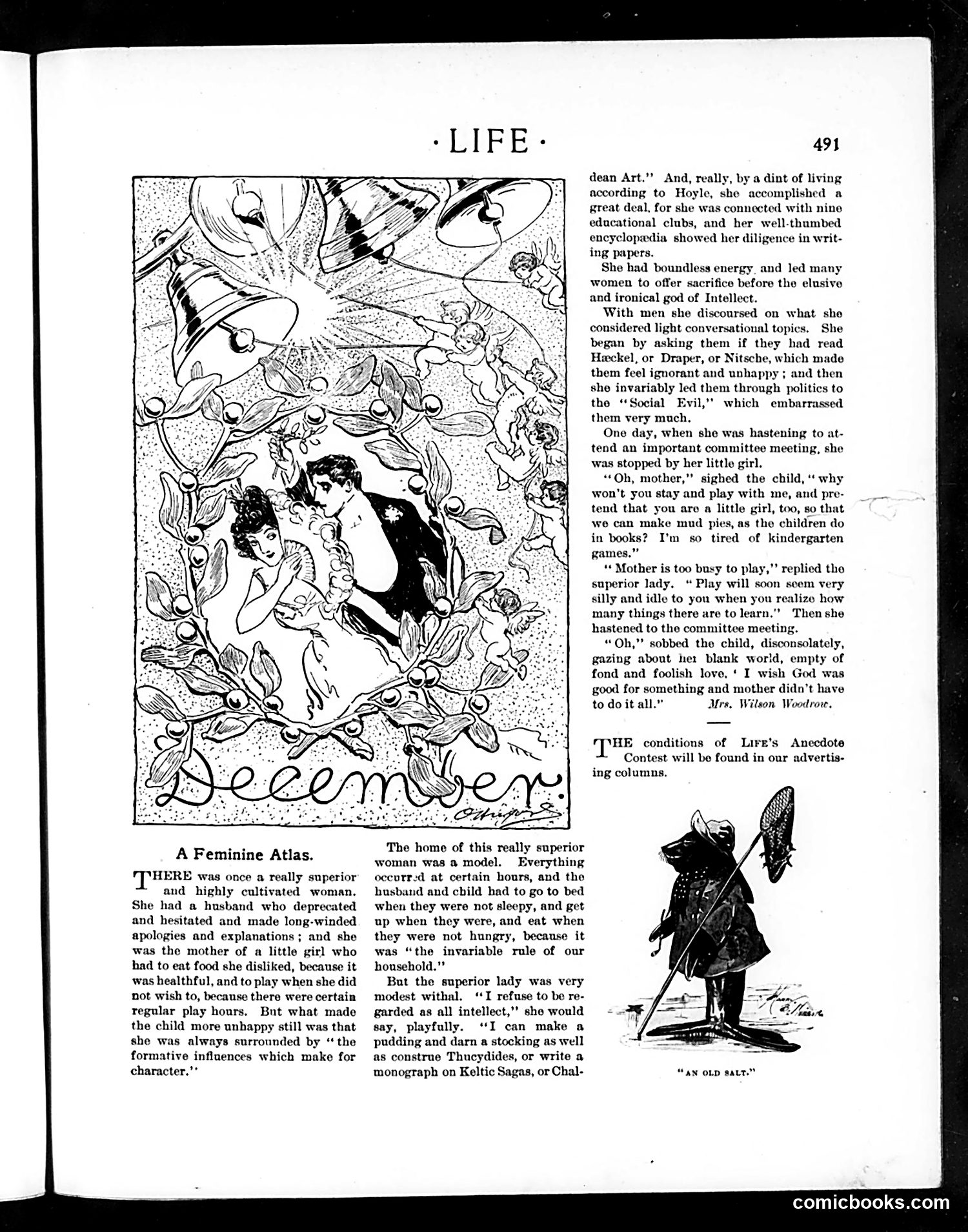
The main illustration, titled "A Feminine Atlas," depicts a woman surrounded by domestic and intellectual burdens—books, household items, and children—literally holding up her world. The accompanying article criticizes a "superior woman" who neglected her child's emotional needs while pursuing intellectual pursuits and social causes. The satire mocks the tension between women's intellectual aspirations and traditional motherhood expectations. The woman's child complains of boredom and loneliness, suggesting the article's argument that maternal duties cannot be delegated to abstract principles or social reform. The small illustration labeled "An Old Salt" at page's bottom appears unrelated. This reflects early 20th-century anxiety about educated women prioritizing careers and activism over childcare—a common satirical target in Life magazine.
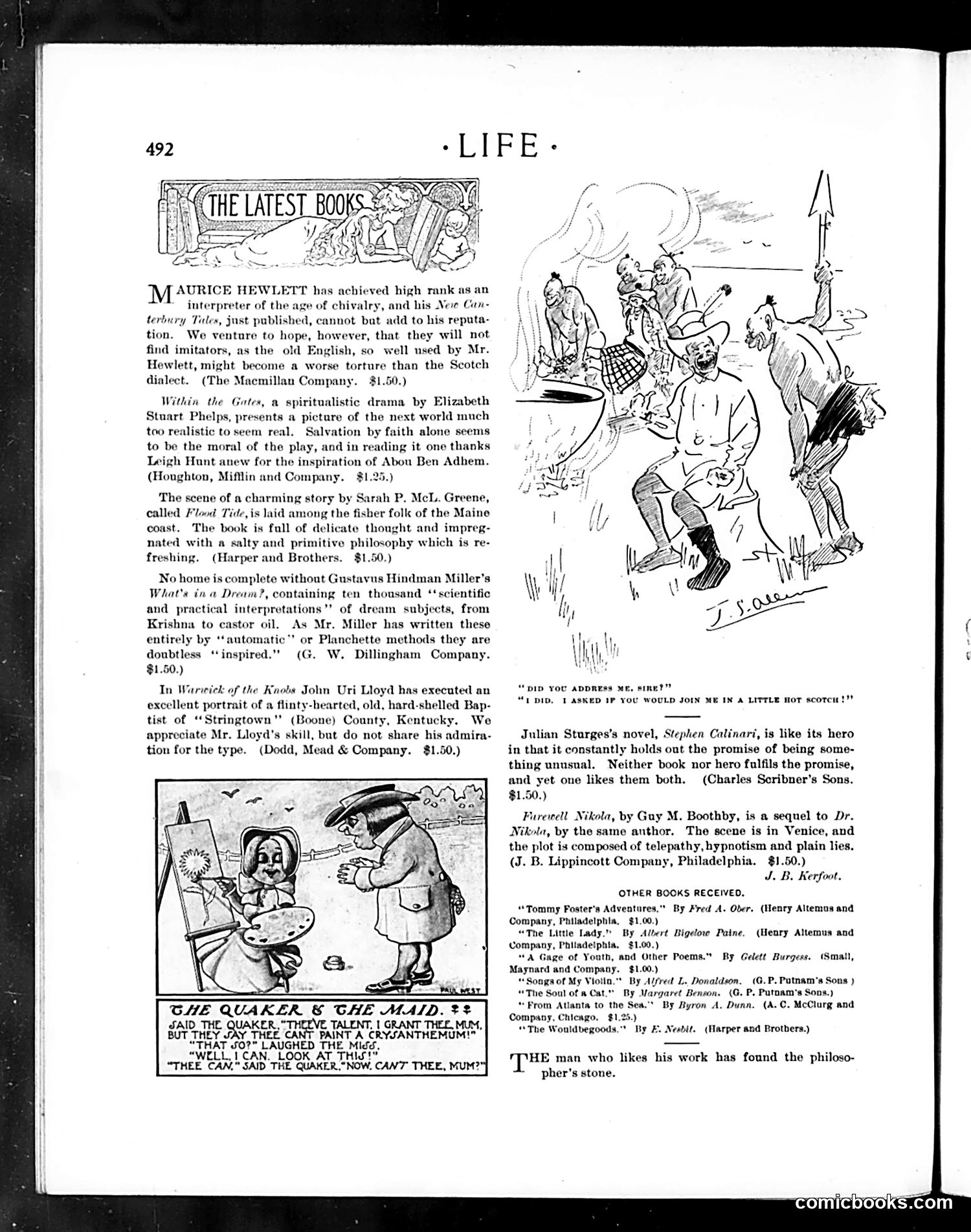
This page contains two unrelated cartoons and book reviews. **Top cartoon**: Shows Scottish Highlanders in kilts with a hot air balloon. The dialogue indicates one character has invited another to join him in "a little hot scotch," playing on the double meaning of "Scotch" (the nationality and the drink). The satire mocks Scottish identity and drinking culture stereotypes. **Bottom cartoon**: Titled "The Quaker & The Maid," depicts a Quaker man and a maid in domestic interaction. The dialogue suggests mild flirtation or social awkwardness, playing on contrasts between Quaker restraint and the maid's boldness—a common comedic pairing of the era. Both cartoons rely on ethnic and religious stereotyping typical of early-20th-century American humor.
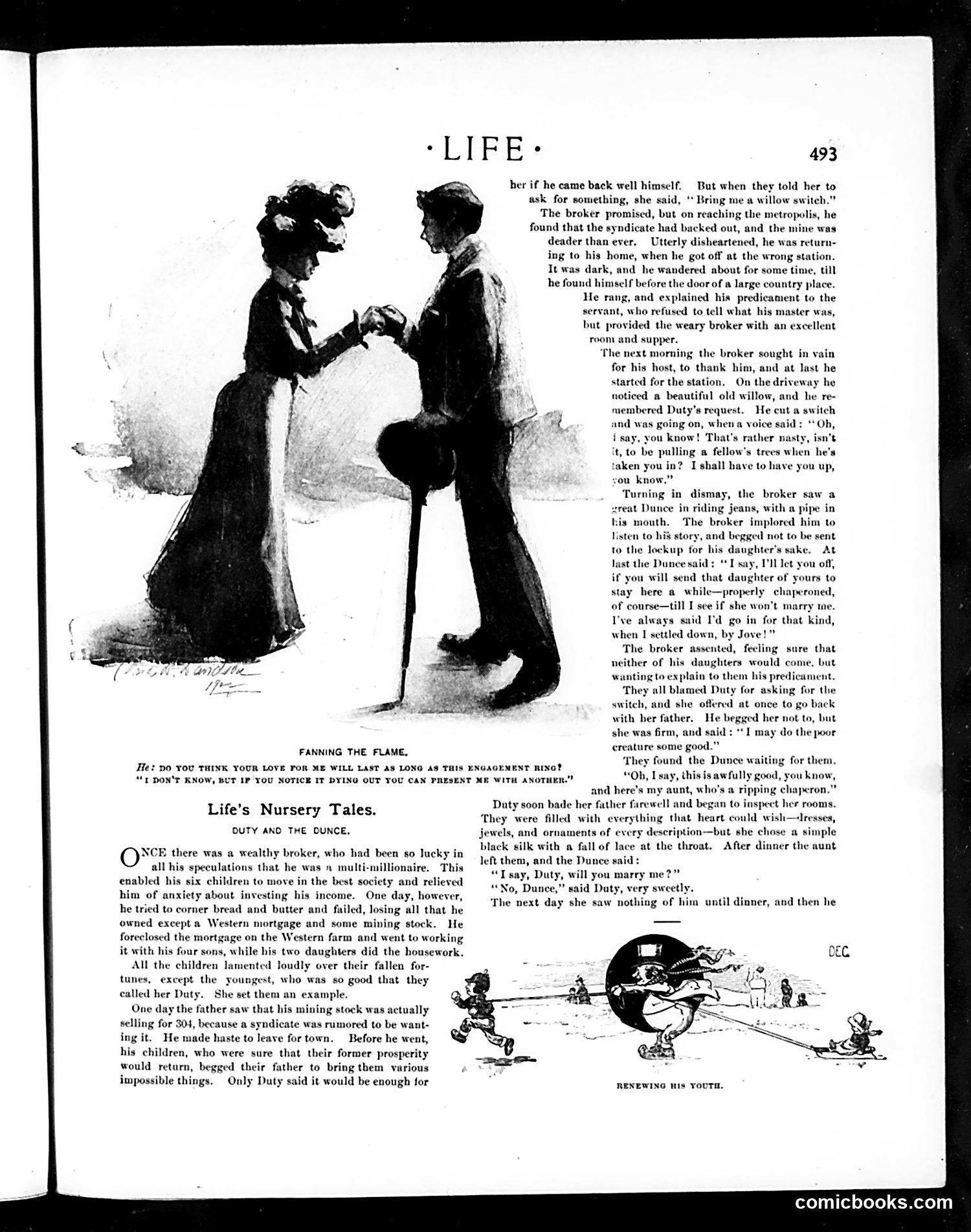
This page contains a serialized story titled "Life's Nursery Tales," specifically the chapter "Duty and Choice." The narrative follows a wealthy broker who loses his fortune through mining stock speculation and Western farm investments. His youngest daughter, Duty, remains optimistic while her siblings despair. The main illustration ("Fanning the Flame") depicts a romantic scene between two figures, captioned with dialogue about an engagement lasting as long as love endures. The story appears to be a moral lesson about duty, perseverance, and character during financial hardship—common themes in early 20th-century satirical magazines. The secondary illustration shows children playing, labeled "Renewing his Youth," continuing the domestic narrative themes throughout the page.
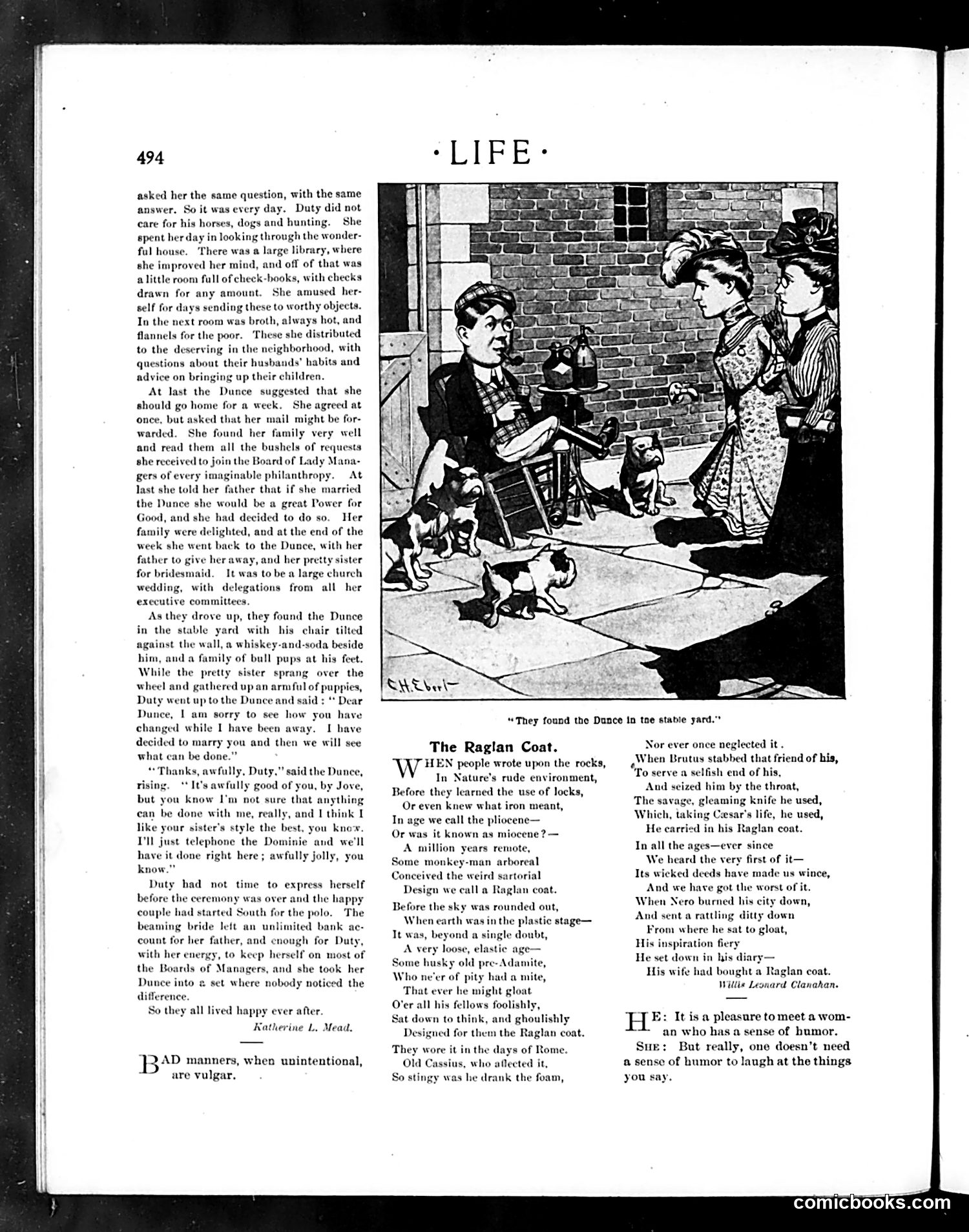
The illustration shows a domestic scene with a man (identified as "the Dunce") sitting in a stable yard surrounded by family members and children. Based on the accompanying text, this illustrates a story about a man who has been away and returns home to find his family's charitable activities and improved circumstances during his absence. The narrative appears to be a sentimental tale about domestic virtue and family improvement—the man's absence somehow enabled positive change, suggesting subtle satire about husbands being obstacles to household progress. Below is a poem titled "The Raglan Coat" by Willie Leonard Clanashan, discussing historical significance of a garment. At bottom, a brief humorous dialogue about humor itself appears, though context is limited on this page excerpt.
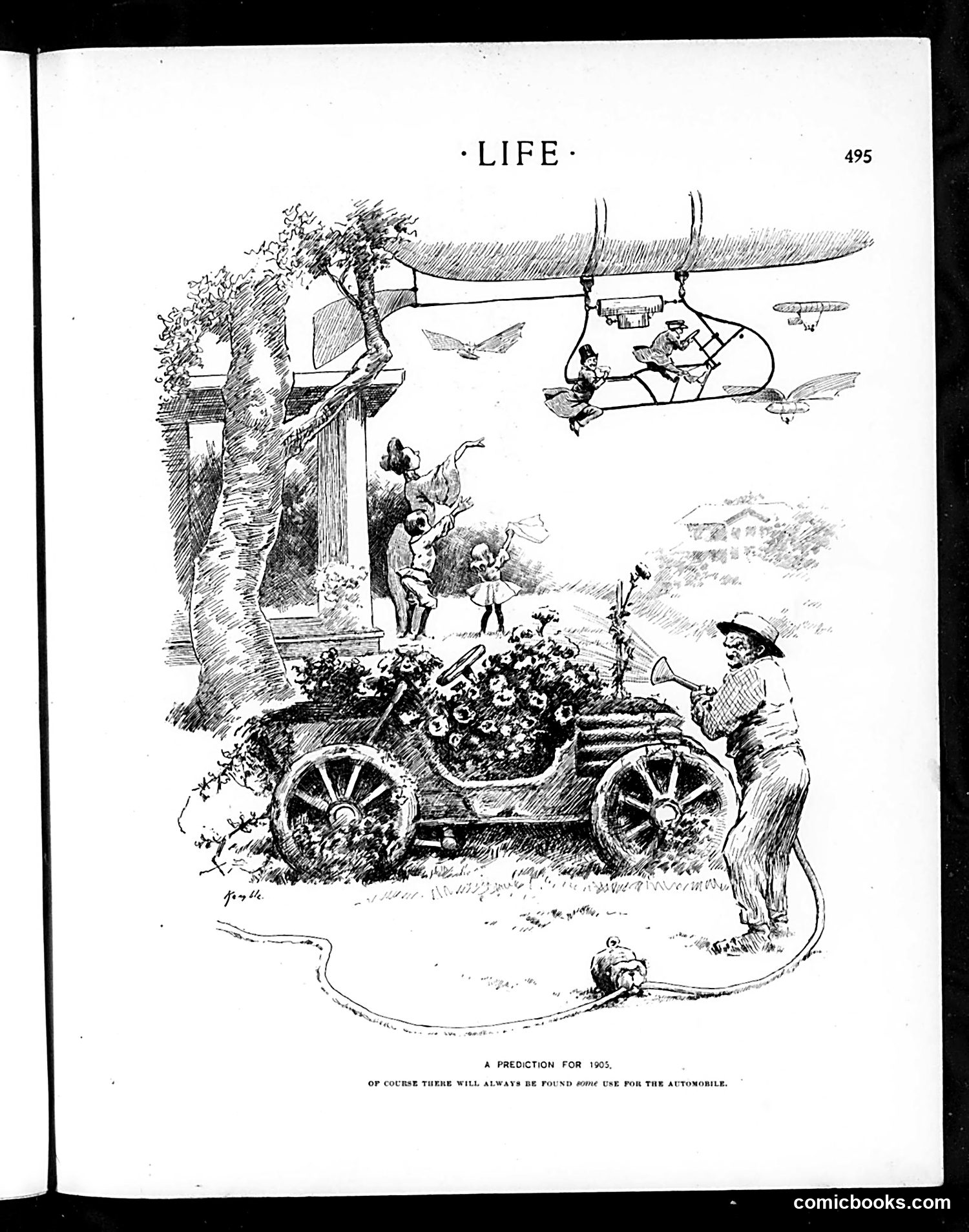
This satirical cartoon predicts future uses of the automobile. The caption reads: "Of course there will always be found some use for the automobile." The illustration shows a fantastical scene where an automobile has been repurposed as a flower cart. A man waters flowers from the vehicle while children play on a rope swing suspended from a tree above. Flying machines appear in the sky. The satire mocks early automobiles by suggesting they're so impractical that their only viable future use would be as a novelty flower delivery cart—essentially useless as transportation. This reflects contemporary skepticism about whether automobiles would become practical vehicles. The absurdist humor contrasts the grand promises of automotive technology with this mundane, whimsical alternative purpose.
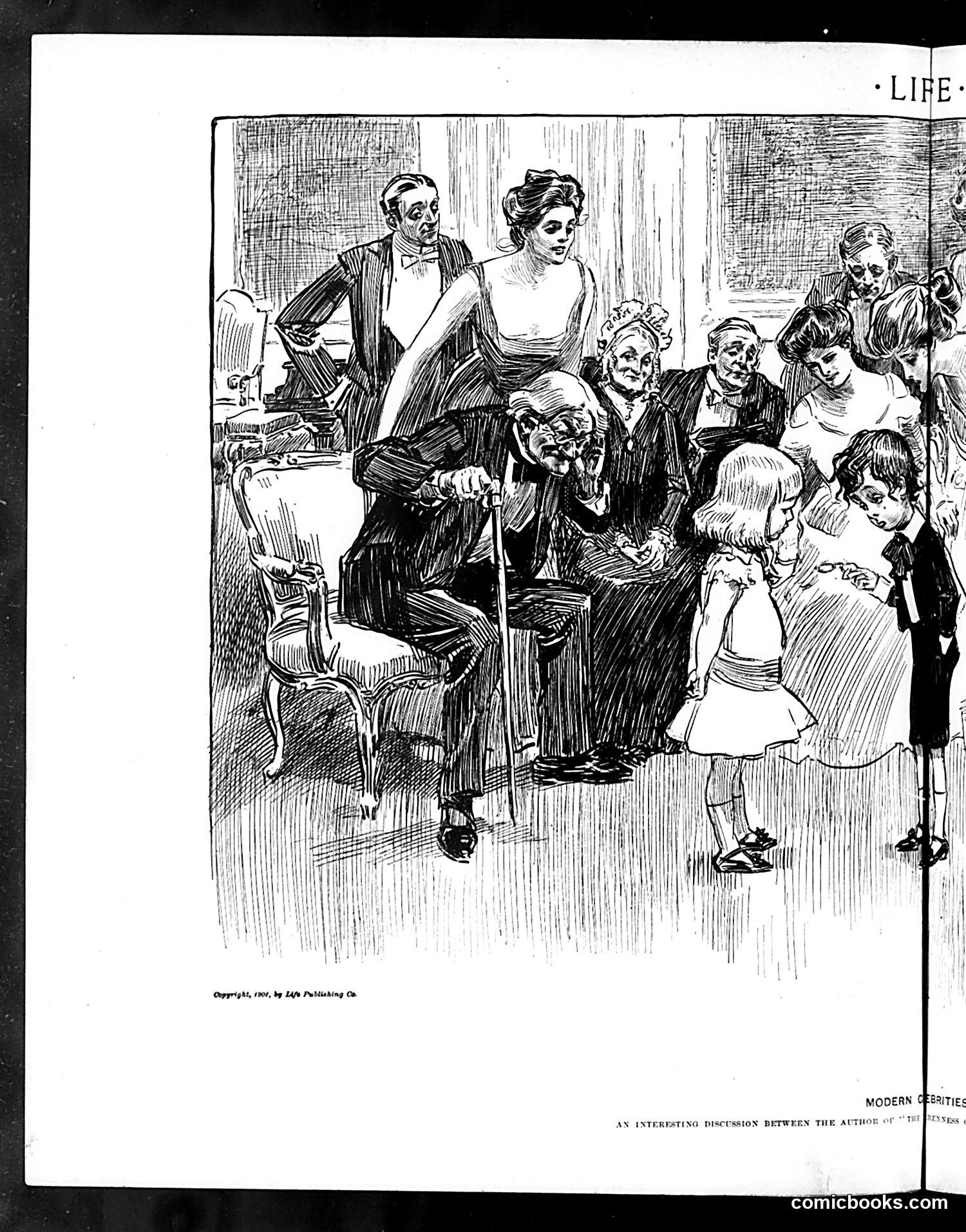
This appears to be a satirical illustration titled "Modern Celebrities: An Interesting Discussion Between the Author of [text cut off]." The sketch depicts what seems to be a social gathering or salon scene, with well-dressed adults and children assembled around an elderly gentleman with a cane who appears to be the central figure of attention or discussion. The satire likely targets pretentious intellectual or literary circles of the early 1900s, mocking the reverence shown toward prominent authors or celebrities of the era. The gathered crowd's attention to the elderly figure suggests commentary on celebrity worship or the artificial nature of such social gatherings. Without the complete caption identifying "the author" referenced, the specific target remains unclear, though the tone is clearly one of gentle ridicule toward fashionable society and its obsessions.
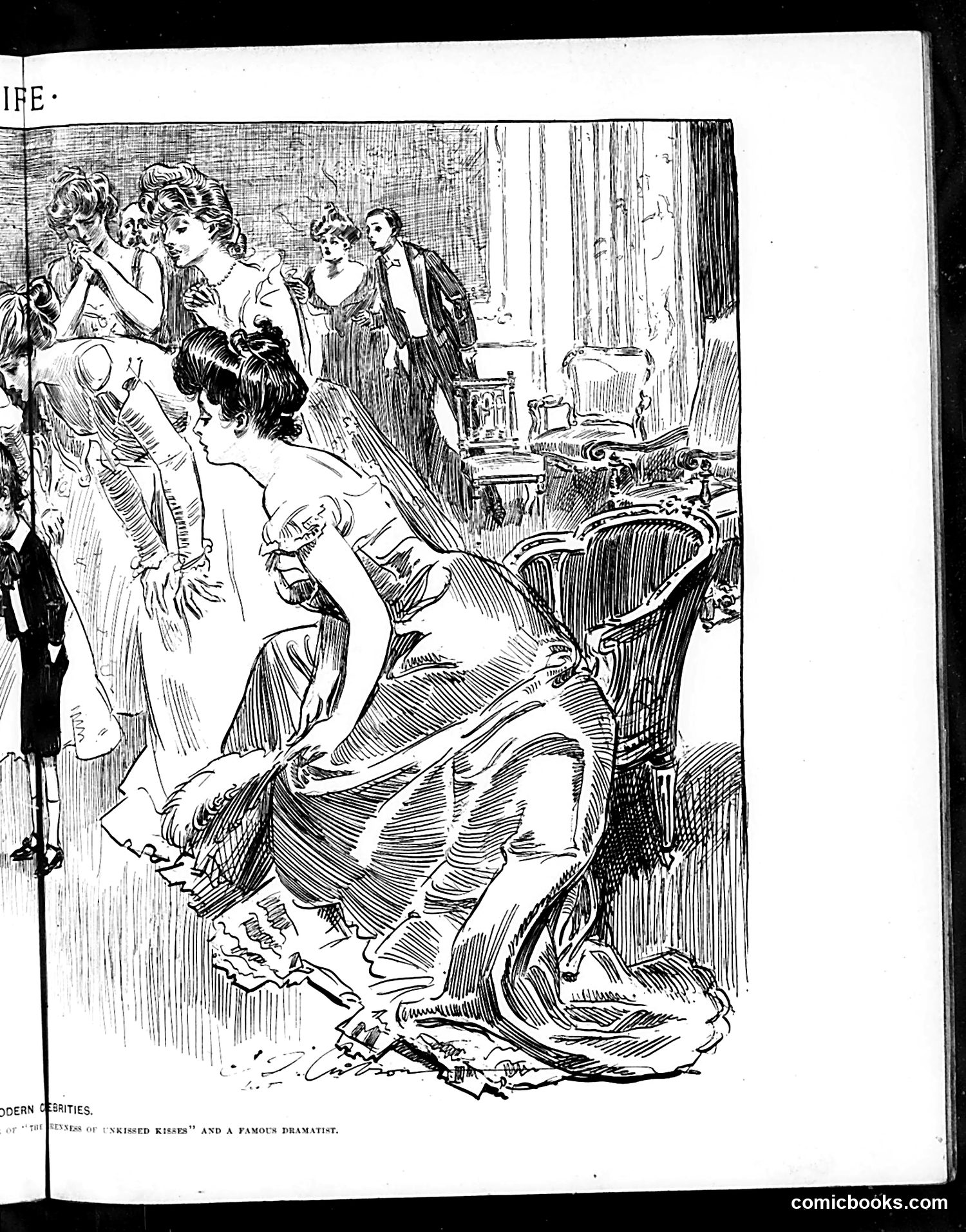
This page from *Life* magazine contains a satirical illustration labeled "Modern Celebrities" with a subtitle referencing "The Kisses of 'Kissed Kisses' and a Famous Dramatist." The drawing depicts an elaborate social scene where a woman in the foreground is dramatically kneeling or reclining, while other well-dressed figures observe in the background. The exaggerated posture and emotional display suggest satire of theatrical performance or melodrama. The caption indicates this mocks either a theatrical production called "Kissed Kisses" or possibly the scandalous behavior of a famous dramatist of the era. Without additional context, the specific targets remain unclear, though the satire appears directed at overwrought theatrical convention and the celebrity culture surrounding dramatic arts in early 20th-century America.
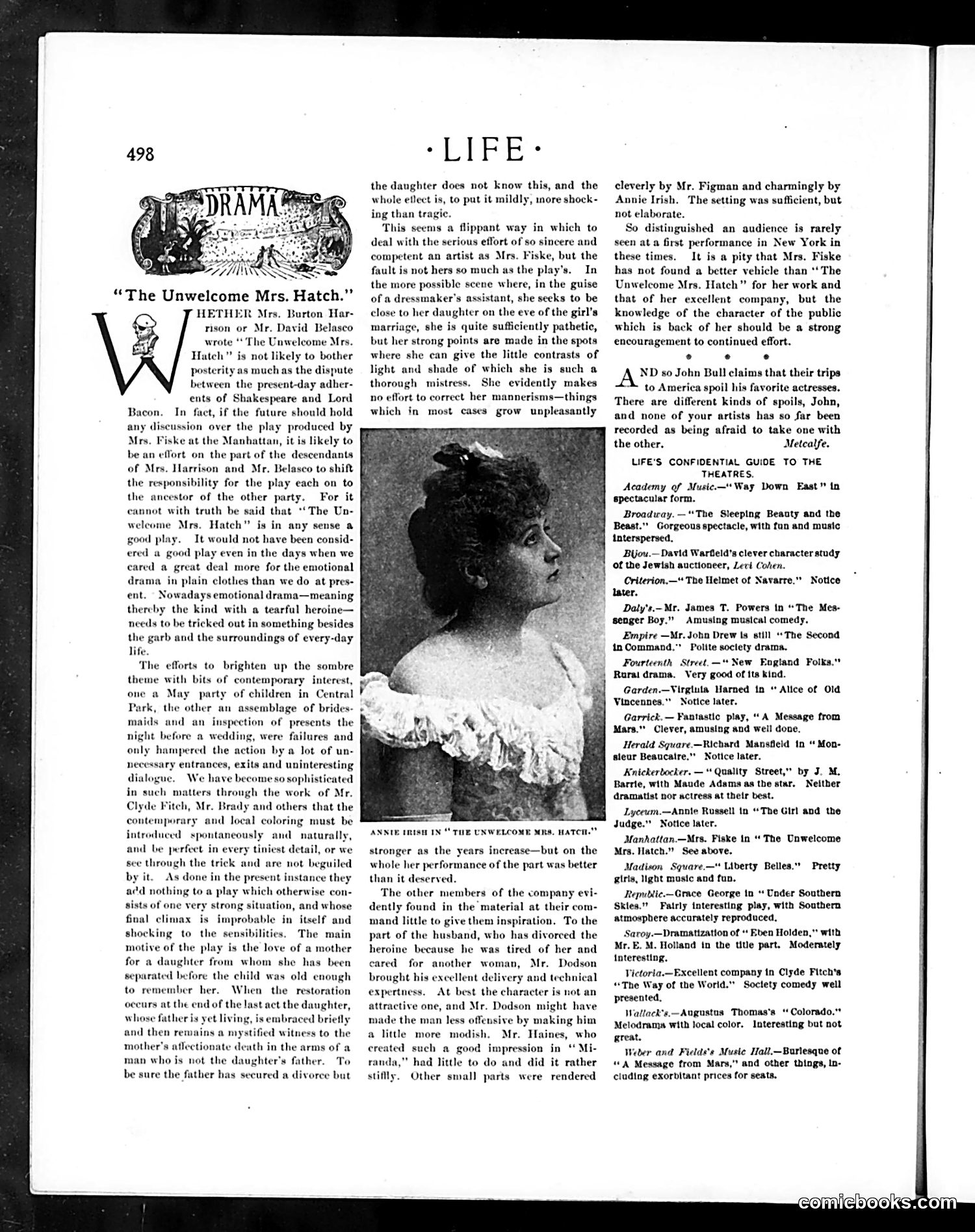
This page reviews a play by that title, written by Hether Mrs. Harton and David Belasco. The review discusses the play's treatment of a domestic dispute between Mr. and Mrs. Hatch, focusing on their daughter. The photograph shows **Annie Irish** in a scene from the production. The review praises Mrs. Fiske's performance in the title role, noting her excellent portrayal of character nuance and her ability to convey emotional depth through subtle acting—a sophisticated approach praised as a rarity in contemporary theater. The page also includes "Life's Confidential Guide to the Theatres," listing brief reviews of other current Broadway productions, indicating this was a regular theater criticism feature in the magazine.
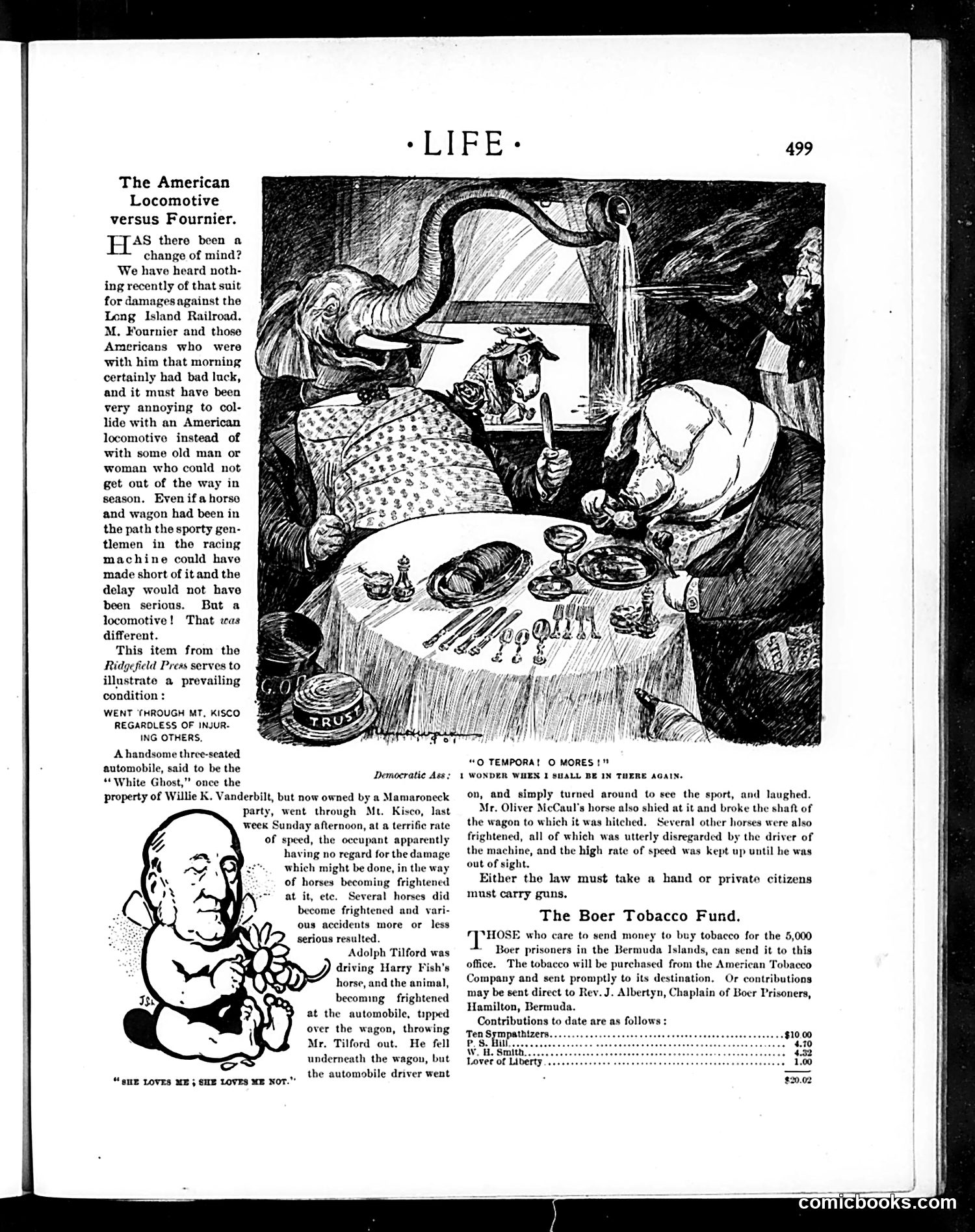
This Life magazine page (page 499) satirizes the dangers posed by early automobiles to pedestrians and animals in the early 1900s. **The Main Cartoon (top):** Shows an elephant at a dining table with a well-dressed man, captioned "O TEMPORA! O MORES!" ("Oh the times! Oh the customs!"). This appears to reference M. Fournier, who apparently sued the Long Island Railroad after his group collided with a locomotive—an ironic complaint, given the text's point: that dangerous vehicles (whether locomotives or automobiles) pose real hazards that deserve legal attention. **The Articles Below:** Document reckless automobile driving. A vehicle called the "White Ghost" (owned by a Vanderbilt heir) raced through Mt. Kisco at dangerous speeds, frightening horses and causing accidents. The driver ignored all damage and injuries. The text sarcastically notes that hitting someone with a car is "different" from hitting them with a wagon—implying automobiles are uniquely destructive. **The Satire's Point:** Wealthy automobile owners drive with impunity, endangering the public. The final line—"Either the law must take a hand or private citizens must carry guns"—darkly suggests frustrated citizens may resort to shooting dangerous drivers.
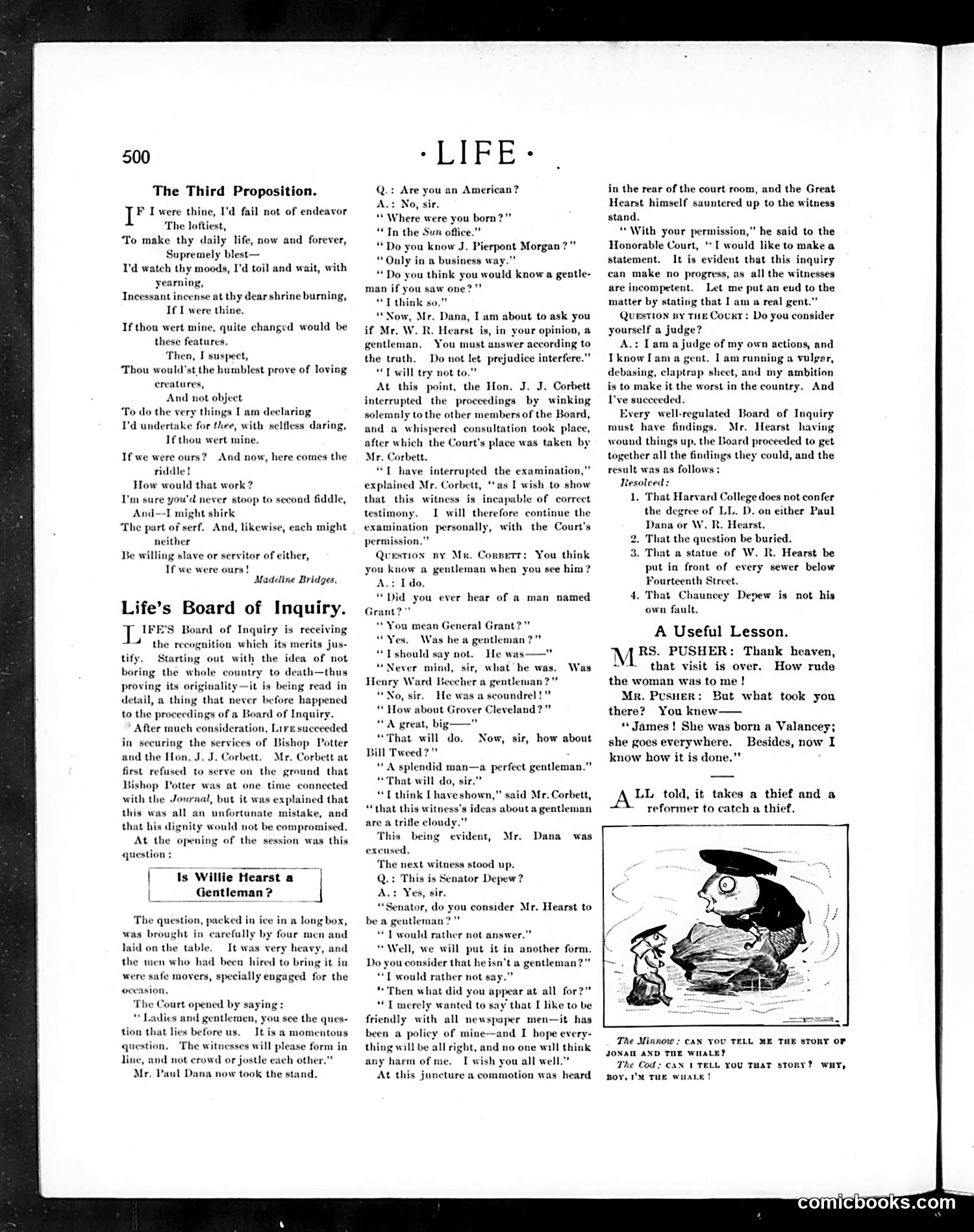
This page satirizes the vagueness of defining a "gentleman" through Life's mock "Board of Inquiry." The setup ridicules both American social pretension and the era's obsession with character assessment. The inquiry questions whether **Willie Hearst** (William Randolph Hearst, the newspaper magnate) qualifies as a gentleman. The satire works by having witnesses give contradictory answers about who *is* a gentleman: they reject General Grant and Henry Ward Beecher as gentlemen, yet call **Boss Tweed** (the corrupt Tammany Hall politician) "a splendid man—a perfect gentleman." This exposes how "gentleman" is meaningless—merely reflecting personal bias and financial status rather than actual character. By having Judge J.J. Corbett control the examination, the piece also mocks legal proceedings' pretense of objectivity. The final witness, **Senator Depew**, refuses to answer, suggesting even prominent figures won't define the term. The joke: American society uses "gentleman" as a status marker while having no coherent definition of it.
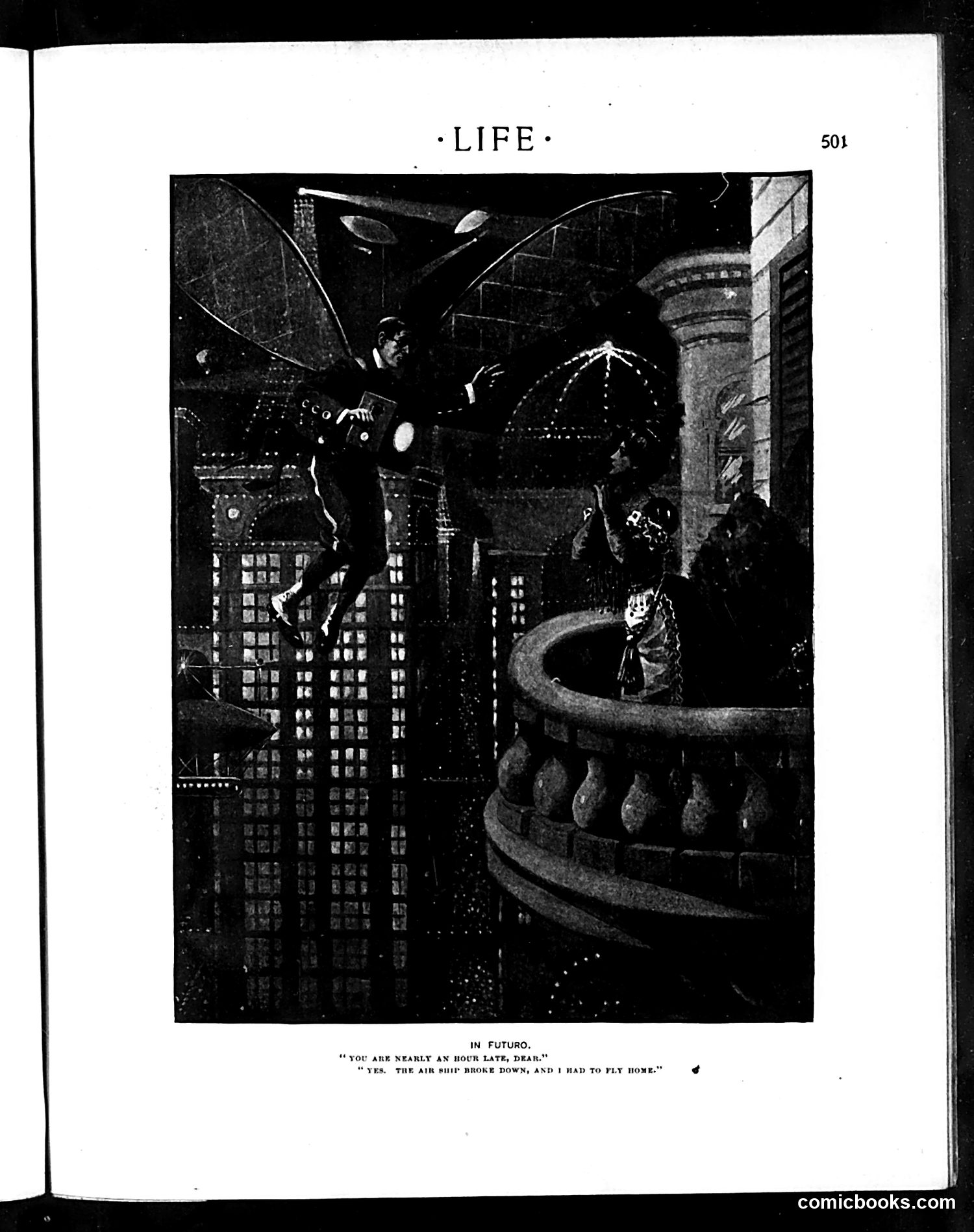
This is a futuristic satire imagining air travel as commonplace personal transportation. The scene shows a couple in what appears to be a high-rise apartment or building, with the husband arriving late wearing what looks like an early aviation suit or aircraft. The joke plays on the idea that in some future time ("in futuro"), mechanical air travel failures will become as routine and mundane as modern transportation breakdowns—so commonplace that "my air suit broke down" becomes an acceptable excuse for tardiness, delivered with the same casual resignation we might use today for car trouble. The artwork's Art Deco style and futuristic cityscape suggest this was likely drawn in the 1920s-1930s, when such technological speculation was popular satirical fodder in magazines like Life.
This page from *Life* magazine contains three humorous anecdotes rather than political cartoons: **"Paradise"**: A brief dialogue contrasting romantic ideals—one person finds paradise in golf and companionship; another in undivided romantic attention. **The Organ-Grinder Story**: French novelist Méry recounts how to permanently discourage street musicians. By enthusiastically encouraging an organ-grinder's first performance, Méry ensured the musician and his colleagues would avoid that street forever, assuming they'd been tricked into unwanted performances. The satire mocks both the persistence of urban street musicians (a common nuisance in the era) and the clever psychology of reverse psychology. **The Cherry Pie Anecdote**: A schoolteacher asks students to count cherry pit stones; young Johnny eats an entire pie to answer accurately (finding 142 stones), then justifies it as logical necessity. The humor targets both overly literal-minded children and perhaps pedantic schoolteachers. These are lighthearted domestic humor pieces reflecting early 20th-century urban life and child-rearing attitudes.
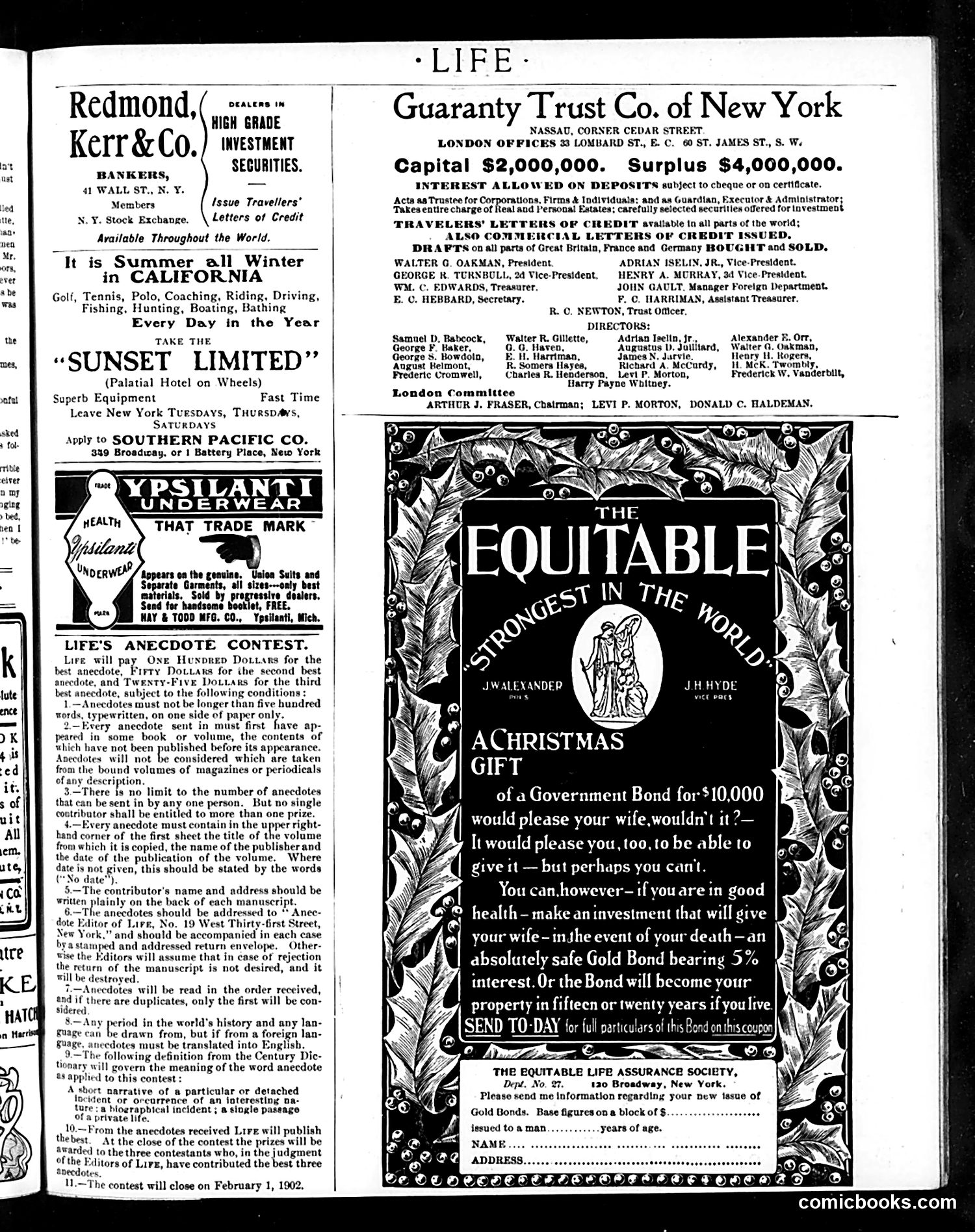
This page is primarily **advertising and business directory content** rather than satirical cartoons. The main elements are: 1. **Banking/Investment ads** for Redmond, Kerr & Co. and the Guaranty Trust Co. of New York—typical early-1900s financial services advertisements. 2. **Travel promotion** for the "Sunset Limited" train to California—marketing year-round recreational activities. 3. **Underwear advertisement** for Ypsilanti brand merchandise. 4. **Life Magazine's Anecdote Contest**—a crowdsourced content initiative offering cash prizes ($100-$25) for previously published anecdotes. 5. **The Equitable Life Assurance Society** insurance ad featuring a large illustrated panel promoting government bonds as Christmas gifts and investment vehicles for wives' financial security. The Equitable ad is the most visually prominent content and appears designed to appeal to middle/upper-class readers concerned with family financial protection—not satirical commentary.
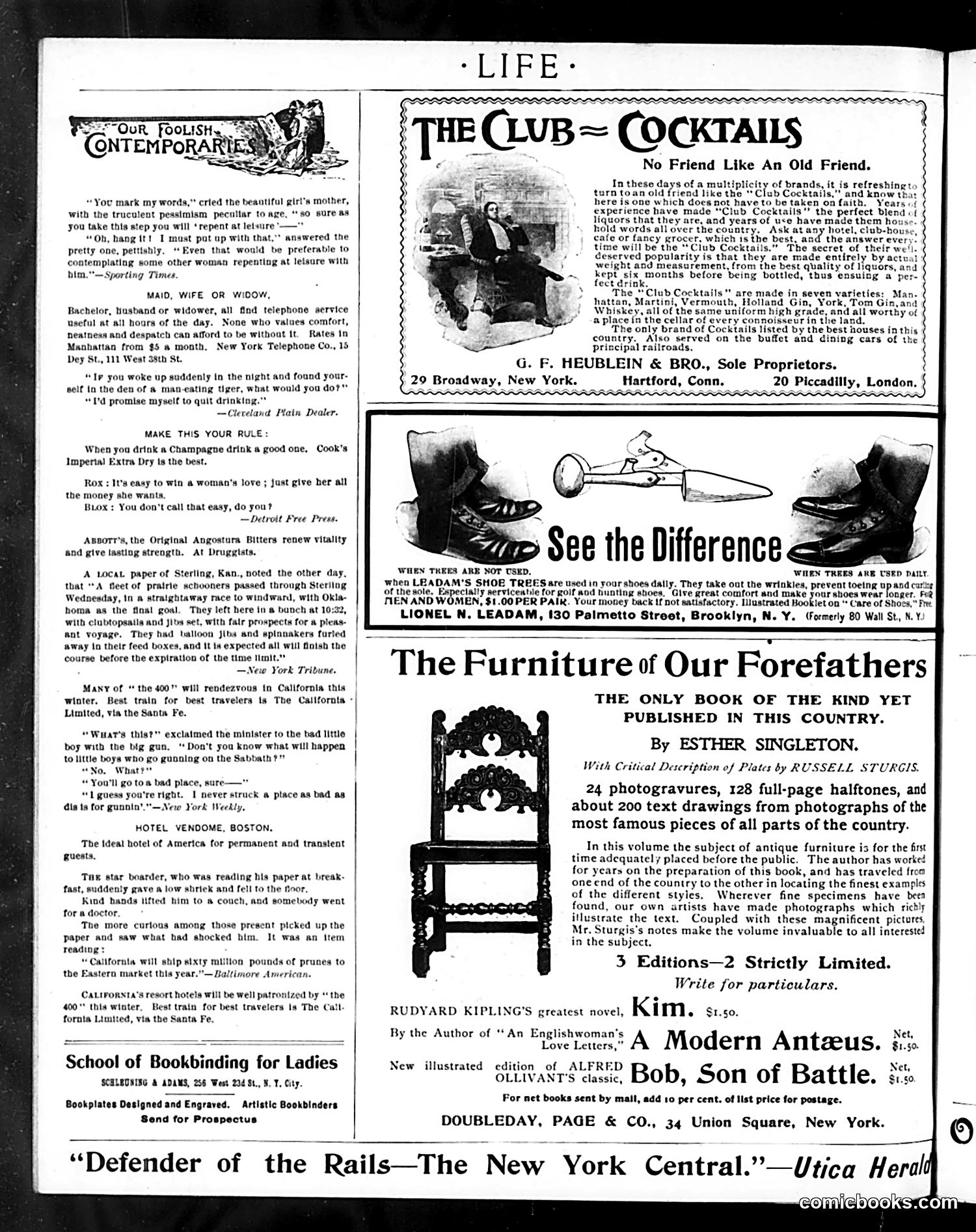
This page consists primarily of **advertisements and brief humor items** rather than political cartoons. The content reflects early 20th-century American attitudes: ## The Humor The "Our Foolish Contemporaries" section collects short anecdotes poking fun at social situations. Notable examples include a woman choosing between marrying a man or watching another woman regret it, and a boy claiming that going hunting on the Sabbath would send him somewhere "bad"—but he knows worse places (implying his neighborhood is disreputable). These jokes rely on period-specific social anxieties: marriage anxiety, religious concerns, and class-based assumptions about dangerous neighborhoods. ## The Advertising The ads target middle and upper-class readers: telephone service, champagne, luxury hotels, and books on antique furniture. The Lionel Tree Shoes advertisement uses "before/after" imagery to promote shoe trees—a mundane product for the era's fashionable consumer. There are **no identifiable political figures or caricatures**. This appears to be a relatively light satirical magazine page focused on lifestyle commentary and consumer goods marketed to affluent readers.
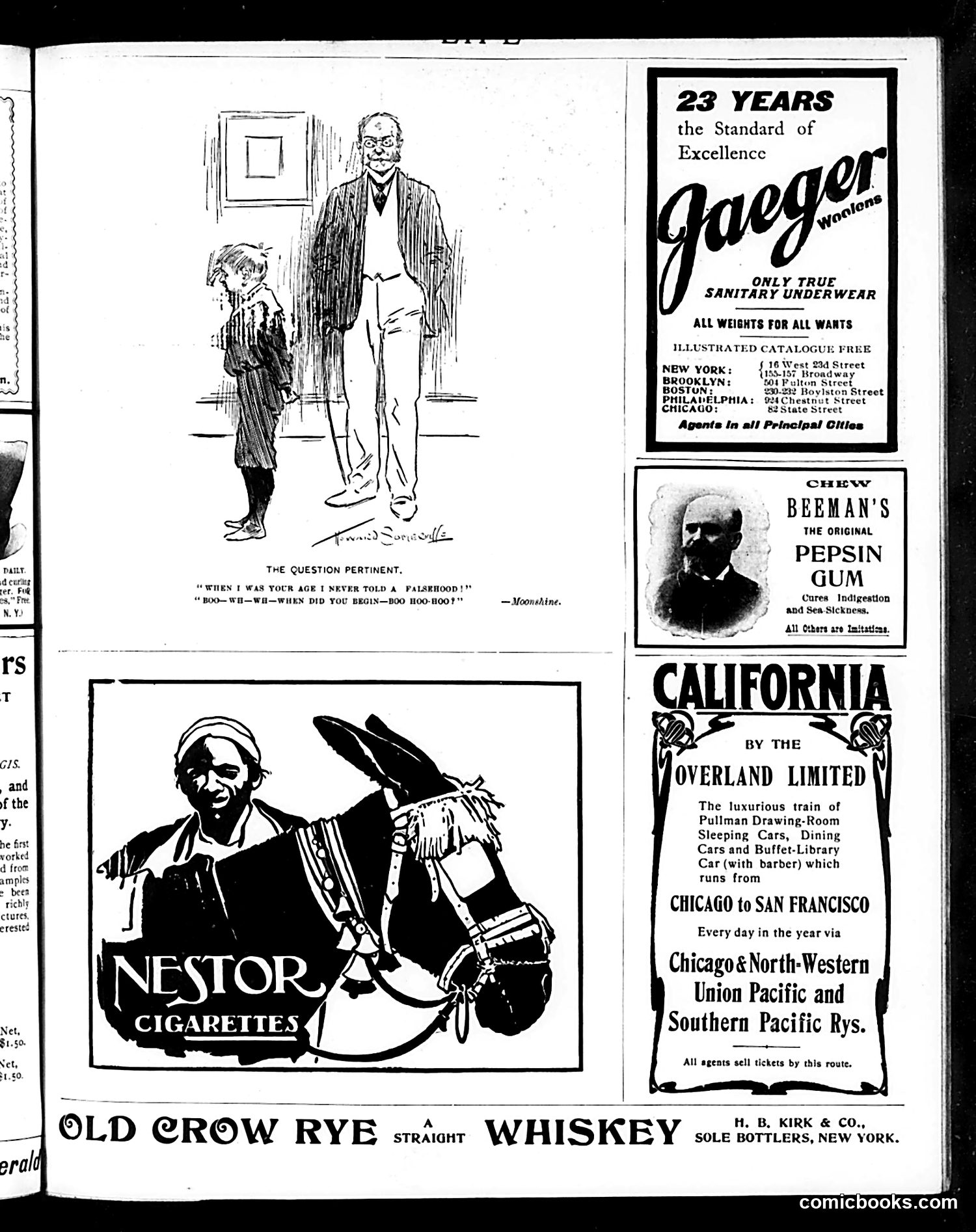
The main cartoon, "The Question Pertinent," satirizes parental hypocrisy. An adult man confronts a child about lying, claiming "When I was your age I never told a falsehood!" The child's response—"Wah-wah-when did you BEGIN?"—exposes the adult's obvious dishonesty, implying he started lying sometime after childhood. The humor lies in catching the father in a transparent lie while lecturing against lying. The page is primarily **advertising**, featuring period products: Jaeger sanitary underwear (23 years established), Beeman's pepsin gum (digestive aid), Nestor cigarettes, Old Crow whiskey, and the Overland Limited train service. These ads reflect early 20th-century consumer goods and travel. The satirical point targets the common parental contradiction of demanding honesty while adults routinely deceive.
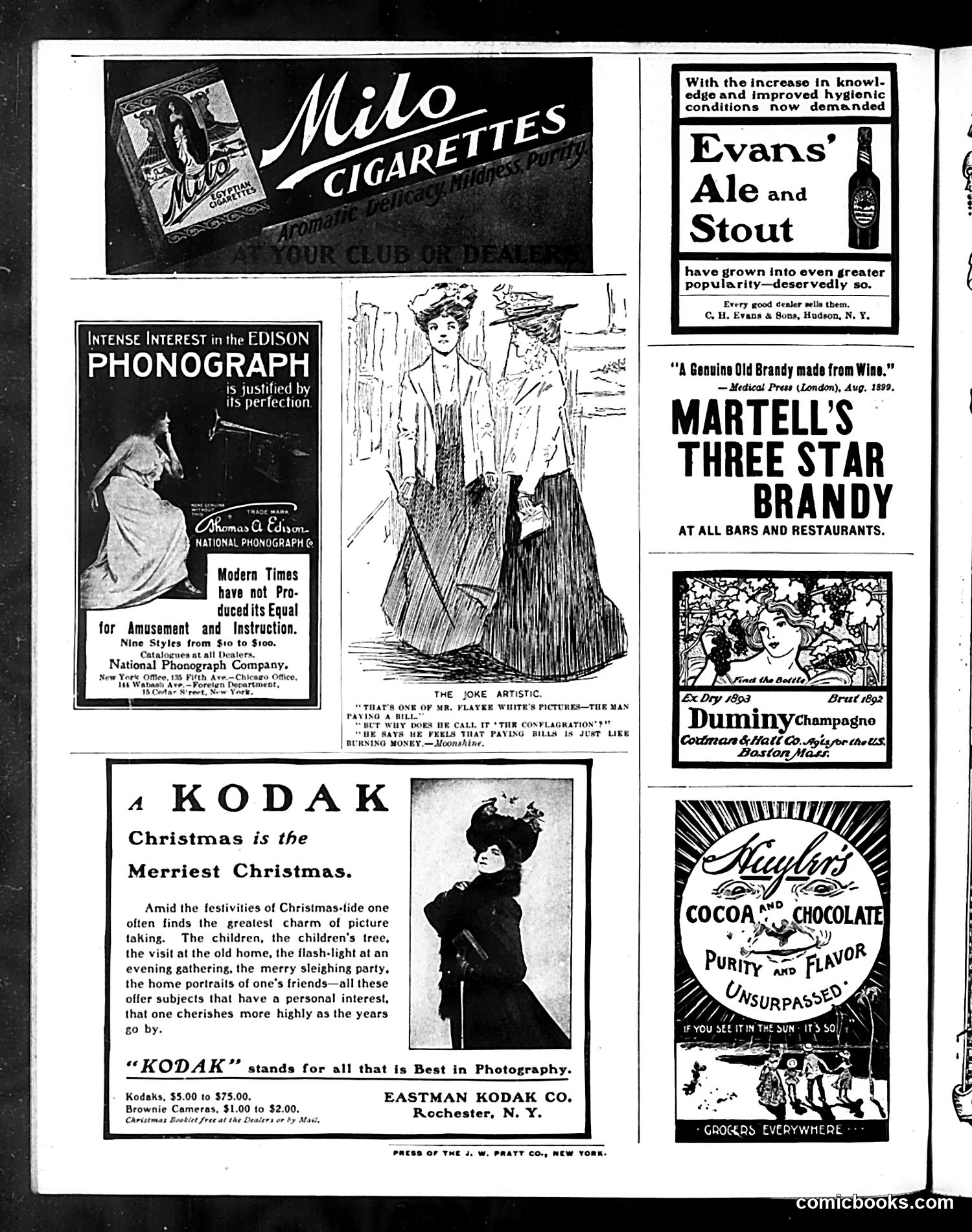
This single-panel cartoon satirizes pretentious art criticism. It depicts a man viewing a painting titled "The Conflagration" (appearing to show a bill or financial document burning). When asked why the artist calls it this, the response is that the artist believes "paying bills is just like burning money." The joke mocks both the artist's melodramatic naming of a mundane subject and the gap between artistic pretension and practical reality. By attributing the painting to "Mr. Player White," the cartoonist appears to be inventing a generic art-world figure to ridicule. The humor relies on exposing the absurdity of elevating everyday financial frustration into "fine art" through grandiose titles—a common target of satirical magazines like *Life* in the early 20th century.