
Life, 1901-12-05 · page 6 of 20
Life — December 5, 1901 — page 6: what you’re looking at
What you’re looking at
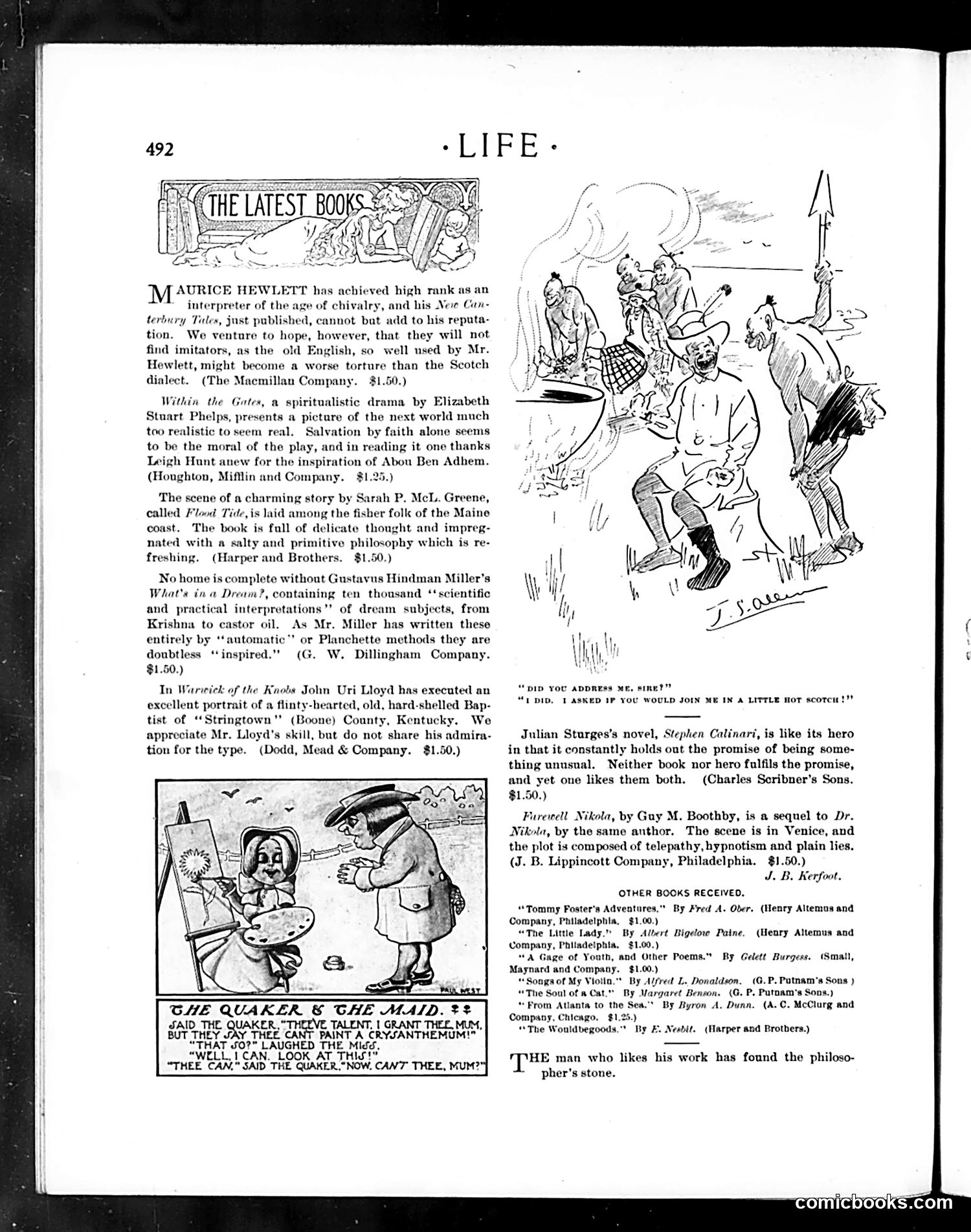
This page contains two unrelated cartoons and book reviews. **Top cartoon**: Shows Scottish Highlanders in kilts with a hot air balloon. The dialogue indicates one character has invited another to join him in "a little hot scotch," playing on the double meaning of "Scotch" (the nationality and the drink). The satire mocks Scottish identity and drinking culture stereotypes. **Bottom cartoon**: Titled "The Quaker & The Maid," depicts a Quaker man and a maid in domestic interaction. The dialogue suggests mild flirtation or social awkwardness, playing on contrasts between Quaker restraint and the maid's boldness—a common comedic pairing of the era. Both cartoons rely on ethnic and religious stereotyping typical of early-20th-century American humor.
📄 Transcribed text from this page (OCR, searchable)
Machine-transcribed from the original scan — historical spelling and the odd misread are preserved.
M AURICE HEWLETT has achieved high rank as an interpreter of the age of chivalry, and his New Can- terbury Tales, just published, cannot but add to his reputa- tion. We venture to hope, however, that they will not find imitators, as the old English, so well used by Mr. Hewlett, might become a worse torture than the Scotch dialect. (The Macmillan Company. 31.50.) Within the Gates, a spiritualistic drama by Elizabeth Stuart Phelps, presents a picture of the next world much too realistic to seem real, Salvation by faith alone seems to be the moral of the play, and in reading it one thanks Leigh Hunt anew for the inspiration of Abou Ben Adhem. (Houghton, Mifin and Company. The scene of a charming story by called Flood Tide, is laid among the coast. nated with a salty a freshing. ‘ah P. Mc. Greene, sher folk of the Maine © thought and impreg- ve philosophy which is re- $1.50.) No home is complete without Gustavus Hindman Miller’s What's ina Dream?, containing ten thousand ‘scientific and practical interpretations” of dream subjects, from Krishna to castor oil Mr. Miller has written these entirely by ‘automatic’ or Planchette methods they are doubtless “inspired.” (G. W. Dillingham Company. $1.50.) In Warieick of the Knobs Join Uri Lloyd has executed an excellent portrait of a flinty-hearted, old, hard-shelled Bap- tist of ‘Stringtown" (Boone) County, Kentucky. We appreciate Mr. Lloyd's skill, but do not share his admira- tion for the type. (Dodd, Mead & Company. $1.50.) CHE QUAKER & CHE MAID. **% SAID THE UAKER, “THEE TALENT, | GRANT THEE. MUM, BUT THEY JAY THEE CANT PAINT A CRYSANTHEMUM!” “THAT SO?” LAUGHED THE Mics. “WELL. 1 CAN. LOOK AT THIS!” “THEE CAN,” SAID THE QUAKER."NOW. CANT THEE, MUM? “pip you aDpRess we, sine?” “1 DID, 1 ASKED IP YOU WOULD JOIN ME IN A LITTLE MoT scotcu!’* Julian Sturges’s novel, Stephen Calinari, is like its hero in that it constantly holds out the promise of being some- thing unusual. Neither book nor hero fulfils the promise, and yet one likes them both. (Charles Scribner’s Sons. $1.50.) ‘uremell Nikola, by Guy M. Boothby, is a sequel to Dr. Nikola, by the same author. The scene is in Venice, and the plot is composed of telepathy, hypnotism and plain lies. (J. B. Lippincott Company, Philadelphia. $1.50.) J.B. Kerfoot, OTHER BOOKS RECEIVED. “Tommy Foster's Adventures.” By Fred A. Ober. (Henry Altemas and Company, Philadelphia, $1.00.) “The Little Lady.” By Altert Bigelow Paine. Company, Philadetphia, $1.00.) A Gage of h, and Other Poems.” Maynard and Company. $1.00.) “Songs of My Violln.”” By Alfred L. Donaldson. (G.P. Putnam's Sons ) “The Soul of a Cat." By Margaret Benson, (G. P. Putnam's Sons.) * From Atlanta to the Sea.’ By Byron A. Dunn. (A.C. McClurg and Company, Chicago, $1.25.) “The Wouldbegoods.” By E. Nesbit. (Henry Altemus and By Gelett Burgess. (Small, (Harper and Brothers.) HE man who likes his work has found the philoso- pher’s stone.