
Life, 1901-12-05 · page 4 of 20
Life — December 5, 1901 — page 4: what you’re looking at
What you’re looking at
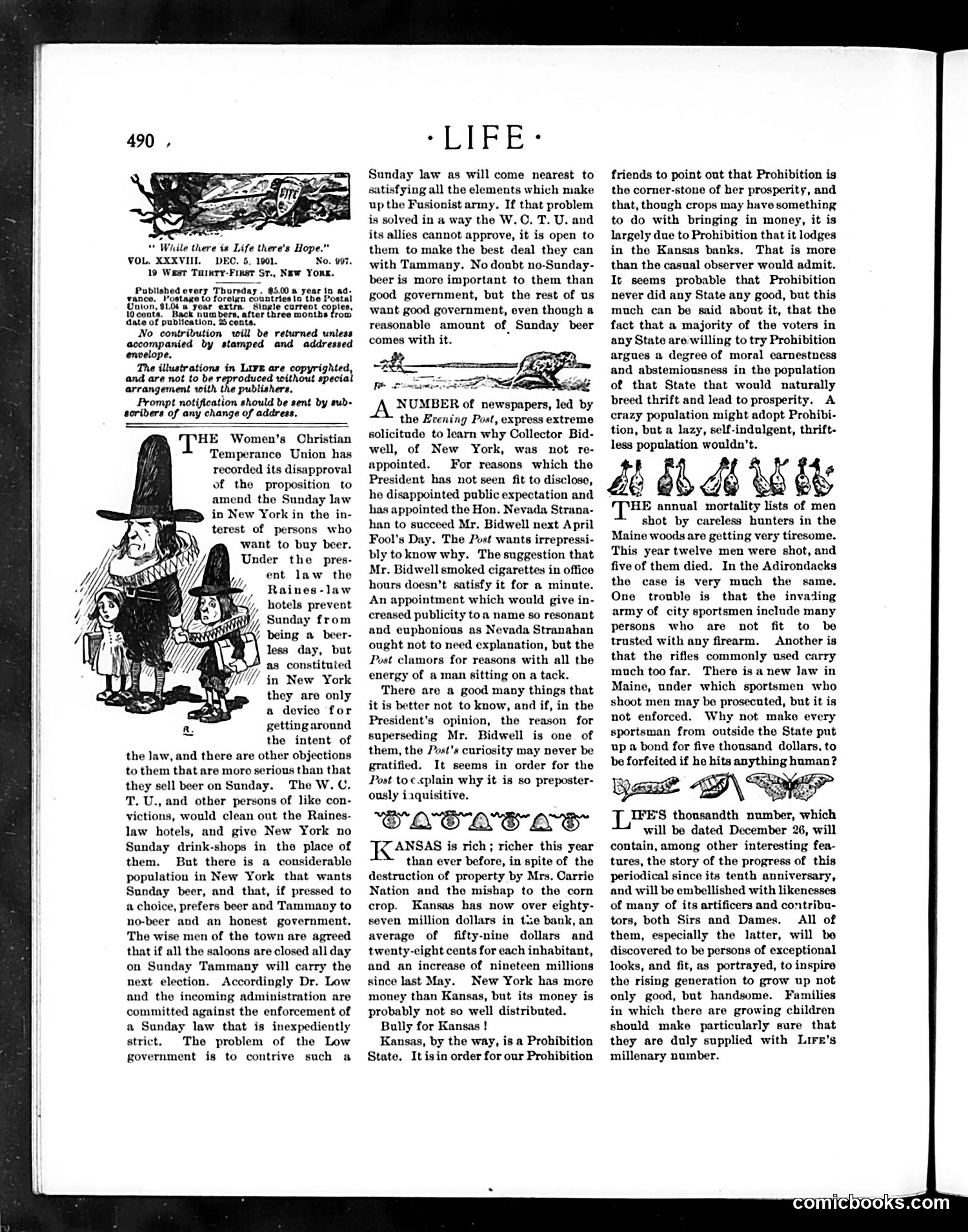
This page contains political commentary about Prohibition and American governance circa 1901. The left cartoon depicts a rotund figure in formal dress labeled as representing those opposed to Sunday beer laws—likely a politician or wealthy businessman. The satire criticizes the hypocrisy of elites who want to restrict working-class Sunday drinking while enjoying privileges themselves. The text discusses the Women's Christian Temperance Union's efforts to amend New York's Sunday laws, and debates whether Prohibition serves moral interests or class control. The piece sarcastically notes that closing saloons on Sundays while allowing other establishments remains inconsistent. The cartoon mocks wealthy interests claiming moral authority while actually pursuing economic or political advantage—a common Life magazine theme critiquing Progressive Era reform movements.
📄 Transcribed text from this page (OCR, searchable)
Machine-transcribed from the original scan — historical spelling and the odd misread are preserved.
“* While there is Life there’s Hope.” VOL. XXXVIII. DEC. 5. 1901. No. 997. 19 West Tarkry-First Sr., New YORg. Published every Thursday. $5.00 8 y vance. Hostage to foreign countries in Coion, $1.06 a year extra. Single curre copii lOcents. “Back numbers, after three months from date of publication, % cents. No contribution will be returned unle accompanied by stamped and addressed envelope. The illustrations in Lure are copyrighted, and are not to be reproduced without special arrangement with the publishers, Prompt notification should be sent by sub- soribers of any change of address. HE Women’s Christian Temperance Union has recorded its disapproval of the proposition to amend the Sunday law in New York in the in- terest of persons who want to buy beer. Under the pres- ent law the Raines-law hotels prevent y, Sunday from / being a beer- less day, but # as constituted // in New York they are only a devico for gettingaround the intent of the law, and there are other objections to them that are moro serious than that they sell beer on Sunday. The W.C. T. U., and other persons of like con- victions, would clean out the Raines- law hotels, and give New York no Sunday drink-shops in the place of them. But there is a considerable population in New York that wants Sunday beer, and that, if pressed to a choice, prefers beer and Tammany to no-beer and an honest government. The wise men of the town are agreed that if all the saloons are closed all day on Sunday Tammany will carry the next election. Accordingly Dr. Low and the incoming administration are committed against the enforcement of a Sunday law that is inexpediently strict. The problem of the Low government is to contrive such a ‘LIFE Sunday law as will come nearest to satisfying all the elements which make up the Fusionist army. If that problem is solved in a way the W. ©. T. U. and its allies cannot approve, it is open to them to make the best deal they can with Tammany. No doubt no-Sunday- beer is more important to them than good government, but the rest of us want good government, even though a reasonable amount of Sunday beer comes with it. . the Evening Post, express extreme solicitude to learn why Collector Bid- well, of New York, was not re- appointed. For reasons which the President has not seen fit to disclose, he disappointed public expectation and has appointed the Hon. Nevada Strana- han to succeed Mr. Bidwell next April Fool's Day. The Post wants irrepressi- bly toknow why. The suggestion that Mr. Bidwell smoked cigarettes in office hours doesn’t satisfy it for a minute. An appointment which would give in- creased publicity toa name so resonant and euphonious as Nevada Stranahan ought not to need explanation, but the Post clamors for reasons with all the energy of a man sitting on a tack. There are a good many things that it is better not to know, and if, in the President’s opinion, the reason for superseding Mr. Bidwell is one of them, the Post's curiosity may never be gratified. It seems in order for the Post toc<plain why it is so preposter- ously iaquisitive. Kow awow Awowawom T ANSAS is rich; richer this year than ever before, in spite of the destruction of property by Mrs. Carrie Nation and the mishap to the corn crop. Kansas has now over eighty- seven million dollars in tie bank, an averago of fifty-nine dollars and twenty-eight cents for each inhabitant, and an increase of nineteen millions since last May. New York has more money than Kansas, but its money is probably not so well distributed. Bully for Kansas ! Kansas, by the way, is a Prohibition State. It isin order for our Prohibition friends to point out that Prohibition is the corner-stone of her prosperity, and that, though crops may have something to do with bringing in money, it is largely due to Prohibition that it lodges in the Kansas banks, That is more than the casual observer would admit. It seems probable that Prohibition never did any State any good, but this much can be said about it, that the fact that a majority of the voters in any State are willing to try Prohibition argues a degree of moral earnestness and abstemiousness in the population of that State that would naturally breed thrift and lead to prosperity. A crazy population might adopt Prohibi- tion, but a lazy, self-indulgent, thrift- less population wouldn’t. db dh dé Os bs HE annual mortality lists of men shot by careless hunters in the Maine woods are getting very tiresome. This year twelve men were shot, and five of them died. In the Adirondacks the case is very much the same. One trouble is that the invading army of city sportsmen include many persons who are not fit to be trusted with any firearm. Another is that the rifles commonly used carry much too far. There is a new law in Maine, under which sportsmen who shoot men may be prosecuted, but it is not enforced. Why not make every sportsman from outside the State put up a bond for five thousand dollars, to be forfeited if he hits anything human? IFE'S thousandth number, which will be dated December 26, will contain, among other interesting fea- tures, the story of the progress of this periodical since its tenth anniversary, and will be embellished with likenesses of many of its artificers and contribu- tors, both Sirs and Dames. All of them, especially the latter, will be discovered to be persons of exceptional looks, and fit, as portrayed, to inspire the rising generation to grow up not only good, but handsome. Families in which there are growing children should make particularly sure that they are duly supplied with Lire’s millenary number.