
Life, 1901-12-05 · page 14 of 20
Life — December 5, 1901 — page 14: what you’re looking at
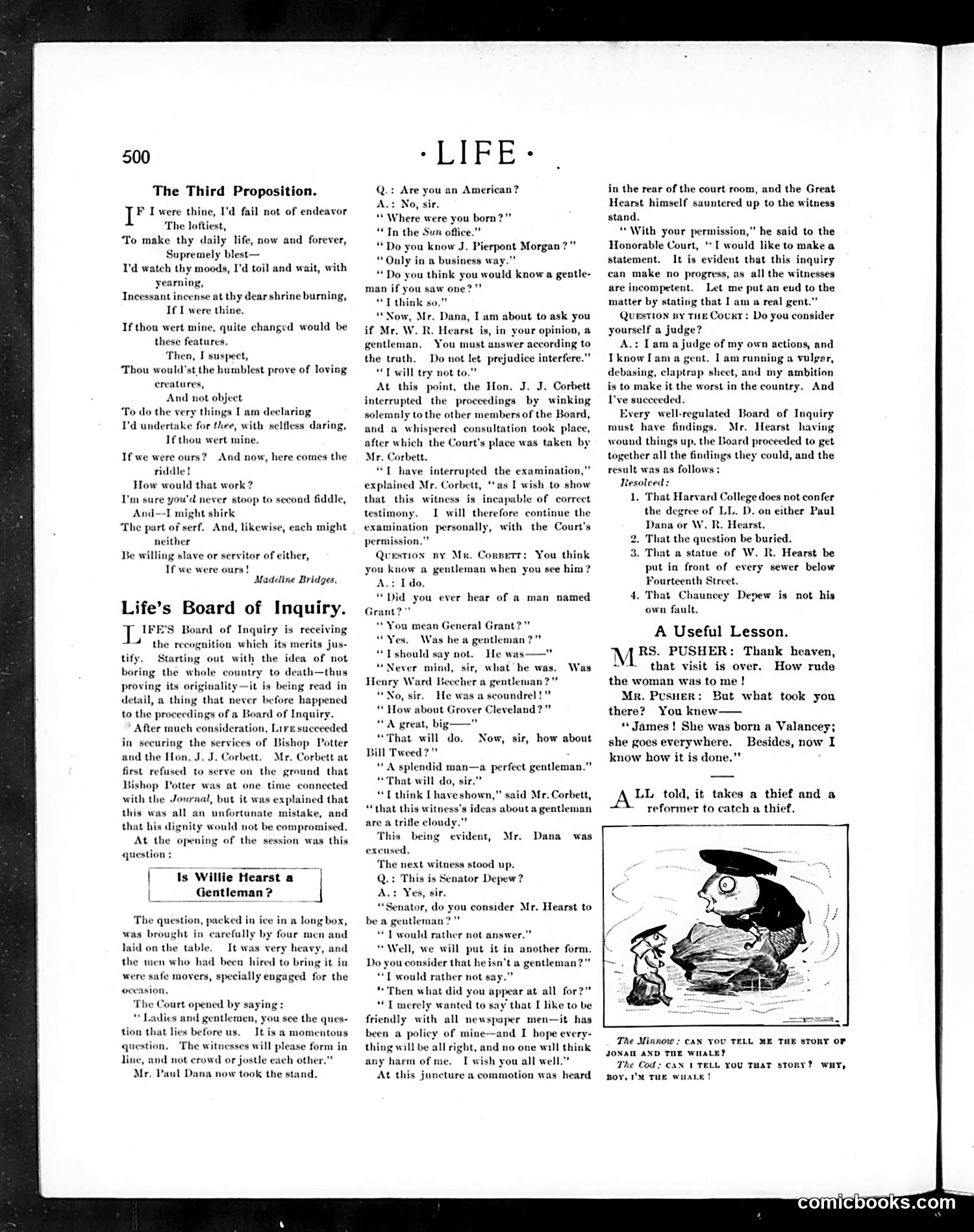
What you’re looking at
This page satirizes the vagueness of defining a "gentleman" through Life's mock "Board of Inquiry." The setup ridicules both American social pretension and the era's obsession with character assessment. The inquiry questions whether **Willie Hearst** (William Randolph Hearst, the newspaper magnate) qualifies as a gentleman. The satire works by having witnesses give contradictory answers about who *is* a gentleman: they reject General Grant and Henry Ward Beecher as gentlemen, yet call **Boss Tweed** (the corrupt Tammany Hall politician) "a splendid man—a perfect gentleman." This exposes how "gentleman" is meaningless—merely reflecting personal bias and financial status rather than actual character. By having Judge J.J. Corbett control the examination, the piece also mocks legal proceedings' pretense of objectivity. The final witness, **Senator Depew**, refuses to answer, suggesting even prominent figures won't define the term. The joke: American society uses "gentleman" as a status marker while having no coherent definition of it.
📄 Transcribed text from this page (OCR, searchable)
Machine-transcribed from the original scan — historical spelling and the odd misread are preserved.
500 The Third Proposition. T° I were thine, I'd fail not of endeavor ‘The loftiest, To make thy daily life, now and forever, supremely blest— I'd watch thy moods, I'd toil and wait, with yearning, Incessant incense at thy dear shrine burning, If I were thine. If thon wert mine, quite changed would be these features. Then, I suspect, Thou would’st,the humblest prove of loving creatures, And not object ‘To do the very things I am declaring I'd undertake for thee, with selfless daring, If thou wert mine. If we were ours? riddle! How would that work? I'm sure you'd never stoop to second fiddle, And—I might shirk The part of serf. And, likewise, each might neither Be willing slave or servitor of either, If we were ours! And now, here comes the Madeline Bridges. Life’s Board of Inquiry. T IFE'S Board of Inquiry is receiving the recognition which its merits jus- tify. Starting out with the idea of not boring the whole country to death—thus proving its originality—it is being read in detail, a thing that never before happened to the proceedings of a Board of Inquiry. After much consideration, Lire succeeded in securing the services of Bishop Potter and the Hon, J. J. Corbett. Mr. Corbett at first refused to serve on the ground that Bishop Potter was at one time connected with the Journal, but it was explained that this was all an unfortunate mistake, and that his dignity would not be compromised. At the opening of the session was this question | Is Willie Hearst a | Gentleman ? | The question, packed was brought in carefull laid on the table, the men who had been hired to bring it in were safe movers, specially engaged for the occasion, ‘The Court opened by * Ladies and gentlemen, ee the ques- tion that lies before us. It is a momentous question, The witnesses will p rm in line, and not crowd or jostle each other.” Mr. Paul Dana now took the stand, in a long box, y by four men and It was very heavy, and *DIFE* . .: Are you an American? : No, sir. “Where were you born?” “In the Sun office.” “Do you know J. Pierpont Morgan?” iness way.” “Do you think you would know a gentle- man if you saw one?” “T think so.” “Now, Mr. Dana, I am about to ask you if Mr. W. R. Hearst is, in your opinion, a gentleman. You must answer according to the truth. Do not let prejudice interfere.” I will try not to.” At this point, the Hon. J. J. Corbett interrupted the proceedings by winking solemnly to the other members of the Board, and a whispered consultation took place, after which the Court's place was taken by Mr. Corbett. I have interrupted the examination,” explained Mr. Corbett, ‘as I wish to show that this witness is incapable of correct testimon I will therefore continue the examination personally, with the Court's permission.” Question ny Mr. Cornett: You think you know a gentleman when you see him? I do, ‘ou ever hear of a man named ‘ou mean General Grant?” “Yes. Was he a gentleman?" “Tshould say not. “Never mind, sir, what he was. Henry Ward Beecher a gentleman?” “No, sir. He was a scoundrel!” “ How about Grover Cleveland?” “A great, big—" “That will do. Bill Tweed?” “A splendid man—a perfect gentleman.” “That will do, sir.” “LT think [haveshown,” said Mr. Corbett, “that this witness's ideas about a gentleman are a tritle cloudy This being evident, xeused. ‘The next witness stood up. Q.: This is Senator Depew? A.: Yes, si “Senator, do be a gentleman ? “ Lwould rather not answe: “Well, we will put it in another form. Do you consider that he isn't a gentleman?” would rather not say.” © Then what did you appear at all for?” “TL merely wanted to say that I like to be friendly with all newspaper men—it has been a policy of mine—and I hope ever: thing will be all right, and no one wall think any harm of me. I wish you all well. At this juncture a commotion was He was—" Was Now, sir, how about Mr. Dana was ‘ou consider Mr. Hearst to in the rear of the court room, and the Great Hearst himself sauntered up to the witness stand. “With your permission,” he said to the Honorable Court, ‘ [ would like to make a statement. It is evident that this inquiry can make no progress, as all the witnesses are incompetent, Let me put an eud to the matter by stating that I am a real gent.” Question by THE CouRT: Do you consider yourself a judge? A.: Lam a judge of my own actions, and Iknow Iam a gent. Iam running a vulgor, debasing, claptrap sheet, and my ambition is to make it the worst in the country. And I've succeeded. Every well-regulated Board of Inquiry must have findings. Mr. Hearst having wound things up. the Board proceeded to get together all the findings they could, and the result was as follows : Resoleed: 1, That Harvard College does not confer the degree of LL. D. on either Paul Dana or W. R. Hearst. . That the question be buried. . That a statue of W. R. Hearst be put in front of every sewer below Fourteenth Street. . That Chauncey Depew is not his own fault. A Useful Lesson. i RS. PUSHER: Thank heaven, - that visit is over. How rude the woman was to me ! Mr. Pusner: But what took you there? You knew—— « James ! She was born a Valancey; she goes everywhere. Besides, now I know how it is done.”” A LL told, it takes a thief and a reformer to catch a thief. The Minnow: CAN YOU TELL ME THE STORY OP JONAM AND THE wiaLz? ¢ Cod: CAN 1 TELL YOU THAT sTORY? WHT, Comicbooks.com