
Life, 1901-12-05 · page 12 of 20
Life — December 5, 1901 — page 12: what you’re looking at
What you’re looking at
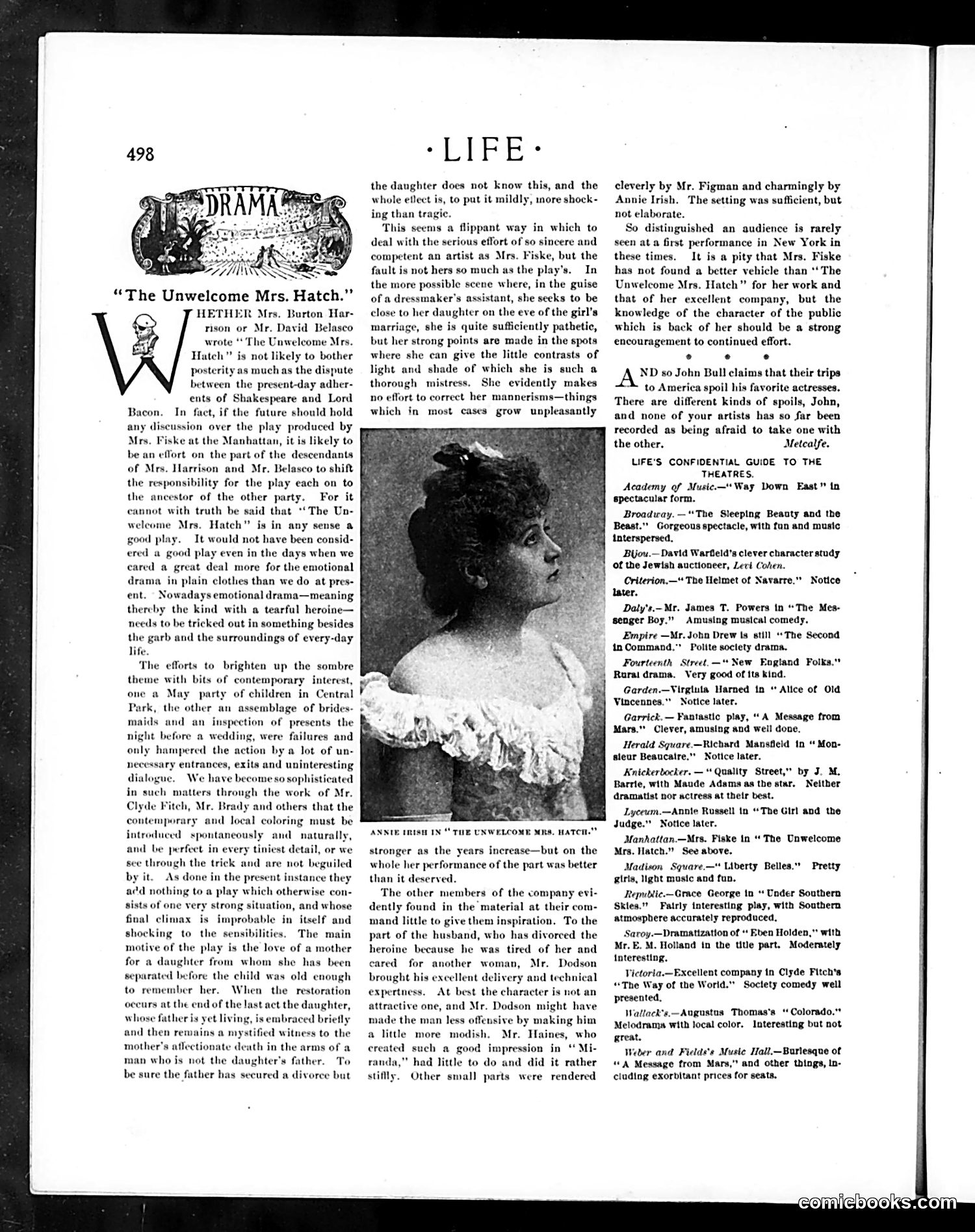
This page reviews a play by that title, written by Hether Mrs. Harton and David Belasco. The review discusses the play's treatment of a domestic dispute between Mr. and Mrs. Hatch, focusing on their daughter. The photograph shows **Annie Irish** in a scene from the production. The review praises Mrs. Fiske's performance in the title role, noting her excellent portrayal of character nuance and her ability to convey emotional depth through subtle acting—a sophisticated approach praised as a rarity in contemporary theater. The page also includes "Life's Confidential Guide to the Theatres," listing brief reviews of other current Broadway productions, indicating this was a regular theater criticism feature in the magazine.
📄 Transcribed text from this page (OCR, searchable)
Machine-transcribed from the original scan — historical spelling and the odd misread are preserved.
HETHER Mrs. Burton Har- rison or Mr. David Belasco wrote ** The Unwelcome Mrs. Hatch” is not likely to bother posterity as much as the dispute between the present-day adber- ents of Shakespeare and Lord Bacon. In fact, if the future should hold any discussion over the play produced by Mrs. Fiske at the Manhattan, it is likely to be an effort on the part of the descendants of Mrs. Harrison and Mr, Belasco to shift the responsibility for the play each on to the ancestor of the other party. For it cannot with truth be said that ‘The Un- welcome Mrs. Hatch” is in any sense a good play. It would not have been consid- ered a good play even in the days when we cared a great deal more for the emotional drama in plain clothes than we do at pres ent. Nowadays emotional drama—meaning thereby the kind with a tearful heroine— needs to be tricked out in something besides arb and the surroundings of every-day ‘The efforts to brighten up the sombre theme with bits of contemporary interest, one a May party of children in Central Park, the other an assemblage of brides- 1 an inspection of presents the re a wedding, were failures and only hampered the action by a lot of un- essary entrances, exits and uninteresting We have become so sophisticated ich matters through the work of Mr. e Fitch, Mr. Brady and others that the contemporary and local coloring must be introduced spontaneous urally, and be perfect in every tiniest detail, or we ce through the trick and are not beguiled by it. As done in the present instance they ad nothing to a play which otherwise con- sists of very strong situation, and whose final climax is improbable in itself and shocking to the sensibilities. The main motive of the play is the love of a mother for a daughter from whom she has been separated before the child was old enough to remember her, When the restoration occurs at the end of the last act the daughter, whose father is yet living, is embraced briefly and then rewains a mystified witn hin the man who is not the daughter's father. be sure the father has secured a div mother's affectionate de: ms 0 «LIFE the daughter does not know this, and the whole eflect is, to put it mildly, more shock- ing than tragic. This seems a flippant way in which to deal with the serious effort of so sincere and competent an artist as Mrs. Fiske, but the fault is not hers so much as the play's. In the more possible scene where, in the guise of a dressmaker’s assistant, she seeks to be close to her daughter on the eve of the girl's marriage, she is quite sufficiently pathetic, but her strong points are made in the spots where she can give the little contrasts of light and shade of which she is such a thorough mistress. She evidently makes no effort to correct her mannerisms—things which in most cases grow unpleasantly ANNIE IRISH IN “THE UNWELCOME DES. HATCH.” stronger as the years increase—but on the whole her performance of the part was better than it deserved. The other members of the company evi- dently found in the material at their com- mand little to give them inspiration. To the part of the husband, who has divorced the heroine because he was tired of her and cared for another Mr. Dodson brought his excellent delivery and technical expertness. At best the character is not an attractive one, and Mr. Dodson might have made the man less offensive by making him a little more Mr. Haines, who created such a good impression in ‘ Mi- randa,” had little to do and did it rather stifly. Other small parts were rendered woman, modish. cleverly by Mr. Figman and charmingly by Annie Irish. The setting was sufficient, but not elaborate. So distinguished an audience is rarely seen ata first performance in New York in these times. It is a pity that Mrs. Fiske has not found a better vehicle than “The Unwelcome Mrs. Hatch” for her work and that of her excellent company, but the knowledge of the character of the public which is back of her should be a strong encouragement to continued effort. ° . . A \D so John Bull claims that their trips to America spoil his favorite actresses. There are different kinds of spoils, John, and none of your artists has so far been recorded as being afraid to take one with the other. Metcalfe. LIFE'S CONFIDENTIAL GUIDE TO THE THEATRES. Academy of Musie—Way Down East” in spectacular form. Broadway. —‘The Sleeping Beauty and the Beast."" Gorgeous spectacle, with fan and music interspersed, BUou.— David Warfeld’s clever character study of the Jewish auctioneer, Lei Cohen. Criterion.—“ The Helmet of Navarre." Notice | Aster. Daly's. Mr. James T. Powers in “The Mes- senger Boy.” Amusing musical comedy. Empire —Mr. John Drew is still “The Second in Command.” Polite soctety drama. Fourteenth Street. —“ New England Folks,"* Rural drama. Very good of tts kind. Garden.—Virgiula Harned in “ Alice of Old. ‘Vincennes. tice later. Garrick. — Fantastic play, “A Message from Mars."" Clever, amusing and weil done, Herald Square.—Richatd Mansfield in “ Mon- sleur Beaucatre.” Notice later. Knickerbocker. — “Quality Street,” by J. M. Barrie, with Maude Adams as the star, Neither dramatist nor actress at thetr best. Lyceum.—Annie Russell tn “The Girl and the Judge.” Notice later. Manhattan.—Mrs. Fiske in “ The Unwelcome Mrs. Hatch.” See above. Madison Square.—* Liberty Belles.” girls, light mastic and fun. Reiblic.—Grace George in “ Under Southern Skies.” Fairly interesting play, with Southern atmosphere accurately reproduced, Saroy.—Dramatization of Eben Holden,” with Mr. E. M. Holland in the tue part, Moderately interesting. Victoria.—Excellent company in Clyde Fitch's “The Way of the World.” Soctety comedy well presented, Watlack"s,—Augustus Thomas's “Colorado.” Melodrama with local color. Interesting but not great. Weber and Ficlds's Music Hall.—Burlesque of “A Message from Mars,” and other things, In- cluding exorbitant prices for seats, Pretty