
Life, 1901-12-05 · page 7 of 20
Life — December 5, 1901 — page 7: what you’re looking at
What you’re looking at
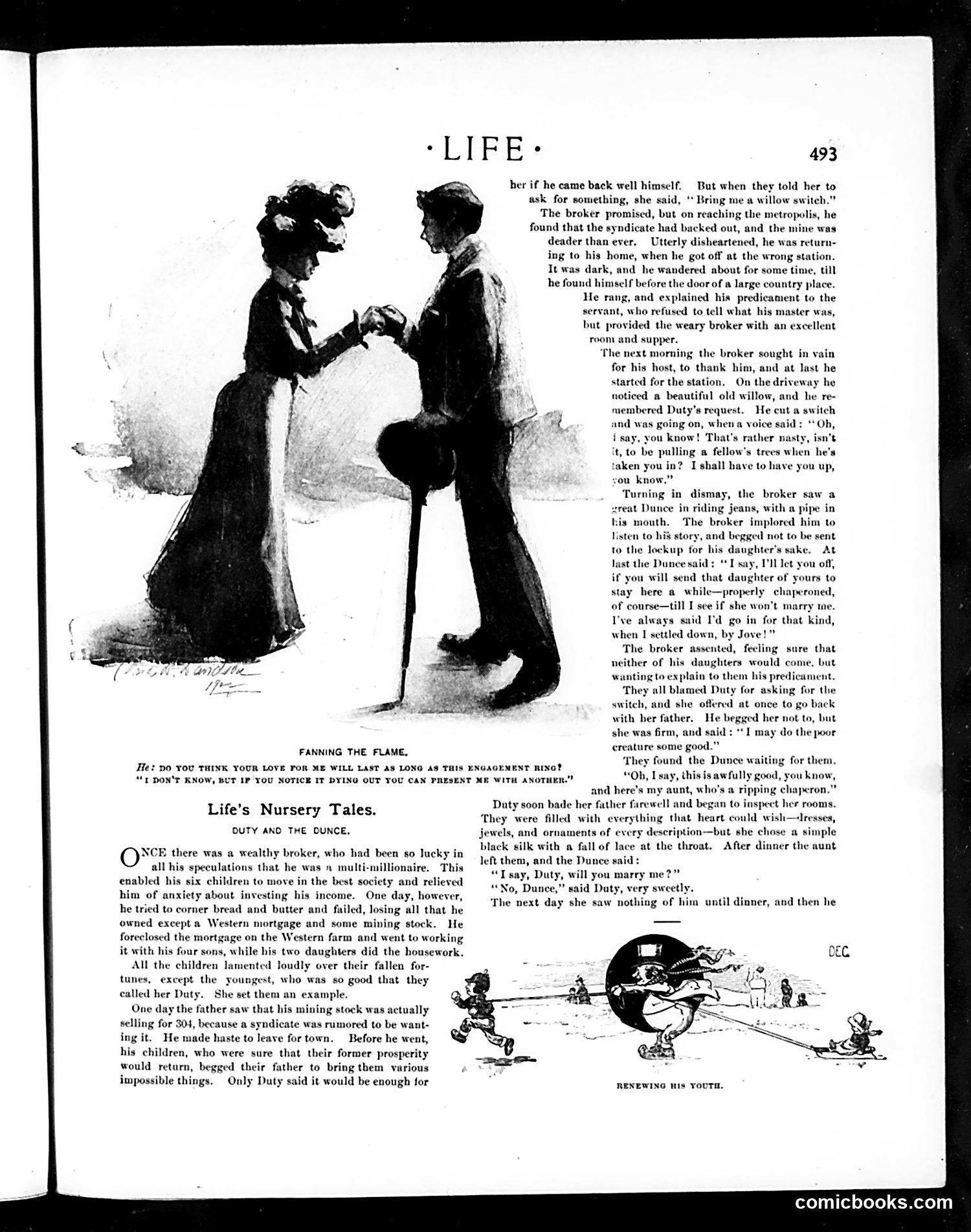
This page contains a serialized story titled "Life's Nursery Tales," specifically the chapter "Duty and Choice." The narrative follows a wealthy broker who loses his fortune through mining stock speculation and Western farm investments. His youngest daughter, Duty, remains optimistic while her siblings despair. The main illustration ("Fanning the Flame") depicts a romantic scene between two figures, captioned with dialogue about an engagement lasting as long as love endures. The story appears to be a moral lesson about duty, perseverance, and character during financial hardship—common themes in early 20th-century satirical magazines. The secondary illustration shows children playing, labeled "Renewing his Youth," continuing the domestic narrative themes throughout the page.
📄 Transcribed text from this page (OCR, searchable)
Machine-transcribed from the original scan — historical spelling and the odd misread are preserved.
‘LIFE: 493 her if he came back well himself. But when they told her to ask for something, she said, ‘* Bring me a willow switch.” The broker promised, but on reaching the metropolis, he found that the syndicate had backed out, and the mine was deader than ever, Utterly disheartened, he was return- ing to his home, when he got off at the wrong station. It was dark, and he wandered about for some time, till he found himself before the door of a large country place. He rang, and explained his predicament to the servant, who refused to tell what his master was, but provided the weary broker with an excellent room and supper. ‘The next morning the broker sought in vain for his host, to thank him, and at last he started for the station, On the driveway he noticed a beautiful old willow, and he re- membered Duty's request. He cut a switch nd was going on, when a voice said; Oh, say, you know! That's rather nasty, isn’t it, to be pulling a fellow’s trees when he's taken you in? I shall have to have you up, vou know.” Turning in dismay, the broker saw a reat Dunce in riding jeans, with a pipe in mouth, The broker implored him to listen to hig story, and begged not to be sent to the lockup for his daughter's sake. At last the Dunce said: “I say, I'll let you off, if you will send that daughter of yours to stay here a while—properly chaperoned, of course—till I see if she won't marry tne. I've always said I'd go in for that kind, when I settled down, by Jove!” The broker assented, feeling sure that neither of his daughters would come, but wanting to explain to them his predicament. They all blamed Duty for asking for the switch, and she offered at once to go bac with her father. He begged her not to, but she was firm, and said : "I may do the poor ! creature some good.” da donno mrhey feud: the; Danes waiting for them. He? po You THINK YOUR LOVE FOR ME WILL LAST AS LONG AS THIS ENGAGEMENT RING? q { DON'T KNOW, BUT IF YOU NOTICE IF DYING OUT YOU CAN PRESENT MH WITH ANOTHER.” "Oh, say, this is awfully good, you know, and here's my aunt, who's a ripping chaperon. Duty soon bade her father farewell and began to inspect her rooms, They were filled with everything that heart could wish—dresses, DUTY ANO THE OUNCE, jewels, and ornaments of every description—but she chose a simple black silk with a fall of at the throat, After dinner the aunt. left them, and the Dunce said: “Tsay, Duty, will you marry me?” “No, Dunce,” said Duty, very sweetly. The next day she saw nothing of him until dinner, and then he Life’s Nursery Tales. E there was a wealthy broker, who had been so lucky in all his speculations that he was 1 multi-millionaire. This enabled his six children to move in the best society and relieved him of anxiety about investing his income. One day, however, he tried to corner bread and butter and failed, losing all that he owned except a Western mortgage and some mining stock. He foreclosed the mortgage on the Western farm and went to working it with his four sons, while his two daughters did the housework. All the children lamented loudly over their fallen for- tunes, except the youngest, who was so good that they called her Duty. She set them an example. One day the father saw that his mining stock was actually selling for 304, because a syndicate was rumored to be want- ing it. He made haste to leave for town. Before he went, his children, who were sure that their former prosperity would return, begged their father to bring them various impossible things. Only Duty said it would be enough for REEWING:m1e:rOUTE: comicbooks.com