
A complete issue · 20 pages · 1901
Life — November 14, 1901
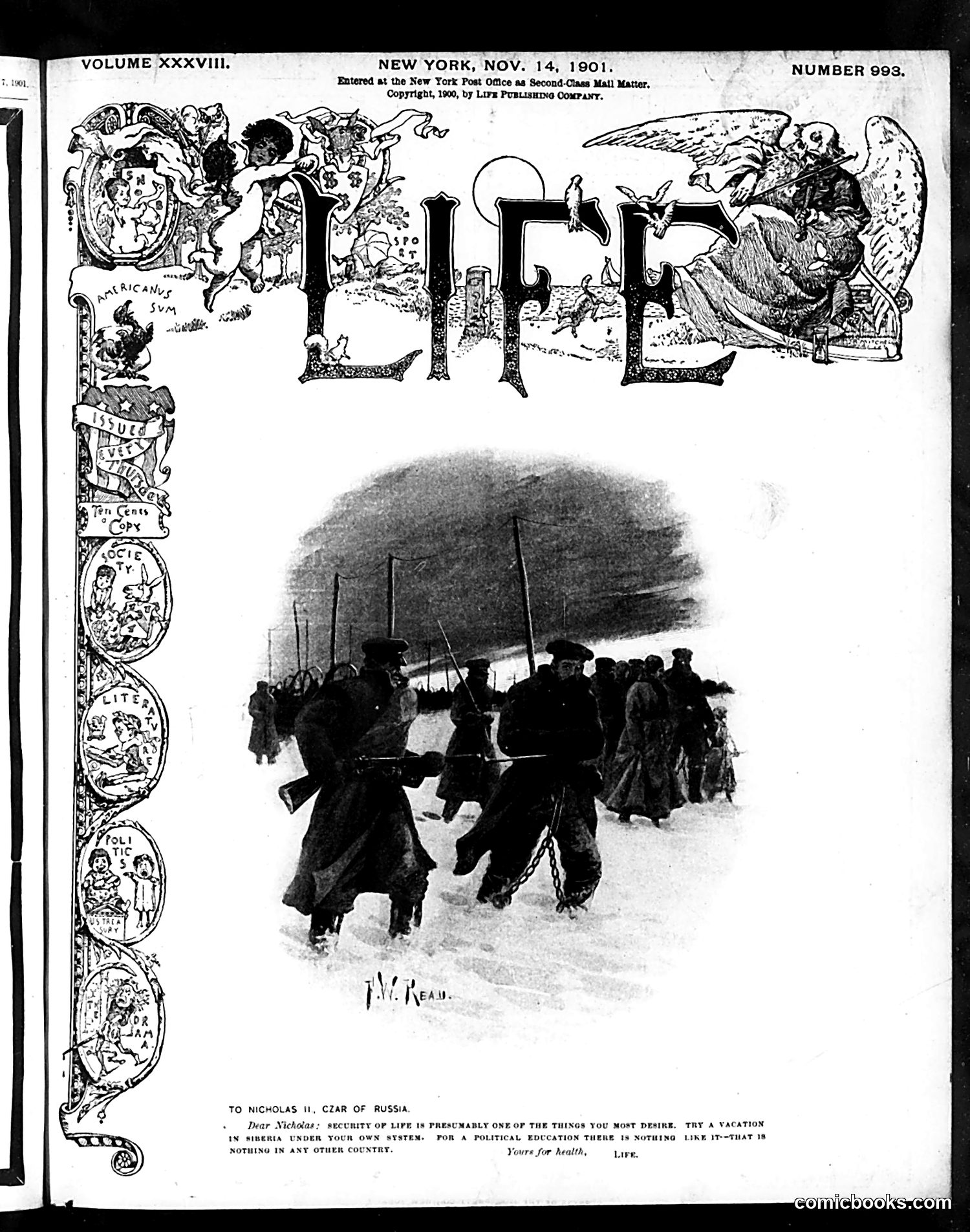
This political cartoon addresses Czar Nicholas II of Russia with dark satire. The main image shows silhouetted figures in snow—apparently soldiers or officials—transporting what appears to be a coffin or cargo across a frozen landscape. The text below reads as advice to the Czar: "Security of life is presumably one of the things you most desire. Try a vacation in Siberia under your own sister. For a political education there is nothing like it—that is nothing in any other country." The satire mocks the Czar's autocratic rule and specifically references political repression, exile, and the notorious Siberian labor camps used to punish dissidents. The "vacation" reference is bitter irony—Siberia was a death sentence, not a resort. This appears critical of Russian imperial brutality.
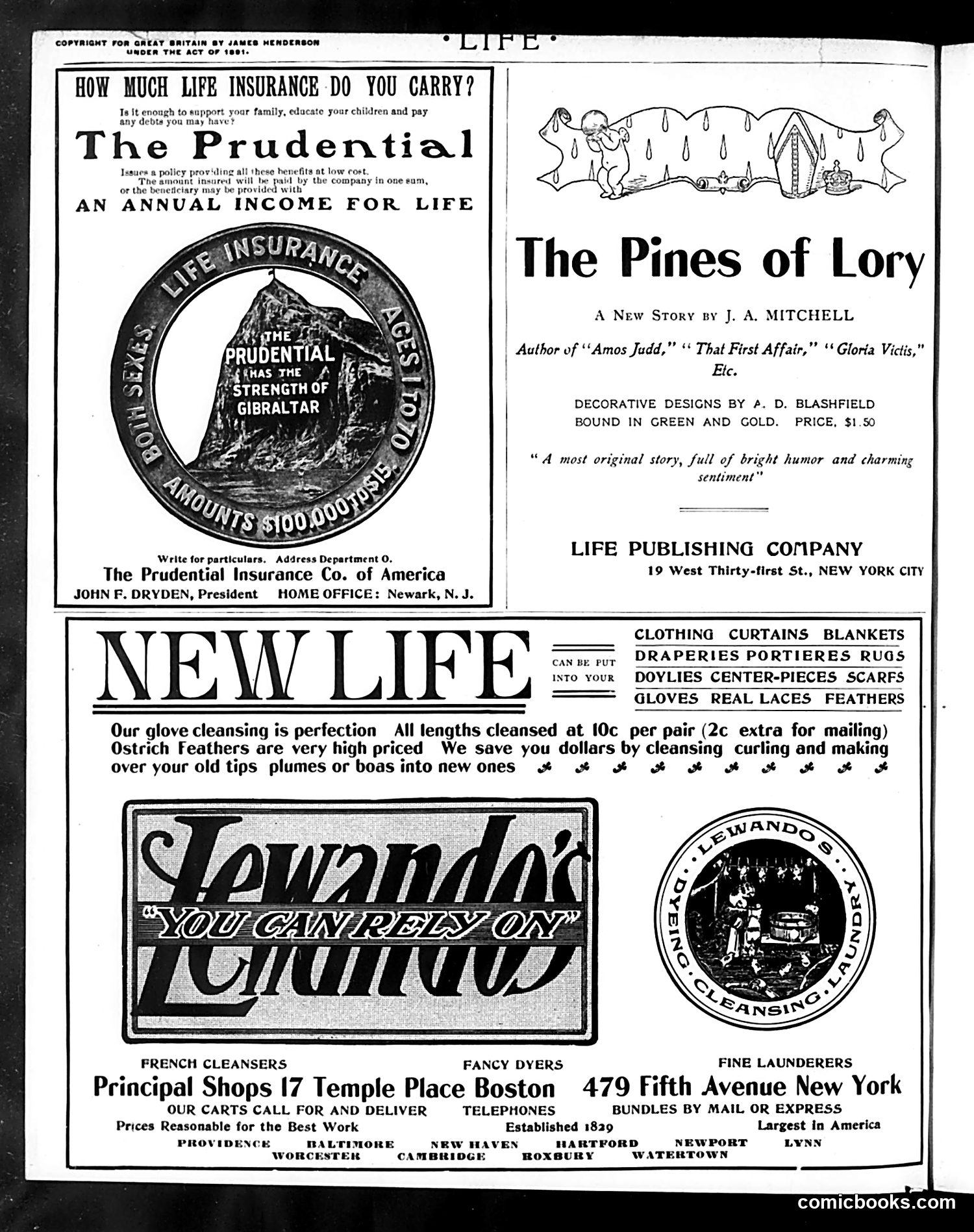
This page is **primarily advertising** with minimal editorial content. The advertisements include: - **The Prudential Insurance Company** (left): A life insurance pitch emphasizing financial security for families, featuring their Gibraltar Rock logo - **"The Pines of Lory"** (top right): A book advertisement for a story by J.A. Mitchell - **"New Life"** (center): A cleaning service for gloves, feathers, and textiles - **Lewando's** (bottom): A French cleansing and laundry service with multiple locations - **Fine Launderers** (bottom right): A laundry service established 1829 There are **no political cartoons or satirical content** visible on this page. It represents typical early-20th-century magazine advertising, targeting middle-class consumers with services for clothing care and financial security.
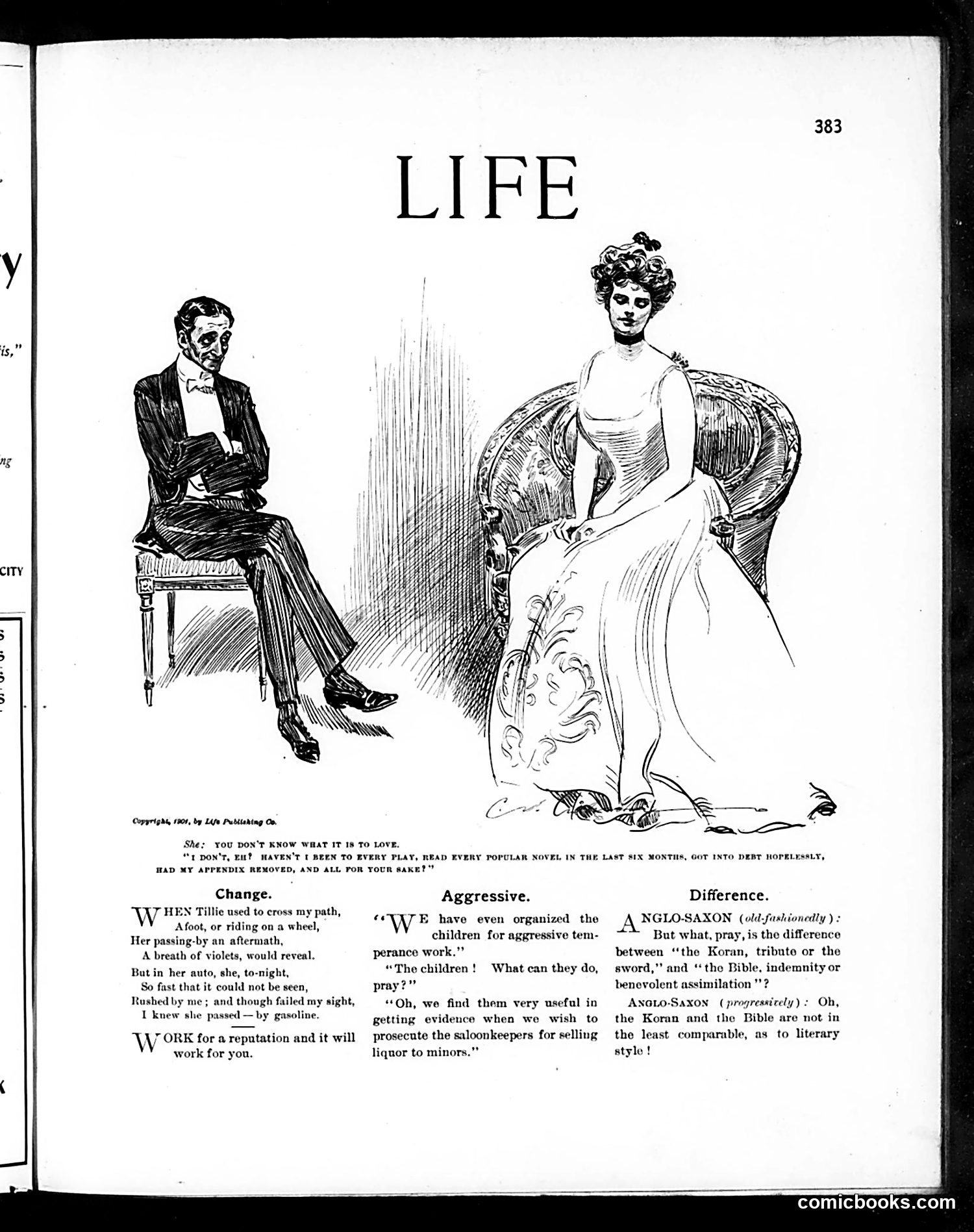
This page contains a satirical illustration and three brief commentary pieces. The top illustration depicts a woman in an evening gown seated while a man in formal attire sits apart, seemingly disengaged. The caption quotes the woman discussing her literary consumption: "You don't know what it is to love. I don't, either! Haven't been to every play, read every popular novel in the last six months, got into debt hopelessly, had my appendix removed, and all for your sake!" The satire mocks wealthy women who pursue cultural sophistication—attending plays and reading novels—while accumulating debt and undergoing unnecessary medical procedures, all ostensibly for romantic purposes. The three accompanying text pieces ("Change," "Aggressive," and "Difference") appear to be separate short satirical comments on contemporary social issues, though their specific references remain unclear without fuller context.
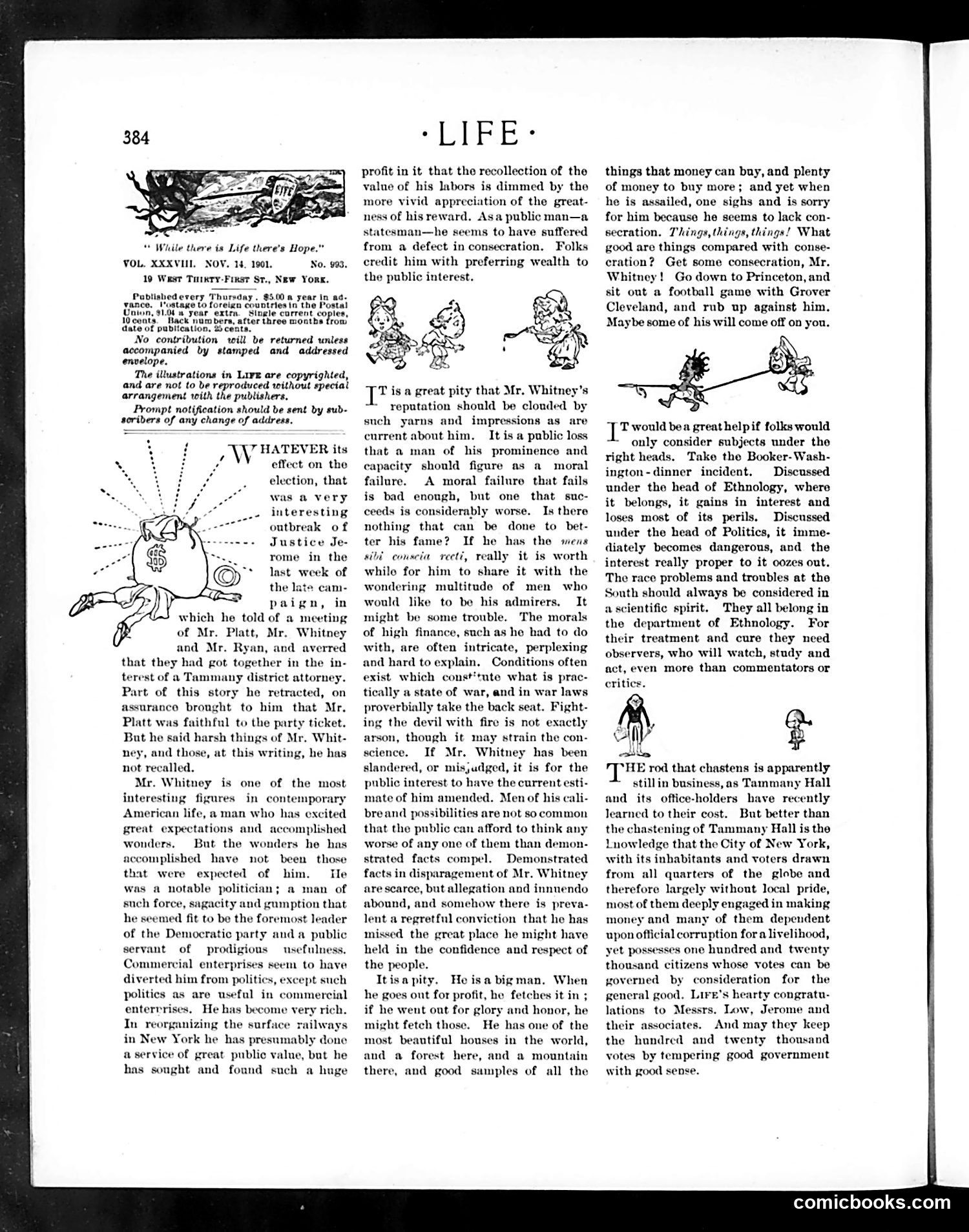
This page critiques **William C. Whitney**, a prominent Democratic politician and financier. The central cartoon shows Whitney as a figure of contradictions: despite his wealth and accomplishments in reorganizing New York railways, he's accused of moral failure through alleged political corruption and opportunism. The satirist argues Whitney prioritized profit over principle, abandoning his Democratic leadership role for commercial gain. The text sarcastically notes his "beautiful houses" and material success while questioning his character—suggesting his reputation is "clouded" by questionable dealings with political figures like Platt and Ryan. The underlying complaint: a man of Whitney's stature should have maintained ethical integrity rather than compromising for wealth.
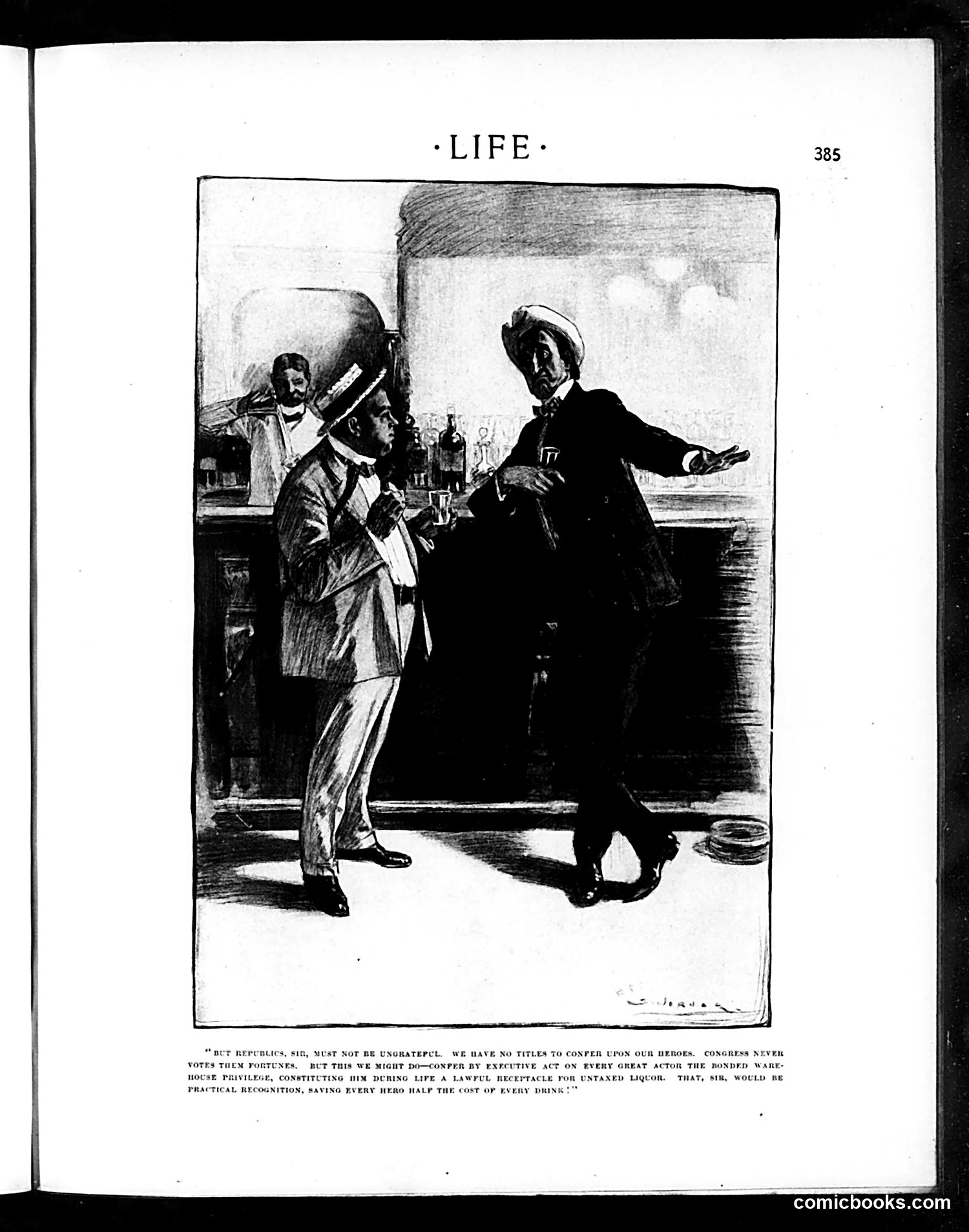
This political cartoon depicts two men in what appears to be a formal interior setting. The figure on the right, wearing dark formal attire and a hat, is gesturing expansively while addressing the man on the left, who wears a lighter suit and top hat. The caption argues against conferring titles on American heroes, asserting that Congress lacks authority to grant such honors. Instead, it proposes "executive act" as an alternative—suggesting the government could reward heroes through practical means like providing "lawful receptacles for untaxed liquor" and "practical humanitarianism, saving every hero half the cost of every drink." The satire appears to critique both government honor-granting and Prohibition-era liquor restrictions, suggesting alternative (ironic) forms of recognition. The specific historical context and identities of the figures remain unclear without additional documentation.
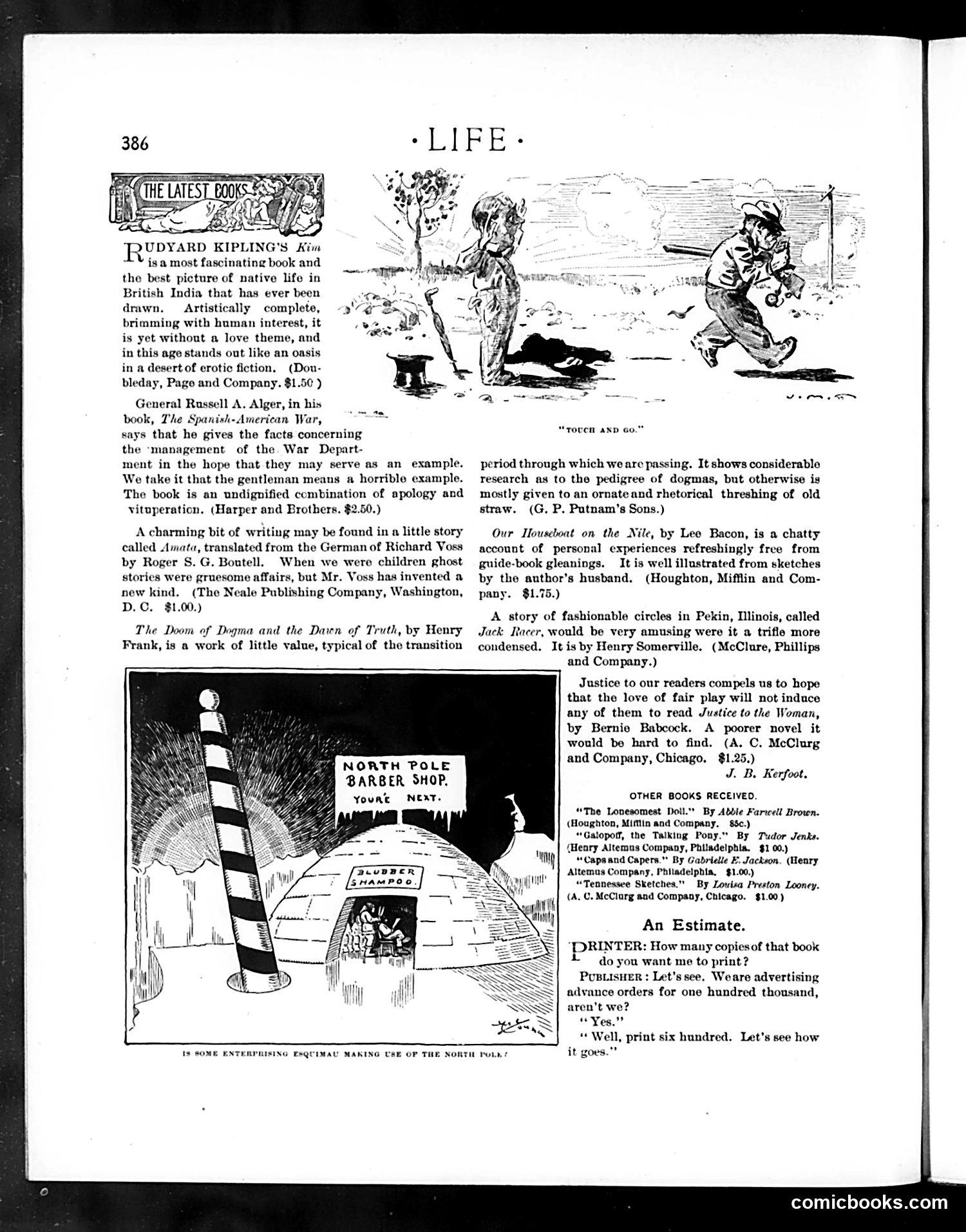
This page is primarily **book reviews** rather than political cartoons. The main illustration shows a humorous scene labeled "IS SOME ENTERPRISING ESQUIMAU MAKING USE OF THE NORTH POLE?" depicting an Inuit barber shop at the North Pole—a whimsical absurdist joke playing on the remoteness and inhospitability of that location. The reviews discuss various books including Rudyard Kipling's *Kim*, General Russell Alger's *The Spanish-American War*, and others. The final section titled "An Estimate" contains a brief comic dialogue between a printer and publisher about printing costs. The page reflects Life's **mix of satirical commentary and entertainment**, using humor to discuss both literature and contemporary affairs, though this particular page lacks overt political messaging.
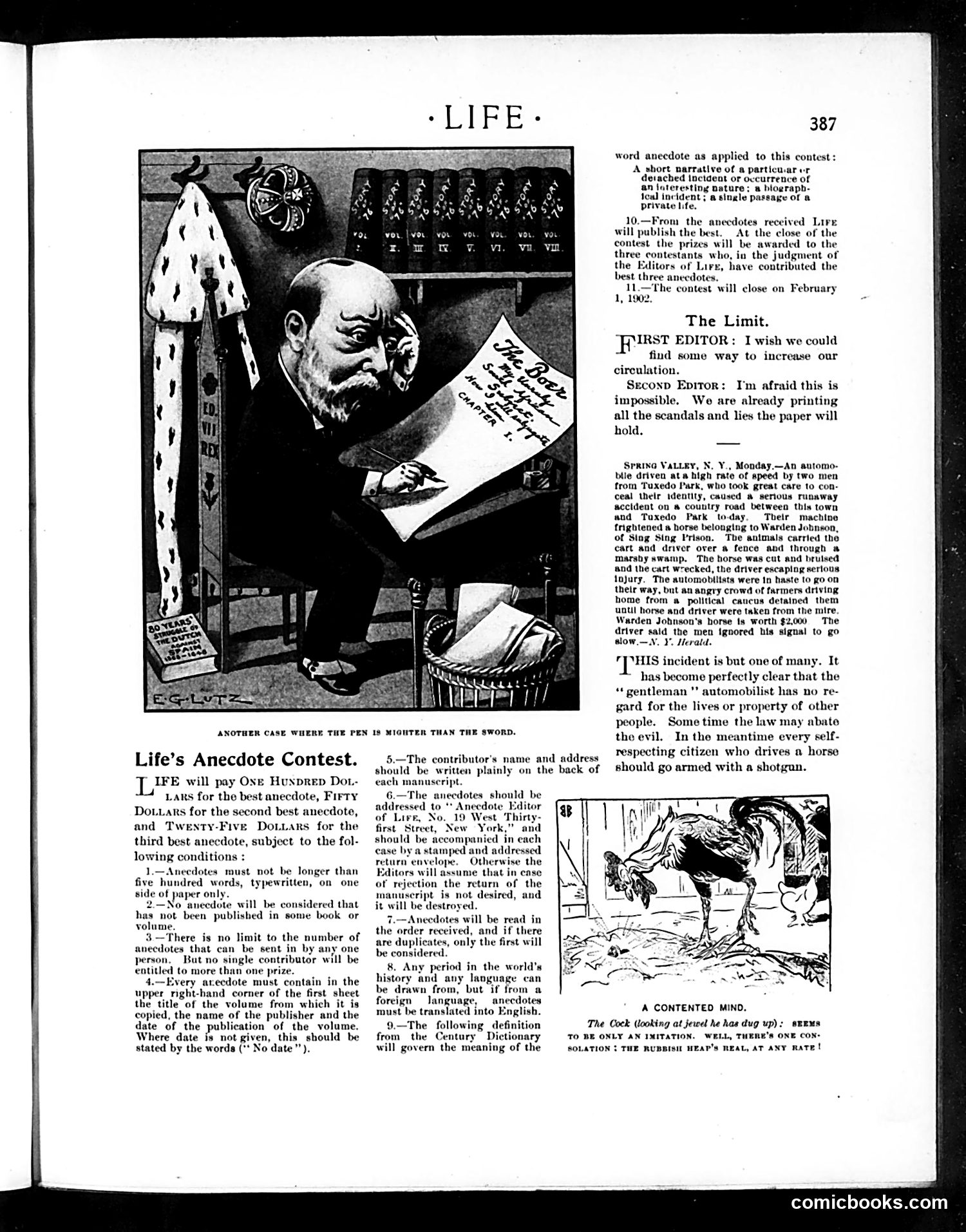
The main cartoon, titled "Another Case Where the Pen Is Mightier Than the Sword," depicts a stern-faced man at a desk writing. The image criticizes the power of editorial writing and journalism. The figure appears to be a newspaper editor or political commentator whose pen—shown as a weapon—is portrayed as more influential than military force. The specific target is unclear from the visible text, but the satire addresses how written opinion shapes public discourse and policy, potentially more effectively than direct action or force. The accompanying contest announcement invites readers to submit anecdotes for publication in Life magazine, reinforcing the magazine's role in shaping public conversation through narrative and commentary.
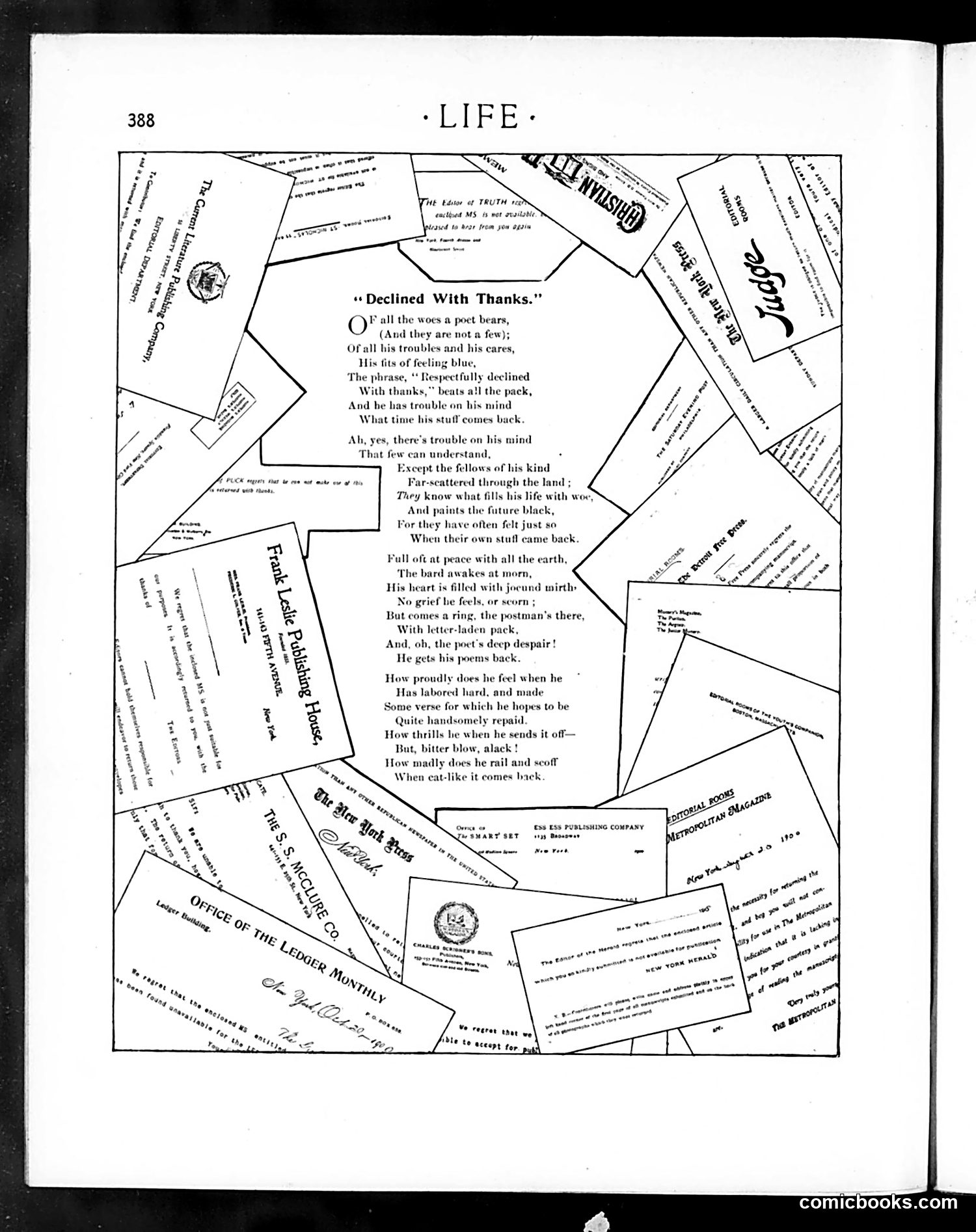
This page presents a poem titled **"Declined With Thanks,"** which satirizes a poet's experience with rejection. The central verse mocks the emotional toll of submitting work to publishers—depicting the poet receiving polite rejections ("Respectfully declined / With thanks") that nonetheless sting his pride. The satire centers on the contrast between the publisher's courteous language and the poet's wounded feelings. The poem humorously notes that rejection becomes routine for struggling writers: "Full oft at peace with all the earth, / The bard awakes at morn," only to have his heart "filled with pained mirth" when rejection letters arrive with the postman. The page is surrounded by mock rejection letters and envelopes, visually reinforcing the poem's theme of persistent artistic rejection.
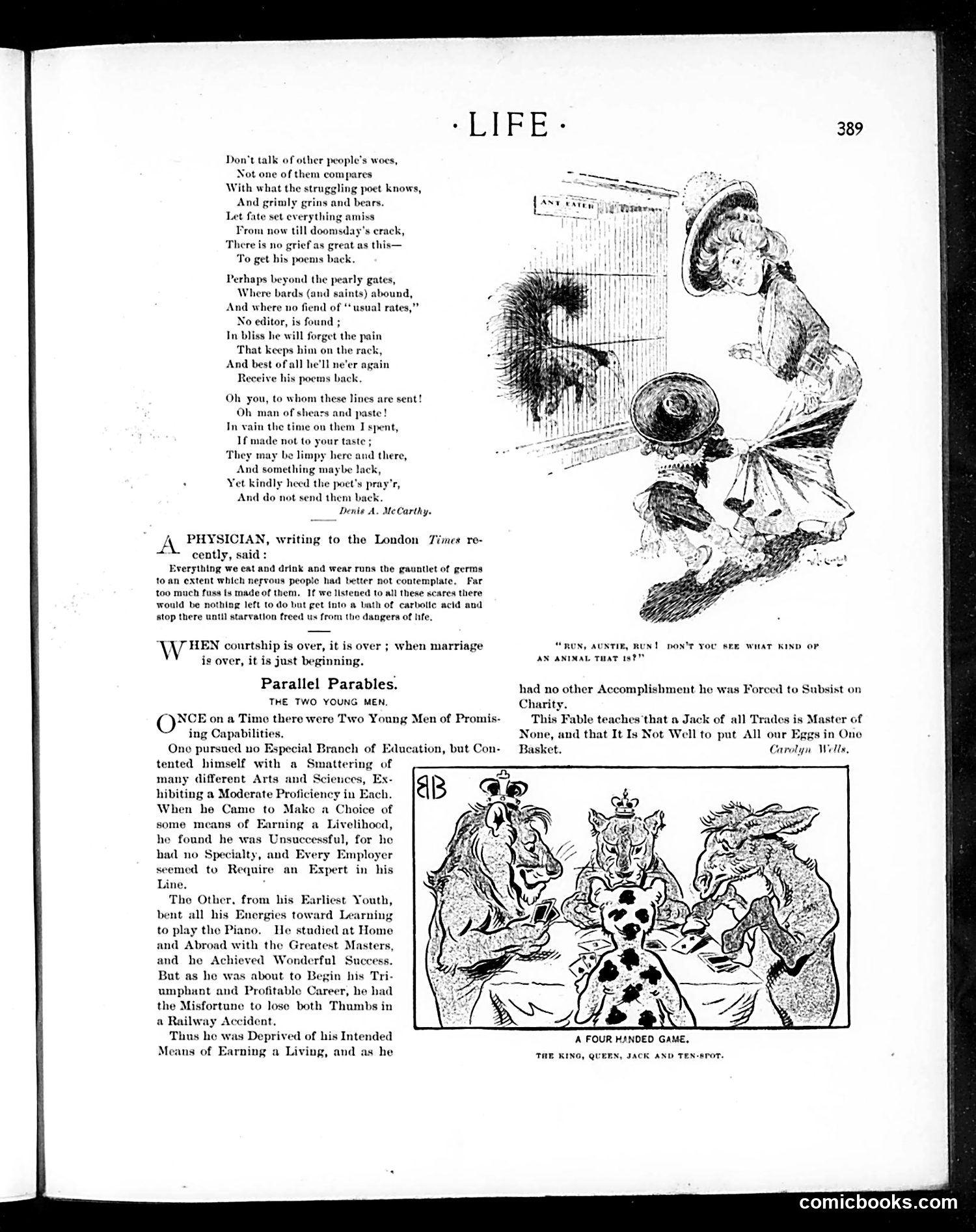
**Upper Content:** A poem by Denis A. McCarthy addresses struggling poets, urging them not to despair over rejection and poverty. It's a sympathetic piece encouraging perseverance in the face of editorial dismissal. **Lower Content:** "Parallel Parables" contrasts two young men—one who pursued diverse arts and sciences but found no specialty, versus another who focused entirely on piano, achieving success until losing both thumbs in a railway accident, thus losing his means of earning. **The Cartoon:** Shows anthropomorphic animals (appears to be the King, Queen, Jack, and Ten-spot) playing cards. The illustration is labeled "A Four Minded Game." **Overall Point:** The page satirizes life's unpredictability—both through the poem's encouragement of artistic persistence and through the fable's dark irony that specialization can become worthless through circumstance.
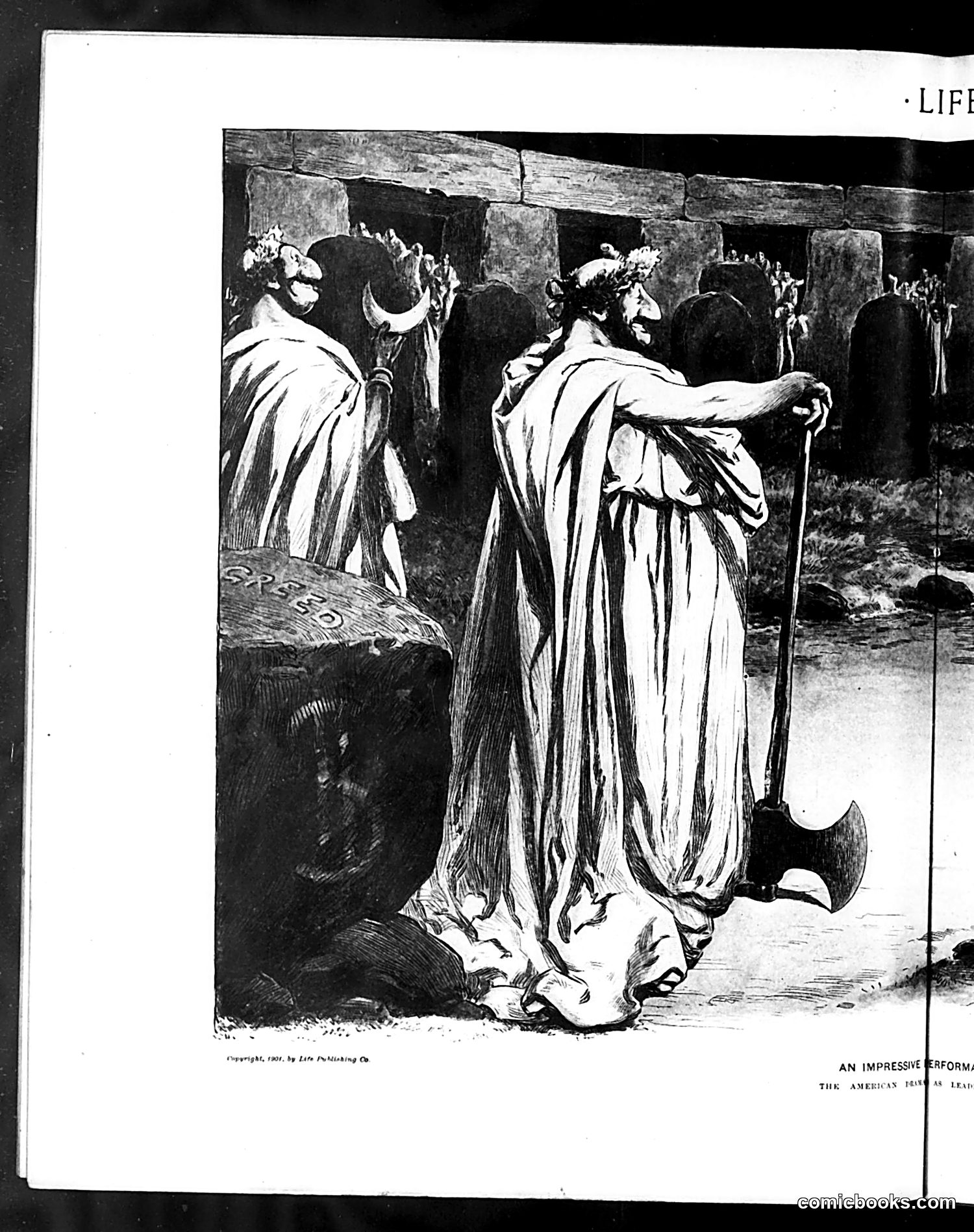
This appears to be a political cartoon from Life magazine (copyright 1907, per visible text). The image shows robed figures in what seems to be a ritualistic or ceremonial setting, with Native American imagery visible in the background. The title references "An Impressive Ceremony" and "The American Indian," suggesting satire about American attitudes toward Native Americans. The formal robes and solemn poses likely mock either: 1. Official government treatment of Native Americans as a ceremonial/historical matter rather than a living people, or 2. White American romanticization of "Native American traditions" The contrast between the formal Western dress/ceremony and the Indigenous imagery suggests irony about how Americans staged, performed, or appropriated Native American culture. Without clearer text, the specific political event referenced remains unclear, but the satire targets American hypocrisy regarding Indigenous peoples.
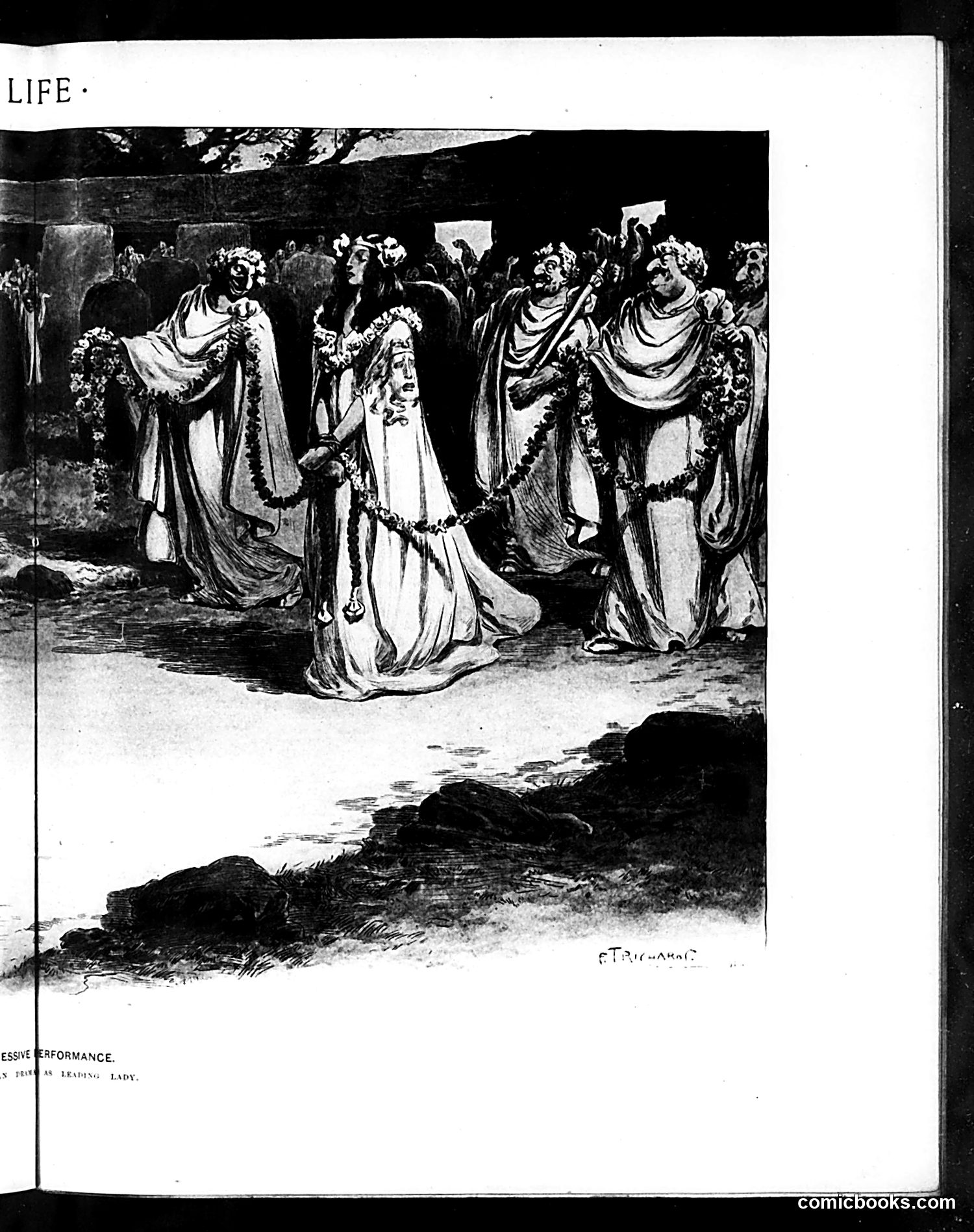
This page from *Life* magazine shows a classical-style illustration titled "LIFE" depicting what appears to be a ceremonial or theatrical scene. A kneeling female figure in white is surrounded by robed male figures wearing garlands, suggesting a formal ritual or pageant. The partially visible caption at bottom mentions "ESSE PERFORMANCE" and references "A LEADING LADY," indicating this likely satirizes theatrical productions or possibly a beauty pageant/social event. However, without clearer text, caption details, or publication date visible, I cannot definitively identify the specific figures, event, or satirical target. The classical artistic style and formal gathering suggest commentary on either high society spectacle or theatrical pretension, but the precise political or social reference remains unclear from this image alone.
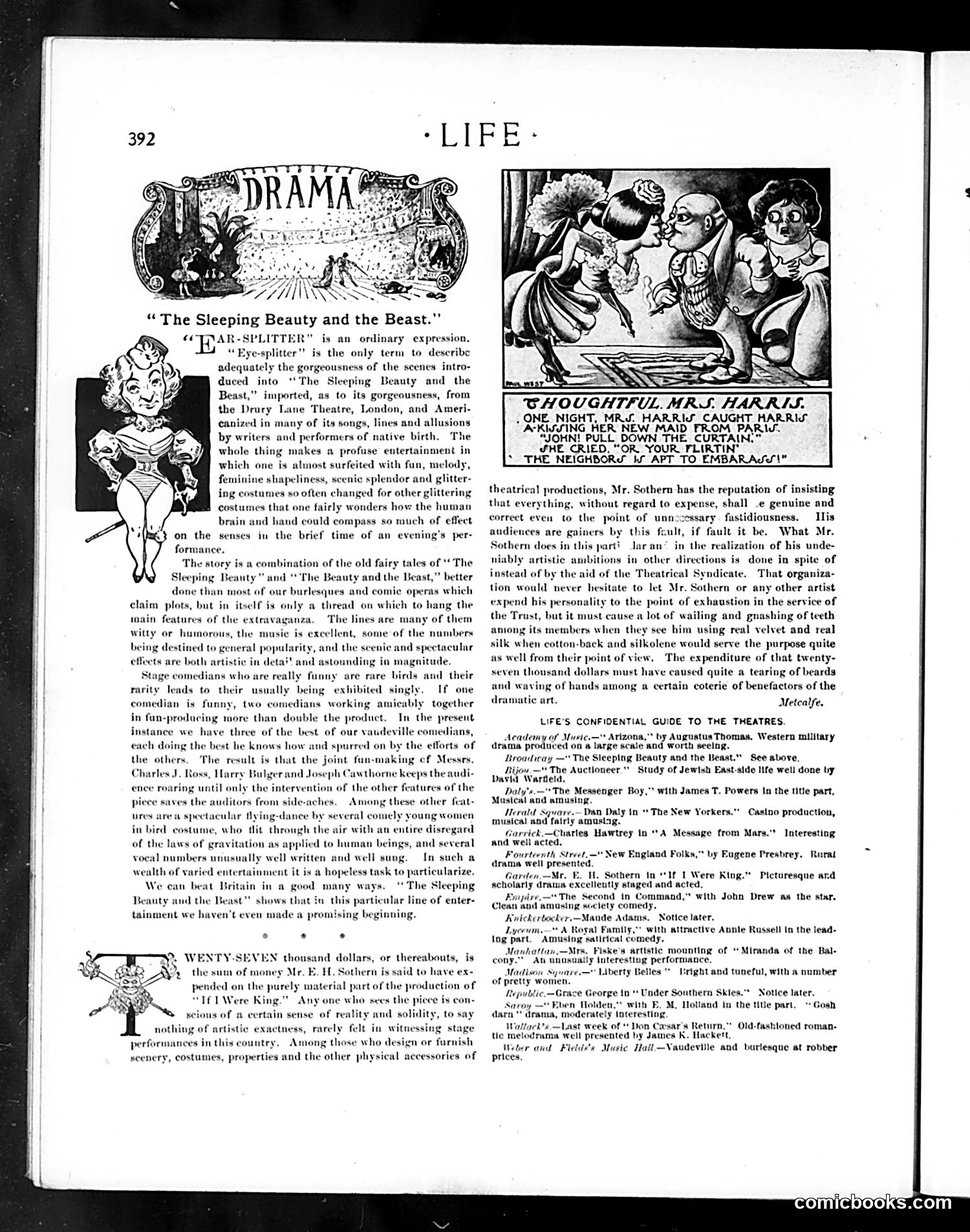
This page reviews theatrical productions, with the main illustration showing a scene from "The Sleeping Beauty and the Beast." The cartoon depicts a woman flirting with a man while gesturing dismissively at a maid entering from behind a curtain, with the caption "Thoughtful Mrs. Harris" describing her deliberately introducing her maid to her husband to distract him from other romantic interests. The satire targets upper-class marital dynamics—specifically a wife's strategy to manage her husband's wandering attention by controlling what women he encounters. The humor relies on dark observations about marriage, infidelity concerns, and a wife's calculated manipulation within domestic hierarchies of the era. The page primarily functions as theater criticism and entertainment guide rather than political satire.
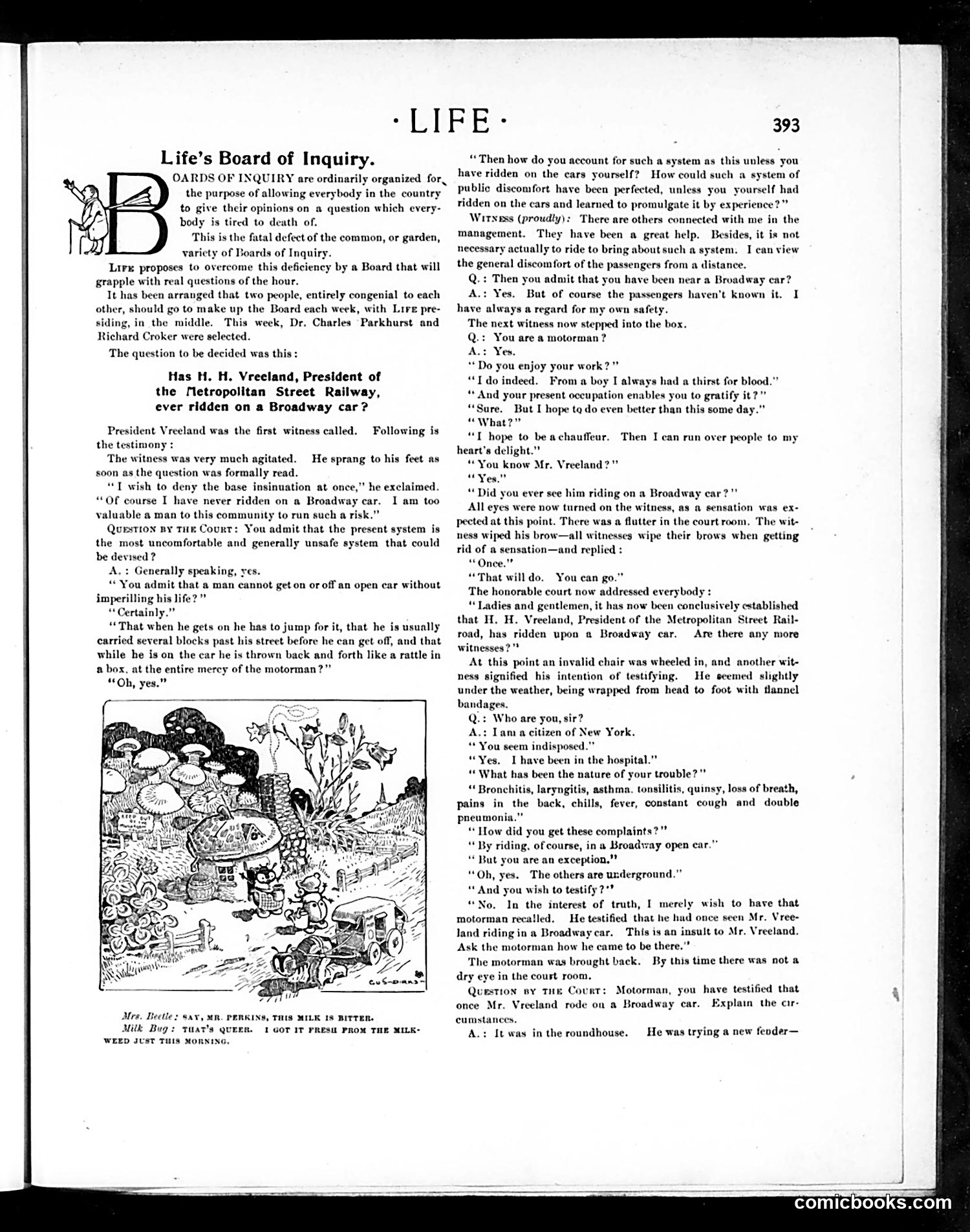
This is a satirical mock-trial attacking H.H. Vreeland, president of the Metropolitan Street Railway, over the dangerous conditions of Broadway cars. The setup is absurd: Life creates a fake "Board of Inquiry" to expose hypocrisy—Vreeland claims he's too important to risk riding his own terrible system, yet his motorman testifies he was seen on a car once. The joke targets corporate malfeasance: Vreeland admits the cars are "uncomfortable and generally unsafe" but denies ever experiencing them himself, suggesting he designed this miserable system without actually testing it. The motorman's dark humor about enjoying his "thirst for blood" and hoping to be a chauffeur (implying vehicular homicide) underscores the real danger these machines posed to New Yorkers. The small cartoon below depicts a milkman discovering his milk has turned bitter from a "milkweed"—likely an unrelated joke about adulteration of dairy products, another consumer safety scandal of the era.
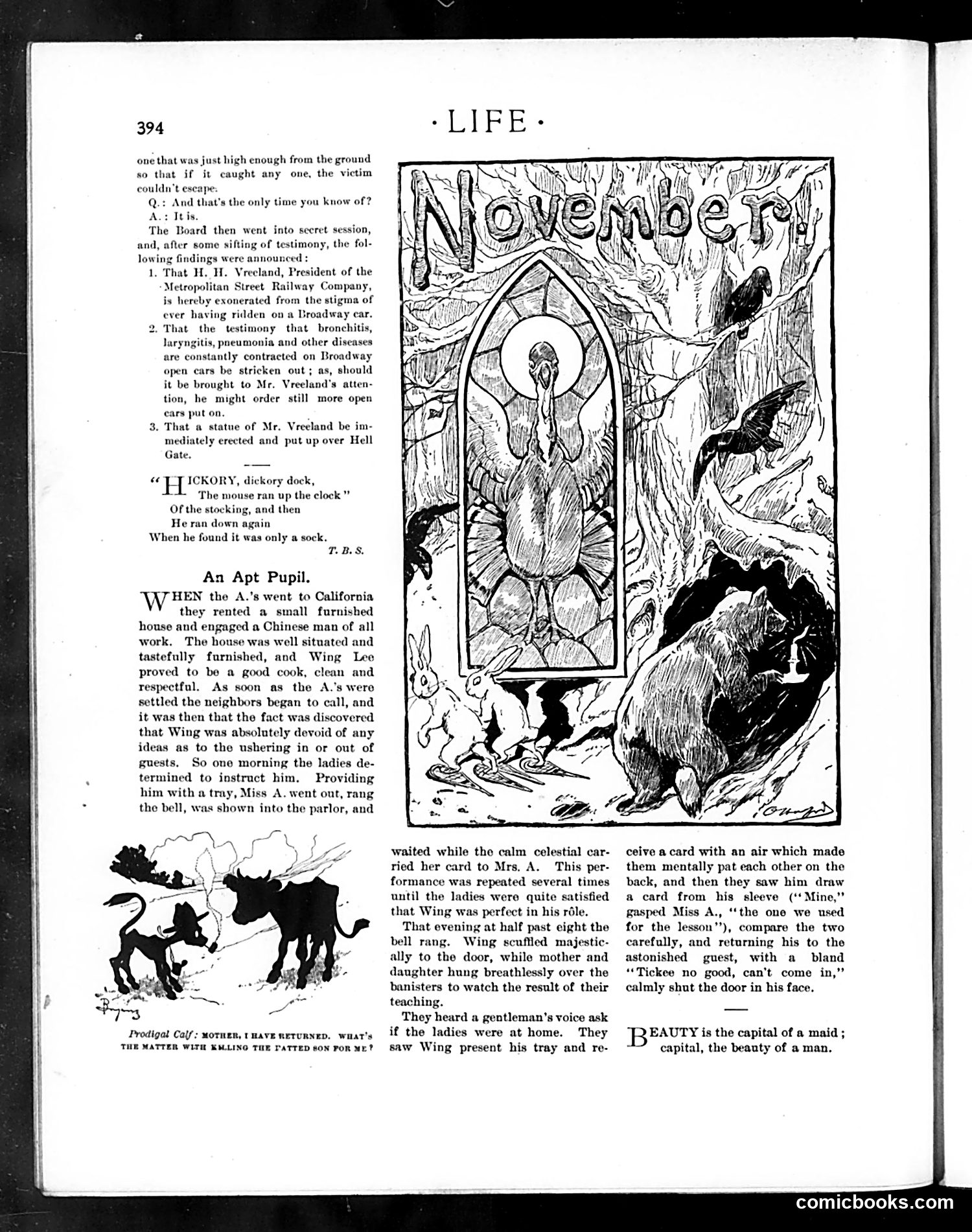
The main content satirizes **H.H. Vreeland, President of the Metropolitan Street Railway Company**, regarding unsafe conditions on Broadway open-air streetcars. The "Board" mockingly exonerates him while highlighting public complaints about disease transmission (bronchitis, pneumonia) from crowded transit. The satire's bite: the findings absurdly suggest that acknowledging these health hazards might prompt Vreeland to *increase* open cars—implying his indifference to passenger welfare and the corruption of oversight boards. The "Apt Pupil" story below is an unrelated humorous anecdote about a Chinese servant (Wing Lee) who, after training in proper etiquette for receiving guests, demonstrates unexpected wit by rejecting an unsuitable visitor's calling card, declaring "Tickee no good, can't come in." The joke plays on stereotypical "broken English" and immigrant cleverness. Both items are representative of *Life* magazine's satirical commentary on contemporary social issues and genteel domestic humor.
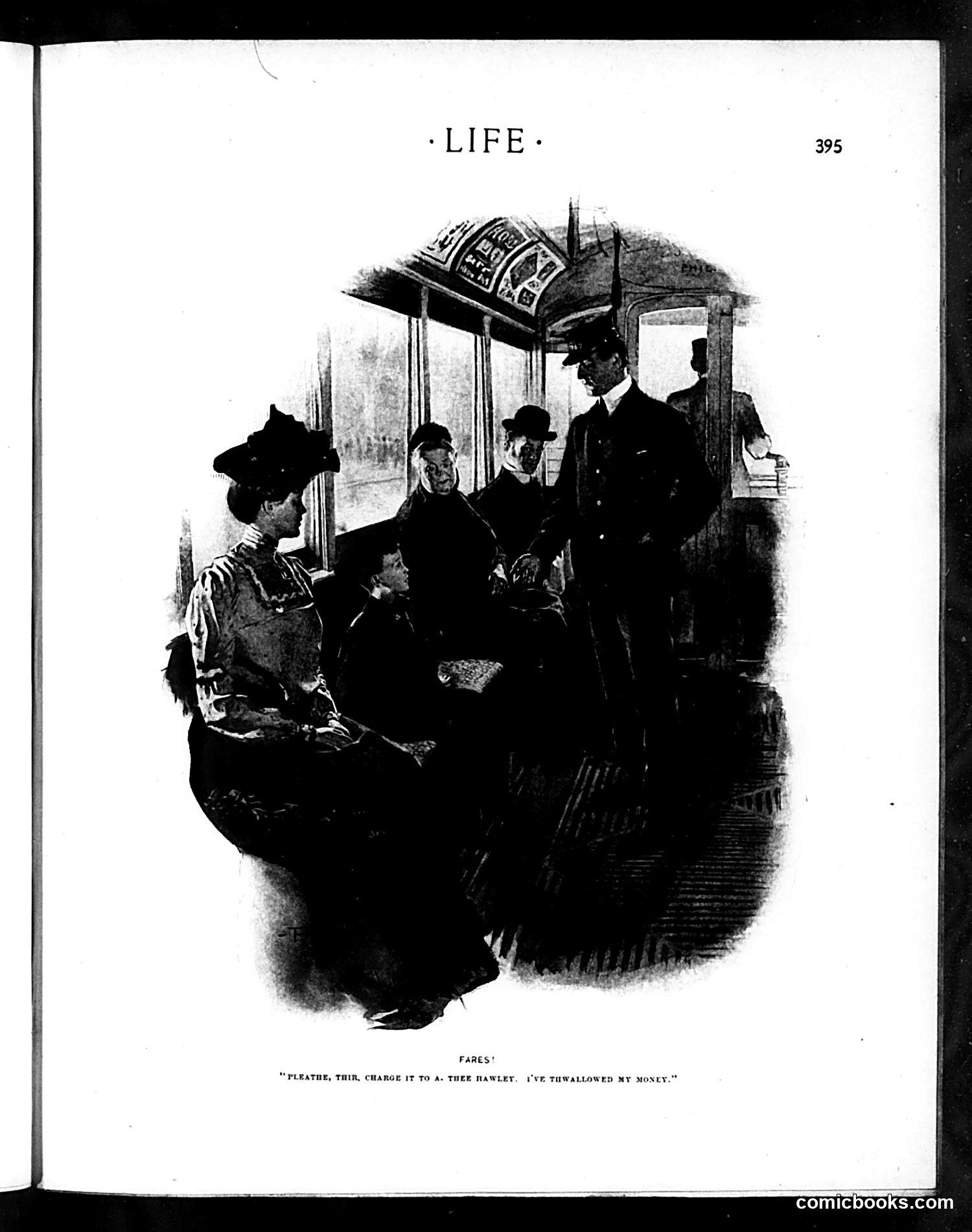
This is a satirical cartoon depicting a scene inside what appears to be a streetcar or omnibus. A conductor stands confronting a passenger who claims to have swallowed his money and requests to charge the fare to "A. Ther Nawley." The humor rests on a pun: "A. Ther Nawley" sounds like "a thoroughnelly" or similar—the passenger is making an absurd excuse for non-payment. The character speaks with exaggerated lisping ("thir," "thwallowed"), suggesting either intoxication or theatrical affectation. The cartoon satirizes both fare-dodging and the ridiculous excuses travelers might invent to avoid payment. The well-dressed passengers and conductor indicate this occurs among respectable society, heightening the absurdity of the claim.
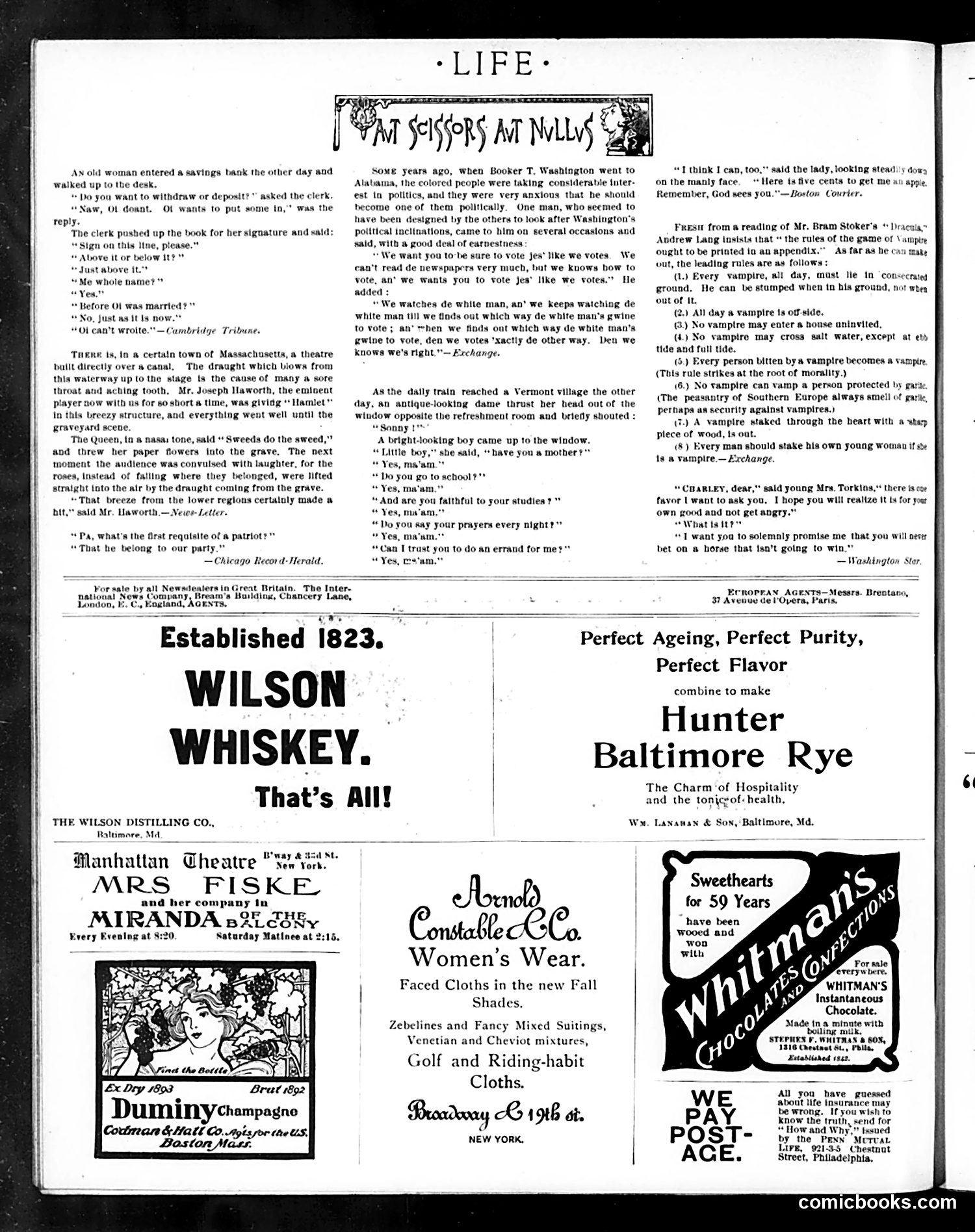
This page from Life magazine contains several humorous anecdotes and satirical pieces typical of early 20th-century American humor: **Main Content:** The page features four separate joke/anecdote pieces mocking various social situations: 1. **Banking scene**: An illiterate elderly woman attempting to open a savings account, highlighting class/education gaps 2. **Theater anecdote**: An actor (Joseph Haworth performing Hamlet) whose scene is disrupted by drafts from a canal beneath the theater—slapstick humor about physical obstacles 3. **Political satire**: A piece about Booker T. Washington being pressured by Alabama voters to vote exactly opposite to white voters, satirizing Black political participation and voting patterns 4. **Virtue testing**: A woman interrogating a boy at a train station about his morality and trustworthiness The advertisements (Wilson Whiskey, Hunter Baltimore Rye, Whitman's Chocolate) and theater listings (Mrs. Fiske in "Miranda of the Balcony") fill remaining space. The humor relies on period stereotypes and class-based comedy common to Life's satirical style.
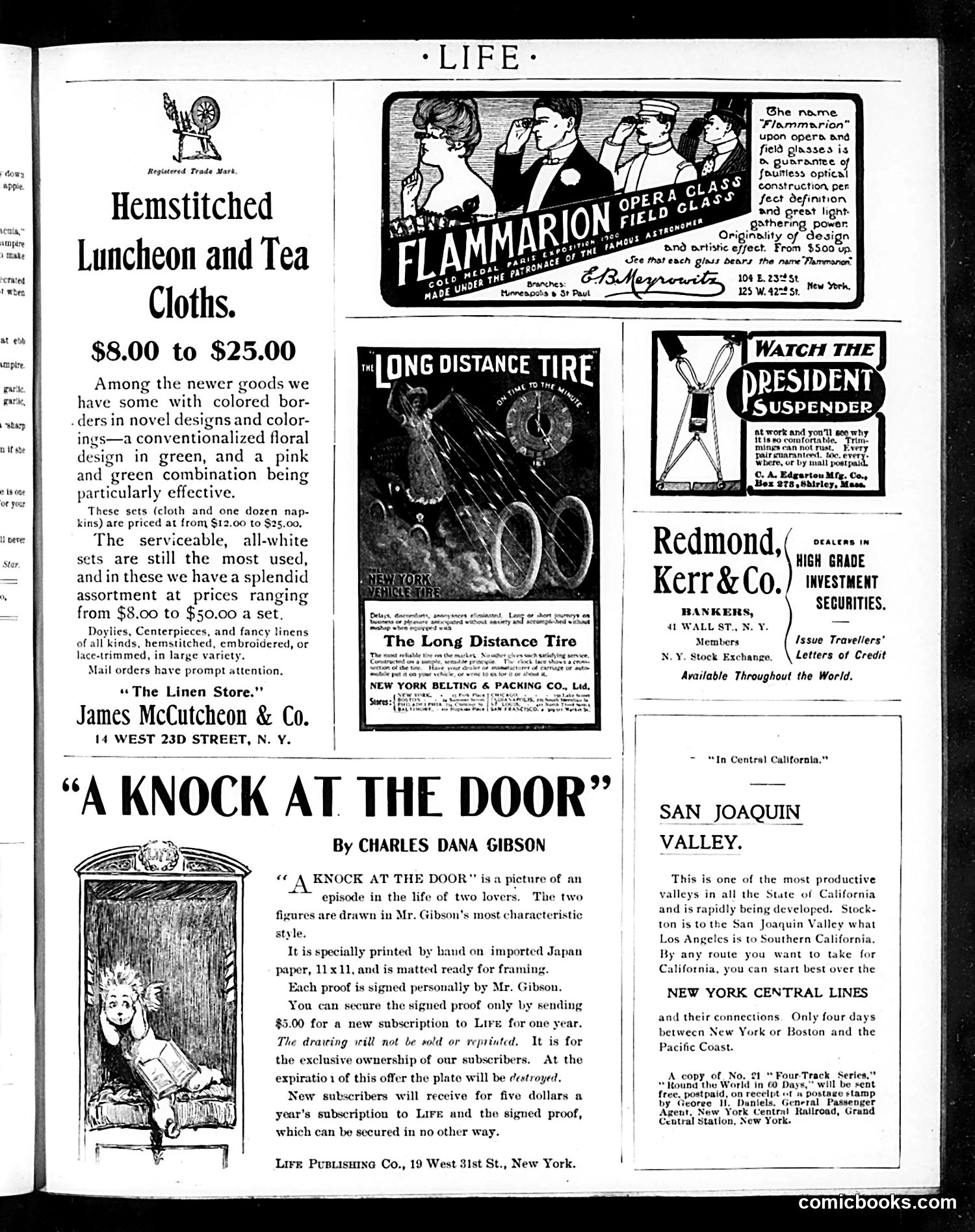
This page is primarily **advertising** with one featured artwork. The main content is a Charles Dana Gibson illustration titled "A Knock at the Door," described as depicting "an episode in the life of two lovers" drawn in Gibson's characteristic style. The artwork itself (visible as a sketch of a woman at a doorway) is being offered as an **exclusive incentive**: subscribers paying $5 for a one-year Life magazine subscription receive a hand-signed, matted print. The offer emphasizes scarcity—the plate will be destroyed after the promotion ends, and the drawing "will not be sold or reprinted." This represents **early 20th-century magazine marketing**: using limited-edition celebrity-artist prints to drive subscriptions. Gibson was extremely famous for his "Gibson Girl" illustrations, making his signed work a valuable collector's item. The remainder of the page contains typical period advertisements for linen cloths, optical equipment, tires, and financial services.
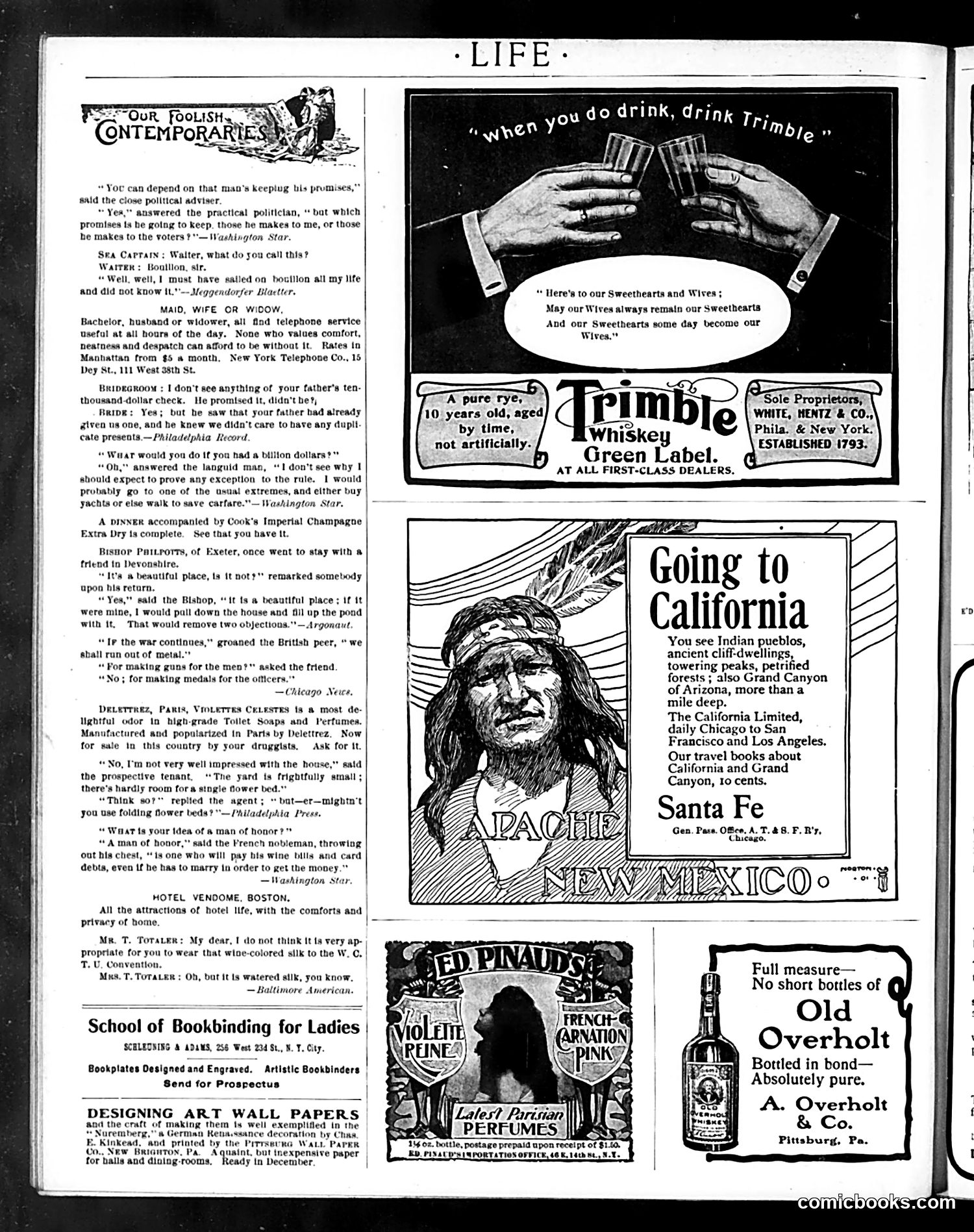
This page from *Life* magazine contains multiple brief satirical jokes mocking contemporary politicians and social figures through dialogue snippets. The main cartoon attacks **political hypocrisy**: a close adviser asks a politician which promises he'll keep—those to political insiders or to voters—implying politicians cynically distinguish between commitments to different audiences. Other jokes similarly target **dishonesty and self-interest**: a father gives duplicate gifts knowing his son won't complain; a wealthy man would pursue yachts or penny-pinching extremes; a British peer worries war will deplete metal for officer medals rather than munitions. A recurring theme mocks **temperance advocates**: one joke shows a woman wearing "watered silk" to a WCTU (Women's Christian Temperance Union) convention—a pun suggesting she's hypocritically associated with diluted/weakened alcohol despite advocating abstinence. The page is primarily **advertising** interspersed with these brief satirical quips, typical of *Life's* format. The humor relies on revealing gap between public professions and private self-interest.
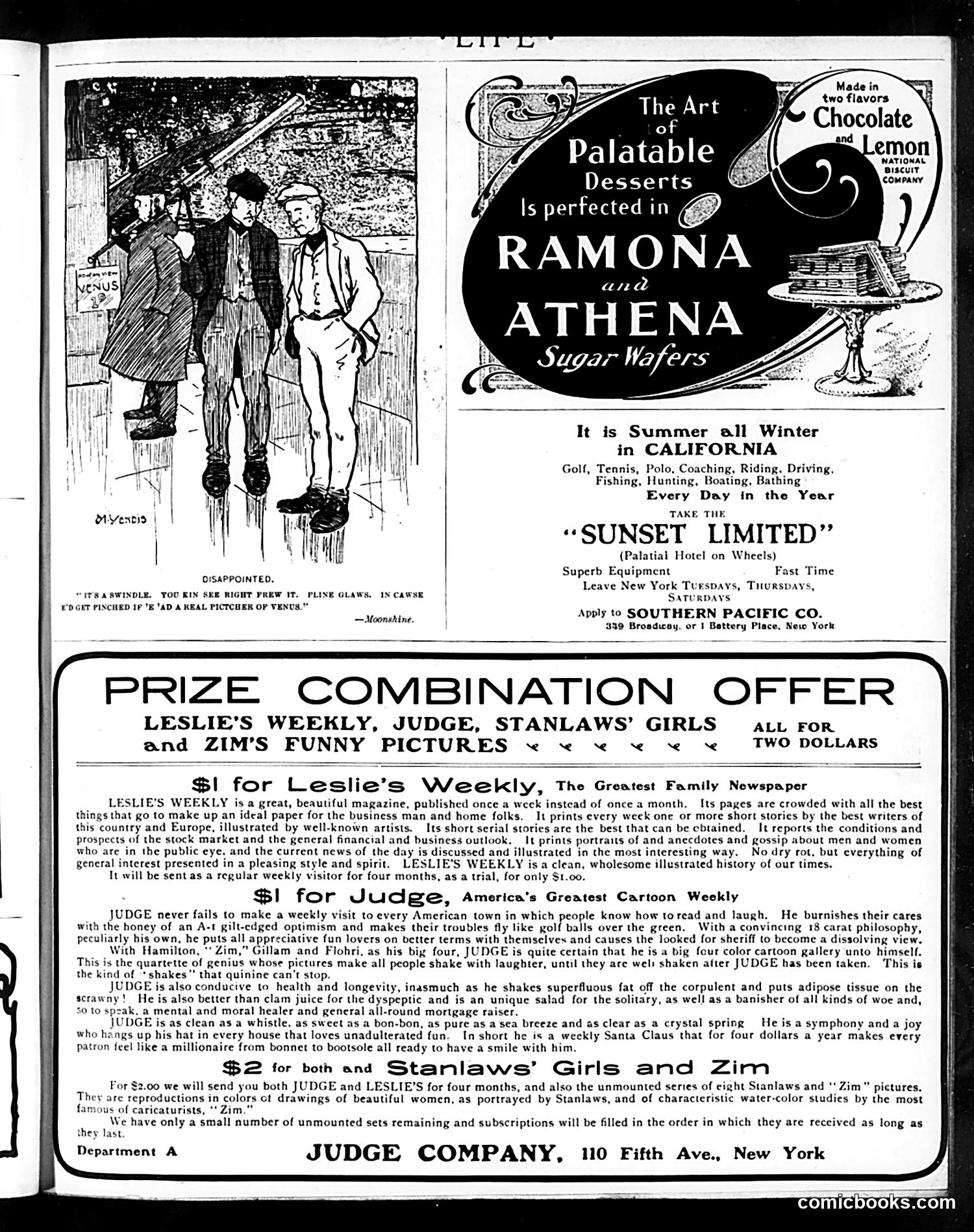
This page is primarily **advertising and subscription offers**, not editorial satire. The single cartoon—a small sketch labeled "Disappointed"—depicts three men examining what appears to be a fraudulent or disappointing piece of art, with dialogue in exaggerated dialect mocking the viewer's gullibility. The caption references "Venus," suggesting someone was swindled buying fake classical artwork. The bulk of the page promotes magazine subscriptions: Leslie's Weekly, Judge (a humor magazine), and collections of drawings by artists Stanlaws and "Zim." The advertisements emphasize these publications' cartoons and illustrations as entertainment and moral uplift for middle-class readers. The top advertisements promote Ramona and Athena sugar wafers and California travel via the Sunset Limited train—typical early-20th-century consumer goods marketing. No specific political figures or events are referenced; this represents standard Life magazine content circa 1900s-1910s.
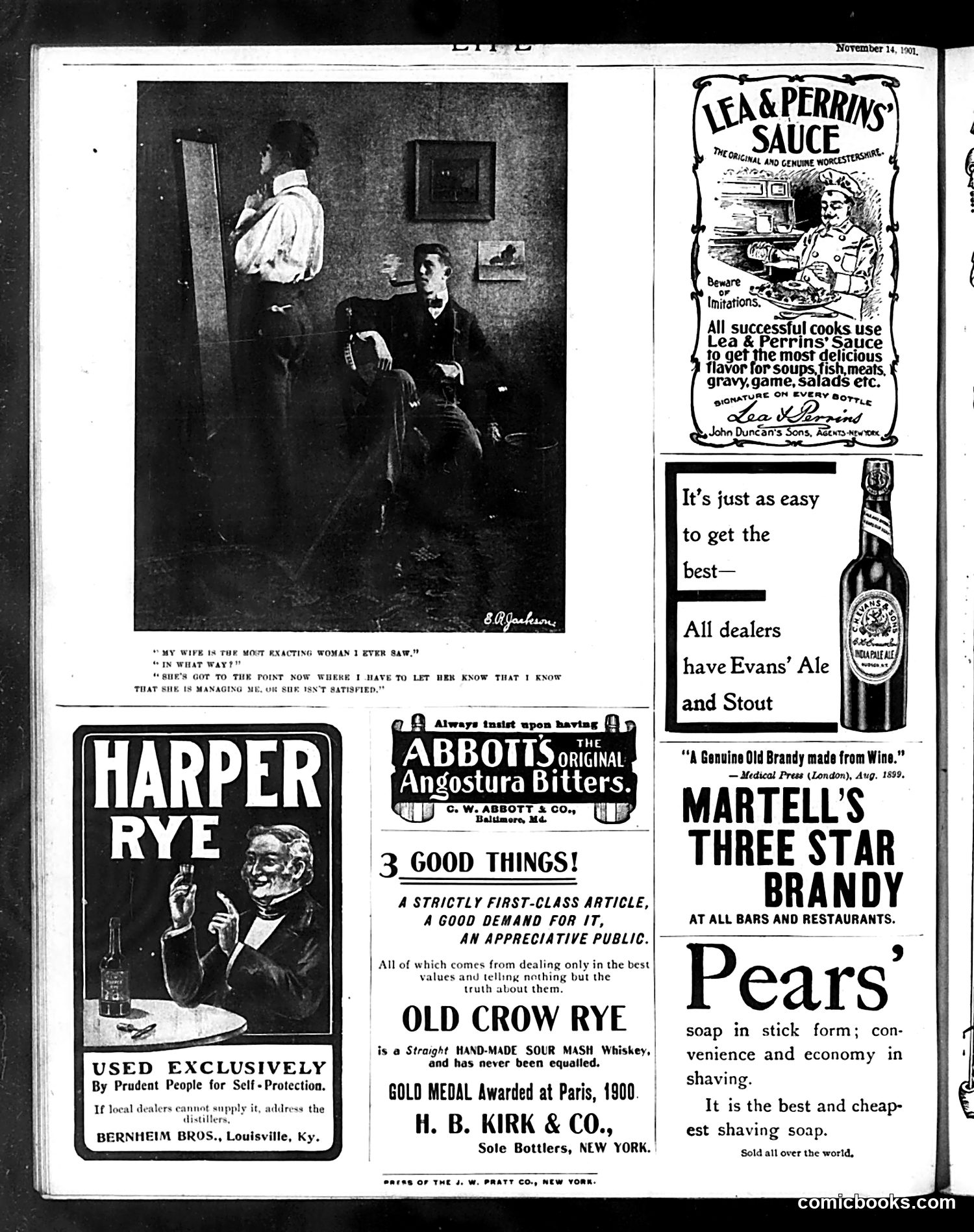
This page is primarily **advertising**, not political satire. The main cartoon at top depicts a domestic scene: a man standing while a woman sits, with dialogue about her being "the most exacting woman I ever saw." The joke reflects early-20th-century gender anxieties—the husband complains that his wife now manipulates him so subtly that he must preemptively demonstrate his awareness of her control to satisfy her. It's a commentary on marital power dynamics and the "managing woman," a common trope suggesting wives exercised domestic authority in ways men found frustrating. The remainder consists of period advertisements for alcohol (Harper Rye, Old Crow Rye, Evans' Ale, Martell's Brandy), Lea & Perrins' Sauce, and Pears' soap—typical for Life magazine's era. These ads reflect consumer products marketed to middle and upper-class readers.