
Life, 1901-11-14 · page 4 of 20
Life — November 14, 1901 — page 4: what you’re looking at
What you’re looking at
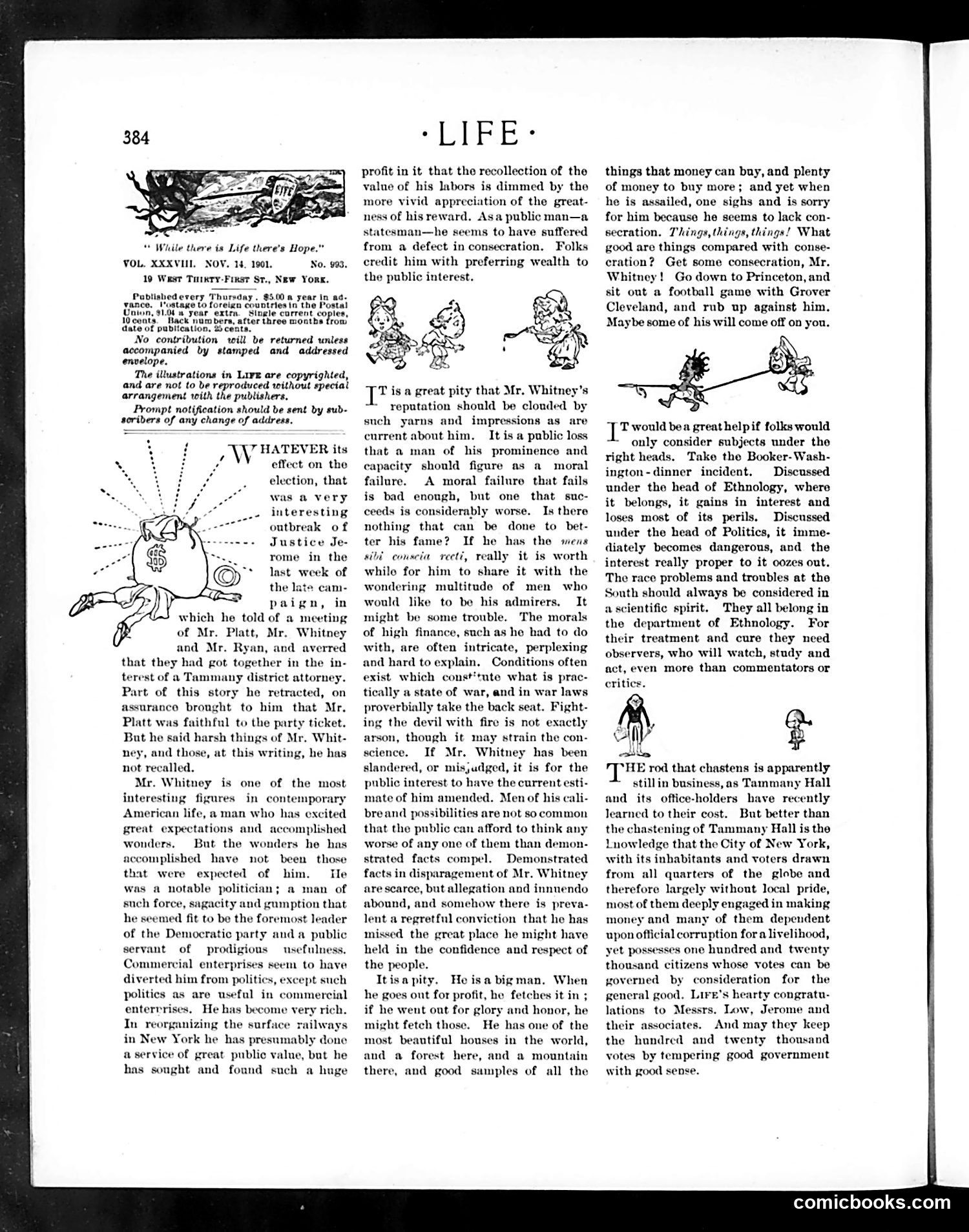
This page critiques **William C. Whitney**, a prominent Democratic politician and financier. The central cartoon shows Whitney as a figure of contradictions: despite his wealth and accomplishments in reorganizing New York railways, he's accused of moral failure through alleged political corruption and opportunism. The satirist argues Whitney prioritized profit over principle, abandoning his Democratic leadership role for commercial gain. The text sarcastically notes his "beautiful houses" and material success while questioning his character—suggesting his reputation is "clouded" by questionable dealings with political figures like Platt and Ryan. The underlying complaint: a man of Whitney's stature should have maintained ethical integrity rather than compromising for wealth.
📄 Transcribed text from this page (OCR, searchable)
Machine-transcribed from the original scan — historical spelling and the odd misread are preserved.
“* While there is Life there's Hope.” VOL. XXXVI. NOV. 14, 1901, No. 993. 19 Wast Tikty-Finst St., New Yor«. Publishedevery Thursday. $5.00 a year in ad- vance. Hostage to foreign countries in the Postal Union, $1.06 a year extra. Single current coples, Weeats. “ack numbers, after three months trom date of publication, 2 cents. No contribution will be returned unless accompanied by stamped and addressed envelope. ‘The illustrations in L1vE are copyrighted, and are not to be reproduced without special arrangement with the publishers, Prompt notification should be sent by sub- soribers of any change of address, i 7 HATEVER its i: Of W effect on the : election, that vas a very interesting outbreak of Justice Je- rome in the last week of the late cam- paign, in which he told of a meeting of Mr. Platt, Mr. Whitney and Mr. Ryan, and averred that they had got together in the in- terest of a Tammany district attorney. Part of this story he retracted, on assurance brought to him that Mr. Platt was faithful to the party ticket. But he said harsh things of Mr. Whit- ney, and those, at this writing, he has not recalled, Mr. Whitney is one of the most interesting figures in contempo American life, a man who has ex great expectations and accomplished wonders. But the wonders he has accomplished have not been those that were expected of him. He was a notable politician; a man of such force, sagacity and gumption that he seemed fit to be the foremost leader of the Democratic party and a public servant of prodigious usefulness. Commercial enterprises seem to ha diverted him from politics, except such politics as are usefal in commercial enterrrises, He has become very rich. In reorganizing the surface railways in New York he has presumably done aservice of great public value, but he has sought and found such a huge «ERIE: « profit in it that the recollection of the value of his labors is dimmed by the more vivid appreciation of the great- ness of his reward, Asa public man—a statesman—he seems to have suffered from a defect in consecration. Folks credit him with preferring wealth to the public interest. es Te ie Keaep oe c i Ws Bs qt is a great pity that Mr. Whitney's reputation should be clouded by such yarns and impressions as are current about him. It is a public loss that a man of his prominence and capacity should figure as a moral failure. A moral failure that fails is bad enough, but one that suc- ceeds is considerably worse. Is there nothing that can be done to bet- ter his fame? If he has the sibi conscia reeti, really it is worth whilo for him to share it with the wondering multitude of men who would like to be his admirers. It might be some trouble. The morals of high finance, such as he had to do with, are often intricate, perplexing and hard to explain. Conditions often exist which const'tute what is prac- tically a state of war, and in war laws proverbially take the back seat. ing the devil with fire is not exactly arson, though it ma science. If Mr. Whitney has been slandered, or mis,udged, it is for the public interest to have the current esti mate of him amended. Men of his breand possibilities are not socommon that the public can afford to think any worse of any one of them than demon- strated facts compel. Demonstrated facts in disparagement of Mr. Whitney are scarce, but allegation and innuendo abound, and somehow there is preva- lent a regretful conviction that he has missed the great place he might have held in the confidence and respect of the people. Itisapity. He isa bigman. When he goes out for profit, he fetches it in ; if he went out for glory and honor, he might fetch those. He one of the most beautiful houses in the world, and a forest here, and a mountain there, and good samples of all the ‘ é i > mens things that money can buy, and plenty of money to buy more; and yet when he is assailed, one sighs and is sorry for him because he seems to lack con- secration. Things, things, things! What good are things compared with conse- cration? Get some consecration, Mr. Whitney! Go down to Princeton, and sit out a football game with Grover Cleveland, and rub up against him. Maybe some of his will come off on you. T would bea great helpif folks would only consider subjects under the right heads, Take the Booker-Wash- ington-dinner incident. Discussed under the head of Ethnology, where it belongs, it gains in interest and loses most of its perils. Discussed under the head of Politics, it imme- diately becomes dangerous, and the interest really proper to it oozes out. The race problems and troubles at the South should always be considered in ascientific 5 They all belong in the department of Ethnology. For their treatment and cure they need observers, who will watch, study and act, even more than commentators or critics. Tee rod that chastens is apparently stillin business, as Tammany Hall and its oftice-holders have recently learned to their cost. But better than the chastening of Tammany Hall is the Luowledge that the City of New York, with its inhabitants and voters drawn from all quarters of the globe and therefore largely without local pride, most of them deeply engaged in making money and many of them dependent upon official corruption for a livelihood, yet possesses one hundred and twenty thousand citizens whose votes can be governed by consideration for the general good. Lire’s hearty congratu- lations to Messrs. Low, Jerome and their associates. And may they keep the hundred and twenty thousand votes by tempering good government with good sense. comicbooks.com