
Life, 1901-11-14 · page 6 of 20
Life — November 14, 1901 — page 6: what you’re looking at
What you’re looking at
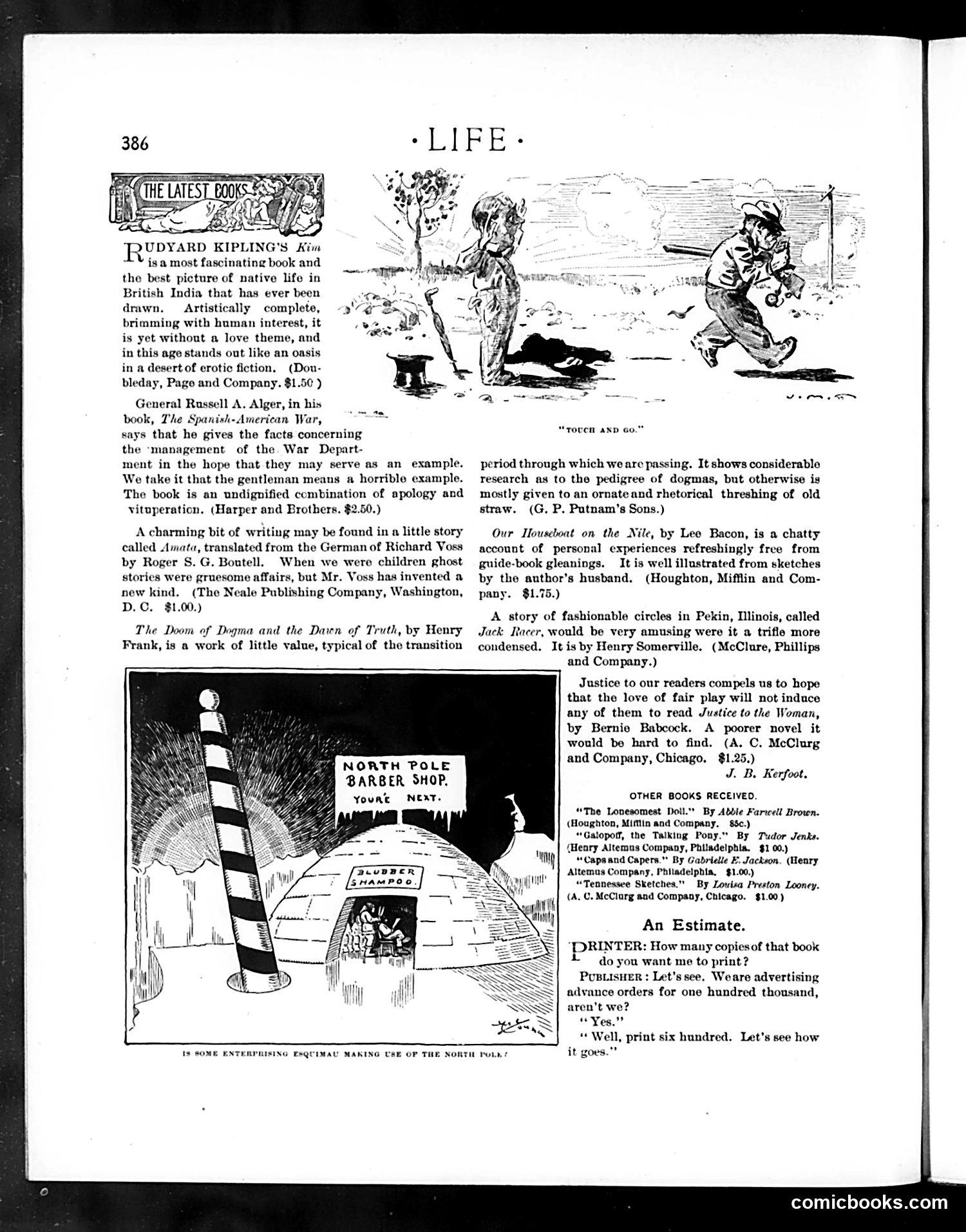
This page is primarily **book reviews** rather than political cartoons. The main illustration shows a humorous scene labeled "IS SOME ENTERPRISING ESQUIMAU MAKING USE OF THE NORTH POLE?" depicting an Inuit barber shop at the North Pole—a whimsical absurdist joke playing on the remoteness and inhospitability of that location. The reviews discuss various books including Rudyard Kipling's *Kim*, General Russell Alger's *The Spanish-American War*, and others. The final section titled "An Estimate" contains a brief comic dialogue between a printer and publisher about printing costs. The page reflects Life's **mix of satirical commentary and entertainment**, using humor to discuss both literature and contemporary affairs, though this particular page lacks overt political messaging.
📄 Transcribed text from this page (OCR, searchable)
Machine-transcribed from the original scan — historical spelling and the odd misread are preserved.
Kin is a most fascinating book and the best picture of native life in British India that has ever been drawn, Artistically complete, brimming with human interest, it is yet without a love theme, and in this age stands out like an oasis in a desert of erotic fiction, (Dou- bleday, Pago and Company. $1.50 ) General Russell A. Alger, in his book, The Spanish-American War, says that he gives the facts concerning the ‘management of the War Depart- ment in the hope that they may serve as an example. We take it that the gentleman means a horrible example. The book is an undignified combination of apology and vituperation. (Harper and Brothers. $2.50.) A charming bit of writing may be found in a little story called Amata, translated from the German of Richard Voss by Roger S. G. Boutell. When we were children ghost stories were gruesome affairs, but Mr. Voss has invented a new kind. (The Neale Publishing Company, Washington, D.C. 31.00.) The Doom of Dogma and the Dawn of Truth, by Henry Frank, is a work of little value, typical of the transition “Tovcn aND Go.” period through which we arc passing. It shows considerable research as to the pedigree of dogmas, but otherwise is mostly given to an ornateand rhetorical threshing of old straw. (G. P. Putnam’s Sons.) Our Houseboat on the Nile, by Lee Bacon, is a chatty account of personal experiences refreshingly free from guide-book gleanings. It is well illustrated from sketches by the author's husband. (Houghton, Mifflin and Com- pany. $1.75.) A story of fashionable circles in Pekin, Ilinois, called Jack Racer, would be very amusing were it a trifle more condensed. It is by Henry Somerville. (McClure, Phillips and Company.) NORTH POLE BARBER SHOP, Yount NEXT. 1S SOME ENTERPRISING ESQUIMAU MAKING USE OP THE NORTH PUL? Justice to our readers compels us to hope that the love of fair play will not induce any of them to read Justice to the Woman, by Bernie Babcock. A poorer novel it would be hard to find. (A. C. McClurg and Company, Chicago. $1.25.) J. By Kerfoot. OTHER BOOKS RECEIVED. “The Lonesomest Doll.” By Abule Farwell Brown. (Houghton, Mimtin and Company. —85c.) “Galopot, the Talking Pony. By Tudor Jenks. (Henry Altemus Company, Philadelphia. $1 00.) “Capa and Capers." By Gabrielle E. Jackson. (Henry Altemas Company, Phitadelphia, $1.00.) “Tennessee Sketches." By Louisa Preston Looney. (A, C. MeClarg and Company, Chicago. $1.00) An Estimate. “‘DRINTER: How many copies of that book do you want me to print? PUBLISHER : Let's see. Weare advertising advance orders for one hundred thousand, aren't we? “Yes.’? ‘Well, print six hundred. Let’s see how it goes."” comicbooks.com