
Life, 1901-11-14 · page 12 of 20
Life — November 14, 1901 — page 12: what you’re looking at
What you’re looking at
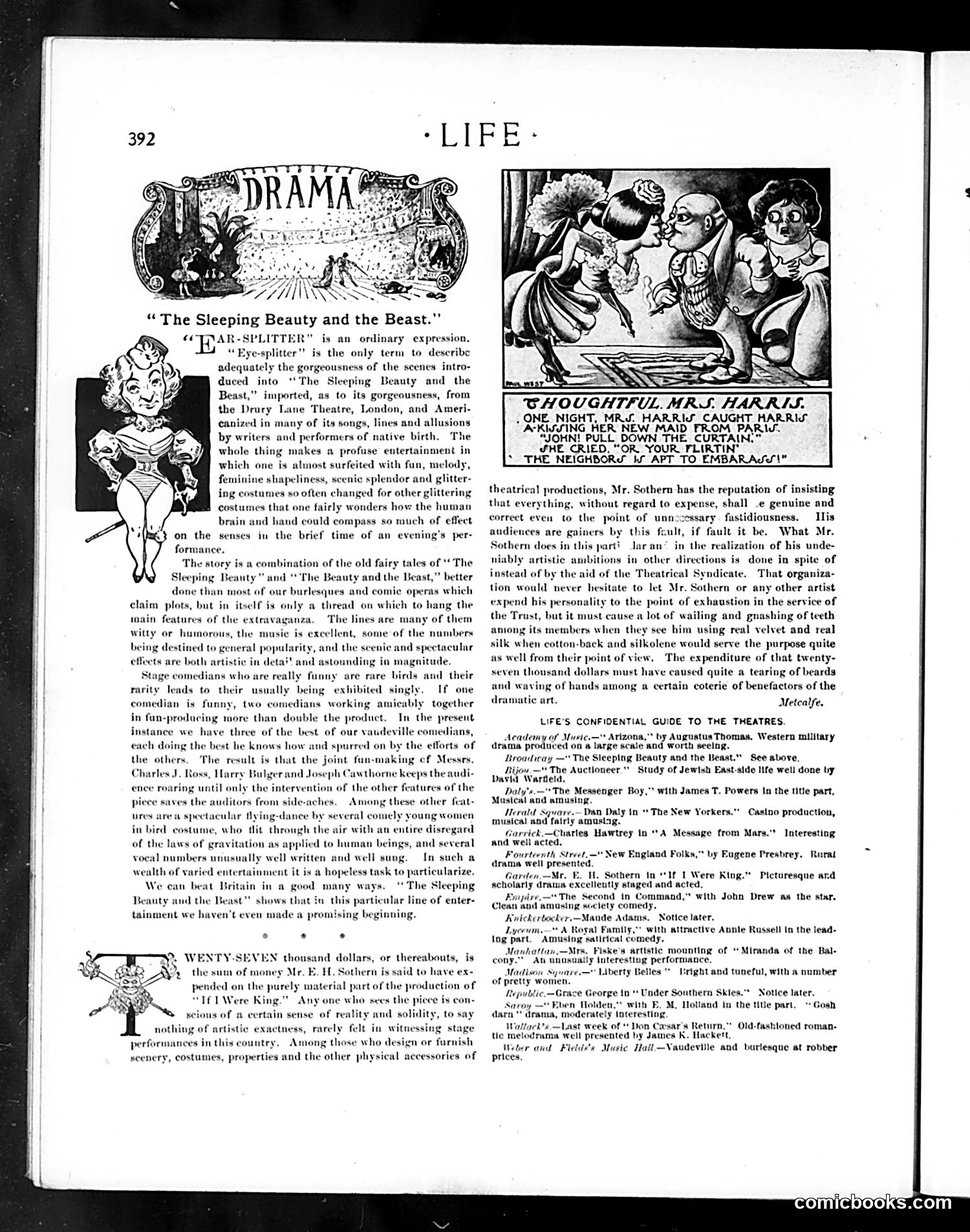
This page reviews theatrical productions, with the main illustration showing a scene from "The Sleeping Beauty and the Beast." The cartoon depicts a woman flirting with a man while gesturing dismissively at a maid entering from behind a curtain, with the caption "Thoughtful Mrs. Harris" describing her deliberately introducing her maid to her husband to distract him from other romantic interests. The satire targets upper-class marital dynamics—specifically a wife's strategy to manage her husband's wandering attention by controlling what women he encounters. The humor relies on dark observations about marriage, infidelity concerns, and a wife's calculated manipulation within domestic hierarchies of the era. The page primarily functions as theater criticism and entertainment guide rather than political satire.
📄 Transcribed text from this page (OCR, searchable)
Machine-transcribed from the original scan — historical spelling and the odd misread are preserved.
“The Sleeping Beauty and the Beast.” pers PLITTER” is an ordinary expression, “Eye-splitter” is the only term to describe adequately the gorgeousness of the scenes intro- duced into “The Sleeping Beauty and the Beast,” imported, as to its gorgeousness, from the Drury Lane Theatre, London, and Ameri- canized in many of its songs, lines and allusions by writers and performers of native birth. The whole thing makes a profuse entertainment in which one is almost suefeited with fun, m feminine shapeliness, scenic splendor and glitter- ing costumes so often cl ed for other glittering costumes that one fairly wonders how the human brain and hand could compass so much of effect on the senses in the brief time of an evening's per- formance The sto Sleeping I bination of the old fai ty" and “The Beauty and th done than most of our burlesques a claim plots, but in itself is only a th y tales of “The Beast,” better J comic operas which on which to hang the The lines are many of them music is excellent, some of the numbers al popularity, and the scenic and spectacular effects are both artistic in de d astounding in magnitude. pmedians why ly funny are nd their leads to hibited singly. If one ns working amicably together n double the product. In the present f the best of our vaudeville comedians, ows how and spurred on by the efforts of the others, The result is that the joint fun-making of Messrs. Charles J, Ross, Harry Bulger and Joseph Cawthorne keeps the audi- ring until only the intervention of the other features of the ves the auditors from sid Among these other feat- ures area spectacular flying-dance by several comely e birds rarity their us comedian is funny, two comedi in fun-producing more th instance we have three each doing the best he y being in bird costume, who it through the air with an of the Jaws of gravitation as applied to human beings, and several vocal numbers unusually well written and well su In such a wealth of varied entertainment it is a hopeless task to particularize. We can beat Britain in a good many ways. ‘The Sleeping and the Beast” shows thi articular line of enter- TY-SEVED QP, the sum of mon pended on the purely material part of the product ee “ILL Were King.” “Any one who sces the piece is con- : scious of a certain sense of reality and solidity, to say artistic exactness, rarely felt in witnessing stage performances in this country. Among those who design or furnish scenery, costumes, properties and the other physical accessories of nothing . ONE NIGHT, MR HARRIS CAUGHT HARRIS A‘KISSING HER NEW MAID FROM PARI. “JOHN! PULL DOWN THE CURTAIN,” SHE CRIED, “OR YOUR FLIRTIN™ *_ THE NEIGHBORY If APT TO EMBARAUS!" theatrica! productions, Mr. Sothern has the reputation of insisting that everything, without regard to expense, shall -e genuine and correct even to the point of unnccessary. fastidiousness. His audiences are gainers by this foult, if fault it be. What Mr. Sothern does in this part} Jar an’ in the realization of his unde- niably artistic ambitions in other directions is done in spite of instead of by the aid of the Theatrical Syndicate, That organiza- tion would never hesitate to let Mr. Sothern or any other artist expend his personality to the point of exhaustion in the service of the Trust, but it must cause a lot of wailing and gnashing of teeth among its members when they see him using real velvet and real silk when cotton-back and silkolene would serve the purpose quite as well from their point of view. The expenditure of that twenty- seven thousand dollars must have caused quite a tearing of beards and waving of hands among a certain coterie of benefactors of the dramatic art. Metcalfe, LIFE’S CONFIDENTIAL GUIDE TO THE THEATRES. Academy of Music. by Augustus Thomas, Western military drama produced on # large scale and worth seeing. Broadway —* The Sleeping Beauty and the Beast." See above. Bijou —* The Auctioneer." Study of Jewish East-side Ife well done by David Warteld. Daty's.—"The Messenger Boy,’ with James T. Powers In the title part, Musteal and amusing. Herald Square.— Dan Daly in The New Yorkers.” Castno production, musical and fairly amusing. Garrick.—Charles. Hawtrey in “A Message from Mara."* Interesting and weil acted. Fourteenth Street. — New England Fotk drama well presented, Garden —Me. E. H. Sothern tn “If | Were King." Pictoresque and scholarly drama excellently staged and acted, Empire,—"The Second in Command,” with John Drew as the star. Clean and amusing seclety comedy. Knickerbock aude Adams, Notice later. Lyceum. A Rogal Family," with attractive Annie Russell In the lead- ing part. Amusing satirical comedy. Manhattan,—Mrs. Fiske’s artistic mounting of “Miranda of the Bal- cony.”” An unusually toteresting performance. Madison Syuare.—" Laberty Belles * Dright and tuneful, with a number of pretty women. Republic. —Grace George tn * Under Southern Skies." Saroy Eben Holden.” with darn" drama, moderat loteresting. Watlack*s.—Last week of * Don ars Return tie melodrama well presented by James K. Hackett, Weber and Fields'« Music Halt.—Naudeville and burtesque at robber prices. by Eugene Presbrey. Rural Notice later. M, Holland in the title part osh Old-fashioned roman-