
A complete issue · 20 pages · 1901
Life — October 24, 1901
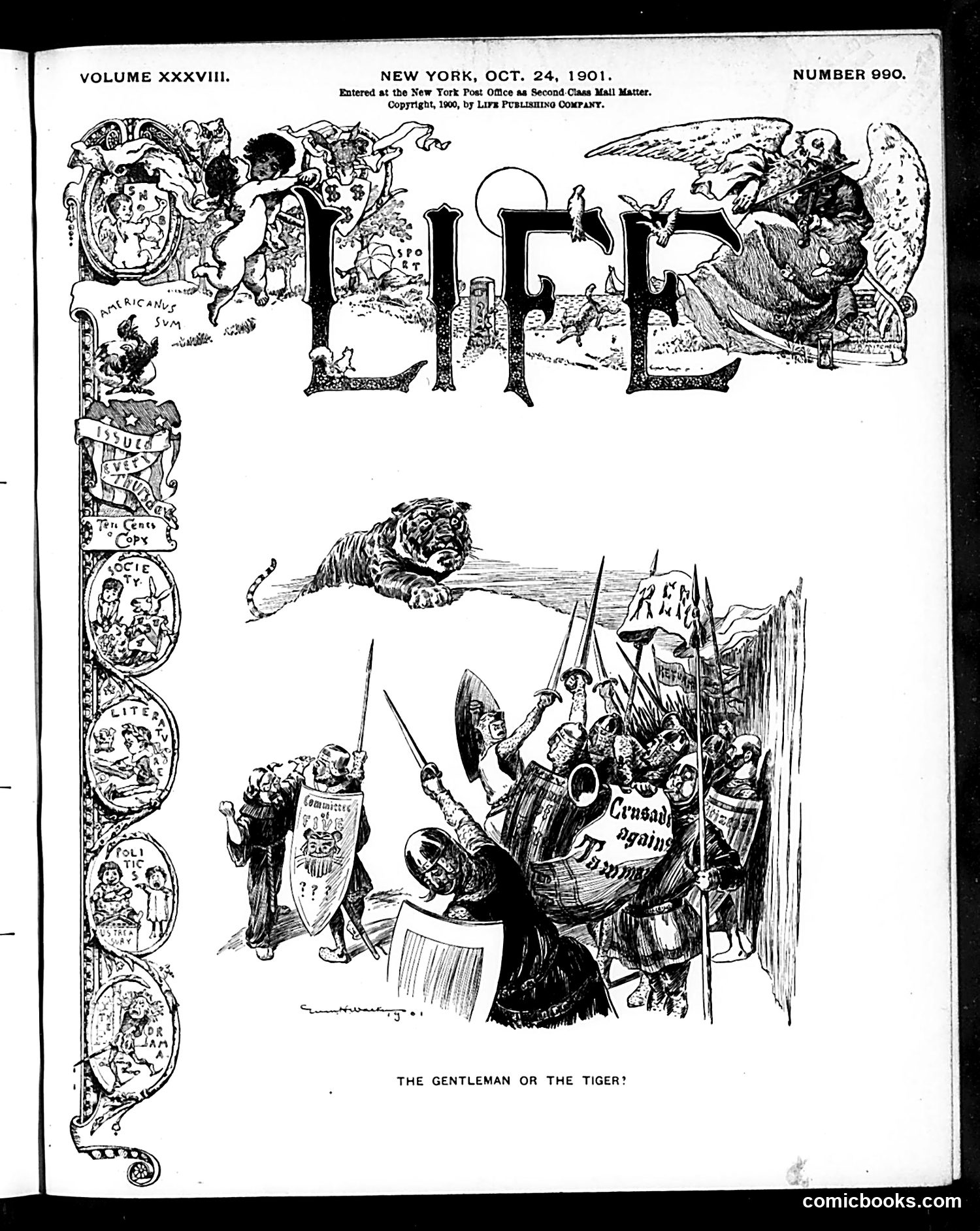
This cartoon satirizes a political or military conflict, likely involving imperialism or colonial conflict. The title "The Gentleman or the Tiger?" presents a moral choice—civilized behavior versus savage brutality. The main illustration shows armed crusaders or soldiers confronting what appears to be a tiger, with banners reading "Crusade against" (text unclear). A gentleman figure in the foreground contrasts with the armed military force behind him. The ornate left border contains small vignettes depicting various literary or cultural scenes, typical of Life's decorative style. Without clearer identification of specific historical figures or events referenced, the exact political meaning remains unclear, though it appears critical of militaristic "civilization" campaigns or colonial violence presented as noble crusades.
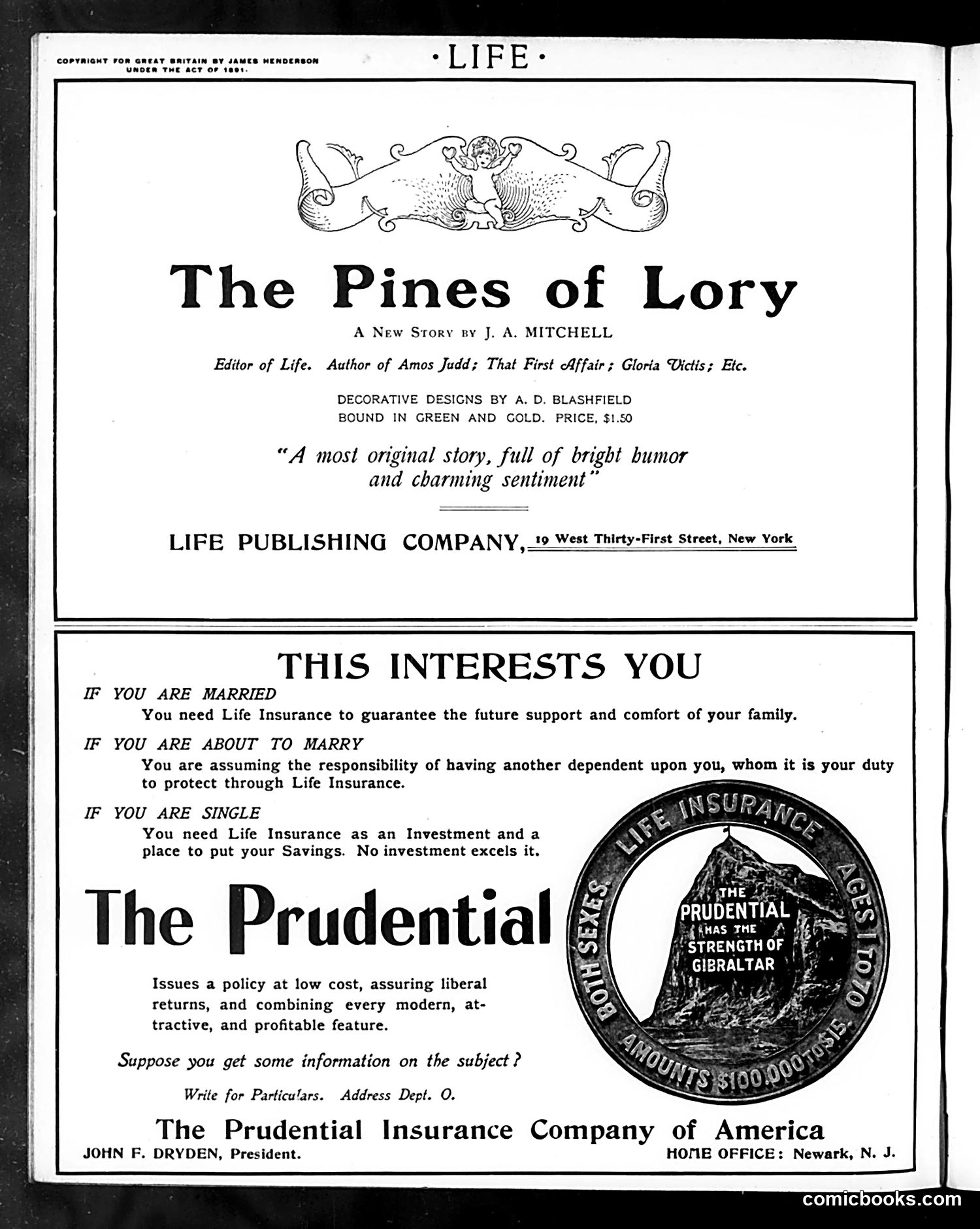
This page contains two distinct elements: **Upper section:** An advertisement for "The Pines of Lory," a story by J.A. Mitchell published by Life Publishing Company. The decorative header and binding details suggest early 20th-century book marketing. **Lower section:** A Life Insurance advertisement for The Prudential Insurance Company of America, featuring their iconic logo—the Rock of Gibraltar with text stating "Prudential has the strength of Gibraltar." The ad uses a segmented approach addressing married, soon-to-be-married, and single readers, positioning life insurance as both protection and investment. The page demonstrates how early Life magazine integrated editorial content with advertisements. The Prudential ad's "Rock of Gibraltar" branding was a well-known marketing campaign emphasizing stability and strength—concepts designed to appeal to early-20th-century American anxieties about financial security and family protection.
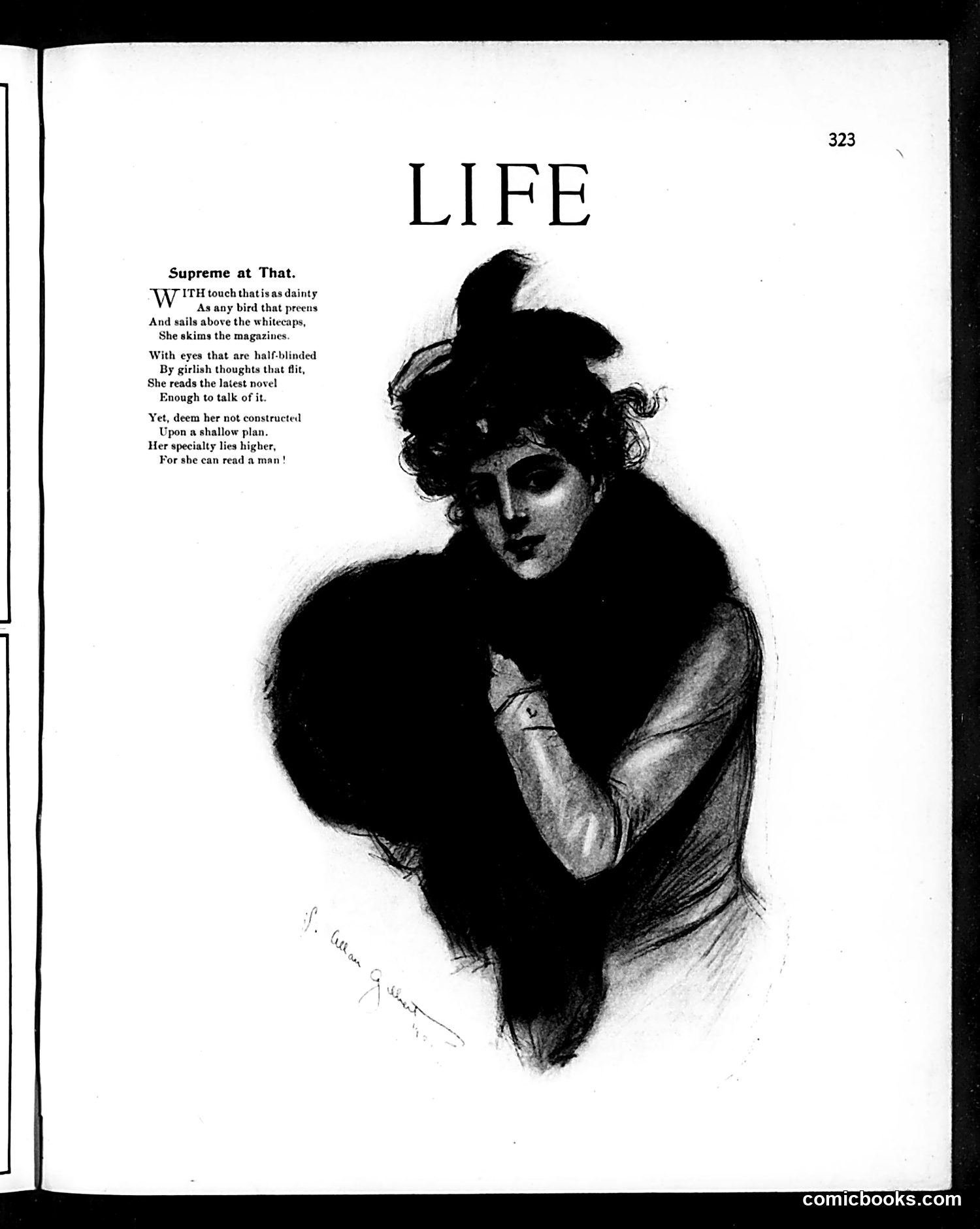
This page titled "Supreme at That" presents a satirical poem about a woman who reads voraciously but superficially. The accompanying sketch shows a fashionable woman in early 20th-century dress. The satire targets women who: - Skim magazines rather than read deeply - Read the latest novels casually to participate in social conversation - Have "half-blinded" eyes from frivolous reading - Follow shallow trends in literature The final couplet suggests paradoxically that despite this superficiality, "she can read a man"—implying women possess intuitive insight into male character that transcends their intellectual limitations. The poem mocks both female reading habits and perhaps reflects period anxieties about women's education and intellectual engagement. The artwork's fashionable styling underscores the critique of vanity-driven culture.
This page contains editorial commentary rather than political cartoons. The main illustrations are decorative headers featuring Yale University imagery (mortarboard, books). The text discusses Yale's bicentennial celebration happening that week in New Haven—a major event the author notes will draw unprecedented attendance from Yale alumni and supporters. The piece also addresses the upcoming New York mayoral election, endorsing a candidate (Shepard) as a reform-minded alternative to Tammany Hall, the notoriously corrupt Democratic political machine controlling city politics. The Schley naval inquiry mentioned refers to an ongoing controversy over Admiral Schley's role in the Spanish-American War. The editorial advocates for anti-corruption municipal governance and criticizes Tammany's entrenched power.
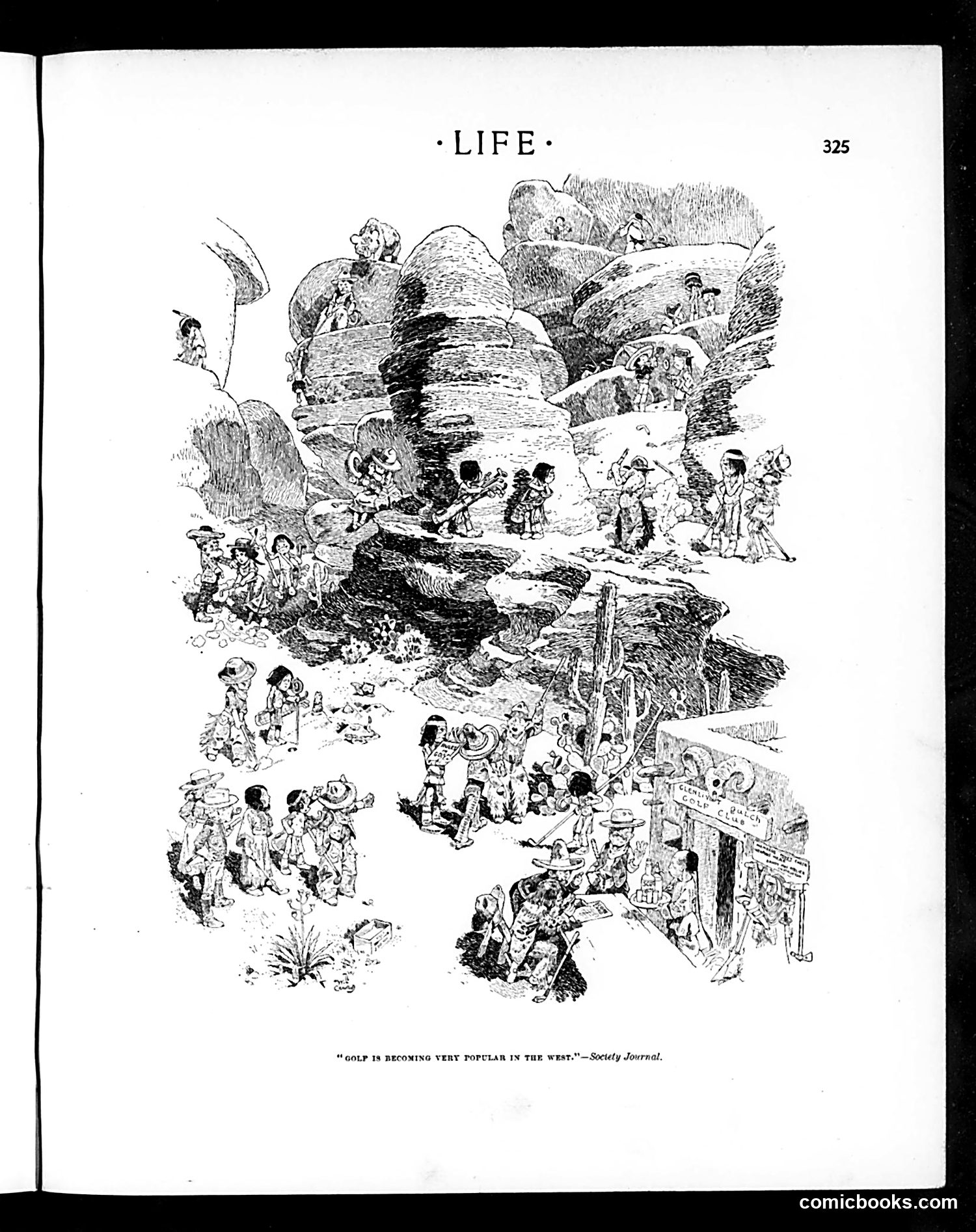
This satirical cartoon from *Life* magazine illustrates the caption: "Golf is becoming very popular in the West." The image depicts a chaotic scene in what appears to be a Western landscape with rocky formations, where numerous people are engaged in golf activities amid considerable disorder and confusion. The satire mocks the rapid spread of golf culture into the American West, suggesting the sport's adoption has created pandemonium rather than the refined leisure activity golf was traditionally associated with. The densely packed figures, makeshift structures, and rough terrain humorously contrast golf's image as an orderly, civilized pastime with the untamed Western frontier setting. The joke relies on the incongruity between golf's genteel reputation and Western roughness.
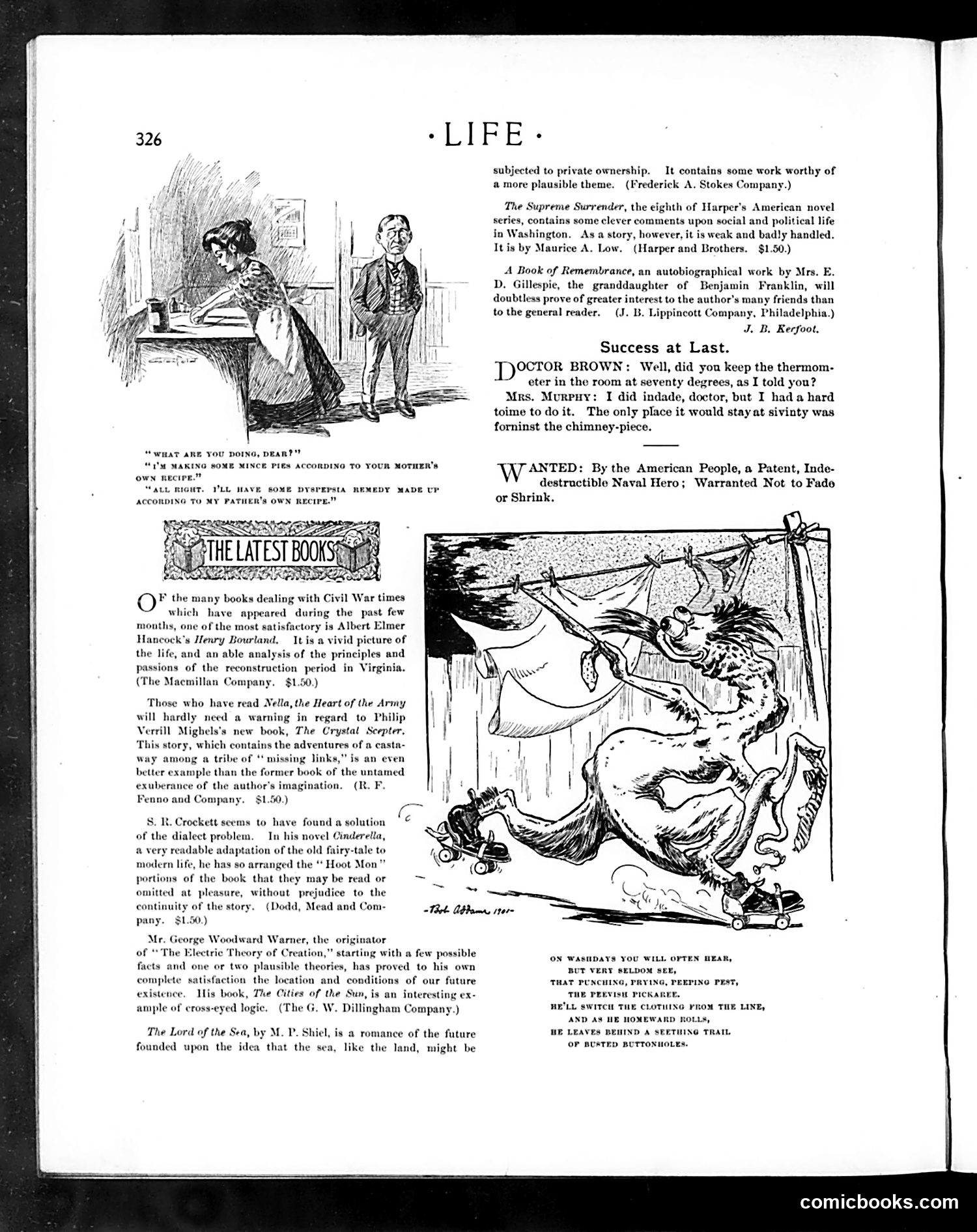
This page contains a brief comedic dialogue ("Success at Last") between Doctor Brown and Mrs. Murphy about maintaining room temperature, followed by a book review section and a political cartoon. The cartoon depicts a figure suspended in what appears to be a hammock or sling, labeled with text about a "Patent, Indestructible Naval Hero; Warranted Not to Fade or Shrink." The accompanying verse mocks this figure, suggesting it's a satirical commentary on American military heroism or perhaps a specific public figure presented as artificial or exaggerated. The exact historical reference is unclear without additional context, but the satire targets the construction or marketing of a "hero" as a commodity—something manufactured and guaranteed not to deteriorate, implying artificiality or hollow patriotism.
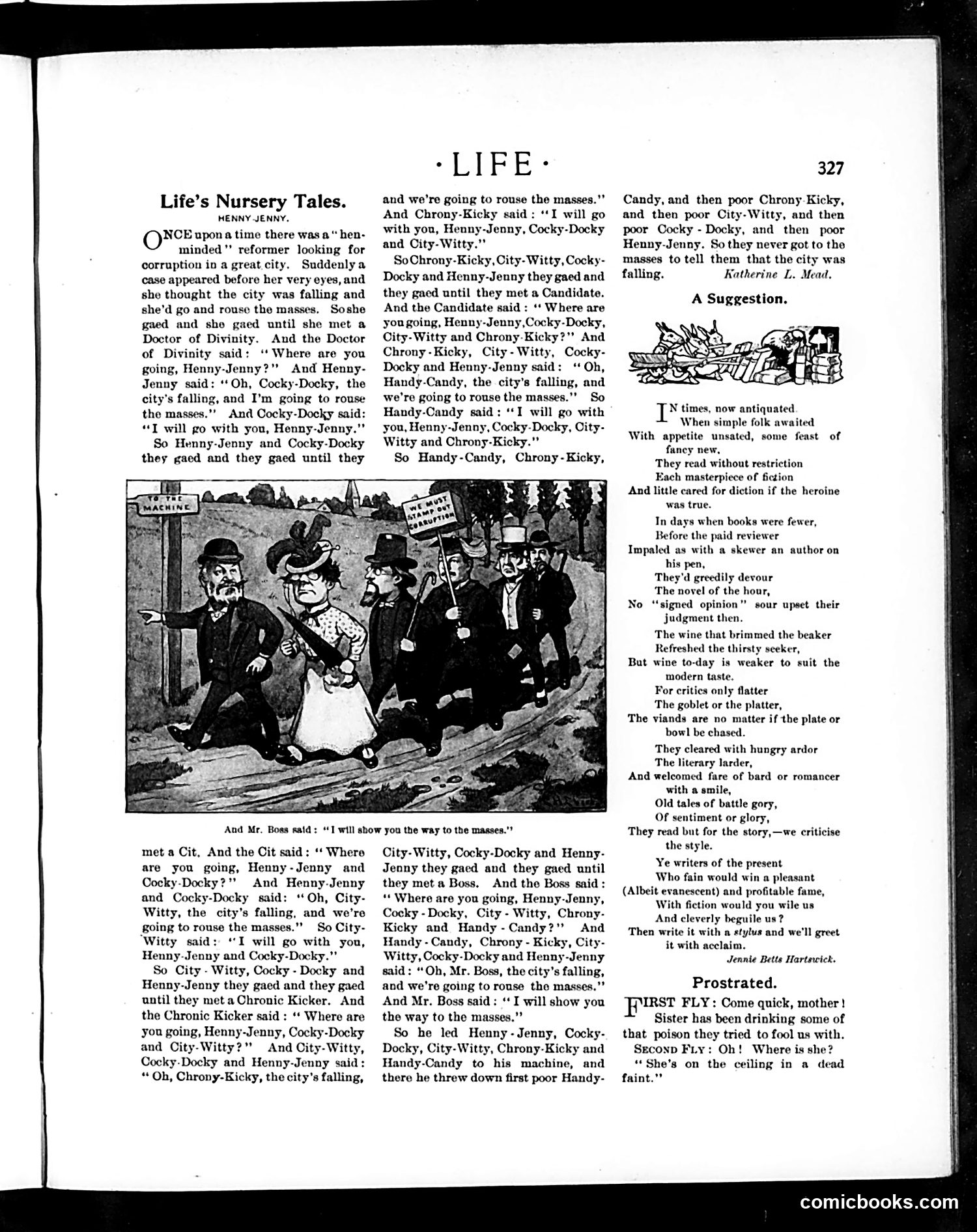
This page presents a satirical nursery rhyme about urban corruption and reform. The narrative features characters with absurd names (Henny-Jenny, Cocky-Dockey, City-Witty, Chrony-Ricky, Handy-Candy) visiting a "Doctor of Divinity" to address "the city's falling." The accompanying illustration depicts what appears to be a political procession or gathering of working-class figures and officials. The satire likely mocks: - **Urban corruption**: "Chrony-Ricky" suggests cronyism in city politics - **Failed reform efforts**: Characters claiming they'll "rouse the masses" but achieving nothing - **Political theater**: Officials using moral rhetoric while perpetuating problems The piece critiques how politicians and reformers made grand promises to address urban decay without substantive change—a recurring theme in American satirical commentary on municipal governance.
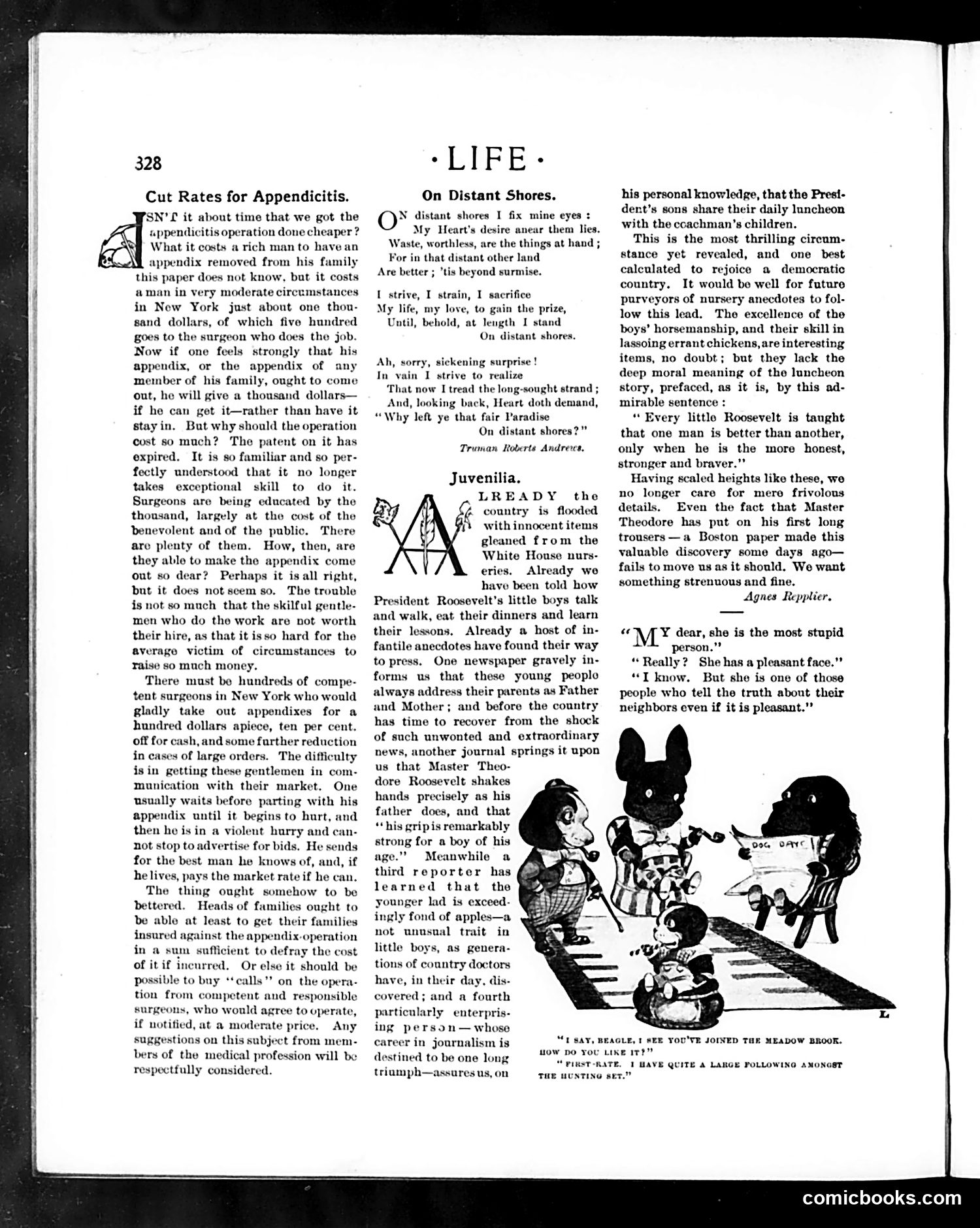
This page contains three distinct pieces. The "Cut Rates for Appendicitis" article satirizes surgeons' competitive bidding for appendectomy patients in New York, mocking how they advertise prices and compete for business like any tradesman—a critique of commercializing medicine. "On Distant Shores" is a poem about sacrifice and longing, likely referencing wartime separation (based on references to "fair Paradise" and sacrifice of "life" and "love"). The cartoon below depicts young children (appearing to be President Roosevelt's sons, based on the "Juvenilia" section discussing Roosevelt's boys) playing at hunting. One child addresses another as "Beagle," discussing joining the "Meadow Brook hunt" with "quite a large following afoot"—satirizing how children imitate and parody adult aristocratic hunting culture and pretensions.
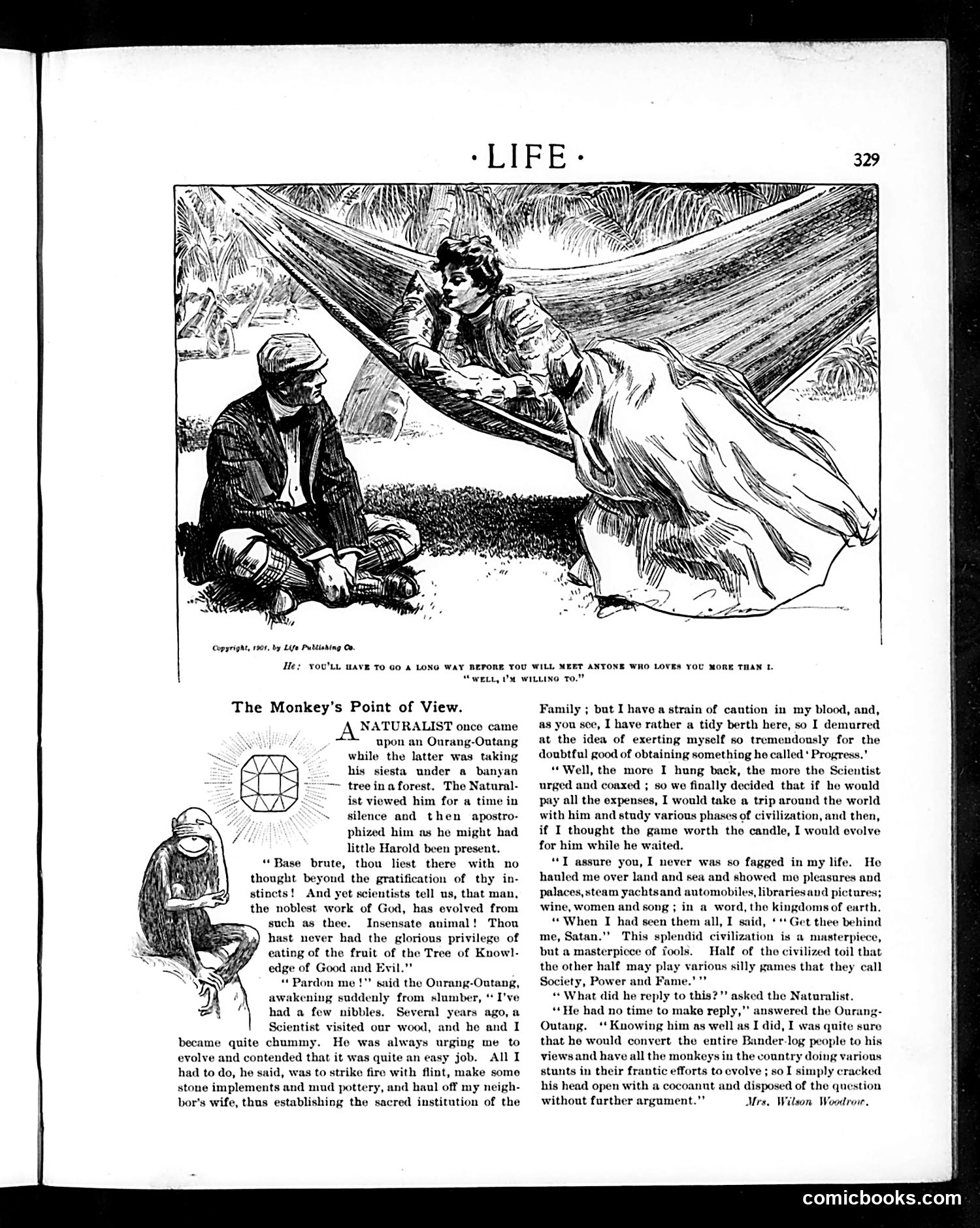
This satirical piece uses a dialogue between a naturalist and an orangutan to critique evolutionary theory and "Progress." The monkey argues that humans, despite claiming civilization and advancement, are merely elaborations on animal instinct. He catalogs human accomplishments—"steam yachts and automobiles, libraries and pictures, wine, women and song"—but dismisses them as tools used to perpetuate base desires. His punchline: "Half of the civilized toil that the other half may play various sham games that they call Society, Power and Fame." The satire mocks both Social Darwinism (using evolution to justify human hierarchy) and the era's faith in "Progress." By placing evolutionary critique in the orangutan's mouth, the author suggests humans' proud accomplishments mask unchanging animal nature—a skeptical take on late-19th-century optimism about civilization.
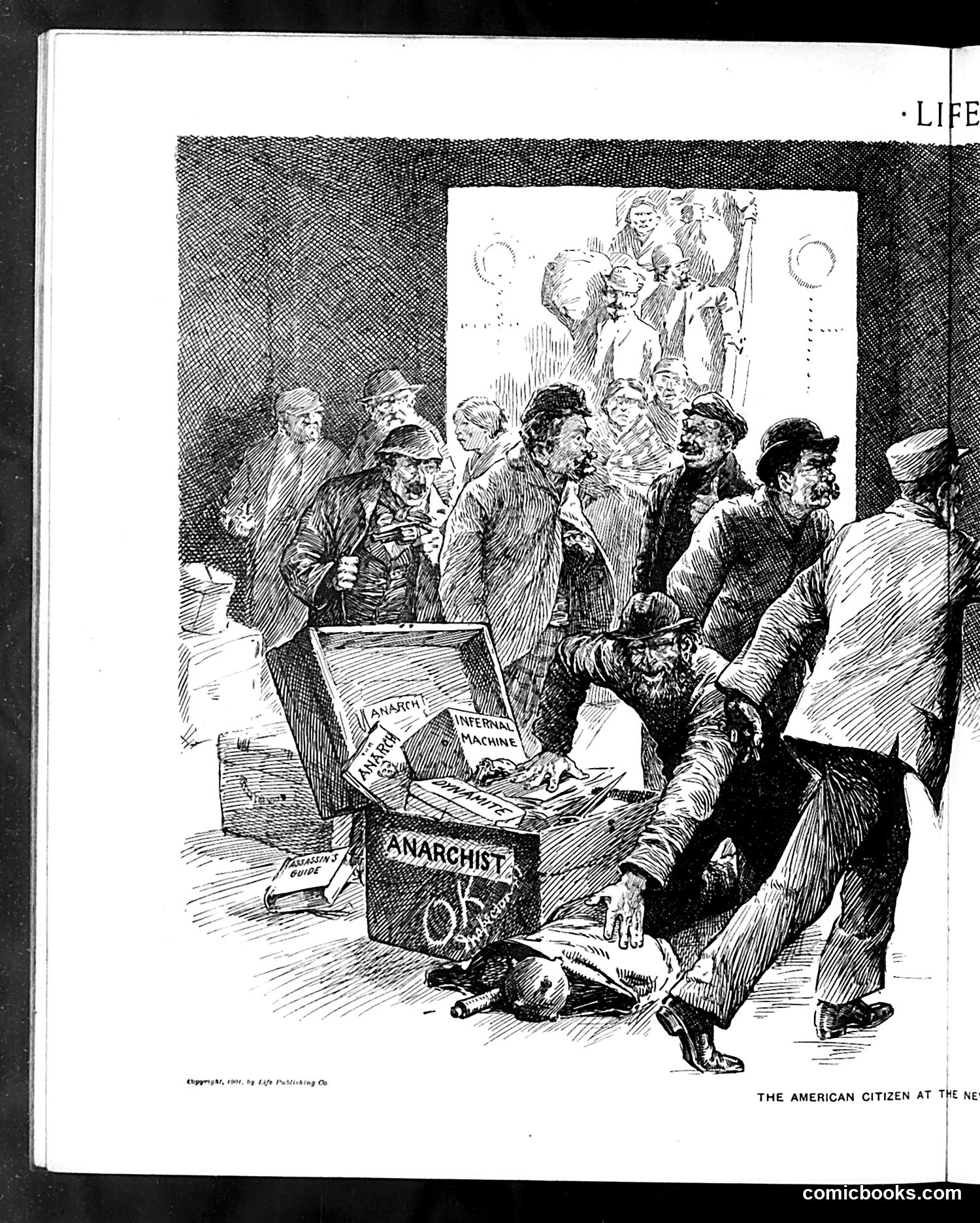
This satirical cartoon depicts anxiety about anarchist threats in early 20th-century America. A group of officials or authorities examines a box labeled "ANARCHIST" containing what appears to be explosive devices or contraband, with additional materials labeled "ANARCHIST'S GUIDE" visible nearby. The men's expressions suggest concern or alarm. The cartoon reflects the historical "Red Scare" period when Americans feared anarchist and socialist movements, particularly following violent incidents like bombings. The caricatured figures represent law enforcement or government officials confronting this perceived threat. The title references "The American Citizen at the Ne[xt]" (text cut off), suggesting commentary on how ordinary Americans were affected by or responded to anarchist-related security concerns and political upheaval of the era.
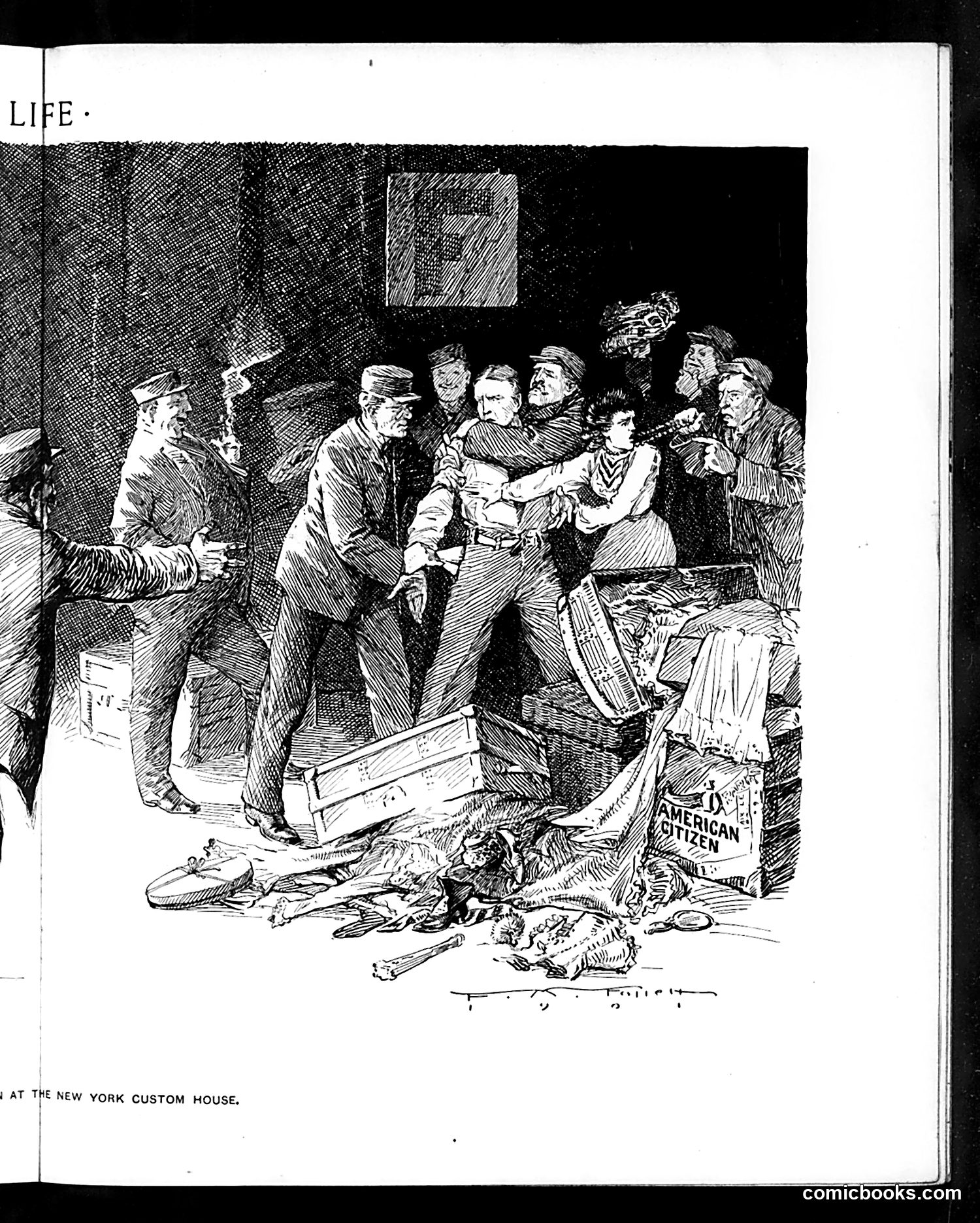
This satirical cartoon depicts what appears to be an inspection or investigation scene at the New York Custom House. A group of officials and workers surround a deceased figure on the ground, with scattered debris and what appears to be an "American Citizen" document visible. The cartoon likely critiques corruption, mismanagement, or violence within the Custom House—a notorious site of political patronage and graft during the Gilded Age. The dead body suggests serious wrongdoing or consequences of institutional malfeasance. Without identifying the specific cartoonist or publication date, the satirical intent appears to be exposing institutional dysfunction or calling attention to abuses of power within this federal agency, a frequent target of American political humor.
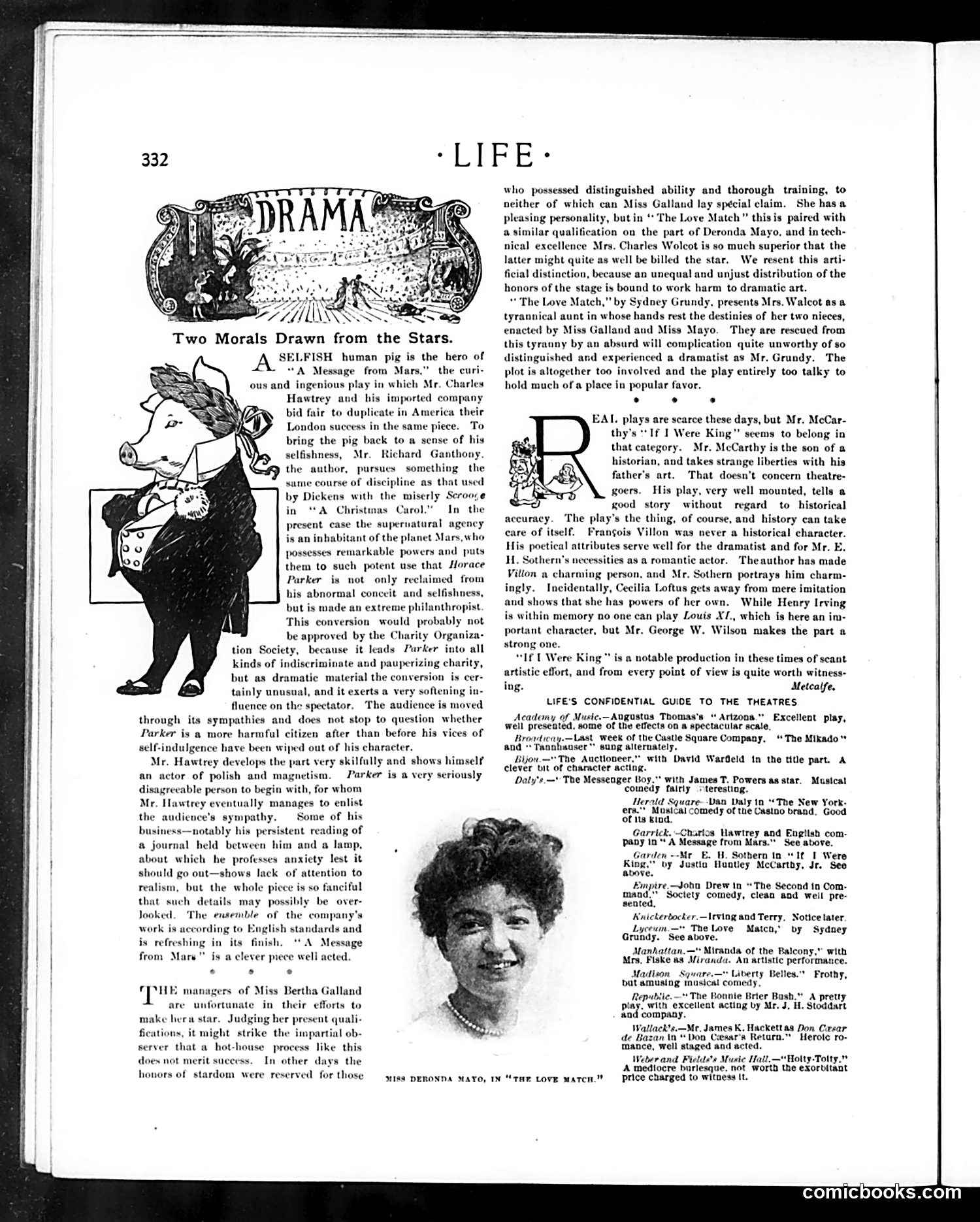
This page satirizes theatrical productions through two reviews. The main cartoon depicts a character from "A Message from Mars," a play about a visitor from the planet Mars who teaches earthly virtue through supernatural intervention. The satire critiques the play's moral instruction as heavy-handed and implausible. The reviewer notes that the conversion plot—where a selfish character learns charity—works through artificial dramatic contrivance rather than genuine character development. The cartoon's exaggerated figure embodies this theatrical artificiality. The accompanying reviews examine how historical accuracy and character authenticity matter less to contemporary audiences than popular entertainment. The critic argues that while such plays move audiences emotionally, they often sacrifice realism for sentimentality and dramatic effect.
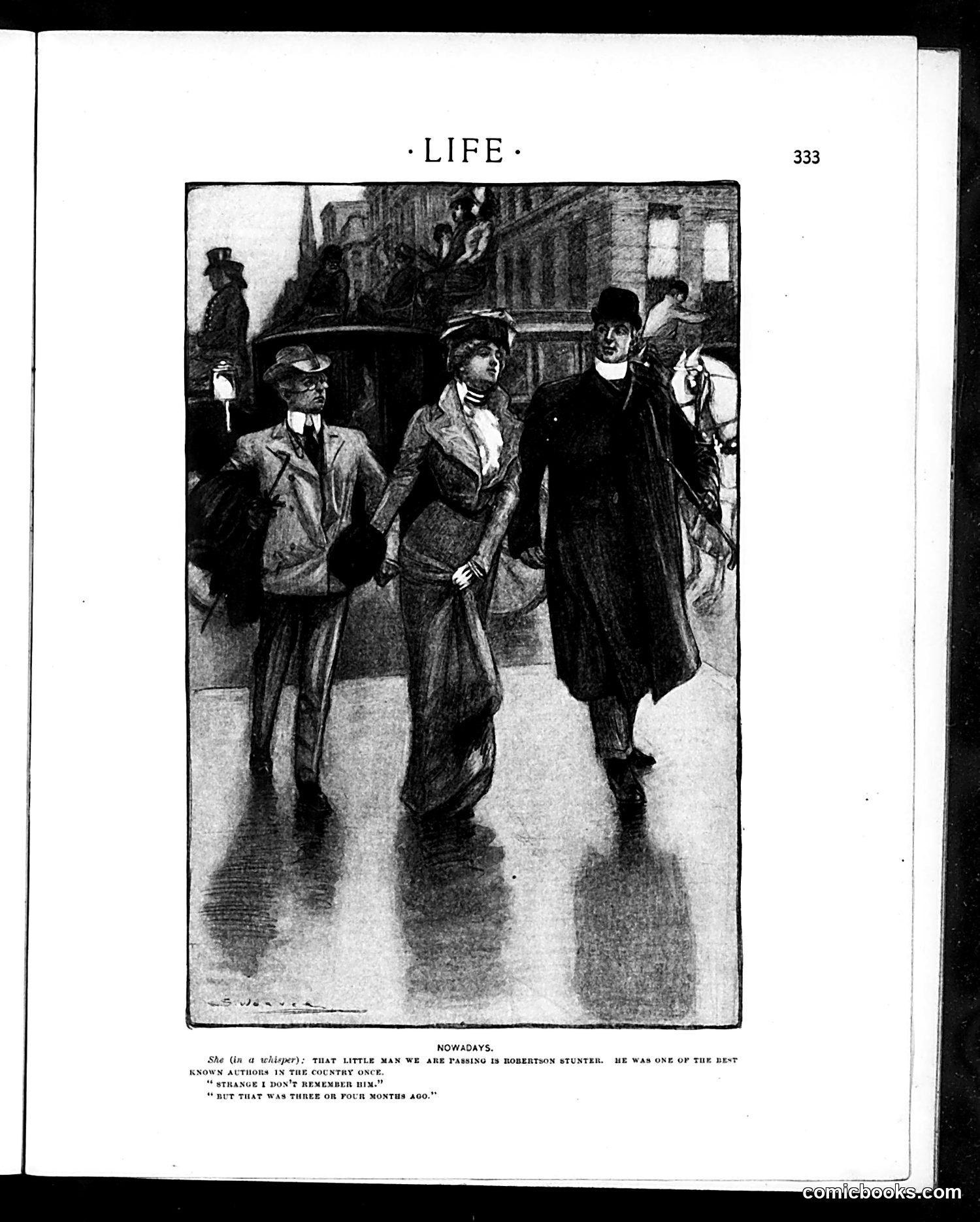
This satirical cartoon depicts a street scene where a woman whispers to her companion about spotting Robertson, identified as a once-famous author. The joke's premise is that Robertson's reputation has dramatically collapsed within just three or four months—he's become so obscure that the woman doesn't even recognize him, despite his former prominence. The satire targets the fickleness of literary fame and public attention in early 20th-century America. It mocks how quickly celebrity status can evaporate and how the public forgets yesterday's celebrated figures. The "little man" descriptor suggests both his physical stature and diminished social standing. This reflects Life magazine's common theme of satirizing vanity, fame's impermanence, and society's shallow memory.
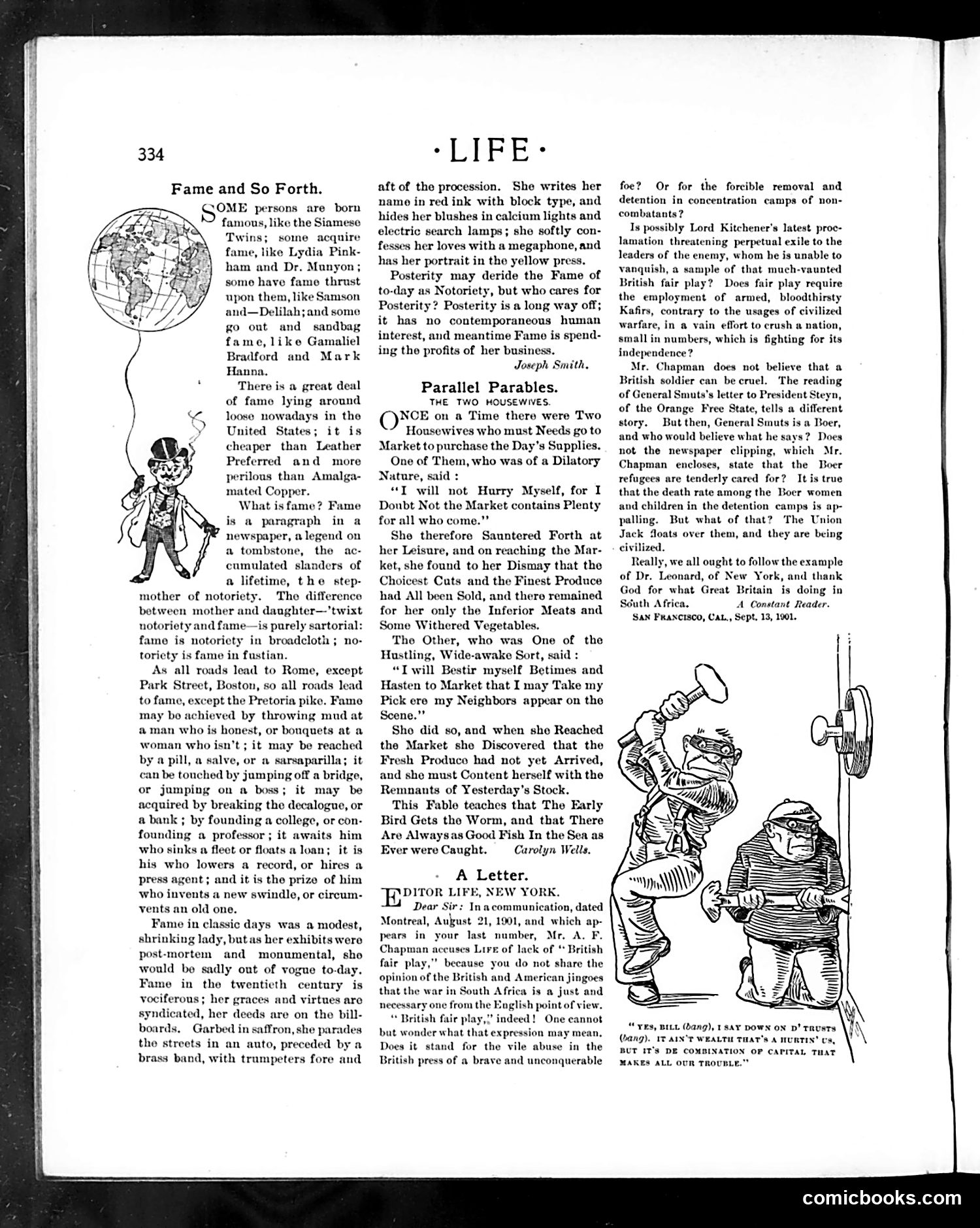
This page contains satirical essays and a fable mocking contemporary American culture. **"Fame and So Forth"** (Joseph Smith) ridicules how modern fame operates. It contrasts classical fame—modest and posthumous—with twentieth-century fame, which is vulgar, commercialized, and publicity-driven. The essay suggests fame can be achieved through scandal, deception, or simply hiring a "press agent." The globes and caricatured figures illustrate how fame is now manufactured and paraded publicly via automobiles and electric lights. **"Parallel Parables: The Two Housewives"** (Carolyn Wells) is ironic fable-within-fable humor: two housewives with opposite approaches both fail—the lazy one misses fresh goods; the eager one arrives too early. The moral's contradictions (early bird gets worm *and* there are always good fish) mock common wisdom's platitudes. **"A Letter"** begins a reader's complaint about *Life's* editorial stance on the Boer War, accusing the magazine of lacking "British fair play." This references contemporary debates about British imperialism in South Africa (1899-1902). The illustrations are generic Victorian-style comic figures, not specific caricatures of identifiable people.
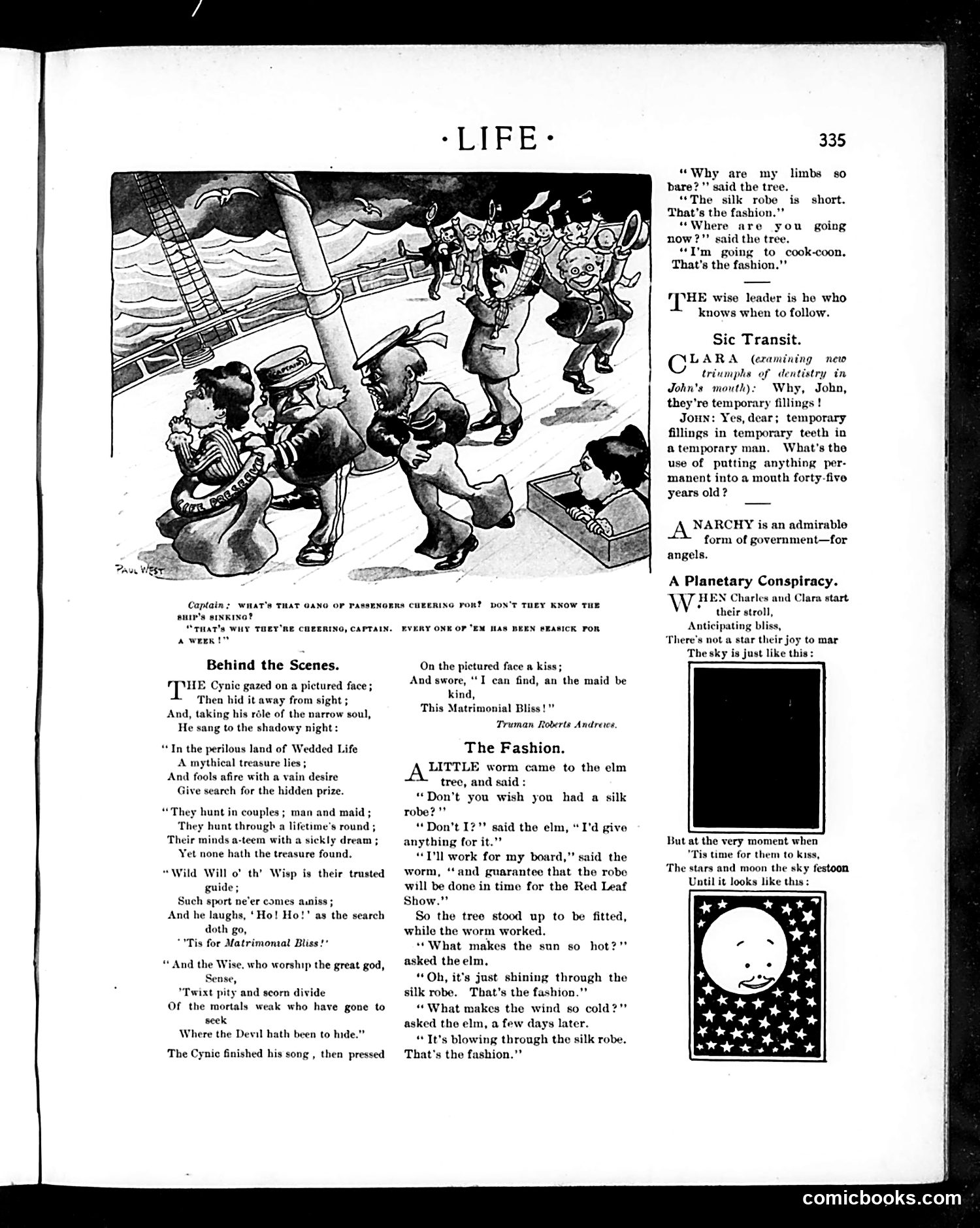
This page contains several satirical pieces typical of early 20th-century American humor: **"Behind the Scenes"** features a Cynic character mocking married life and the pursuit of "Matrimonial Bliss"—presented as a fool's errand. The cynical perspective criticizes those who marry for romantic ideals rather than practical sense. **"The Fashion"** uses an elm tree and parasitic worm as allegory. The worm promises a silk robe but delivers only a thin covering that fails functionally—it makes the tree hot, then cold, then leaves it bare. The repeated refrain "That's the fashion" satirizes blind adherence to superficial trends regardless of actual benefit or sense. The worm's final departure to "cook-coon" suggests exploitation and abandonment. **"Sic Transit"** jokes about temporary dental fillings in a temporary man—mocking both the absurdity of mortality and the practical futility of investing in permanence when life is fleeting. **"A Planetary Conspiracy"** uses astronomical imagery to humorously suggest even celestial bodies conspire to create romantic moments, likely mocking sentimental notions of cosmic destiny in love.
This page contains three humorous anecdotes satirizing American social pretenses and absurdities: 1. **Fiancée's allowance demand**: A young woman engaged to a wealthy man ($4,000 income) demands he live on only $5/week for cigars and neckties while she controls the rest—mocking both male vanity and women's financial manipulation in marriage. 2. **Eugene Field anecdote**: A celebrity-seeker offers the broke poet money; Field indignantly refuses—until asking the stranger to increase it to fifteen dollars. This mocks both desperate pride and shameless opportunism. 3. **Civil War German soldier**: A confused immigrant soldier reports his battery was captured, then casually mentions they recaptured it. The satire targets immigrant soldiers' confusion during combat and their practical, illogical solutions. The page's title suggests these are random observations ("at nullys"—nowhere in particular). The humor relies on irony, unexpected reversals, and exaggerated character types familiar to *Life* magazine's educated readership around the turn of the century.
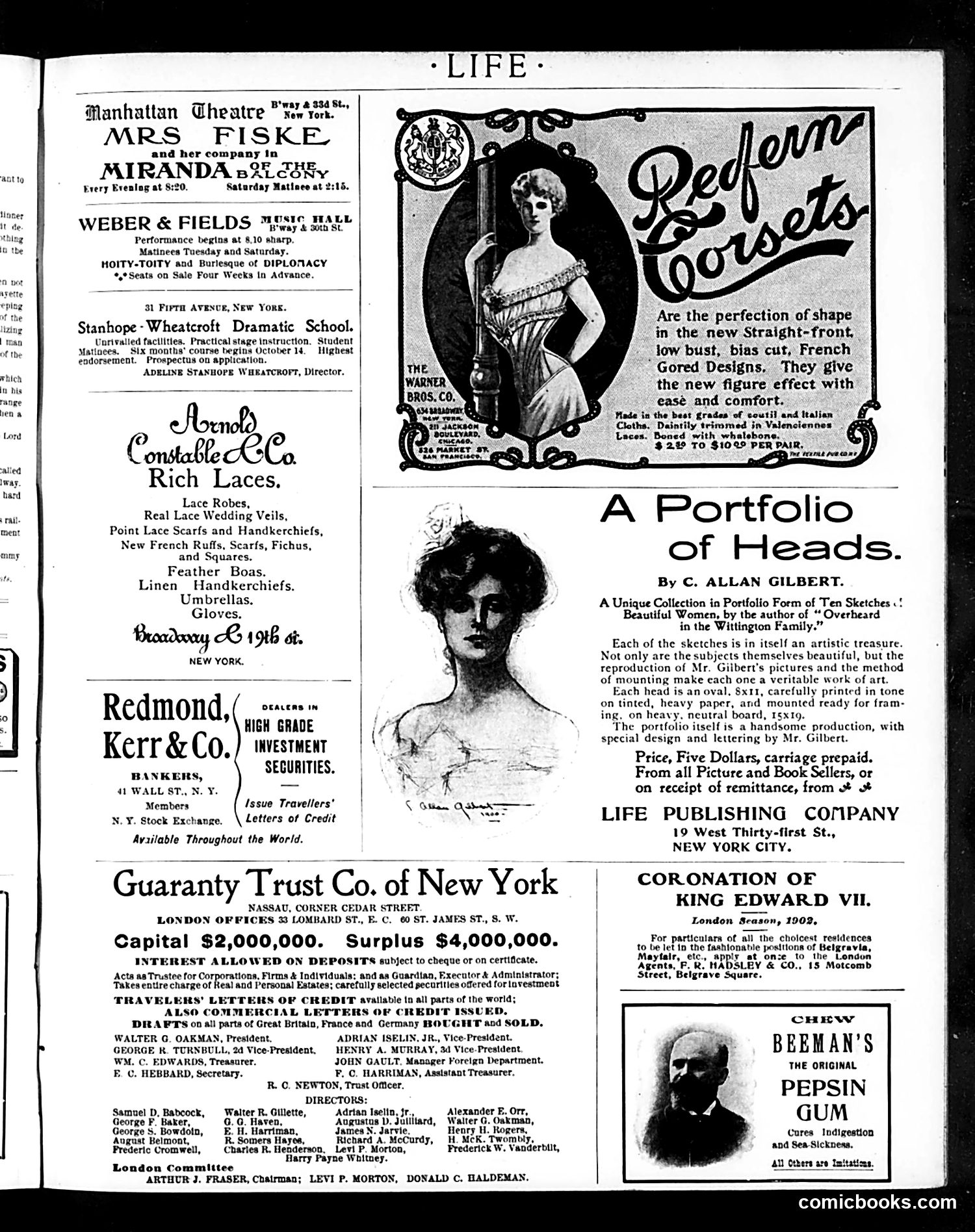
This page is **primarily advertisements** with one illustrated feature article. The main content is "A Portfolio of Heads" by C. Allan Gilbert—a collection of ten portrait sketches of beautiful women, marketed as fine art suitable for framing. Gilbert was known for illustrations and commercial art of the period. The cartoons/illustrations visible are: 1. **Upper right**: Advertisement for "Redfern Corsets," showing a stylized woman in classical dress. The joke/sales pitch is that these corsets achieve an "ideal" figure through French design and modern "Gored Designs." 2. **Lower center**: Illustration for "Beeman's Pepsin Gum," showing a man's face. This appears to be straightforward product advertising, not satire. The page reflects early 1900s consumer culture: corset advertising targeting women's body idealization, and patent medicine/gum marketing. The "Portfolio of Heads" positions women's beauty as purchasable fine art—a notably commodified approach to female portraiture.
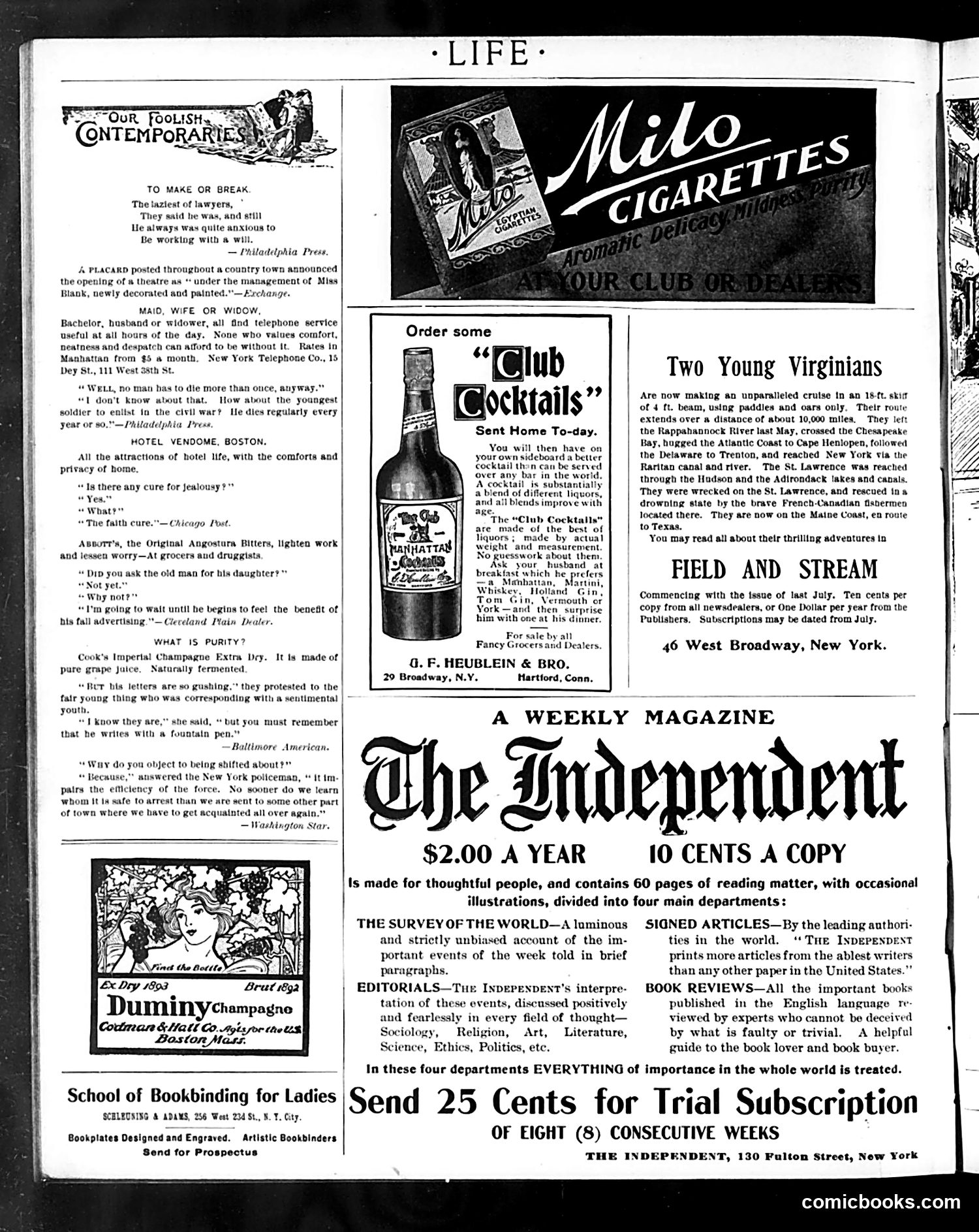
This page is primarily **advertising and promotional content** rather than political satire. The dominant feature is an ad for *The Independent* weekly magazine, positioned centrally and occupying substantial space. The upper left contains brief **humorous anecdotes** typical of Life's satirical format—short jokes about lawyers, theater management, telephone service, and jealousy. These are gentle social commentary rather than pointed political satire, poking fun at everyday situations and human foibles. Notable content includes an ad for "Club Cocktails" (pre-Prohibition liquor marketing) and a human-interest story about "Two Young Virginians" undertaking an 18-foot boat journey covering 10,000 miles—presented as thrilling adventure. The page reflects early 20th-century American consumer culture and leisure interests, with ads targeting middle-class readers (bookbinding classes, hotels, champagne). The *Independent* promotion emphasizes serious journalism and book reviews for "thoughtful people," positioning itself as intellectual-minded reading. **This is not primarily a satire or cartoon page**—it's a mixed advertising and editorial layout typical of period magazines.
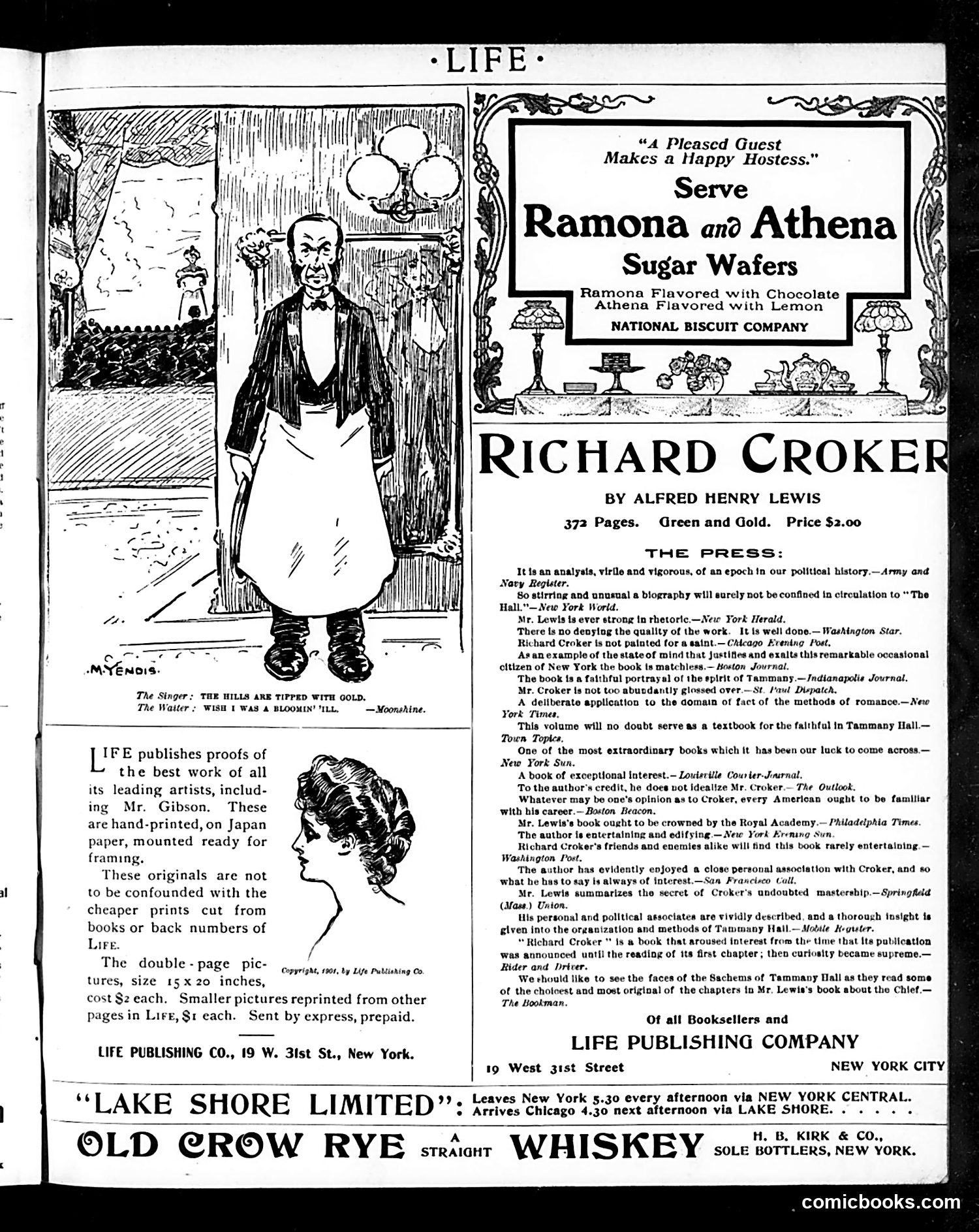
This page is primarily **advertising and book promotion** rather than political satire. The main content advertises Alfred Henry Lewis's biography "Richard Croker" (372 pages, $2.00). **The cartoon** (signed "Myendis") depicts a waiter and singer in what appears to be a class-commentary joke. The caption reads: "The Singer: THE WILLS ARE TIPPED WITH GOLD. The Waiter: WISH I WAS A BLOOMIN' ILL." This suggests social inequality—the wealthy ("tipped with gold") versus working-class servants wishing they were wealthy enough to be ill and avoid labor. **Richard Croker** was a notorious Tammany Hall political boss, and the book's numerous press quotes emphasize it as an unflinching, factual portrayal of corruption and political machinery in New York. The reviews suggest the book was controversial and widely discussed. The page also advertises sugar wafers and whiskey—typical early-1900s commercial fare mixed with literary content.
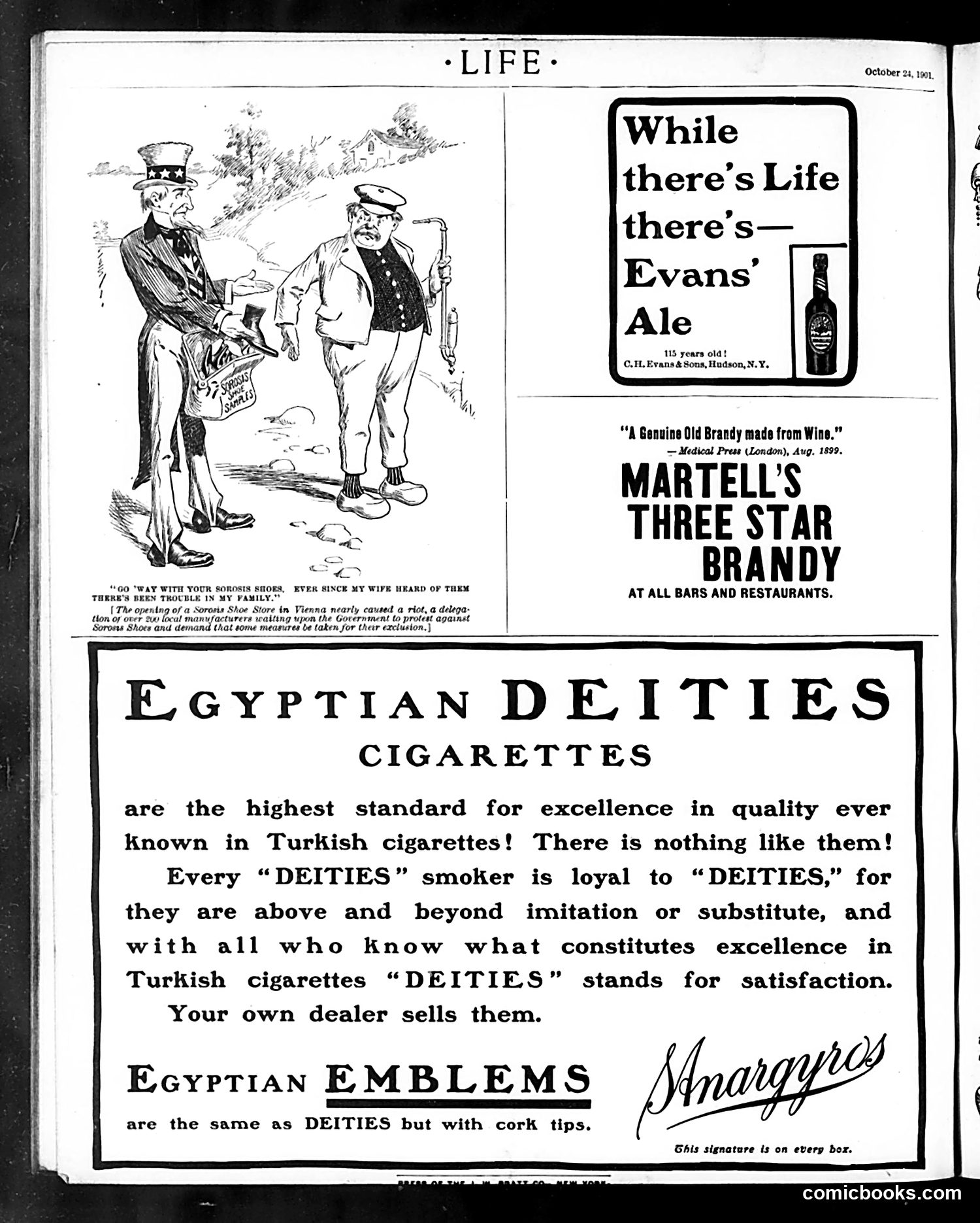
This page is primarily **advertising**, not political satire. The main cartoon depicts two working-class men—one in a top hat, one in casual dress—discussing trouble with their wives, likely referencing marital discord over some unspecified issue. The caption references "Sorosis Shoes in Flats," suggesting the cartoon advertises women's footwear. The page is dominated by three product advertisements: 1. **Evans' Ale** (115 years old) 2. **Martell's Three Star Brandy** (with a medical endorsement quote from 1899) 3. **Egyptian Deities Cigarettes** (a Turkish cigarette brand claiming superior quality) These ads reflect early 1900s consumer marketing—appeals to tradition, medical authority, and product loyalty. The cigarette advertisement particularly emphasizes exclusivity and loyalty among smokers, standard marketing rhetoric of the era before health warnings became required.