
Life, 1901-10-24 · page 12 of 20
Life — October 24, 1901 — page 12: what you’re looking at
What you’re looking at
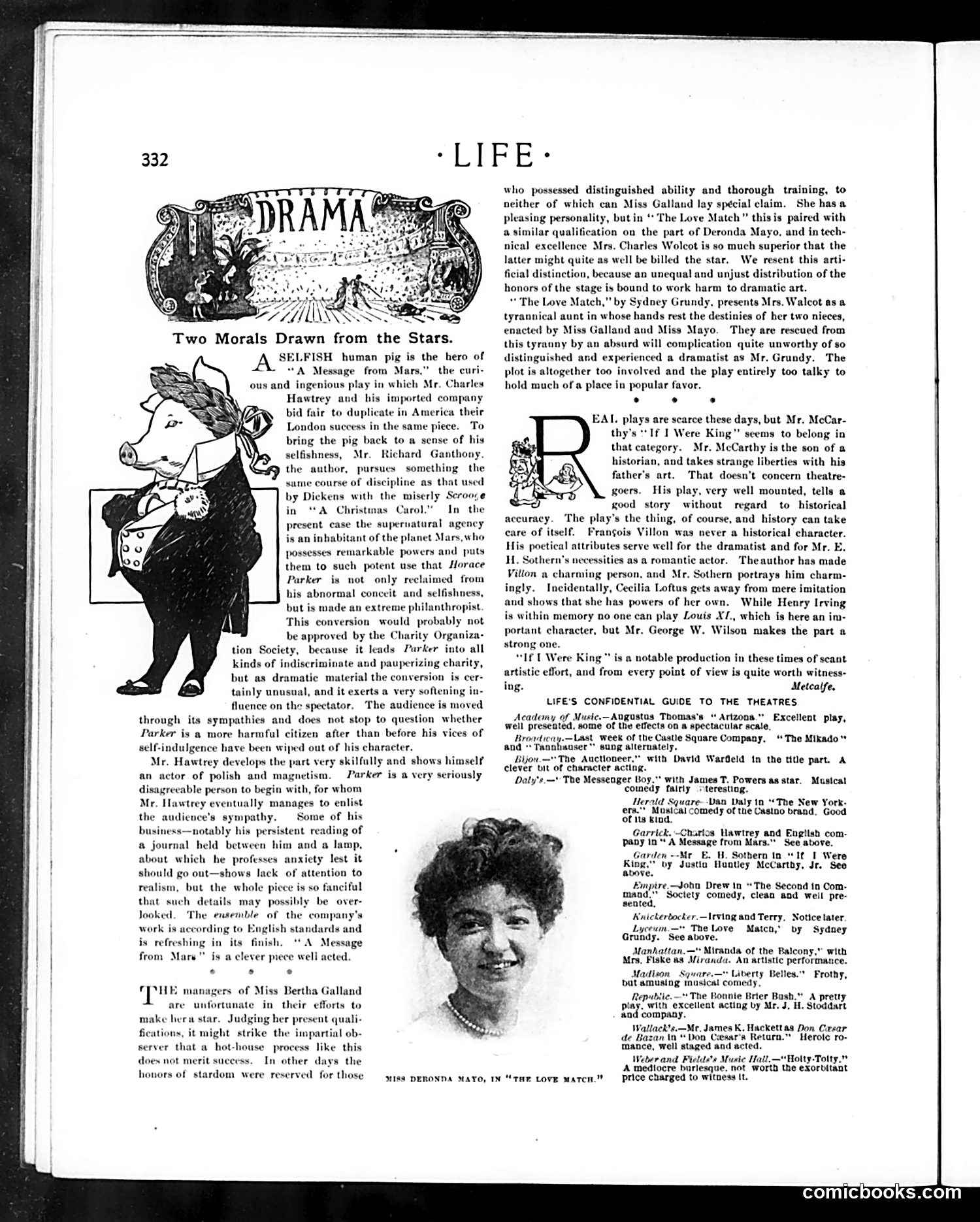
This page satirizes theatrical productions through two reviews. The main cartoon depicts a character from "A Message from Mars," a play about a visitor from the planet Mars who teaches earthly virtue through supernatural intervention. The satire critiques the play's moral instruction as heavy-handed and implausible. The reviewer notes that the conversion plot—where a selfish character learns charity—works through artificial dramatic contrivance rather than genuine character development. The cartoon's exaggerated figure embodies this theatrical artificiality. The accompanying reviews examine how historical accuracy and character authenticity matter less to contemporary audiences than popular entertainment. The critic argues that while such plays move audiences emotionally, they often sacrifice realism for sentimentality and dramatic effect.
📄 Transcribed text from this page (OCR, searchable)
Machine-transcribed from the original scan — historical spelling and the odd misread are preserved.
~ LEP * Two Morals Drawn from the Stars. A SELFISH human pig is the hero of “A Message from Mars,” the curi- ous and ingenious play in which Mr, Charles Hawtrey and his imported company bid fair to duplicate in America their London success in the same piece. To bring the pig back to a sense of his selfishness, Mr. Richard Ganthony. the author, omething the same course of discipline as that used by Dickens with the miserly Scroo, in ‘A Christinas Carol.” In the present case the supernatural agency is an inhabitant of the planet Mars, who pursues possesses remarkable powers and puts them to such potent use that Horace Parker is not only reclaimed from his abnormal conceit and selfishn but is made an extreme philanthropist This conv would probably not be approved by the Charity Organiza- tion Society, because it leads Parker into all kinds of indiscriminate and pauperizing charity, but as dramatic material the conversion is cer- tainly unusual, and it exerts a very softening in- fluence on the spectator, The audience is moved through its sympathies and does not stop to question whether Parker is a more harmful citizen after than before his vices of self-indulgence have been wiped out of his character, Mr. Hawtrey develops the part very skilfully and shows himself an actor of polish and mi Parker is a very seriously disagreeable person to begin with, for whom Mr. Hawtrey eventually manages to enlist the audience's sympathy. Some of his business—notably his persistent reading of a journal held between him and a lamp, about which he professes anxiety lest it should go out—shows lack of attention to realism, but the whole piece is so fanciful that such details may possibly be over- looked. ‘The ensemble of the company’s work is according to English standards and is refreshing in its finish. ‘A Message from Mars” is a clever piece well acted. ° ° ° gnetism. fPHE managers of Miss Bertha Galland are unfortunate in their efforts to make heea star, Judging her present quali- fications, it might strike the impartial ob- server that a hot-house process like this does not merit success. In other days the honors of stardom were reserved MISS DERONDA MAYO, IN “THE LovE MATCH.” who possessed distinguished ability and thorough training, to neither of which can Miss Galland lay spécial claim, She has a pleasing personality, but in “The Love Match” this is paired with milar qualification ou the part of Deronda Mayo, and in tech- nical excellence Mrs. Charles Wolcot is so much superior that the latter might quite as well be billed the star. We resent this arti- ficial distinction, because an unequal and unjust distribution of the honors of the stage is bound to work harm to dramatic art. “The Love Match,” by Sydney Grundy, presents Mrs. Walcot as a tyrannical aunt in whose hands rest the destinies of her two nieces, enacted by Miss Galland and Miss Mayo. They are rescued from this tyranny by an absurd will complication quite unworthy of so distinguished and experienced a dramatist as Mr. Grundy. The plot is altogether too involved and the play entirely too talky to hold much of a place in popular favor. . . ° EAL. plays are scarce these days, but Mr. McCar- thy's "If I Were King” seems to belong in that category. Mr. McCarthy is the son of a historian, and takes strange liberties with his father’s art. That doesn't concern theatre- goers. His play, very well mounted, tells a good story without regard to historical accuracy. The play's the thing, of course, and history can take care of itself. Frangois Villon was never a historical character. His poetical attributes serve well for the dramatist and for Mr. E. H. Sothern’s necessities as a romantic actor. Theauthor has made Villon a charming person, and Mr. Sothern portrays him charm- ingly. Incidentally, Cecilia Loftus gets away from mere imitation and shows that she has powers of her own. While Henry Irving is within memory no one can play Louis X/., which is here an im- portant character, but Mr. George W. Wilson makes the part a strong one. “Lf L Were King" is a notable production in these times of scant artistic effort, and from every point of view is quite worth witness- ing. Metcalfe, LIFE'S CONFIDENTIAL GUIDE TO THE THEATRES Acadeny of Music.— Augustus Thomas's “ Arizona." Excellent play, well presented, some of the effects on a spectacular scale, Broadicay.—Last week of the Castle Square Company, and * Tannhaoser” sung alternately. Bijou.—"The Auctioneer.” with David Wardeld tn the tile part. A clever bit of character acting. Daly's.—" The Messenger Boy."* with James T. Powers as star. comedy fairly teresting. Herald Square--Van Daly in “The New York- era Musical comedy of the Casino brand. Good of its kind, Garrick. -Charios Mawtrey and Engilsh com- pany In A Message from Mars." See above, _ Garden Me EB. W. Sothern in it 1 Were King,” by Justin Huntley McCartby, Jr. See above, Empire.—John Drew tn “The Second in Com- mand," Soctety comedy, clean and weil pre- sented, Kuictertocker.—Irving and Terry, Notice tater. Lyceum —" Tae Love Match,’ by Sydney Grundy. See above. Manhattan. —" Miranda of the Balcony,” with Mrs, Fiske as Miranda. An artistic performance. Madison Square.— Liberty Belles." Frothy, bat amusing musical comedy. Repubsic.— The Bonnie Brier Bash.” A pretty play, with excellent acting by Mr. J, H. Stoddart and company. Watlack"s.—Mr, James K. Hackett as Don Carsar de Bazan \n “Don Ceesat's Return.” Heroic ro- mance, well staged and acted. Weber and Fietds's Music Halt.—“Holty-Tolty.” A mediocre burlesque, not worth the exorbitant Price charged to witness tt. “The Mikado * Mustcat comicbooks.com