
Life, 1901-10-24 · page 14 of 20
Life — October 24, 1901 — page 14: what you’re looking at
What you’re looking at
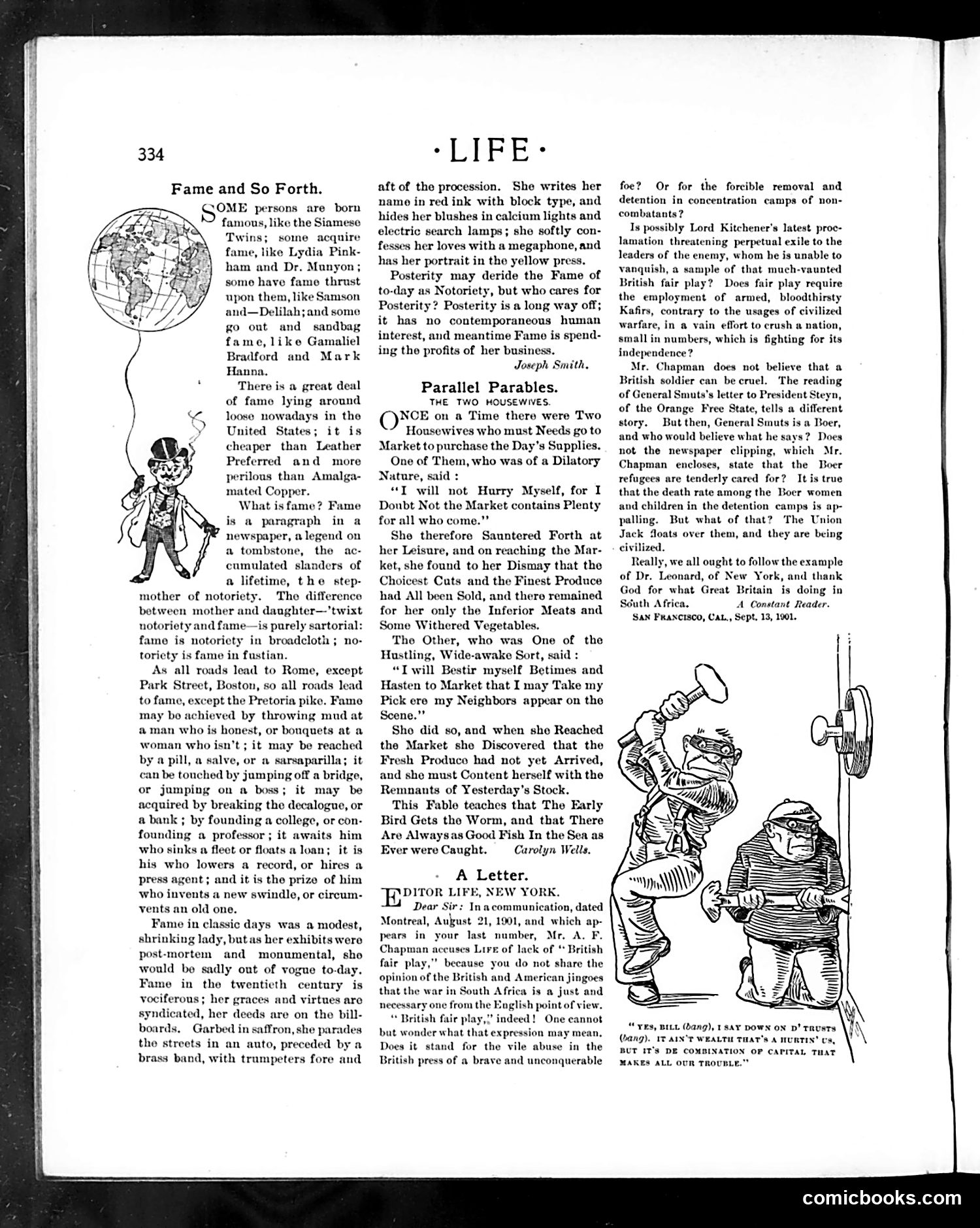
This page contains satirical essays and a fable mocking contemporary American culture. **"Fame and So Forth"** (Joseph Smith) ridicules how modern fame operates. It contrasts classical fame—modest and posthumous—with twentieth-century fame, which is vulgar, commercialized, and publicity-driven. The essay suggests fame can be achieved through scandal, deception, or simply hiring a "press agent." The globes and caricatured figures illustrate how fame is now manufactured and paraded publicly via automobiles and electric lights. **"Parallel Parables: The Two Housewives"** (Carolyn Wells) is ironic fable-within-fable humor: two housewives with opposite approaches both fail—the lazy one misses fresh goods; the eager one arrives too early. The moral's contradictions (early bird gets worm *and* there are always good fish) mock common wisdom's platitudes. **"A Letter"** begins a reader's complaint about *Life's* editorial stance on the Boer War, accusing the magazine of lacking "British fair play." This references contemporary debates about British imperialism in South Africa (1899-1902). The illustrations are generic Victorian-style comic figures, not specific caricatures of identifiable people.
📄 Transcribed text from this page (OCR, searchable)
Machine-transcribed from the original scan — historical spelling and the odd misread are preserved.
Fame and So Forth. GomME persons are born famous, like the Siamese Twins; some acquire fame, like Lydia Pink- ham and Dr. Manyon; some have fame thrust upon them, like Samson and—Delilah;and some go out and sandbag fame, like Gamaliel Bradford and Mark Hanna. There is a great deal of fame lying around loose nowadays in the United States; it is cheaper than Leather Preferred and more perilous than Amalga- mated Copper. What is fame? Fame is a paragraph in a newspaper, alegend on a tombstone, the ac- cumulated slanders of a lifetime, the step- mother of notoriety. The difference between mother and daughter—’twixt notoriety and fame—is purely sartorial: fame is notoriety in broadcloth ; no- toriety is fame in fustian. As all roads lead to Rome, except Park Street, Boston, so all roads lead to fame, except the Pretoria pike. Fame may bo achieved by throwing mud at a man who is honest, or bonquets at a woman who isn’t ; it may be reached by a pill, a salve, or a sarsaparilla; it can be touched by jumping off a bridge, or jumping on a boss; it may be acquired by breaking the decalogue, or a bank ; by founding a college, or con- founding a professor ; it awaits him who sinks a fleet or floats a loan; it is his who lowers a record, or hires a press agent; and it is the prize of him who invents a new swindle, or circum- vents an old one. Fame in classic days was a modest, shrinking lady, but as her exhibits were post-mortem and monumental, sho would be sadly out of vogue to-day. Fame in the twentieth century is vociferous ; her graces and virtues aro syndicated, her deeds are on the bill- boards, Garbed in saffron, she parades the streets in an auto, preceded b; brass band, with trumpeters fore ‘LIFE: aft of the procession. She writes her name in red ink with block type, and hides her blushes in calcium lights and electric search lamps; she softly con- fesses her loves with a megaphone, and has her portrait in the yellow press. Posterity may deride the Fame of to-day as Notoriety, but who cares for Posterity? Posterity is a long way off; it has no contemporaneous human interest, and meantime Fame is spend- ing the profits of her business. Joseph Smith, Parallel Parables. THE TWO HOUSEWIVES. O NCE on a Time there were Two Housewives who must Needs go to Market to purchase the Day's Supplies. One of Them, who was of a Dilatory Nature, said : “1 will not Hurry Myself, for I Doubt Not the Market contains Plenty for all who come.” She therefore Sauntered Forth at her Leisure, and on reaching the Mar- ket, she found to her Dismay that the Choicest Cuts and the Finest Produce had All been Sold, and there remained for her only the Inferior Meats and Some Withered Vegetables. Tho Other, who was One of the Hustling, Wide-awake Sort, said : “Iwill Bestir myself Betimes and Hasten to Market that I may Take my Pick ere my Neighbors appear on the Scene.”” Sho did so, and when she Reached the Market she Discovered that the Fresh Produco had not yet Arrived, and she must Content herself with the Remnants of Yesterday's Stock. This Fable teaches that The Early Bird Gets the Worm, and that There Are Alwaysas Good Fish In the Sea as Ever were Caught. Carolyn Wells. A Letter. DITOR LIFE, NEW YORK. Dear Sir: Inacommunication, dated Montreal, August 21, 1901, and which ap- pears in your last number, Mr. A. F. accuses Lire of lack of “ British because you do not share the opinion of the British and American jingoes that the war in South Africa is a just and necessary one from the English point of view. “ British fair play,” indeed! One eannot but wonder what that expression may mean, Does it stand for the vile abuse in the British press of a brave and unconquerable foe? Or for the forcible removal and detention in concentration camps of non- combatants? Is possibly Lord Kitchener's latest proc- lamation threatening perpetual exile to the leaders of the enemy, whom he is unable to vanquish, a sample of that much-vaunted British fair play? Does fair play require the employment of armed, bloodthirsty Kafirs, contrary to the usages of civilized warfare, in a vain effort to crush a nation, small in numbers, which is fighting for its independence? Mr. Chapman does not believe that a British soldier can be cruel. The reading of General Smuts’s letter to President ‘yn, of the Orange Free State, tells a different story. But then, General Smuts is a Boer, and who would believe what he says? Does not the newspaper clipping, which Mr. Chapman encloses, state that the Boer refugees are tenderly cared for? It is true that the death rate among the Boer women and children in the detention eamps is ap- palling. But what of that?) The Union Jack floats over them, and they are being civilized. Really, we all ought to follow the example of Dr. Leonard, of New York, and thank God for what Great Britain is doing in Sduth Africa, A Constant Reader. SAN PRANCISCO, CaL., Sept, 13, 1901, “ yes, BILL (bang), 1 SAY DOWN ON D! TRUSTS (ang). VT AIN'T WEALTH THAT'S A URTIN’ U8, comicbooks.com