
Life, 1901-10-24 · page 8 of 20
Life — October 24, 1901 — page 8: what you’re looking at
What you’re looking at
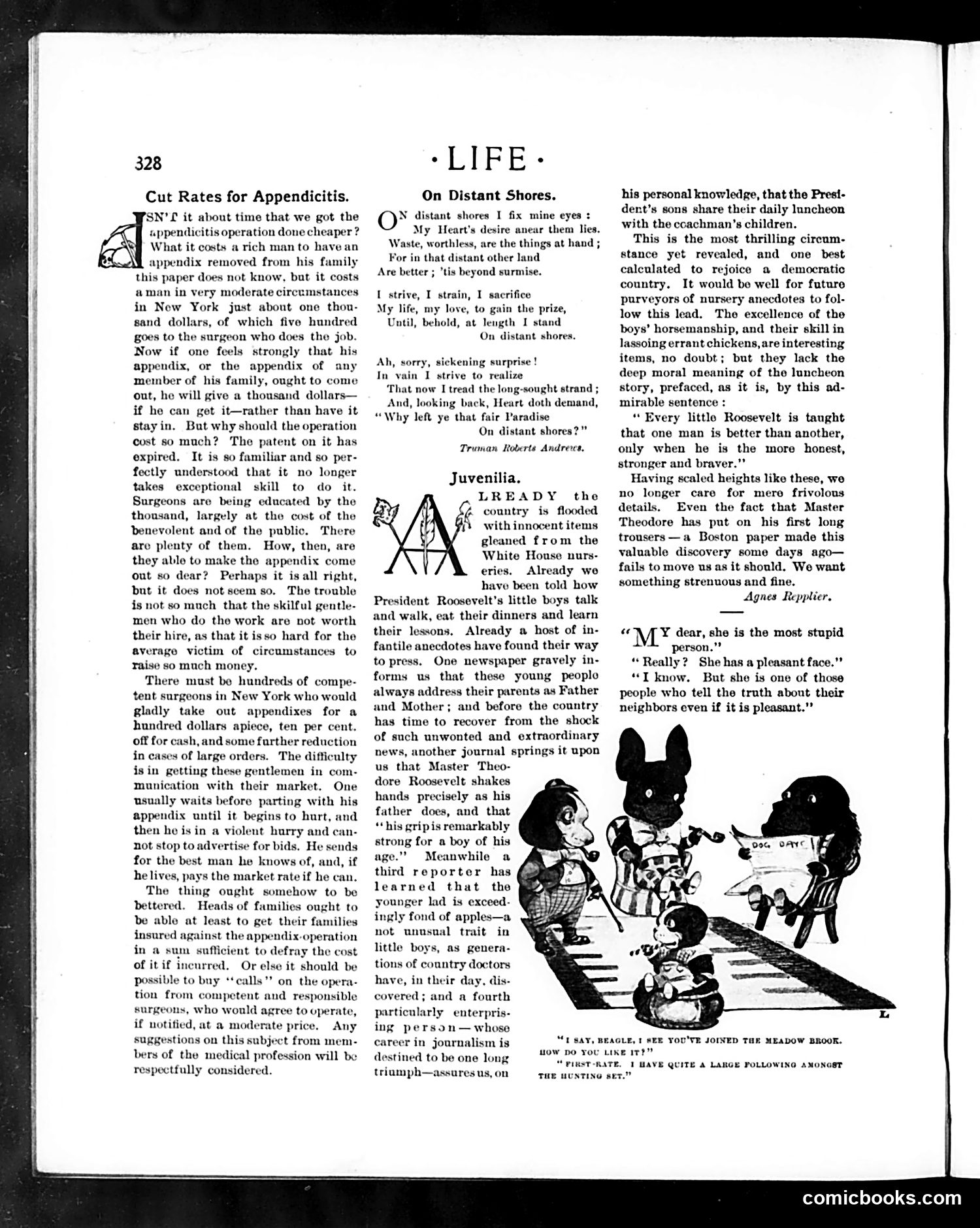
This page contains three distinct pieces. The "Cut Rates for Appendicitis" article satirizes surgeons' competitive bidding for appendectomy patients in New York, mocking how they advertise prices and compete for business like any tradesman—a critique of commercializing medicine. "On Distant Shores" is a poem about sacrifice and longing, likely referencing wartime separation (based on references to "fair Paradise" and sacrifice of "life" and "love"). The cartoon below depicts young children (appearing to be President Roosevelt's sons, based on the "Juvenilia" section discussing Roosevelt's boys) playing at hunting. One child addresses another as "Beagle," discussing joining the "Meadow Brook hunt" with "quite a large following afoot"—satirizing how children imitate and parody adult aristocratic hunting culture and pretensions.
📄 Transcribed text from this page (OCR, searchable)
Machine-transcribed from the original scan — historical spelling and the odd misread are preserved.
328 Cut Rates for Appendicitis. 'SN’L it about time that we got the appendicitis operation done cheaper ? What it costs a rich man to havean appendix removed from his family this paper does not know, but it costs aman in very moderate circumstances in New York just about one thou- sand dollars, of which five hundred goes to the surgeon who does the job. Now if one feels strongly that his appendix, or the appendix of any member of his family, ought to come out, he will give a thousand dollars— if he can get it—rather than have it stay in. But why should the operation cost so much? The patent on it has expired. It is so familiar and so per- fectly understood that it no longer takes exceptional skill to do it. Surgeons are being educated by the thousand, largely at the cost of the benevolent and of the public. There are plenty of them. How, then, are they able to make the appendix come Perhaps it is all right, out so dear? but it does not seem so. The trouble is not so much that the skilful gentle- men who do the work are not worth their hire, as that it isso hard for the average victim of circumstances to raise so much money. There must be hundreds of compe- tent surgeons in New York who would gladly take out appendixes for a hundred dollars apiece, ten per cent. off for cash, and some farther reduction in cases of large orders. ‘The difficulty isin getting these gentlemen in com- munication with their market. One usually waits before parting with his appendix until it begins to hurt, and then he is in a violent hurry and can- not stop to advertise for bids. He sends for the best man he knows of, and, if he lives, pays the market rate if he can. The thing ought somehow to be bettered. Heads of families ought to be able at least to get their families insured against the appendix-operation in a sum sufficient to defray the cost of it if incurred. Or else it should be possible to buy ‘calls’? on the opera- tion from competent and responsible surgeons, who would agree to operate, if notified, at a moderate price. Any suggestions on this subject from mem- Ders of the medical profession will be respectfully considered. -LIFE- On Distant Shores. N distant shores I fix mine eyes : My Heart's desire anear them lies. Waste, worthless, are the things at hand ; For in that distant other land Are better ; ’tis beyond surmise. I strive, I strain, I sacrifice My life, my love, to the prize, Until, behold, at length I stand On distant shores. Ah, sorry, sickening surprise ! In vain I strive to realize That now I tread the long-sought strand ; And, looking back, Heart doth demand, “Why left ye that fair Paradise On distant shores?” Truman Roberts Andrews. Juvenilia. LREADY the « country is flooded {+ with innocent items gleaned from the White House nurs- eries. Already we have been told how President Roosevelt's little boys talk and walk, eat their dinners and learn their lessons. Already a host of in- fantile anecdotes have found their way to press. One newspaper gravely in- forms us that these young peoplo always address their parents as Father and Mother; and before the country has time to recover from the shock of such unwonted and extraordinary news, another journal springs it upon us that Master Theo- dore Roosevelt shakes hands precisely as his father does, and that “his gripis remarkably strong for a boy of his age.’ Meanwhile a third reporter has learned that the younger lad is exceed- ingly fond of apples—a not unusual trait in little boys, as genera- tions of country doctors have, in their day, dis- covered; and a fourth particularly enterpris- ing person— whose career in journalism is destined to be one long triumph—assures us, on his personal knowledge, that the Presi- dent’s sons share their daily luncheon with the coachman’s children. This is the most thrilling circam- stance yet revealed, and one best calculated to rejoice a democratic country, It would be well for future purveyors of nursery anecdotes to fol- low this lead, Tho excellence of the boys’ horsemanship, and their skill in lassoing errant chickens, are interesting items, no doubt; but they lack the deep moral meaning of the luncheon story, prefaced, as it is, by this ad- mirable sentence : “Every little Roosevelt is taught that one man is better than another, only when he is the more honest, stronger and braver.” Having scaled heights like these, we no longer care for mere frivolous details. Even the fact that Master Theodore has put on his first long trousers —a Boston paper made this valuable discovery some days ago— fails to move us as it should. We want something strenuous and fine. Agnes Repplier. “ Y dear, she is the most stupid Mr eae “Really? She has a pleasant face.”” “TI know. But she is one of those people who tell the truth about their neighbors even if it is pleasant.” GLE, 1 SEE YOU'VE JOINED THE MEADOW BROOK. wow po You Like Itt” PLuST-RATE, THE UUNTING SET.” 1 WAVE QUITE A LARGE FOLLOWING AMONGST comicbooks.com