
Life, 1901-10-24 · page 4 of 20
Life — October 24, 1901 — page 4: what you’re looking at
What you’re looking at
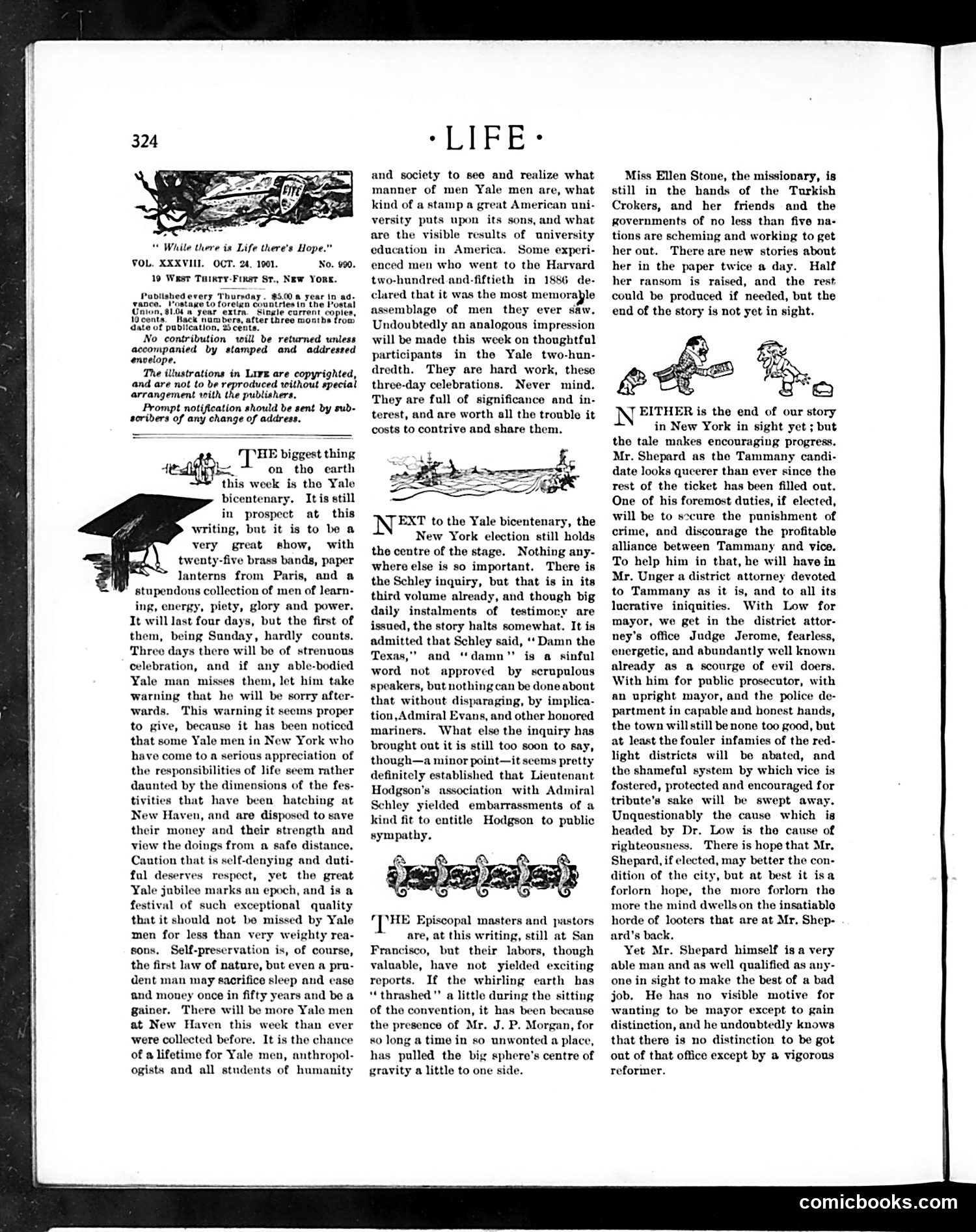
This page contains editorial commentary rather than political cartoons. The main illustrations are decorative headers featuring Yale University imagery (mortarboard, books). The text discusses Yale's bicentennial celebration happening that week in New Haven—a major event the author notes will draw unprecedented attendance from Yale alumni and supporters. The piece also addresses the upcoming New York mayoral election, endorsing a candidate (Shepard) as a reform-minded alternative to Tammany Hall, the notoriously corrupt Democratic political machine controlling city politics. The Schley naval inquiry mentioned refers to an ongoing controversy over Admiral Schley's role in the Spanish-American War. The editorial advocates for anti-corruption municipal governance and criticizes Tammany's entrenched power.
📄 Transcribed text from this page (OCR, searchable)
Machine-transcribed from the original scan — historical spelling and the odd misread are preserved.
“ While there is Life there's Hope.” VOL. XXXVIII. OCT. 24, 1901. No. 990. 19 Wrst Taixty-Finst St., New Yors. edevery Thursday. $5.00 a year in ad. stage to foreign countries in the Postal $104.4 year extra, Single current copies, 19 cents. Back nambers, after three months trow Gate vf publication, scents, No contribution will be returned unt accompanied by stamped and addressed envelope. The illustrations in Live are copyrighted, and are not to de reproduced without special arrangement with the publishers. Prompt notification should be sent by sud- soribers of any change of address. (DHE biggest thing _: on tho earth this week is the Yale bicentenary. It is still in prospect at this writing, but it is to be a very great show, with twenty-five brass bands, paper lanterns from Paris, and a ’ stupendons collection of men of learn- ing, energy, piety, glory and power. It will last four days, but the first of them, being Sunday, hardly counts. Three days there will be of strenuous celebration, and if any able-bodied Yale man misses them, let him take warning that he will be sorry after- wards. This warning it seems proper to give, because it has been noticed that some Yale men in New York who have come to a serious appreciation of the responsibilities of life seem rather daunted by the dimensions of the fes- tivities that have been hatching at New Haven, and are disposed to save their money and their strength and view the doings from a safe distance. Caution that is self-denying and dati- ful deserves respect, yet the great Yale jubilee marks an epoch, and is a festival of such exceptional quality that it should not be missed by Yale men for less than very weighty rea- sons. Self-preservation is, of course, the first law of nature, but even a pru- dent man may sacrifice sleep and ease and money once in fifty years and be a gainer. There will be more Yale men at New Haven this week than e were collected before. It is the chance of a lifetime for Yale men, anthropol- ogists and all students of humanity LIFE and society to see and realize what manner of men Yale men are, what kind of a stamp a great American uni- versity puts upon its sons, and what are the visible results of university education in America. Some experi- enced men who went to the Harvard two-hundred and-fiftieth in 1886 de- clared that it was the most memorable assemblage of men they ever saw. Undoubtedly an analogous impression will be made this week on thoughtful participants in the Yale two-hun- dredth. They are hard work, these three-day celebrations. Never mind. They are full of significance and in- terest, and are worth all the trouble it costs to contrive and share them. EXT to the Yale bicentenary, the New York election still holds the centre of the stage. Nothing any- where else is so important. There is the Schley inquiry, but that is in its third volume already, and though big daily instalments of testimory are issued, the story halts somewhat. It is admitted that Schley said, ‘‘ Damn the Texas,” and ‘damn’ is a sinful word not approved by scrupulous speakers, but nothing can be done about that without disparaging, by implica- tion,Admiral Evans, and other honored mariners. What else the inquiry has brought ont it is still too soon to say, though—a minor point—it seems pretty definitely established that Lieutenant Hodgson’s association with Admiral Schley yielded embarrassments of a kind fit to entitle Hodgson to public sympathy, T HE Episcopal masters and pastors are, at this writing, still at San Francisco, but their labors, though valuable, have not yielded exciting reports. If the whirling earth has ‘thrashed’ a little during the sitting of the convention, it has been because the presence of Mr. J. P. Morgan, for so long a time in so unwonted a place, has pulled the big sphere’s centre of gravity a little to one side. Miss Ellen Stone, the missionary, is still in the hands of the Turkish Crokers, and her friends and the governments of no less than five na- tions are scheming and working to get her out. There are new stories about her in the paper twice a day. Half her ransom is raised, and the rest could be produced if needed, but the end of the story is not yet in sight. ete %.. N EITHER is the end of our story in New York in sight yet ; but the tale makes encouraging progress. Mr. Shepard as the Tammany candi- date looks queerer than ever since the rest of the ticket has been filled out. One of his foremost duties, if elected, will be to sccure the punishment of crime, and discourage the profitable alliance between Tammany and vice. To help him in that, he will have in Mr. Unger a district attorney devoted to Tammany as it is, and to all its lucrative iniquities. With Low for mayor, we get in the district attor- ney's office Judge Jerome, fearless, energetic, and abundantly well known already as a scourge of evil doers. With him for public prosecutor, with an upright mayor, and the police de- partment in capable and honest hands, the town will still be none too good, but at least the fouler infamies of the red- light districts will be abated, and the shamefal system by which vice is fostered, protected and encouraged for tribute’s sake will be swept away. Unquestionably the cause which is headed by Dr. Low is the cause of righteousness. There is hope that Mr. Shepard, if elected, may better the con- dition of the city, but at best it isa forlorn hope, the more forlorn the more the mind dwells on the insatiablo horde of looters that are at Mr, Shep- ard's back, Yet Mr. Shepard himself isa very able man and as well qualified as any- one in sight to make the best of a bad job. He has no visible motive for wanting to be mayor except to gain distinction, and he undoubtedly knows that there is no distinction to be got out of that office except by a vigorous reformer. comicbooks.com