
A complete issue · 20 pages · 1901
Life — September 12, 1901
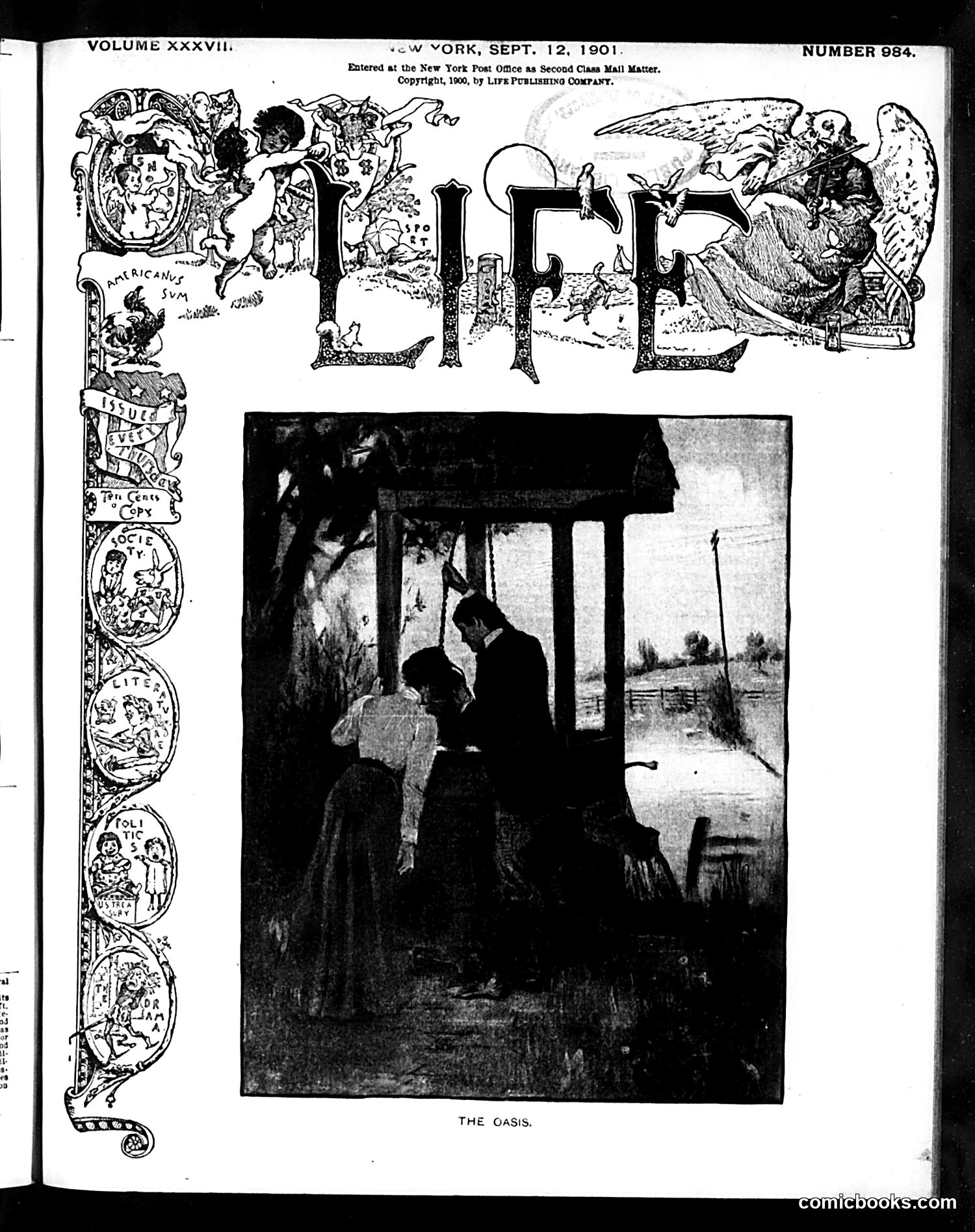
This page features decorative masthead artwork typical of Life magazine's satirical style, with classical and allegorical figures surrounding the title "LIFE." The main photograph below, captioned "THE OASIS," shows two figures in dark clothing sheltering under a wooden structure with a view of water or landscape beyond. The image appears to be a dramatic or narrative photograph rather than a political cartoon. Without additional context or visible text identifying the specific subjects, I cannot definitively explain what social or political commentary this photograph was meant to convey. The title "The Oasis" suggests themes of refuge or respite, but the exact satirical point remains unclear from the image alone.
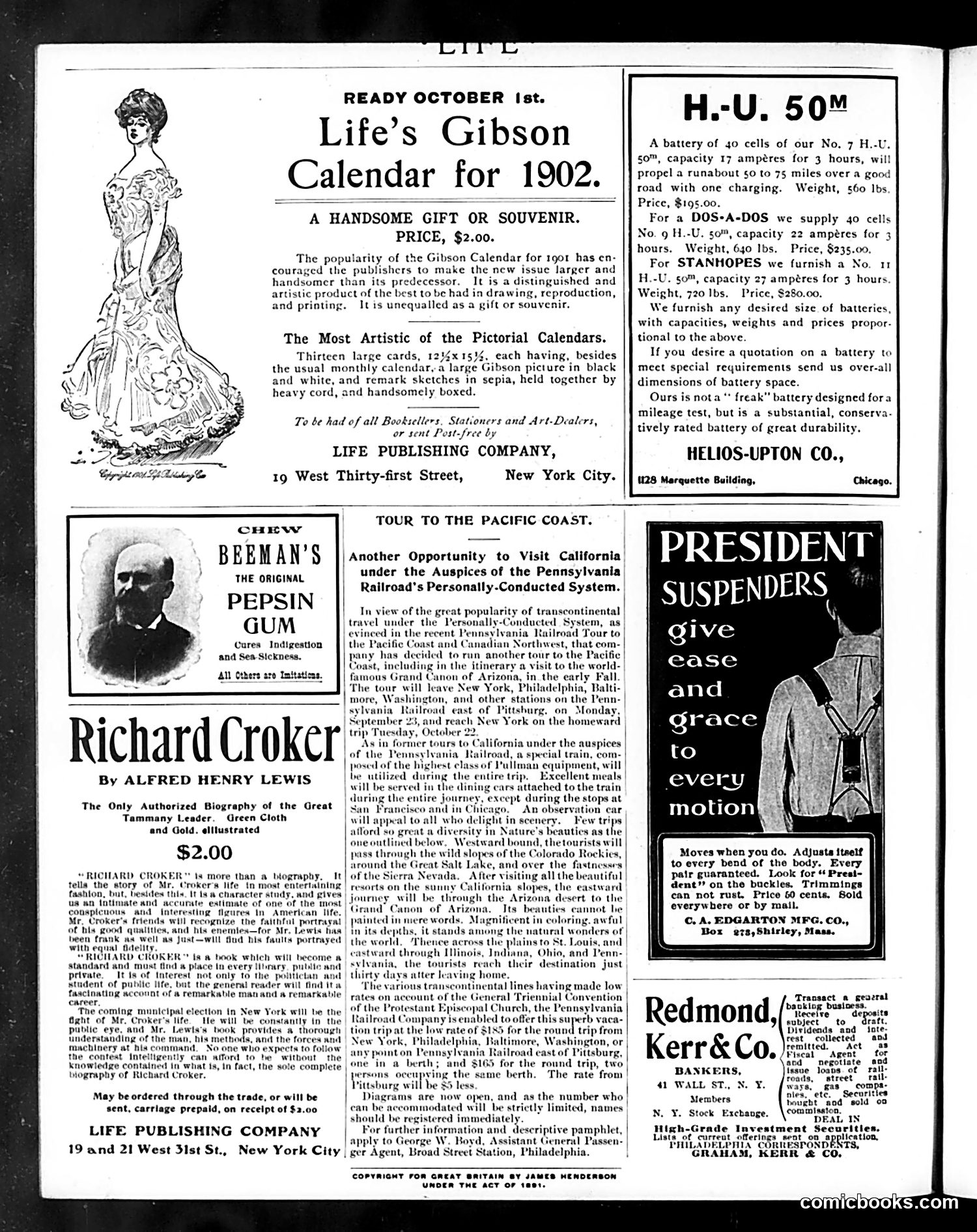
This page is **primarily advertising** with minimal satirical content. The advertisements include: - **Life's Gibson Calendar for 1902**: A fashionable female figure in Charles Dana Gibson's distinctive illustration style—the "Gibson Girl" was a popular cultural ideal of feminine beauty at the time. - **Beeman's Pepsin Gum**: Features a bearded man promoting digestive benefits. - **Richard Crocker biography**: Advertises a book about the "Tammany Leader," referencing New York City's Democratic political machine and its controversial boss. - **President Suspenders**: A product advertisement using minimal imagery. - **Redmond, Kerr & Co.**: A banking/investment firm ad. The page reflects early 1900s consumer culture and advertising practices rather than containing pointed political satire. The Richard Crocker reference is the only item with clear political significance, acknowledging Tammany Hall's notorious reputation.
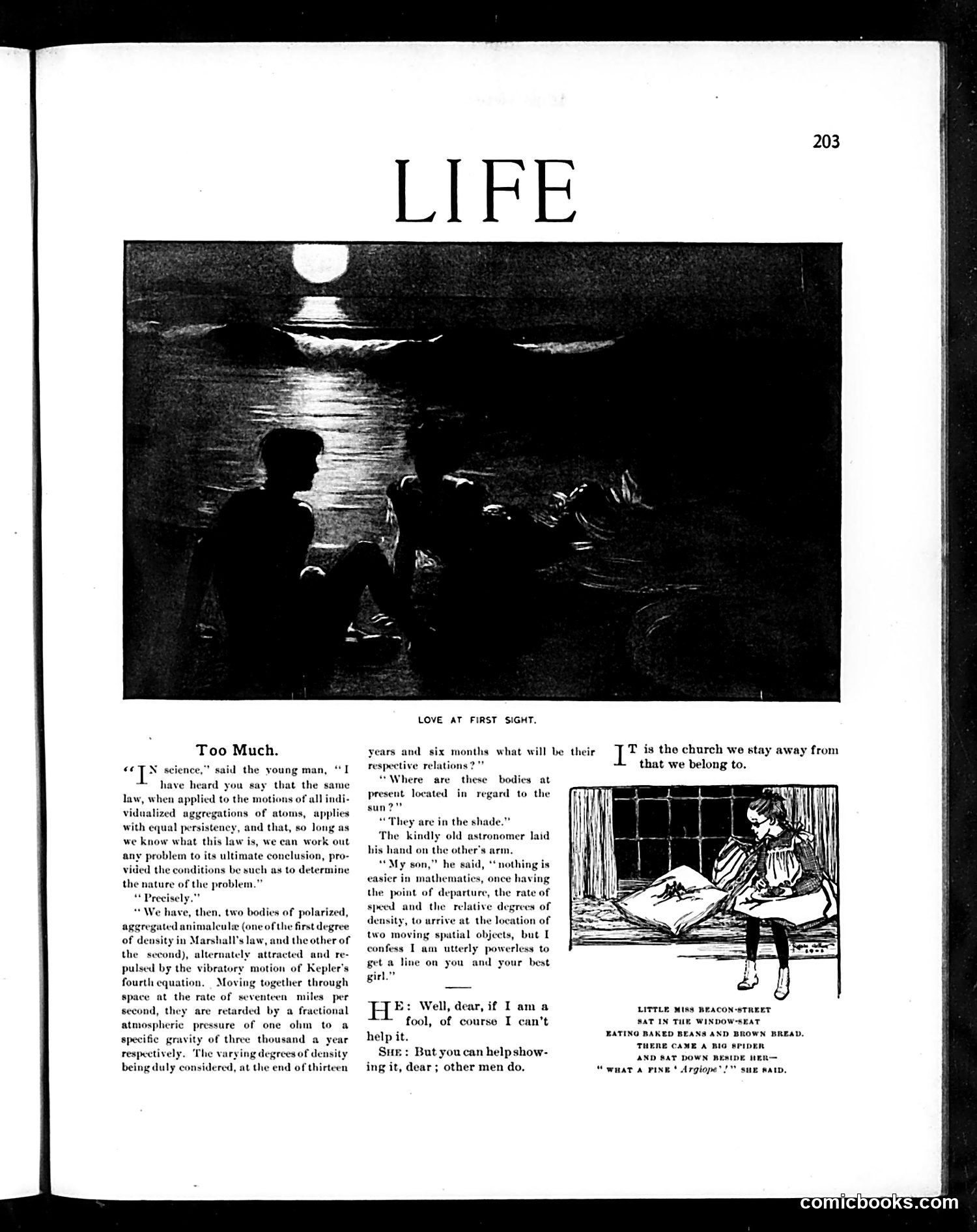
This page contains two distinct pieces: **"Love at First Sight"** (top image): A romantic nighttime scene showing silhouetted figures by moonlit water, illustrating a romantic encounter. **"Too Much"** (bottom left): A dialogue between a young man and woman discussing scientific principles. The man lectures about polarized atoms and gravitational physics, applying these concepts to romantic attraction. The woman interrupts with practical frustration, noting that while his scientific explanation may be correct, other men manage to express affection without such pedantic complexity. **"Little Miss Beacon Street"** (bottom right): A brief illustrated vignette about a girl encountering a spider—presented as charming domestic humor. The satire targets intellectual pretension: the young man's excessive scientific jargon masks his inability to simply express romantic feelings, mocking overly analytical approaches to human emotion.
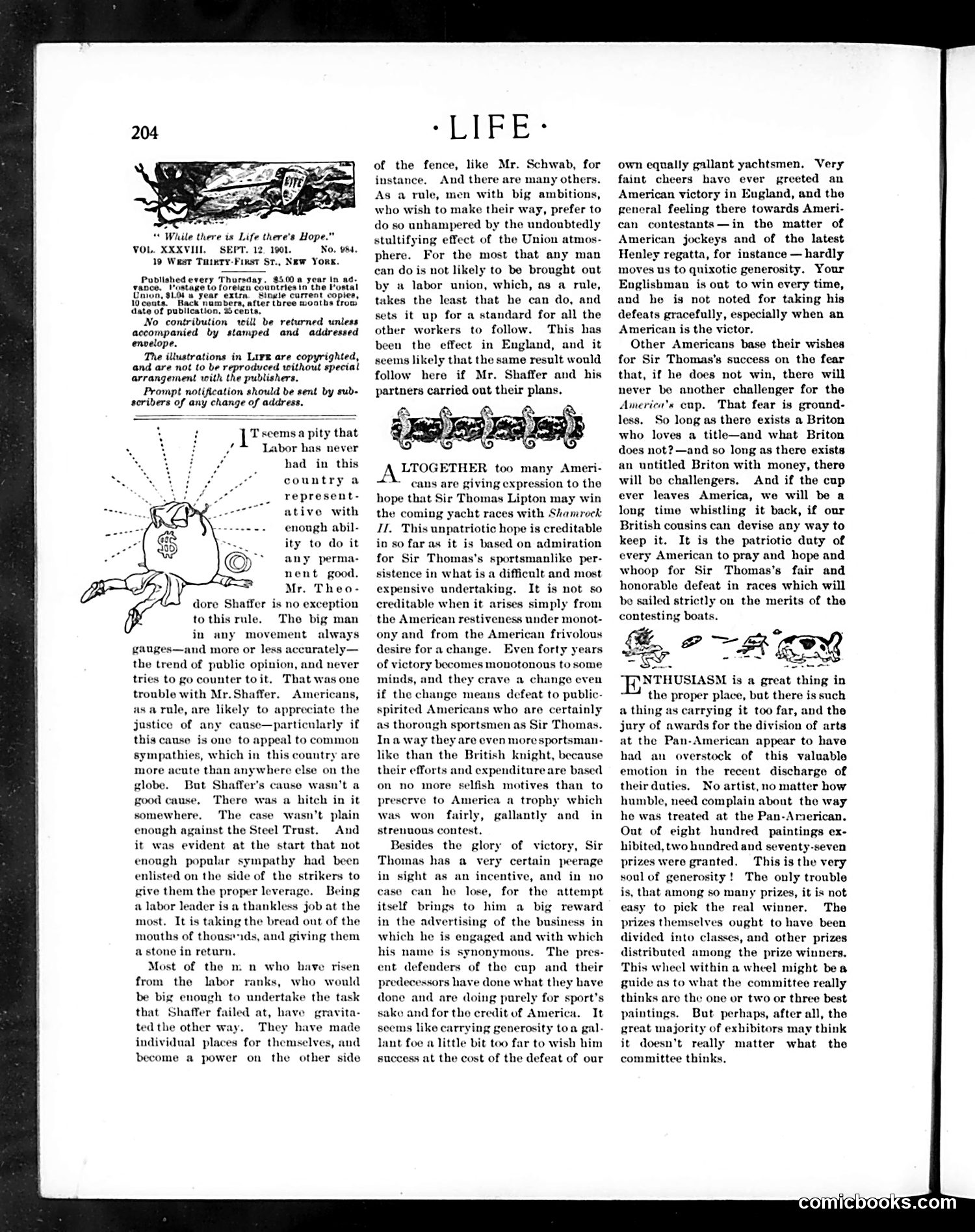
The left side features a cartoon labeled "While there is Life there's Hope," depicting a figure labeled "Theodore" (likely Theodore Roosevelt) as a pugilistic character with boxing gloves, energetically jabbing or fighting. The illustration satirizes Roosevelt as a combative personality—a "big man in any movement" always gauging trends and pushing opinions, per the accompanying text. The article criticizes labor unions for setting rigid standards that stifle individual achievement, arguing that ambitious men like Roosevelt prefer operating without such constraints. The satire suggests Roosevelt's aggressive, uncompromising approach to business competition mirrors labor's inflexibility—both represent obstacles to progress. The page critiques both organized labor AND aggressive capitalists, positioning each as threats to American opportunity.
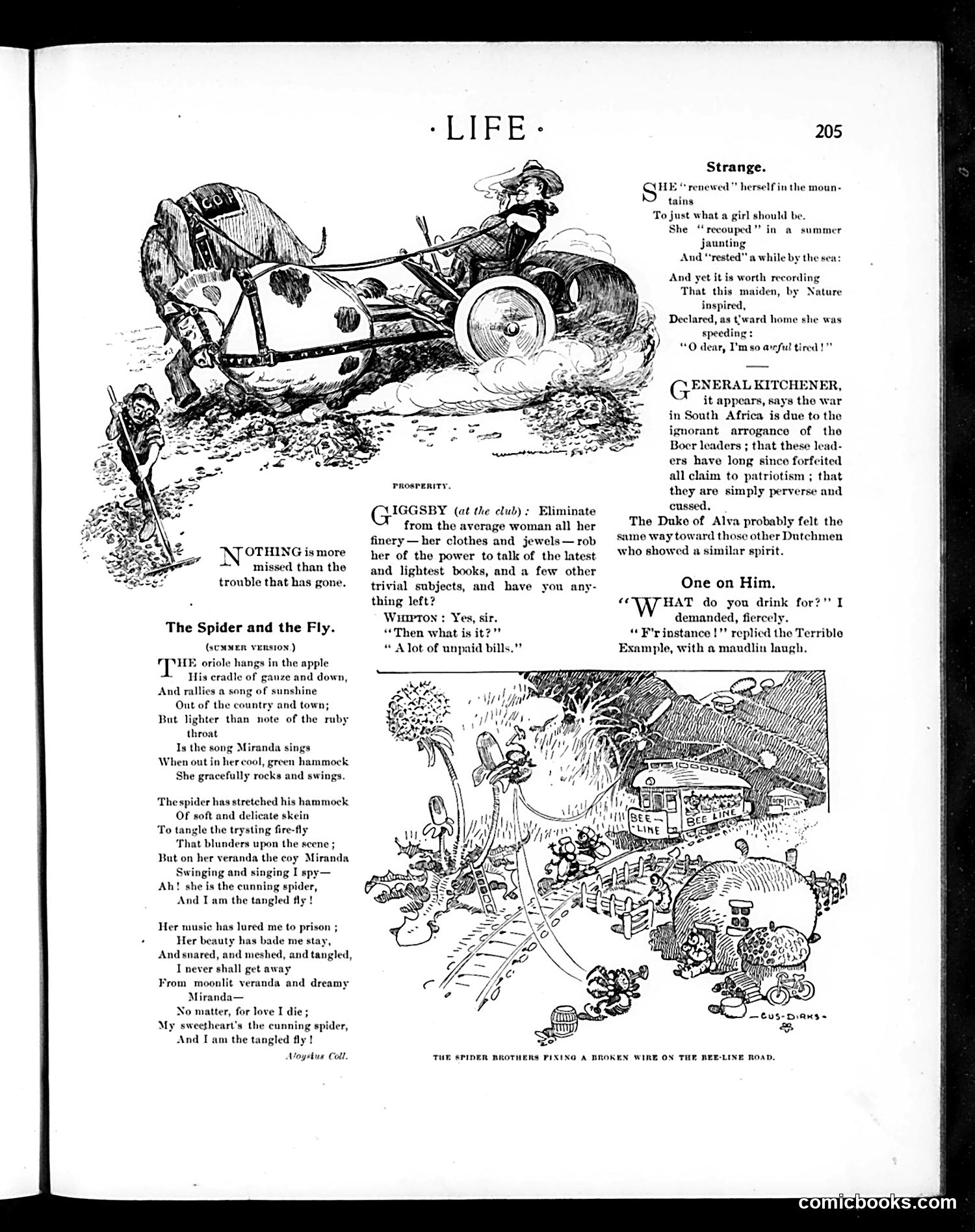
This page contains literary content and illustrations rather than political satire. The main features are: 1. **"The Spider and the Fly"** — A poem (Summer version) by Rupert Brooke, accompanied by an illustration of a spider and fly in nature. 2. **"Prosperity"** — A humorous dialogue between Giggsby and Wimpson about a woman's financial troubles, depicted through a sketch of a woman in a cart pulled by a horse. 3. **"One on Him"** — A brief joke about what someone drinks. 4. **Bottom illustration** — Shows "Spider Brothers Fixing a Broken Wire on the Bee-Line Road," a whimsical scene combining insects and rural infrastructure. The page is primarily literary/humorous rather than political commentary.
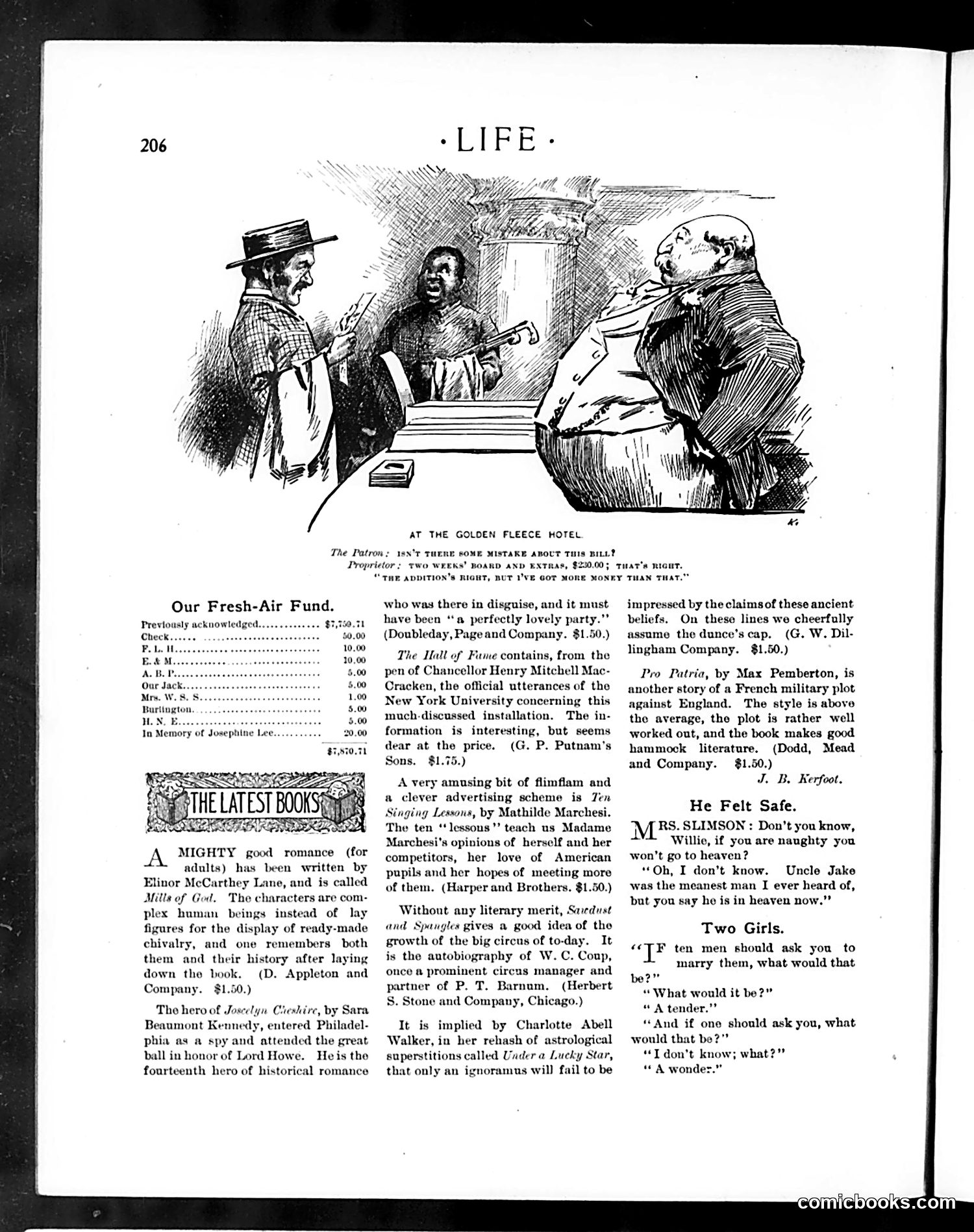
This cartoon satirizes a hotel billing dispute. A patron (left, in hat) confronts the proprietor (center, behind counter) about an inflated bill, while another guest (right) listens. The patron claims a $20 charge for "two weeks' board and extras" is excessive, protesting "the addition's right, but I've got more money than that." The satire targets exploitative innkeeping practices—the "Golden Fleece" name itself suggests fleecing (defrauding) guests. The humor lies in the patron's absurd defense: he's not disputing the math, only claiming he shouldn't have to pay everything he's worth. This mocks both dishonest hoteliers and wealthy travelers' entitlement.
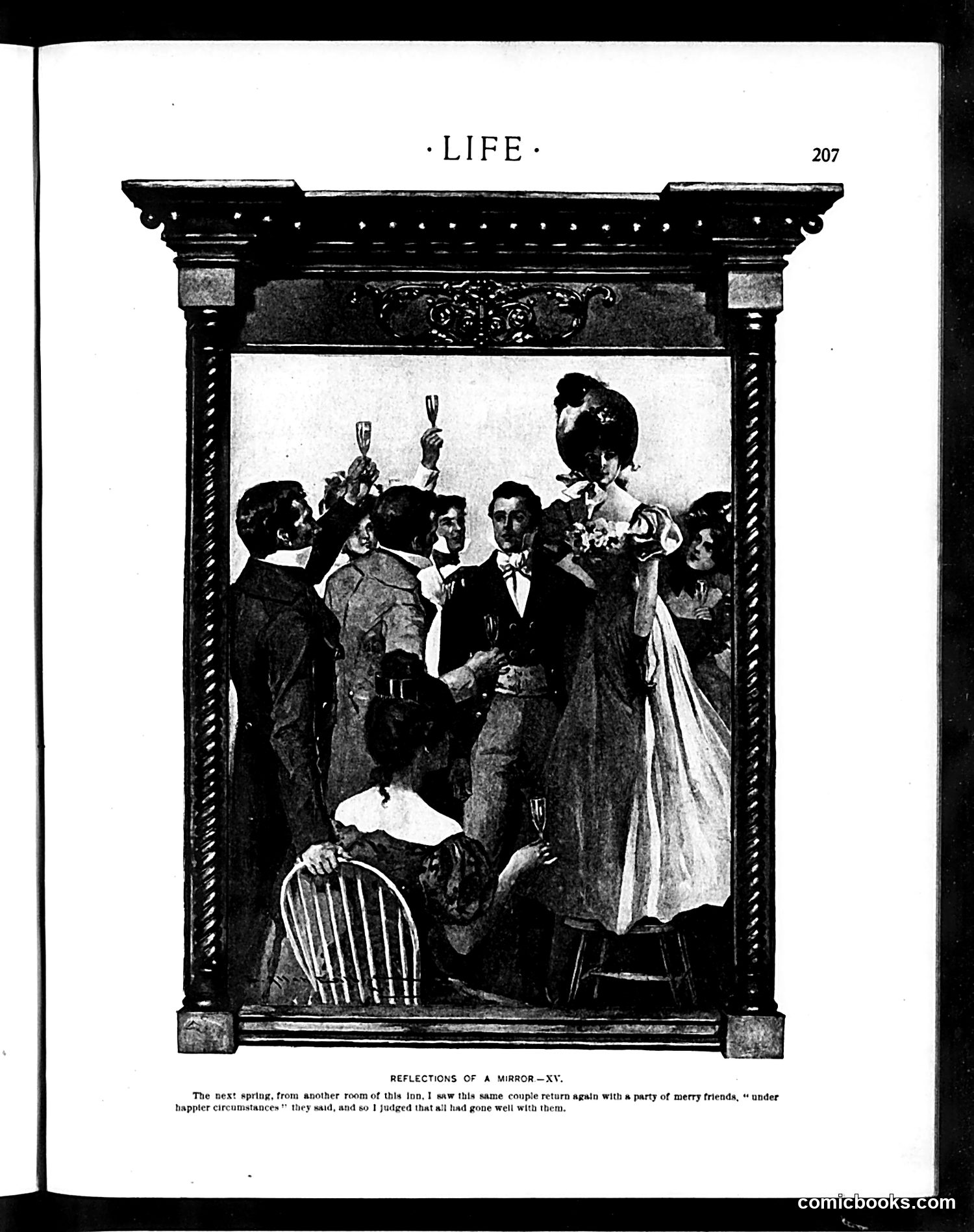
This illustration depicts a social scene at an inn, showing a well-dressed couple returning with a group of "merry friends" under "happier circumstances" than their previous visit. The caption suggests the couple had experienced misfortune on an earlier occasion ("all had gone well with them"). The framed scene uses the "mirror reflection" conceit to comment on social fortune and change. The formal dress, crowded gathering, and celebratory atmosphere contrast with an implied previous hardship. This appears to be social satire about how people's circumstances fluctuate and how their social reception changes accordingly—friends reappear when prosperity returns. The specific identities of the figures remain unclear without additional historical context.
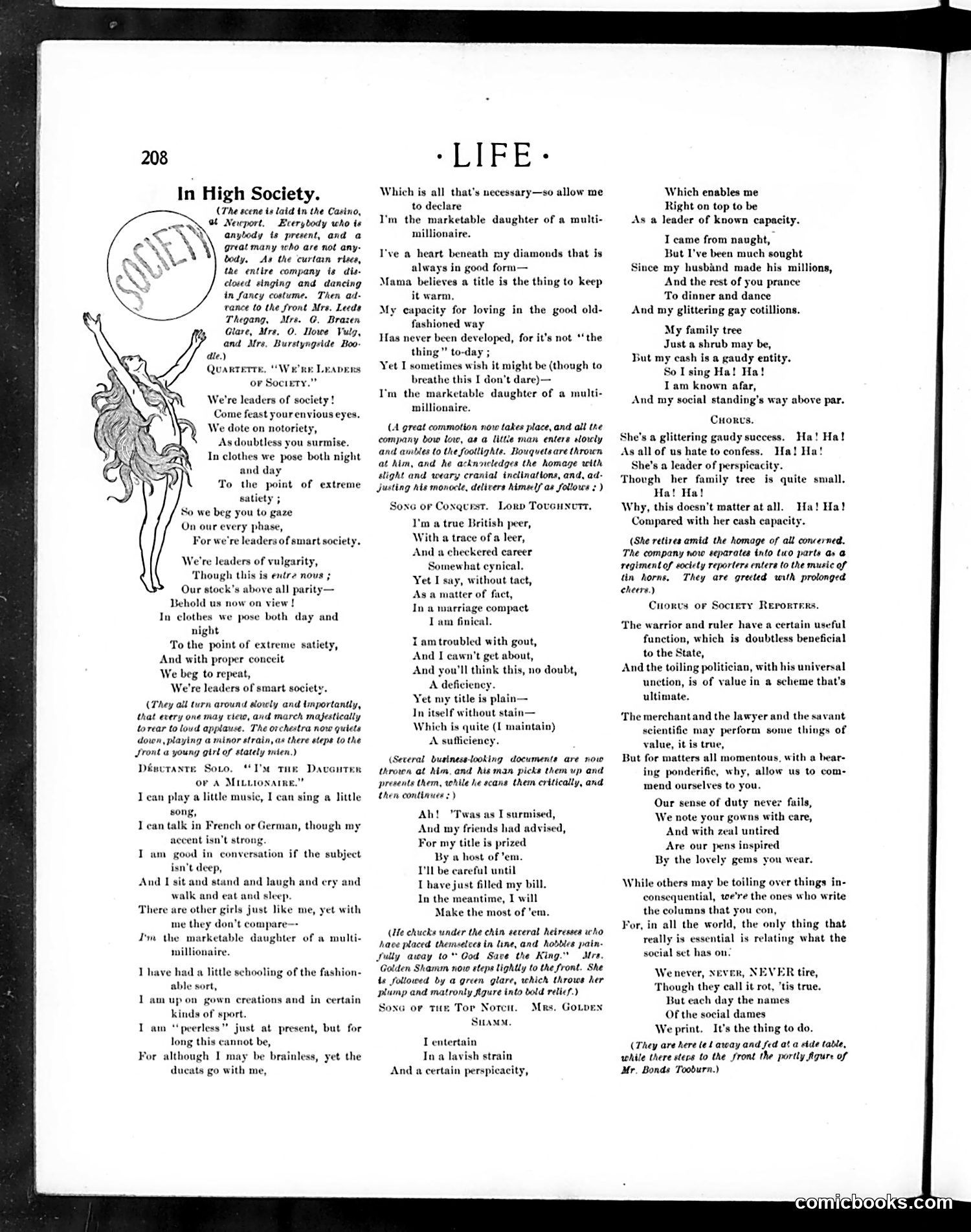
This page satirizes wealthy high-society women through a caricatured female figure dancing or posing. The left column presents a "Quartette of Society Leaders" (Mrs. G. Breadaxe, Mrs. O. Vulgarity, Mrs. H. Tycoon, Mrs. Hardingale Boo) mocking nouveau-riche behavior—boasting of their wealth, vulgar displays, and social climbing. The central text features a millionaire's daughter describing herself as a "markable daughter of a multimillionaire," highlighting her obsession with titles, diamonds, and social status while admitting her capacity for love remains underdeveloped. The satire critiques wealthy women for prioritizing appearance and social position over substance, intelligence, or genuine feeling. The mockery targets the emptiness of gilded-age aristocracy and conspicuous consumption among the American ultra-wealthy.
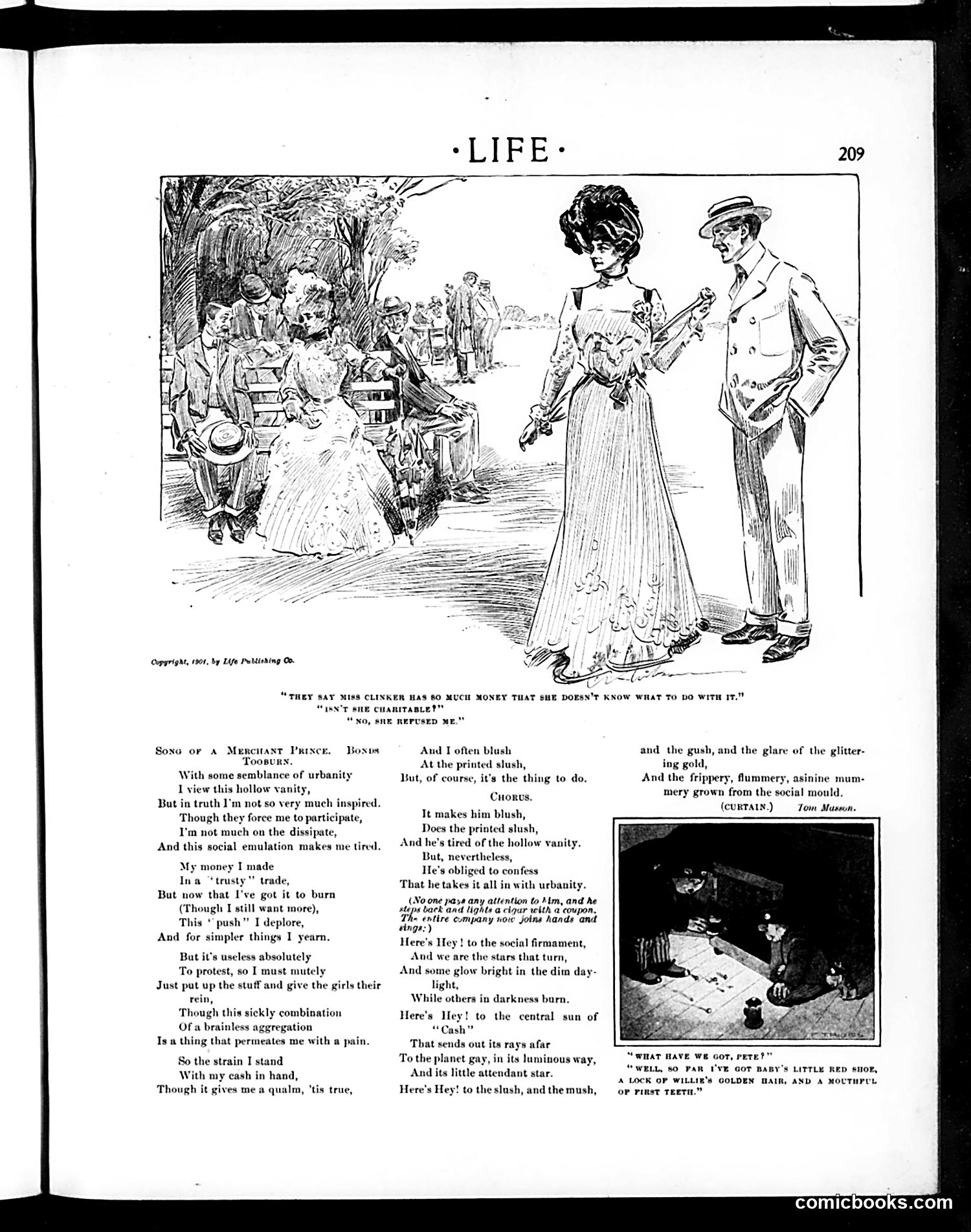
This page contains a satirical poem titled "Song of a Merchant Prince" mocking wealthy industrialists and their social pretensions. The cartoon shows a wealthy couple at what appears to be a park or social gathering, with the caption: "They say Miss Clinker has so much money that she doesn't know what to do with it." "Isn't she charitable?" "No, she refunded me." The satire targets the era's nouveau riche—newly wealthy businessmen who ostentatiously display their money but lack genuine charitable character. The poem criticizes how these merchants "make" money through dubious "trade," then attempt social respectability while remaining fundamentally hollow. The joke suggests that despite her wealth, Miss Clinker's refusal to be charitable reveals her true mercenary nature, mocking the gap between apparent wealth and actual virtue in Gilded Age society.
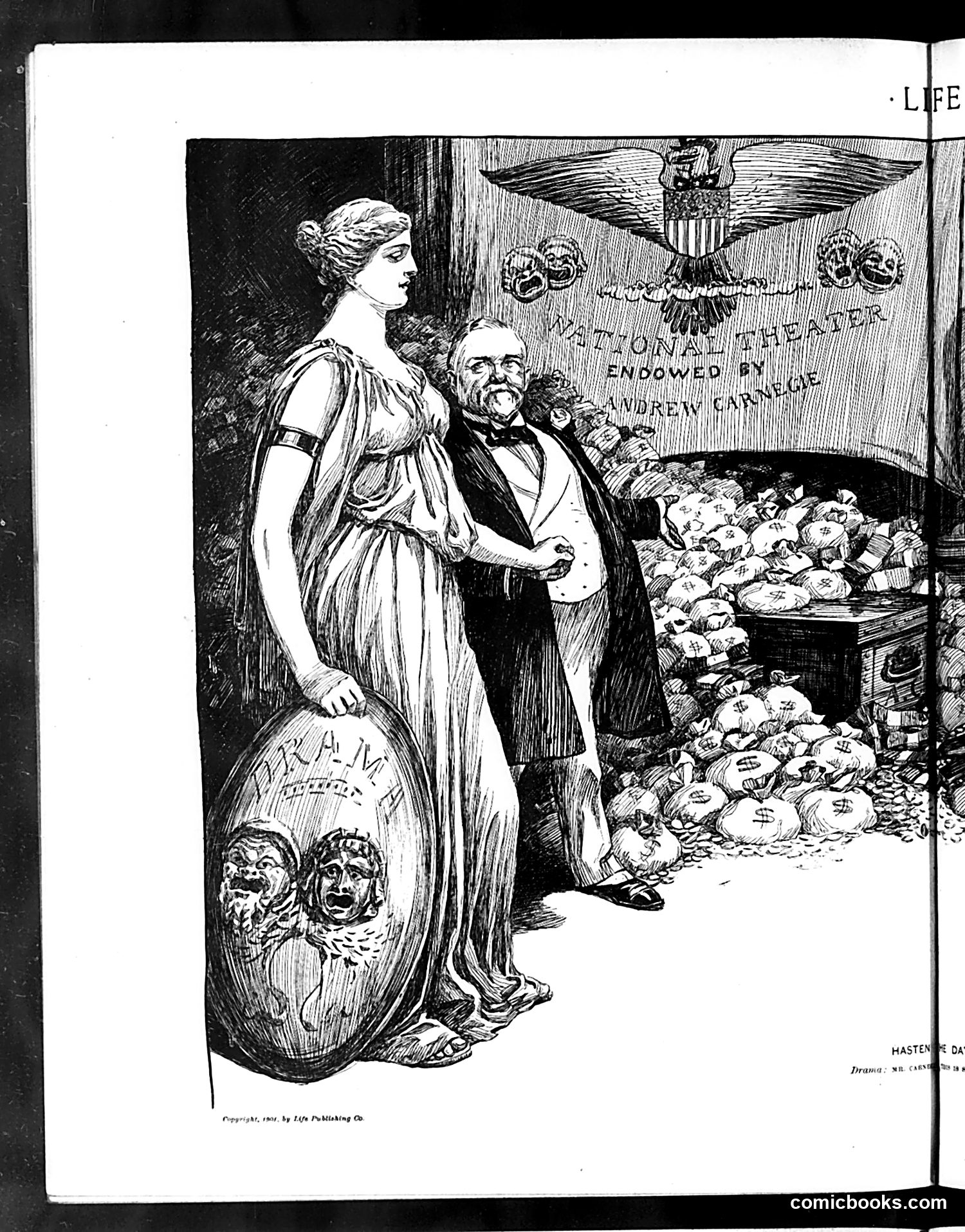
This is a satirical cartoon about wealth and philanthropy. The image shows a well-dressed gentleman (identified by the banner text as "endowed by Andrew Carnegie") presenting money bags to a classical female figure labeled "National Trusts" (visible on the shield above). The satire critiques Carnegie's philanthropic practices: the gentleman appears somewhat self-satisfied or smug while distributing wealth, and the sheer quantity of money bags suggests either excess generosity or ostentatious display of wealth. The classical allegorical woman receiving the funds represents national institutions or the public good. The cartoon likely comments on the tension between Carnegie's genuine charitable contributions and the public perception of his motivations—whether his donations served the nation's interests or primarily enhanced his own legacy and reputation during the Gilded Age.
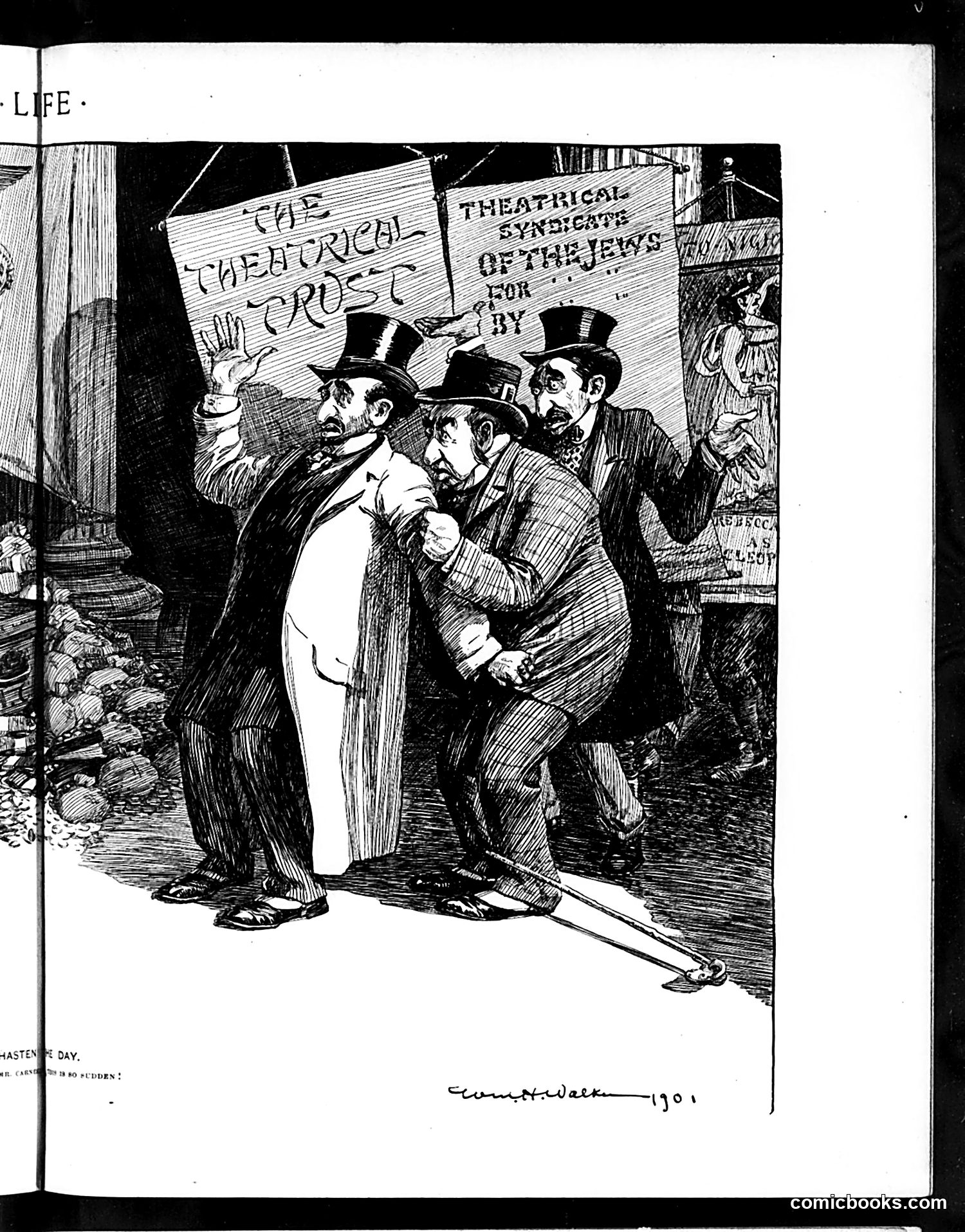
This 1901 cartoon satirizes Jewish theatrical producers or theater owners. Three well-dressed men in top hats stand before a banner reading "THEATRICAL SYNDICATE OF THE JEWS FOR..." (text cuts off). One man gestures emphatically while another appears to be conducting business. The cartoon employs antisemitic caricature conventions common to the era—exaggerated features and the stereotype of Jewish control over theater business. The "syndicate" reference likely alludes to actual theatrical trusts of the period, but here filtered through an ethnic lens. This reflects early 20th-century American prejudice that blamed Jewish businessmen for monopolizing entertainment industries. The satire targets perceived Jewish economic power and influence, representing a common antisemitic trope of the time.
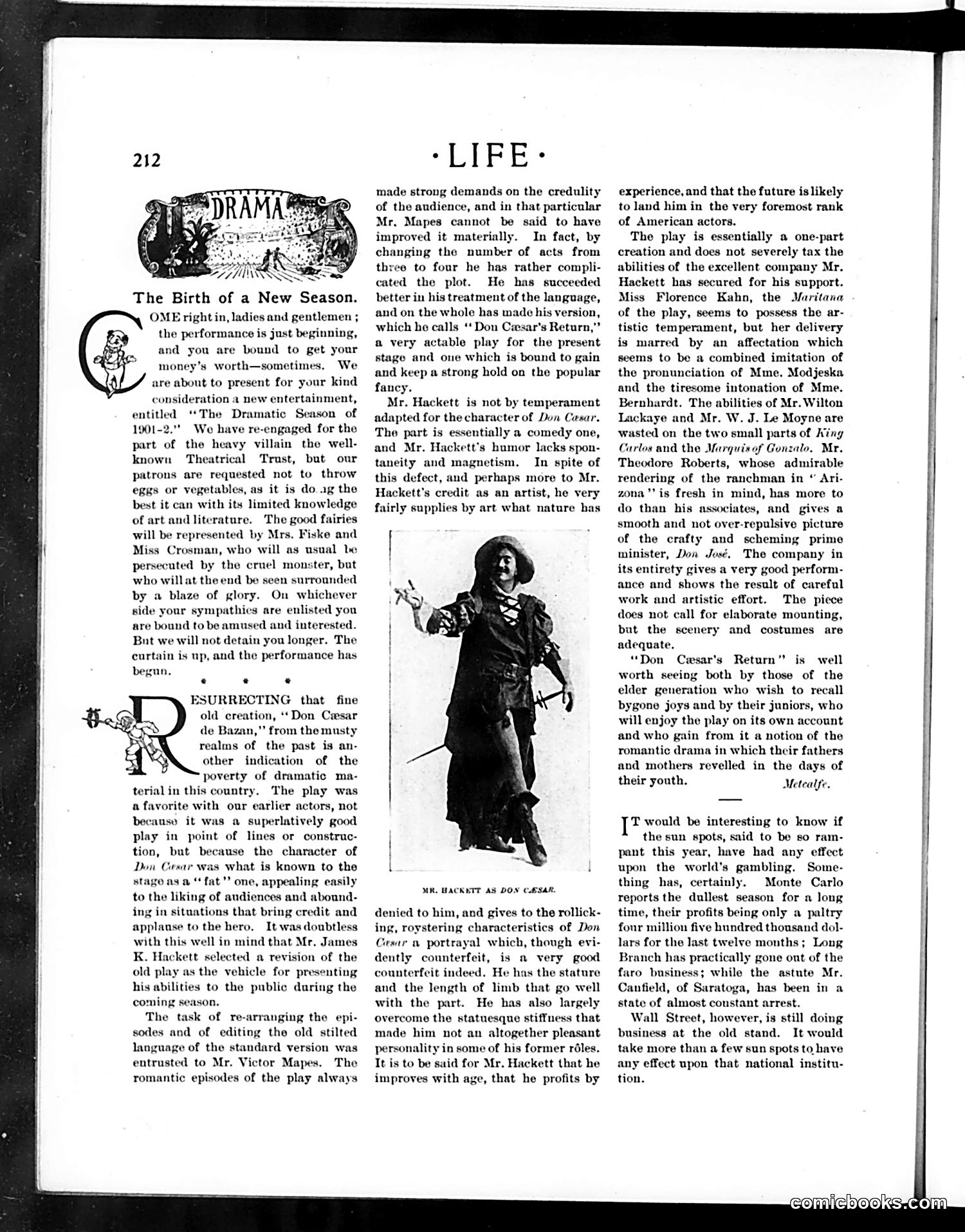
This page reviews "The Dramatic Season of 1901-2," focusing on a theatrical production of "Don Caesar de Bazan." The main image shows **Mr. Hackett as Don Caesar** — a costumed character in period dress wielding a sword. The text praises Hackett's revival of this classic play, noting he successfully modernized it while maintaining audience appeal. The review emphasizes Hackett's comedic talent and artistic improvement over his earlier roles. The piece also discusses Monte Carlo's gambling troubles and Wall Street's financial instability, suggesting Broadway's theatrical season reflected broader American social anxieties about fortune and loss. This is primarily **theater criticism**, not political satire — the "cartoon" is simply an illustrative photograph of the lead actor in costume.
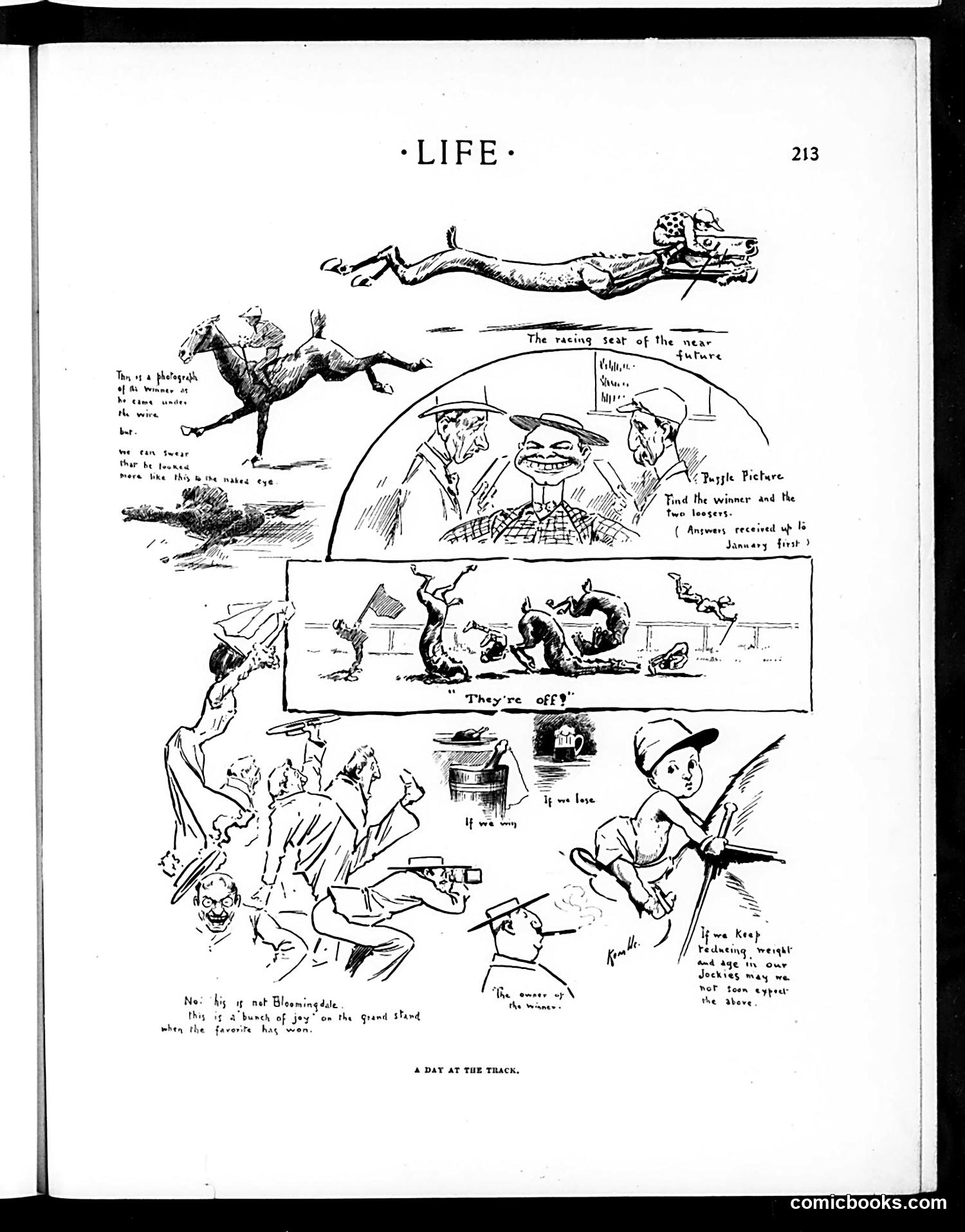
This is a humorous illustrated essay about horse racing, depicting the chaos and comedy surrounding a day at a racetrack. The page shows various scenes: horses and jockeys in motion at the top; a betting tent where spectators watch the race; and crowds celebrating or reacting to results below. The satire targets the excitement and irrationality of horse racing enthusiasts. One caption notes "a bunch of joy" erupts at the grandstand when the favorite horse wins. Another sketch shows Bloomingdale's patrons (likely wealthy spectators) experiencing the unpredictability of gambling—depicting the contrast between dignified expectations and the chaotic reality of wagering. The overall joke mocks how ordinary people become caught up in racing fever, celebrating winners and lamenting losses with exaggerated emotional displays.
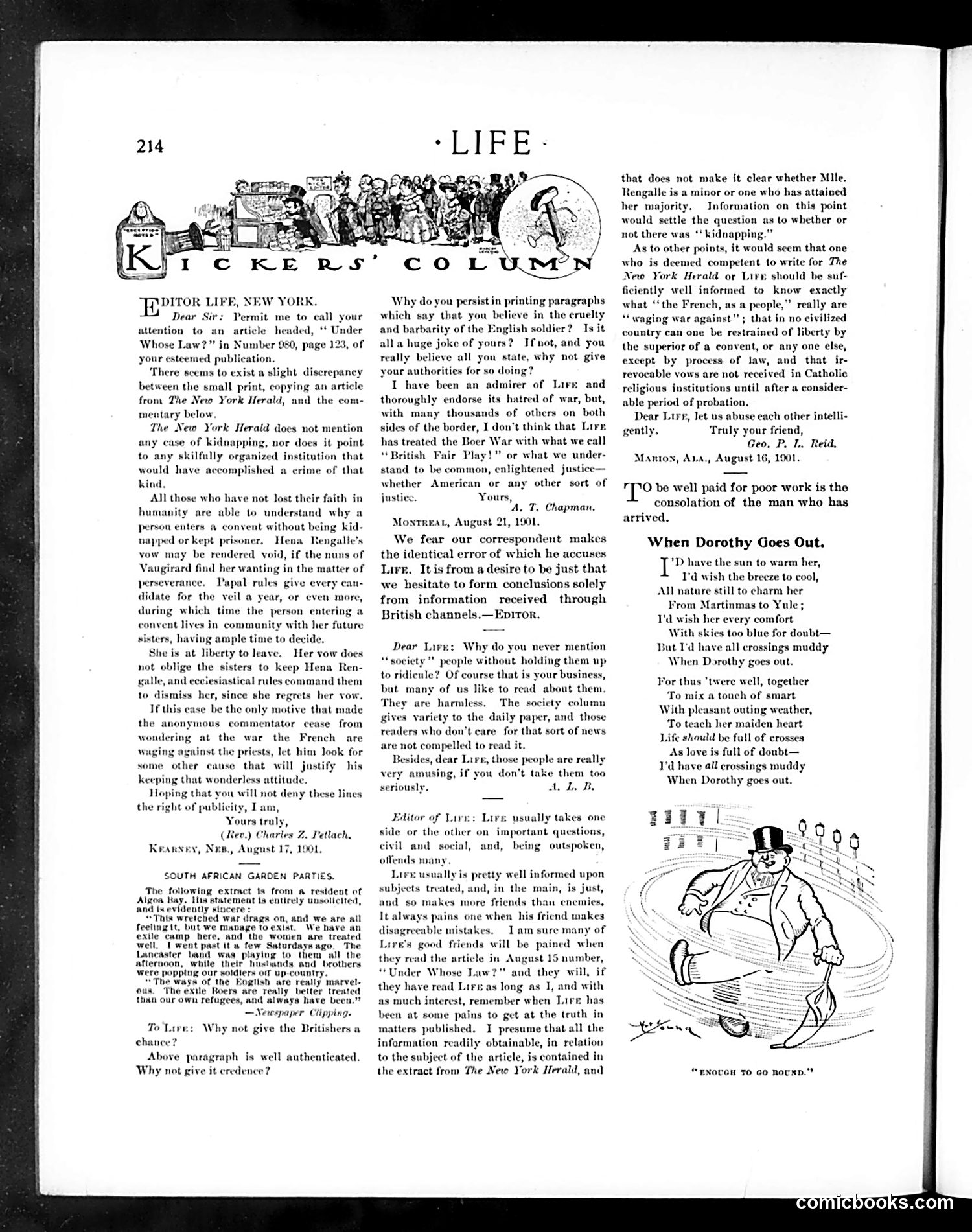
This page presents **reader letters to Life magazine's editorial column**, not political cartoons. The content reflects debates circa August 1901. **Main topics:** 1. **Convent entry controversy**: A correspondent challenges Life's characterization of a woman (Hena Tengalle) entering a French convent as "kidnapping," arguing she entered voluntarily under Church rules allowing withdrawal. 2. **Boer War coverage**: Two letters debate Life's editorial stance on the British conduct in the South African war. One correspondent defends Life's criticism; another urges restraint, citing British fair play and noting the British treated Boer exiles better than their own refugees. 3. **Society column criticism**: A reader defends gossip coverage of wealthy people as harmless entertainment. The page's small illustration shows a figure on horseback captioned "ENOUGH TO GO BOARD"—likely satirizing excess or indulgence, though the specific reference is unclear without additional context. The overall thrust reveals Life's reputation as **outspoken social critic**, with readers both praising and challenging its positions on war, religion, and class.
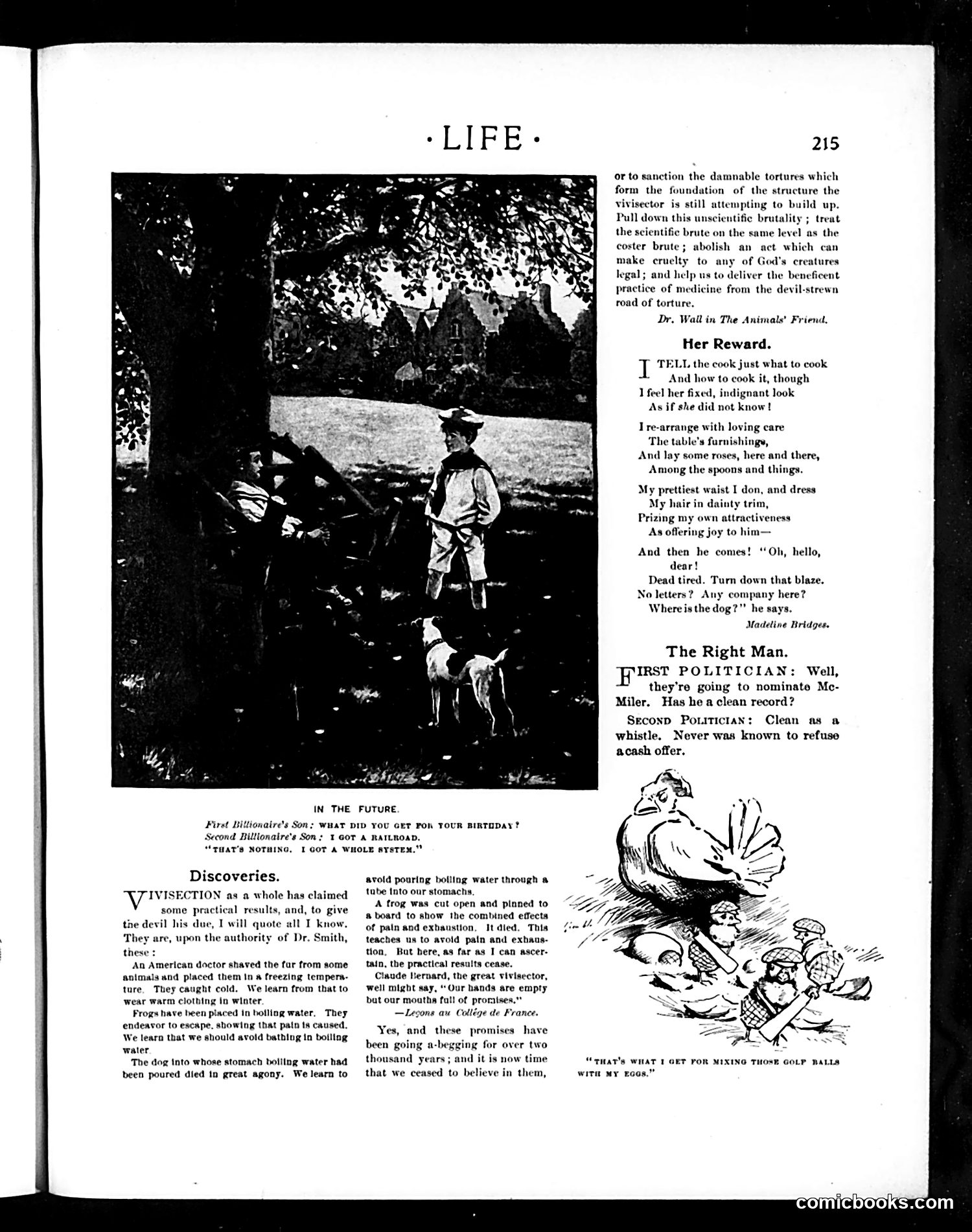
This page contains three distinct pieces of satire: 1. **"In the Future"**: A joke mocking the obscene wealth concentration among America's richest families (the Vanderbilts and Rockefellers are implied). One billionaire's son receives a railroad as a birthday gift; the other receives an entire *system*—satirizing how the ultra-wealthy monopolized entire industries. 2. **"Discoveries"**: A scathing critique of vivisection (animal testing). The piece argues that medical experiments on animals—frogs in boiling water, dogs with scalded stomachs—produce obvious, useless conclusions ("don't pour boiling water in your stomach"). The satire targets the vivisector Claude Bernard's empty promises of scientific progress built on animal torture, calling the practice "unscientific brutality." 3. **"Her Reward"** and **"The Right Man"**: Brief poems about gender relations and political corruption—a woman's domestic efforts go unappreciated by an indifferent husband; a politician's "clean record" means he's never refused a bribe. The overall tone is Progressive-era social criticism targeting wealth inequality, animal cruelty, and political corruption.
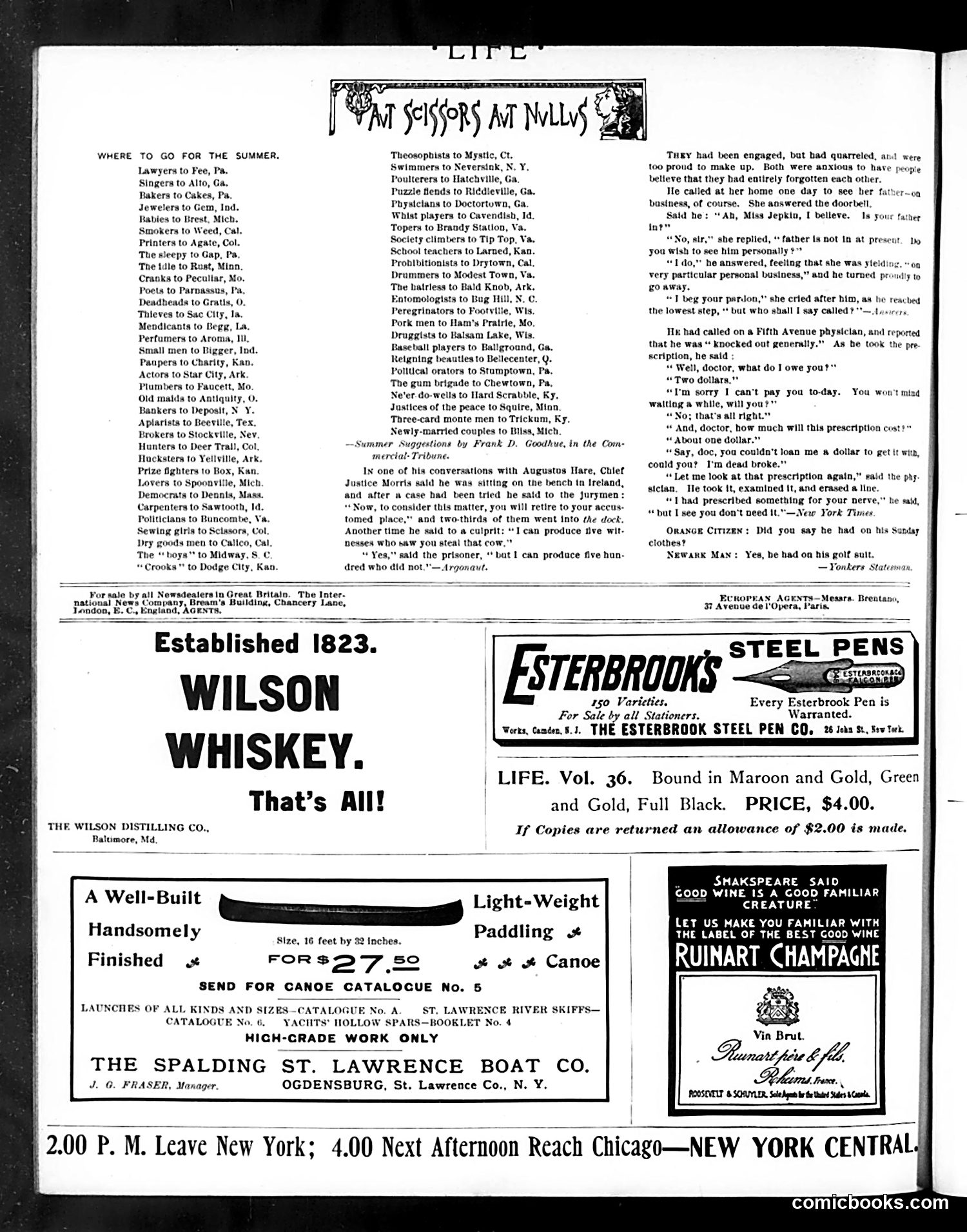
This page contains two distinct satirical pieces: **"Where to Go for the Summer"** is a punning joke list matching occupational groups with real American town names containing relevant words. Lawyers go to "Fee, Pa."; smokers to "Weed, Cal."; Democrats to "Dennis, Mass." The humor derives from wordplay—each profession is humorously "suited" to locations whose names pun on their trade. This format was popular in satirical magazines of the era. **The three brief humorous anecdotes** below satirize human behavior: a Chief Justice describing absurd courtroom scenes; a couple too proud to reconcile after quarreling; and a broke patient negotiating medical bills. The final joke suggests a doctor's dubious practice of prescribing unnecessary nerve treatments to paying patients—subtle social commentary on medical ethics and class disparities. The page is primarily filled with period advertisements (Wilson Whiskey, Esterbrook Steel Pens, canoes) typical of *Life* magazine's commercial content.
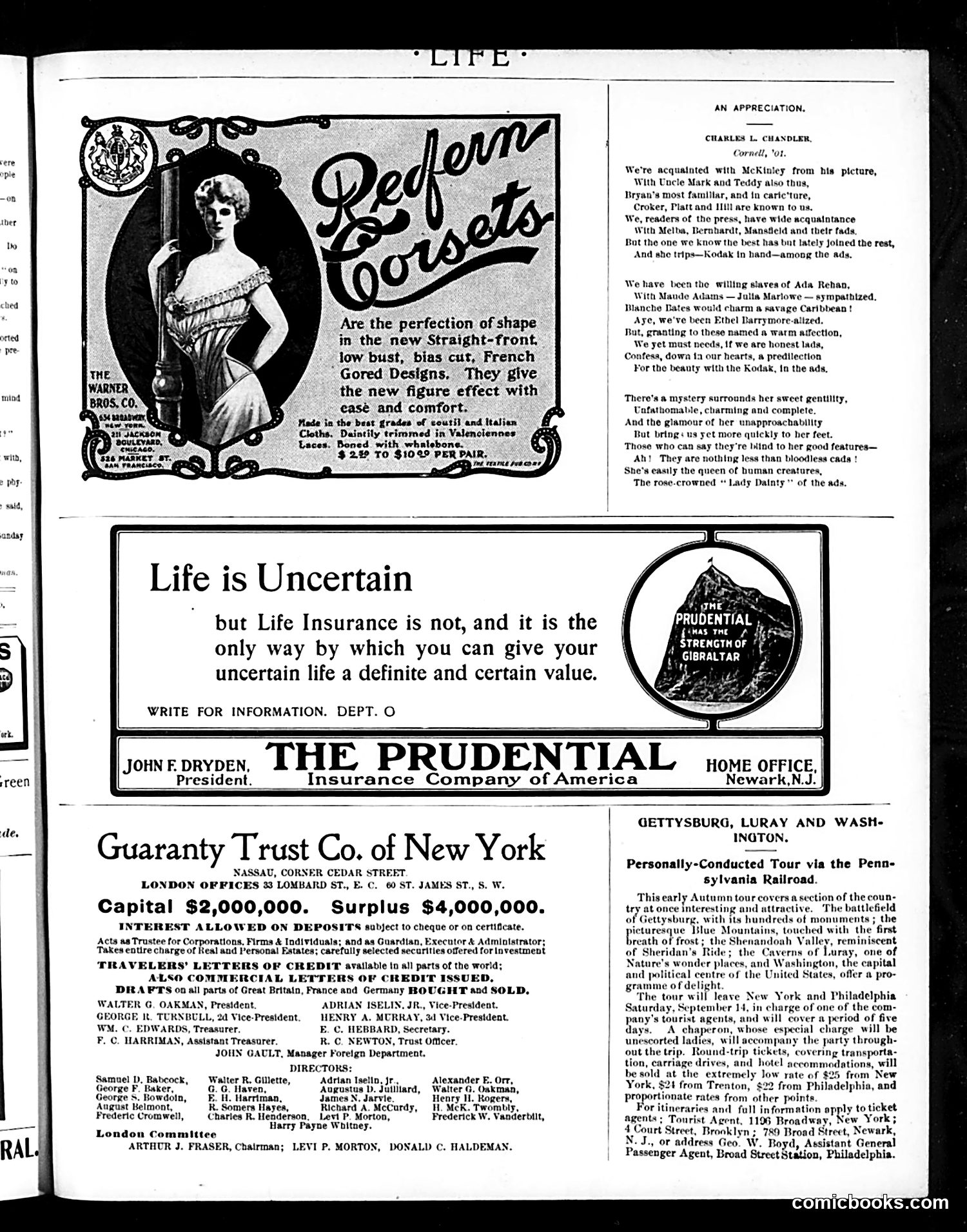
This page is primarily **advertising**, not political satire. The dominant content includes: **Redfern Corsets** (top): A fashion advertisement for women's corsets, emphasizing the "new figure effect" with specific design features (straight-front, low bust, French goring). The accompanying illustration shows a fashionable woman. **"An Appreciation"** (right column): A humorous poem celebrating an unnamed woman from Kodak advertisements, comparing her favorably to celebrated actresses of the era (Ada Rehan, Maude Adams, Julia Marlowe, Ethel Barrymore). The joke is that this anonymous model has become more familiar to readers than actual theatrical celebrities—satirizing how ubiquitous advertising had become in public consciousness. **Life Insurance & Banking Ads**: Standard corporate advertisements for Prudential Insurance and Guaranty Trust Co. **Travel Advertisement**: Information about a Pennsylvania Railroad tour. The page reflects early 1900s consumer culture and advertising's growing cultural prominence rather than political commentary.
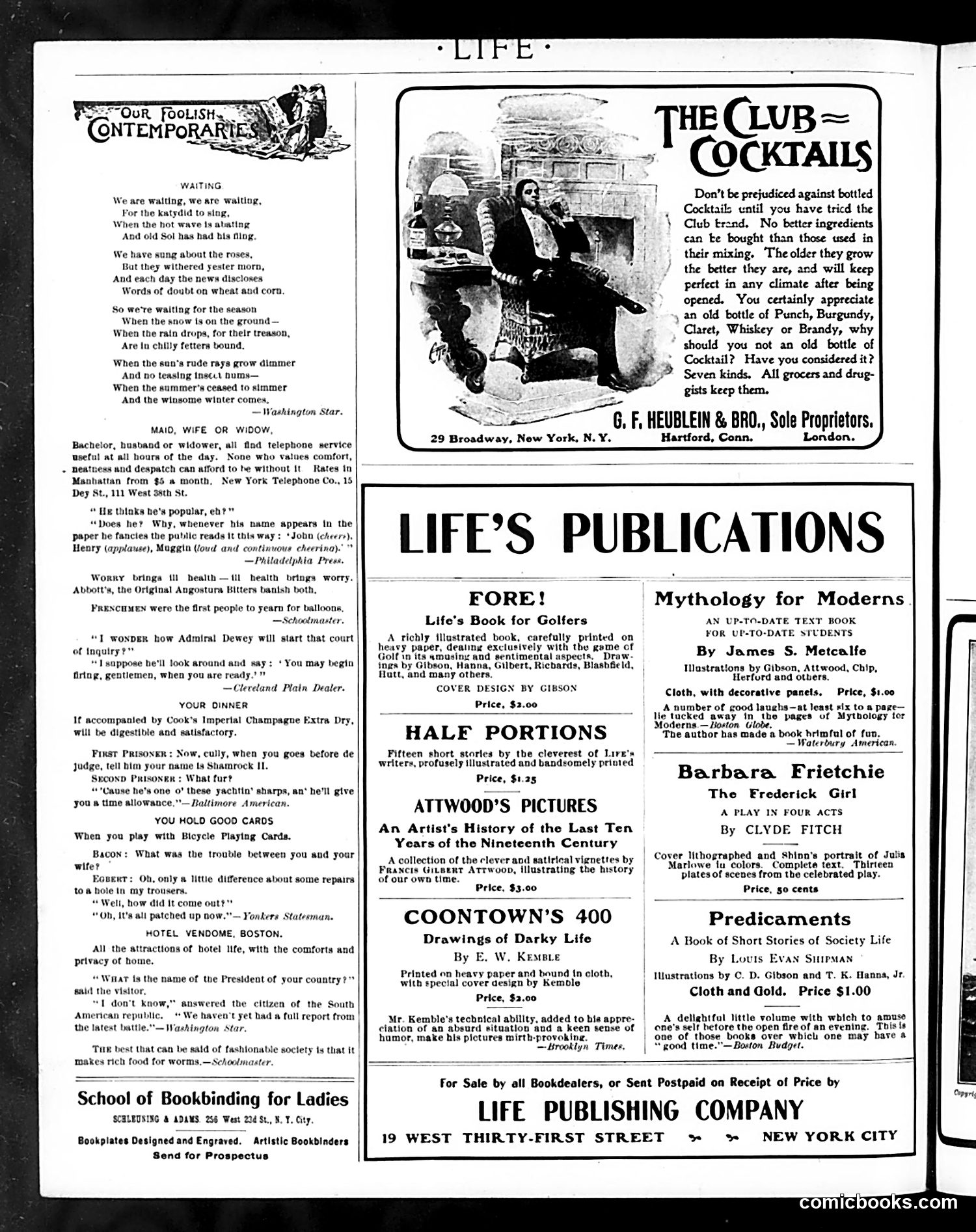
This page from *Life* magazine (likely early 1900s) is primarily **advertising and light humor**, not political satire. The content includes: **Left side:** Humorous verse and joke snippets mocking everyday life—people waiting for winter, confused foreigners, marital squabbles. These are mild social observations rather than political commentary. **Center/right:** Multiple product advertisements (telephone service, champagne, bitters, playing cards, hotels) interspersed with short jokes. **Main content block:** "Life's Publications"—book advertisements including works on golf, mythology, and social satire. **The cartoon:** Shows well-dressed club members, advertising bottled cocktails as a premium product. This reflects early 1900s upper-class consumption culture. **Overall context:** This is a lifestyle magazine for educated, affluent readers, mixing light humor about contemporary life with advertisements. There's no significant political messaging—it's society-page entertainment and commercial promotion.
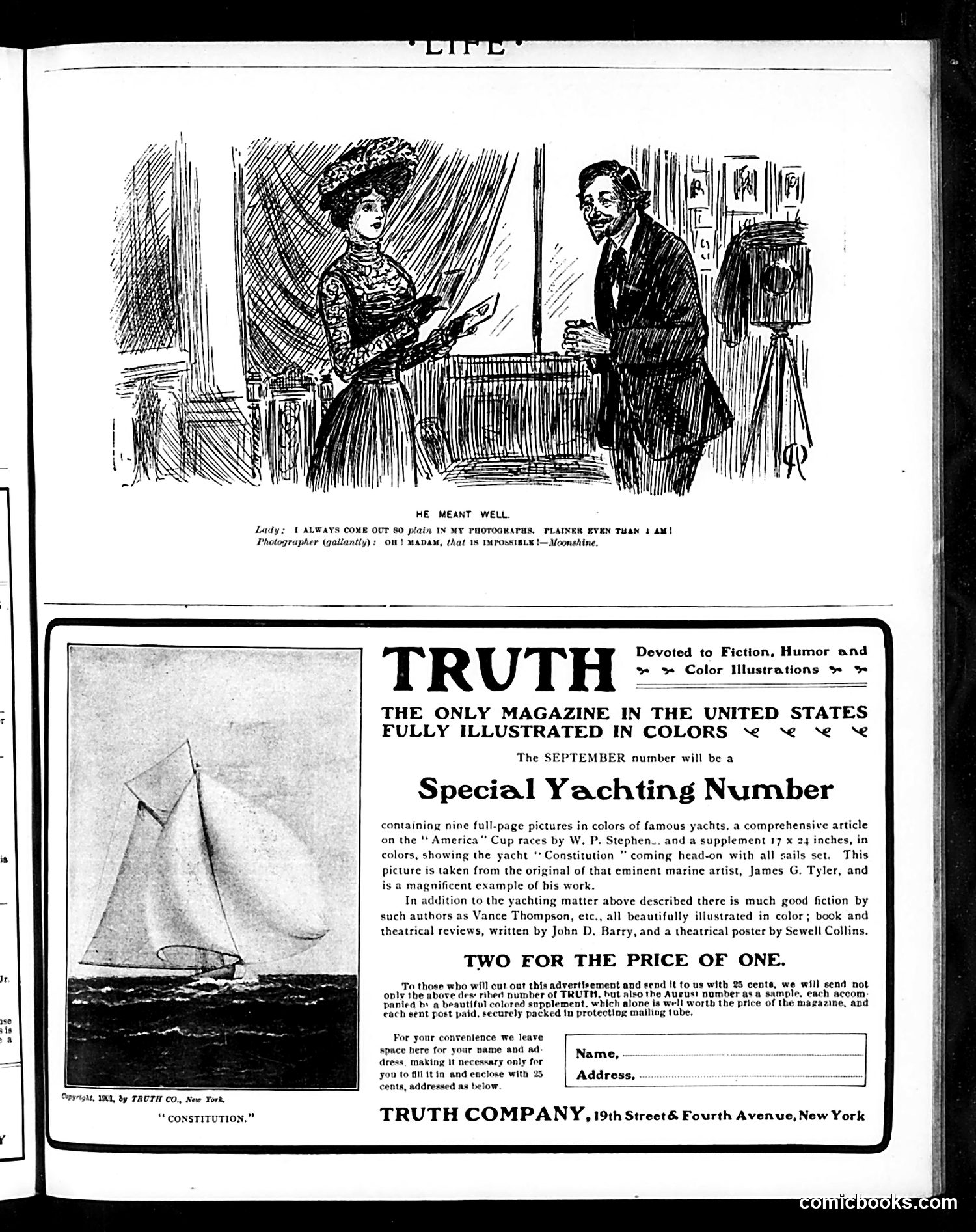
**The Cartoon ("He Meant Well"):** A photographer tries to flatter a female client by insisting her photographs don't make her look plain—implying she's naturally attractive. She's complained that photos always make her look plainer than she is. His gallant reassurance ("that is impossible!") is meant as a compliment but backfires, suggesting she's already very plain in person. The joke relies on the photographer's clumsy flattery inadvertently insulting her. **The Advertisement:** The lower half is a promotion for *Truth* magazine's September "Special Yachting Number," featuring yacht illustrations and articles about the America's Cup races. The offer provides two issues for the price of one (plus 25 cents) as a subscription incentive. This reflects *Life*'s position as a color-illustrated luxury magazine for affluent audiences interested in high-society leisure activities like yachting.
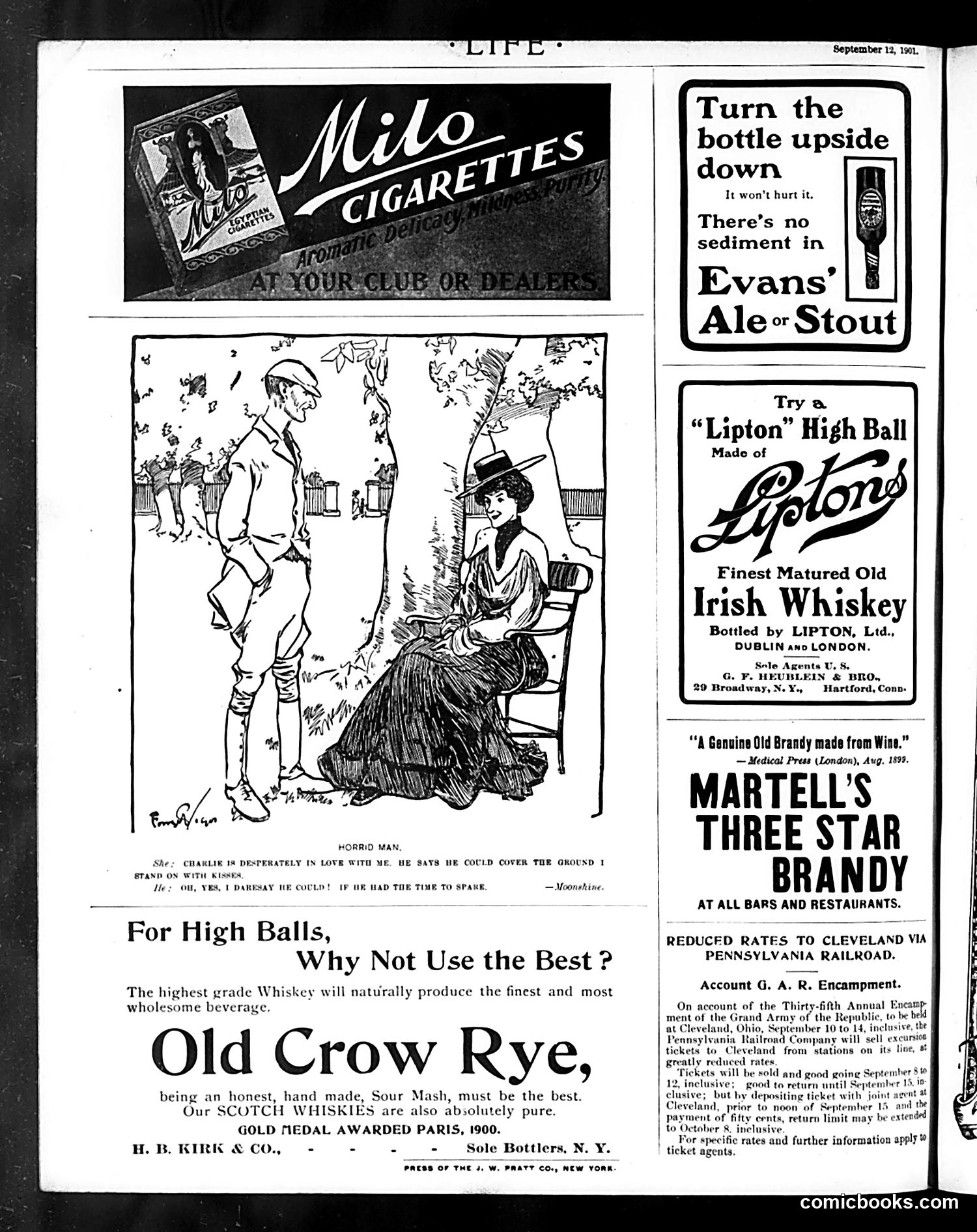
This page is primarily **advertising**, with one small cartoon at center. The cartoon, titled "Horrid Man," depicts a flirtation joke. A woman tells a man that "Charlie is desperately in love with me. He says he could cover the ground I stand on with kisses." The man responds: "Oh yes, I daresay he could! Had the time to spare." The humor relies on a cynical, dismissive view of the woman's attractiveness—the implication being that Charlie's romantic gesture would require an impossibly long time because of the large area she occupies. It's a cutting insult disguised as agreement, typical of turn-of-the-century "wit." The surrounding advertisements promote whiskey, brandy, ale, and railroad excursion rates to Cleveland for a Civil War veterans' encampment (G.A.R.—Grand Army of the Republic).