
Life, 1901-09-12 · page 4 of 20
Life — September 12, 1901 — page 4: what you’re looking at
What you’re looking at
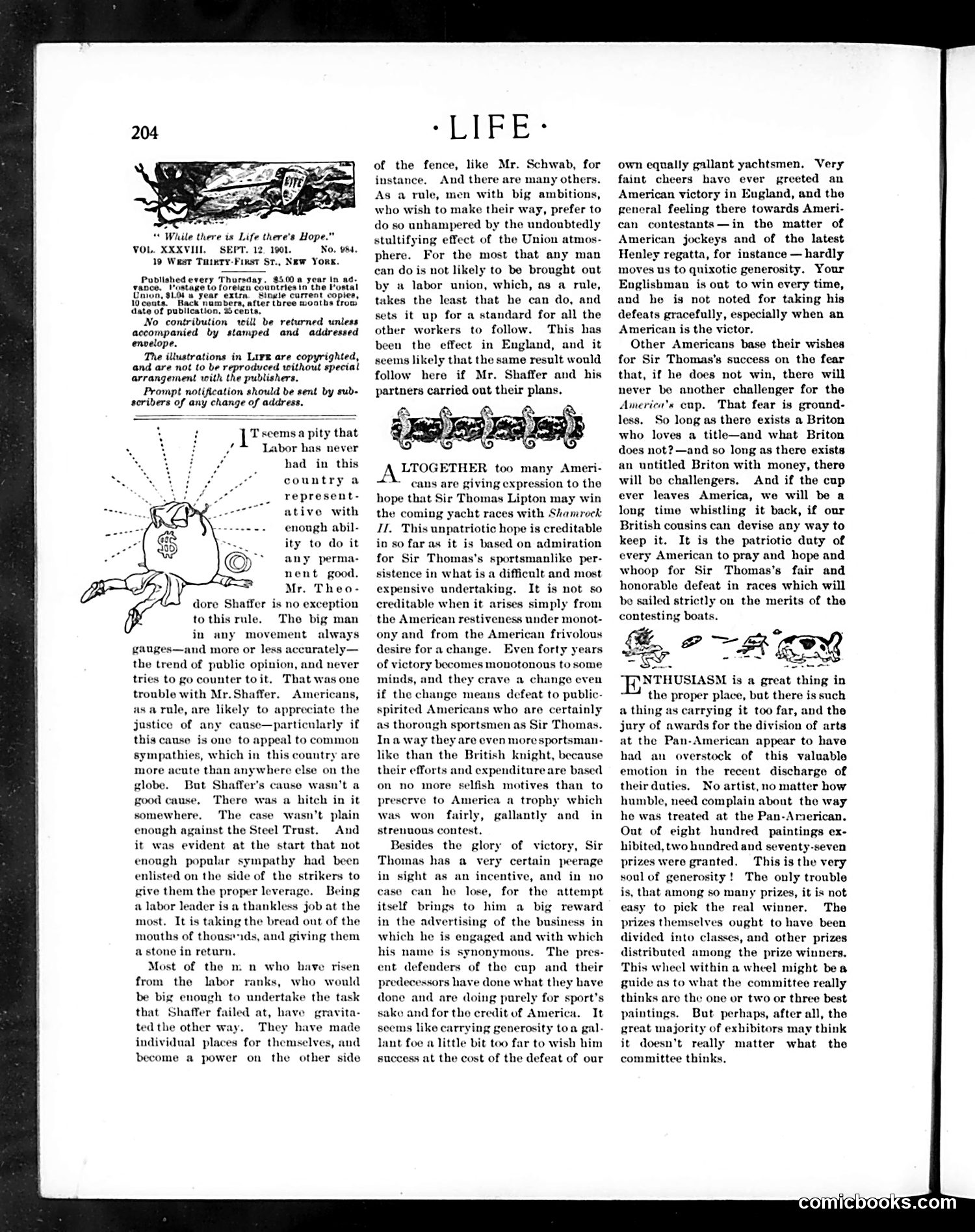
The left side features a cartoon labeled "While there is Life there's Hope," depicting a figure labeled "Theodore" (likely Theodore Roosevelt) as a pugilistic character with boxing gloves, energetically jabbing or fighting. The illustration satirizes Roosevelt as a combative personality—a "big man in any movement" always gauging trends and pushing opinions, per the accompanying text. The article criticizes labor unions for setting rigid standards that stifle individual achievement, arguing that ambitious men like Roosevelt prefer operating without such constraints. The satire suggests Roosevelt's aggressive, uncompromising approach to business competition mirrors labor's inflexibility—both represent obstacles to progress. The page critiques both organized labor AND aggressive capitalists, positioning each as threats to American opportunity.
📄 Transcribed text from this page (OCR, searchable)
Machine-transcribed from the original scan — historical spelling and the odd misread are preserved.
“ While there is Life there's Hope.” VOL. XXXVIII, SEPT. 12. 1901. No. 84. 19 Wast Tuiery-Fixst St., New YORK. edevery Thursday. $5.00 a yea: E ‘oatage to foreign countries in the Postal LOb a year extra. Single current copies, 10cei Back numbers, after (bree moaths frow ate of publication, % cents, No contribution twill be returned unless accompanied by stamped and addressed envelope. The illustrations in Lire are copyrighted, and are not to be reproduced without special arrangement with the publishers. Prompt notification should be sent by sub- scribers of any change of address. Publi 1 ems a pity that Labor has never had in this country a represent- ative with enough abil- ity to do it any perma- nent good, Mr. Theo- dore Shatfer is no exception to this rule. The big man in any movement always gauges—and more or less accurately— the trend of public opinion, and never tries to go counter toit. That was one trouble with Mr.Shaffer. Americans, asarule, are likely to appreciate the justice of any canse—particularly if this cause is one to to common sympathies, which in this country are more acute than anywhere else on the globe. But Shaffer use wasn’t a good cause, There was a hitch in it somewhere. The case wasn’t plain enough against the Steel Trust. And it was evident at the start that not enough popular sympathy had been enlisted on the side of the strikers to give them the proper leverage. Being a labor leader is a thankless job at the most. It is taking the bread out of the mouths of thouseds, and giving them a stone in return. Most of the mn who bave risen from the labor ranks, who would be big enough to undertake the task that Shaffer failed at, have grav ted the other way. They have made individual places for themselves, and become a power on the other side “ihe of the fence, like Mr. Schwab, for instance. And there are many others. As a rule, men with big ambitions, who wish to make their way, prefer to do so unhampered by the undoubtedly stultifying effect of the Union atmos- phere. For the most that any man can do is not likely to be brought out by # labor union, which, as a rule, takes the least that he can do, and sets it up for a standard for all the other workers to follow. This has been the effect in England, and it seems likely that the same result would follow here if Mr. Shaffer and his partners carried out their plans. LTOGETHER too many Ameri- cans are giving expression to the hope that Sir Thomas Lipton may win the coming yacht races with Shamrock II. This unpatriotic hope is creditable in so far as it is based on admiration for Sir Thomas's sportsmanlike per- sistence in what is a difficult and most expensive undertaking. It is not so creditable when it arises simply from the American restiveness under monot- ony and from the American frivolous desire for a change. Even forty years of victory becomes monotonous to some minds, and they crave a change even if the change means defeat to public- spirited Americans who are certainly as thorough sportsmen as Sir Thomas. Ina way they are even more sportsman- like than the British knight, because their efforts and expenditure are based on no more selfish motives than to preserve to America a trophy which was won fairly, gallantly and in strenuous contest. Besides the glory of victory, Sir Thomas has a very certain peerage sight as an incentive, and in no he lose, for the attempt itself brings to him a big reward in the advertising of the busin in which he is engaged and with which his name is synonymous. The pres- ent defenders of the cup and their predecessors have done what they have done and are doing purely for sport's sake and for the credit of America. It seems like carrying generosity toa gal- lant foe a little bit too far to wish him success at the cost of the defeat of our own equally gallant yachtsmen. Very faint cheers have ever greeted an American victory in England, and the general feeling there towards Ameri- can contestants—in the matter of American jockeys and of the latest Henley regatta, for instance — hardly moves us to quixotic generosity. Your Englishman is out to win every time, and he is not noted for taking his defeats gracefully, especially when an American is the victor, Other Americans base their wishes for Sir Thomas's success on the fear that, if he does not win, there will never be another challenger for the America’s cap. That fear is ground- less. So long as there exists a Briton who loves a title—and what Briton does not?—and so long as there exists an untitled Briton with money, there will bo challengers, And if the cup ever leaves America, we will be a long time whistling it back, if our British cousins can devise any way to keep it. It is the patriotic duty of every American to pray and hope and whoop for Sir Thomas’s fair and honorable defeat in races which will be sailed strictly on the merits of the contesting boats. ENTHUSIASM is a great thing in the proper place, but there is such a thing as carrying it too far, and the jury of awards for the division of arts at the Pan-American appear to have had an overstock of this valuable emotion in the recent discharge of their duties. No artist, no matter how humble, need complain about the way ho was treated at the Pan-American, Ont of eight hundred paintings ex- hibited, two hundred and seventy-seven prizes were granted. This is the very soul of generosity! The only trouble is, that among so many prizes, it is not easy to pick the real winner. The prizes themselves ought to have been divided into classes, and other prizes distributed among the prize winners, This wheel within a wheel might bea guide as to what the committee really thinks are the one or two or three best paintings. But perhaps, after all, the great majority of exhibitors may think it doesn't really matter what the committee thinks.