
Life, 1901-09-12 · page 6 of 20
Life — September 12, 1901 — page 6: what you’re looking at
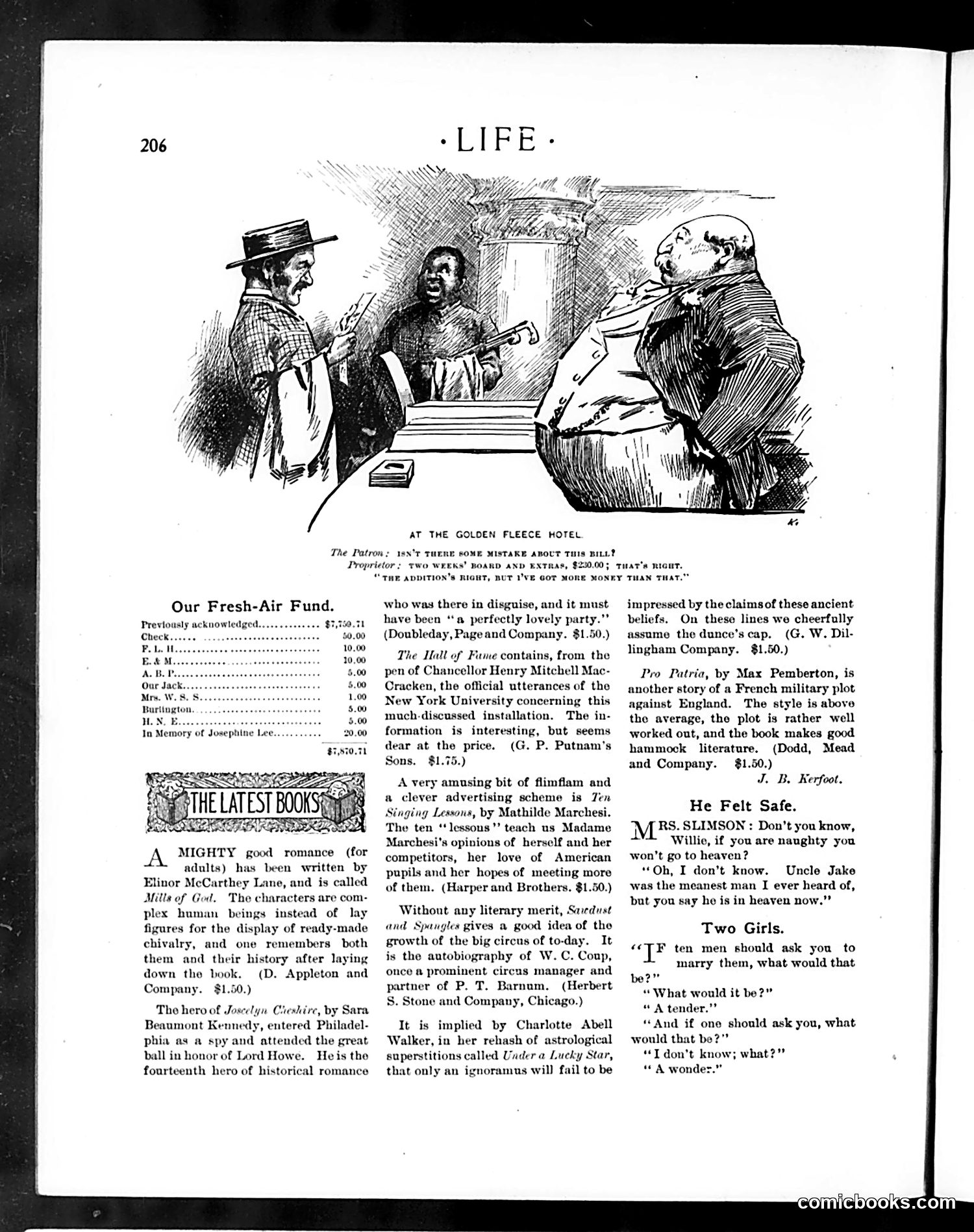
What you’re looking at
This cartoon satirizes a hotel billing dispute. A patron (left, in hat) confronts the proprietor (center, behind counter) about an inflated bill, while another guest (right) listens. The patron claims a $20 charge for "two weeks' board and extras" is excessive, protesting "the addition's right, but I've got more money than that." The satire targets exploitative innkeeping practices—the "Golden Fleece" name itself suggests fleecing (defrauding) guests. The humor lies in the patron's absurd defense: he's not disputing the math, only claiming he shouldn't have to pay everything he's worth. This mocks both dishonest hoteliers and wealthy travelers' entitlement.
📄 Transcribed text from this page (OCR, searchable)
Machine-transcribed from the original scan — historical spelling and the odd misread are preserved.
The Patron : Proprietor; two Our Fresh-Air Fund. Previously acknowledged . Check. MIGHTY good romance (for adults) has been written by Elinor McCarthey Lane, and is called Mills of God. The characters are com- plex human beings instead of lay figures for the display of ready-made chivalry, and one remembers both them and their history after laying down the book. (D. Appleton and Company. $1.50.) Tho hero of Joseelyn Cheshire, by Sara Beaumont Kennedy, entered Philadel- phia as a spy and attended the great ball in honor of Lord Howe. Heis the fourteenth hero of historical romance Se ALA 4, tijh oa AT THE GOLDEN FLEECE HOTEL ISN'T THERE SOME MISTAKE ABOUT THIS BILL? 5) ROARD AND EXTRAS, $200.00; THAT's RIGHT. “THE ADDITION’S RINT, RUT VE GOT MORE MONRY THAN THAT.” who was there in disguise, and it must have been “a perfectly lovely party.”” (Doubleday, Page and Company. $1.50.) The Hall of Fane contains, from the pen of Chancellor Henry Mitchell Mac- Cracken, the official utterances of the New York University concerning this much-discussed installation. The in- formation is interesting, but seems dear at the price. (G. P. Putnam's Sons, $1.75.) A very amusing bit of flimflam and a clever advertising scheme is Jen Singing Lessons, by Mathilde Marchesi. The ten ‘lessons’? teach us Madame Marchesi's opinions of herself and her competitors, her love of American pupils and her hopes of meeting more of them, (Harper and Brothers, $1.50.) Without any literary merit, Suedust and Spaugtes gives a good idea of the growth of the big circus of to-day. It is the autobiography of W. C. Coup, once a prominent circus manager and partner of P. T. Barnum. (Herbert S$. Stone and Company, Chicago.) It is implied by Charlotte Abell Walker, in her rehash of astrological superstitions called Under a Lucky Star, that only an ignoramus will fail to be impressed by the claimsof these ancient beliefs. On these lines we cheerfully assume the dunce’s cap. (G. W. Dil- lingham Company. $1.50.) Pro Patria, by Max Pemberton, is another story of a French military plot against England. The style is above the average, the plot is rather well worked out, and the book makes good hammock literature. (Dodd, Mead and Company. $1.50.) J. By Kerfoot. He Felt Safe. RS. SLIMSON : Don’t you know, IVIL Willie, if you are naughty you won't go to heaven? “Oh, I don’t know. Uncle Jake was the meanest man I ever heard of, but you say he is in heaven now.” Two Girls. ‘¢TF ten men should ask you to marry them, what would that be?” “ What would it be?” “ A tender.” “And if one should ask you, what would that be?" “TI don't know; what?” “A wonder.”