
Life, 1901-09-12 · page 14 of 20
Life — September 12, 1901 — page 14: what you’re looking at
What you’re looking at
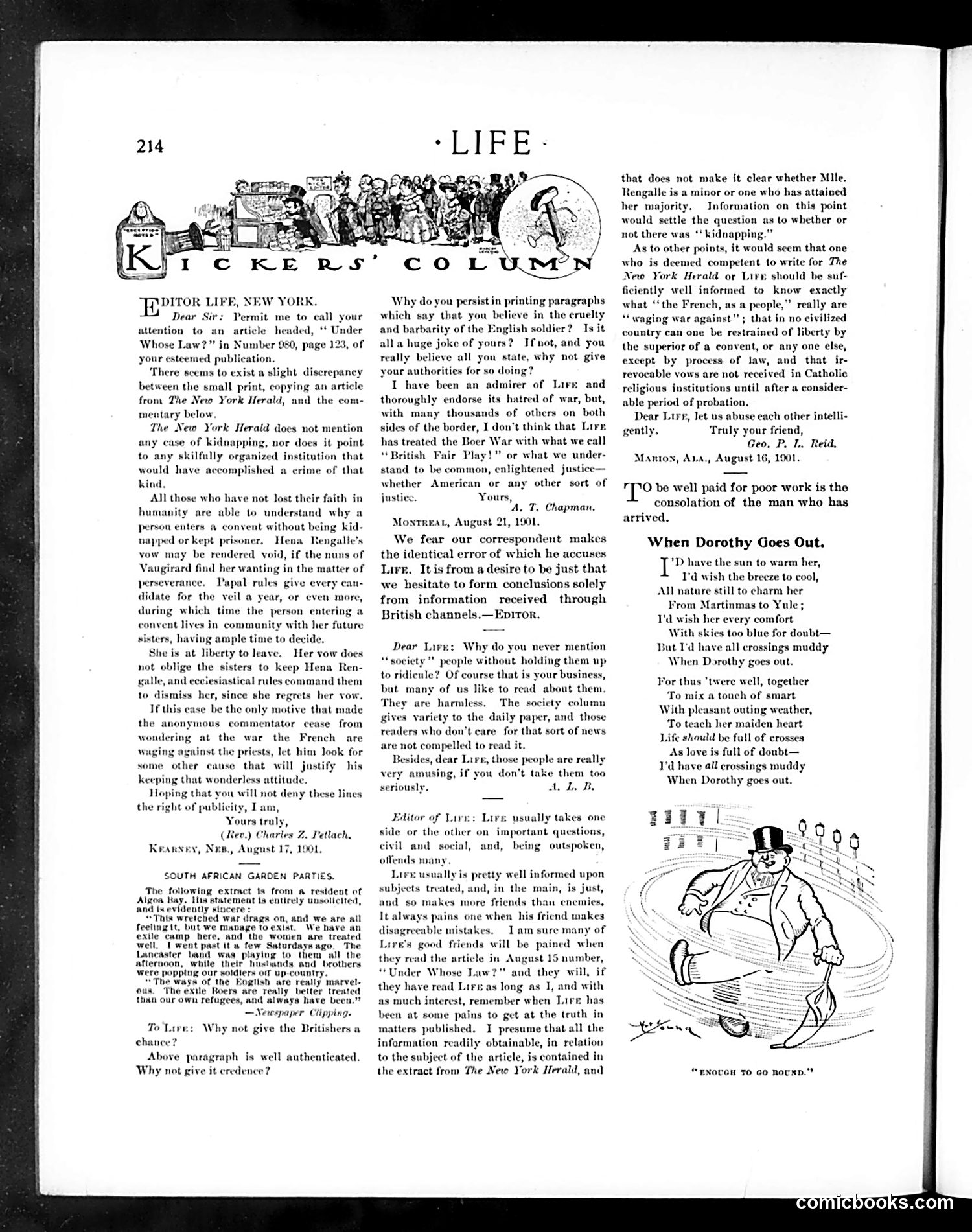
This page presents **reader letters to Life magazine's editorial column**, not political cartoons. The content reflects debates circa August 1901. **Main topics:** 1. **Convent entry controversy**: A correspondent challenges Life's characterization of a woman (Hena Tengalle) entering a French convent as "kidnapping," arguing she entered voluntarily under Church rules allowing withdrawal. 2. **Boer War coverage**: Two letters debate Life's editorial stance on the British conduct in the South African war. One correspondent defends Life's criticism; another urges restraint, citing British fair play and noting the British treated Boer exiles better than their own refugees. 3. **Society column criticism**: A reader defends gossip coverage of wealthy people as harmless entertainment. The page's small illustration shows a figure on horseback captioned "ENOUGH TO GO BOARD"—likely satirizing excess or indulgence, though the specific reference is unclear without additional context. The overall thrust reveals Life's reputation as **outspoken social critic**, with readers both praising and challenging its positions on war, religion, and class.
📄 Transcribed text from this page (OCR, searchable)
Machine-transcribed from the original scan — historical spelling and the odd misread are preserved.
DITOR LIF: Dear Sir: W YOR Permit me to call your cle headed, ** Under in Number 980, page 123, of cation. ‘There scems to exist a slight discrepanc between the small print, copying an article from The New York Herald, and the com- mentary below. The New York Herald does not mention any case of kidnapping, nor does it point to any skilfully organized institution that would have accomplished a crime of that kind. All those who have not lost their faith in humanity are able to understand why a person enters a convent without being kid- napped or kept prisoner, Hena Tengalle’s vow may be rendered void, if the nuns of Vaugirard find her wanting in the matter of perseverance. Papal rules give every can- didate for the veil a year, or even more during which time the person entering a t lives in community with her future sisters, having ample time to decid She is at liberty to leave. Her vow does oblige the rs to keep Hena Ren- le, and ecciesiastical rules command them miss her, since she regrets her vow. © be the only motive that made ymous commentator cease from wondering at the war the French are z against the priests, let him look for some other cause that will justify his g that wonderless attitude. ing that you will not deny these lines the right of publicity, Iam, Yours truly, (Rev,) Charles Z. Petlach, , August 17, 1901. SOUTH AFRICAN GARDEN PARTIES. The following extract ts from a resident of Algoa Kay. Its statement {4 entirely uusolicited, and Is evidently sincere : + This wretched war drags on, and we are all feeling tt, but we manage to exist, We have an exile camp here, and the women are treated well, I went past it a few Saturdaysago. The Lancaster band was playing to them all the afternoon, while their hustands and brothers were popping our soldiers oif up-country. “The ways of the English are really marvel- ous. The exile Roers are really better trea than our own refugees, and always have b attention to an ari Whose Law? your esteemed publ conve Kransey, Newspaper Clippings Lire: Why not give the Britishers a chane Above paragraph is well authenticated. Why not give it crede ‘hy do you persist in printing paragraphs which say that you believe in the cruelty and barbarity of the English soldier? Is it alla huge joke of yours? Ifnot, and you really believe all you state, why not give your authorities for so doing? I have been an admirer of Lir and thoroughly endorse its hatred of war, but, with many thousands of others on both sides of the border, I don’t think that LiF has treated the Boer War with what we call “British Fair Play!” or what we under- stand to be common, enlightened justice— whether American or any other sort of Yours, ‘A. T. Chapman, Mostreat, August 21, 1901. We fear our correspondent makes the identical error of which he accuses Lire. It is from a desire to be just that we hesitate to form conclusions solely from information received through British channels.—Epitor. justie Dear Lire: Why do you never mention “society” people without holding them up to ridicule? Of course that is your business, but many of us like to read about them They are harmless. The society column gives variety to the daily paper, and th readers who don't care for that sort of news are not compelled to read it. Besides, dear Lire, those people are really amusing, if you don’t take them too riously. ALL. Be Lire usually takes one side or the other on important questions, civil and 1, and, being outspoken, offends many. Lire usually is pretty well informed upon subjects treated, and, in the main, is just, and so makes more friends t It always pains one when his friend makes disagreeable mistakes, Lam sure many of res good friends will be pained when y read the article in August 15 number, “Under Whose Law?" and they wi they have read Lire as long as I, and with as much interest, remember when Lire has been at some pains to get at the truth in matters published. I presume that all the information readily obtainable, in relation to the subject of the article, is contained in the extract from The New York Herald, and 1 cnen that does not make it clear whether Mlle. Rengalle is a minor or one who has attained her majority. Information on this point would settle the question as to whether or not there was ‘ kidnapping.” As to other points, it would seem that one who is deemed competent to write for The New York Herald or Lire: should be suf- ficiently well informed to know exactly what ‘the Fren “waging war against country can one be restrained of liberty by the superior of a convent, or any one else, except by process of Jaw, and that ir- revocable vows are not received in Catholic religious institutions until after a consider- able period of probation. Dear Lire, let us abuse each other intelli- gently. Truly your friend, Geo, P. 1. Reid, Mantoy, Aua., August 16, 1901. O be well paid for poor work is the consolation of the man who has arrived. When Dorothy Goes Out. I” have the sun to warm her, I'd wish the breeze to cool, All nature still to charm her From Martinmas to Yule; I'd wish her every comfort With skies too blue for doubt— But I'd have all crossings muddy When Dorothy goes out. For thus ‘twere well, together To mix a touch of smart With pleasant outing weather, To teach her maiden heart Life should be full of crosses As love is full of doubt— I'd have all crossings muddy When Dorothy goes out. “ENovGH TO GO ROUND.”* Ccomicbooks.com