
A complete issue · 28 pages · 1901
Life — June 6, 1901
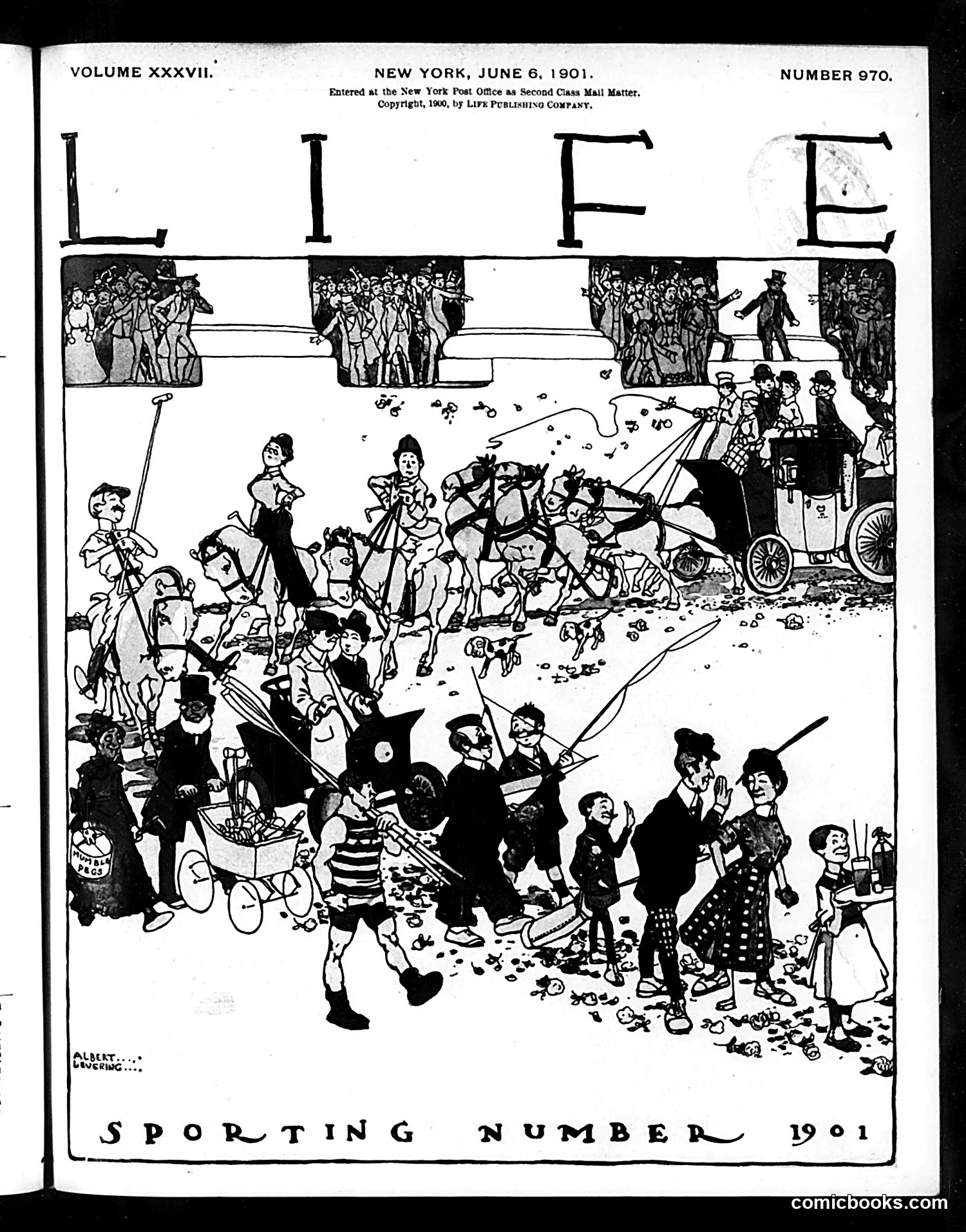
This is a satirical "Sporting Number" cover depicting urban chaos and reckless behavior as a sport. The illustration shows well-dressed adults and children engaged in dangerous activities—pole-vaulting, riding bicycles recklessly, fighting, and generally causing mayhem in what appears to be a city street or park. The satire critiques early 1900s urban life, particularly the chaotic, unregulated behavior of city dwellers. The term "sporting" here is ironic—these aren't gentlemanly sports but rather the wild, uncontrolled "sport" of urban living itself. The mix of social classes and the emphasis on dangerous, frivolous activities suggests commentary on contemporary anxieties about modern city life, safety, and social disorder during the Progressive Era.
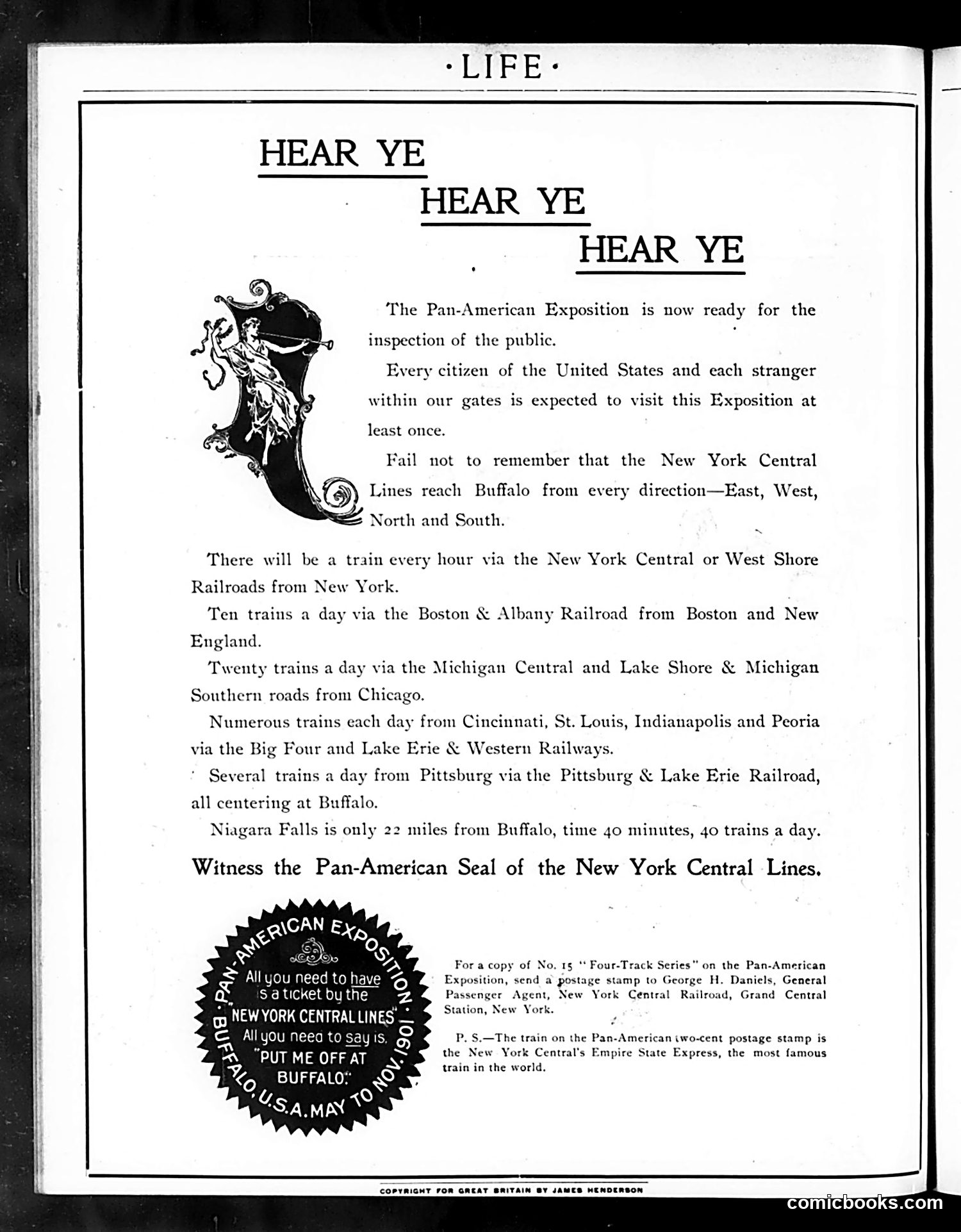
This page is primarily **advertising for the Pan-American Exposition** held in Buffalo, New York (May-November 1901), not political satire. The ornamental figure on the left appears to be **Lady Liberty or an allegorical representation** of America, rendered in an Art Nouveau style typical of the period. The circular seal at bottom is a **railroad advertisement** promoting the New York Central Lines as the primary transportation to the exposition. The slogan "PUT ME OFF AT BUFFALO" emphasizes convenient rail access from multiple directions. The repeated "HEAR YE" opening mimics **town-crier proclamations**, lending an official, ceremonial tone to promote the fair as a major national event. The text lists numerous rail routes to encourage attendance from across the country. This is essentially **promotional content**, not satire.
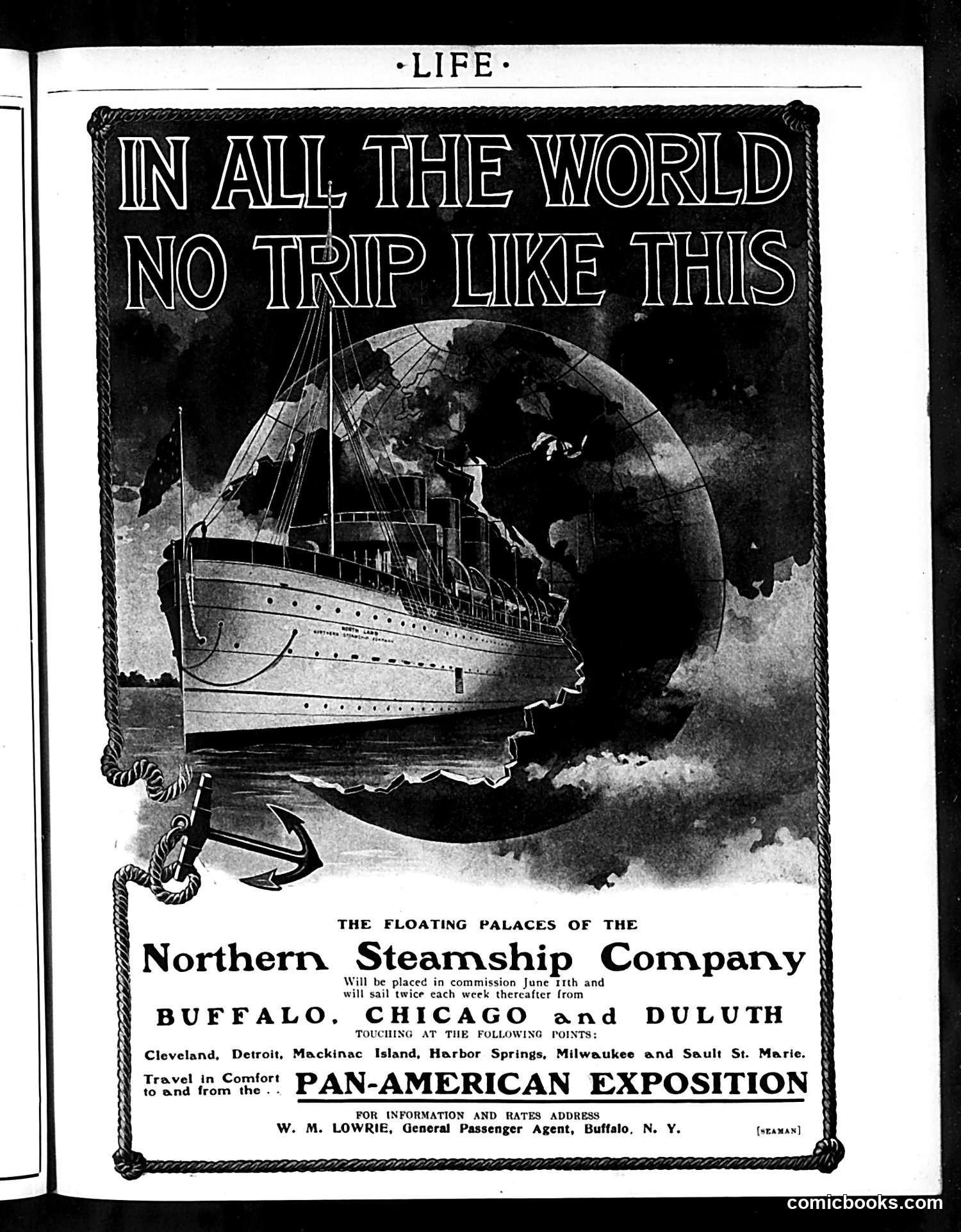
This is primarily **advertising content**, not satire or political commentary. The page promotes the Northern Steamship Company's passenger vessels operating between Buffalo, Chicago, and Duluth. The dramatic imagery—a large ocean liner superimposed over a globe—uses hyperbolic marketing language ("IN ALL THE WORLD / NO TRIP LIKE THIS") typical of early 20th-century travel advertising. The "floating palaces" phrase emphasizes luxury accommodations for passengers. The advertisement mentions connections to the Pan-American Exposition, suggesting this dates to around 1901 (when Buffalo hosted that fair). The contact information for W. M. Lowrie, General Passenger Agent, indicates this targeted potential Great Lakes travelers seeking comfortable passage and access to the exposition. There is no political satire present—this is straightforward commercial promotion in *Life* magazine's advertising section.
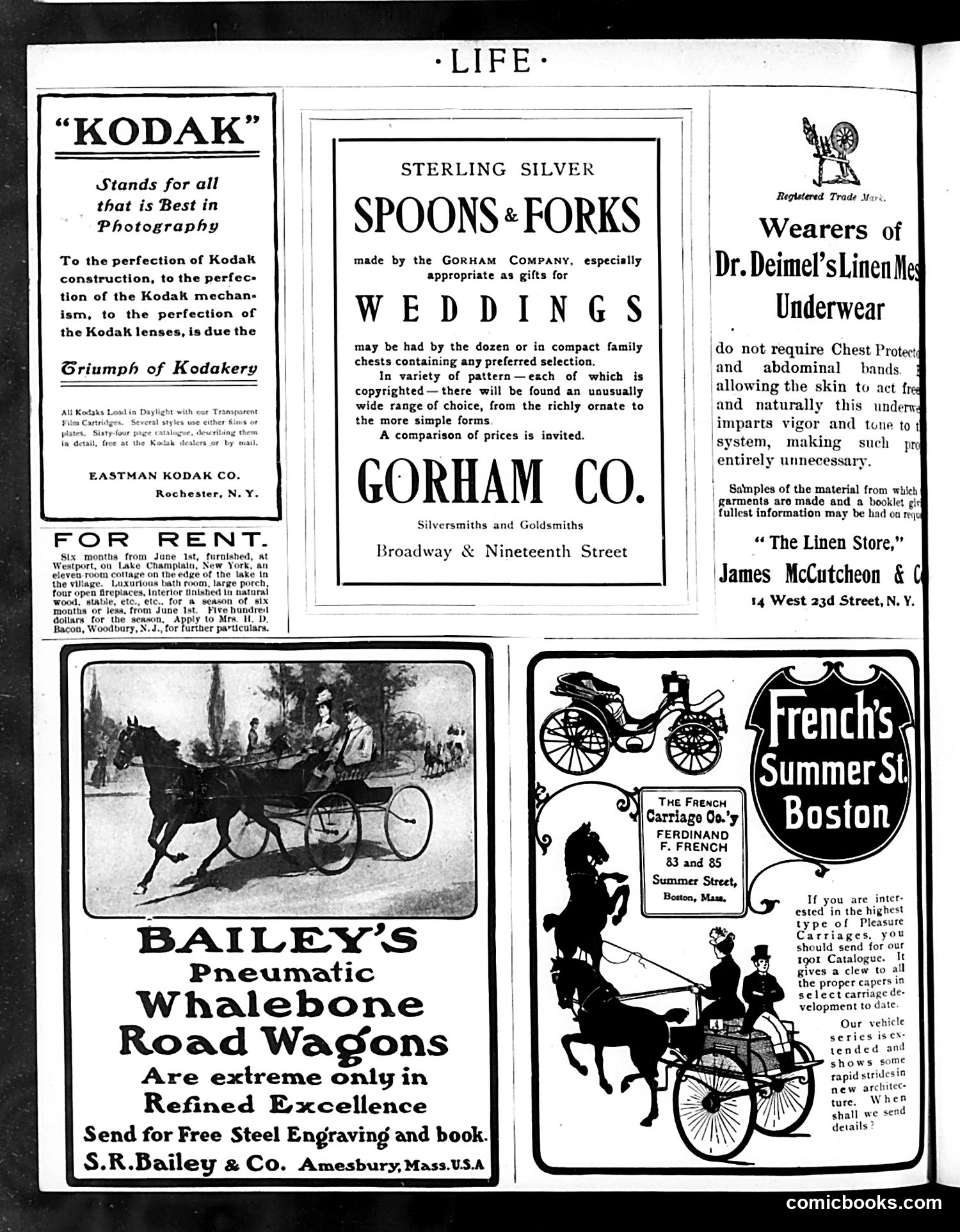
This page is **primarily advertising**, not editorial satire. It contains five advertisements: 1. **Kodak** - photography equipment 2. **Gorham Company** - sterling silver spoons and forks for weddings 3. **Dr. Deimel's Linen Mesh** - underwear 4. **Bailey's Pneumatic Whalebone Road Wagons** - horse-drawn vehicles 5. **French's Carriage Company** (Boston) - custom carriages The only visual element with narrative quality is Bailey's advertisement, which shows a horse-drawn wagon photograph. There is **no political cartoon or satire** on this page. The content reflects early 20th-century luxury goods marketed to affluent readers, with emphasis on wedding gifts, fine carriages, and quality photography equipment.
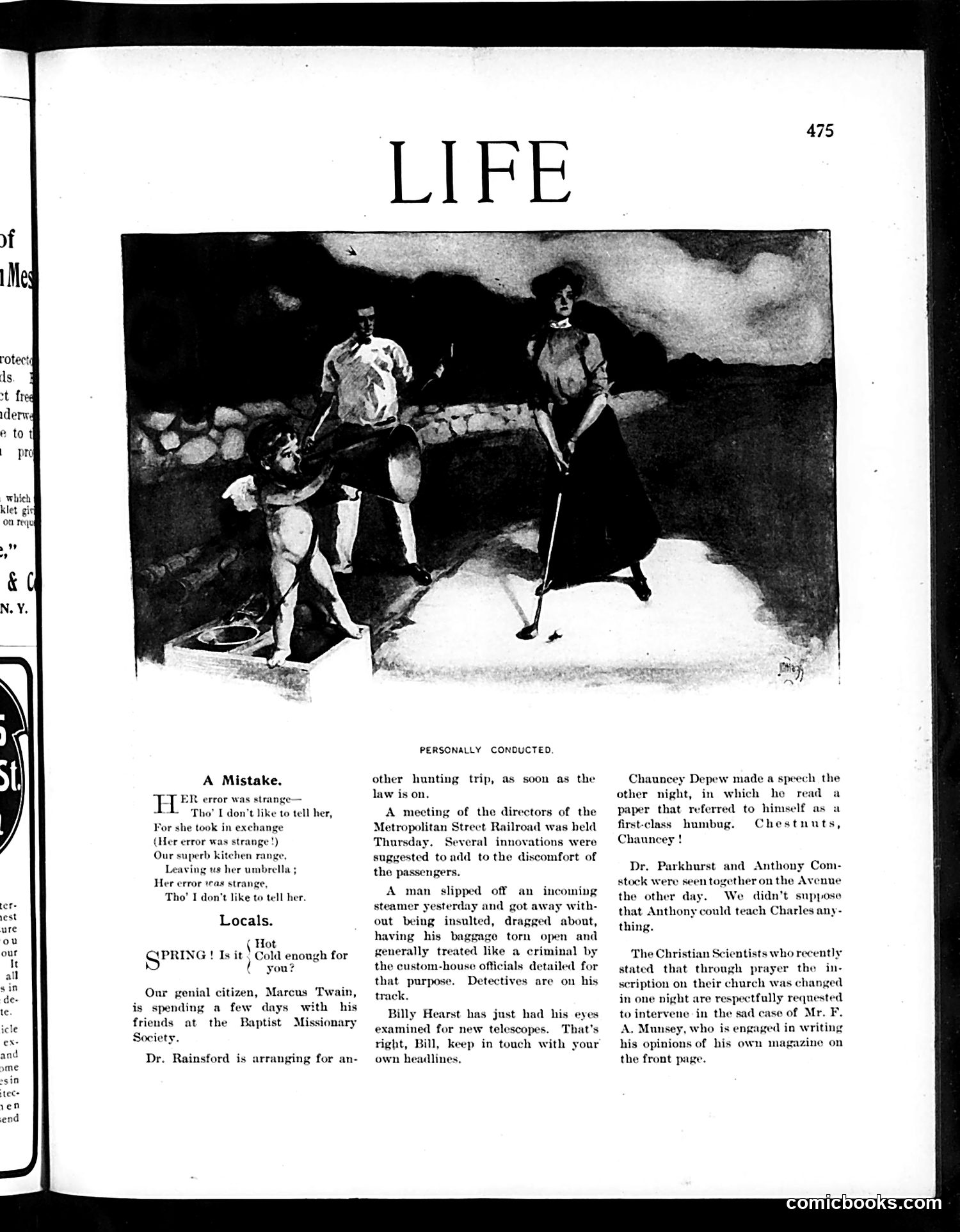
The illustration titled "Personally Conducted" depicts what appears to be a guided tour or excursion gone wrong. Four figures are shown in a nighttime scene with stone walls, suggesting either a cave, dungeon, or historical site. The composition and title suggest this is satirizing the experience of organized tours—likely poking fun at incompetent or poorly-managed tourist guides. The accompanying text sections ("A Mistake," "Locals," "Chauncey Depew") are brief humorous anecdotes rather than political commentary. They reference social figures like Marcus Twain and Billy Hearst, suggesting this is general satirical commentary on contemporary American society rather than focused political satire. The overall page content appears to be miscellaneous social humor typical of Life magazine's format.
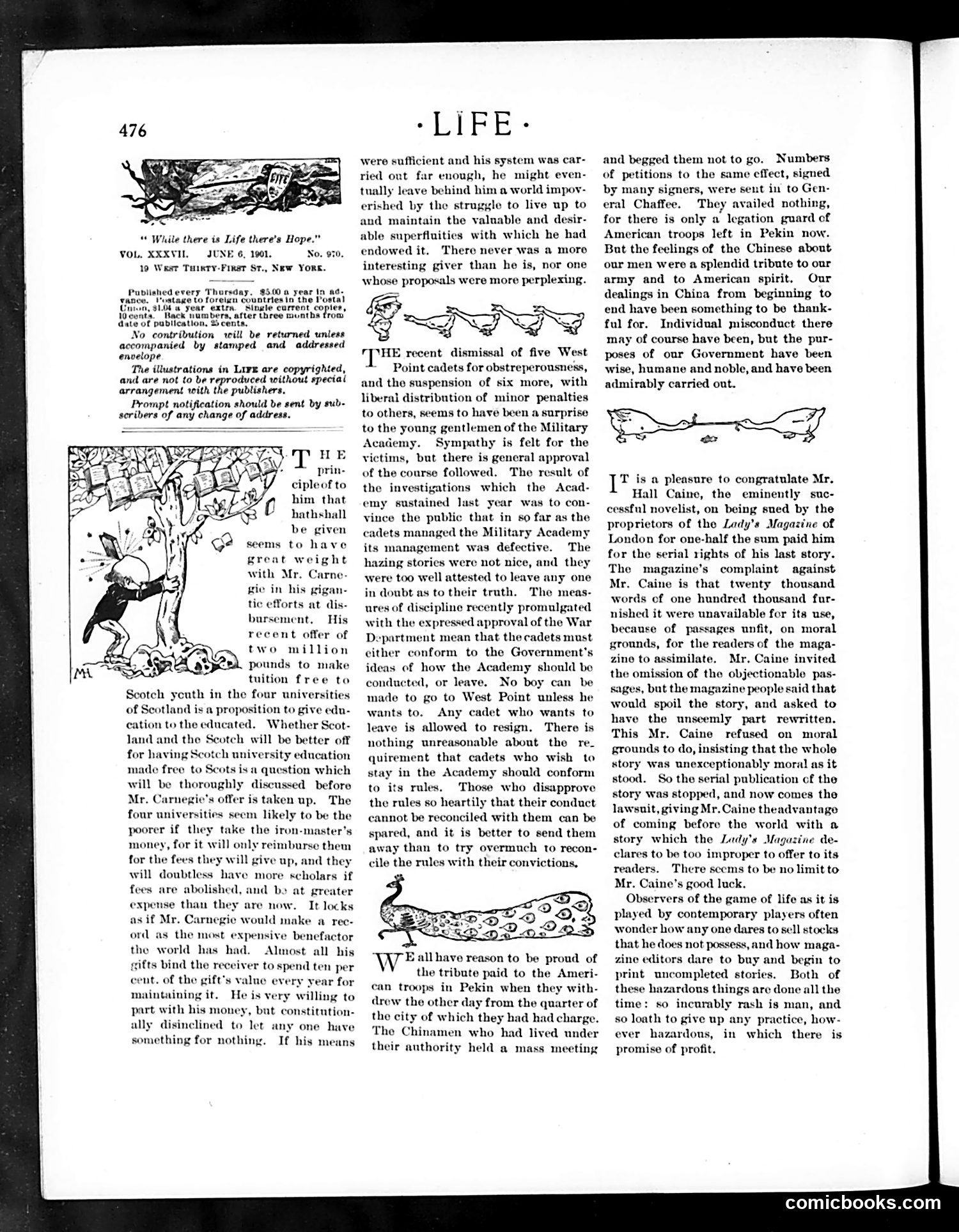
This page contains two main political cartoons and editorial commentary about early-1900s American military affairs. The left cartoon depicts a **Scottish figure** being offered a university education proposition, likely satirizing debates over Scottish educational independence versus British control. The right section discusses the **dismissal of five West Point cadets** for infractions, praising the Military Academy's disciplinary standards. The text defends strict cadet conduct rules and criticizes those who questioned the severity of punishments. The page also includes commentary **congratulating novelist Hall Caine** for refusing to allow his work *Lad's Tragedy* to be used in a questionable magazine context—praising his moral integrity. The overall tone reflects Progressive Era concerns about institutional discipline, moral standards, and American military preparedness during the post-Spanish American War period.
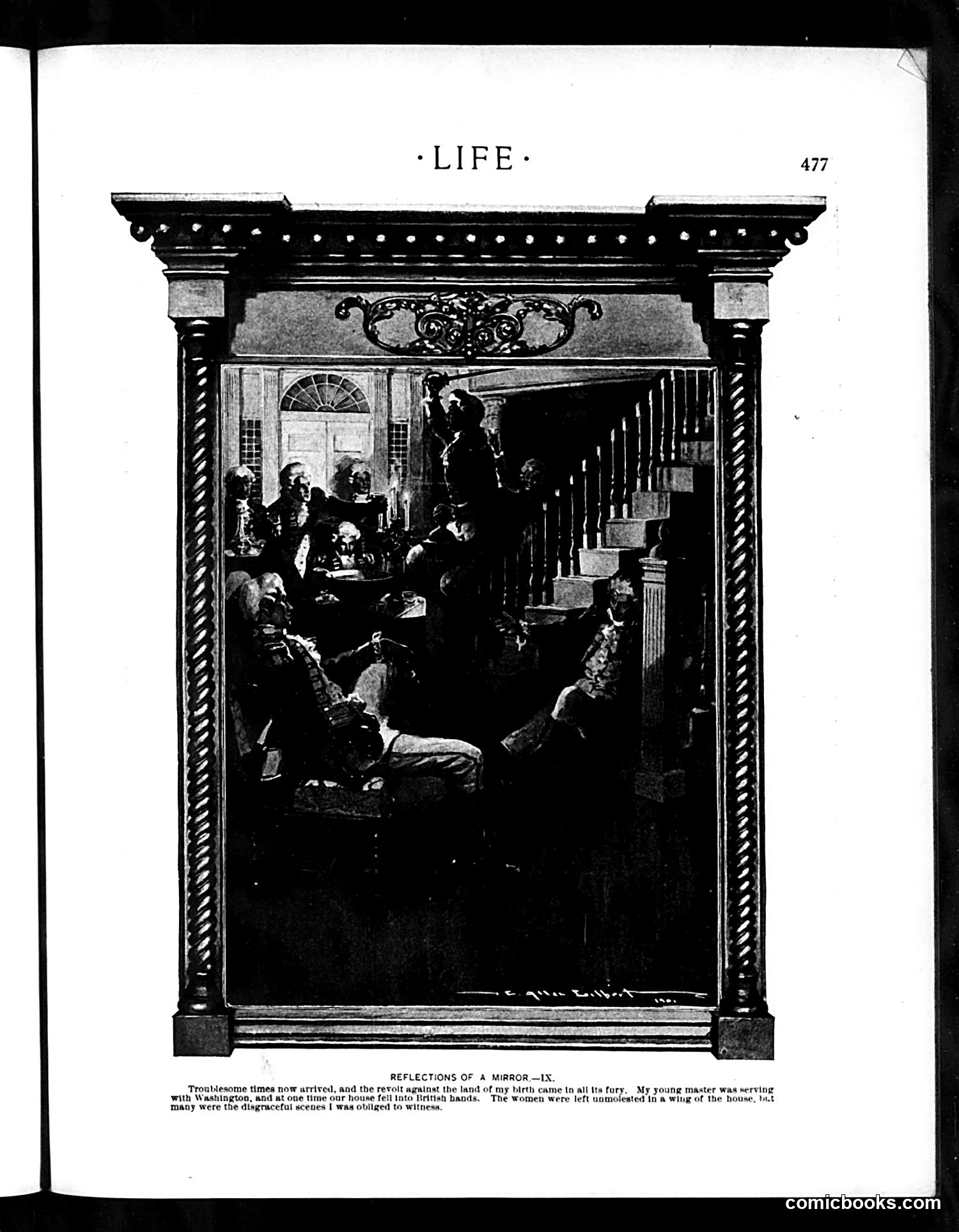
This satirical illustration depicts a parlor scene during the American Revolutionary period. The caption references "troublesome times" and mentions Washington, British occupation, and a house being commandeered by military forces. The scene shows civilians gathered indoors while a young master writes—likely documenting or witnessing significant historical events. Women are segregated in a separate wing, and the composition suggests the disruption of domestic life during wartime occupation. The "mirror" concept (suggested by the title) appears to reflect on how Revolutionary War chaos invaded American homes. The formal architectural framing emphasizes the contrast between civilized domestic space and the violence of military conflict intruding upon it. This likely satirizes the personal toll of the Revolution on ordinary citizens rather than grand military narratives.
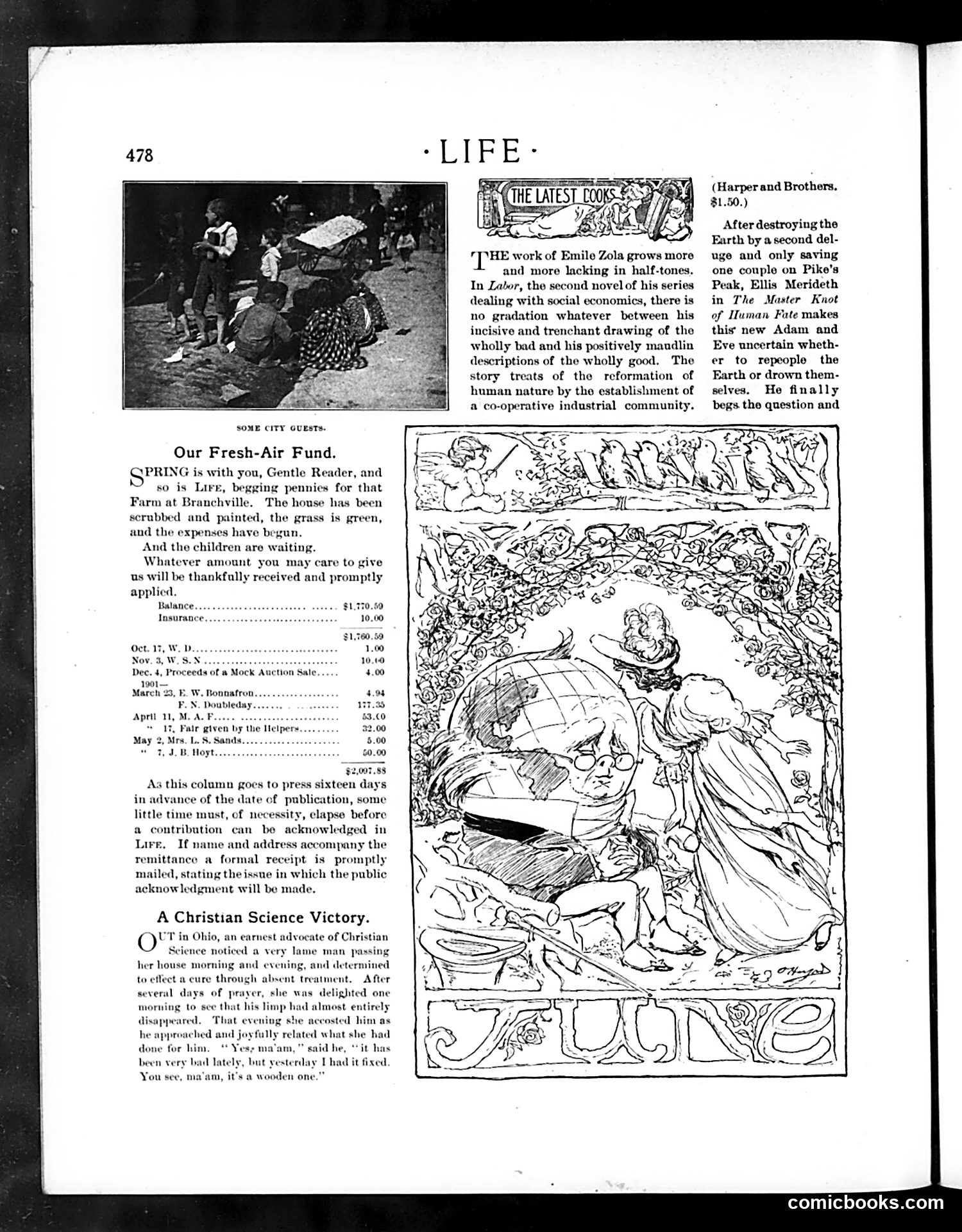
This page contains three distinct sections: 1. **"The Latest Cooks"** - A literary review discussing Emile Zola's novel *Labor*, critiquing his writing style as lacking nuance and containing overly harsh character descriptions. The reviewer mentions another book, *The Master Knot of Human Fate*. 2. **"Some City Guests"** and **"Our Fresh-Air Fund"** - A charitable fundraising column listing donations to send poor children from the city to a farm in Branchville for fresh air and rest. The amounts are small (ranging from $1 to $177.50), typical of modest middle-class charitable giving. 3. **"A Christian Science Victory"** - A humorous anecdote about an Ohio Christian Scientist woman who cures a lame man through prayer rather than medical treatment, satirizing Christian Science's faith-healing claims. The illustrated material appears decorative rather than directly satirical.
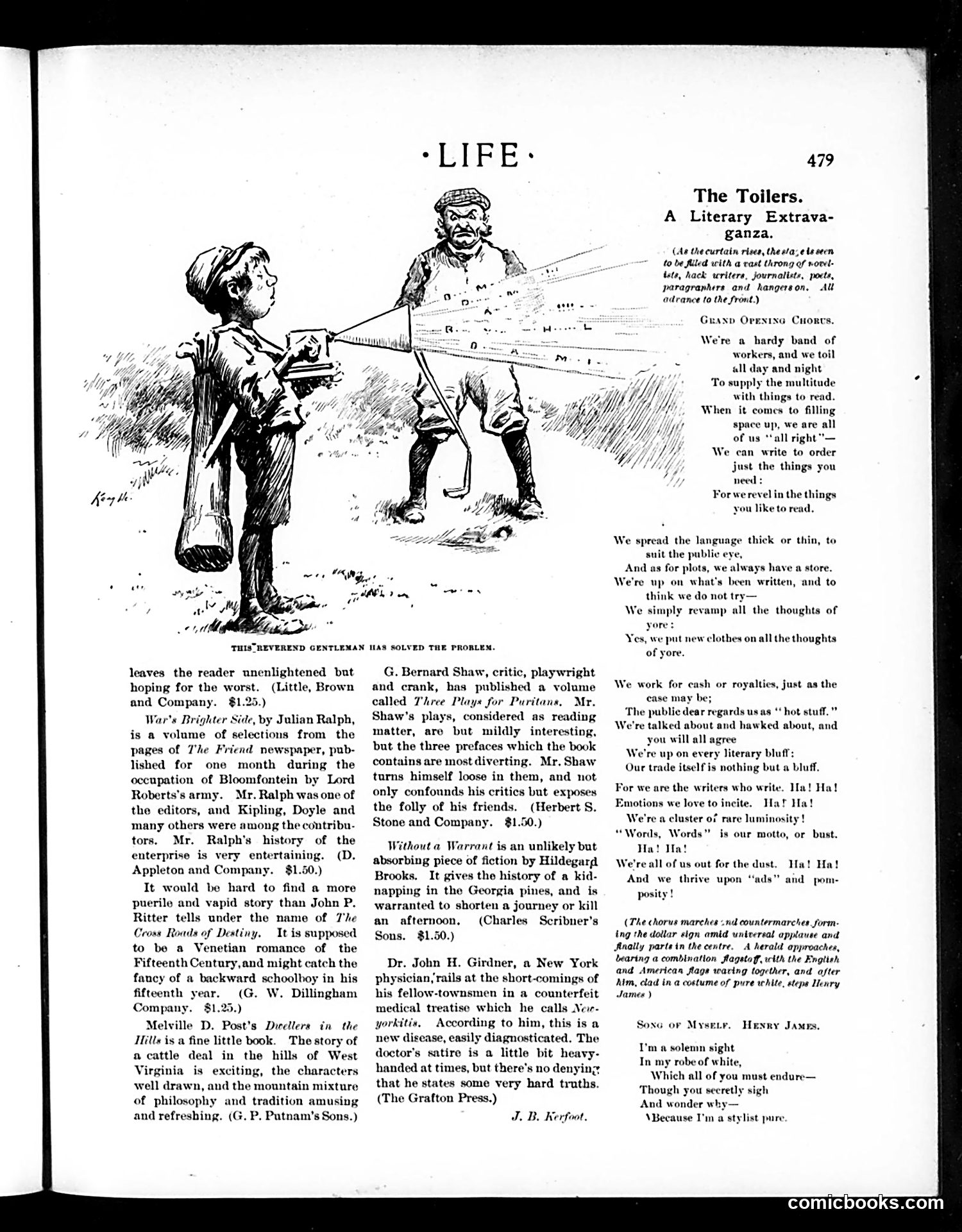
This cartoon satirizes literary magazine editors and their contributors. The illustration shows a clergyman firing a cannon labeled with letters (representing text) at another figure, with the caption suggesting he has "solved the problem" of filling magazine space. The accompanying text, "The Toilers: A Literary Extravaganza," is a mock-heroic poem by the magazine's writers celebrating their own labor. They boast of being "a hardy band of toilers" who work "for cash or royalties," write on demand, and fill pages with whatever content suits readers' tastes—whether serious literature or mere "ads" and sensationalism. The satire mocks both editors desperate to fill pages and writers willing to produce mediocre work commercially.
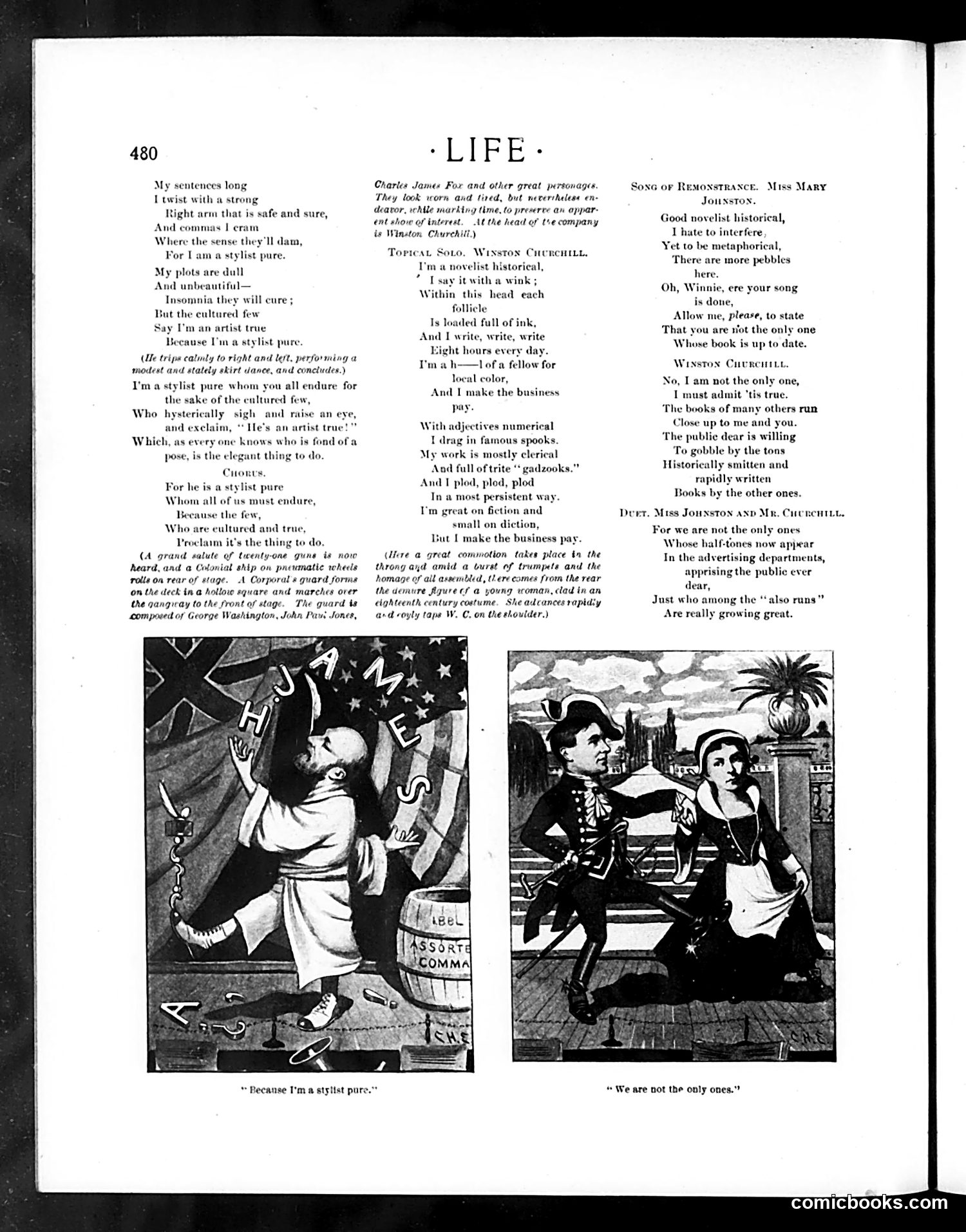
This page presents a humorous debate about literary stylists. The left cartoon depicts a figure juggling letters and punctuation marks, labeled "Because I'm a stylist pure"—mocking writers who prioritize ornate style over substance. The right cartoon shows two figures in period costume labeled "We are not the only ones," suggesting that stylistic pretension isn't unique to contemporary writers. The dialogue above satirizes "stylist pure" writers who prioritize elegant form over meaningful content. Churchill is quoted defending novelists, while Johnston argues that many books deserve updating. The satire targets the literary debate of the era: whether writers should focus on beautiful prose or practical, accessible storytelling. The overall message critiques excessive stylistic flourishes as self-indulgent and disconnected from actual readership needs.
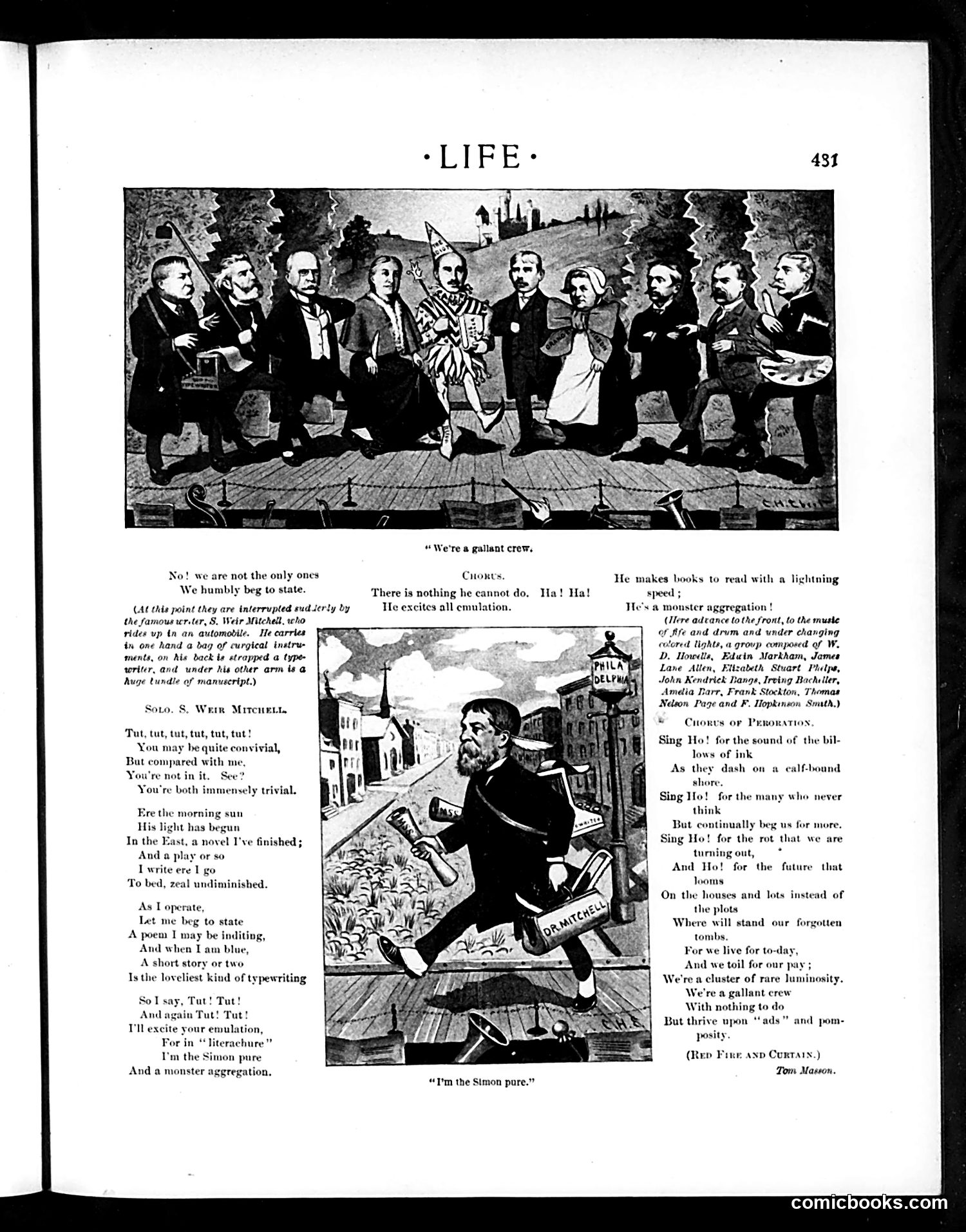
This page satirizes literary pretension, particularly targeting prolific authors of the era. The top cartoon shows a group of men in formal dress labeled "We're a gallant crew," likely representing contemporary writers competing for acclaim. The central illustration depicts a caricatured author (labeled "I'm the Simon pure") surrounded by manuscript pages, working frantically at his desk. The accompanying poem by S. Weir Mitchell mocks writers who produce excessive volumes of mediocre work, boasting about novels, plays, and poems simultaneously. The satire critiques the publishing industry's reward of quantity over quality—writers churning out numerous works ("excite your emulation") while claiming artistic integrity. The "Simon pure" reference means genuine/authentic, ironically applied to someone clearly manufacturing content rather than creating meaningful literature.
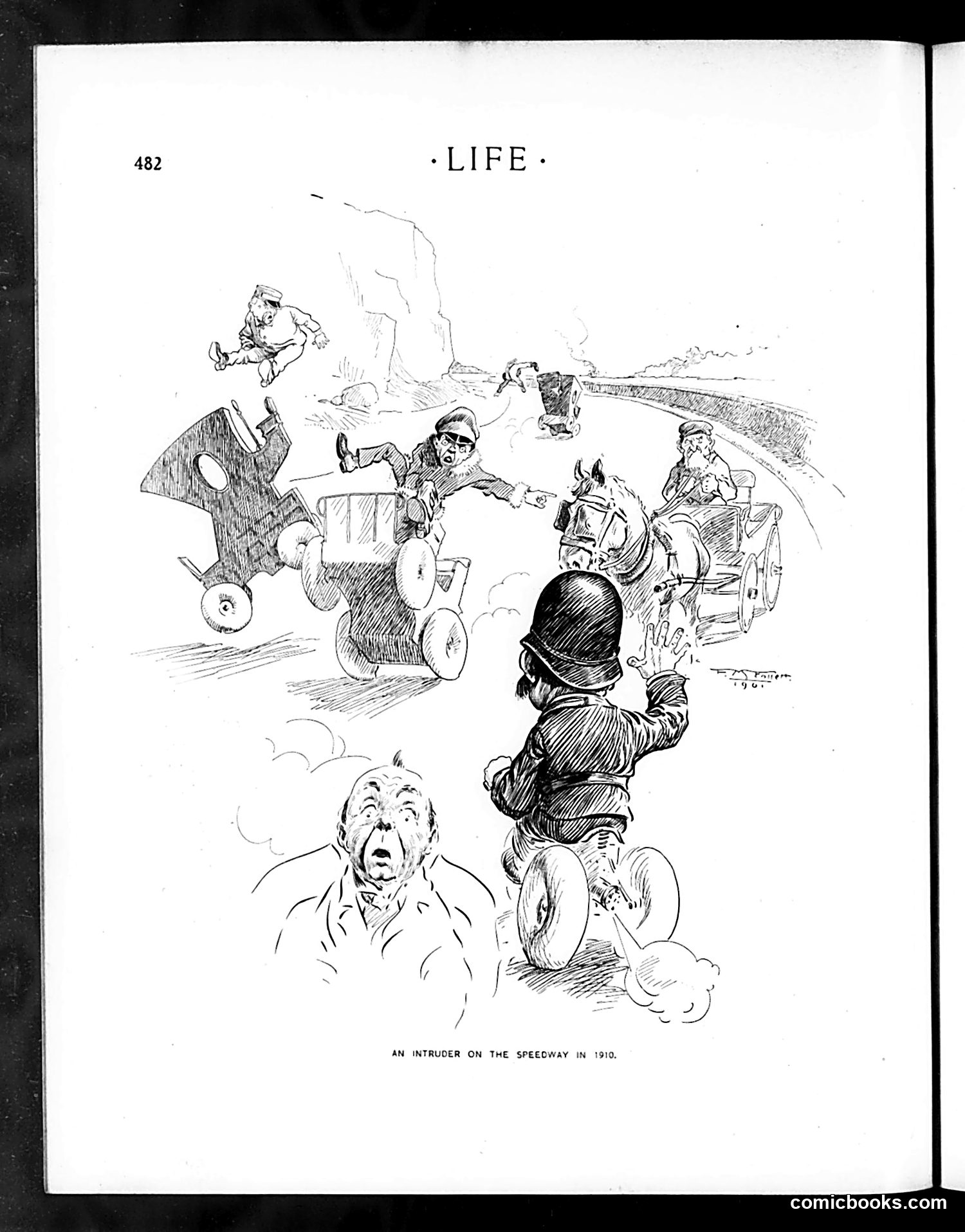
This satirical cartoon depicts early automobile racing culture circa 1910. The image shows speeding motorists on a racetrack, with various vehicles moving at dangerous velocities. The central figure—a man in a bowler hat positioned prominently in the foreground with an expression of shock or alarm—appears to represent an unsuspecting pedestrian or intruder who has wandered onto the active speedway. His shocked face contrasts with the reckless drivers behind him who seem oblivious to danger. The satire likely mocks both the hazardous nature of early auto racing and the careless attitude of motorists toward public safety. The "intruder" represents the vulnerability of ordinary people in an era when automobiles were becoming dangerously fast and racing was increasingly popular, with little regard for bystander safety.
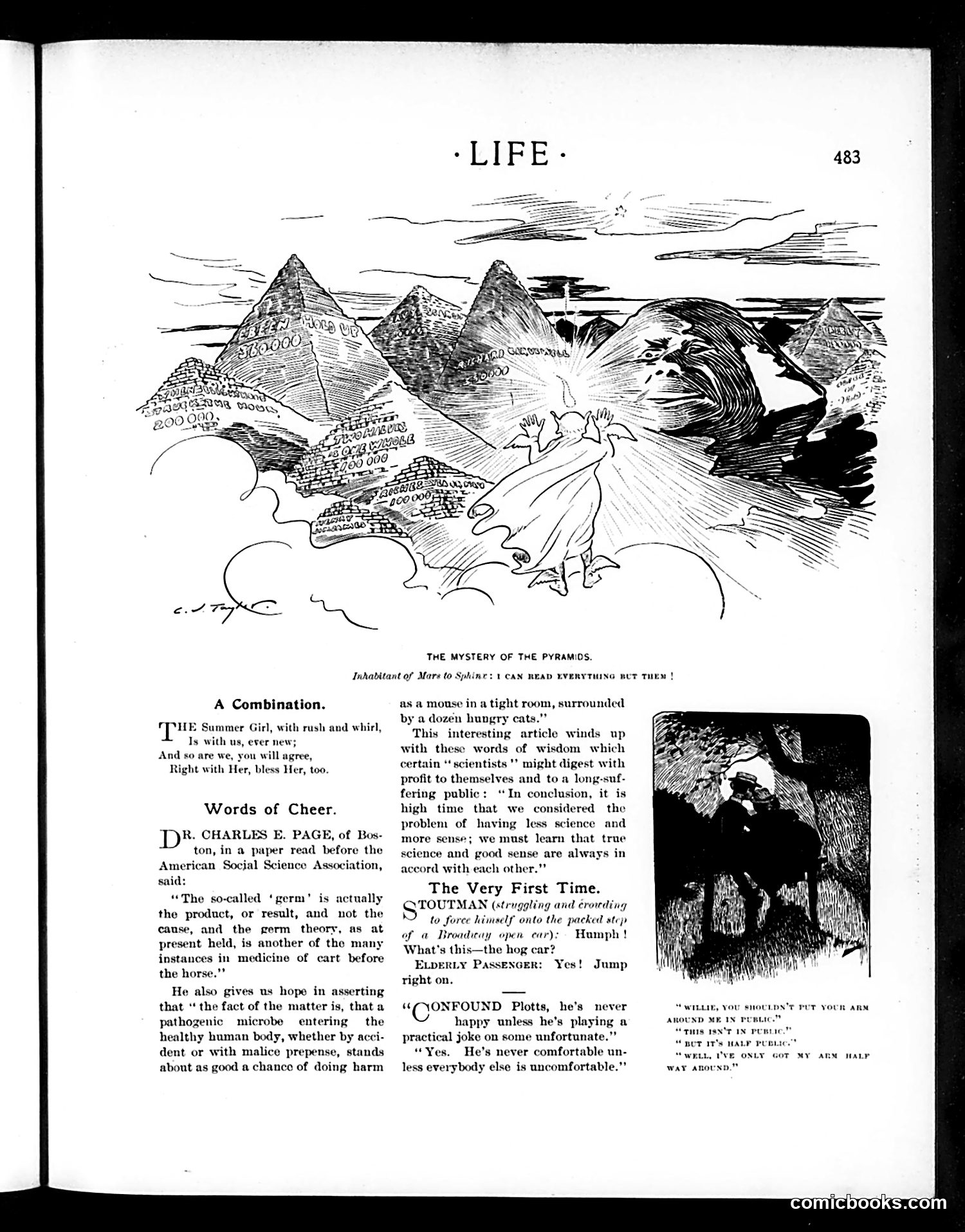
**The Main Cartoon ("Mystery of the Pyramids"):** A figure stands surrounded by Egyptian pyramids covered in numerical calculations, declaring "I can read everything but them!" This satirizes pseudo-scientific attempts to decode hidden meanings in the pyramids—a popular craze of the era. The joke mocks those who claim special knowledge while remaining baffled by the actual subject. **"Words of Cheer":** This section ridicules Dr. Charles E. Page's dismissal of germ theory, quoting his absurd claim that germs entering a healthy body have "about as good a chance of doing harm as a mouse in a tight room surrounded by a dozen hungry cats." Life satirizes this anti-scientific nonsense by presenting it as folly masquerading as wisdom. **"The Very First Time":** A brief comedic sketch about a man forcing himself onto an overcrowded streetcar, sarcastically called the "hog car." **"Confound Plotts":** A joke about a man who enjoys practical jokes specifically because they make others uncomfortable. The page critiques pseudoscience and celebrates common sense over false expertise.
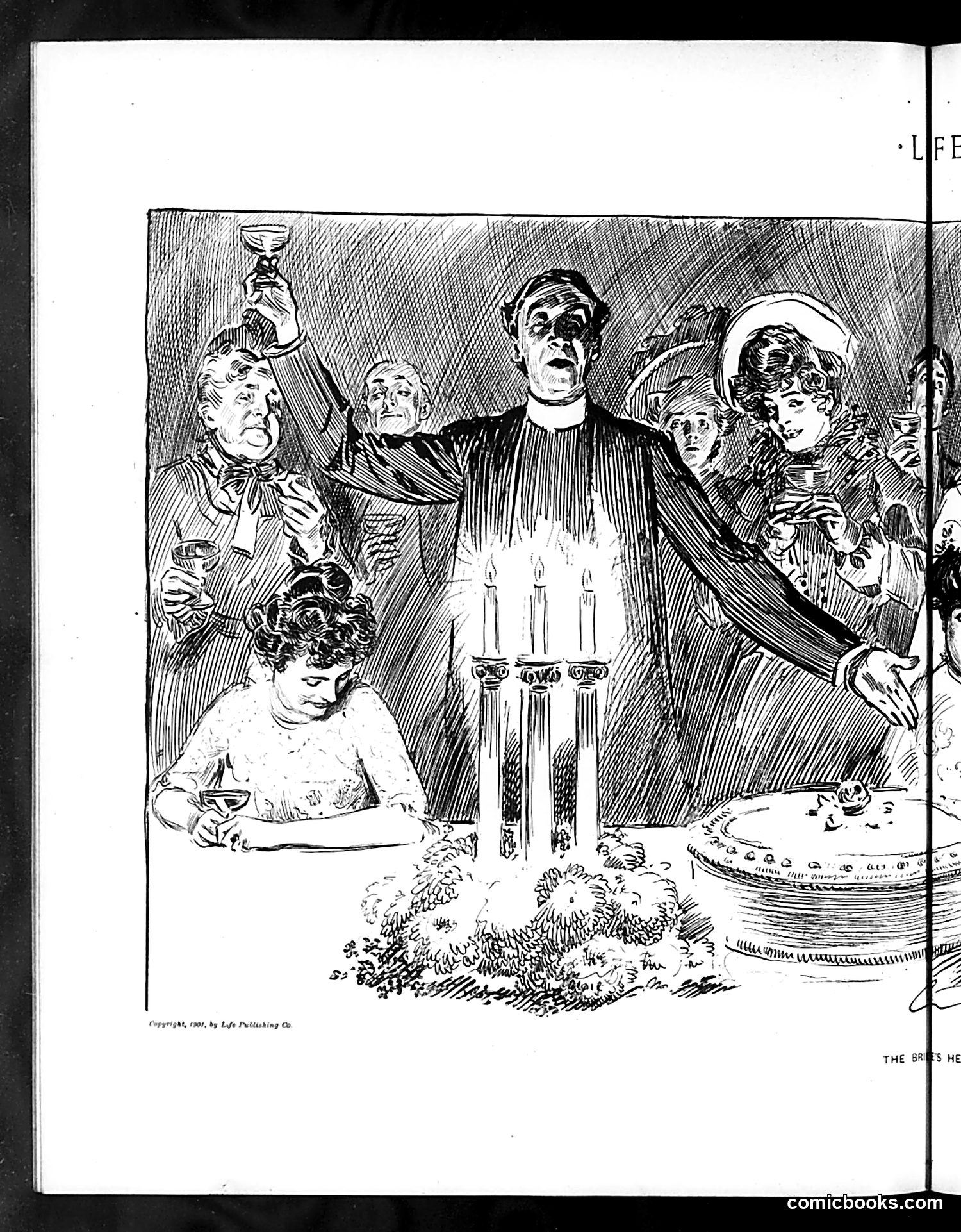
This is a satirical illustration depicting a formal dinner or religious ceremony. A priest or clergyman in robes stands centrally at a candlelit table, surrounded by well-dressed figures in period clothing. A woman in the foreground appears to be writing or signing something. The image likely satirizes institutional authority—possibly the Catholic Church or clergy's influence over secular matters. The formal setting, candlelight, and ritualistic appearance suggest mockery of religious ceremony or influence. However, the OCR text is fragmentary ("THE SRIB'S HE" appears corrupted), making it impossible to identify the specific satire, figures, or historical reference with certainty. Without the complete caption or article text, I cannot definitively explain what political or social issue this cartoon addresses or who these individuals represent. The artwork style and publication in *Life* magazine suggests early-to-mid 20th century American satire.
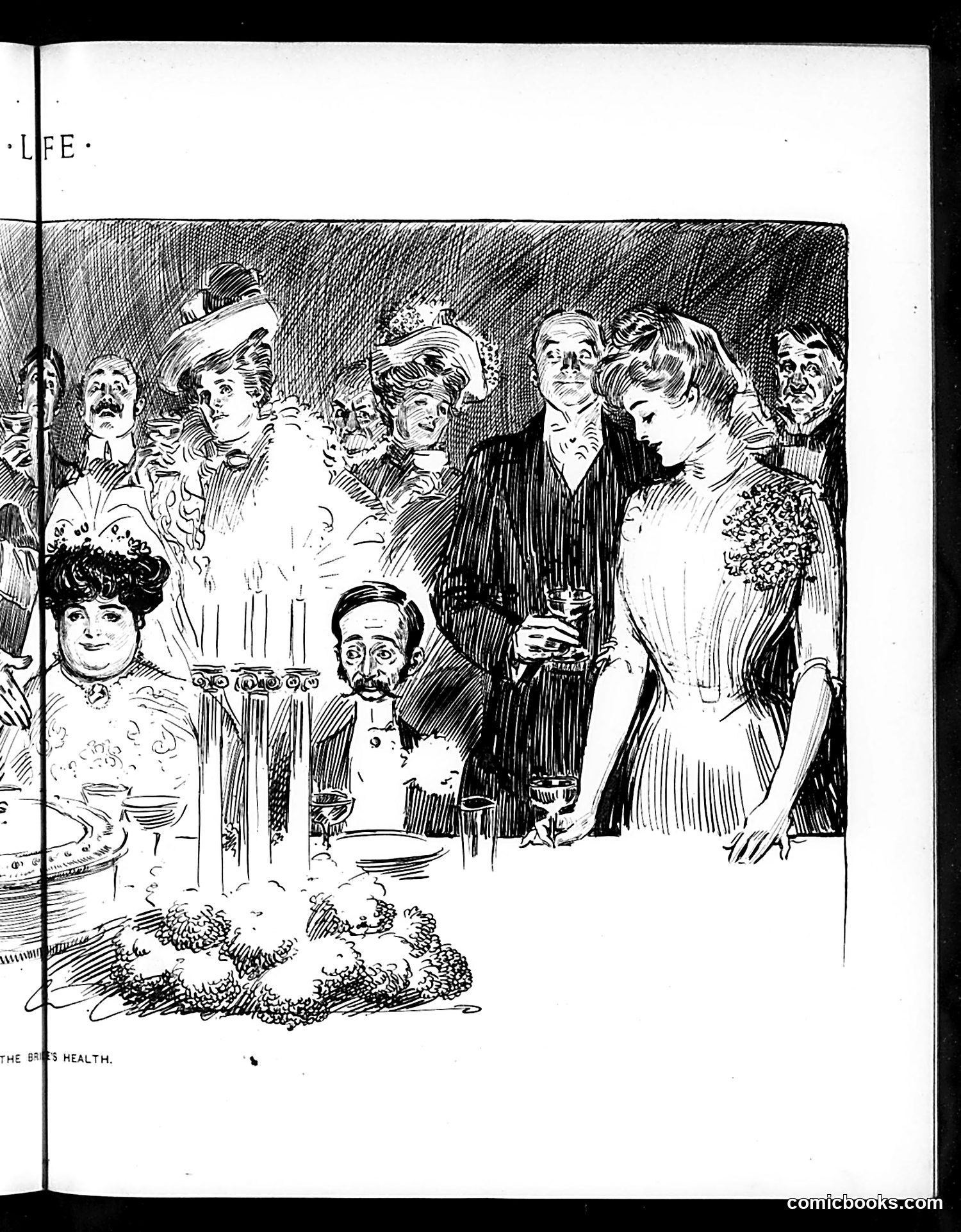
This appears to be a satirical dinner scene from Life magazine, likely early 20th century based on the art style. The caption reads "THE BRIS HEALTH" (possibly "BRIT'S HEALTH"), suggesting this depicts a formal British social gathering or toast. The cartoon shows well-dressed men and women at a formal dinner table with candelabra and place settings. The figures display exaggerated facial features typical of period caricature—a common technique for satirizing prominent individuals, though their specific identities are unclear from the image alone. The satire likely mocks British social pretension, dining customs, or specific political figures of the era, but without additional context or clearer identification of the caricatured figures, the precise target and meaning remain uncertain. The formal setting contrasts with the somewhat crude artistic treatment, suggesting social commentary on upper-class behavior.
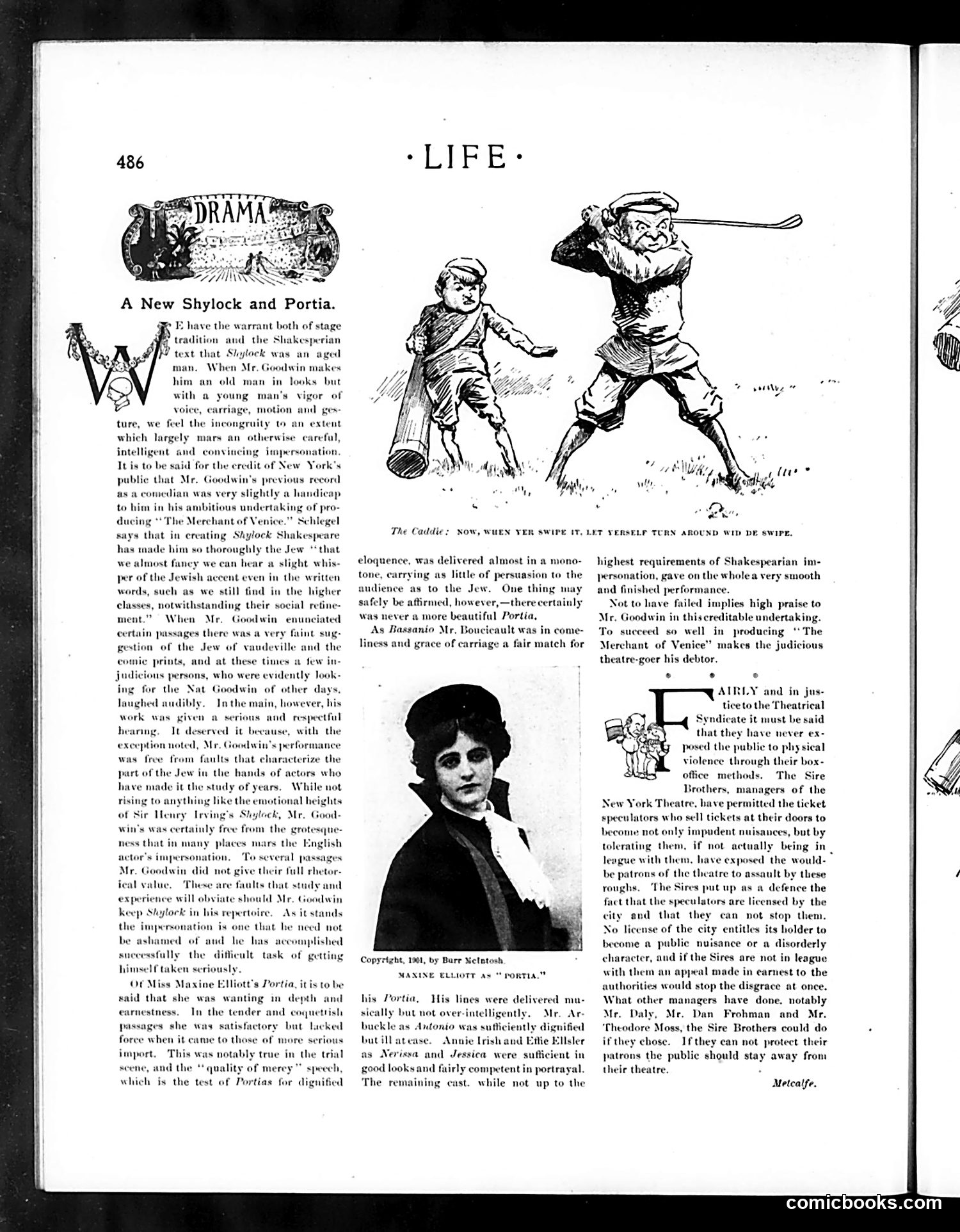
This page contains **drama criticism** (not political satire) reviewing a 1901 production of Shakespeare's *The Merchant of Venice* starring actor Mr. Goodwin as Shylock and actress Maxine Elliott as Portia. The two cartoon illustrations show **comedic depictions of the "Caddie"** (ticket scalper/speculator)—a contemporary social nuisance operating outside theaters. The caption jokes about the scalper's aggressive tactics: "Now, when yer swipe it, let yerself turn around wid de swipe" (mockingly using exaggerated dialect to satirize the ticket scalper's behavior). The accompanying text criticizes the **Theatrical Syndicate's tolerance** of these scalpers operating at theater doors, calling them "impudent nuisances" who harass the public. This was a real Progressive Era complaint about monopolistic theater practices enabling street-level crime and harassment. The drama review itself praises Goodwin's serious approach to Shylock while noting minor faults in his performance and criticizing Elliott's Portia as beautiful but emotionally shallow.
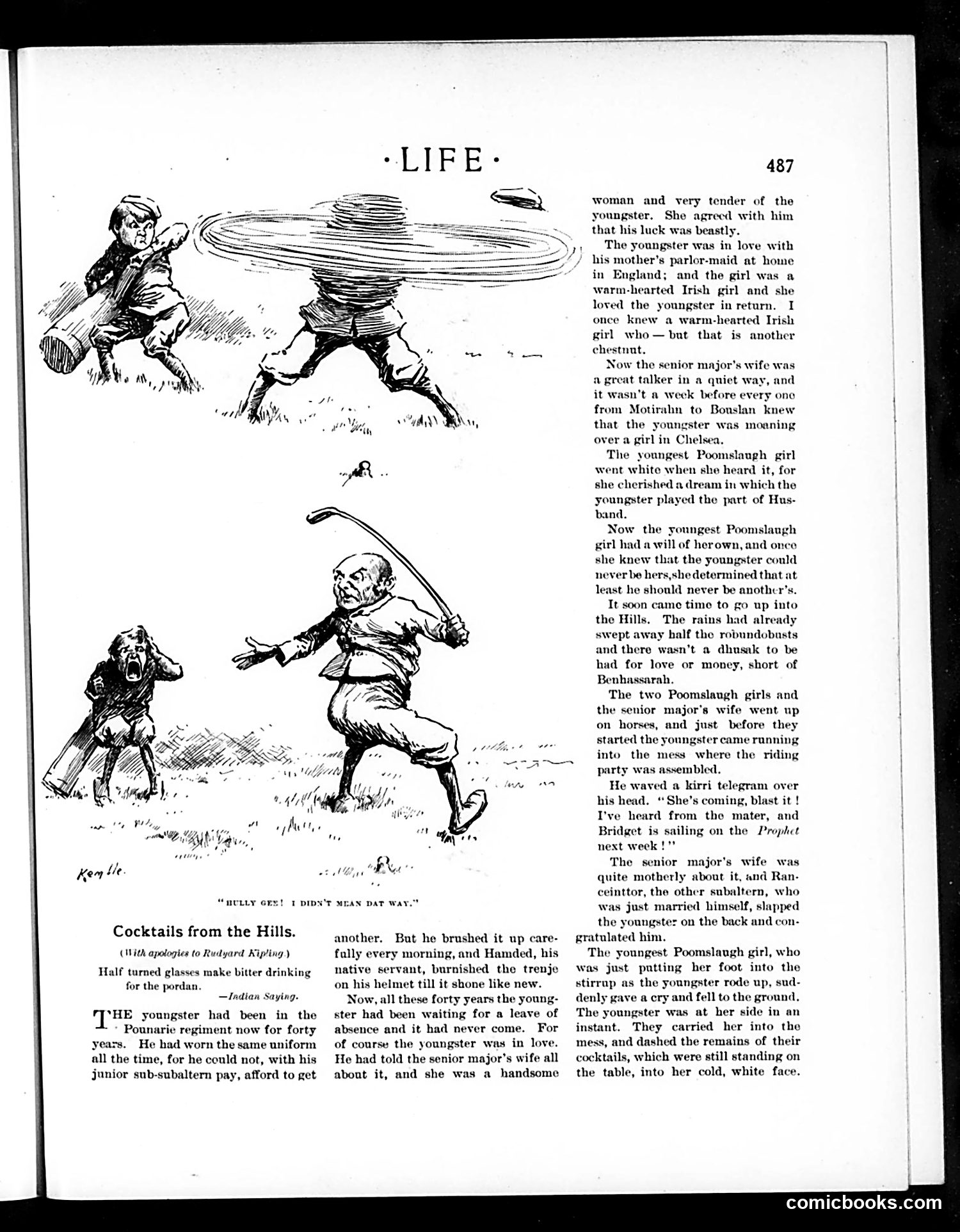
This is a satirical short story (not a political cartoon) parodying Rudyard Kipling's colonial Indian tales. The narrative follows a British Army subaltern stationed in India for forty years, pining for an English parlor maid named Bridget. A rival—the youngest Poomslaugh girl—also loves him and, learning he can never be hers, apparently sabotages his happiness. The story mocks melodramatic Victorian romance and British colonial life in India, using exaggerated dialect ("Hully Gee!"), invented place names (Motirahn, Bouslan), and ridiculous plot twists. The illustrations show physical comedy: children swinging hoops and playing with sticks. The final absurdist touch—reviving the fainted girl with cocktails—satirizes both the overwrought emotions of period fiction and the casual eccentricity of imperial British society.
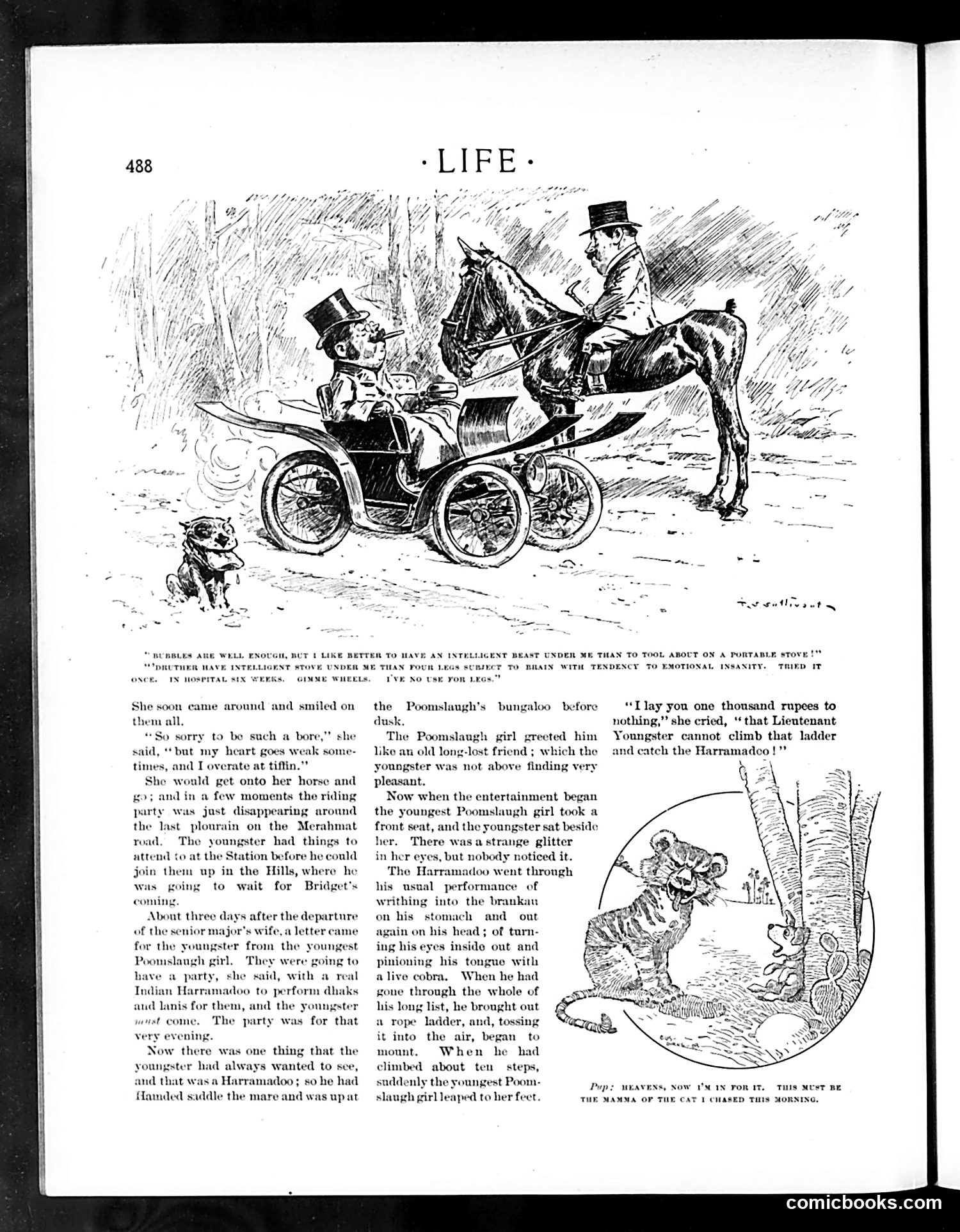
This page from *Life* magazine presents a serialized story set in colonial India, satirizing British imperial attitudes and gender dynamics of the era. **The Setup:** A young British officer ("the youngster") is invited to a social gathering by a Poomslaugh girl featuring an Indian street performer (a "Harramadoo") doing traditional acrobatic tricks with a cobra and rope ladder. **The Satire:** The top cartoon ridicules the newly-invented automobile ("portable stove") as inferior to horses for transportation and control. The dialogue contrasts the reliability of "an intelligent beast" with the unreliability of mechanical contraptions—a common early-20th-century anxiety about automobiles. **Colonial Context:** The story depicts the casual British attitude toward Indian culture as exotic entertainment. The Poomslaugh girl's sudden bet challenging the officer to climb the ladder appears designed to compromise or humiliate him, suggesting class and gender tensions within colonial society. The narrative satirizes British presumptions of superiority while hinting at underlying anxieties about loss of control—both mechanical and social.
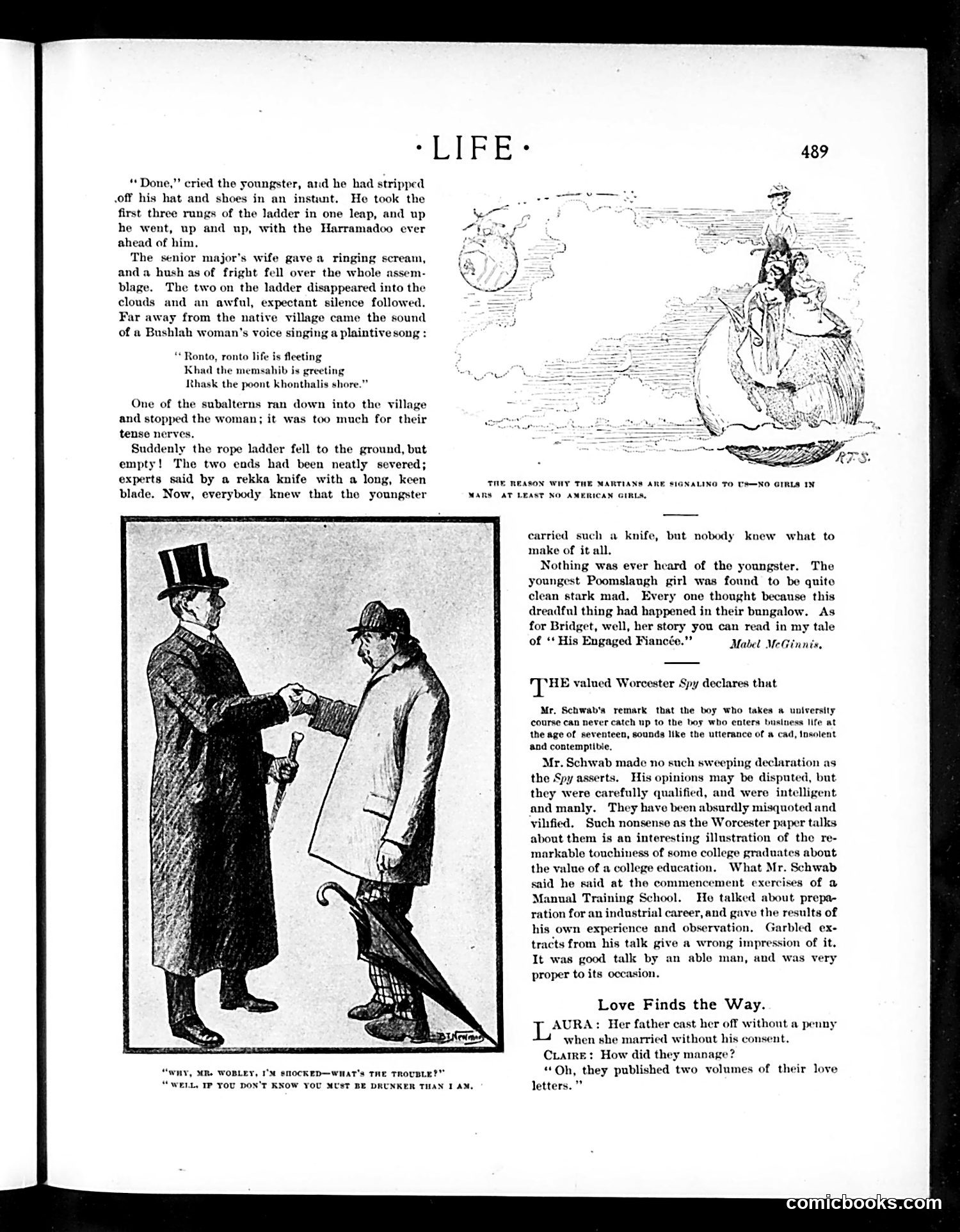
This page contains two distinct items: **Top cartoon:** A Victorian-era illustration showing two men in formal dress (top hats and coats). One appears shocked, asking "Why, Mr. Worley, I'm shocked—what's the trouble?" The other responds about drunkenness. The satire likely mocks Victorian propriety and social embarrassment over drinking—the humor lies in the absurdity of the drunk man's logic in his response. **Bottom item:** A brief comedic dialogue titled "Love Finds the Way." A wealthy father disowned his daughter for marrying without consent, yet the couple managed financially by "publishing two volumes of their love letters." The joke satirizes both romantic sentiment and commercialism—the couple capitalized on their private emotions for profit, a pointed critique of publishing trends and bourgeois sentimentality in the era. Both pieces exemplify Life's satirical approach to social manners and middle-class pretensions.
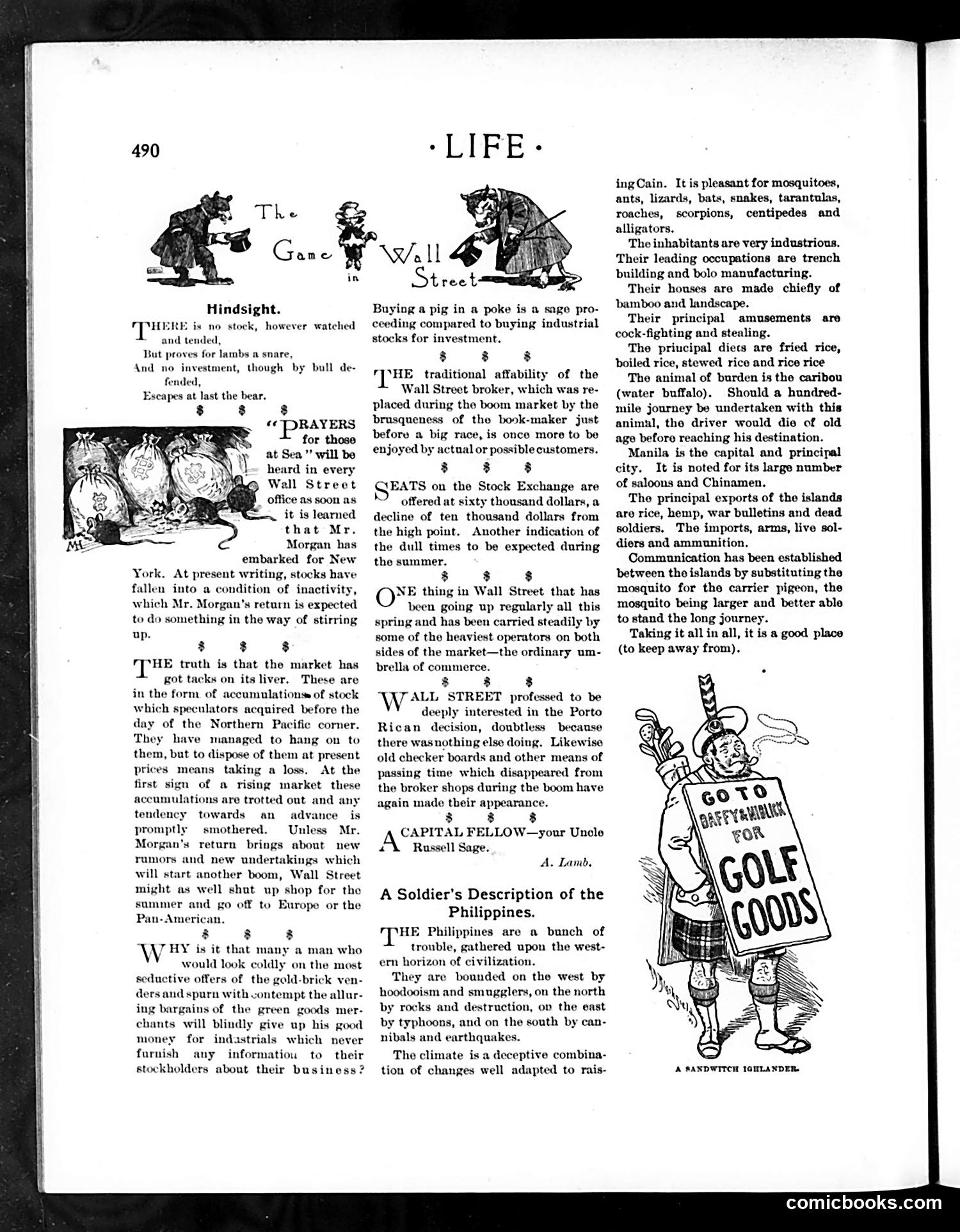
This page contains two distinct satirical pieces typical of Life magazine's early 1900s content. **"The Game Wall Street" section** mocks stock market speculation and investor naïveté. It ridicules wealthy speculators holding worthless Northern Pacific stocks, comparing buying industrial stocks to purchasing "pigs in a poke" (blind bargains). The satire targets J.P. Morgan's influence—his rumored return to New York is expected to "stir up" the dormant market. The piece criticizes investors who blindly hand money to brokers without demanding transparency about companies' actual business operations. **"A Soldier's Description of the Philippines"** uses absurdist humor to satirize American imperialism following the Spanish-American War. The Philippines are described as a chaotic land of "hoodooism," disease, and constant hardship, with inhabitants engaged in "trench building and bolo manufacturing" (weapons production). This reflects anti-imperialist sentiment—mocking both the colonial enterprise and romanticized notions of "civilizing missions" in the Pacific territories.
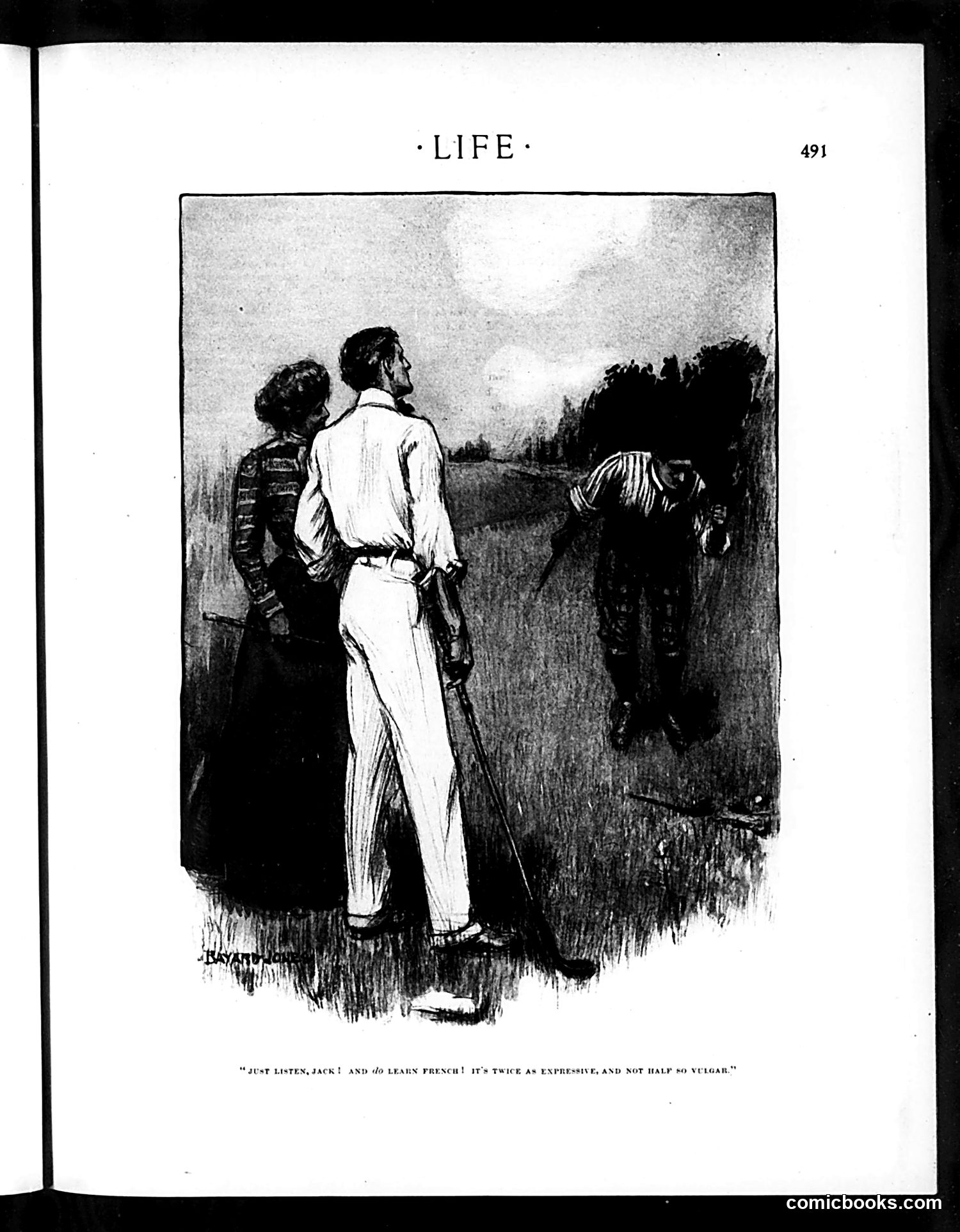
This cartoon satirizes the pretensions of upper-class Americans who adopt French mannerisms and language as markers of sophistication. The central figure in white (appearing to be a military or formal uniform) stands with two companions in a rural setting, listening to someone instructing him to learn French because it's "more expressive and not half so vulgar" than English. The joke mocks the snobbish assumption that French is inherently more refined—a common attitude among wealthy Americans of the early 20th century who viewed European culture as superior. The rural setting emphasizes the absurdity: even in casual outdoor contexts, this character advocates for affected Francophilia. The satire targets class pretension and the performative adoption of foreign affectations as markers of respectability.
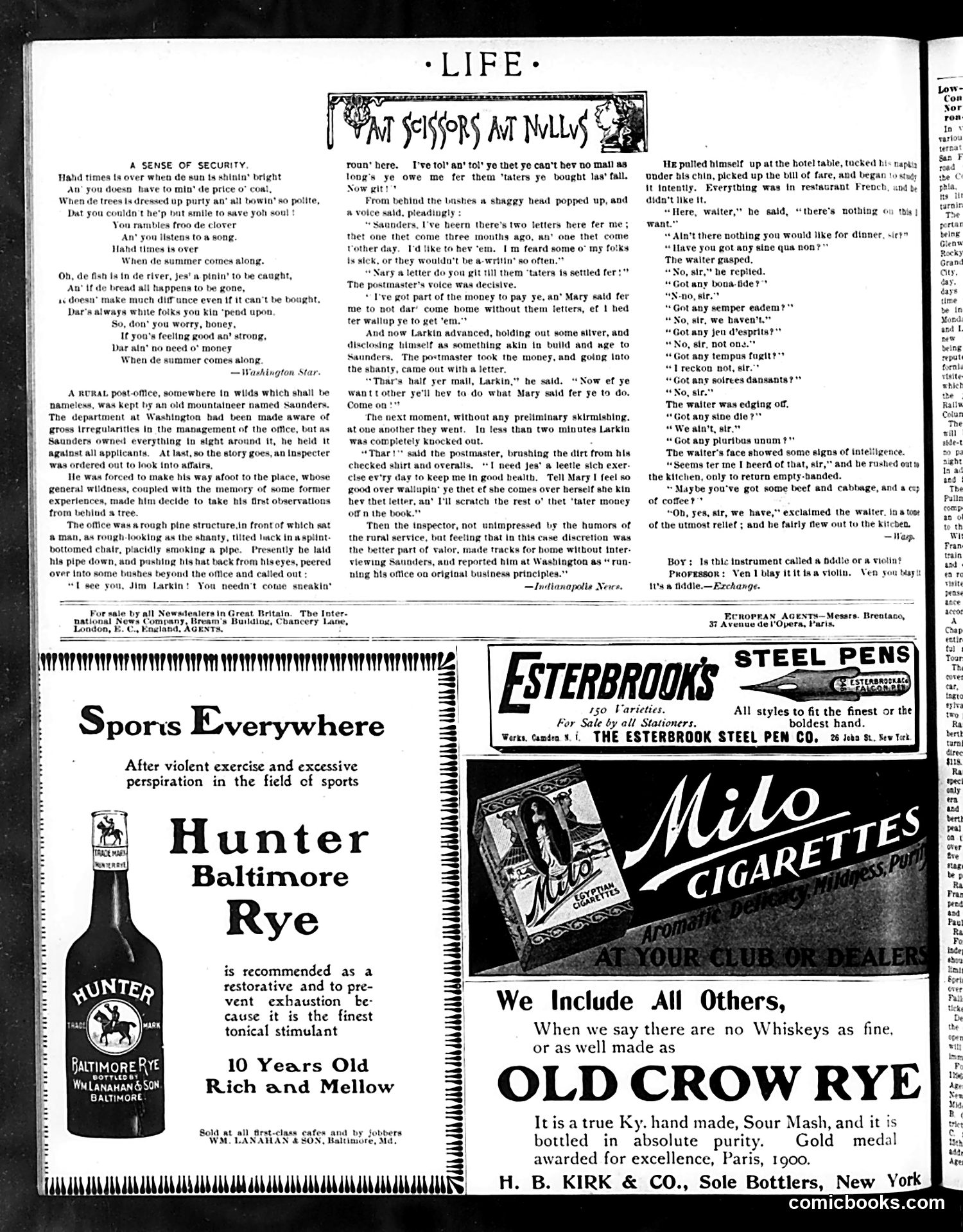
This page features a multi-panel cartoon about a rural postmaster named Saunders who physically beats a patron, Jim Larkin, to collect a debt for potatoes before releasing his mail. **The Satire's Point:** The humor mocks the rough justice and informal power dynamics of remote rural America. Saunders operates his post office as personal fiefdom—withholding mail as debt collection and using violence as acceptable dispute resolution. The inspector sent from Washington to investigate corruption ultimately deems Saunders's brutality acceptable "original business principles," implying that federal oversight is toothless against entrenched rural strongmen. **Historical Context:** This reflects early 20th-century critiques of: - Post office corruption and patronage - Rural lawlessness beyond federal authority - The gap between Washington bureaucracy and frontier reality The broader page contains period advertising (whiskey, cigarettes, steel pens) and a poem celebrating rural life without money worries—creating ironic contrast with the cartoon's depiction of rural economic coercion.
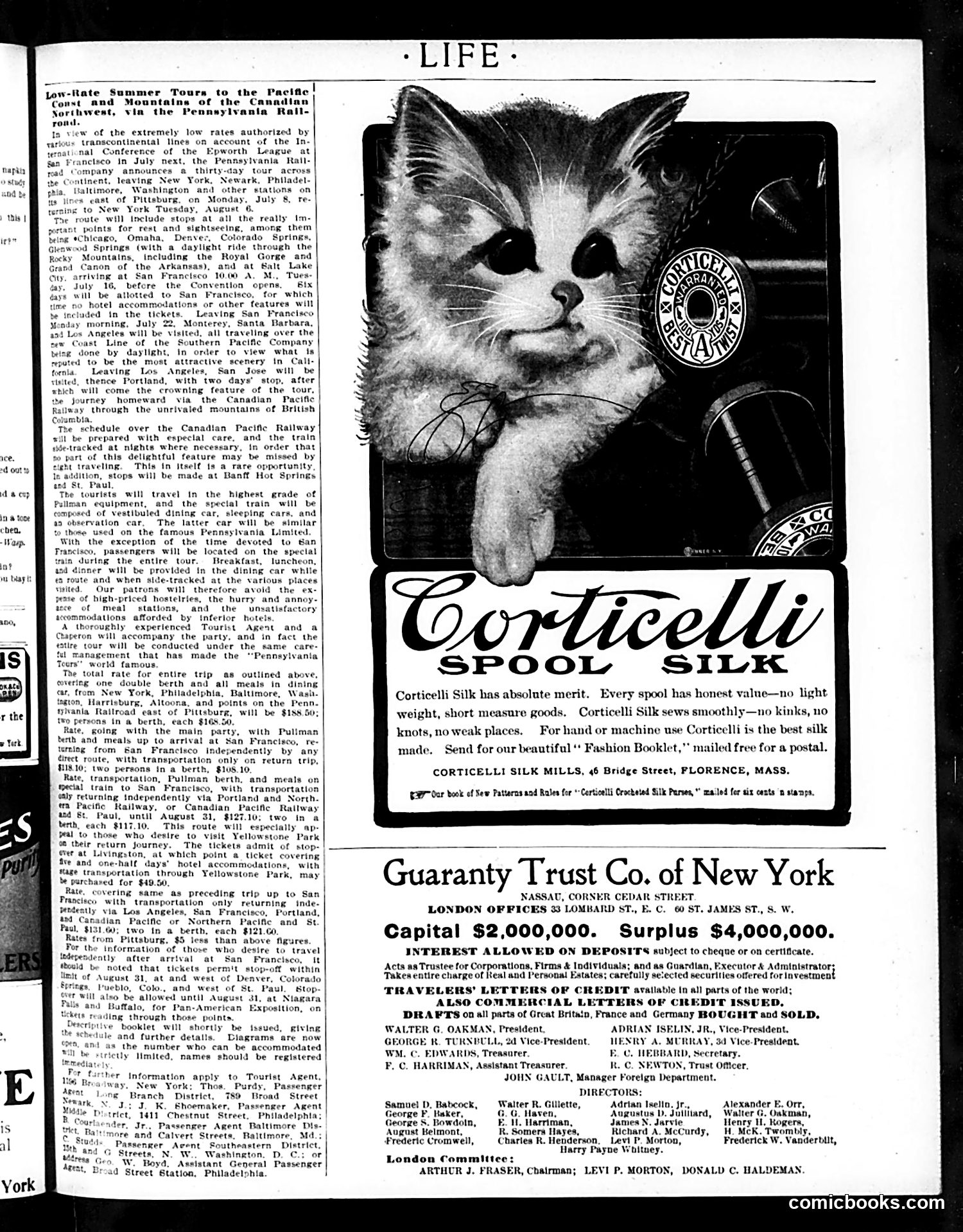
This page is **primarily advertising and travel promotion**, not satirical content. The main image shows a **Corticelli Silk spool advertisement** featuring an artistic photograph of silk thread or fabric with the company's circular logo. The accompanying text emphasizes product quality ("absolute merit," "no kinks, no knots"). Below that is a **Guaranty Trust Co. of New York advertisement** promoting banking services including travelers' letters of credit and commercial letters of credit—standard financial services for affluent travelers. The dominant text column describes **low-rate Pennsylvania Railroad summer tours** to the Pacific Coast and Canadian Rockies, timed to coincide with the 1907 Epworth League Convention in San Francisco. This is straightforward promotional material detailing itineraries, pricing ($188.50-$127.10), and amenities. **No political satire or cartoon commentary appears on this page.** It represents a typical early-20th-century *Life* magazine layout mixing travel promotion, luxury goods advertising, and banking services aimed at affluent Americans.
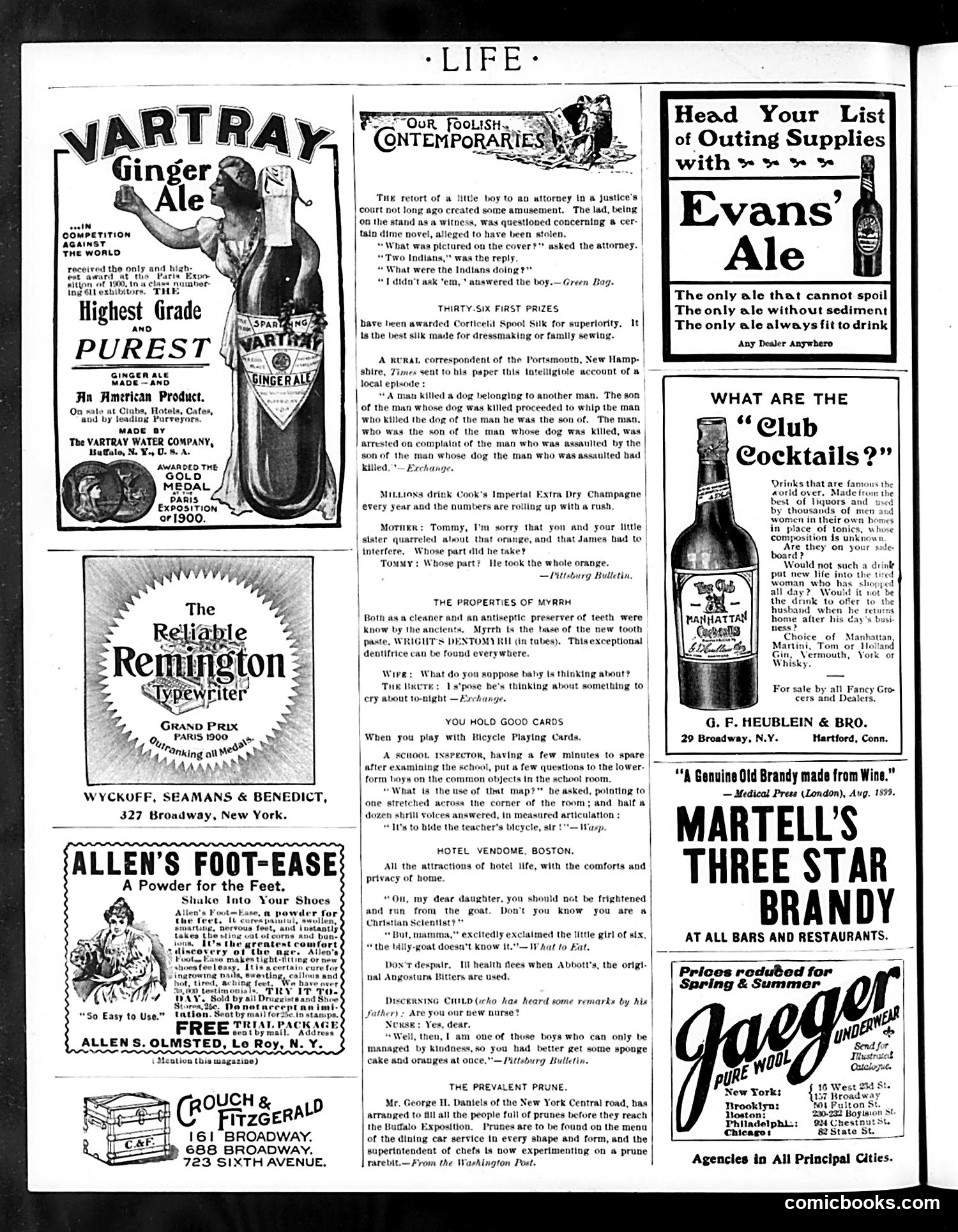
This is primarily an **advertising page** from Life magazine, circa 1900 (based on the Paris Exposition 1900 gold medal reference). The layout contains numerous product advertisements interspersed with brief humorous anecdotes and jokes. The small cartoon items scattered throughout are **lighthearted domestic and social humor** typical of the era—not political satire. Examples include: - A boy's literal interpretation of a legal question about a dime novel - A child's confusion about which part of an orange a friend "took" during a quarrel - A schoolboy's cheeky answer about a map's purpose - A child assuming a new nurse must be managed through treats rather than discipline These reflect **period attitudes about childhood, education, and family dynamics**. The advertised products (ginger ale, foot powder, champagne, brandy, silk thread) target middle and upper-class consumers concerned with propriety, health, and refinement. The page represents *Life* magazine's original function: a vehicle for both consumer advertising and genteel humor for affluent readers.
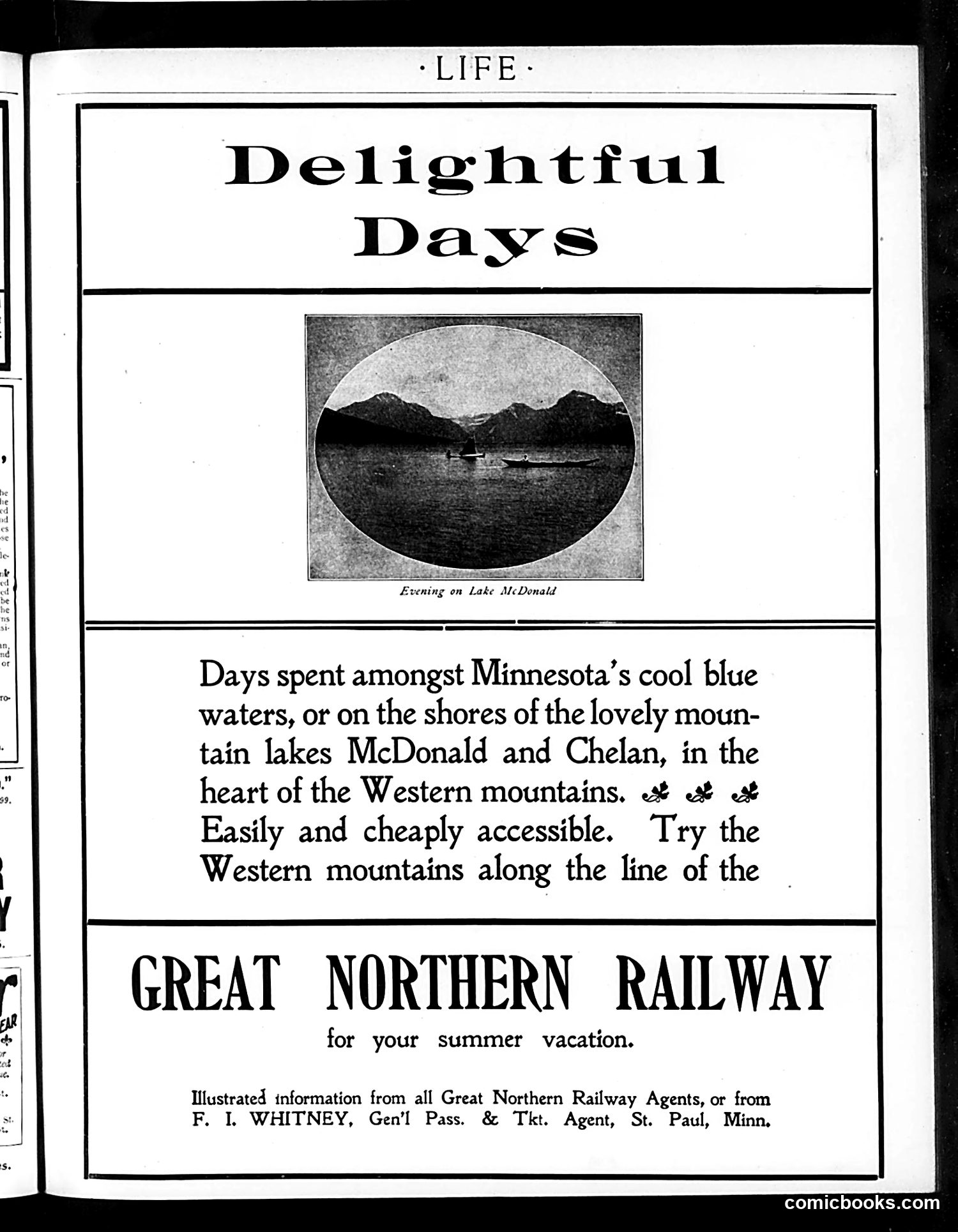
This is primarily a **travel advertisement**, not satire or political commentary. It promotes summer vacations to Minnesota's mountain lakes—McDonald and Chelan—via the Great Northern Railway. The single landscape photograph shows an evening scene on Lake McDonald, depicting mountains and water with small boats, emphasizing the scenic appeal. The copy emphasizes accessibility and affordability ("easily and cheaply accessible"), targeting middle-class Americans planning leisure travel. This represents early 20th-century railroad marketing: railways competed for passenger revenue by advertising vacation destinations within their service routes. The page directs readers to contact F.I. Whitney, the General Passenger & Ticket Agent in St. Paul, Minnesota, for illustrated information—standard procedure before digital marketing. The romantic language ("cool blue waters," "lovely mountain lakes") reflects the era's celebration of wilderness tourism and outdoor recreation.
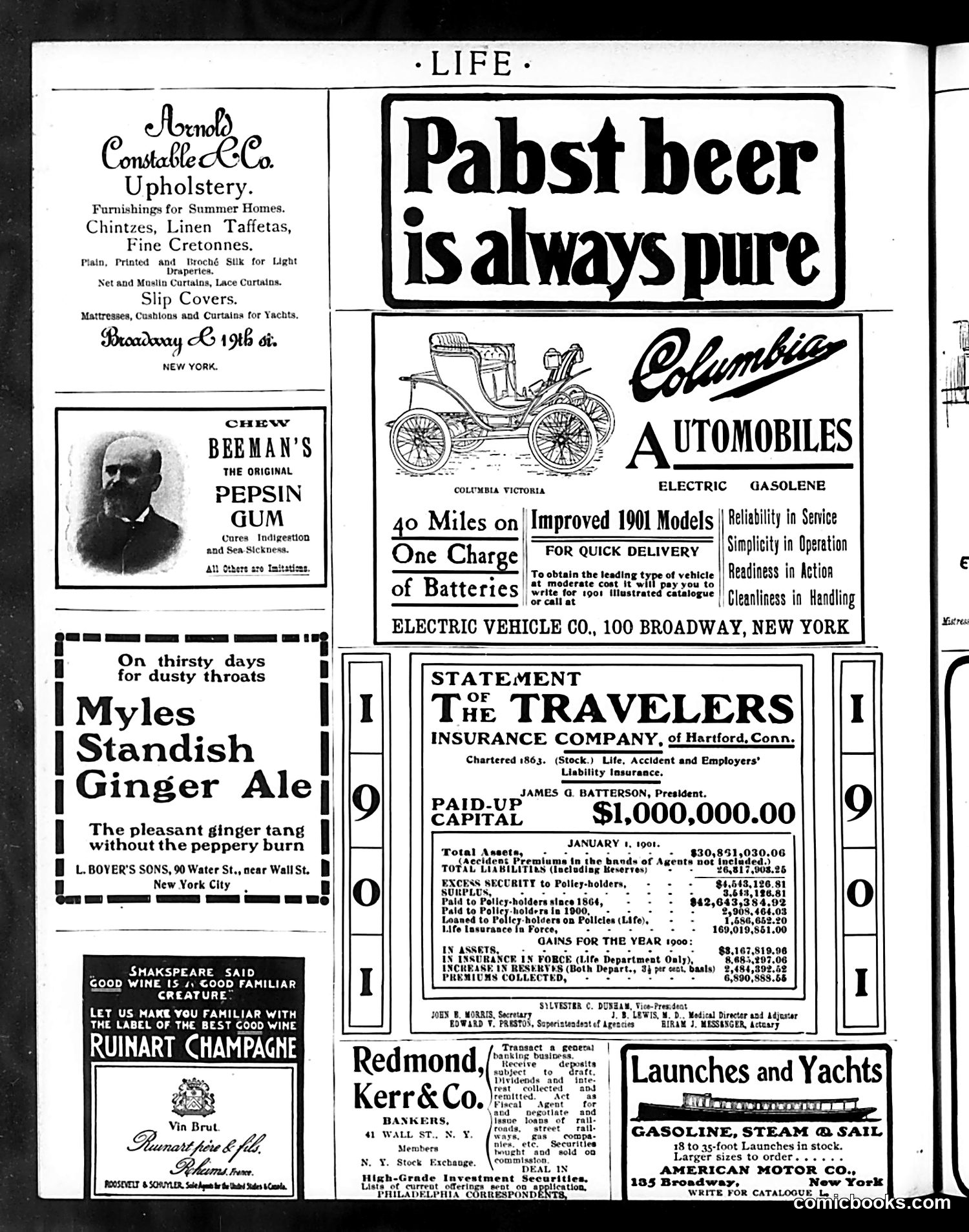
This is primarily an **advertising page** from Life magazine, not a satirical cartoon. The page displays various commercial advertisements typical of early 1900s America, with no political cartoons or satirical content to analyze. The ads reflect the era's consumer products and aspirations: upholstery furnishings for wealthy homes, patent medicines (Beeman's gum claimed to cure indigestion and seasickness), beverages (ginger ale, champagne, beer), and emerging technologies like **electric automobiles** and **gasoline launches**. The Columbia automobile ad notably emphasizes 40 miles per charge—highlighting the novelty of electric vehicles before gasoline engines dominated. The Travelers Insurance statement demonstrates a major insurance company's financial strength to modern readers unfamiliar with how companies then proved their stability. The "Myles Standish Ginger Ale" reference invokes the Mayflower Pilgrim to suggest American heritage and quality. Overall, this reflects Gilded Age consumer culture aimed at affluent readers.
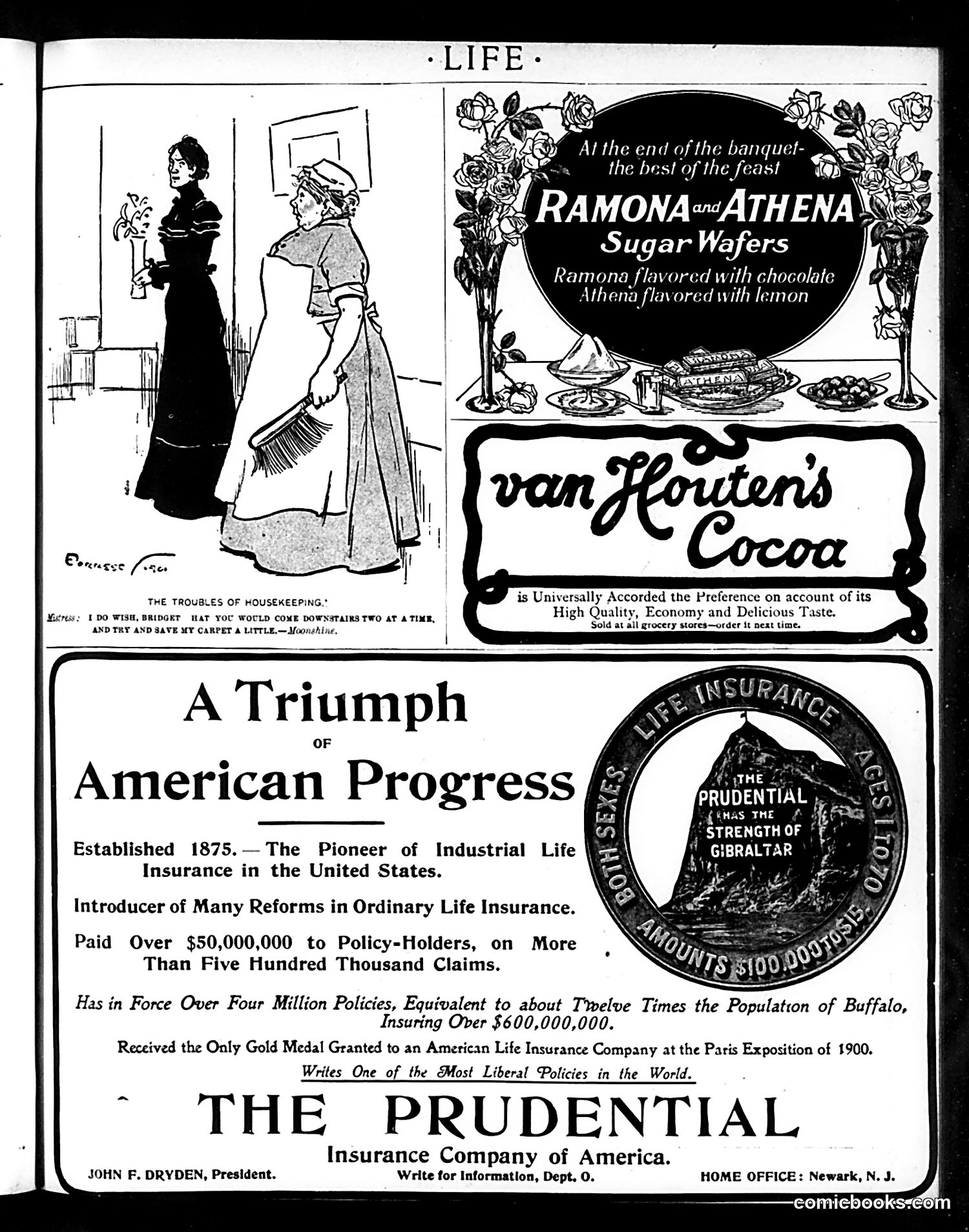
This page mixes satire with advertising typical of early 1900s magazines. **The Cartoon:** "The Troubles of Housekeeping" depicts a wealthy woman (likely addressing her Irish maid "Bridget") complaining that the servant walks downstairs one step at a time rather than two, which damages the carpet. The satire mocks the absurd priorities of the affluent—worrying more about home furnishings than their employees' safety. The maid's exasperation is implicit in the setup. **The Advertisements:** The page also includes ads for Van Houten's Cocoa and The Prudential Insurance Company, which were major consumer brands. The Prudential ad emphasizes American industrial progress and financial security—common themes used to market insurance in this era. The juxtaposition of frivolous domestic complaint with advertisements promoting progress and security reflects the magazine's satirical approach to modern American life and consumer culture.
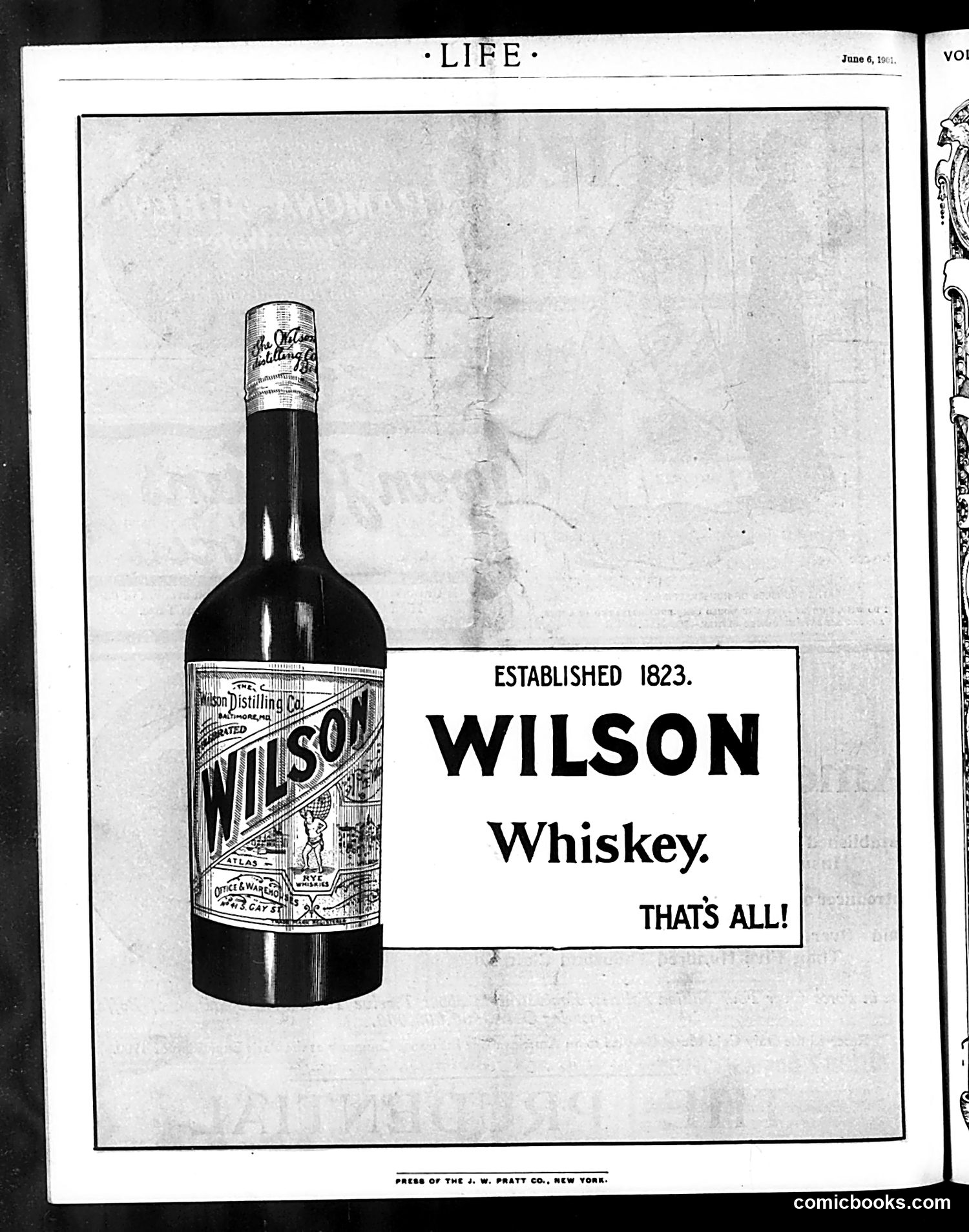
This is a straightforward advertisement, not satire or a political cartoon. It appears in *Life* magazine from June 6, 1921 (visible in header). The ad promotes Wilson Whiskey, established 1823, with the slogan "THAT'S ALL!" The bottle features the Wilson Distilling Co. label with decorative period imagery. The timing is significant: this advertisement ran during Prohibition (1920-1933), when alcohol sales were federally banned in the United States. This makes the ad notable as either a final pre-Prohibition publication or, more likely, evidence that *Life* magazine continued running liquor advertisements even after Prohibition's enactment—a practice that violated federal law and reflected the magazine's willingness to challenge or ignore the new legislation.