
Life, 1901-06-06 · page 6 of 28
Life — June 6, 1901 — page 6: what you’re looking at
What you’re looking at
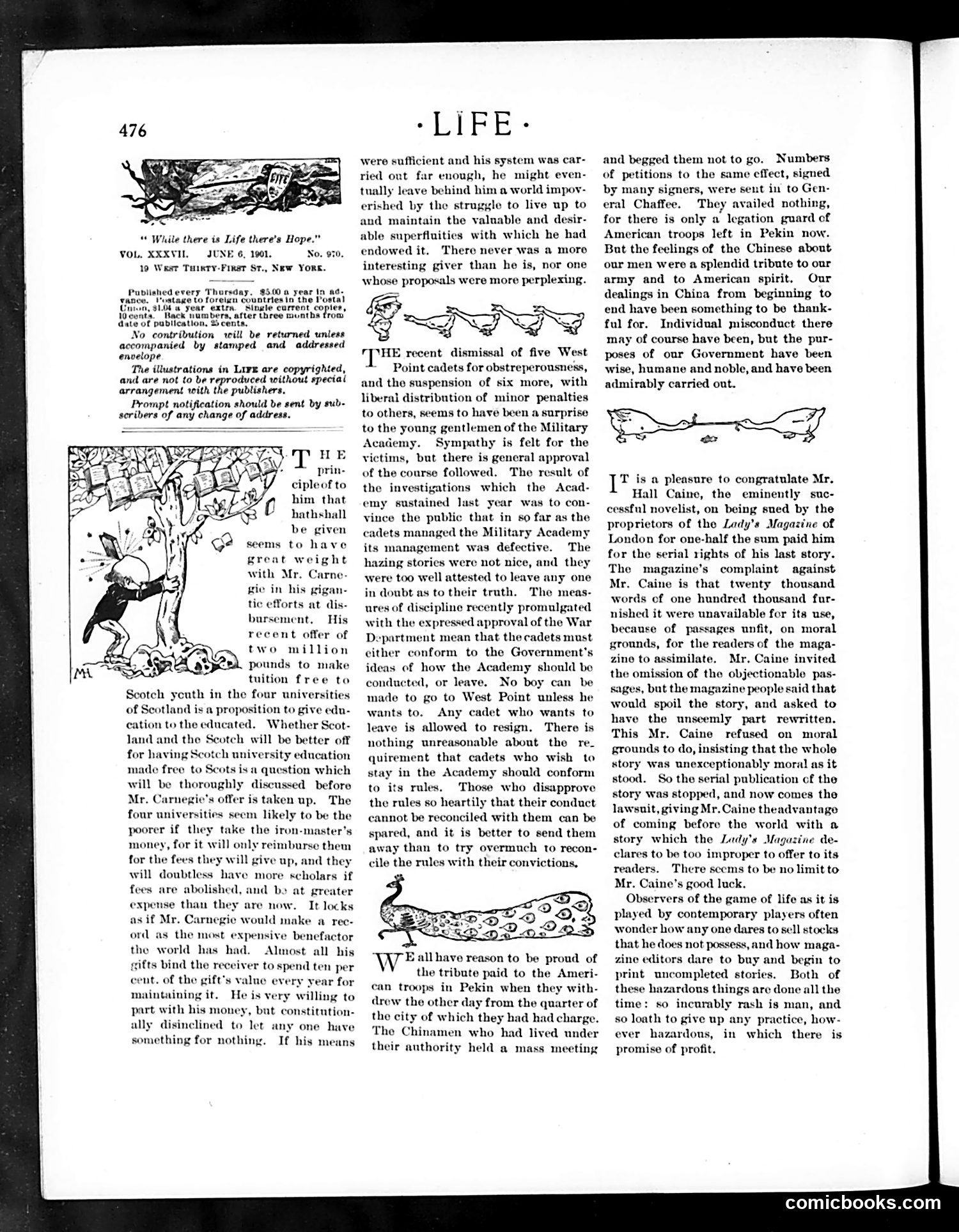
This page contains two main political cartoons and editorial commentary about early-1900s American military affairs. The left cartoon depicts a **Scottish figure** being offered a university education proposition, likely satirizing debates over Scottish educational independence versus British control. The right section discusses the **dismissal of five West Point cadets** for infractions, praising the Military Academy's disciplinary standards. The text defends strict cadet conduct rules and criticizes those who questioned the severity of punishments. The page also includes commentary **congratulating novelist Hall Caine** for refusing to allow his work *Lad's Tragedy* to be used in a questionable magazine context—praising his moral integrity. The overall tone reflects Progressive Era concerns about institutional discipline, moral standards, and American military preparedness during the post-Spanish American War period.
📄 Transcribed text from this page (OCR, searchable)
Machine-transcribed from the original scan — historical spelling and the odd misread are preserved.
“ While there is Life there’s Hop VOL. XXXVIL, JUNE 6, 1901. No. 970. 19 Wast Tuiwry-Pixet St., New Yore. Puplished every Thursday. $500 0 sear In age vance. Hostage to foreign countries in the Postal Union, 31.064 year extra. Single current copier, Wconts. “Rack numbers, after three munths froa’ date of publication, 2 cent, No contribution will be returned unless accompanied by stamped and addressed envelope The illustrations in Lire are copyrighted, and are not to be reproduced without special arrangement with the publishers, Prompt notification should be sent by sub- soribers of any change of address. TH E prin- cipleof to him that hathshall be given seems to have great weight with Mr. Carne- gie in his gigan- tic efforts at = bursement. His recent offer of two million pounds to make tuition free to Scotch yeuth in the four universities of Scotland is a proposition to give edu- cation to the educated. Whether Scot- land and the Scotch will be better off for having Scotch university education made free to Scots is 1 question which will be thoroughly discussed before Mr. Carnegie’s offer is taken up. The four universities seem likely to be the poorer if they take the jron-m: money, for it will only reimburse them for the fees they will give up, and they will doubtle: ave more scholars if fees are abolished, and bo at greater expense than they are now. It locks as if Mr. Carnegie would make a rec- ord as the most expensive benefactor the world has had. Almost all his ifts bind the recei to spend ten per cent. of the gift’s value every year for maintaining it. He is very willing to part with his money, but constitution- ally disinclined to let a something for nothing. ter’s one have If his means LIFE were sufficient and his system was car- ried out far enough, he might even- tually leave behind him a world impov- erished by the struggle to live up to and maintain the valuable and desir- able superfluities with which he had endowed it. There never was a moro interesting giver than he is, nor one whose proposals were more perplexing. THE recent dismissal of five West Point cadets for obstreperousness, and the suspension of six more, with liberal distribution of minor penalties to others, seems to have been a surprise to the young gentlemen of the Military Academy. Sympathy is felt for the victims, but there is gencral approval of the course followed. The result of the investigations which the Acad- emy sustained Just year was to con- vince the public that in so far as the cadets managed the Military Academy its management was defective. The hazing stories were not nice, and they were too well attested to leave any one in doubt as to their truth. The meas- ures of discipline recently promulgated with the expressed approval of the War Department mean that the cadets must either conform to the Government's ideas of how the See oy should be conducted, or leave. No boy can be made to go to West Put unless he wants to. Any cadet who wants to leave is allowed to resign. There is nothing unreasonable about the re_ quirement that cadets who wish to stay in the Academy should conform to its rules. Those who disapprove the rules so heartily that their conduct cannot be reconciled with them can be spared, and it is better to send them away than to try overmuch to recon- cile the rules with their convictions, E allhave reason to be proud of the tribute paid to the Ameri- can troops in Pekin when they with- drew the other d: the city of which they had had charge. The Chinamen who had lived under their authority held a mass meeting and begged them not to go. Numbers of petitions to the same effect, signed by many signers, were sent in to Gen- eral Chaffee. They availed nothing, for there is only a legation guard of American troops left in Pekin now. But the feelings of the Chinese about our men were a splendid tribute to our army and to American spirit. Our dealings in China from beginning to end have been something to be thank- ful for. Individual misconduct there may of course have been, but the pur- poses of our Government have been wise, humane and noble, and have been admirably carried out. is a pleasure to congratulate Mr. . I Hall Caine, the eminently suc- cessful novelist, on being sued by the proprietors of the Lady’s Magazine of London for one-half the sum paid him for the serial rights of his last story. The magazine’s complaint against Mr. Caine is that twenty thousand words of one hundred thousand fur- nished it were unavailable for its use, because of passages unfit, on moral grounds, for the readers of the maga- zine to assimilate. Mr, Caine invited the omission of the objectionable pas- sages, but the magazine people said that would spoil the story, and asked to have the unseemly part rewritten. This Mr. Caine refused on moral grounds to do, insisting that the whole story was unexceptionably moral as it stood. So the serial publication cf the story was stopped, and now comes the lawsuit, giving Mr.Caine theadvantage of coming before the world with a story which the Lady's Magazine de- clares to be too improper to offer to its readers. There sccms to be no limit to Mr. Caine’s good luck. Observers of the game of life as it is played by contemporary players often wonder how any one dares to sell stocks that he does not possess, and how maga- zine editors dare to buy and begin to print uncompleted stories. Both of these hazardons things are done all the time: so incurably rash is man, and so loath to give up any practice, how- ever hazardous, in which there is promise of profit. comicbooks.com