
Life, 1901-06-06 · page 8 of 28
Life — June 6, 1901 — page 8: what you’re looking at
What you’re looking at
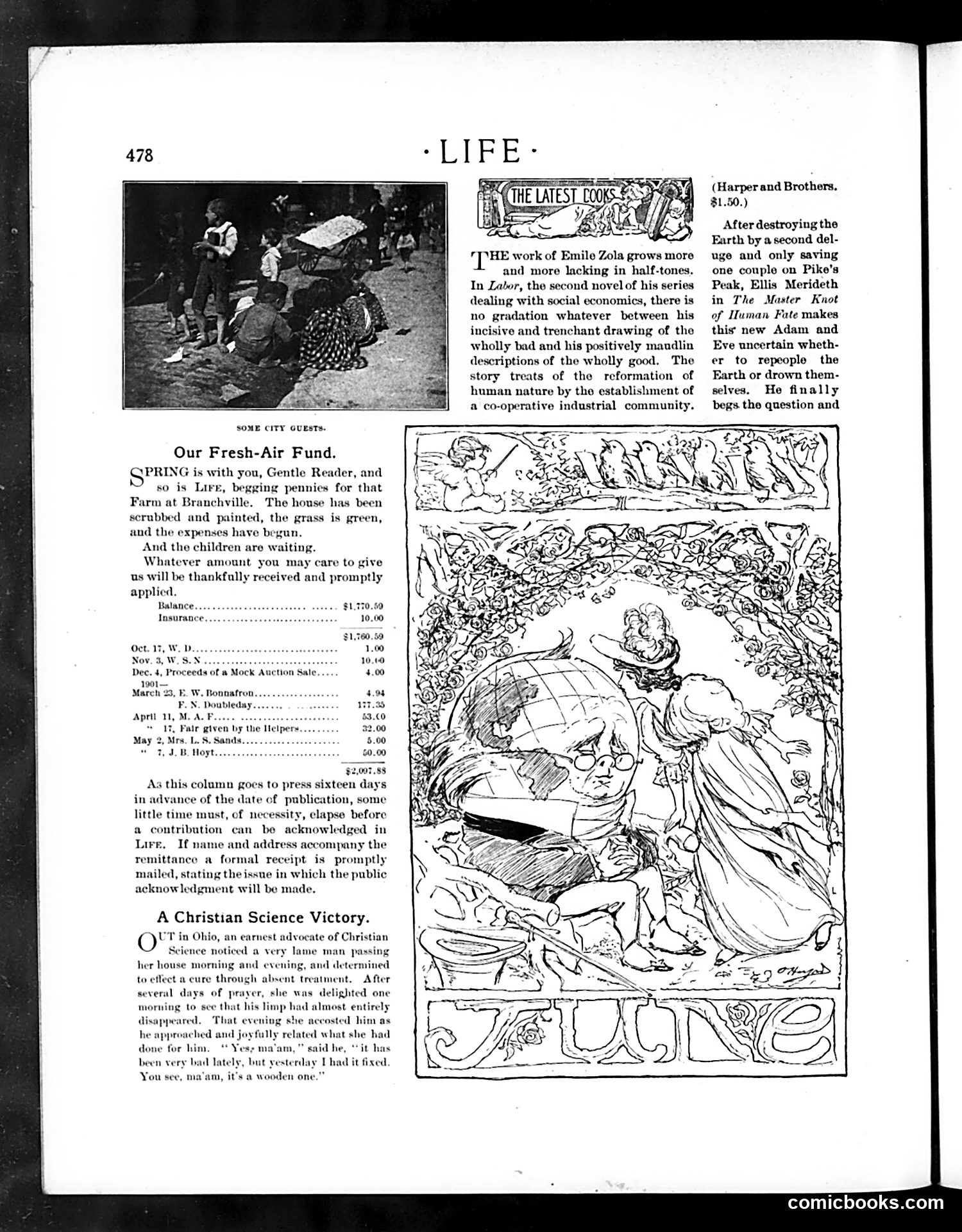
This page contains three distinct sections: 1. **"The Latest Cooks"** - A literary review discussing Emile Zola's novel *Labor*, critiquing his writing style as lacking nuance and containing overly harsh character descriptions. The reviewer mentions another book, *The Master Knot of Human Fate*. 2. **"Some City Guests"** and **"Our Fresh-Air Fund"** - A charitable fundraising column listing donations to send poor children from the city to a farm in Branchville for fresh air and rest. The amounts are small (ranging from $1 to $177.50), typical of modest middle-class charitable giving. 3. **"A Christian Science Victory"** - A humorous anecdote about an Ohio Christian Scientist woman who cures a lame man through prayer rather than medical treatment, satirizing Christian Science's faith-healing claims. The illustrated material appears decorative rather than directly satirical.
📄 Transcribed text from this page (OCR, searchable)
Machine-transcribed from the original scan — historical spelling and the odd misread are preserved.
SOME CITY GUESTS. Our Fresh-Air Fund. GFPRING is with you, Gentle Reader, and so is Lire, begging pennies for that Farm at Branchville. The house has been scrubbed and painted, the grass is green, and the expenses have begun. And the children are waiting. Whatever amount you may care to give us will be thankfully received and promptly applied. Balan: saves GU Insuranc 7, J.B. Hoyt. As this column goes to press sixteen days in advance of the date of publication, some little time must, of necessity, clapse before a contribution can be acknowledged in Lire, If name and address accompany the remittance a formal receipt is promptly mailed, stating the issue in which the public acknowledgment will be made. A Christian Science Victory. UT in Ohio, an earnest advocate of Christian Science noticed a very lame man passing her house morning and evening, and determined to effect a cure through absent treatment. After eral days of prayer, she was delighted one morning to see that his limp had almost entirely disappeared. That evening she accosted him as he approached and joyfully related what sly done for him. * Yes been very bad Is t yesterday [had it fixed wooden one.” (THE work of Emile Zola grows more and more lacking in half-tones. In Labor, the second novel of his series dealing with social economics, there is no gradation whatever between his incisive and trenchant drawing of the wholly bad and his positively maudlin descriptions of the wholly good. The story treats of the reformation of human nature by the establishment of a co-operative industrial community, (Harper and Brothers. $1.50.) After destroying the Earth by a second del- uge and only saving one couple on Pike's Peak, Ellis Merideth in The Master Knot of Human Fate makes this new Adam and Eve uncertain wheth- er to repeople the Earth or drown them- selves. He finally begs the question and comicbooks.com