
A complete issue · 22 pages · 1901
Life — May 30, 1901
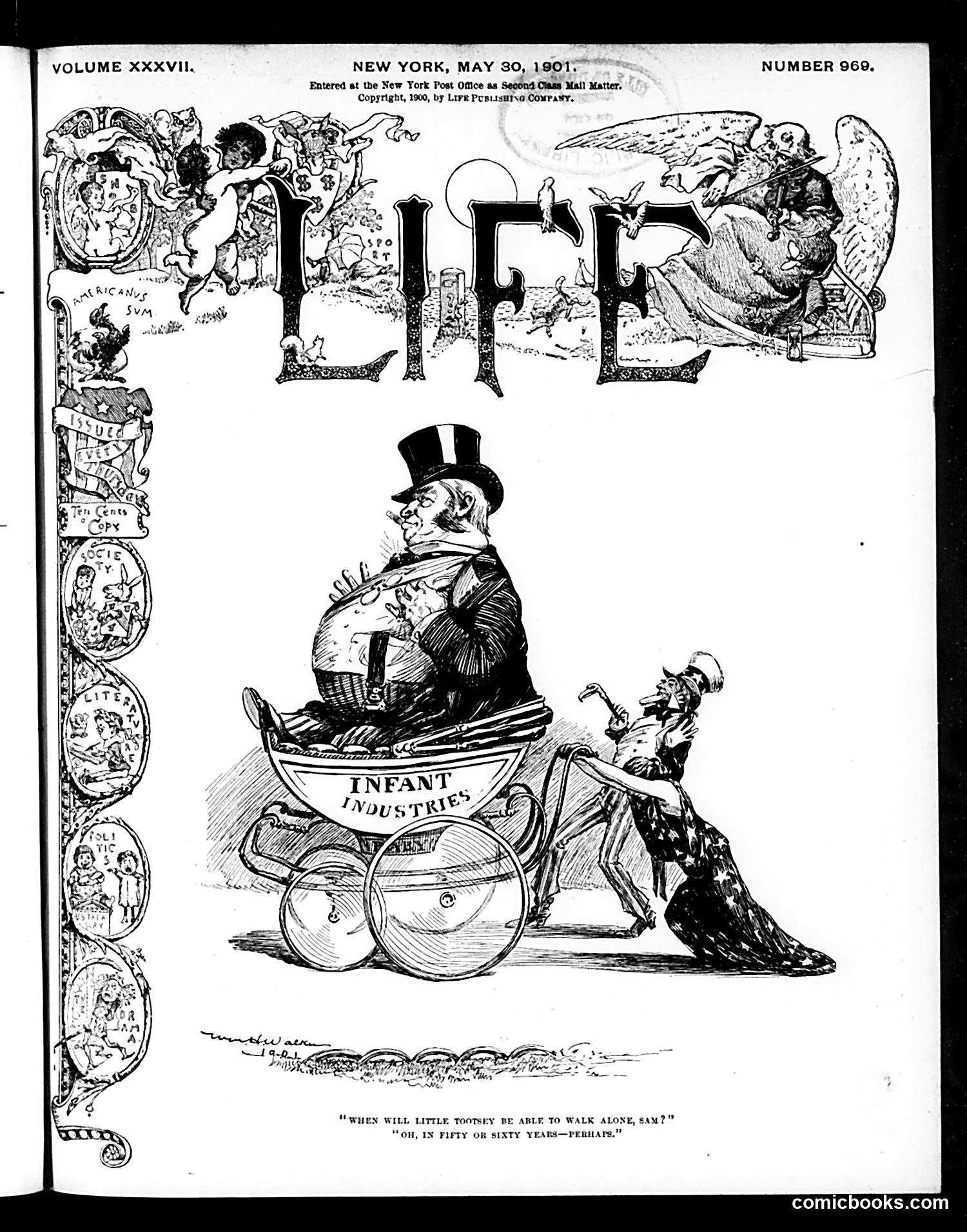
This satirical cartoon critiques **child labor in American industries**. A wealthy, top-hatted capitalist sits contentedly in a baby carriage labeled "Infant Industries," smoking a cigar and holding a whip. A figure (likely representing Labor or the American worker) pushes the carriage. The caption reads: "When will little Tootsey be able to walk alone, Sam?" with the response "Oh, in fifty or sixty years—perhaps." The satire suggests that American infant industries—newly developing manufacturing sectors—are being artificially protected and coddled by the government, while simultaneously exploiting child workers. The "fifty or sixty years" response mockingly implies these industries won't achieve independence for generations, remaining dependent on exploitative labor practices.
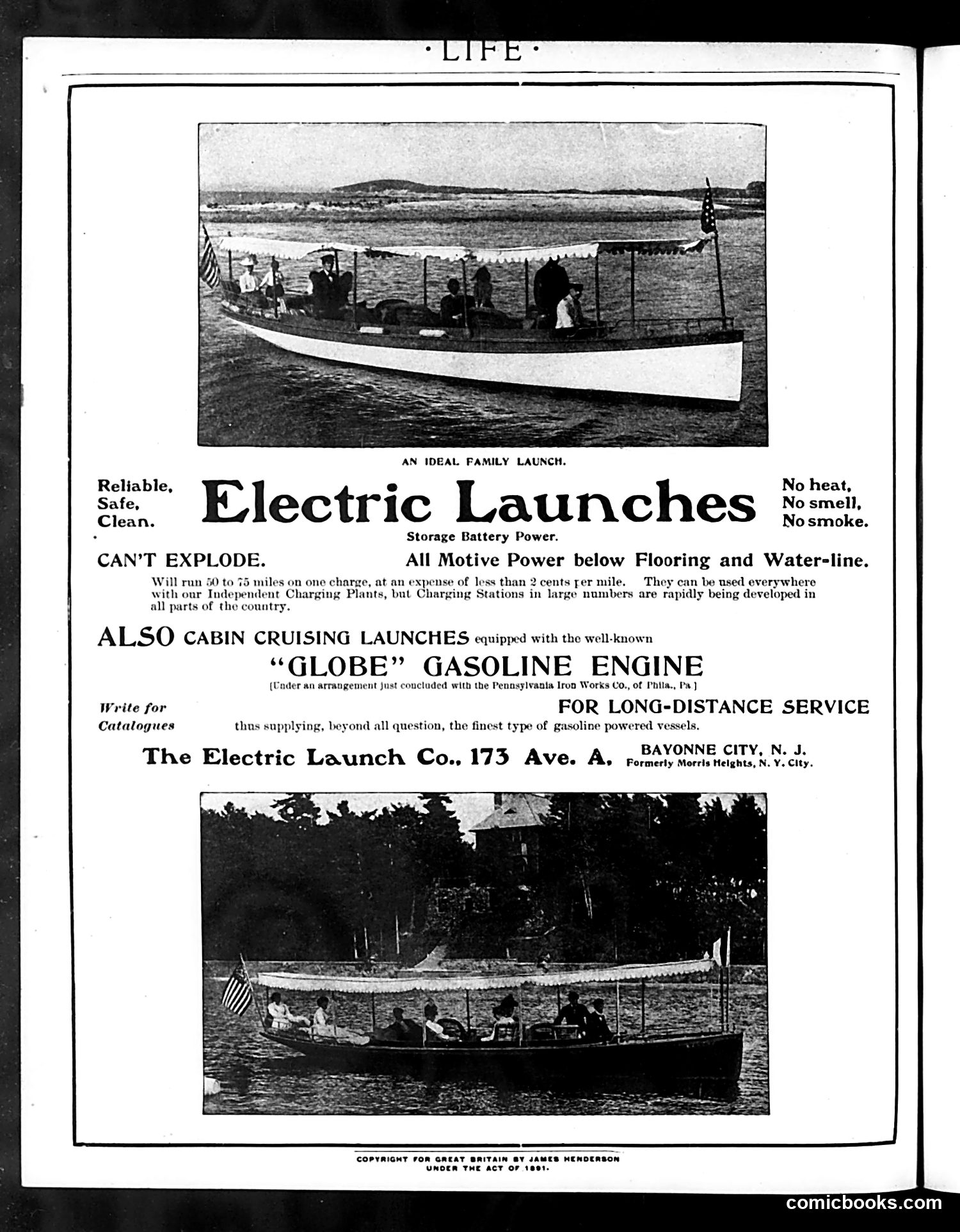
This page is **primarily an advertisement**, not satirical content. It promotes "Electric Launches" — small electric-powered boats — manufactured by The Electric Launch Co. in Bayonne, New Jersey. The ad emphasizes practical benefits: reliability, safety, cleanliness, and the absence of "heat, smell, [and] smoke" associated with gasoline engines. It highlights that electric launches run up to 50-75 miles on a single charge at minimal cost (less than 2 cents per mile). The two photographs show family leisure activities on water — positioning these boats as ideal for recreational boating during an era when electric vehicles were considered modern, safe alternatives to gasoline-powered engines. The advertisement also mentions gasoline-powered "Globe" engines as an alternative for longer-distance service.
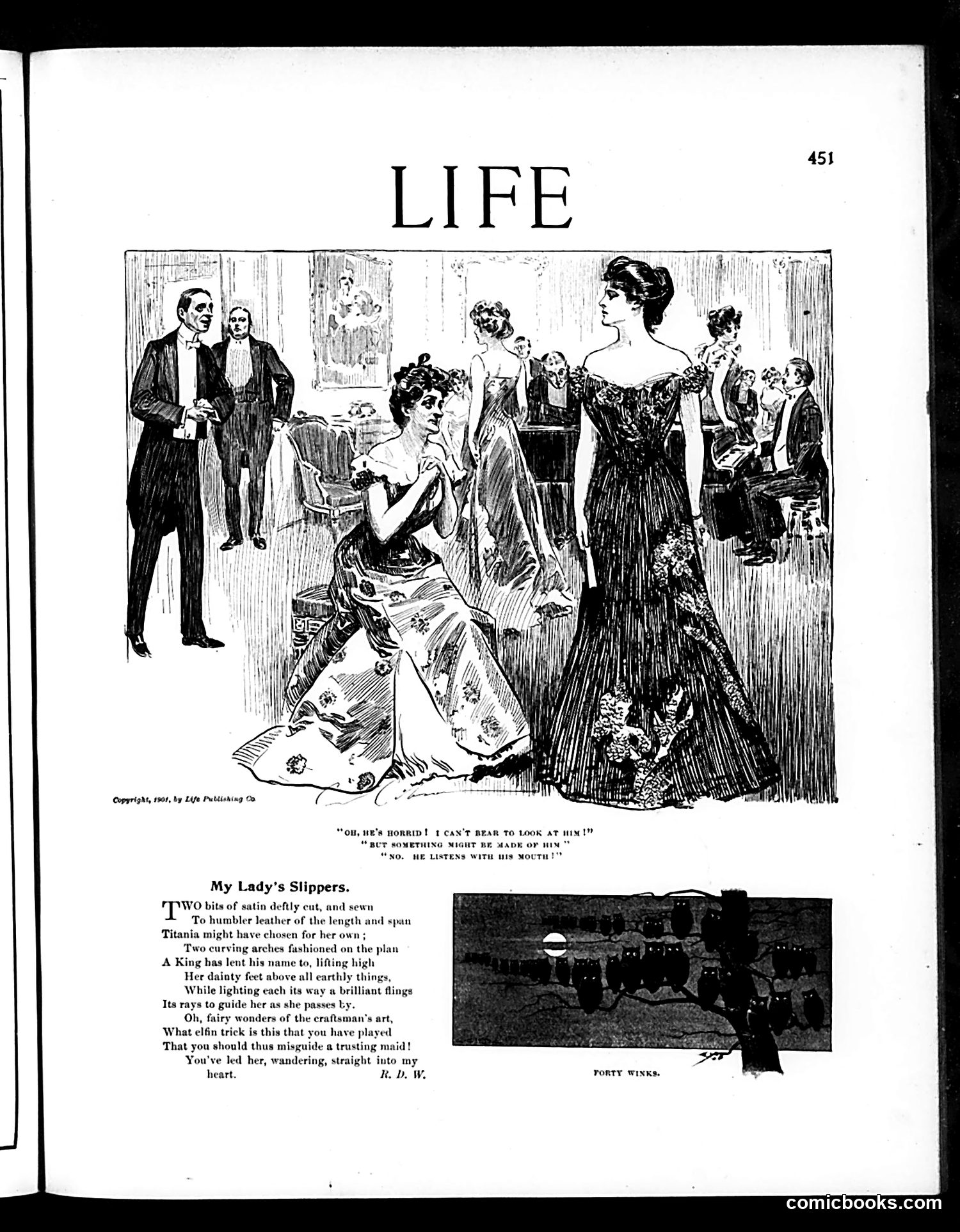
This page features a satirical illustration of a formal social gathering, likely a high-society ball or reception. The main cartoon depicts elegantly dressed men and women in formal attire, with dialogue suggesting romantic or marital tension: "Oh, he's horrid! I can't bear to look at him!" / "But something might be made of him" / "No, he listens with his mouth!" The accompanying poem, "My Lady's Slippers," celebrates the craftsmanship of women's formal footwear, comparing elaborately decorated slippers to luxury items like Titania's shoes and a King's coronet. The satire appears to mock both aristocratic affectation and the absurdity of valuing ornamental details over substantive character traits in social relationships. The photograph labeled "Forty Winks" appears unrelated to the main content.
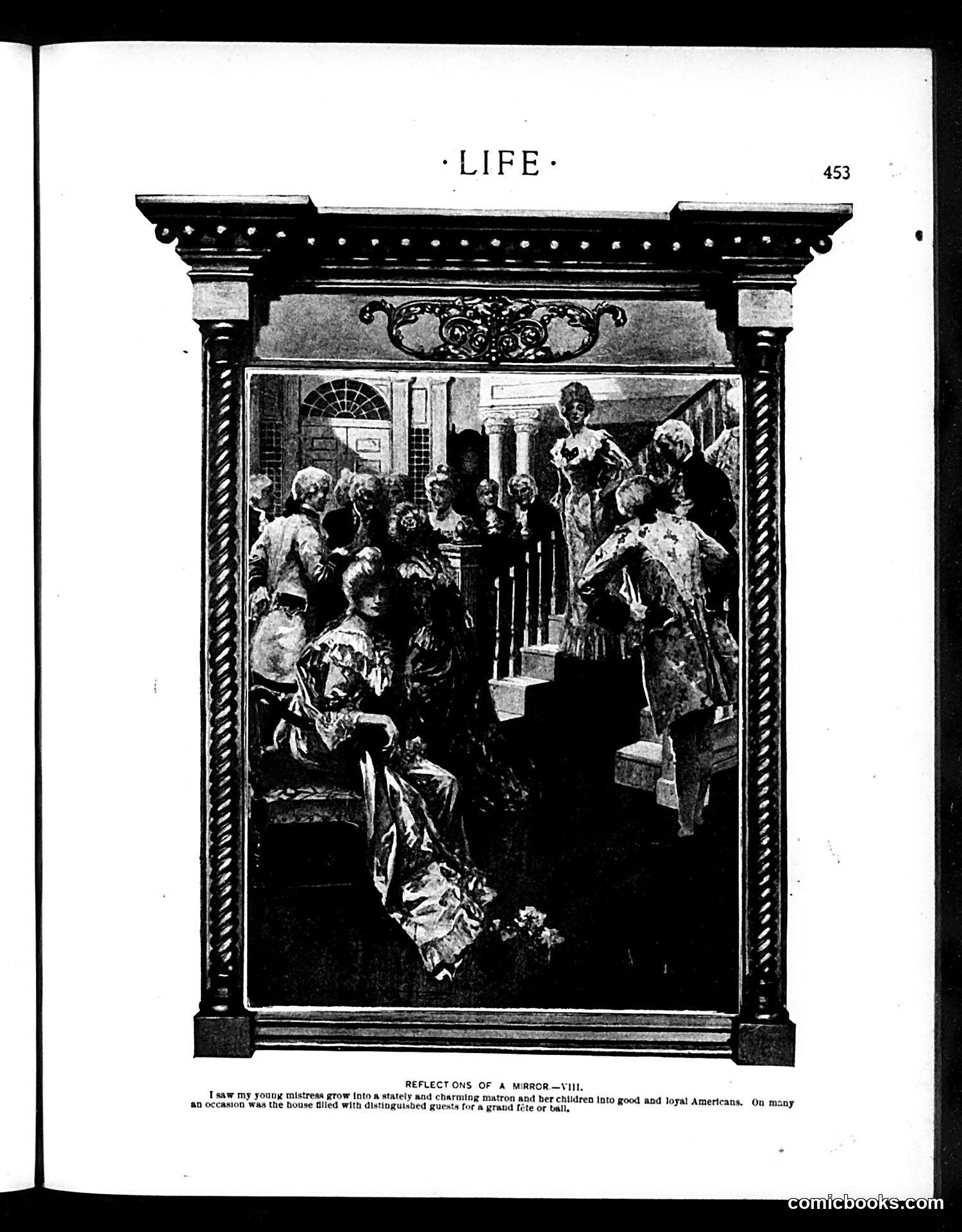
This satirical illustration depicts a formal social gathering, likely a ball or grand reception. The caption describes observing a "young mistress grow into a stately and charming matron and her children into good and loyal Americans," noting the house was "filled with distinguished guests for a grand fete or ball." The image appears to be social satire about American upper-class life and assimilation. The elaborate framing (classical columns, ornate surround) suggests this represents an idealized vision of American society and prosperity. The "mirror" metaphor in the title implies the illustration reflects society back upon itself—likely critiquing the pretensions, formality, or values of wealthy American social circles during what appears to be the late 19th or early 20th century. The specific satirical point remains unclear without additional context.
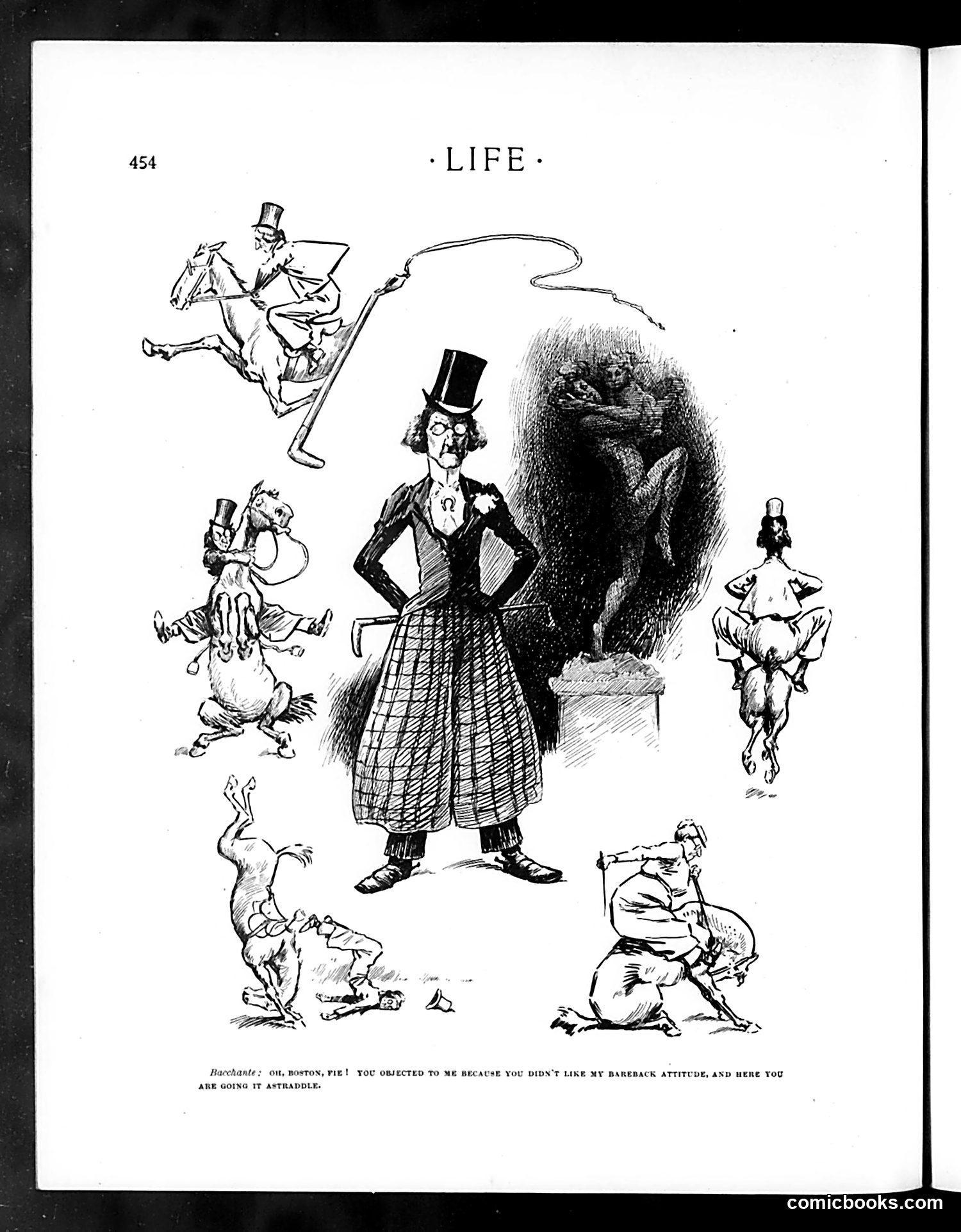
This satirical page depicts various circus and vaudeville performers arranged around a central ringmaster figure in top hat and formal dress. The caption references "Barackante" and mentions objections to "bareback attitude," suggesting this is political satire using circus imagery as metaphor. The central figure appears to represent a political leader or authority figure, surrounded by acrobats, clowns, and performers in exaggerated poses. The "bareback" reference likely plays on political accusations of impropriety or unconventional behavior. The composition presents politics as theatrical spectacle—performers executing tricks under a ringmaster's direction. This reflects early 20th-century Life magazine's common practice of mocking politicians and public figures through circus/performance metaphors, suggesting incompetence, fakery, or entertaining incompetence in governance. Without clearer context or publication date, the specific political figures remain unclear.
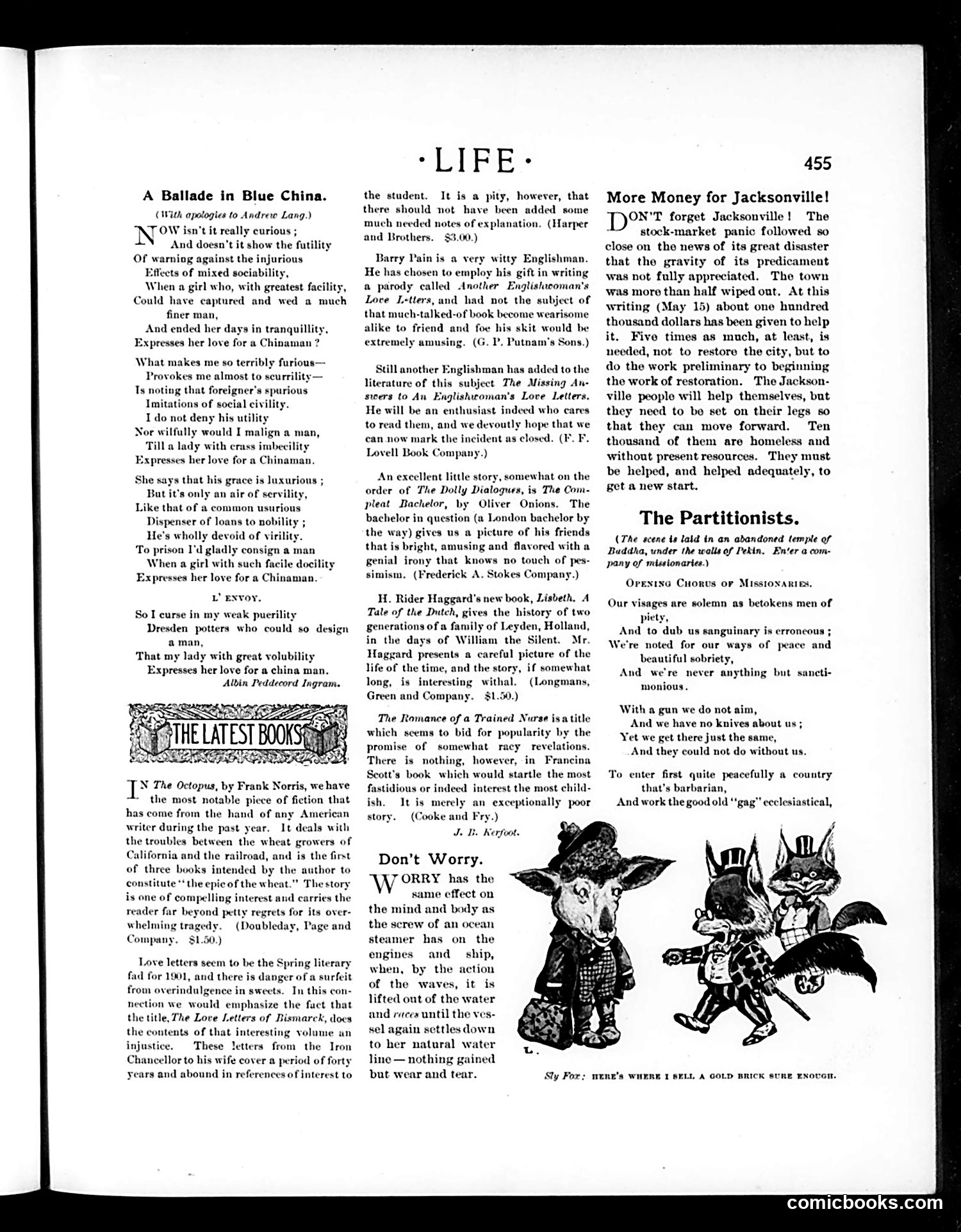
This cartoon illustrates the proverb "men's where I sell a gold brick sure enough," depicting a sly fox successfully deceiving another animal (likely a goose or similar bird). The visual pun plays on the phrase "selling a gold brick"—a common 19th-century con meaning to swindle someone with a worthless item disguised as valuable. The cartoon accompanies an article titled "Don't Worry," which discusses how worry affects people physically and mentally, comparing it to an ocean steamer's distress. The accompanying illustration humorously suggests that deception and cunning can be as damaging as worry itself—the "fox" exploiting the victim's gullibility, much as worry exploits human vulnerability.
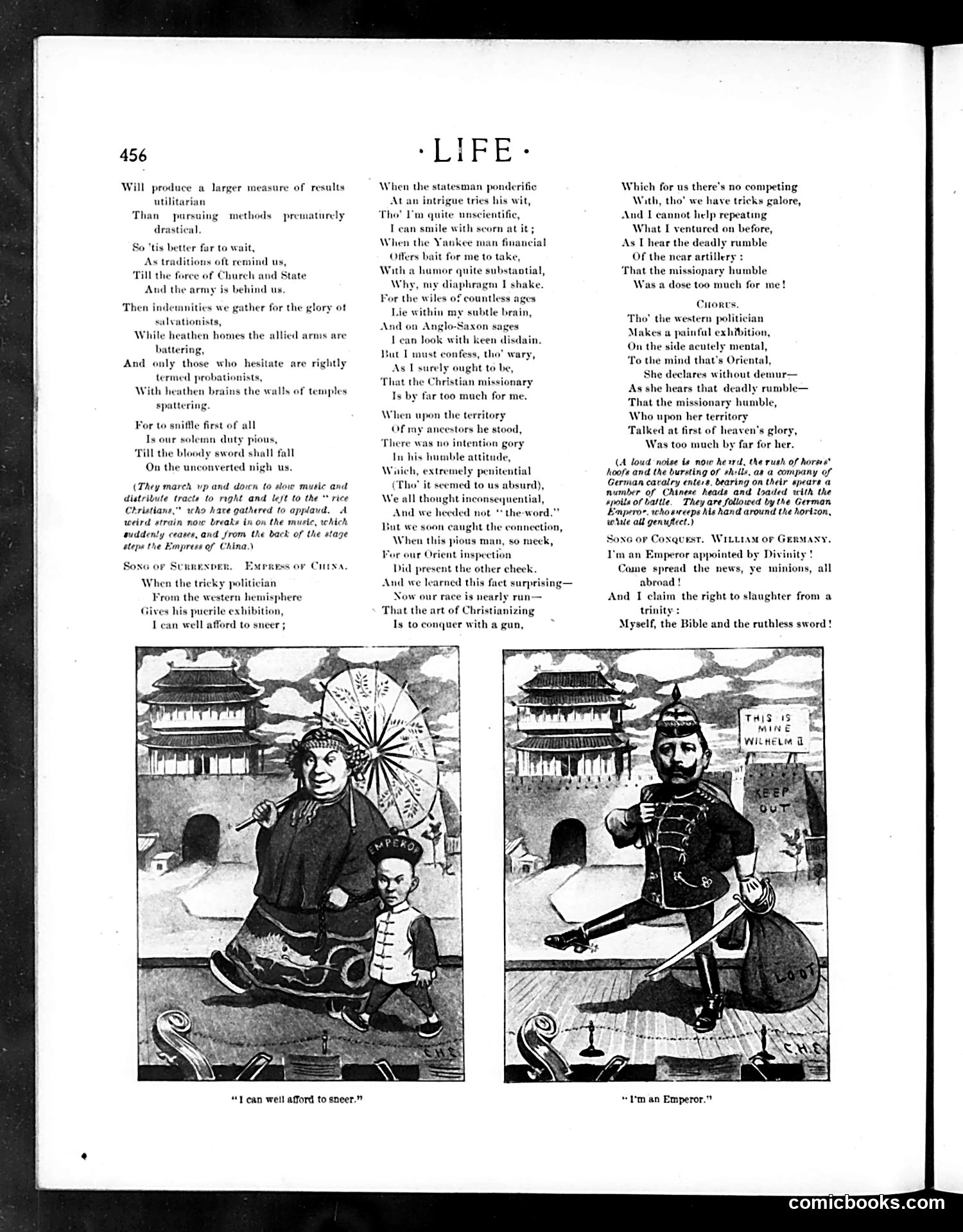
This page satirizes Western imperial attitudes toward Asia, particularly China and Germany's imperial ambitions. The two cartoons present contrasting stereotypes: **Left cartoon** ("I can well afford to sneer"): Shows a Chinese woman with parasol and child, mocking Western pretensions. The caption suggests China's ancient civilization gives it reason to dismiss Western claims of superiority. **Right cartoon** ("I'm an Emperor"): Depicts a German military figure with sword and spiked helmet, aggressively asserting imperial dominance. The sign reading "THIS IS MINE WILHELM II" references Kaiser Wilhelm II's expansionist policies. The surrounding poetry criticizes both Christian missionary efforts and militaristic conquest as tools of Western imperialism, questioning whether "Christianizing" through force constitutes civilization or merely exploitation. The satire challenges Western moral authority in imperial ventures.
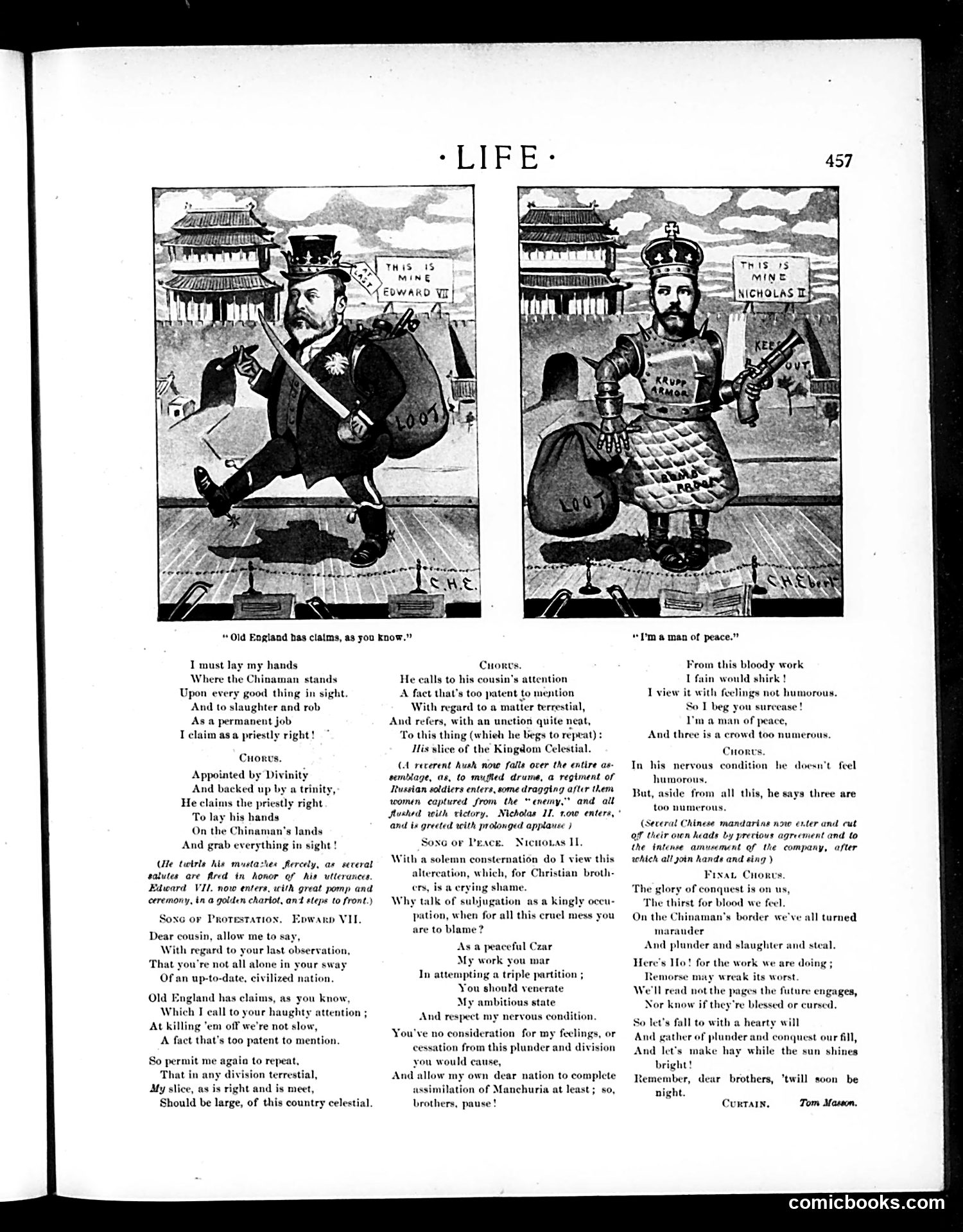
This page contains two parallel caricatures satirizing European imperial powers during what appears to be a conflict over China (referenced by the Chinese architecture). **Left panel:** King Edward VII of Britain claims territorial rights to China, positioned as an armed figure asserting dominance. **Right panel:** Tsar Nicholas II of Russia similarly declares "I'm a man of peace" while simultaneously armed and aggressive. The satire's central joke is the **hypocrisy of these imperial rulers**—both claim peaceful intentions while visibly prepared for war and territorial seizure. The dueling monologues highlight how competing European powers justified imperial expansion through contradictory rhetoric. The Chinese setting indicates this likely addresses the Boxer Rebellion era or post-Boxer conflicts when Western powers competed for Chinese concessions while publicly maintaining they sought "order" and "peace."
This illustration depicts a seaside bathing establishment with "Space Reserved For" signage visible on the upper structure. The cartoon satirizes class segregation and social hierarchy at public beaches during the early 20th century. The composition contrasts two groups: well-dressed, affluent figures occupy the privileged upper viewing platform and pavilion area, while working-class or lower-income beachgoers are relegated to the lower beach section near the water and underneath the arched structure. The satire critiques how public recreational spaces maintained rigid social divisions—wealthier patrons received better amenities and views, while others accessed inferior facilities. This reflects broader Progressive Era concerns about class inequality in supposedly "public" spaces that were actually designed to enforce social stratification.
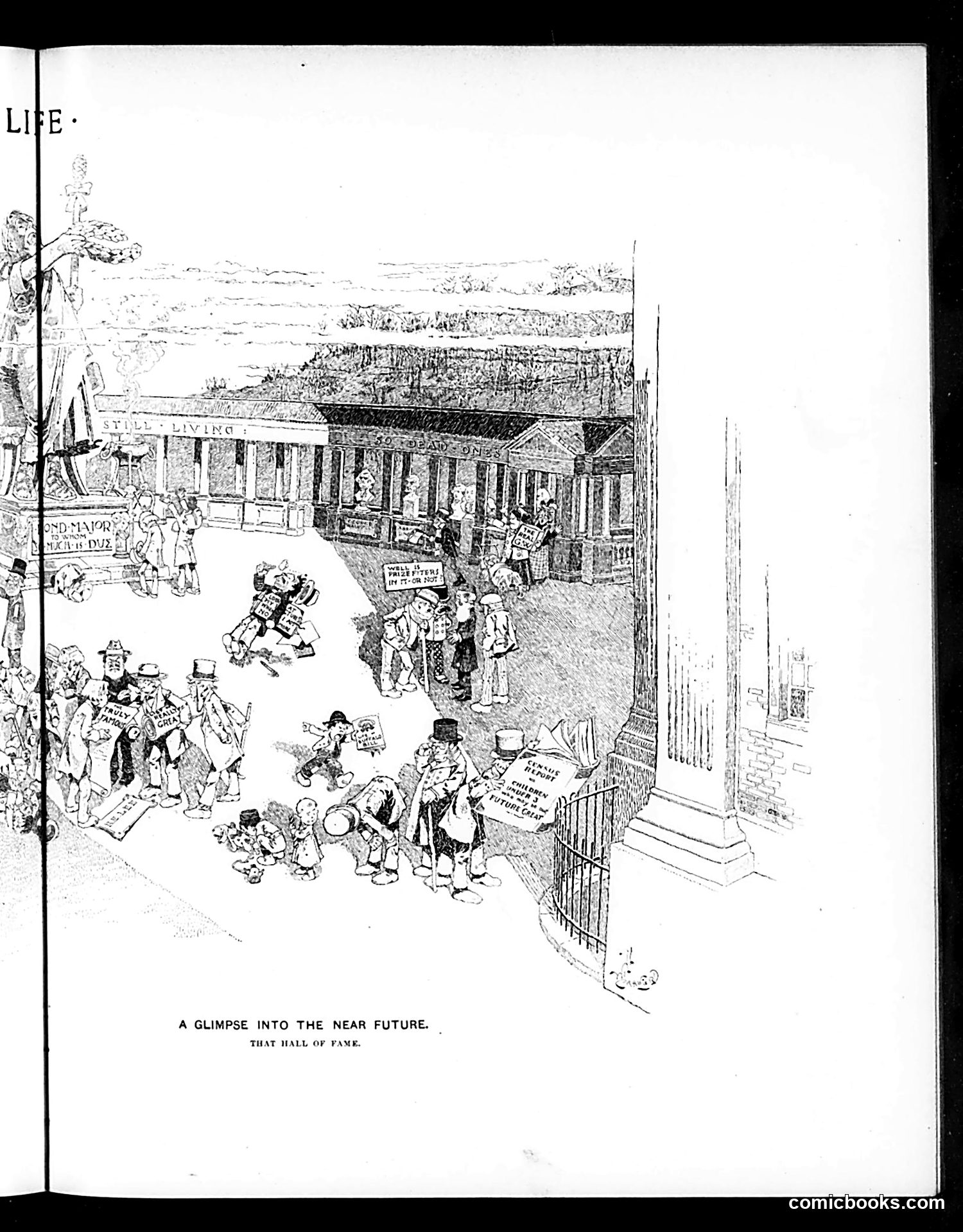
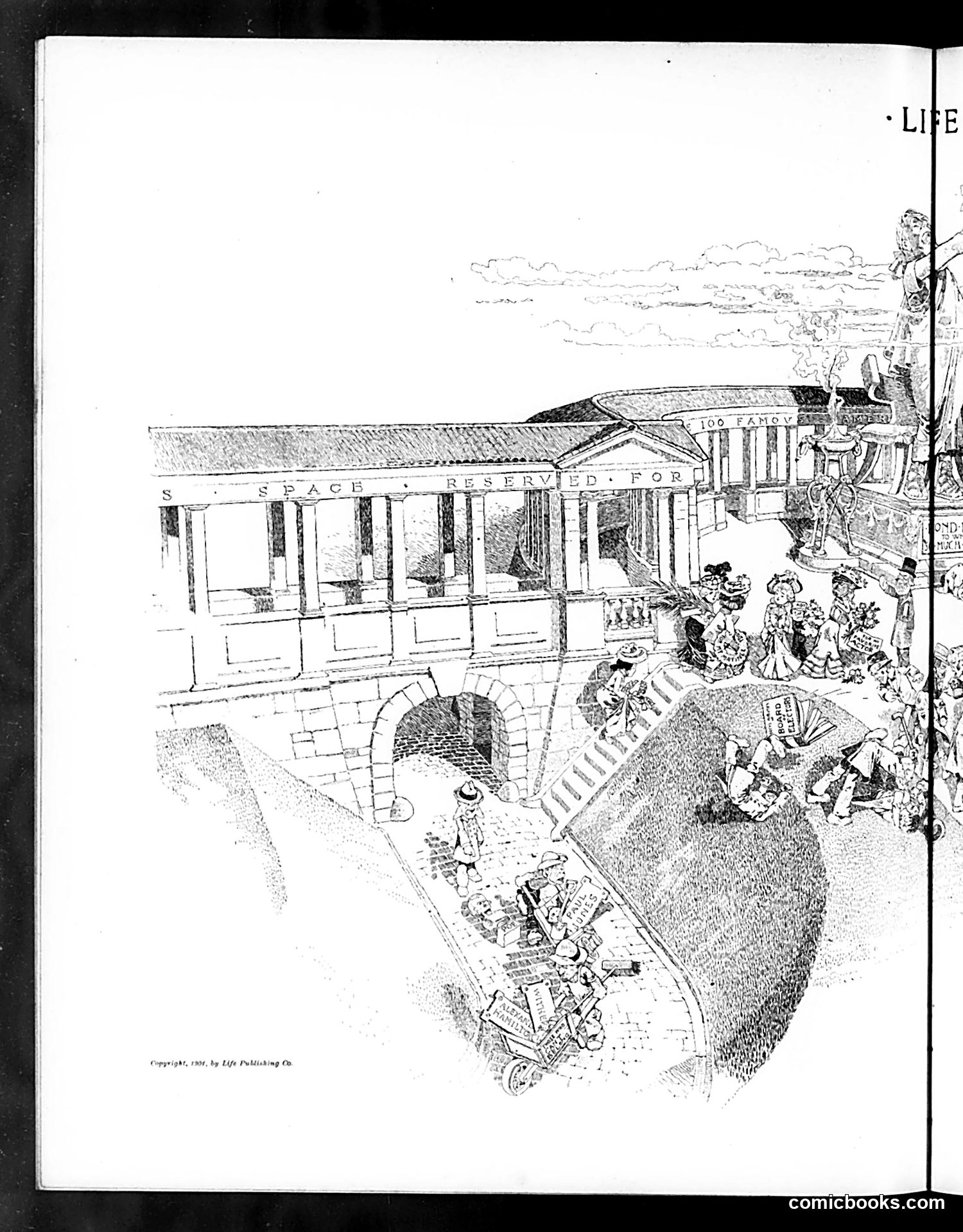
This satirical cartoon depicts a crowded public space—apparently a future "Hall of Fame"—where various figures in period dress mingle. The scene appears to mock the idea of historical commemoration and celebrity worship. The cartoon satirizes which figures might achieve lasting fame or be remembered historically. Various caricatured individuals are shown, some appearing to be politicians, performers, or public personalities of the era, though specific identities are difficult to determine from the image alone. The satire seems to comment on the arbitrary or questionable nature of who achieves historical prominence, suggesting that some contemporary figures considered important might prove unworthy of remembrance, or conversely, that fame is unpredictable and often absurd.
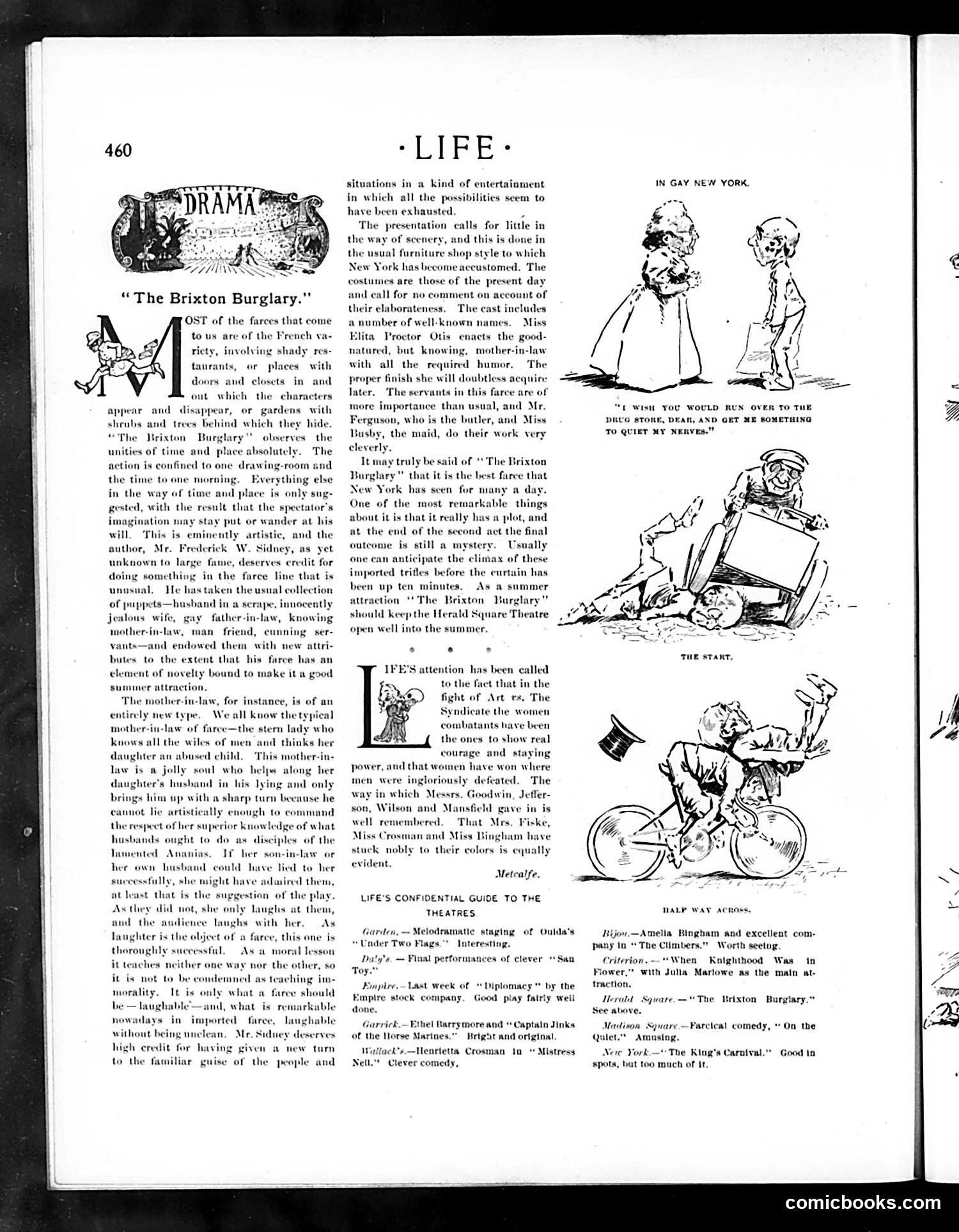
This page reviews a farce called "The Brixton Burglary" at Herald Square Theatre. The cartoons illustrate comedic scenes: "The Start" shows characters in chaotic preparation, while "Half Way Across" depicts them tangled with furniture during a burglary attempt. The review praises the play's plot and humor, noting it's "the best farce that New York has seen for many a day." The cast includes well-known performers. The text emphasizes the farce's traditional elements—physical comedy, mistaken identities, and impossible situations—which appear captured in the accompanying sketches showing characters struggling with props and each other during supposedly comedic criminal misadventure.
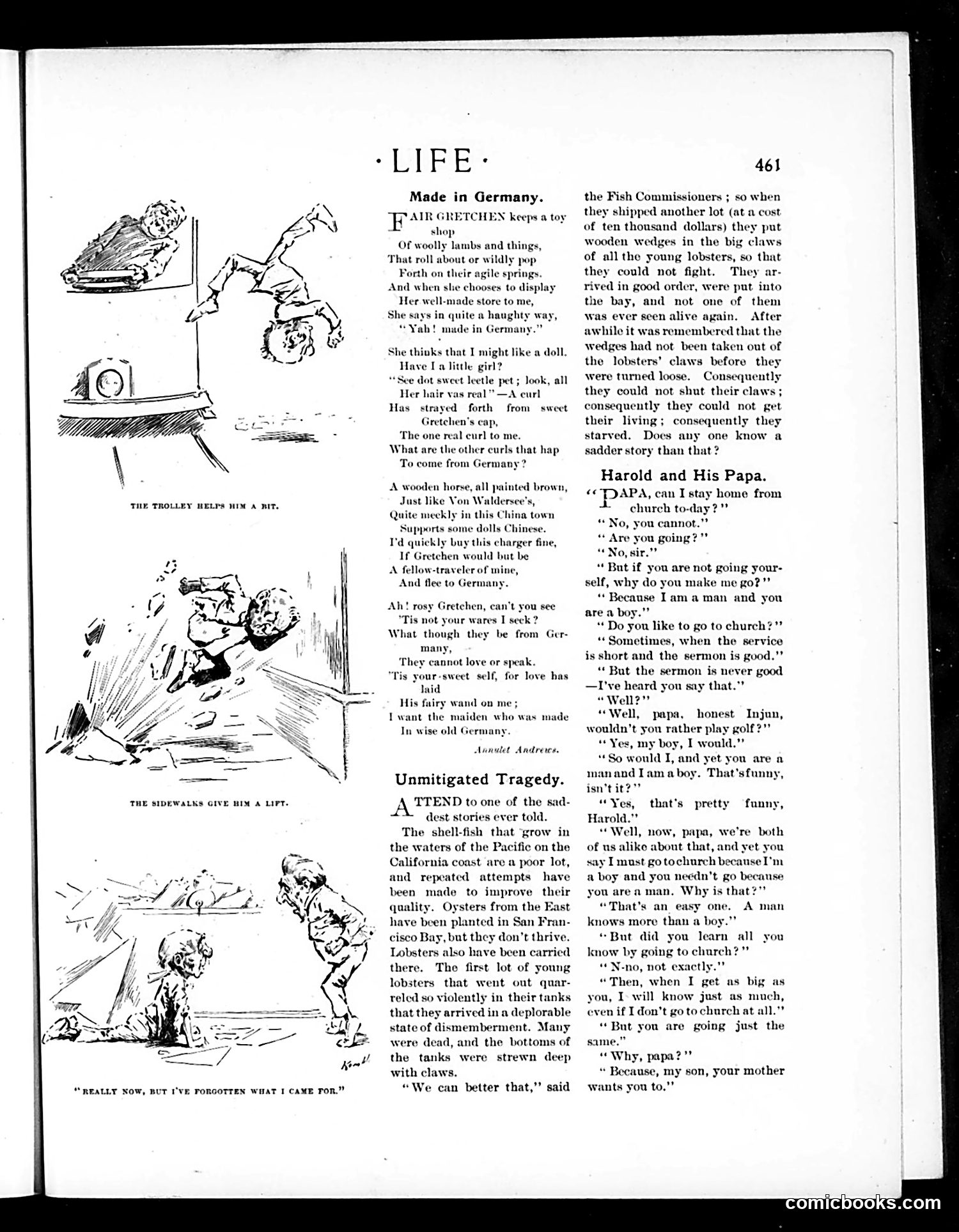
This Life magazine page contains three separate pieces of humor: **"Made in Germany"** (top): A romantic poem where a male narrator is infatuated with Gretchen, a German shopkeeper who proudly displays her German-made toys. He's unimpressed by the merchandise (wooden horses, dolls) and wishes she would abandon Germany to be with him instead. The satire targets both German commercial pride and sentimental romance. **"Unmitigated Tragedy"** (middle): A darkly comic anecdote about California's Fish Commission attempting to improve Pacific lobster quality. They shipped young lobsters with wooden wedges clamped on their claws to prevent fighting during transport—then forgot to remove the wedges before releasing them into the bay. The lobsters starved because they couldn't feed themselves. The joke mocks bureaucratic incompetence and the unintended consequences of "improvement" efforts. **"Harold and His Papa"** (bottom): A dialogue where young Harold logically questions why his father forces him to attend church when the father himself dislikes it and admits he didn't learn there. The father ultimately admits his wife demands it. The satire gently mocks parental hypocrisy and illogical authority.
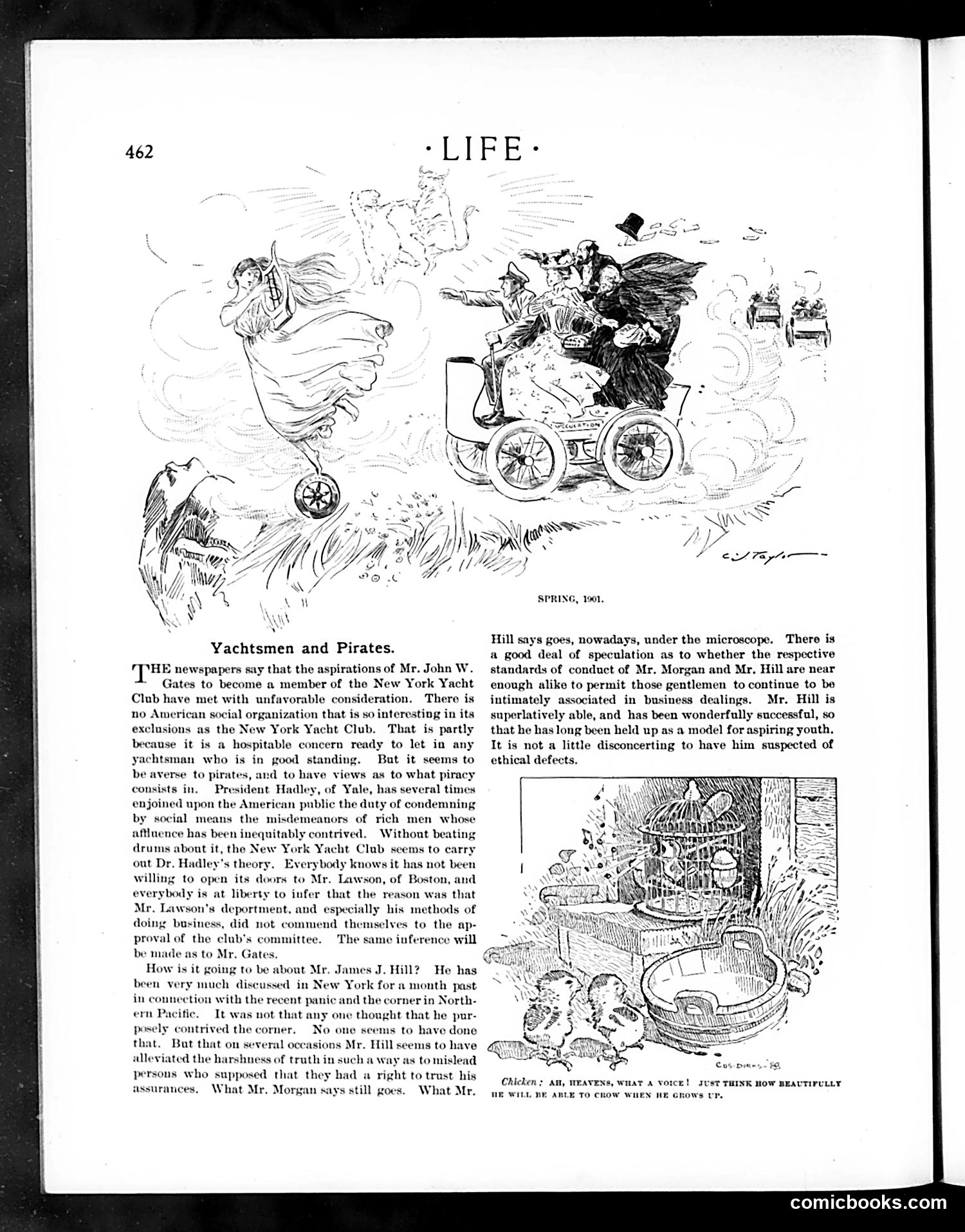
This article satirizes wealthy industrialists excluded from the elite New York Yacht Club for ethical misconduct. The piece discusses three wealthy men: **John W. Gates** (denied membership), **Thomas Lawson** (previously rejected), and **James J. Hill** (railroad magnate under scrutiny). The satire's point: the Yacht Club, despite claiming to admit any "yachtsman in good standing," actually judges members by moral standards. Hill is particularly suspect following the recent Northern Pacific railroad panic, where he allegedly misled investors. The article notes his reputation now requires "microscope" scrutiny—unlike J.P. Morgan, whose word still carries unquestioned weight. The bottom illustration (captioned about a chicken) appears to comment on boastful talk versus actual character—likely suggesting these wealthy men's reputations will prove hollow. The overall message: **wealth alone doesn't guarantee respectability; questionable business practices have consequences**, even among the ultra-rich.
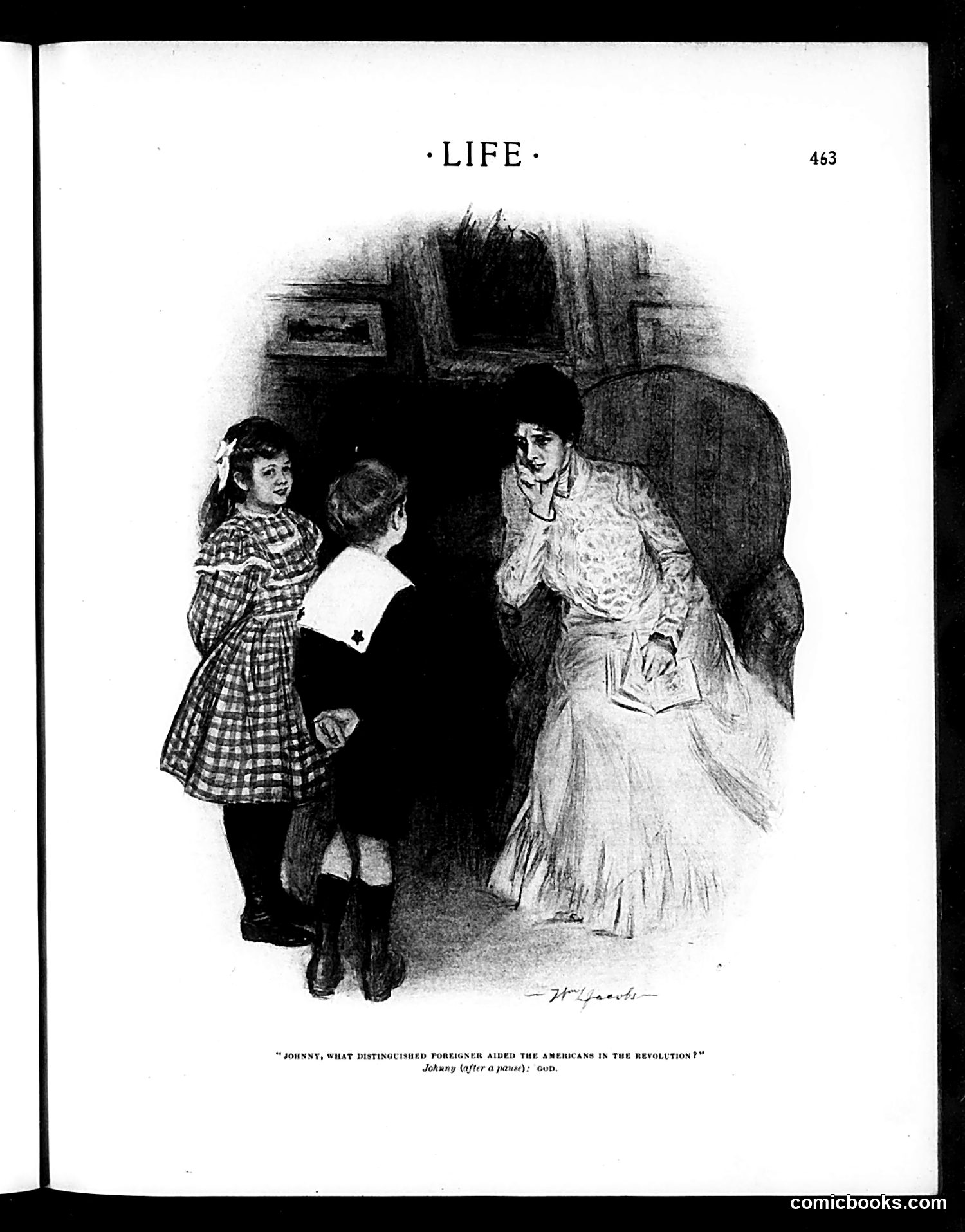
This is a single-panel cartoon depicting a schoolroom scene. A woman (likely a teacher) questions a young boy named Johnny about which foreign figure aided Americans during the Revolutionary War. After a pause, Johnny answers "God"—apparently unable to recall the correct answer: the Marquis de Lafayette, the French general who played a crucial role in American independence. The satire mocks childhood education and forgetfulness. The joke relies on the reader knowing Lafayette's historical importance; Johnny's flippant, religiously-tinged non-answer is meant to be humorous rather than reverent. This type of quiz-based humor was common in early Life magazine's satirical approach to American social institutions.
This page satirizes **Rudyard Kipling**, the famous British author, through a mock poem titled "The Old Tale." The satire, inspired by Kipling's "latest crime," attacks his literary formula and commercial success. **The Critique:** The poem mocks Kipling for: - Recycling the same story structure repeatedly (drawing on place names like "Brogaart, Leeuwin, Kalkouras") - Exploiting imperialist themes ("White Man's Burden," "Five Free Nations," "Our Lady of the Snows") - Cynically profiting from popular tastes ("Editors bring me Westland gold") - Using vague, meaningless phrases designed to impress readers of the *Times* - His self-aggrandizing vanity and pretension **The Point:** This is a direct attack on Kipling's commercialism and formulaic imperialism during the Boer War era (1901), when he was at peak popularity. The satire suggests his celebrated "genius" is actually lazy plagiarism dressed in jingoistic language.
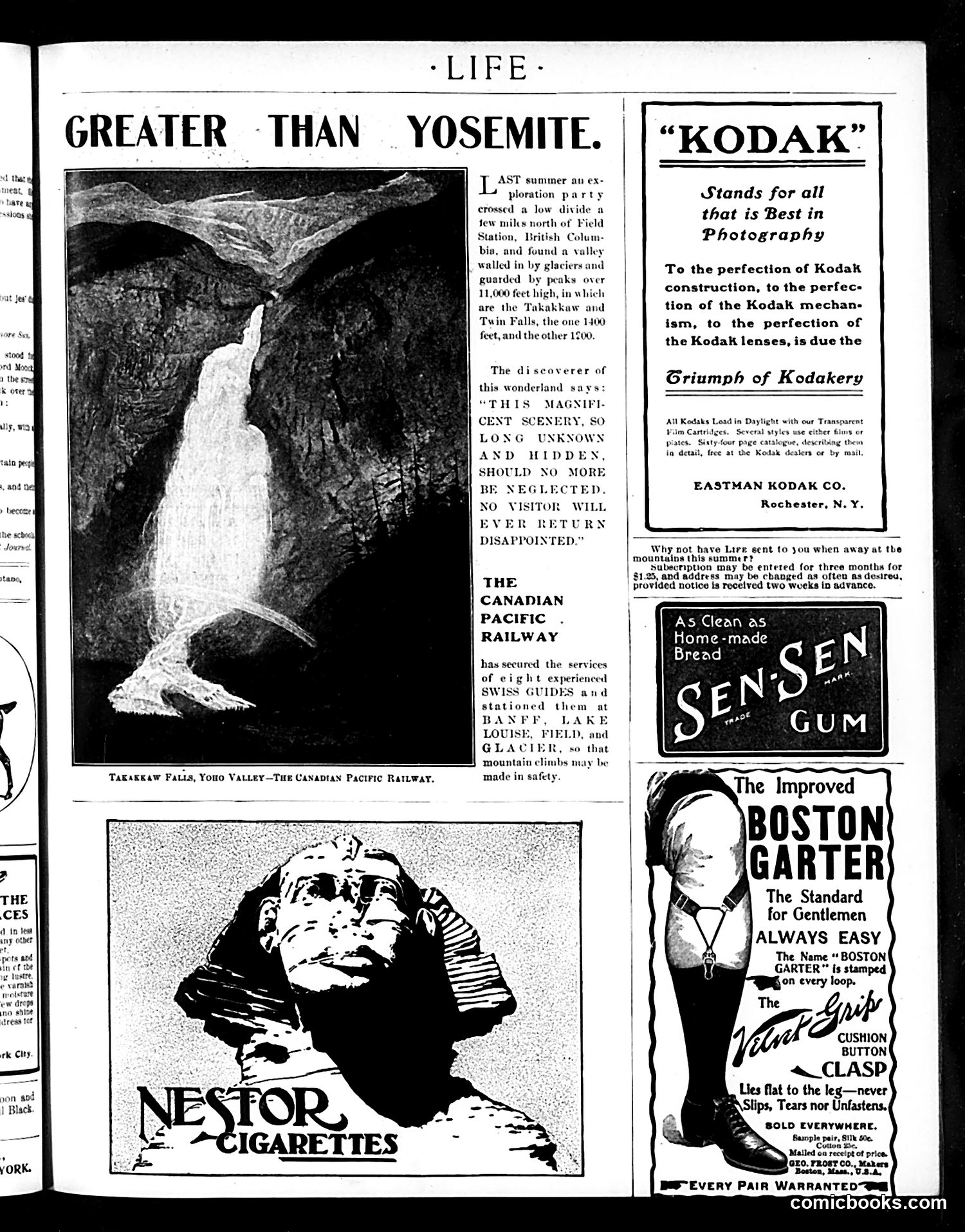
This page is primarily **advertising and travel promotion**, not political satire. The main content features: **Editorial Content:** An article promoting the Canadian Pacific Railway's newly discovered Takakkaw Valley in British Columbia, featuring a dramatic photograph of the falls. The text emphasizes the valley's natural grandeur ("greater than Yosemite") and notes the railway has hired Swiss mountain guides for tourist safety. **Advertisements:** The page includes period product ads for Kodak cameras, Nestor Cigarettes, Sensen Gum, and Boston Garters (men's leg garters). The Nestor Cigarettes ad features a stylized Egyptian pharaoh head—a common design motif of the era, reflecting early 20th-century fascination with Egyptology. **Satirical Element:** The only potential satire appears subtle—Life's self-promotion mentions readers can subscribe to the magazine "when away at the mountains," implying humorous commentary on leisure travel culture among the wealthy. The page reflects Edwardian-era consumer culture and tourism marketing rather than overt political commentary.
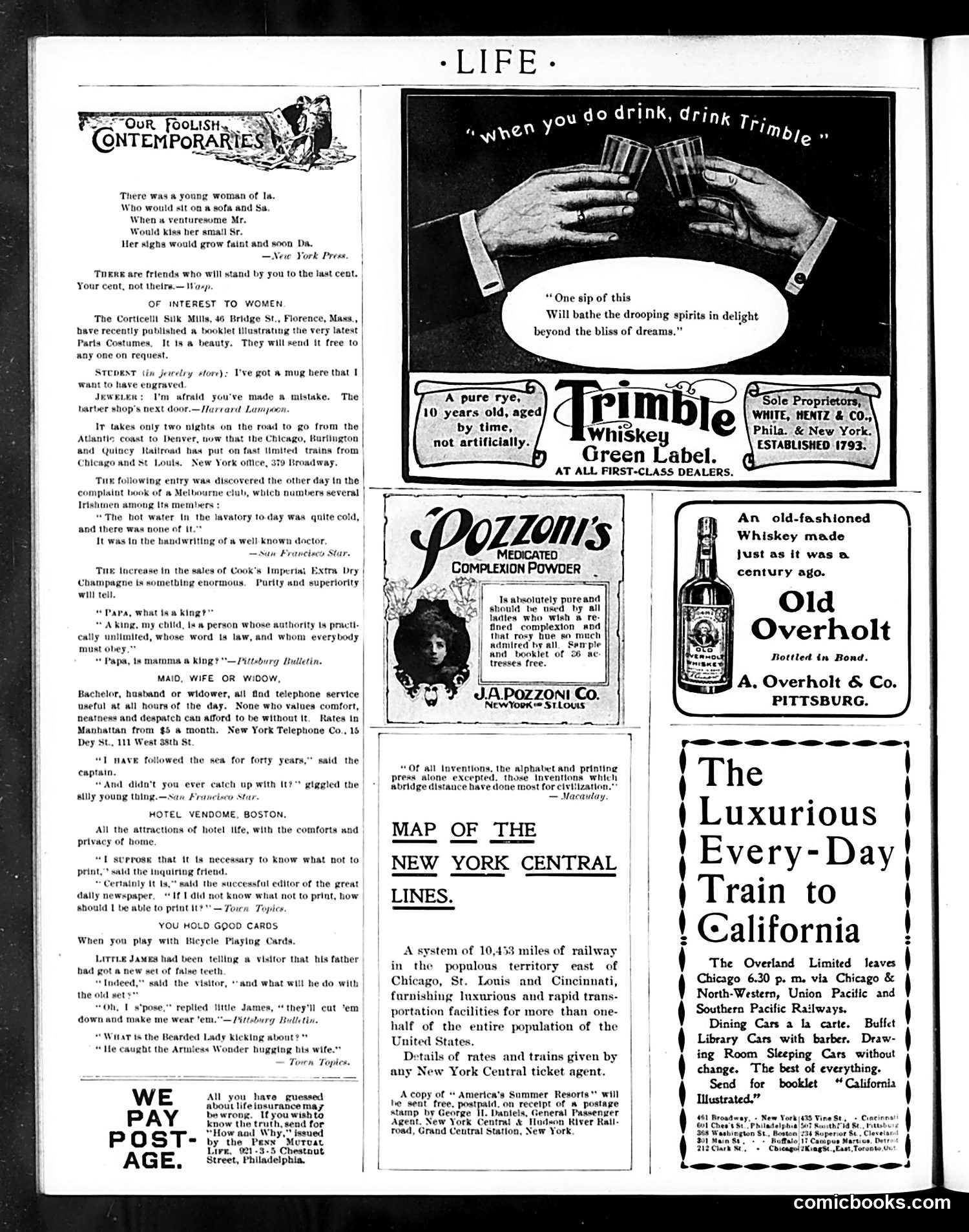
This page from *Life* magazine is primarily **advertising and humor columns**, not political cartooning. The content reflects early 20th-century American life and attitudes. ## Main Elements: **"Our Foolish Contemporaries"** (top left): A humor section reprinting witty observations from other publications—brief satirical remarks about relationships, friendship, and social behavior. These are generic social observations rather than political commentary. **Advertisements**: The page is dominated by product ads—whiskey (Trimble, Old Overholt), complexion powder (Pozzoni's), telephone service, and train travel. These ads reflect period concerns: alcohol consumption was openly advertised, women's beauty products were marketed heavily, and rail travel was a luxury amenity. **Humor bits**: Short jokes about marriage, wealth, telephones, and family life that reflect genteel, upper-class American concerns. **Context**: This appears to be a society/lifestyle page mixing entertainment, advertising, and light humor rather than substantive satire or political commentary. It reflects early 1900s attitudes toward consumerism, gender roles, and leisure.
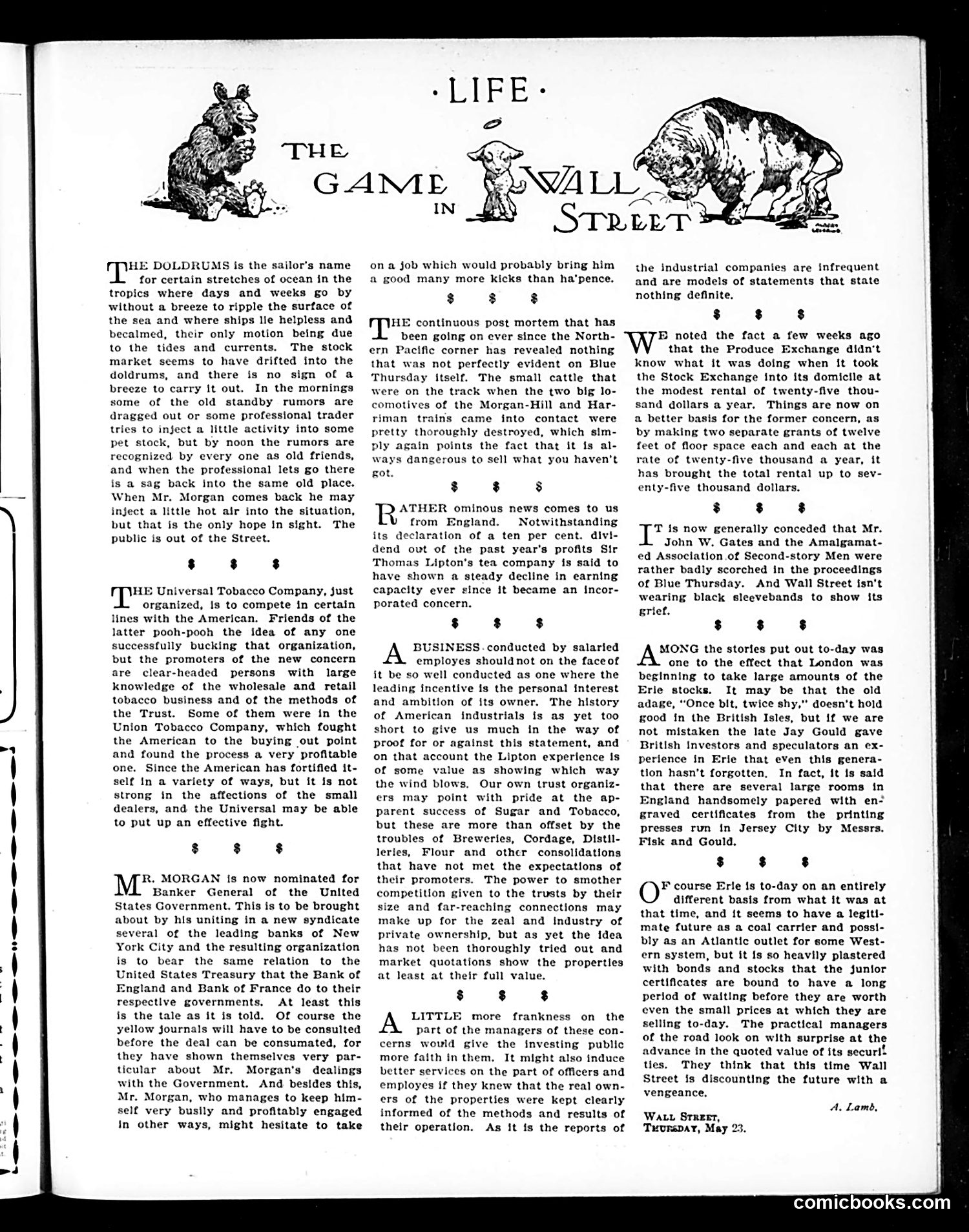
This page comprises financial commentary disguised as casual observation. The masthead depicts animals (appears to be a fox, goat, and bear) representing market speculation and volatility. The articles critique early 1900s financial practices: the stock market's stagnation ("doldrums"), competition against the American Tobacco Trust, and J.P. Morgan's rumored role as unofficial "Banker General." Key satirical points include mockery of Morgan's power over government finances, criticism of small investors caught in the Northern Pacific railroad corner (a speculative bubble), and skepticism about whether salaried corporate employees can conduct business as effectively as owner-operated firms—referencing Sir Thomas Lipton's tea company's decline after incorporation. The tone is wry rather than outraged, treating financial manipulation as inevitable theater. The "game" metaphor suggests Wall Street operates by its own rules, largely indifferent to public welfare or actual economic logic.
This is a book advertisement, not a cartoon. Life magazine is promoting Alfred Henry Lewis's biography of Richard Croker, the powerful boss of Tammany Hall (New York's Democratic political machine). The ad emphasizes that this is "the only authorized biography" and describes it as essential reading for understanding Croker ahead of an upcoming New York municipal election. The text positions the book as valuable for both Croker's supporters and critics, claiming Lewis provides balanced coverage of both his "good qualities" and "faults." For modern readers: Tammany Hall was synonymous with urban machine politics and corruption; this advertisement reflects the public fascination with—and anxiety about—powerful political bosses during the Progressive Era. The $2.00 price and green cloth binding indicate it was marketed as a serious, substantial work.
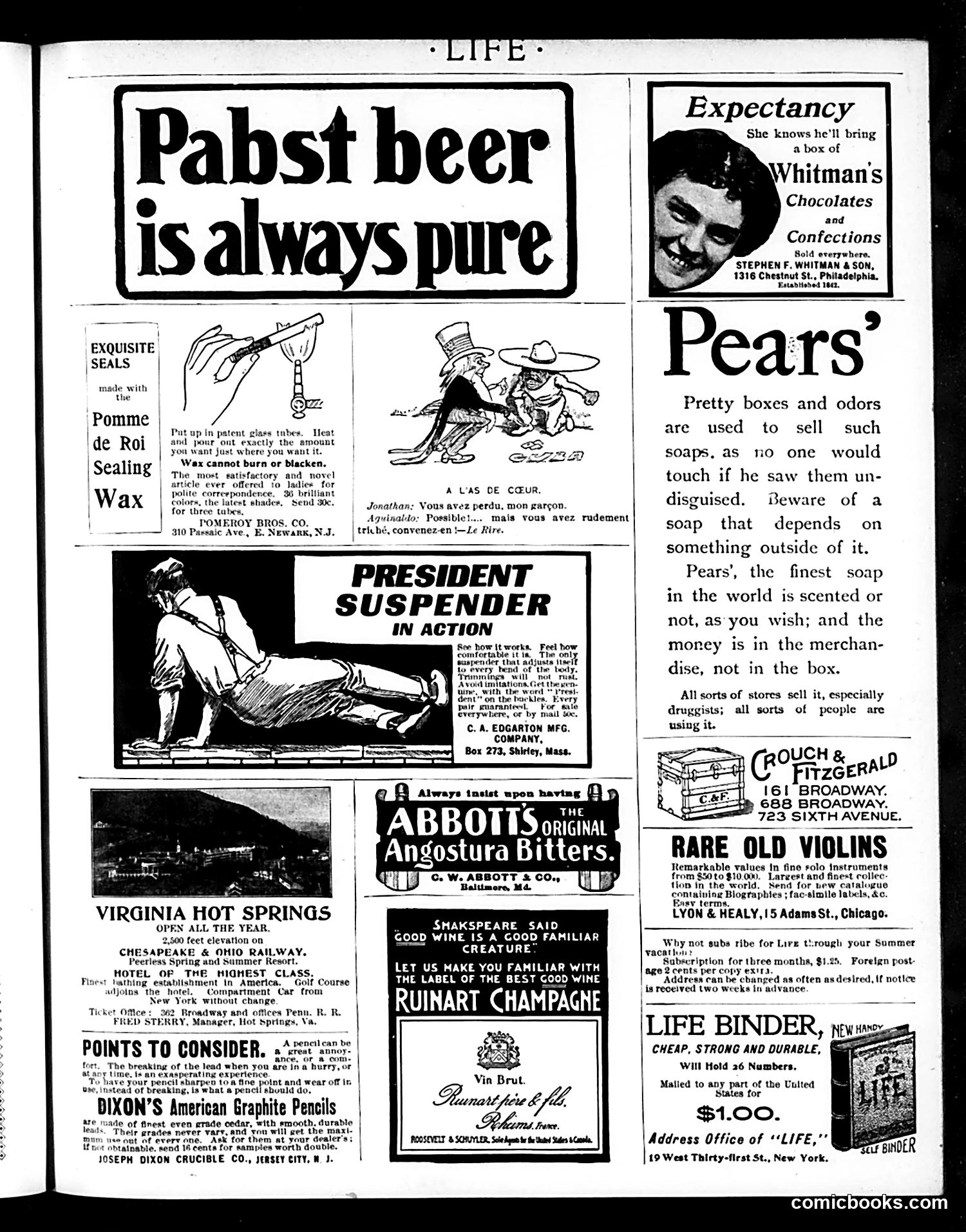
This page is primarily **advertising**, but contains one notable political cartoon. The "President Suspender in Action" depicts a figure suspended in mid-air by suspenders—a visual pun on the product name. The cartoon likely references **Theodore Roosevelt**, who was president during this Life magazine era (early 1900s), though the image alone doesn't confirm identity beyond showing a man in casual dress. The humor relies on the double meaning of "suspender": both the clothing item and the concept of suspension. It's a straightforward product advertisement using a pun rather than political satire. The page's remaining content consists entirely of period advertisements for luxury goods (Whitman's chocolates, Pears' soap, champagne, violins, pencils) and services (Virginia Hot Springs resort), reflecting Life's audience of affluent readers.
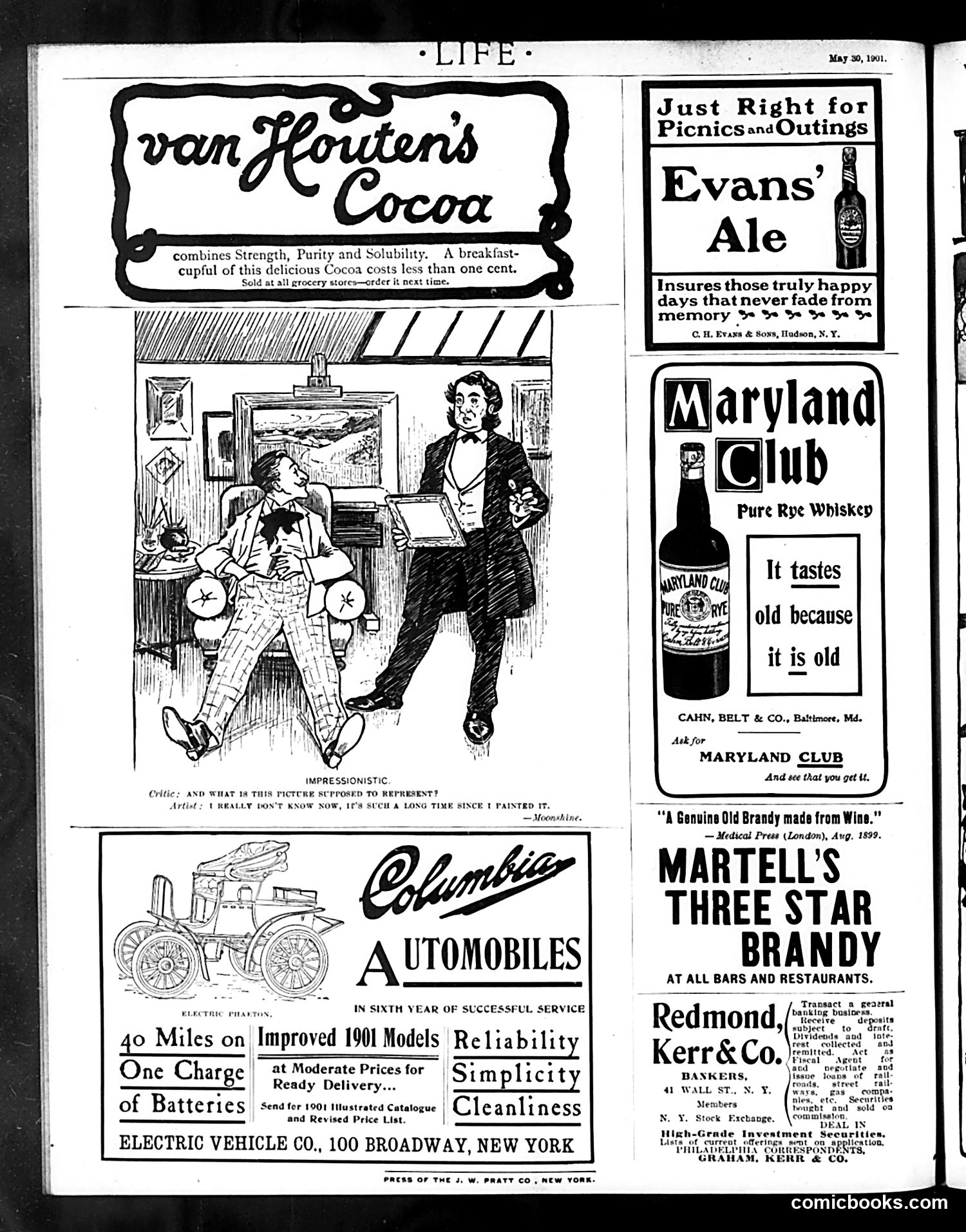
This page is primarily **advertising**, not political satire. The dominant content consists of product advertisements for beverages (cocoa, ale, whiskey, brandy) and early automobiles. The only cartoon is small and modest: titled "Impressionistic," it shows an artist and critic discussing a painting. The joke is straightforward—the artist admits he painted it so long ago he no longer remembers what it was supposed to represent. This gently mocks both pretentious modern art and artists' poor memories, a common early-1900s humor theme. The page's main interest lies in its **historical advertisement content**: it documents 1901 consumer products and marketing language. The Electric Vehicle Company ad notably emphasizes "40 Miles on One Charge," highlighting early automotive technology and the competing electric vehicle market before gasoline engines dominated.