
Life, 1901-05-30 · page 14 of 22
Life — May 30, 1901 — page 14: what you’re looking at
What you’re looking at
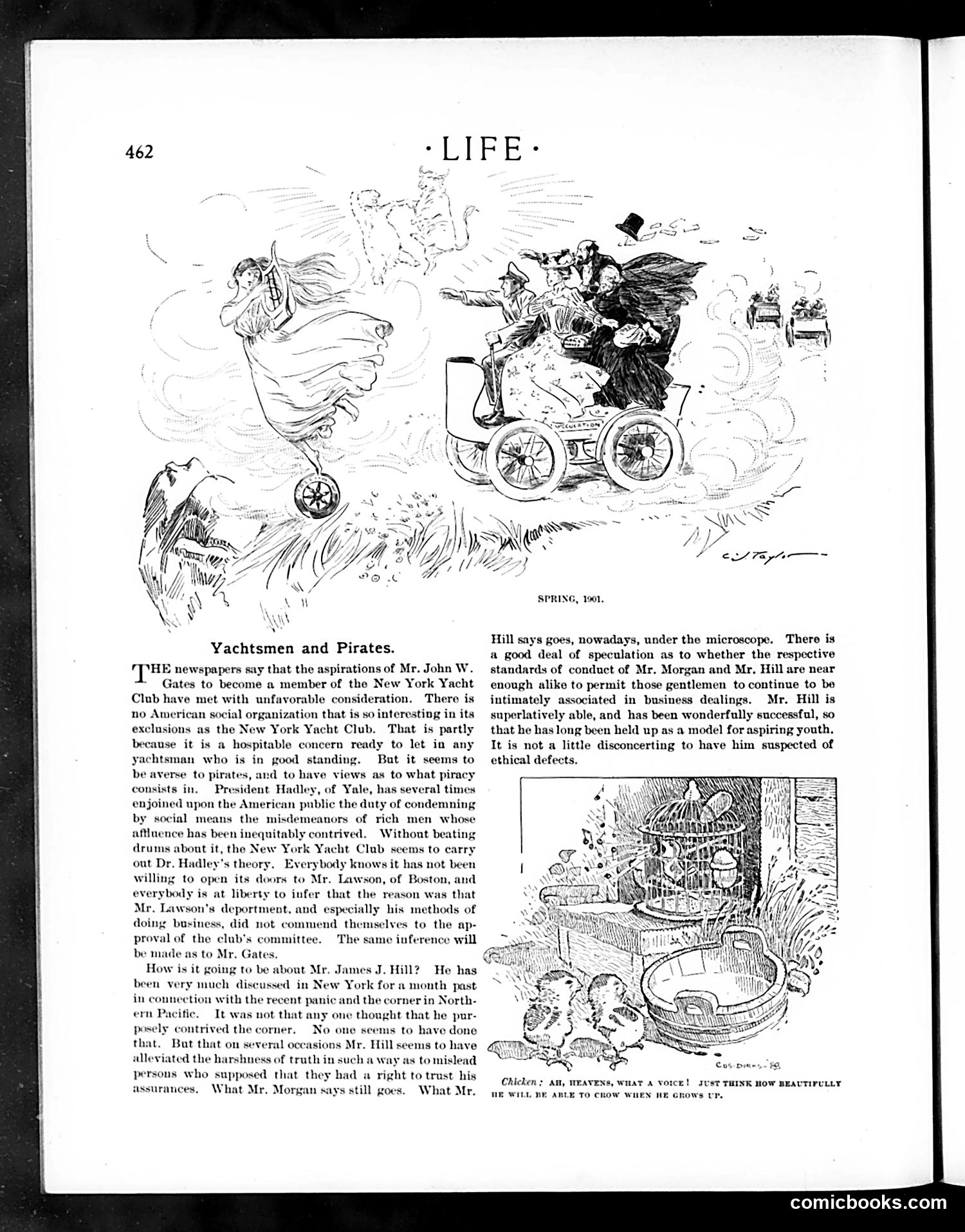
This article satirizes wealthy industrialists excluded from the elite New York Yacht Club for ethical misconduct. The piece discusses three wealthy men: **John W. Gates** (denied membership), **Thomas Lawson** (previously rejected), and **James J. Hill** (railroad magnate under scrutiny). The satire's point: the Yacht Club, despite claiming to admit any "yachtsman in good standing," actually judges members by moral standards. Hill is particularly suspect following the recent Northern Pacific railroad panic, where he allegedly misled investors. The article notes his reputation now requires "microscope" scrutiny—unlike J.P. Morgan, whose word still carries unquestioned weight. The bottom illustration (captioned about a chicken) appears to comment on boastful talk versus actual character—likely suggesting these wealthy men's reputations will prove hollow. The overall message: **wealth alone doesn't guarantee respectability; questionable business practices have consequences**, even among the ultra-rich.
📄 Transcribed text from this page (OCR, searchable)
Machine-transcribed from the original scan — historical spelling and the odd misread are preserved.
Pas vay thw a \ X \ (\ y Yachtsmen and Pirates. .HE newspapers say that the aspirations of Mr. John W. Gates to become a member of the New York Yacht Club have met with unfavorable consideration. There is no American social organization that is so interesting in its exclusions as the New York Yacht Club. That is partly because it is a hospitable concern ready to let in any yachtsman who is in good standing. But it seems to be averse to pirate nd to have views as to what piracy consists in, President Hadley, of Yale, has several times d upon the American public the duty of condemning cial means the misdemeanors of rich men whose affluence has been inequitably contrived. Without beating drums about it, the New York Yacht Club scems to carry out Dr. Hadley’s theory. Everybody knows it has not been willing to open its doors to Mr. Lawson, of Boston, and everybody is at liberty to infer that the reason v that Mr, Lawson's deportment, and especially his methods of doing business, did not commend themselves to the ap- proval of the club's committee. The same inference will be made as to Mr. Gates. How is it going to be about Mr. James J. Hill? He has been very much discussed in New York for a month past in connection with the recent panic and the corner in North- ern Pacitic. It was not that any one thought that he pur- posely contrived the corner. No one seems to have done that. But that on several occasions Mr. Hill seems to have alleviated the harshness of truth in such a way as to mislead persons who supposed that they had a right to trust his assurances, What Mr, Morgan says still goes. What Mr. SPRING, 1901. Hill says goes, nowadays, under the microscope. Thero is a good deal of speculation as to whether the respective standards of conduct of Mr. Morgan and Mr, Hill are near enough alike to permit those gentlemen to continue to be intimately associated in business dealings. Mr. Hill is superlatively able, and has been wonderfully successful, so that he has long been held up as a model for aspiring youth, It is not a little disconcerting to have him suspected of ethical defects. Cos piers 6 Chicken ; AM, WEAVENS, WHAT A Votce! JUST THINK HOW BEAUTIFULLY HE WILL BY ABLE TO ChOW WHEN HE crows Ur. comicbooks.com