
Life, 1901-05-30 · page 4 of 22
Life — May 30, 1901 — page 4: what you’re looking at
A restored page from Life, 1901-05-30. Page through the whole issue in the reader above.
📄 Transcribed text from this page (OCR, searchable)
Machine-transcribed from the original scan — historical spelling and the odd misread are preserved.
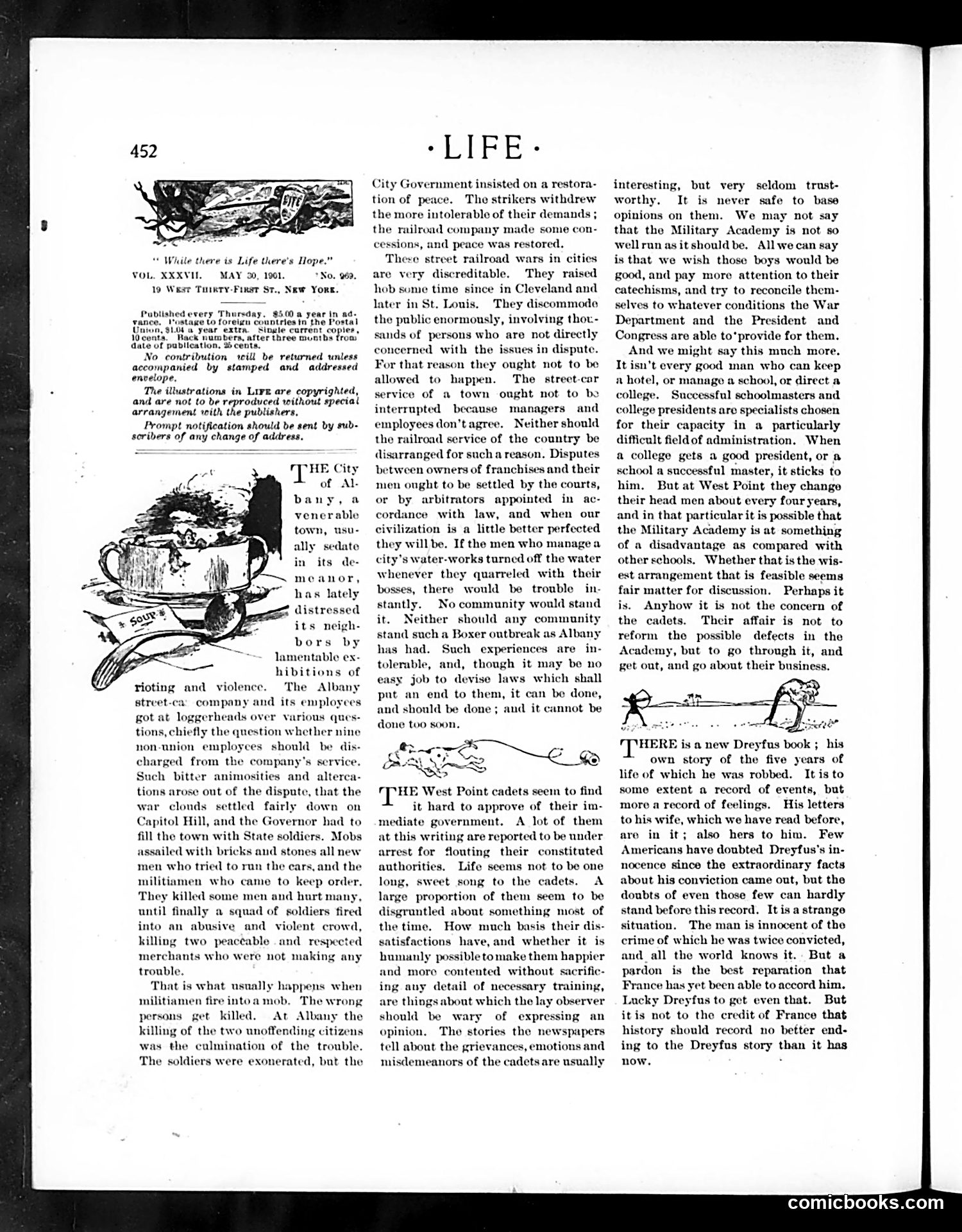
* While there is Life Uvere's Hope.” VOL. XXXVI. MAY 90, 1901. * No, 969. 19 West TuIRTY-Finst St., New Yorg. Published every Thursday. $500 a year In ad ance. Ke Lo foreign countries tn the Postal Union, shutu year extra. ‘Single curreat copier, Jconts. Rack numbers, after three munths date of publication, 3 cents. No contribution will be returned unless accompanied by stamped and addressed envelope. rom The illustrations in Lire are copyrighted, and are not to be reproduced without special arrangement with the publishers, Prompt notification should be sent by sub- scribers of any change of address. ae HE City of Al. bany, a venerable town, usu- ally sedate in its de- meanor, has lately lamentable ex- hibitions of rioting and violence. The Albany street-ca’ company and its employees got at loggerheads over various ques- tions, chiefly the question whether nine non-union employees should be di charged from the company's servi Such bitter animosities and alterc tions arose out of the dispute, that the war clonds settled fairly down on Capitol Hill, and the Governor had to fill the town with State soldiers. Mobs assailed with bricks and stones all new men who tried to ran the cars, and the militiamen who came to keep order, They killed some men and hurt many. until finally a squad of soldiers fired into an abusive and violent crowd, killing two peaceable and respected merchants who were not making any trouble. That is what usually happens when militiamen fire intoa mob. The wrong persons get killed. At Albany the killing of the two unoffending citizens was the culmination of the trouble. The soldiers were exonerated, but the LIFE City Government insisted on a restora- tion of. The strikers withdrew the more intolerable of their demands the railroad company made some con- cessions, and peace was restored. There street railroad wars in cities are very discreditable. They raised hob some time since in Cleveland and later in St. Louis. They discommode the public enormously, involving thov- sands of persons who are not directly concerned with the issues in dispute. For that reason they ought not to be allowed to happen. The street-car service of a town ought not to bo interrupted because managers and employees don’tagree. Neither should the railroad service of the country be disarranged for such a reason. Disputes between owners of franchises and their men ought to be settled by the courts, or by arbitrators appointed in ac- cordance with law, and when our civilization is a little better perfected they will be. If the men who manage a city’s water-works turned off the water whenever they quarreled with their bosses, there would be trouble in- stantly. No community would stand it. Neither should any community stand such a Boxer outbreak as Albany has had. Such experiences are in- tolerable, and, though it may be no easy job to devise laws which shall put an end to them, it can be done, and should be done ; and it cannot be done too soon, Ls =, Weal Point cadets seem to find it hard to approve of their im- mediate government. A lot of them at this writing are reported to be under arrest for flouting their constituted authorities. Life seems not to be one long, sweet song to the cadets, A large proportion of them seem to be disgruntled about something most of the time. How much basis their dis satisfactions have, and whether it is humanly possible tomake them happier and moro contented without sacrific- ing any detail of necessary training, are things about which the lay observer should be wary of expressing an opinion. The stories the newspapers tell about the grievances, emotions and misdemeanors of the cadets are usually interesting, but very seldom trust- worthy, It is never safe to base opinions on them. We may not say that the Military Academy is not so wellrun as itshould be, Allwecan say is that we wish those boys would be good, and pay more attention to their catechisms, and try to reconcile them- selves to whatever conditions the War Department and the President and Congress are able to‘provide for them. And we might say this much more. It isn't every good man who can keep a hotel, or manage a school, or direct a college. Successful schoolmasters and college presidents are specialists chosen for their capacity in a particularly difficult fieldof administration. When a college gets a good president, or a school a successful master, it sticks to him, But at West Point they change their head men about every four years, and in that particular it is possible that the Military Academy is at something of a disadvantage as compared with other schools. Whether that is the wis- est arrangement that is feasible seems fair matter for discussion. Perhaps it is. Anyhow it is not the concern of the cadets. Their affair is not to reform the possible defects in the Academy, but to go through it, and get out, and go about their business. pee HERE is a new Dreyfus book ;_ his own story of the five years of life of which he was robbed. It is to some extent a record of events, but more a record of feelings. His letters to his wife, which we have read before, are in it; also hers to him. Few Americans have doubted Dreyfus’s in- nocence since the extraordinary facts about his conviction came out, but the doubts of even those few can hardly stand before this record. It is a strango situation, The man is innocent of the crime of which he was twice convicted, and_all the world knows it. But a pardon is the best reparation that France has yet been able to accord him, Lucky Dreyfus to get even that. But itis not to the credit of France that history should record no better end- ing to the Dreyfus sory, t than it has now. comicbooks.com