
Life, 1901-05-30 · page 7 of 22
Life — May 30, 1901 — page 7: what you’re looking at
What you’re looking at
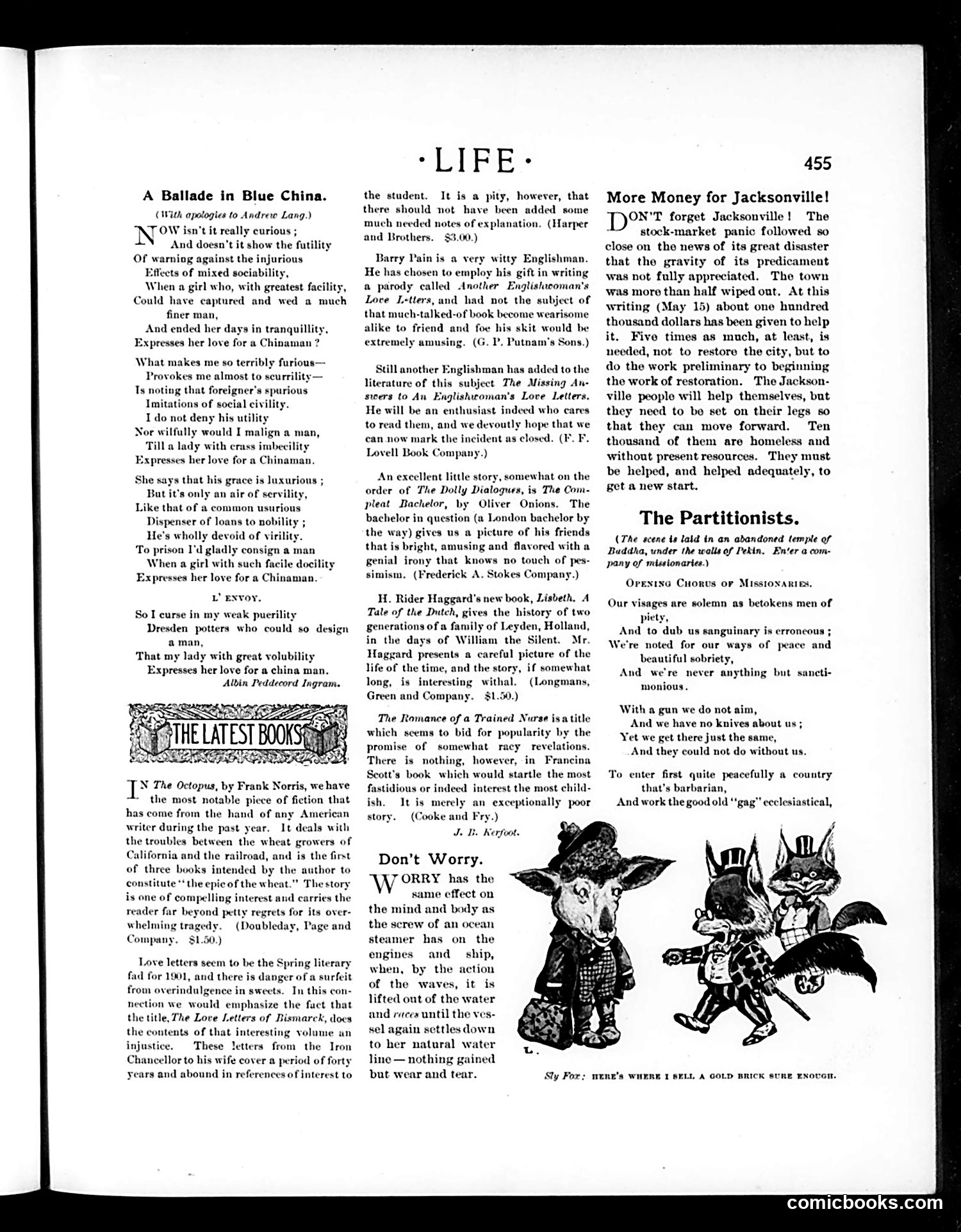
This cartoon illustrates the proverb "men's where I sell a gold brick sure enough," depicting a sly fox successfully deceiving another animal (likely a goose or similar bird). The visual pun plays on the phrase "selling a gold brick"—a common 19th-century con meaning to swindle someone with a worthless item disguised as valuable. The cartoon accompanies an article titled "Don't Worry," which discusses how worry affects people physically and mentally, comparing it to an ocean steamer's distress. The accompanying illustration humorously suggests that deception and cunning can be as damaging as worry itself—the "fox" exploiting the victim's gullibility, much as worry exploits human vulnerability.
📄 Transcribed text from this page (OCR, searchable)
Machine-transcribed from the original scan — historical spelling and the odd misread are preserved.
A Ballade in Blue China. (With apologies to Andrew Lang.) T OW isn't it really curious ; And doesn't it show the futility Of warning against the injurious Effects of mixed sociability, When a girl who, with greatest facilit Could have captured and wed a much finer man, And ended her days in tranquillity, Expresses her love for a Chinaman ? What makes me so terribly furious— Provokes me almost to scurrility— Is noting that foreigners spurious Imitations of social civility. I do not deny his utility Nor wilfully would I malign a man, Till a lady with crass imbecility Expresses her love for a Chinaman, She says that his grace is luxurious ; Bat it’s only an air of servility, Like that of a common usurious Dispenser of loans to nobility He's wholly devoid of viri ‘To prison I'd gladly consign a man When a girl with such facile docility Expresses her love for a Chinaman. L EXVoY. So I curse in my weak puerility Dresden potters who could so design a man, ‘That my lady with great volubility Expresses her love for a china man. Albin Peddecord Ingram. Pile UTES of plu eS EK NY I N The Octopus, by Frank Norris, we have the most notable piece of fiction that has come from the hand of any American writer during the past year. It deals with the troubles between the wheat growers of California and the railroad, and is the first of three books intended by the author to constitute“ the epic of the wheat.” T is one of compelling interest and carries the reader far beyond petty regrets for its over- whelming tragedy. (Doubleday, Page and Company. ).) Love letters seem to be th fad for 1901, and there is danger of a surfeit from overindulgence in sweets. In this con- nection we would emphasize the fact that the title, The Love Letters of narek, docs the contents of that interesting volume an injustic These letters from the Iron Chancellor to his wife cover a period of forty years and abound in references of interest to ring lite LIFE the student. It is a pity, however, that there should not have been added some much needed notes of explanation. (Harper and Brothers. $3.00.) Barry Pain is a very witty Englishman. He has chosen to employ his gift in writing a parody called Another Englislicoman's Love Letters, and had not the subject of that much-talked-of book become wearisome alike to friend and foe his skit would be extremely amusing. (G. P. Putnam's Sons.) Still another Englishman has added to the literature of this subject The Missing An- swers to An Englishtcoman's Love Letters. He will be an enthusiast indeed who cares to read them, and we devoutly hope that we can now mark the incident as closed. (F. Lovell Book Company.) An excellent little story, somewhat on the order of The Dolly Dialogues, is The Com- pleat Bachelor, by Oliver Onions. The bachelor in question (a London bachelor by the way) gives us a picture of his friends that is bright, amusing and flavored with a genial irony that knows no touch of pes- simism, (Frederick A. Stokes Company.) H. Rider Haggard’s new book, Lisbeth. A Tale of the Dutch, 3 the history of two generations of a fa y of Leyden, Holland, in the days of William the Silent. Mr. Haggard presents a careful picture of the life of the time, and the story, if somewhat long, is interesting withal. (Longmans, Green and Company. $1.50.) The Romance of a Trained Nurse isatitle which scems to bid for popularity by the promise of somewhat racy revelations. There is nothing, however, in Francina Scott's book which would startle the most pus or indeed interest the most child- It is merely an exceptionally poor (Cooke and Fry.) JB Don’t Worry. V 7 ORRY has the same effect on the mind and body as the screw of an ocean steamer has on the engines and ship, when, by the action of the waves, it is lifted out of the water and races until the ves- sel again settles down to her natural water line — nothing gained but wear and tear. Sly For: 455 More Money for Jacksonville! ON’T forget Jacksonville! The stock-market panic followed so close on the news of its great disaster that the gravity of its predicament was not fully appreciated. The town was more than half wiped out. At this writing (May 15) about one hundred thousand dollars has been given to help it. Five times as much, at least, is needed, not to restore the city, but to do the work preliminary to beginning the work of restoration. The Jackson- ville people will help themselves, but they need to be set on their legs so that they can move forward. Ten thousand of them are homeless and without present resources. They must be helped, and helped adequately, to get a new start. The Partitionists. (The scene is laid in an abandoned temple of Buddha, under the walls of Pekin. En'er a com- pany of missionaries.) Oresxixo Cuorus or Missionaries. Our visages are solemn as betokens men of piety, And to dub us sanguinary is erroneous ; We're noted for our ways of peace and beautiful sobriety, And we're never anything but sancti- monious. With a gun we do not aim, And we have no knives about us ; Yet we get there just the same, And they could not do without us, To enter first quite peacefully a country that’s barbarian, And work the good old ‘‘gag" ecclesiastical, TERE'S WHERE I BELL A GOLD BRICK SURE ENOUOT. comicbooks.com