
A complete issue · 20 pages · 1901
Life — March 28, 1901
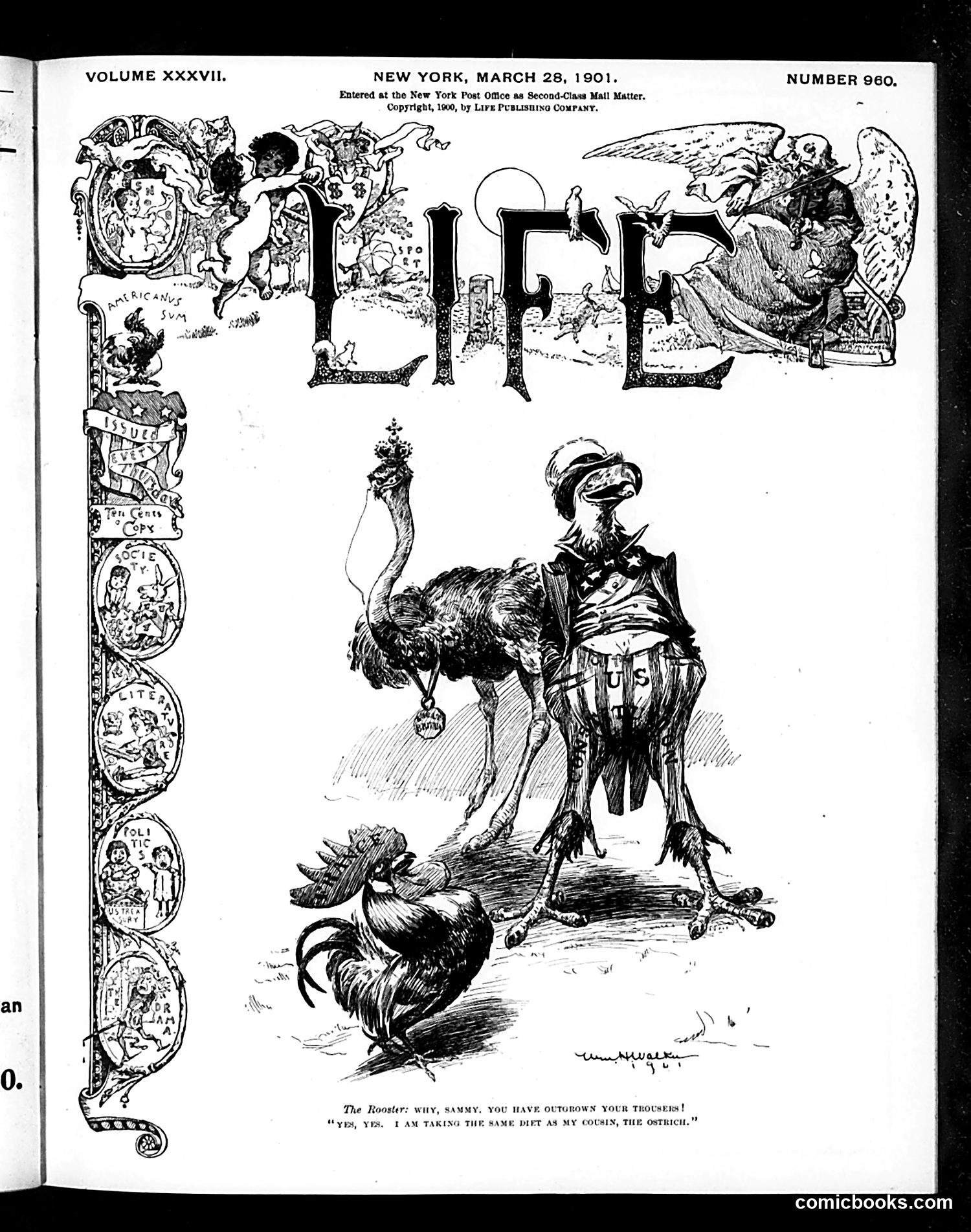
This political cartoon satirizes a confrontation between a rooster and an ostrich, with the ostrich depicted as a caricatured human figure wearing military dress and labeled "U.S." The caption reads: "The Rooster: WHY, SAMMY, YOU HAVE OUTGROWN YOUR TROUSERS!" with the ostrich responding "YES, YES. I AM TAKING THE SAME DIET AS MY COUSIN, THE OSTRICH." The cartoon likely references American imperial expansion around 1901, with "Sammy" (Uncle Sam/the U.S.) depicted as having grown too large, possibly critiquing overextension in foreign conflicts or territories. The ostrich—traditionally symbolizing avoidance or willful blindness—suggests ironic commentary on American policy. The rooster appears to represent a critical observer mocking this expansion. The exact political context remains unclear without additional historical documentation.
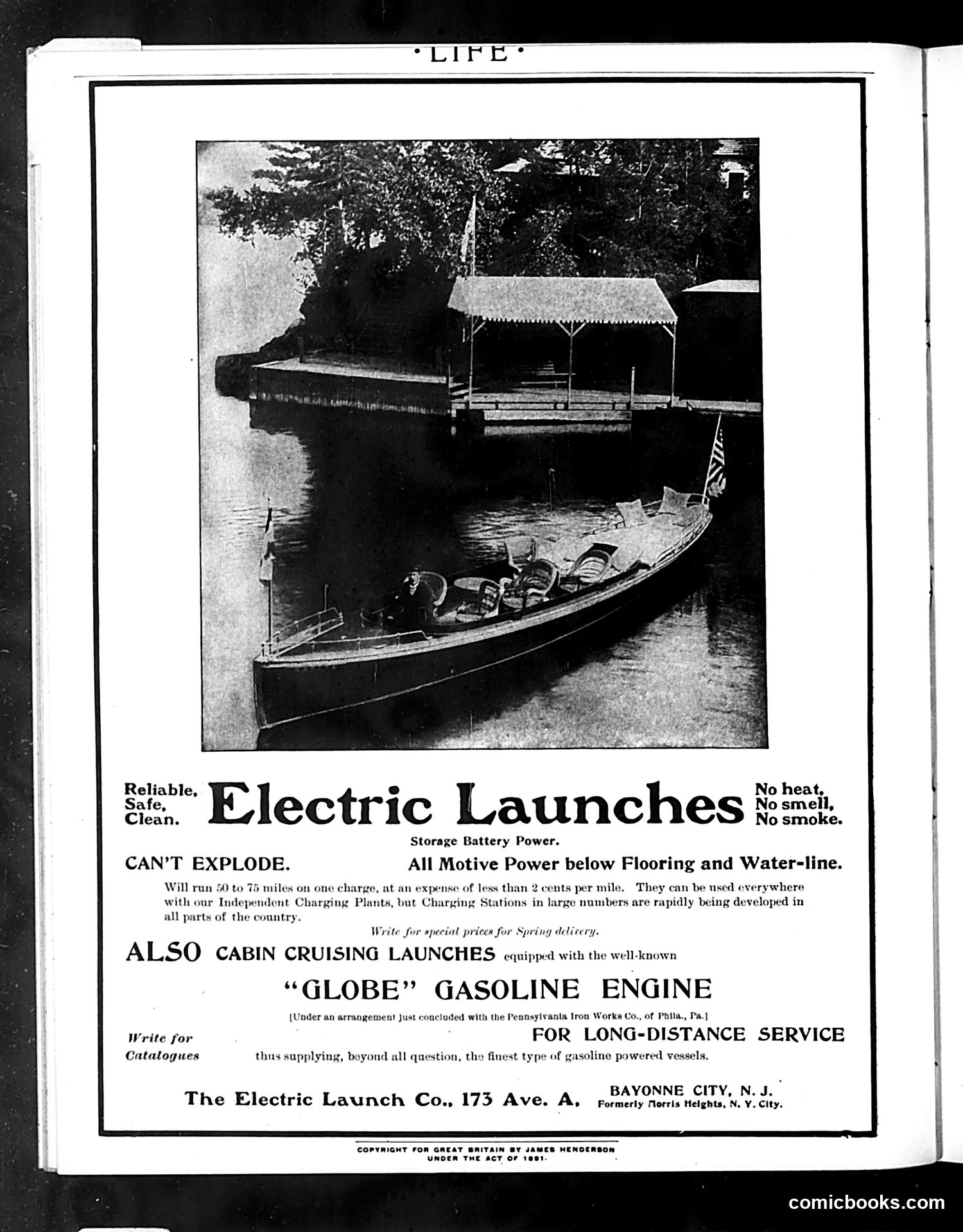
This page is **primarily an advertisement**, not satire or political commentary. It promotes electric-powered boats manufactured by The Electric Launch Company of Bayonne, New Jersey. The ad emphasizes the advantages of electric launches over gasoline-powered vessels: they're reliable, safe, and clean—producing "no heat, no smell, no smoke." The pitch highlights that electric boats "can't explode" and offer efficient long-distance cruising via battery power, with charging stations becoming widely available. The photograph shows a sleek electric launch moored near a waterfront pavilion, presumably demonstrating the vessel's elegant design. The only notable detail: a reference to Pennsylvania Iron Works' "Globe" gasoline engines, suggesting some competition acknowledged even within the ad. This reflects early-1900s enthusiasm for electric vehicles before gasoline ultimately dominated.
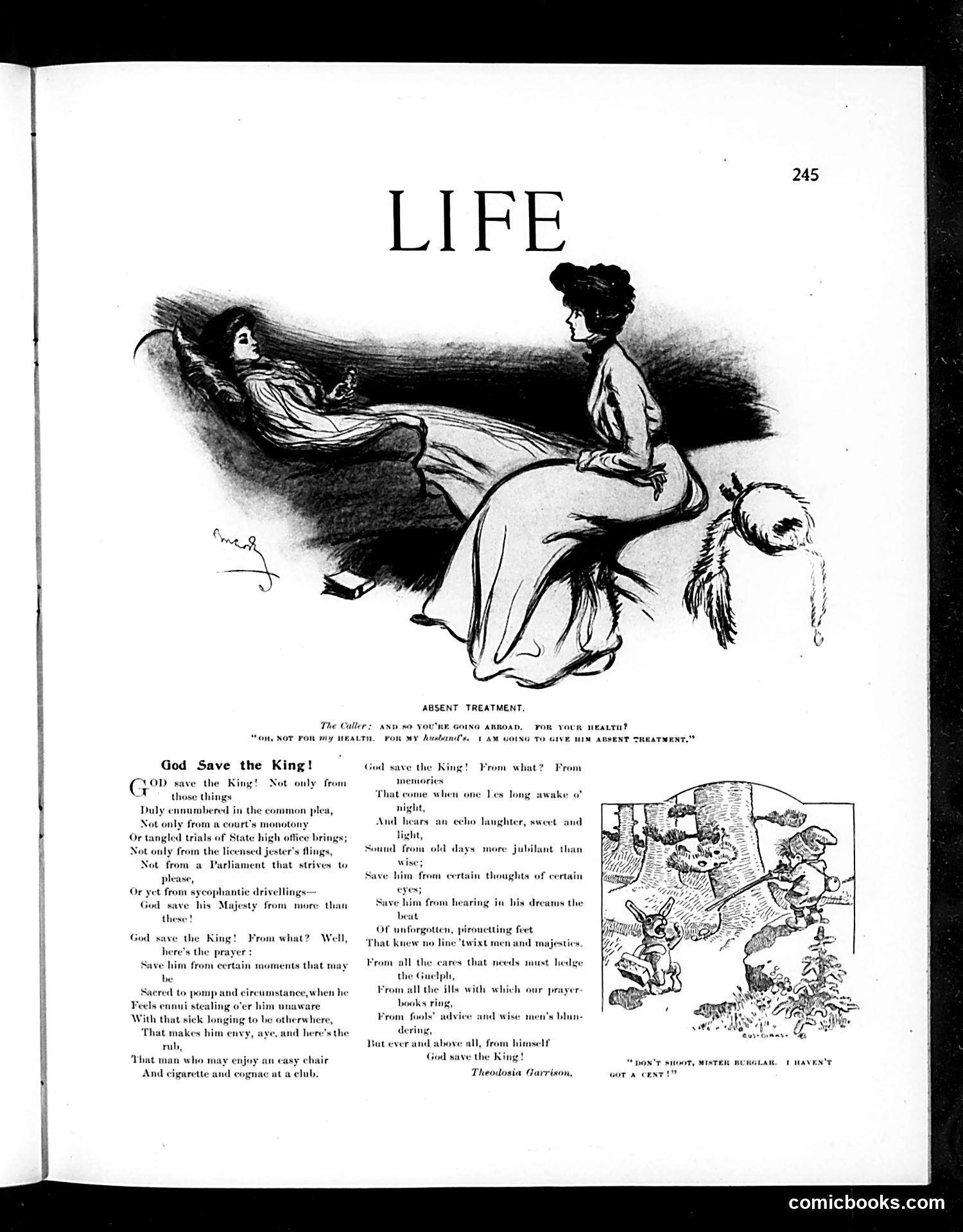
**Top Cartoon ("Absent Treatment"):** A woman sits with a small dog while ignoring a man in the background. The caption suggests she's giving her husband "absent treatment" (the silent treatment) as punishment, claiming it's "for your health" and "for my husband's. I am going to give him absent treatment." **Poem ("God Save the King"):** A sentimental poem by Theodosia Garrison about preserving the monarchy from various modern threats—idle gossip, dreams, "twist men and majesties," and bad advice. It advocates spiritual protection of the king. **Bottom Cartoon:** Shows two figures (likely children or working-class people) in a domestic scene. The caption reads "I say, Sniff, Sister Burglah, I haven't got a cent!" The page satirizes contemporary social anxieties about gender relations, royal stability, and class conditions in early 20th-century America.
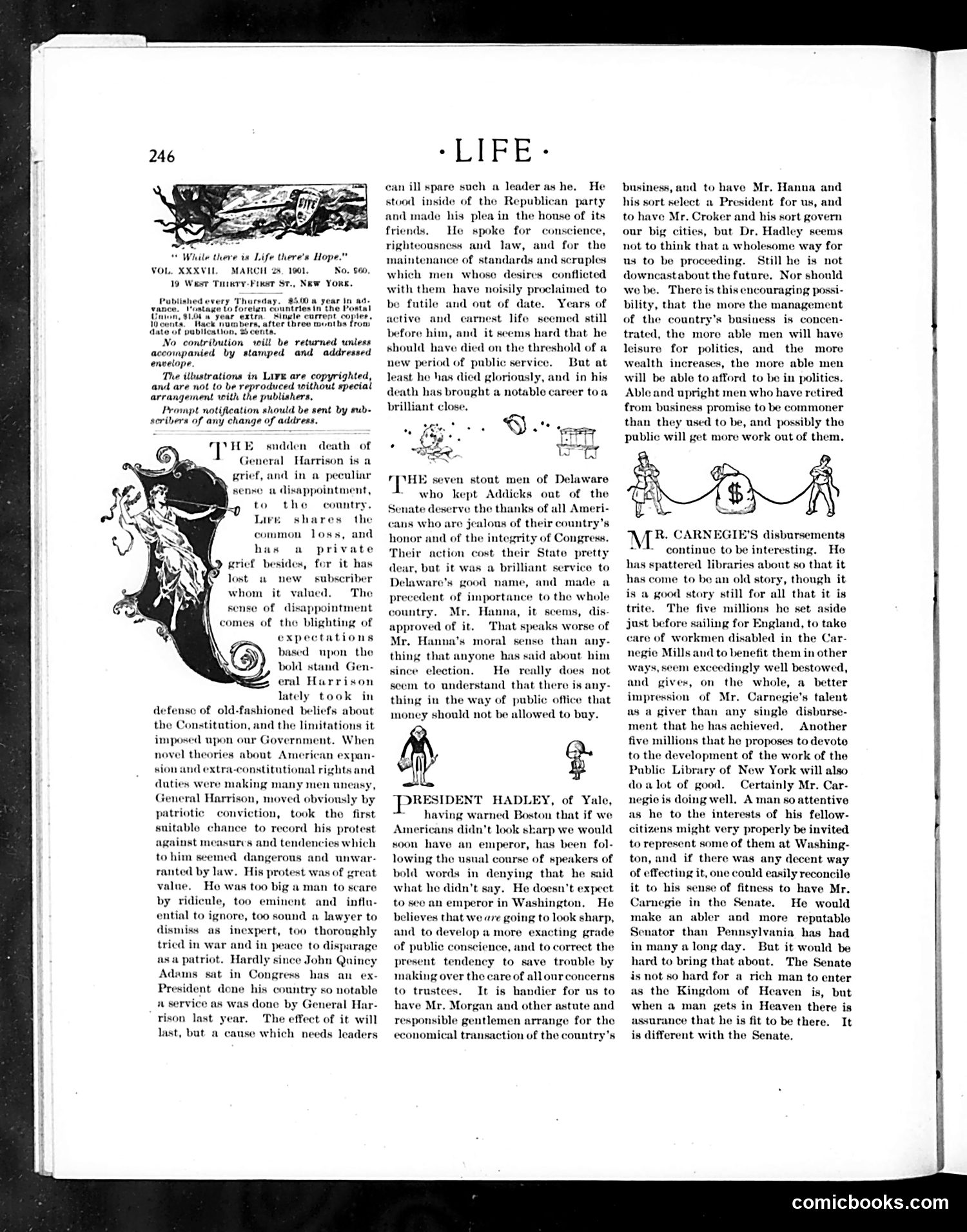
This page contains political commentary rather than a cartoon. The text discusses General Harrison's death and its impact on the Republican party, along with critiques of various political figures including President Hadley (of Yale) and Mr. Hanna. The illustrations appear to be small decorative vignettes rather than narrative cartoons. One shows figures pulling a money bag—likely satirizing financial dealings in politics. Another depicts what appears to be a seated official. The content criticizes the concentration of power among wealthy businessmen in politics and questions whether government appointments should prioritize business interests over public service. The commentary suggests concerns about corporate influence on American governance during this era, though the specific historical context remains unclear without additional dating information.
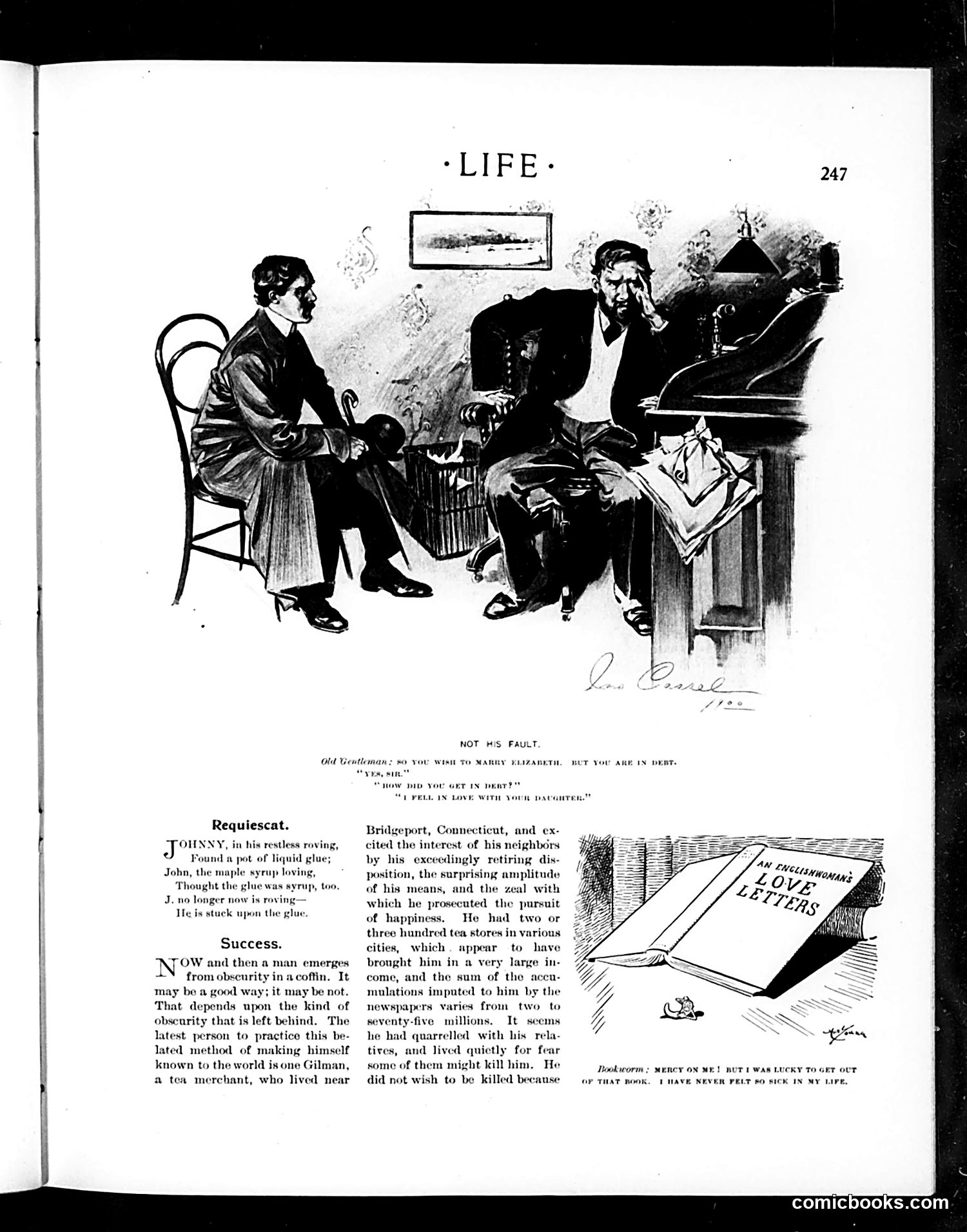
The top cartoon illustrates "Not His Fault," depicting a confrontation between an old gentleman and a younger man in debt. The dialogue reveals the setup: the older man wished to marry Elizabeth but is now in debt; the younger man fell in love with her and caused the debt. The satire critiques romantic entanglement and financial irresponsibility—suggesting young men's romantic pursuits lead to their financial ruin, a common early-20th-century concern. Below are two short story sections: "Requescat" about Johnny's restless roving and failed business ventures, and "Success" about a tea merchant named Gilman who became wealthy through obscurity and quiet living. The page satirizes competing 1920s values: romantic passion versus practical financial security, and the paradox that success comes not from pursuit but from avoiding notice.
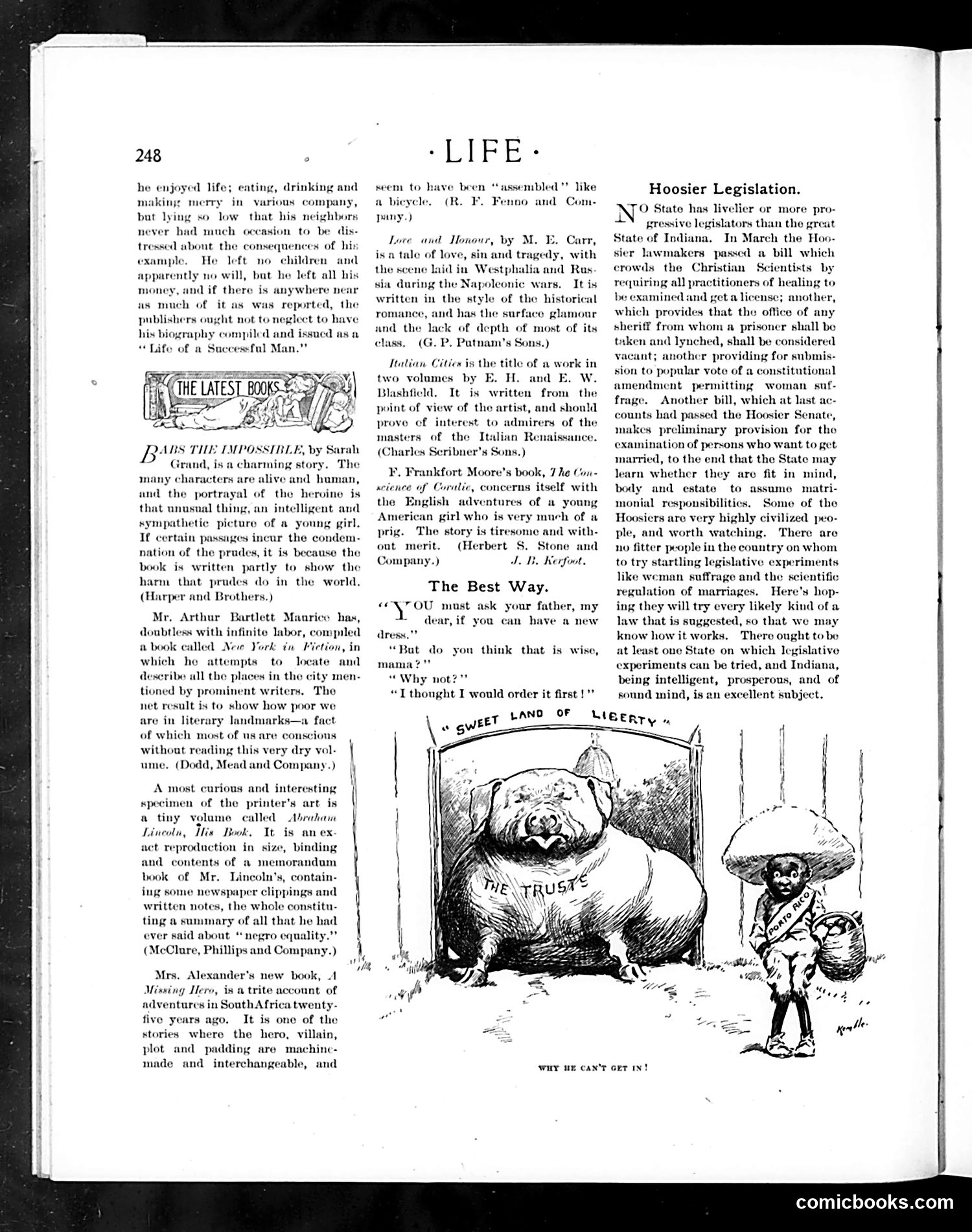
This political cartoon depicts a large figure labeled "THE TRUSTEE" sitting heavily on "SWEET LAND OF LIBERTY," while a small figure (appearing to represent the common citizen or "the people") stands trapped beneath an umbrella, asking "WHY HE CAN'T GET IN?" The satire criticizes how powerful corporate trustees or monopolists have seized control of American freedoms and resources, literally sitting atop the nation's liberty and excluding ordinary citizens from accessing it. The umbrella suggests the citizen's futile attempt at protection or shelter from this oppressive arrangement. The cartoon comments on the Gilded Age concern that wealthy corporate interests had monopolized American opportunity, leaving average people unable to participate in the nation's promised freedom and prosperity.
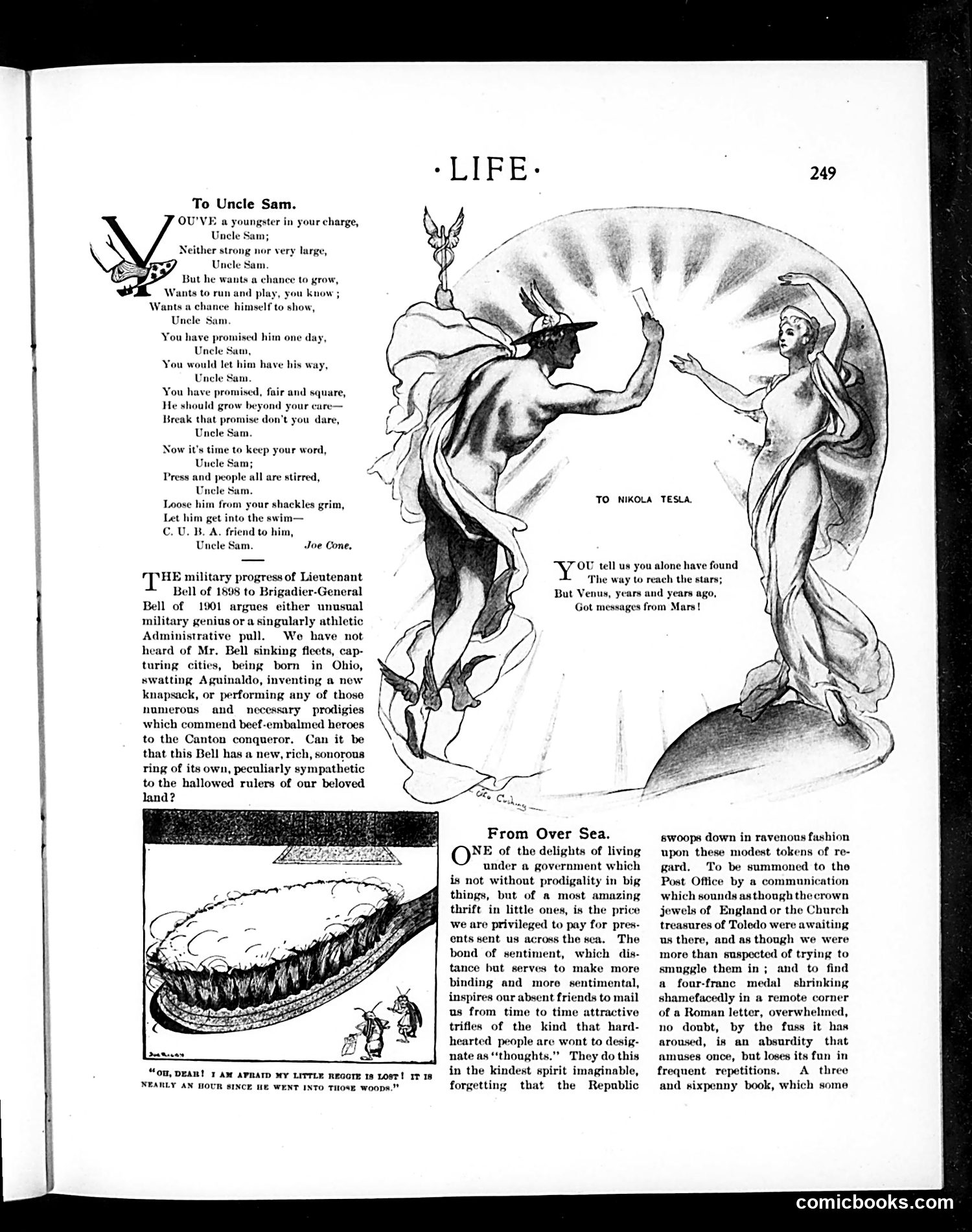
This page contains three distinct pieces: 1. **"To Uncle Sam"** (poem by Joe Omé): A patriotic appeal urging the U.S. government to honor promises to develop young talent and keep commitments—likely referencing post-WWI obligations or domestic programs. 2. **Center illustration**: Two allegorical figures (one muscular, one ethereal) labeled "To Nikola Tesla," apparently celebrating the inventor's scientific achievements, particularly regarding space exploration or wireless transmission. 3. **"From Over Sea"** (article): Satirizes the American postal system's inefficiency by contrasting it favorably with foreign governments. The humor lies in praising modest government services as "treasures," mocking American complacency about its own institutional shortcomings. The bottom cartoon shows a lost child, providing lighter comedic relief.
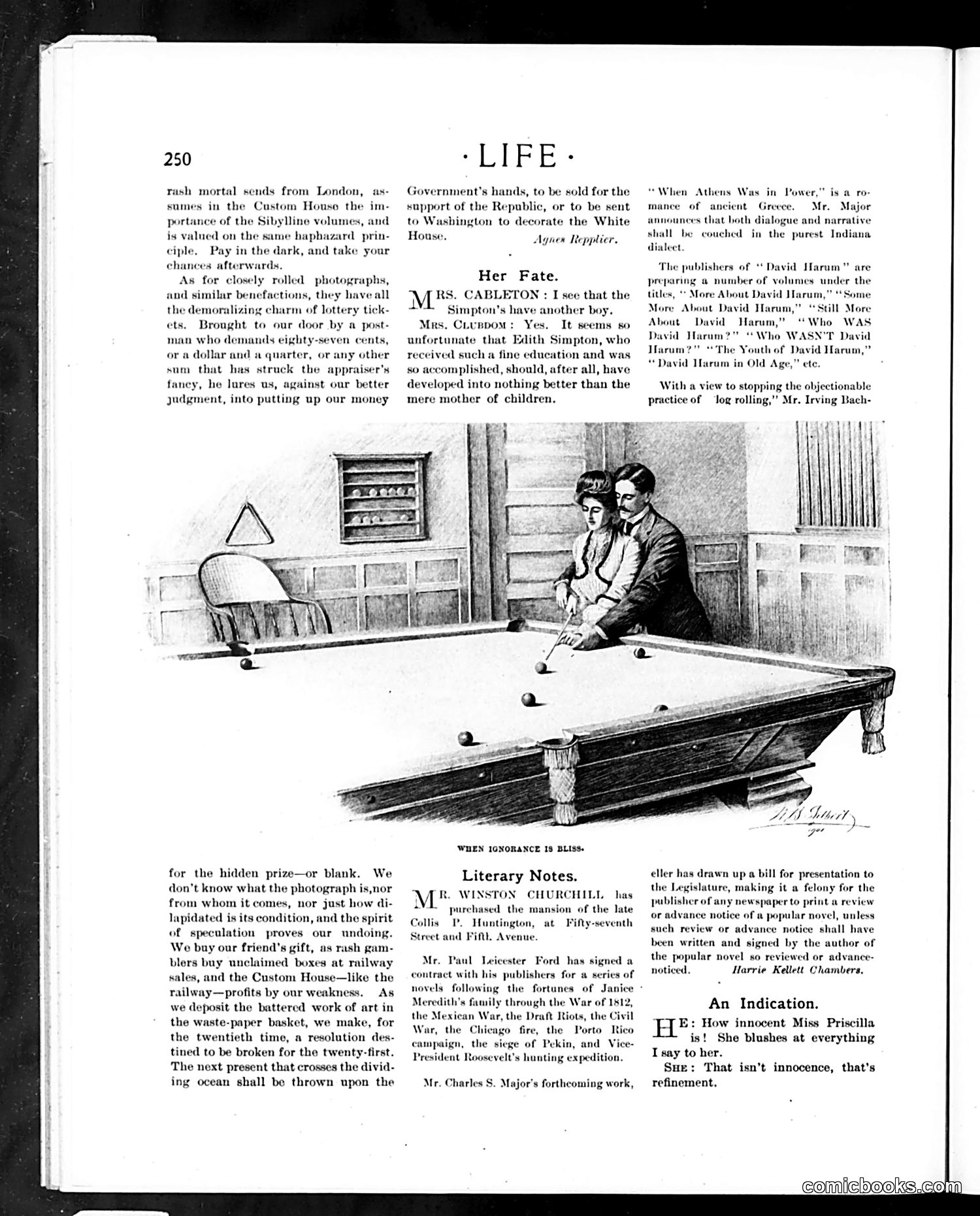
This cartoon illustrates a social critique about inequality and willful blindness. Two figures play billiards while appearing oblivious to their surroundings—suggesting they ignore uncomfortable social realities around them. The caption "When Ignorance Is Bliss" is a reference to the phrase "where ignorance is bliss, 'tis folly to be wise," implying these characters deliberately avoid confronting inconvenient truths, presumably about poverty, labor conditions, or social injustice prevalent in the era. The well-furnished room with fine furnishings suggests wealthy individuals insulated from societal problems. The cartoon satirizes how the privileged classes distract themselves with leisure while remaining indifferent to broader social issues—a common critique in early 20th-century American satire about class consciousness and social responsibility.
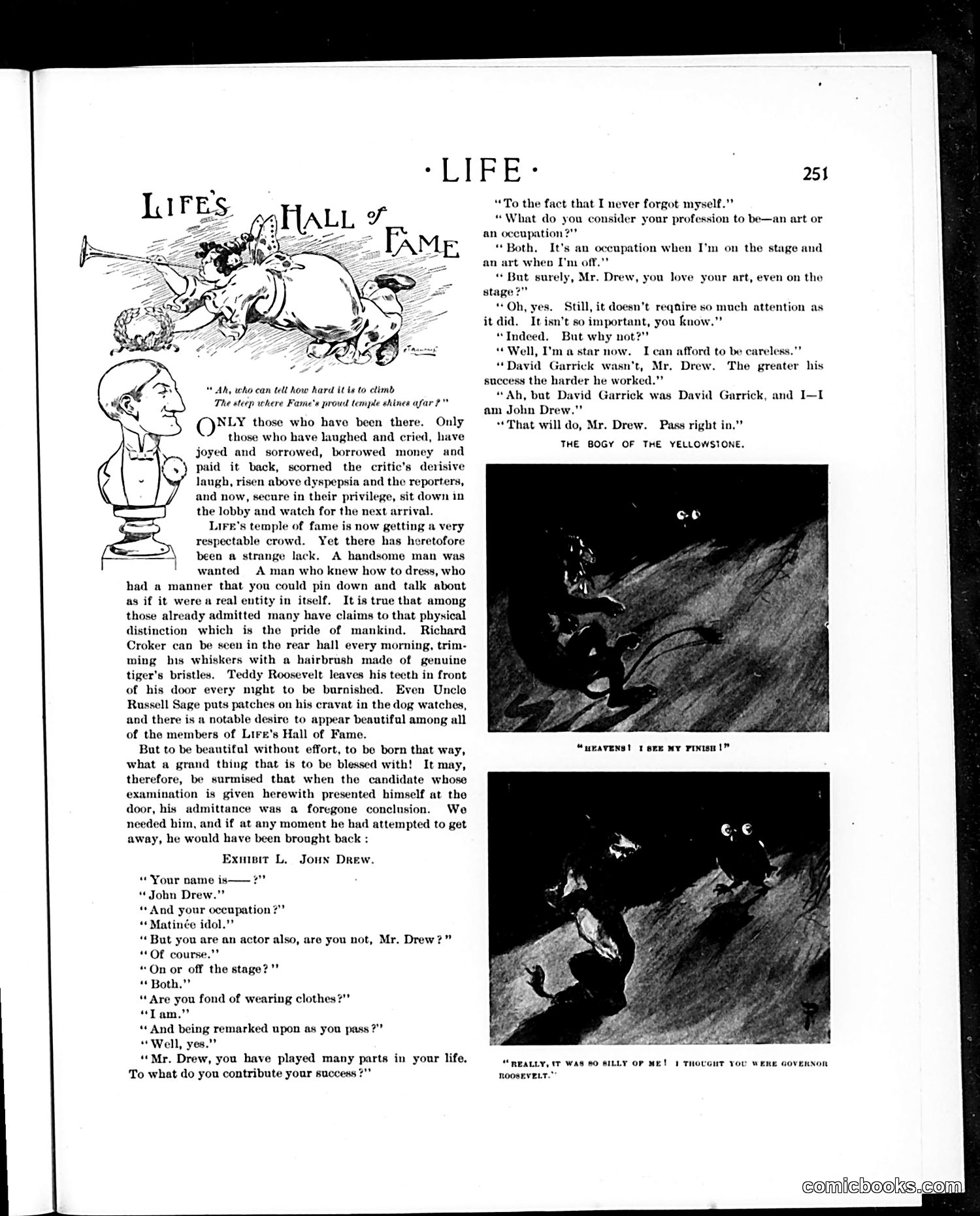
This page satirizes the superficiality of celebrity culture. The left column presents an interview with "John Drew," a matinee idol actor, examining what makes someone famous. The article mocks how Hall of Fame members are selected based on appearance and public persona rather than substance—mentioning that distinguished men like Richard Croker and Theodore Roosevelt are admired for trivial attributes (grooming, dental habits). The satire suggests celebrity admission depends on being "a handsome man" with proper dress and manner, not actual accomplishment. Drew himself admits his success comes partly from "wearing clothes" well. The two photographs on the right appear to show scenes from a theatrical production, supporting the text's focus on stage performance as the route to fame.
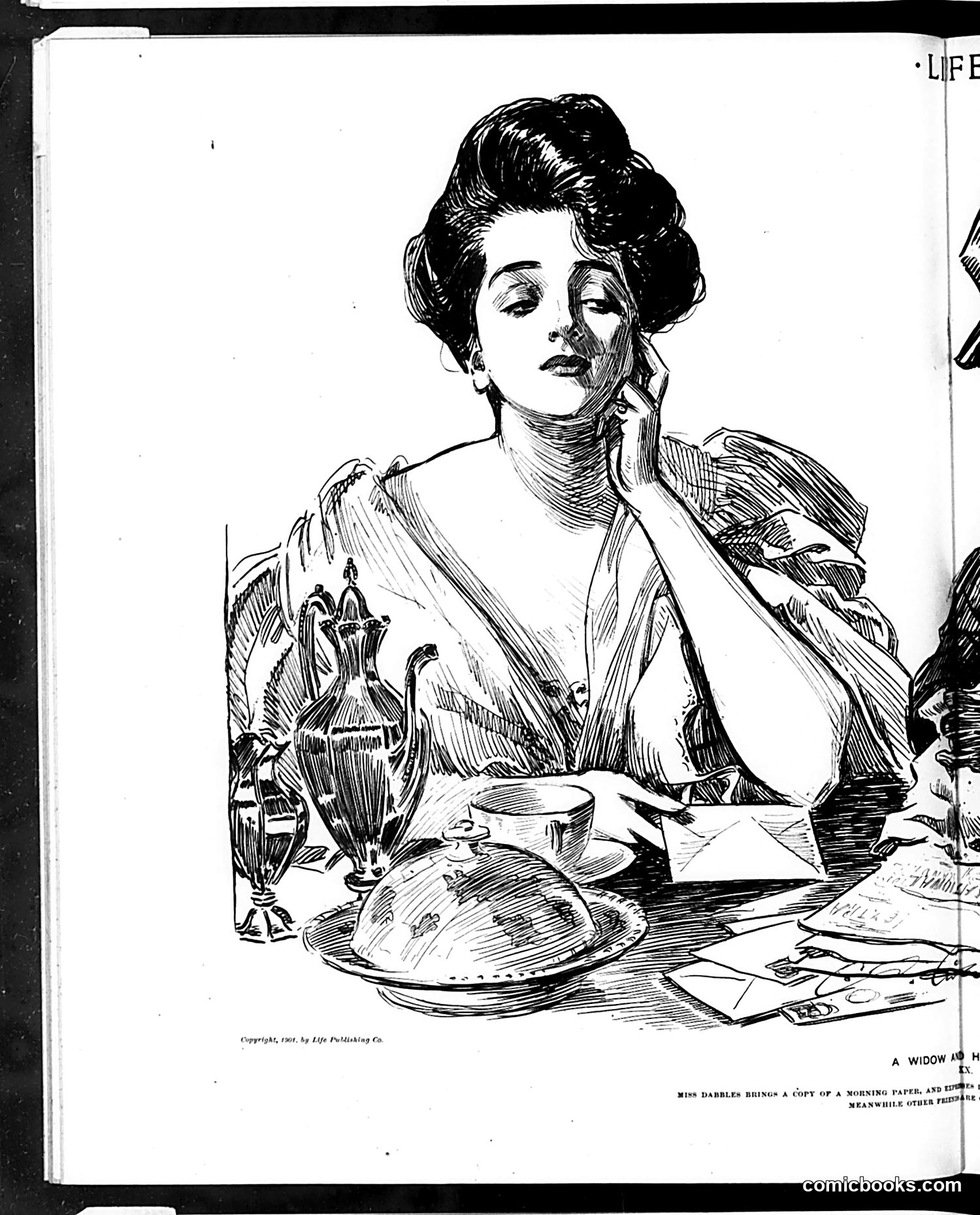
This is an illustration from *Life* magazine (copyright 1907, per the visible credit). The caption reads: "A WIDOW AND HER MORNING PAPER — MISS DABBLES BRINGS A CUP OF MORNING TEA AND MEANWHILE OTHER PERSONS INTERRUPT." The drawing depicts a well-dressed woman at breakfast, examining correspondence and a newspaper with apparent concern. The scene satirizes the social position of a wealthy widow managing her domestic life and affairs independently. The illustration's focus on her morning routine—receiving tea service while handling mail—suggests satire about widows' newfound autonomy or the social complications arising from their independent status. The specific "Miss Dabbles" reference and the detailed domestic scene appear to reference a recurring character or social type recognizable to *Life*'s contemporary readership, though the exact reference is unclear without additional context.
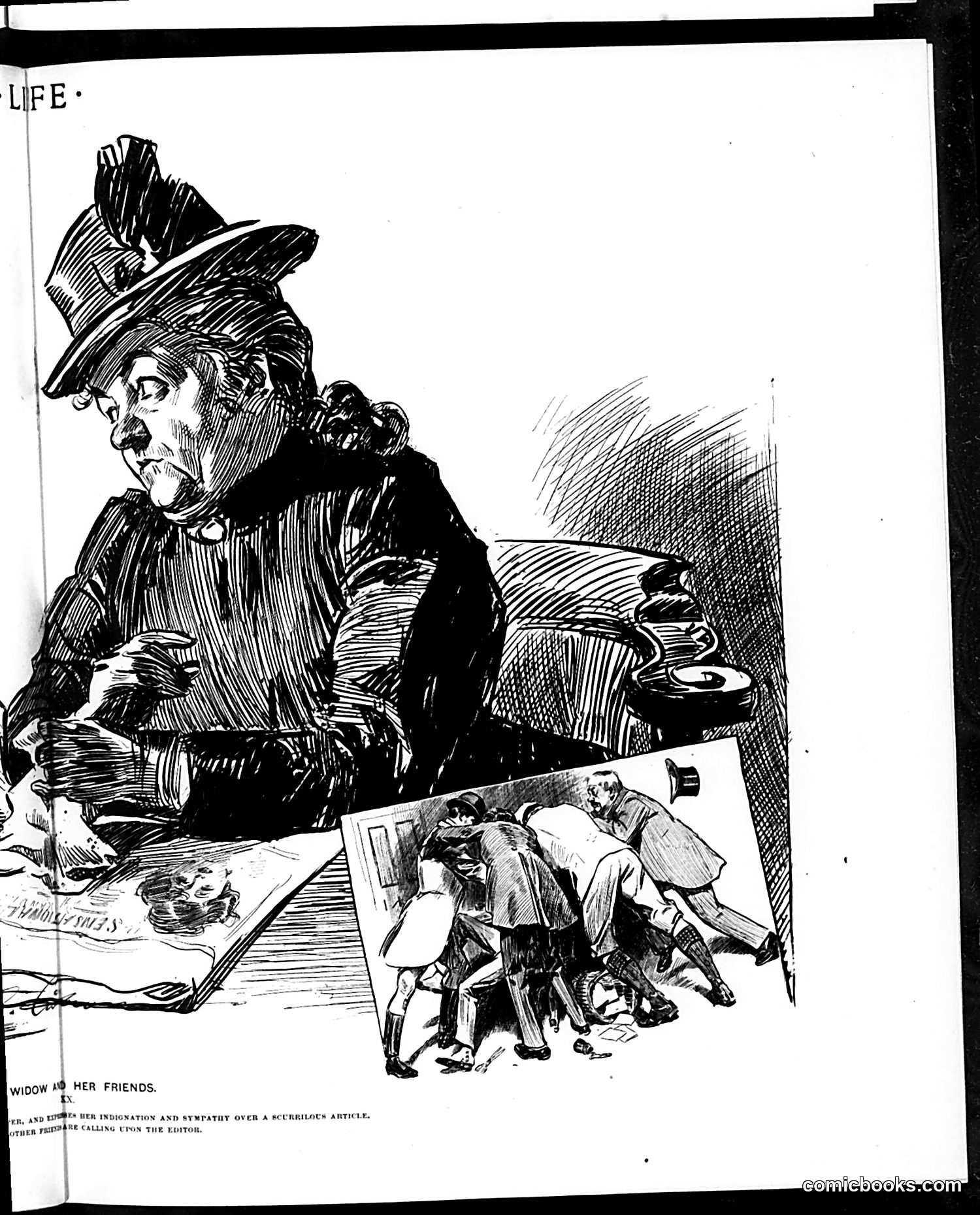
This satirical cartoon depicts an elderly woman (the "widow") seated at a desk, examining what appears to be newspaper clippings or documents. Small figures below her—appearing to be editors or journalists—are shown in a huddle or confrontational pose. The caption indicates the widow is responding to a scurrilous article, with text referencing her "indignation and sympathy" and a complaint to the editor calling upon him to take action. The satire likely critiques sensationalist journalism or yellow journalism of the era, mocking how newspapers published inflammatory stories about private citizens. The widow represents an ordinary person wronged by irresponsible press coverage, while the small editors below suggest their diminished moral stature. The cartoon advocates for editorial accountability and decency in reporting.
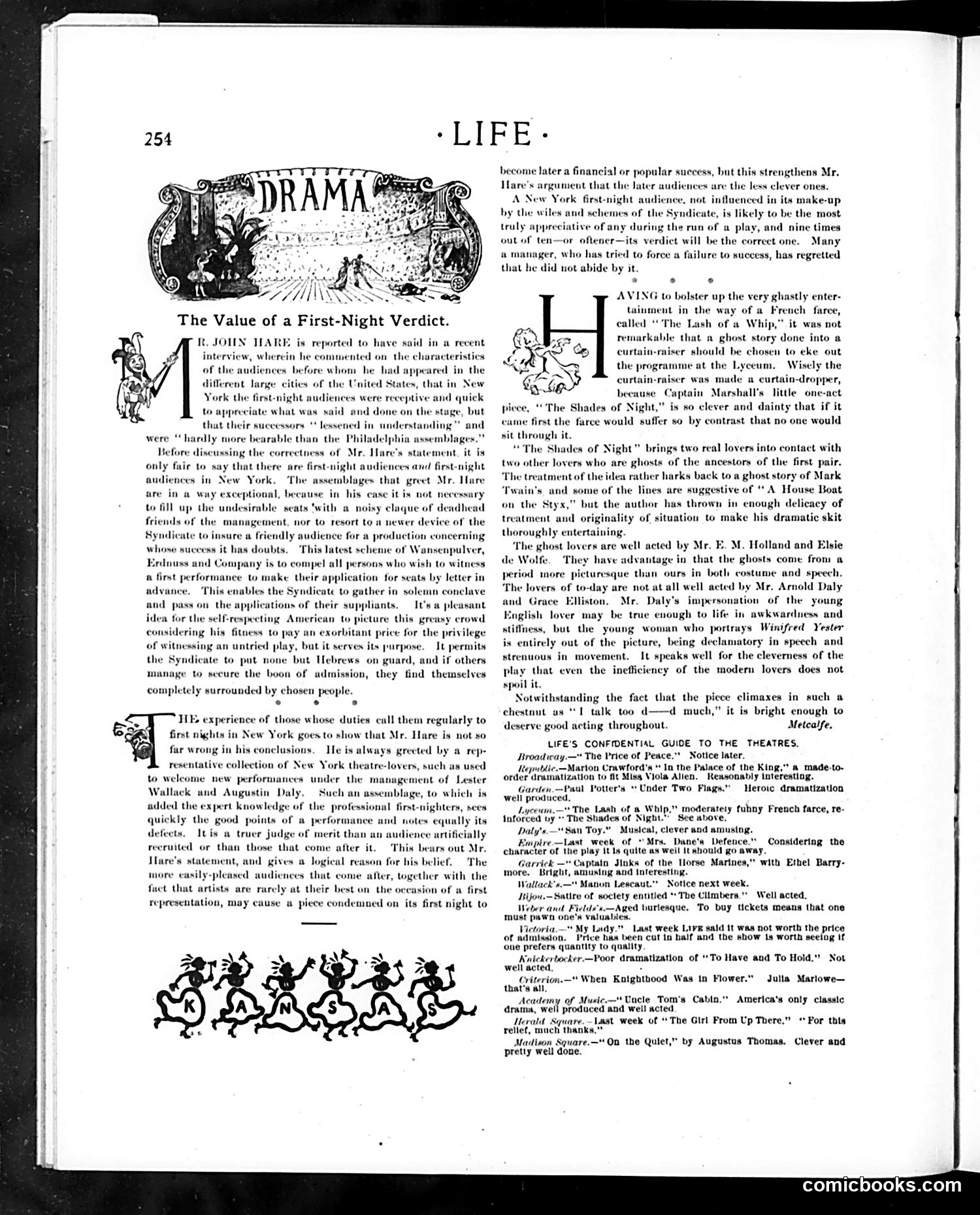
This page contains a drama criticism section titled "The Value of a First-Night Verdict." The main article discusses **John Hare**, a prominent actor, and his approach to audiences in New York versus London theaters. The text argues that Hare's statement about audiences being "hardly more bearable than the Philadelphia assemblages" was controversial. The author defends first-night New York audiences as appropriately critical, noting they represent theater-lovers and the Syndicate's interests—not just "deadwood" friends. The decorative header features a theatrical mask design. Below the main text is a **row of dancing figures** (appears to be stylized theatrical performers or cherubs in motion)—likely decorative rather than satirical. The page also includes theater reviews under "Life's Confidential Guide to the Theatres," recommending various contemporary productions.
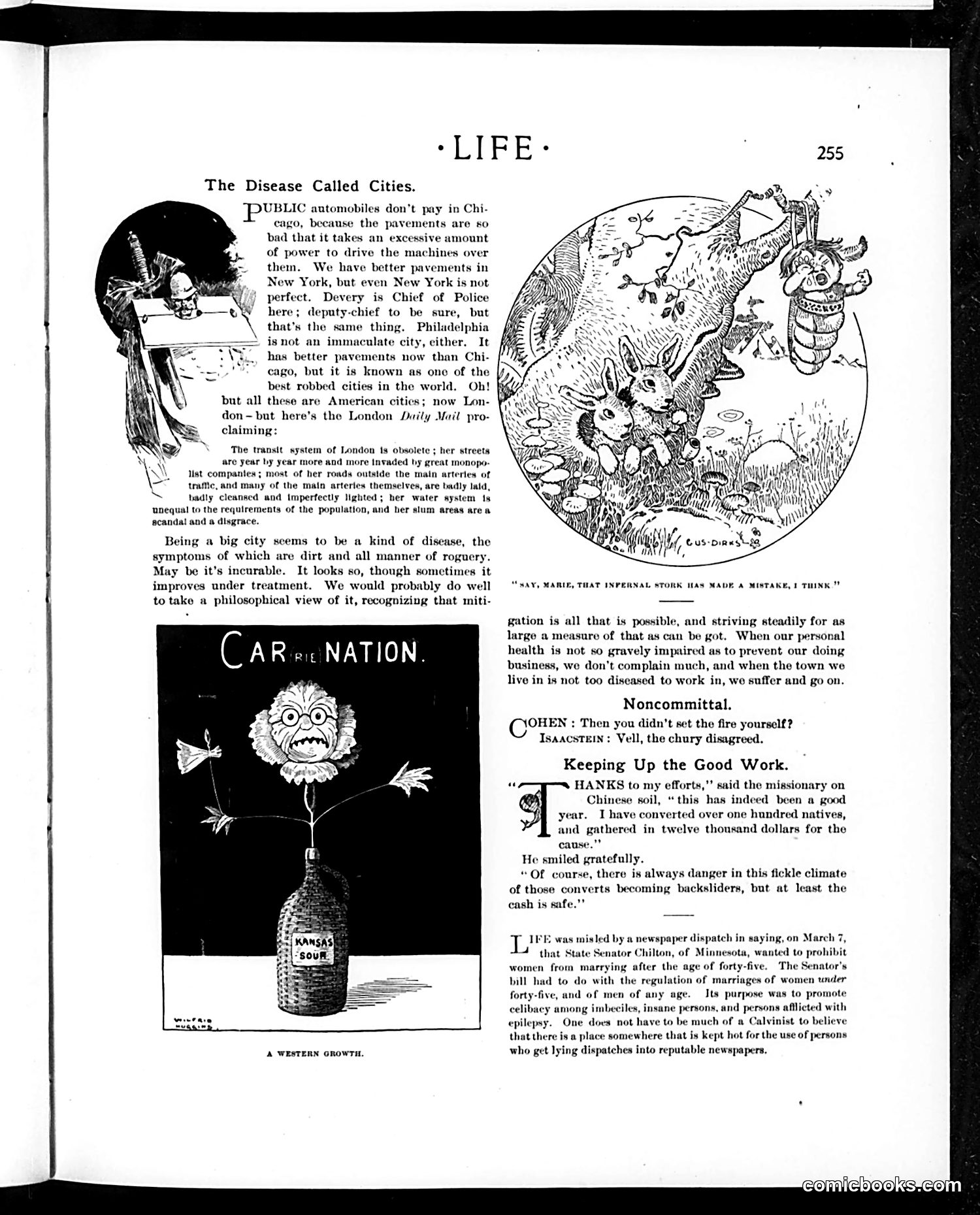
This satirical page critiques urban decay and moral hypocrisy circa early 1900s. **"The Disease Called Cities"** compares large cities to illness, listing infrastructure failures (bad pavements in Chicago, transit obsolescence in London, crime in Philadelphia). The metaphor suggests urban problems are widespread and perhaps incurable, requiring acceptance rather than solutions. **"Car-ible Nation"** cartoon (left) depicts a grotesque flower-headed creature growing from a "Kansas Sour" bottle labeled "A Western Growth"—satirizing Midwestern agricultural/industrial expansion as producing something monstrous and unnatural. **The circular cartoon** (right) shows a stork making a "mistake," likely commenting on unwanted births or population issues. **"Keeping Up the Good Work"** mocks missionary work in China, exposing the contradiction between spiritual conversion claims and financial self-interest—the missionary cares more that donations are "safe" than actual faith commitment. **"Noncommittal"** is a brief legal joke about jury disagreement in a fire case. The page overall satirizes urban problems, western expansion, and institutional hypocrisy with characteristic early-Life cynicism.
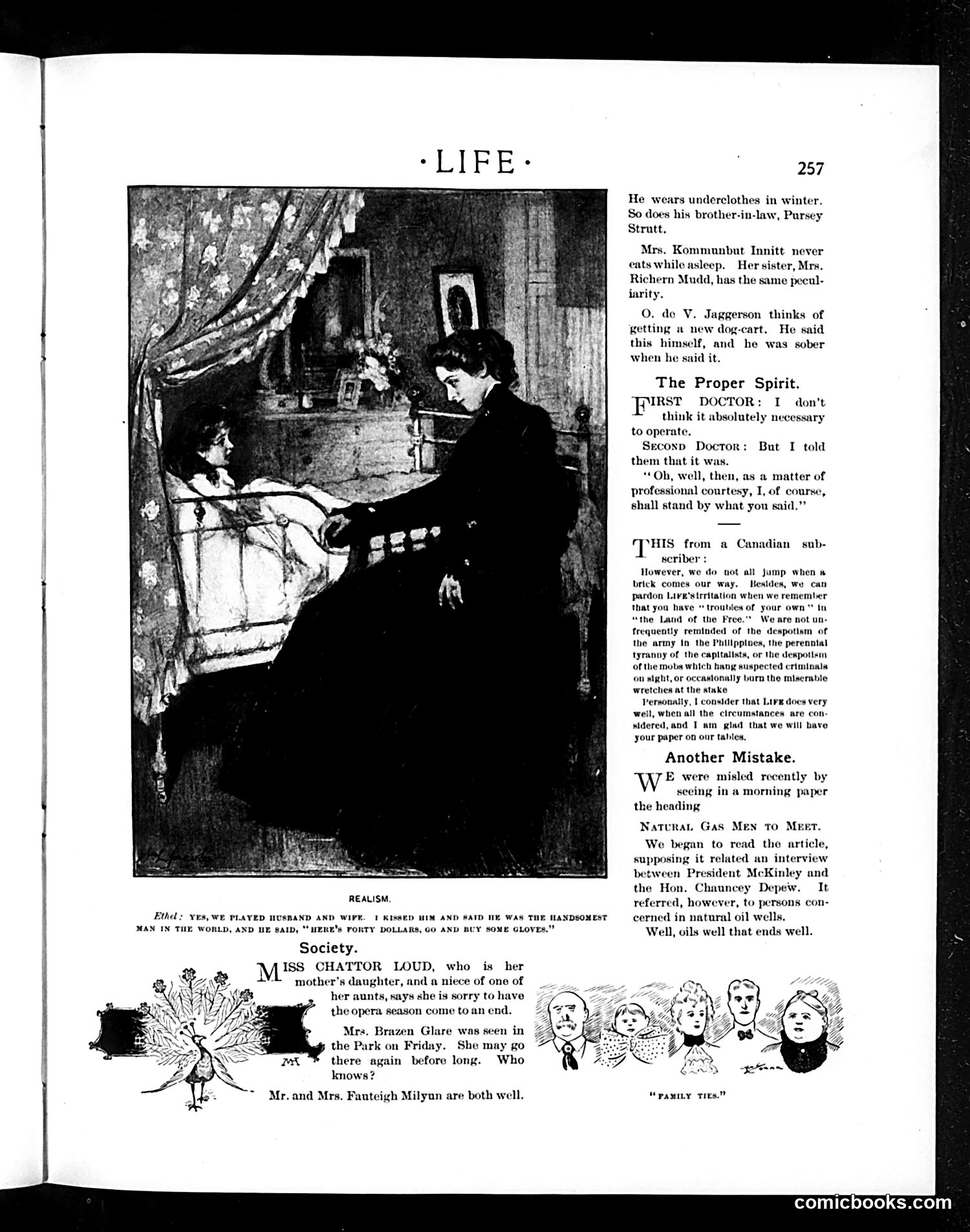
This page contains **satirical social commentary** rather than political cartoons. The main sections are: **"The Proper Spirit"**: A joke mocking professional hypocrisy among doctors. Two physicians discuss operating on a patient—the first says it's unnecessary, but the second insists he already told the patient it was needed. The first agrees to "stand by" his colleague's judgment "as a matter of professional courtesy," satirizing how professionals prioritize loyalty over honest practice. **"Realism"**: A sarcastic caption beneath an illustration showing a husband receiving money, mocking sentimental domestic scenes where women flatter men. **"Another Mistake"**: A brief joke about misreading a newspaper headline about "Natural Gas Men" (oil industry figures), with the punchline "oils well that ends well." **"Society"**: Brief gossip notes about unnamed socialites with absurdly pretentious names (Miss Chattop Loud, Mrs. Brazen Glare), poking fun at high society. The page exemplifies *Life*'s formula: gentle satire targeting professional incompetence, marital dynamics, and upper-class pretension.
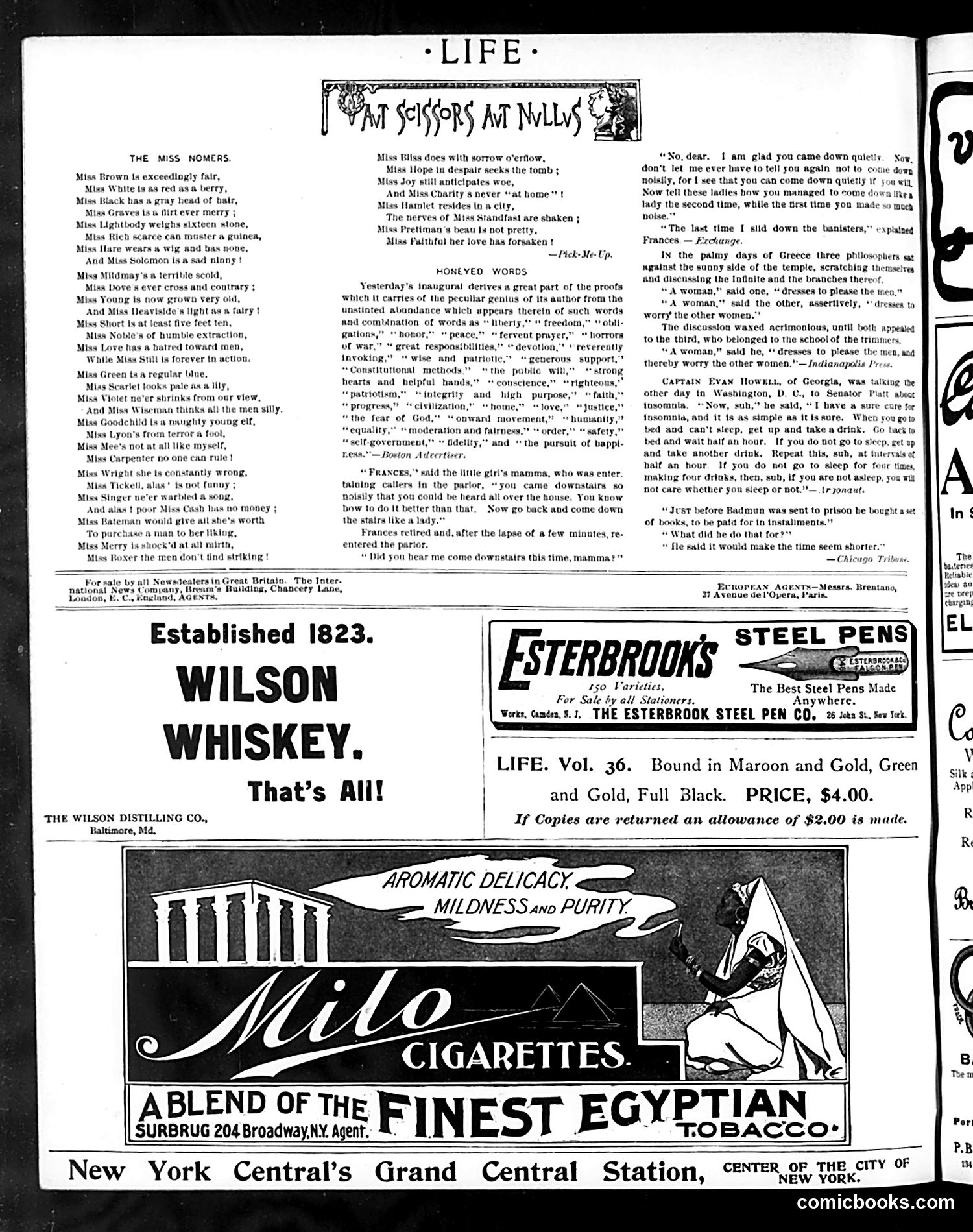
This page is primarily **miscellaneous humor and advertisements** rather than political satire. **"The Miss Nomers"** is a light comedic poem playing on ironic contradictions between women's surnames and their actual characteristics—Miss White is red-faced, Miss Lightbody weighs heavily, Miss Young is old, etc. It's wordplay humor typical of Victorian-era comic magazines. **"Honeyed Words"** comments on an inaugural address (likely presidential, though unspecified), satirizing the speaker's abundant use of lofty rhetoric—"liberty," "honor," "patriotism"—suggesting empty political grandstanding through flowery language. The remaining short humorous anecdotes involve children's behavior and a Greek philosophy debate about women's motivations for dress—genteel period humor with no political content. The page is dominated by **period advertisements** for Wilson Whiskey, Esterbrook Steel Pens, and Milo Cigarettes, indicating this is a commercial publication. No specific political figures or events are identifiable.
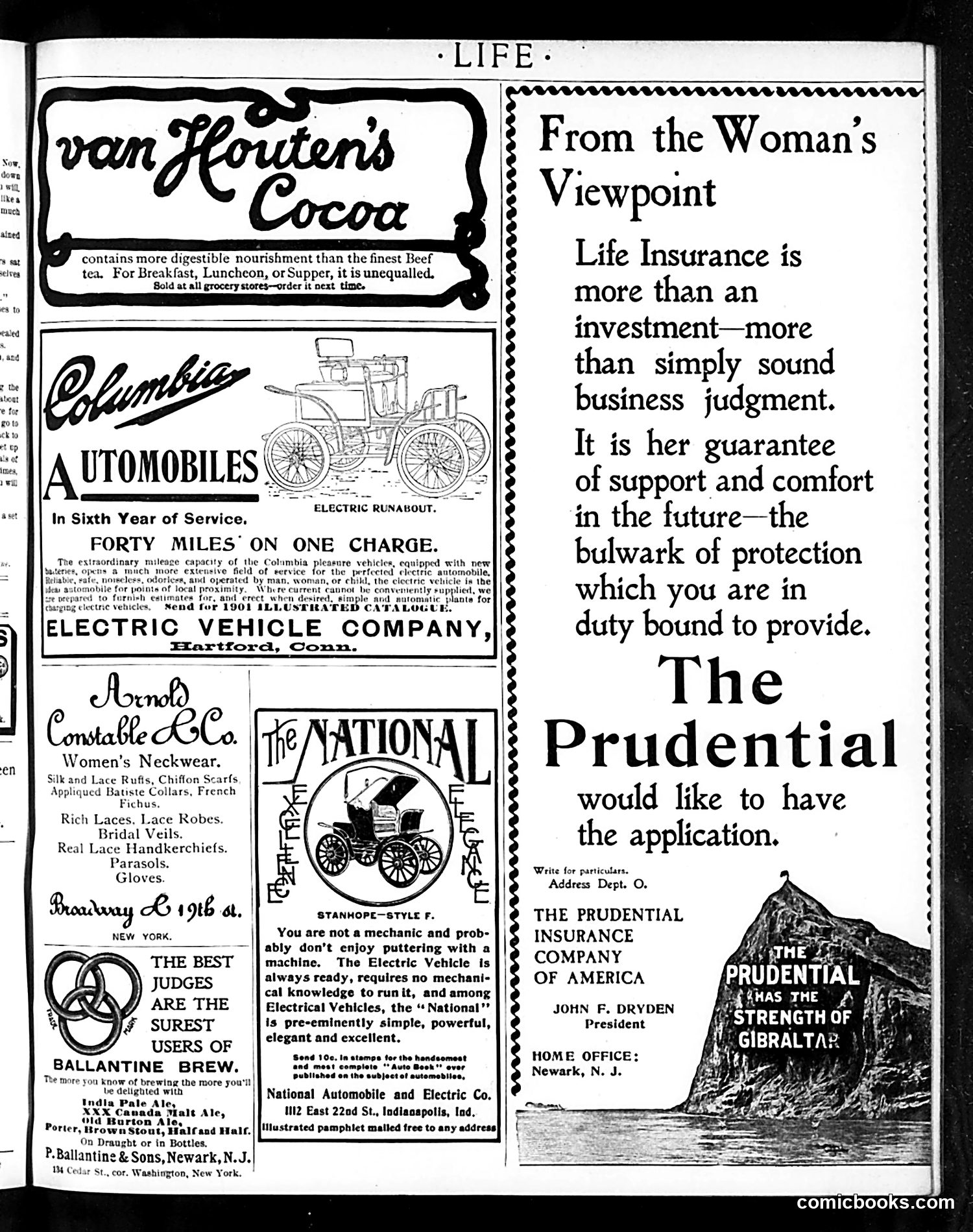
This is primarily an **advertising page**, not a satirical cartoon section. The page contains multiple product advertisements from circa 1916, each targeting different consumer interests. **Key Advertisements:** - **Van Houten's Cocoa** and **Ballantine Beer** promote food/beverage products - **Columbia Electric Automobiles** advertise a 40-mile electric vehicle, positioning it as requiring no mechanical knowledge—appealing to non-technical users, particularly women - **Arnold Constable & Co.** sells women's fashion items (neckwear, laces, parasols) - **The Prudential Insurance** features the largest ad, using a "Woman's Viewpoint" to frame life insurance as a husband's duty to protect his wife financially after his death **Social Context:** The Prudential ad reveals early-20th-century gender assumptions: women are positioned as economically dependent, requiring male protection through insurance. The company appeals to male responsibility and duty. The electric vehicle ads similarly recognize women as potential consumers who might prefer vehicles requiring less mechanical expertise. This reflects Progressive Era marketing strategies targeting expanding female purchasing power while reinforcing traditional gender roles.
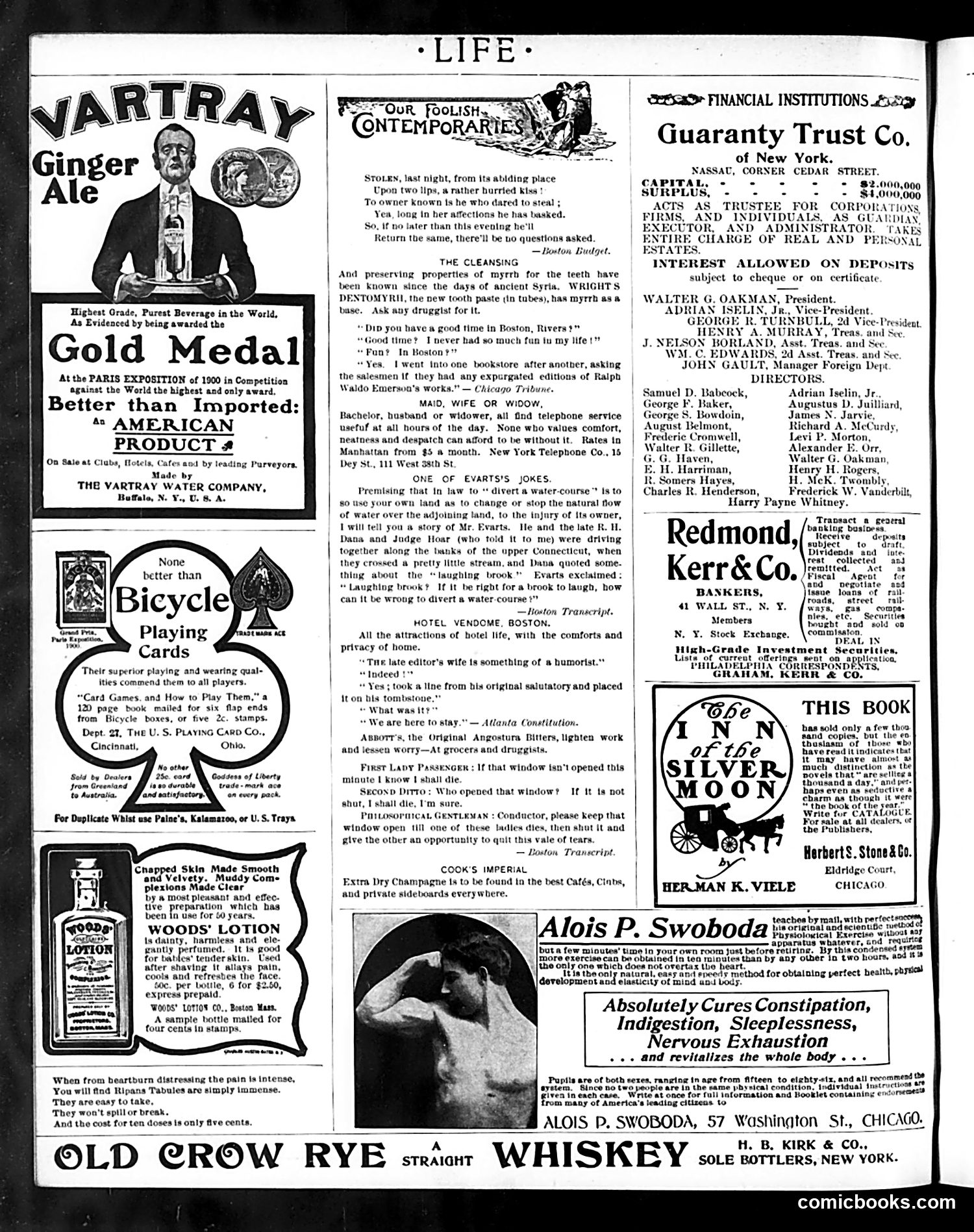
This page is primarily **advertisements and light humor**, typical of Life magazine's early 1900s format. The main content includes: **Humorous Anecdotes:** - A stolen kiss notice (romantic joke) - A Boston bookstore joke about finding "expurgated" (censored) editions of Ralph Waldo Emerson—satirizing either overly prudish editing or intellectual pretension - An Evarts anecdote playing on legal terminology about water rights - A widow's tombstone joke ("We are here to stay") - A railway window comedy about passengers dying dramatically **Advertisements:** Vartray Ginger Ale, Bicycle Playing Cards, Woods' Lotion, Ripans Tabules (digestive aid), telephone service, and other period products. **Context for Modern Readers:** The humor relies on wordplay, double meanings, and genteel Victorian sensibilities. References to "expurgated" books reflect early-1900s anxiety about proper literature. The overall tone is light, domestic, and genteel rather than hard-hitting satire.
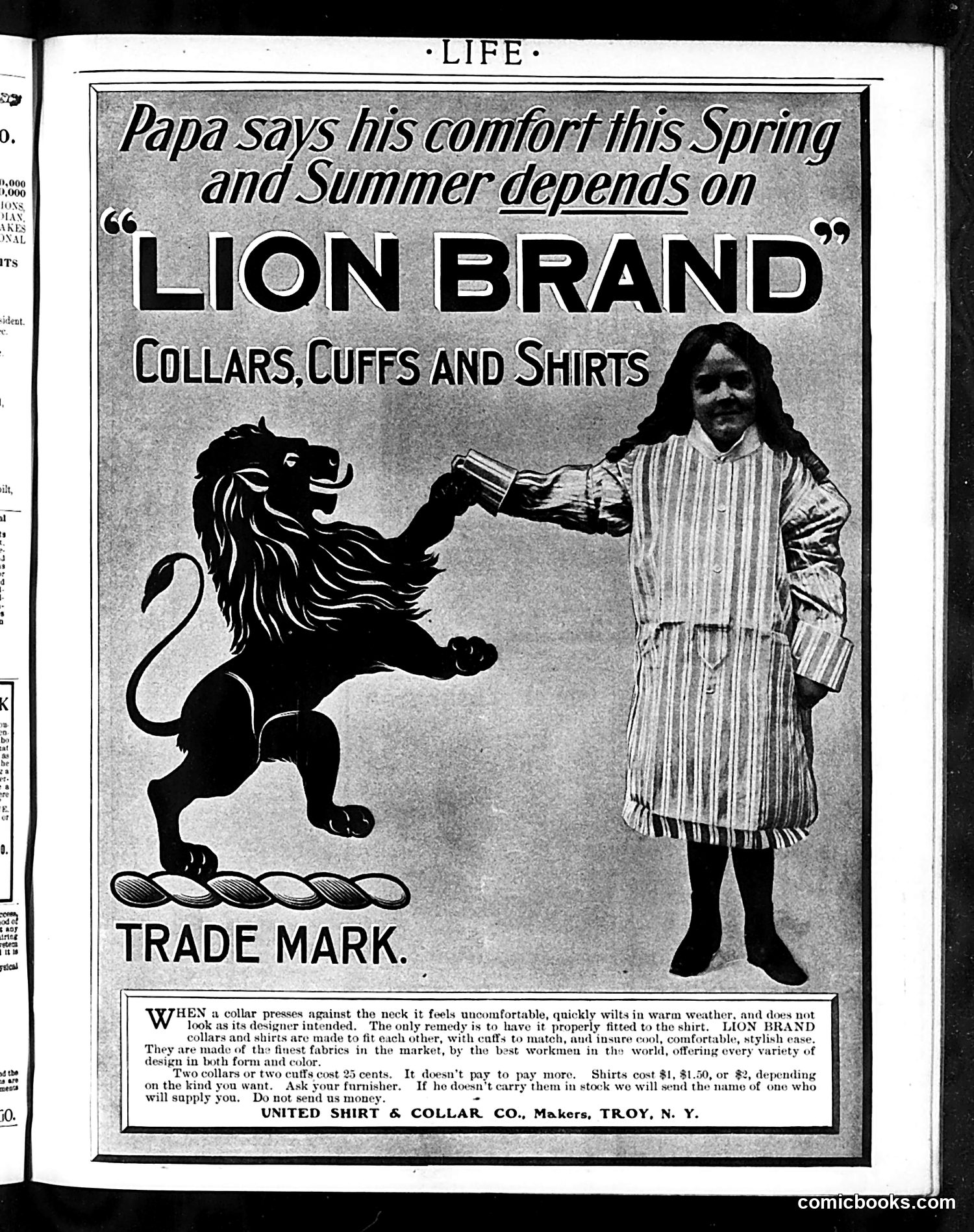
This is primarily a **product advertisement** for Lion Brand collars and shirts, not political satire. The ad uses a problematic racial caricature—a figure with exaggerated features wearing a striped shirt—interacting with the Lion Brand trademark (a rearing lion). The advertisement's premise is that "Papa" (unclear who this references—possibly a generic family figure) recommends Lion Brand for spring and summer comfort. The text emphasizes that properly fitted collars and cuffs prevent wilting and discomfort in warm weather. **What's jarring today**: The human figure depicted uses deeply offensive blackface-style caricature conventions common in early 20th-century advertising, reflecting the racist imagery routinely used in commerce of that era. Modern viewers recognize this as dehumanizing and unacceptable, though it appeared unremarkably in mainstream publications then. The ad promotes collars at 25 cents and shirts at $1-$2, positioning Lion Brand as quality affordable menswear made in Troy, New York.
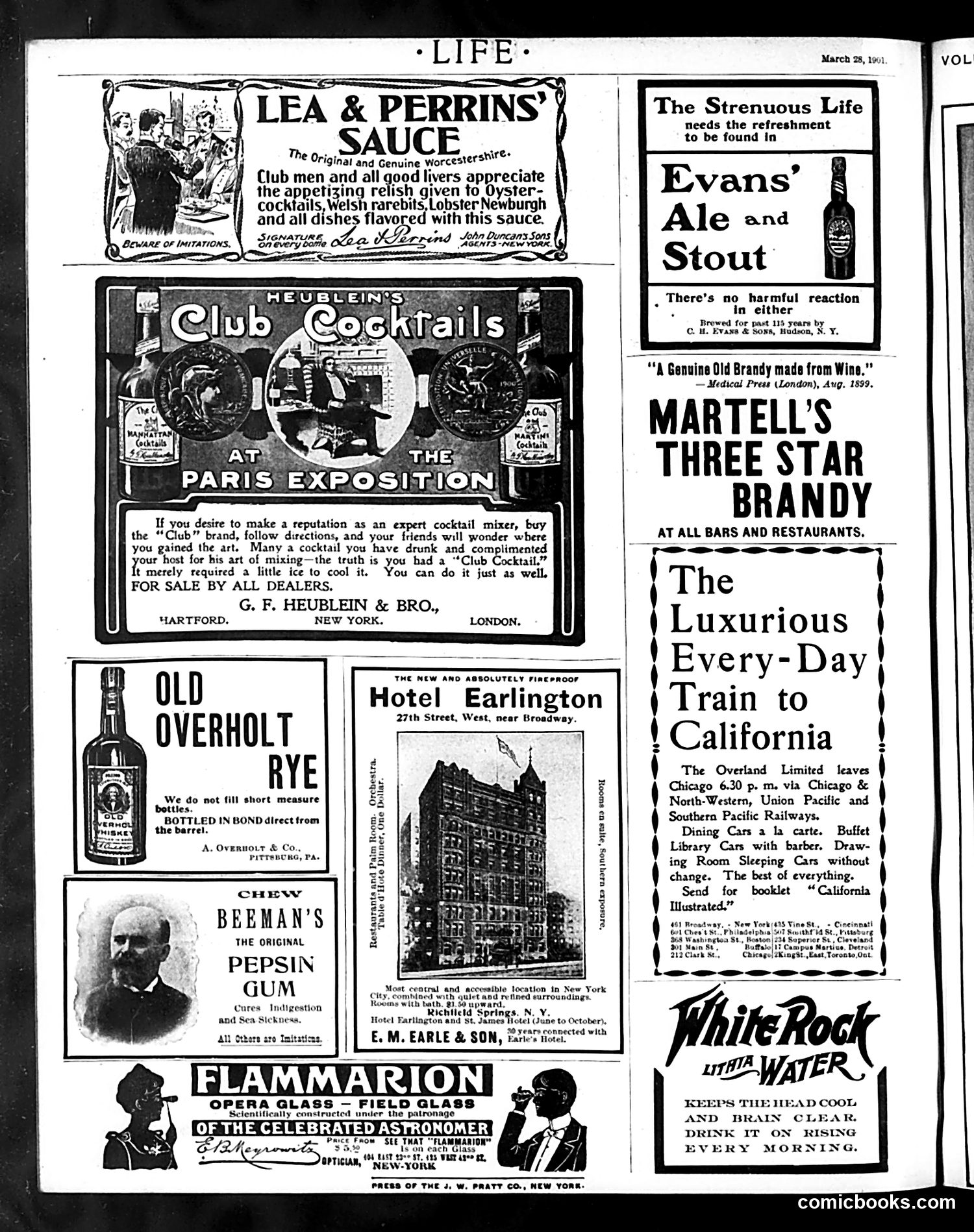
This is primarily an **advertising page** with no political cartoons or satire. It contains commercial advertisements typical of the Gilded Age period, promoting luxury consumer goods to affluent readers. The ads feature: - **Lea & Perrins Sauce** and **Martell's Brandy** — premium imported condiments and spirits marketed to "club men and all good livers" - **Evans' Ale and Stout** — alcoholic beverages - **Old Overholt Rye** whiskey, bottled in bond - **Beeman's Pepsin Gum** — a digestive remedy - **Hotel Earlington** — upscale New York lodging - **The Overland Limited train** to California — luxury rail travel - **Flammarion opera glasses** and **White Rock lithia water** The page reflects early 1900s consumer culture: imported goods signified status, patent medicines promised health benefits (pepsin gum "cures indigestion"), and rail travel represented modern leisure for the wealthy. No satire or political content is evident.