
Life, 1901-03-28 · page 12 of 20
Life — March 28, 1901 — page 12: what you’re looking at
What you’re looking at
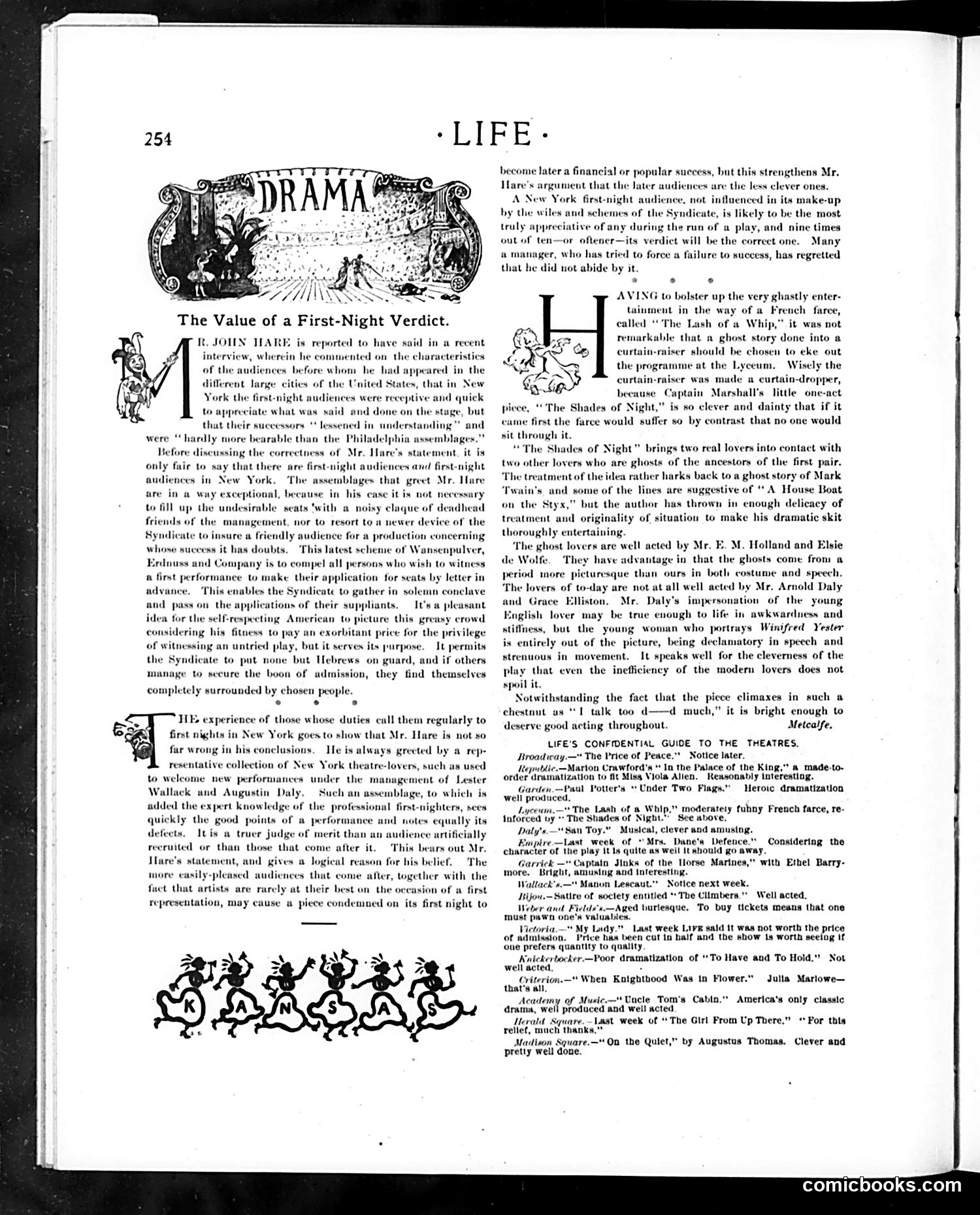
This page contains a drama criticism section titled "The Value of a First-Night Verdict." The main article discusses **John Hare**, a prominent actor, and his approach to audiences in New York versus London theaters. The text argues that Hare's statement about audiences being "hardly more bearable than the Philadelphia assemblages" was controversial. The author defends first-night New York audiences as appropriately critical, noting they represent theater-lovers and the Syndicate's interests—not just "deadwood" friends. The decorative header features a theatrical mask design. Below the main text is a **row of dancing figures** (appears to be stylized theatrical performers or cherubs in motion)—likely decorative rather than satirical. The page also includes theater reviews under "Life's Confidential Guide to the Theatres," recommending various contemporary productions.
📄 Transcribed text from this page (OCR, searchable)
Machine-transcribed from the original scan — historical spelling and the odd misread are preserved.
« LIBE The Value of a First-Night Verdict. R. JOUN HARE is reported to have said in a recent interview, wherein he commented on the characteristics of th ences before whom he had appeared in the different large cities of the United States, that in New York the first-night audiences were receptive and quick to appr 1 and done on the stage, but that their successors ** lessened in und wg” and were “hardly more bearable than the Philadelphia assemblage Before discussing the correctness of Mr. Hare's statement. it is only faie to say that there are first-night au ght audiences in New York. The assemblages that greet Mr. Hare are in a way exceptional, becuu to fill up the undesirable seats ‘with a friends of the management, nor to resort to a newer device of the Syndicate to insure a friendly audience for a production concerning ns it has doubts. ‘This latest scheme of Wansenpulver, Erdnuss and Company is to compel all persons who wish to witness 8 first performance to make their applicati advance. ‘This enables the gather in solemn conclave and pass on the applications of their suppliants. — It's a pleasant idea for the self-respecting American to picture this greasy crowd idering his fitness to pay an exorbitant price for the privilege of witnessing an untried play, but it serves its pu It permits the Syndicate to put none but Hebrews on guard, and if others manage to secure the boon of admission, they find themselves ciate what was sa es and first it ix not necessar pisy claque of deadhead in his case whose st ) for seats by letter in pose. completely surrounded by chosen people. ° ° ° HE experience of those whose duties call them regularly to first nights in New York goes to show that Mr. Hare is not so fur wrong in his conclusions. Ie is always greeted by a rep- resentative collection of New York theatre. to welcome new performances under th Wallack and Augustin Daly added the expert knowledge of the professional first quickly the good points of a performance and notes equally its defects. Itis a truer judge of merit than an audience artificially reeruited or than those that come after it. ‘This bears out Mr. Hare's statement, and gives a loj his belief. The wore easily-pleased audiences that come after, together with the fact that artists are rarely at their best on the occasion of a first representation, may cause a piece condemued on its first night to lovers, such as used management of Lester Such an assemblage, to which is ighters, sees 1 reason fe become later a financial or popular success, but this strengthens Mr. Hare's argument that the later audiences are the less cle ork first-night audience, not influenced hy the wiles and schemes of the Syndicate, is likely to be the most truly appreciative of any during the run of a play, and nine times out of ten—or oftener—its verdict will be the correct one. Many nager, who has tried to force a failure to success, has regretted that he did not abide by it. ° ° ° F ones. its make-up AVING to bolster up the very ghastly enter- tainment in the way of a French farce, called “The Lash of a Whip,” it was not remarkable that a ghost story done into a Ce J curtain-raiser should be chosen to eke out Ri TS the programme at the Lyceum. Wisely the Pm iN curtain-raiser was mude a curtain-dropper, si Decause Captain Marshall's little one-act piece, “The Shades of Night,” is so clever and dainty that if it ume first the farce would suffer so by contrast that no one would sit through it. “The Shades of Night" brings two real lovers into contact with two other lovers who are ghosts of the ancestors of the first pair. ‘The treatment of the idea rather harks back to a ghost story of Mark ‘Twain's and some of the lines are suggestive of "A House Boat on the Styx,” but the author has thrown in enough delicacy of treatment and originality of situation to make his dramatic skit thoroughly entertaining. ‘The ghost lovers are well acted by Mr. E. M. Holland and Elsie de Wolfe. They have advantage in that the ghosts come from a period more picturesque than ours in both costume and speech. ‘The lovers of to-day are not at all well acted by Mr. Arnold Daly and Grace Elliston, Mr. Daly's impersonation of the young lish lover may be true enough to life in awkwardness and stiffness, but the young woman who portrays Winifred Yester rely out of the picture, being declamatory in speech and strenuous in movement. It speaks well for the cleverness of the play that even the inefficiency of the modern lovers does not spoil it, Notwithstanding the fact that the picce climaxes in such a chestnut as “1 talk too d—d much,” it is bright enough to deserve good acting throughout. Metcalfe, LIFES CONFIDENTIAL GUIDE TO THE THEATRES. Broadway.—* The Price of Peace,” Notice later. Reublic.—Marion Crawford's “ In the Palace of the King,” a made-to- order dramatization to fit Miss Viola Allen. Reasonably interesting. Garden.—Paul Potter's “Under Two Flags.” Heroic dramatization well produced, is en Lycewn.—"The Lash of & Whip,” moderatety fubny French farce, re- lnforced uy “ The Shades of Night.” See atove, Daly's.—" San Toy.” Musical, clever and amusing. Empire—Last week of “Mrs. Dane's Defence.” character of the play It Is quite as Weil Itahould go away, Garrick —* Captain Jinks of the Horse Marines," with Ethel Barry- more. Bright, amusing and Interesting. Wallack's.—* Manon Lescaut.” Notice next week. Bijou.— Satire of society entitled * The Climbers.” Well acted. Weber and Fields's—Aged buriesque. To buy tickets means that one must pawn one’s valuables. Victoria.—" My Lady.” Last week Liv sald tt was not worth the price of admission. Price has been cut in half and the show ts worth seelog if ‘one prefers quantity to quality. Naickertocker.—Poor dramatization of “To Have and To Hold.” well acted, Criterion. ‘that’s all, Academy of Music.—* Uncle Tom's Cabin." America’s only classic drama, well produced and weil acted, Herald Square. Last: week of “The Girl From Up There.” rellef, mach thanks.” Madison Square.—" On the Quiet, pretty weil done. Considering the Not When Knighthood Wa: in Flower." Julla Marlowe— For this by Augustus Thomas. Clever and comicbooks.com