
Life, 1901-03-28 · page 4 of 20
Life — March 28, 1901 — page 4: what you’re looking at
What you’re looking at
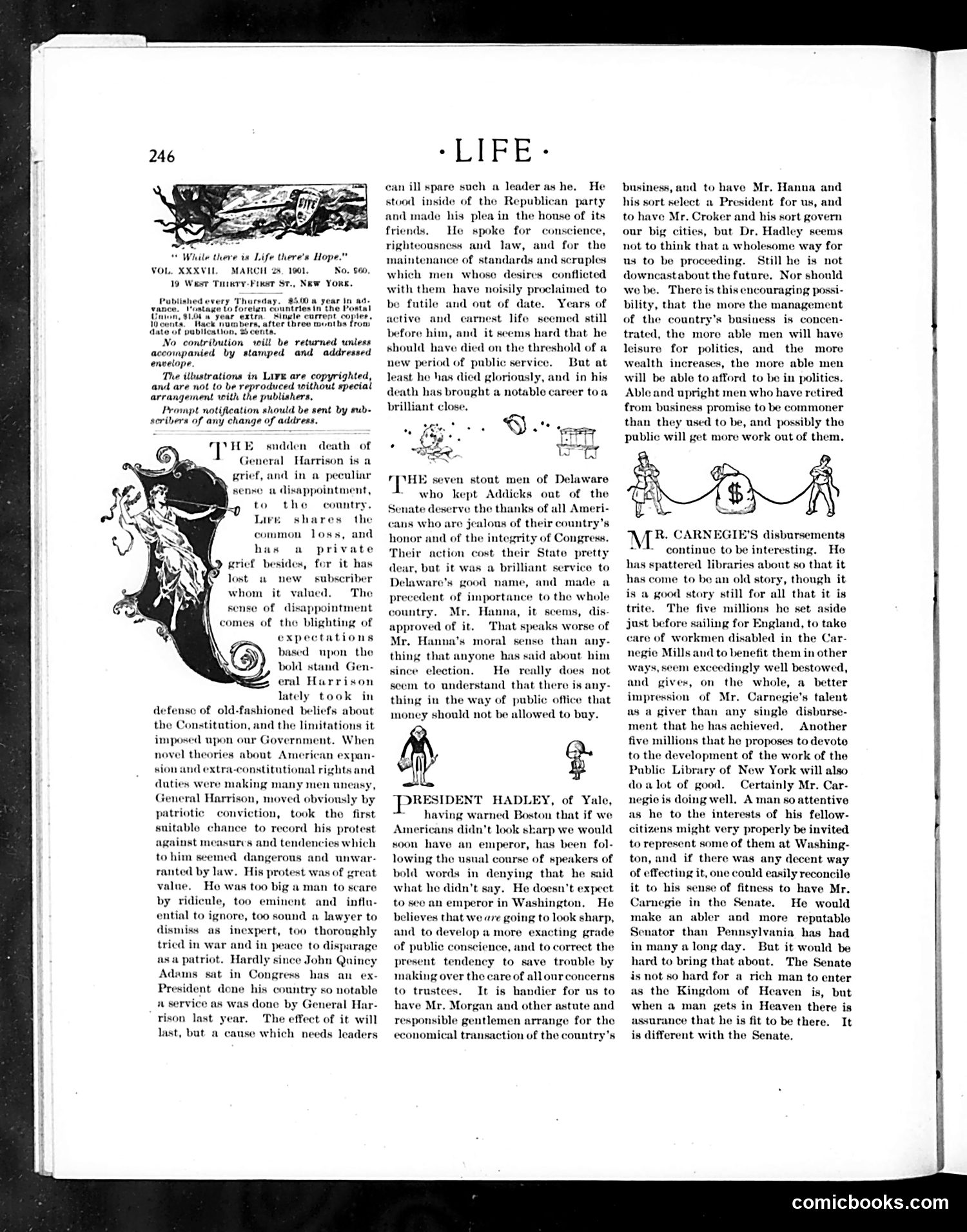
This page contains political commentary rather than a cartoon. The text discusses General Harrison's death and its impact on the Republican party, along with critiques of various political figures including President Hadley (of Yale) and Mr. Hanna. The illustrations appear to be small decorative vignettes rather than narrative cartoons. One shows figures pulling a money bag—likely satirizing financial dealings in politics. Another depicts what appears to be a seated official. The content criticizes the concentration of power among wealthy businessmen in politics and questions whether government appointments should prioritize business interests over public service. The commentary suggests concerns about corporate influence on American governance during this era, though the specific historical context remains unclear without additional dating information.
📄 Transcribed text from this page (OCR, searchable)
Machine-transcribed from the original scan — historical spelling and the odd misread are preserved.
* While there is Life there's Hope. XXXVIL MARCH 2s. 1901, No. $60. 19 West Tuiery-Piest St., New Yors. vou. ry Thursday. $5.00 4 year in ad. forelan countrles in the Postal Single current copter. lafter three months from nts. No contribution will be returned unless accompanied by stamped and addressed envelope. The illustrations in Live are copyrighted, and are not to be reproduced without special arrangement with the publishers, Prompt notification should be sent by sub- seribers of any change of address. death of J YHE sudden Harrison is a ¢ ral wri sense a disappointment, to the country. Lire, the common 1 , and has a private grief besides, for it has lost a new subscriber whom it valued The sense of disappointment comes of the blighting of expectations based upon the bold stand Gen- eral Harrison lately took in se of old-fashioned beliefs about the Constitution, and the limitations it imposed upon our Government. When novel theories about American expan- sion and extra-constitutional rights and making many men uneasy, General Harrison, moved obviously by jotic conviction, took the first suitable chance to record his protest against measures and te to him seemed dangerous and unwar- ranted by law. His protest was of great value. He was too big a man to scare by ridicule, too eminent and influ. ential to ignore, too sound a lawyer to dismiss as inexpert, too thoroughly tried in war and in peace to disparage asa patriot. Hardly since John Quincy Adams sat in Congress has an ex- President done his country so notable a service as was done by General Har- rison last year. The effect of it will last, but a cause which needs leaders and in a peculiar shares Jencies which «LIFE + can ill spare such a leader as he. He stood inside of the Republican party and made his plea in the house of its friends, He spoke for conscience, righteousness and law, and for the mainte: » of standards and scruples which m whose desires conflicted with them have noisily proclaimed to be futile and out of date. Years of and carnest life seemed still before him, and it seems hard that he should have died on the threshold of a new period of public service. But at least he has died gloriously, and in his death has brought a notable career toa brilliant close, ‘TBE seven stout men of Delaware who kept Addicks out of the Senate deserve the thanks of all Ameri- cans who are jealous of their country’s honor and of the integrity of Congress. Their action cost their State pretty dear, but it was a brilliant service to Delaware’s good name, and made a precedent of importance to the whole country. Mr. Hanna, it scems, dis- approved of it. That speaks worse Mr. Hanna's moral sense than any- thing that anyone has said about him since election. He really does not seem to understand that there is any- thing in the way of public office that money should not be allowed to buy. a, RESIDENT HADLEY, of Yale, having warned Boston that if we Americans didn’t look skarp we would soon have an emperor, has been fol- lowing the usual course of speakers of bold words in denying that he said what he didn’t say. He doesn’t expect to see an emperor in Washington, He believes that we are going to look sharp, and to develop a more exacting grade of public conscience, and to correct the ent tendency to save trouble by ig over the care of allour concerns to trustees. It is handier for us to have Mr, Morgan and other astute and responsible gentlemen arrange for the economical transaction of the country’s business, and to have Mr. Hanna and his sort select a President for us, and to have Mr. Croker and his sort govern our bij but Dr. Hadley seems not to think that a wholesome way for us to be proceeding. Still he is not downcastabout the future. Nor should wo be. There is this encouraging possi- bility, that the more the management of the country’s business is concen- trated, the more able men will have leisure for politics, and the more wealth increases, the more able men will be able to afford to be in politics. Able and upright men who have retired from business promise to be commoner than they used to be, and possibly the public will get more work out of them. M. R. CARNEGIE’S disbursements ~". continue to be interesting. He has spattered libraries about so that it has come to be an old story, though it is a good story still for all that it is The five millions he set aside just before sailing for England, to take care of workmen disabled in the Car- Mills and to benefit them in other ys, seem exceedingly well bestowed, and gives, on the whole, a_ better impression of Mr. Carnegie’s talent as a giver than any single disburse- ment that he has achieved. Another five millions that he proposes to devote. to the development of the work of the Public Library of New York will also doa lot of good. Certainly Mr. Car- negie is doing well. A man so attentive as he to the interests of his fellow- citizens might very properly be invited to represent some of them at Washing- ton, and if there was any decent way of effecting it, one could easily reconcile it to his sense of fitness to have Mr. Carnegie in the Senate. He would make an abler and more reputable Senator than Pennsylvania has had in many along day. But it would be hard to bring that about. The Senate is not so hard for a rich man to enter as the Kingdom of He: is, but when a man gets in Heaven there is assurance that he is fit to be there. It is different with the Senate. comicbooks.com