
Life, 1901-03-28 · page 6 of 20
Life — March 28, 1901 — page 6: what you’re looking at
What you’re looking at
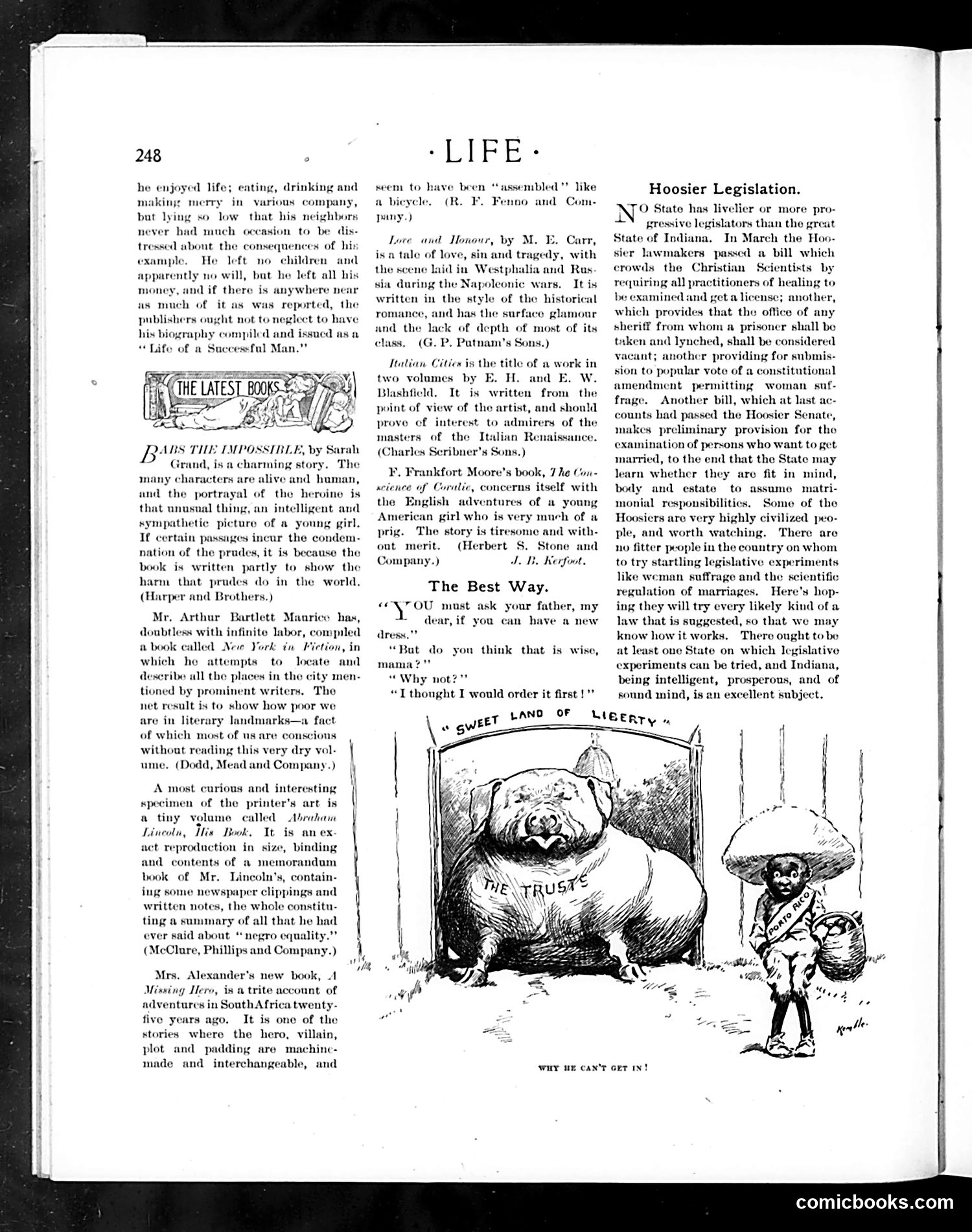
This political cartoon depicts a large figure labeled "THE TRUSTEE" sitting heavily on "SWEET LAND OF LIBERTY," while a small figure (appearing to represent the common citizen or "the people") stands trapped beneath an umbrella, asking "WHY HE CAN'T GET IN?" The satire criticizes how powerful corporate trustees or monopolists have seized control of American freedoms and resources, literally sitting atop the nation's liberty and excluding ordinary citizens from accessing it. The umbrella suggests the citizen's futile attempt at protection or shelter from this oppressive arrangement. The cartoon comments on the Gilded Age concern that wealthy corporate interests had monopolized American opportunity, leaving average people unable to participate in the nation's promised freedom and prosperity.
📄 Transcribed text from this page (OCR, searchable)
Machine-transcribed from the original scan — historical spelling and the odd misread are preserved.
248 0 he enjoyed life; eating, drinking and makingg merry in but lying so low various company, that his neighbors never had much occasion to be dis- abont the consequences of hi» examp! He left no children and apparently no will, bat he left all his money, and if there is anywhere near as much of it as was reported, the publishers ought not to neglect to have raph dand issued as a of a Successful Man.” omy Bass THE IMPOSSIBLE, by Se Grand, is a charming story. The many characters are alive and human, and the portrayal of the heroine is that unusual thing, an intelligent and sympathetic picture of a young girl, If certain passages incur the condem- nation of the prades, it is because the book is written partly to show the harm that prudes do in the world. (Harper and Brothers.) Mr. Arthur Bartlett Manrice has, doubtless with infinite labor, com piled a book called New York in which he attempts to describe all the places i tioned by prominent writers. The net result is to show how poor we are in literary landmarks—a fact of which most of us are conscious without reading this very dry vol- ume, (Dodd, Mead and Company.) A most curious and interesting specimen of the printer's art is a tiny volume called Lincoln, His Book. Tt is an ex. act reproduction in size, binding and contents of a memorandum book of Mr. Lincoln's, contain- ing some newspaper clippings and written notes, the whole constitu- ting a summary of all that he had ever said about “ negro equalit (McClure, Phillips and Company.) Abrahan Mrs. Alexander's new book, Missing Hero, is a trite account of adventures in SouthAfrica twenty- five years ago. It is one of the stories where the hero, villain, plot and padding are machine- made and interchangeable, and mbled"’ like Fenno and Co: pany.) Lore and Honour, by M. ¥. isa tale of love, sin and the scene laid in Westphalia and Rus sia during the Napoleonic wars, It is written in the style of the historical romance, and has the surface glamour and the lack of depth of most of its class, (G. P. Patnam’s Sons.) Carr, edy, with Italian Cities is the title of a work in two volumes by E. H. and E. W. Blashficld. It is written from the point of w of the artist, and should prove of interest to admirers of the of the Italian Renaissance. Scribner's Sons.) mast (Char) F, Frankfort Moore's book, 7 he Con- acience of Coralic, concerns itself with the English adventures of a young American girl who is very much of a prig. The story is tiresome and with- out merit. (Herbert S. Stone and Company.) J.B. Kerfoot. The Best Way. «¢\7 OU must ask your father, my } dear, if you can have a new dress."? “But do mama ?"* “Why not?" “I thought I would order it first !"’ you think that is wise, er LAND OF Hoosier Legislation. N°s State has livelier or more pro- legislators than the great State of Indiana. In March the Hoo- sier lawmakers passed a bill which an Scientists by ing all practitioners of healing to amined and get a license; another, which provides that the office of any sheriff from whom a prisoner shall be taken and lynched, shall be considered vacant; another providing for submis- sion to popular vote of a constitutional amendment permitting woman suf- frage. Another bill, which at last ac- counts had passed the Hoosier Senate, makes preliminary provision for tho examination of persons who want to get married, to the end that the State may learn whether they are fit in mind, body and estate to assume matri- responsibilities. Some of the Hoosiers are very highly civilized peo- ple, and worth watching. There are no fitter people in the country on whom to try startling legislative experiments. like weman suffrage and the scientific regulation of marriages. Here's hop- ing they will try every likely kind of a law that is suggested, so that we may know how it works. There ought to be at least one State on which Icgislative experiments can be tried, and Indiana, being intelligent, prosperous, and of sound inind, is an excellent subject. moni: WHY UE CAN'T GET IN! comicbooks.com