
A complete issue · 20 pages · 1901
Life — March 14, 1901
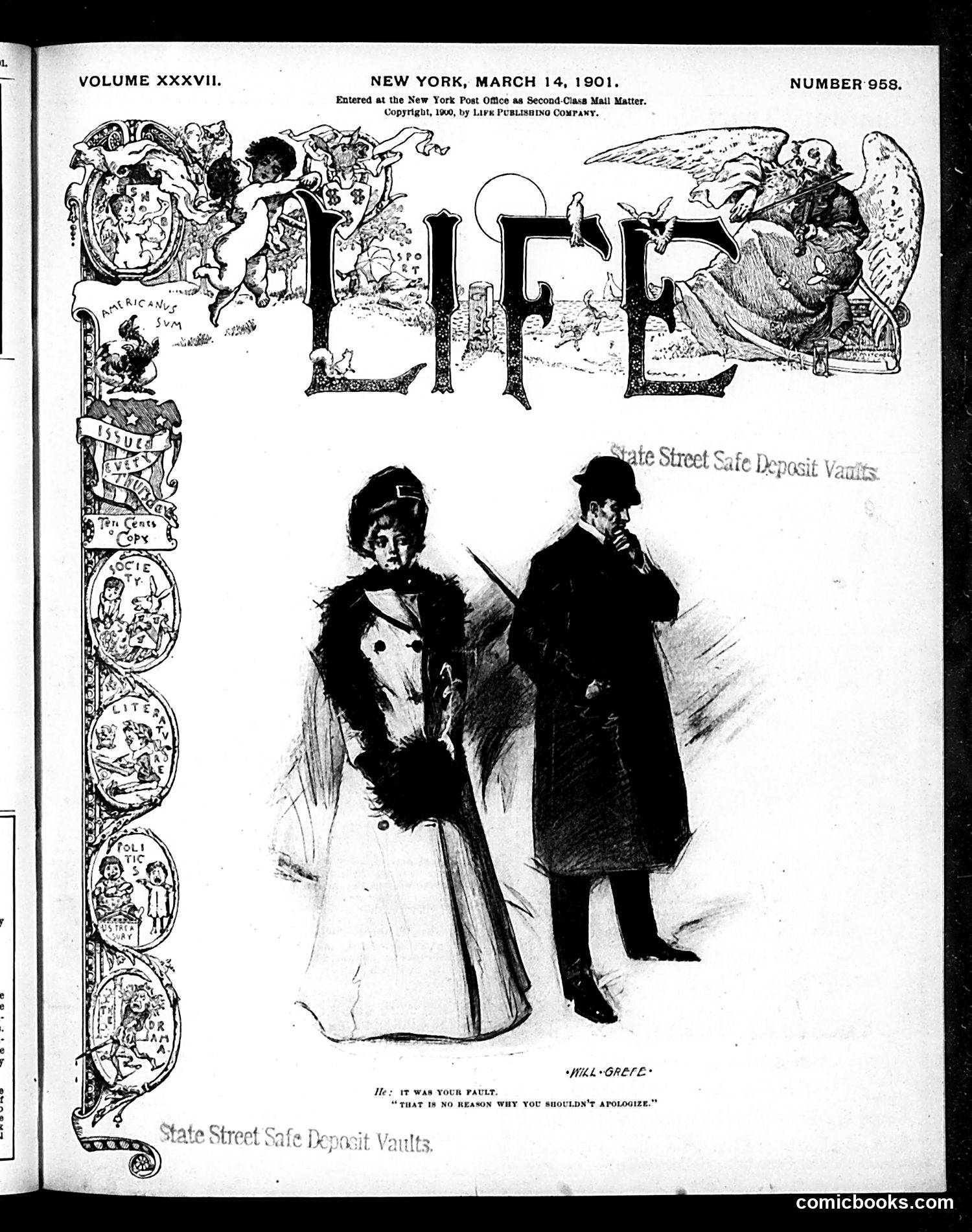
This is a satirical cover featuring an elegantly dressed couple in what appears to be a tense domestic moment. The man stands pensively with hand to face while the woman holds what looks like a riding crop or similar implement, suggesting marital discord. The caption reads: "He: 'It was your fault.' She: 'That is no reason why you shouldn't apologize.'" The cartoon satirizes contemporary gender dynamics and marriage etiquette—specifically the tension between traditional male authority and emerging expectations that men should apologize regardless of fault. The woman's assertive posture with the implement suggests she's using emotional or physical pressure to enforce an apology, mocking both stubborn masculinity and manipulative femininity in early 1900s relationships.
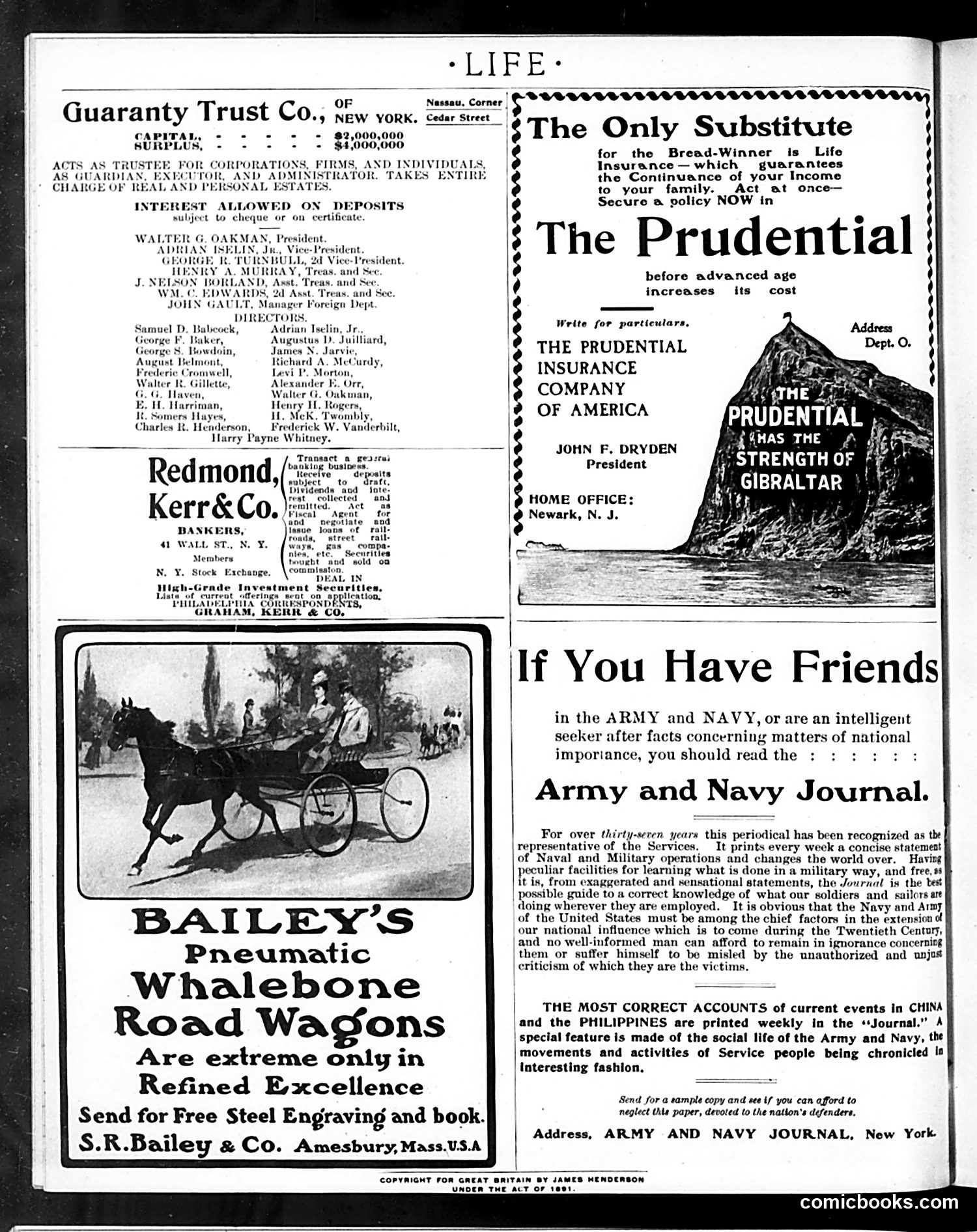
This page is primarily **advertising**, not satire or political commentary. It contains four distinct advertisements: 1. **Guaranty Trust Co.** - A financial services firm listing officers and directors 2. **The Prudential Insurance Company** - Features the Rock of Gibraltar imagery, promoting life insurance as financial security for families 3. **Bailey's Pneumatic Whalebone Road Wagons** - Promotes refined horse-drawn wagons; the "whalebone" likely refers to flexible suspension springs 4. **Army and Navy Journal** - Advertises a 37-year-old periodical covering military operations and current events, emphasizing credibility for readers with military connections The page reflects early 20th-century commercial messaging—financial institutions, insurance, transportation, and military publications—with no evident political satire or cartoon humor present.
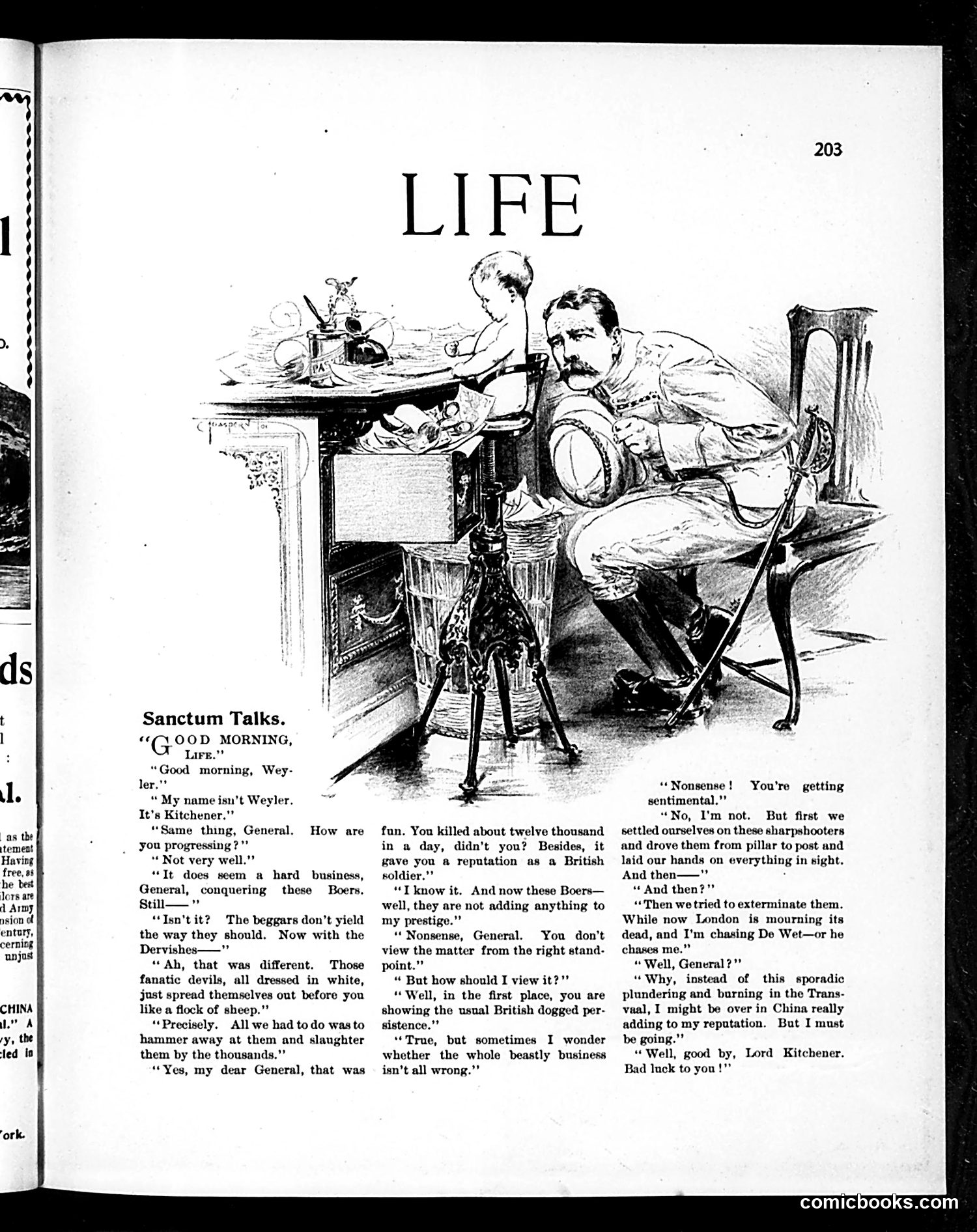
This satirical dialogue depicts two military figures discussing the Boer War. One character, identified as "Lord Kitchener" (British military commander), defends killing thousands of Boer soldiers daily as necessary warfare. His interlocutor challenges whether this approach is ethical, suggesting the British are merely "slaughtering" the enemy rather than fighting honorably. The satire critiques Kitchener's brutal tactics in South Africa (1899-1902), where British forces faced guerrilla resistance from Boer farmers. The cartoon mocks Kitchener's casual justification of mass casualties and his dismissal of moral objections as impractical sentiment. The joke targets both the general's callousness and contemporary British imperial warfare methods that prioritized overwhelming force over traditional combat conventions.
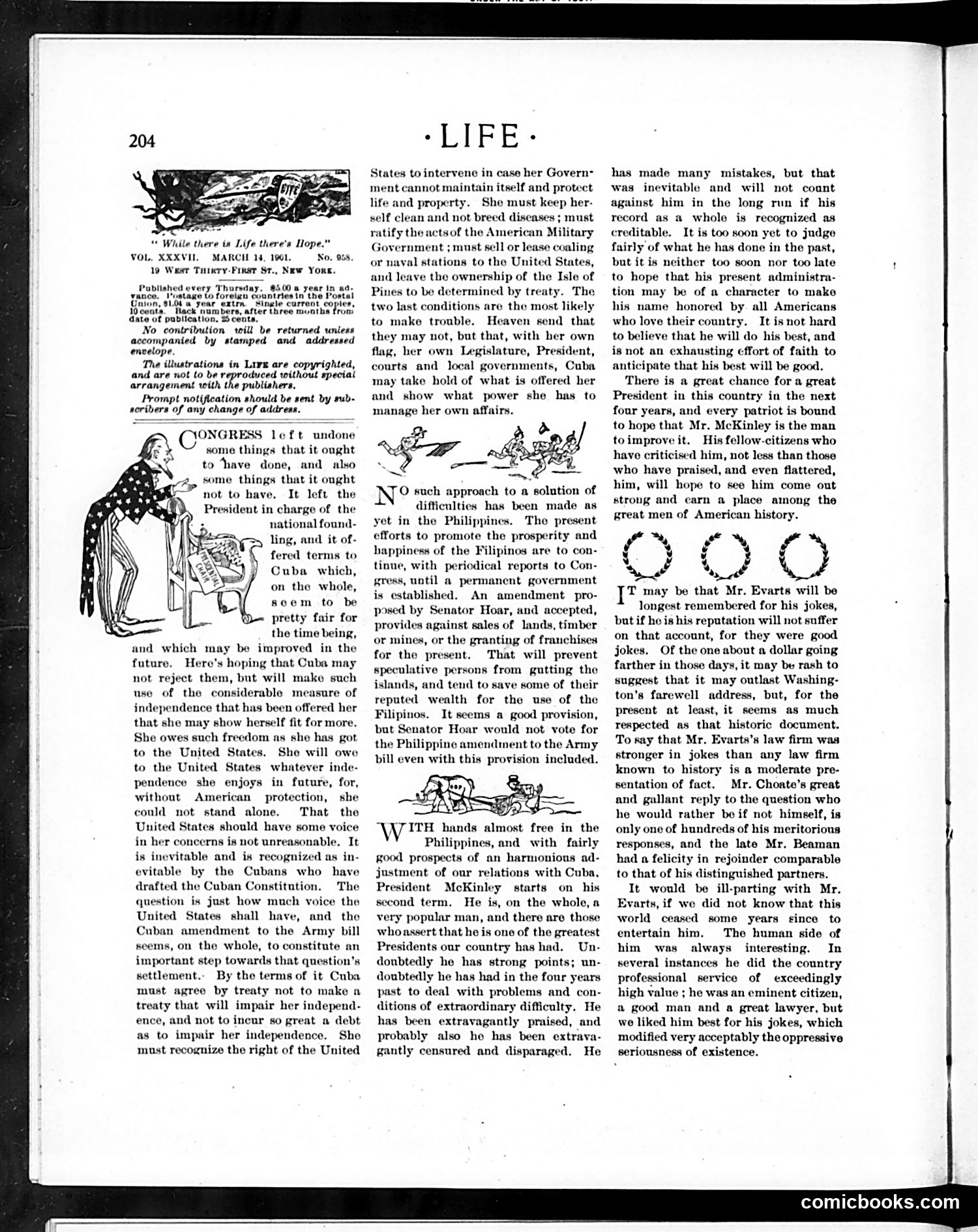
This page contains editorial commentary on President McKinley's second-term agenda, particularly regarding Cuba and the Philippines. The text discusses Congressional debate over Philippine policy and land sales, mentioning Senator Hoar's amendment protecting against land speculation. The two political cartoons appear to satirize Congressional dynamics: the first shows a figure (likely representing Congress) with Uncle Sam, commenting on Congressional power regarding Cuba policy and independence questions. The second cartoon depicts figures in discussion about Philippine affairs. The commentary praises McKinley as "popular" but notes criticism from both supporters and opponents. It also discusses lawyer David Evarts' reputation for jokes, suggesting his "law firm was stronger in jokes than any law firm known to history." The overall tone supports McKinley's administration while acknowledging legitimate policy debates within Congress.
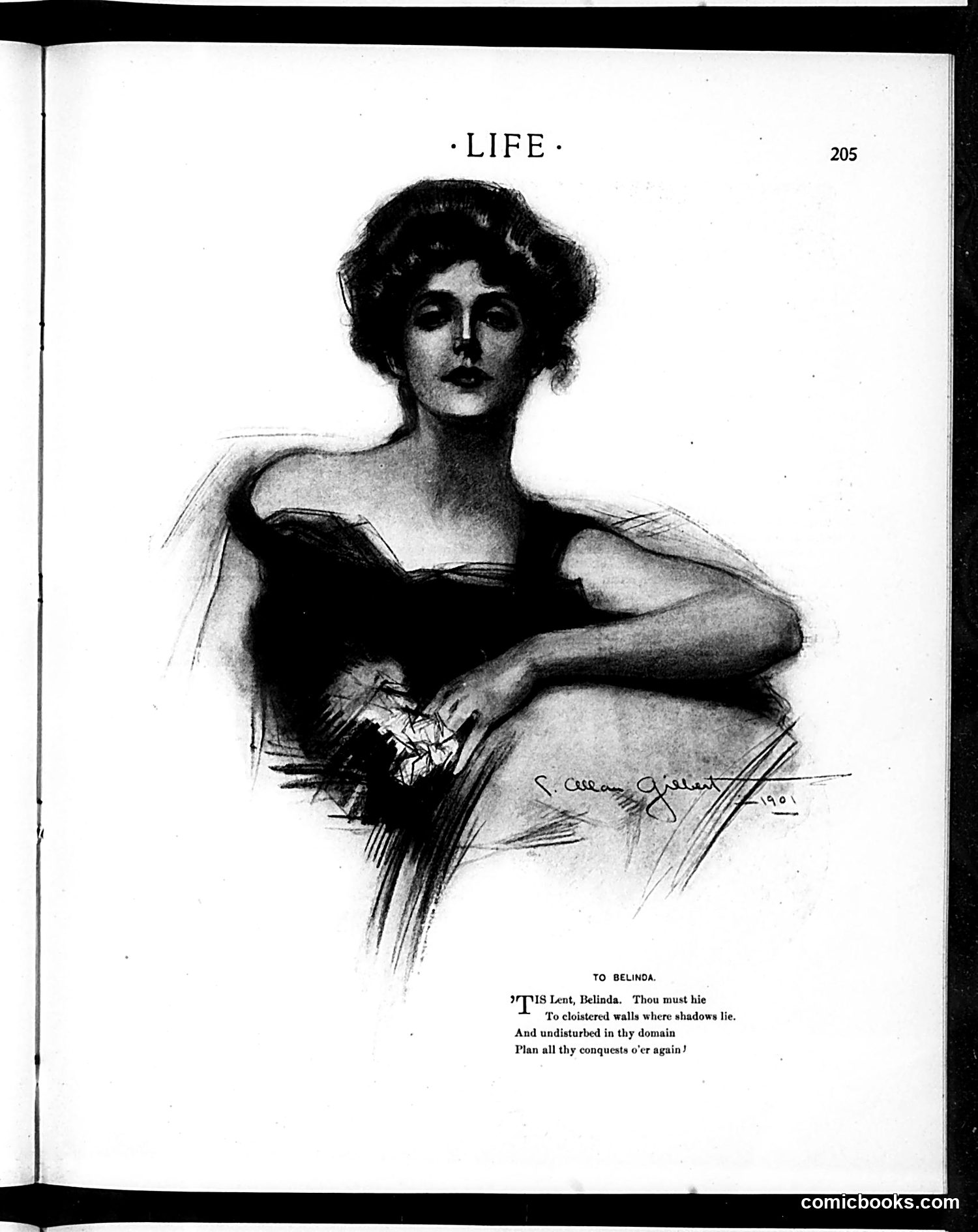
This page from *Life* magazine (page 205) features a portrait sketch titled "To Belinda" accompanied by a poem. The drawing shows a woman in an elegant, off-shoulder dark dress with styled dark hair characteristic of early 20th-century fashion. The artist's signature appears to read "S. Cesare Ricchetti" with a date. The accompanying verse addresses "Belinda," referencing "cloistered walls where shadows lie" and "undisturbed in thy domain," followed by "Plan all thy conquests o'er again?" This appears to be a satirical or romantic commentary on a woman's domestic sphere and social ambitions, typical of *Life*'s satirical treatment of social conventions and gender roles of the era. The specific identity of "Belinda" remains unclear without additional context.
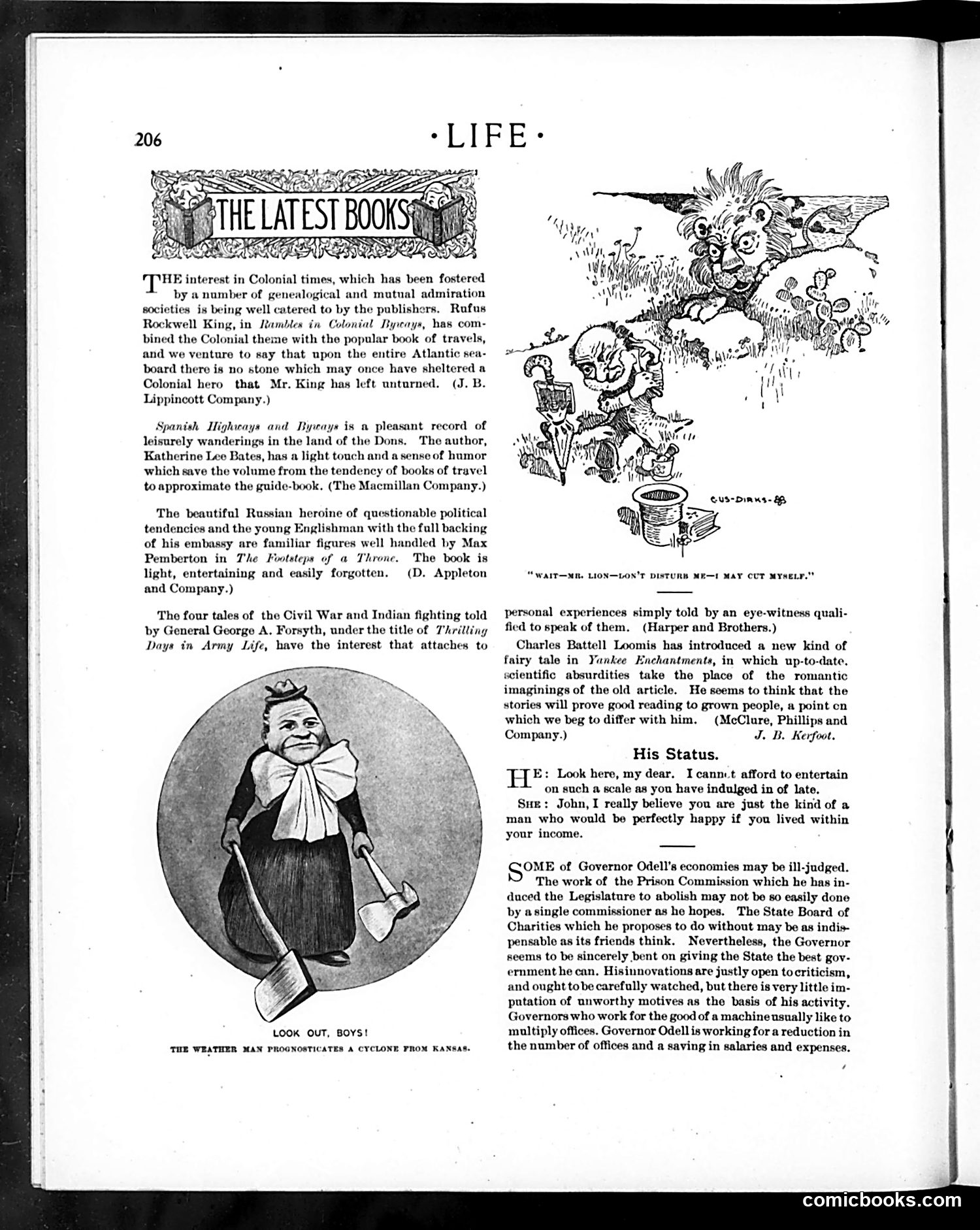
**"The Latest Books" Section:** This page reviews recent publications, including works on Colonial history and Russian politics. **Two Cartoons:** 1. **Upper right**: A humorous illustration titled "Wait—Mr. Lion—Don't Disturb Me—I May Cut Myself" shows anthropomorphic animals in a domestic scene, likely satirizing human behavior through animal characters (a common Life magazine technique). 2. **Lower left**: "Look Out, Boys! The Weather Man Prognosticates a Cyclone from Kansas" depicts a rotund figure labeled "The Weather Man," appearing to satirize inaccurate weather forecasting or perhaps a specific meteorologist or public figure known for unreliable predictions. The exaggerated caricature and warning tone suggest mockery of his credibility. Both cartoons use visual humor and caricature typical of early 20th-century satirical magazines.
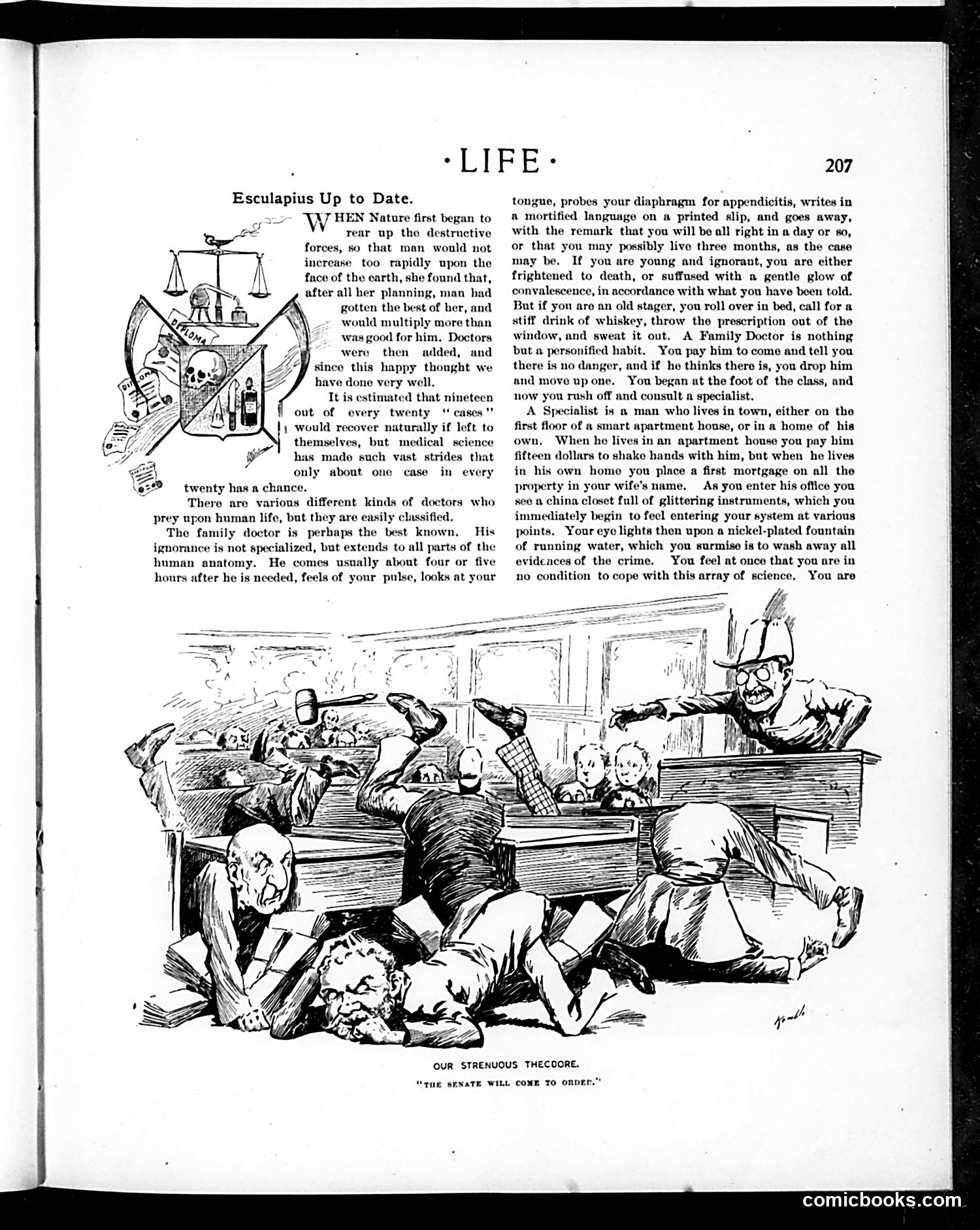
This page from *Life* magazine satirizes medical practice through two pieces: **Upper section ("Esculapius Up to Date"):** The article mocks modern doctors' proliferation and specialization. It argues that Nature would have recovered 19 of 20 cases left alone, but medical science has made "vast strides." The tone is sarcastic—suggesting doctors aren't actually improving outcomes, just multiplying their own numbers and fees. The accompanying illustration shows a quack doctor's toolkit. **Lower cartoon ("Our Strenuous Theocracy"):** Captioned "The Senate will come to order," this depicts the U.S. Senate in complete chaos—senators fighting, sprawling, and disorderly. The satire targets congressional dysfunction and incompetence, suggesting the Senate cannot maintain basic order or decorum. Both pieces reflect Progressive-era skepticism toward institutions (medicine, government) claimed to serve the public interest.
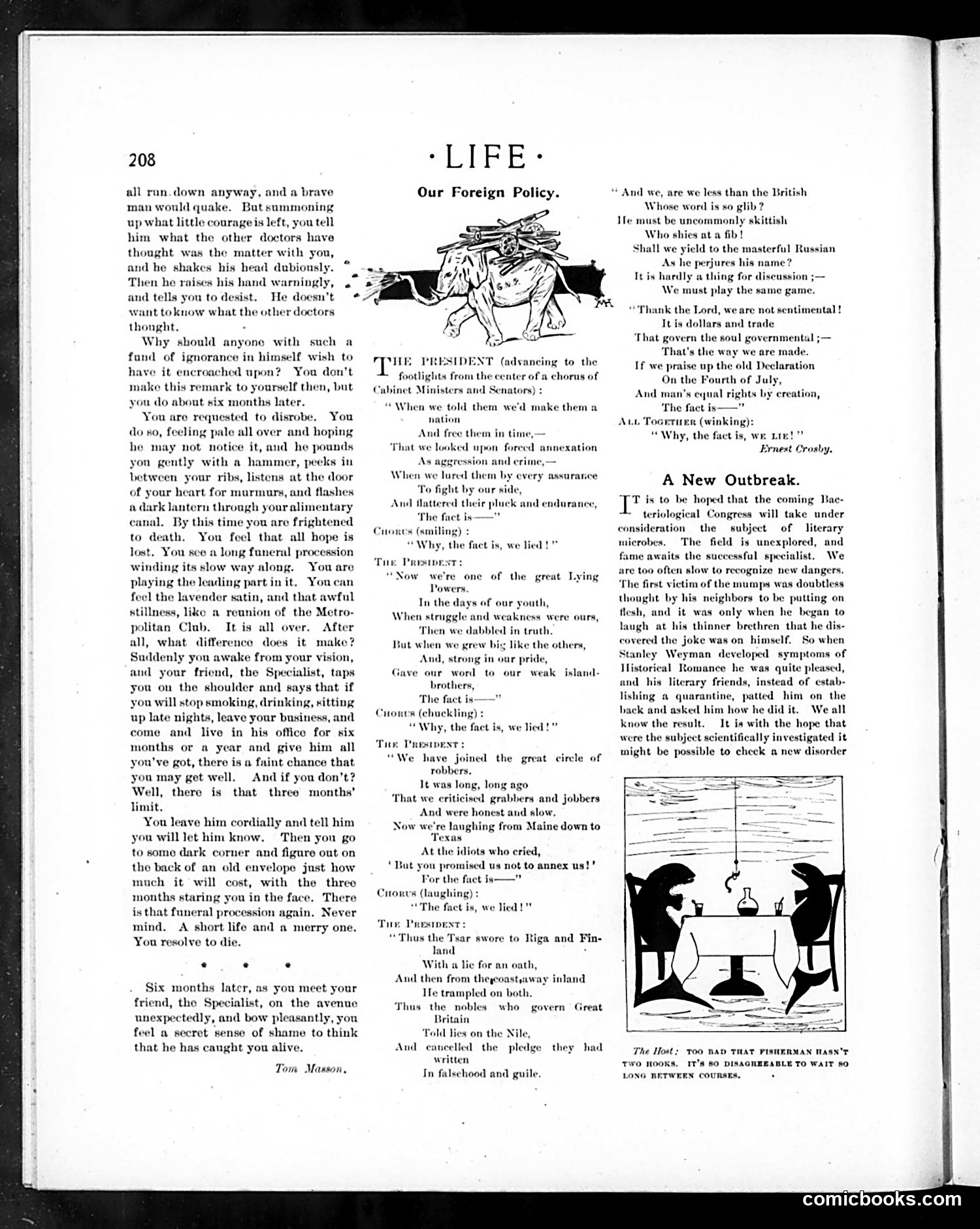
The page contains two distinct pieces: 1. **"Our Foreign Policy"** — A satirical poem-dialogue featuring THE PRESIDENT and a CHORUS, debating Russia. The cartoon illustration shows figures in a confrontational stance. The satire mocks American foreign policy as hypocritical: the U.S. criticizes Russia's aggression and "lying" while the poem suggests America itself engages in similar deceptive practices ("the fact is, we lied!"). 2. **"A New Outbreak"** — Text discussing a bacteriological congress investigating "literary microbes." The accompanying silhouette cartoon shows two figures at a table with scientific equipment, satirizing academic or medical pseudo-science applied to literature. Both pieces mock government dishonesty and intellectual pretension, though the specific historical context—likely 1920s U.S.-Soviet tensions—is unclear without the magazine's date.
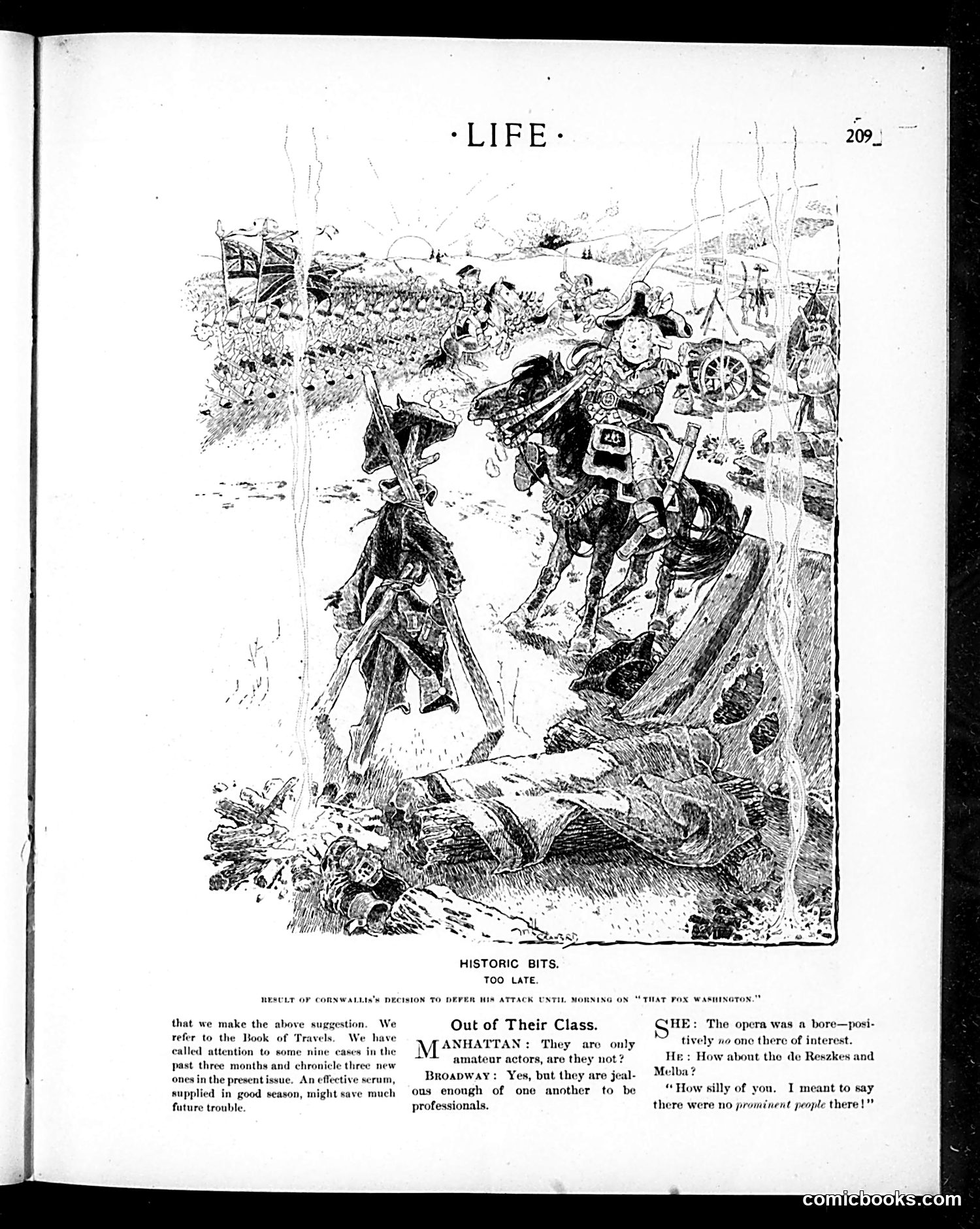
**The Main Illustration:** "Historic Bits: Too Late" depicts a military scene where a mounted officer appears to be addressing troops, with a caption referencing "Cornwallis's decision to offer his attack until morning on 'That Fox Washington.'" This satirizes a historical moment—likely the American Revolutionary War—mocking British General Cornwallis's delay in attacking George Washington, suggesting this hesitation proved strategically fatal. **The Text Below** contains dialogue mocking amateur versus professional actors on Broadway, with characters debating whether Broadway performers qualify as "professionals." The humor hinges on class pretension—the dismissive comment that no "prominent people" attended suggests these actors lack social standing. Both segments appear designed to entertain through historical irony and contemporary social mockery, typical of Life's satirical approach.
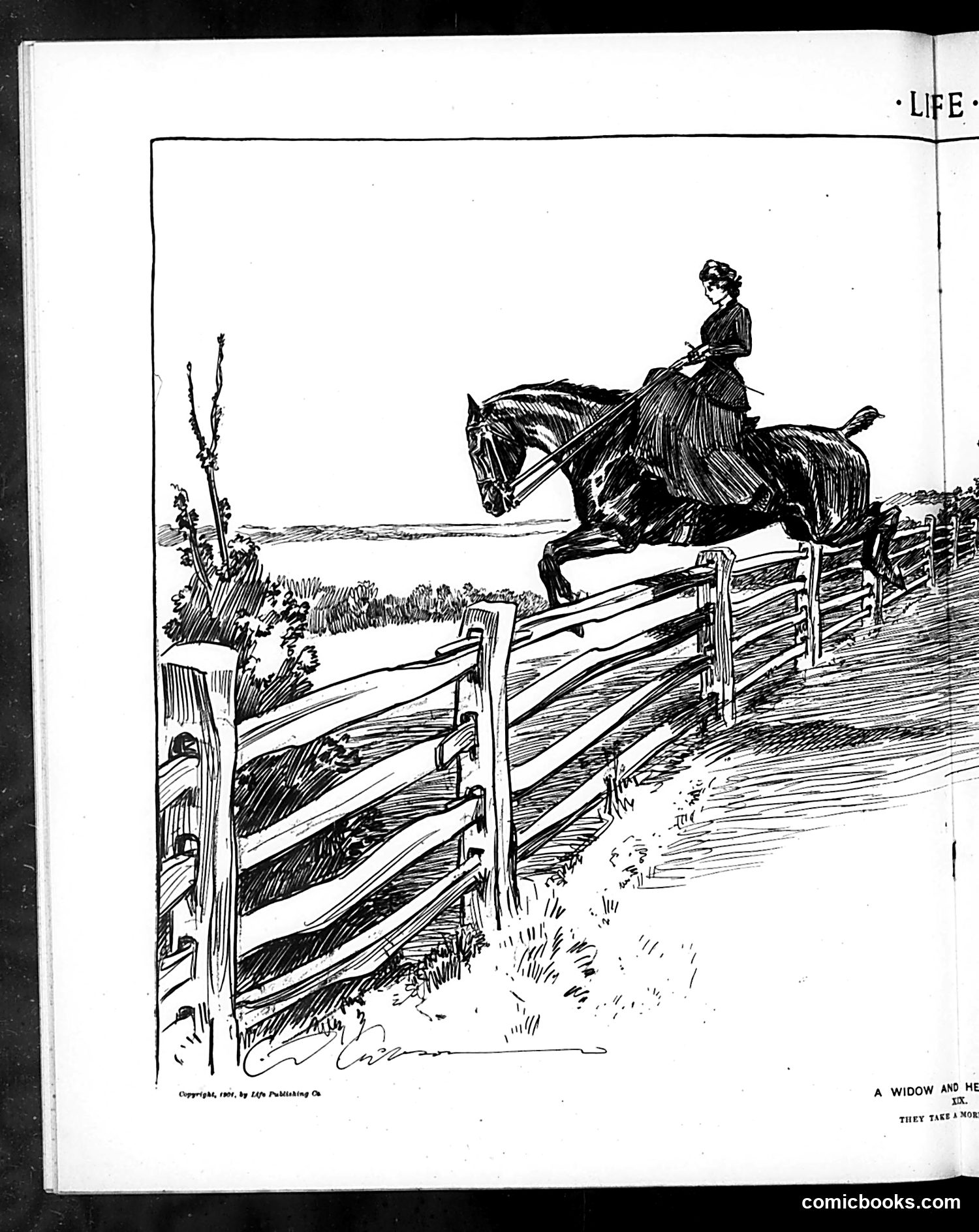
This appears to be an illustration from *Life* magazine showing a woman on horseback jumping over a wooden fence in a rural setting. The visible caption fragment reads "A WIDOW AND HE..." with additional text "THEY TAKE A..." suggesting this is part of a larger narrative or story. The sketch depicts a scene of equestrian sport or country pursuits, rendered in the magazine's characteristic pen-and-ink style. Without the complete caption and surrounding text, the specific satirical point is unclear. This could be illustrating a social commentary about widows, courtship, or gender roles in early 20th-century America, but the exact satire cannot be determined from the visible portion alone.
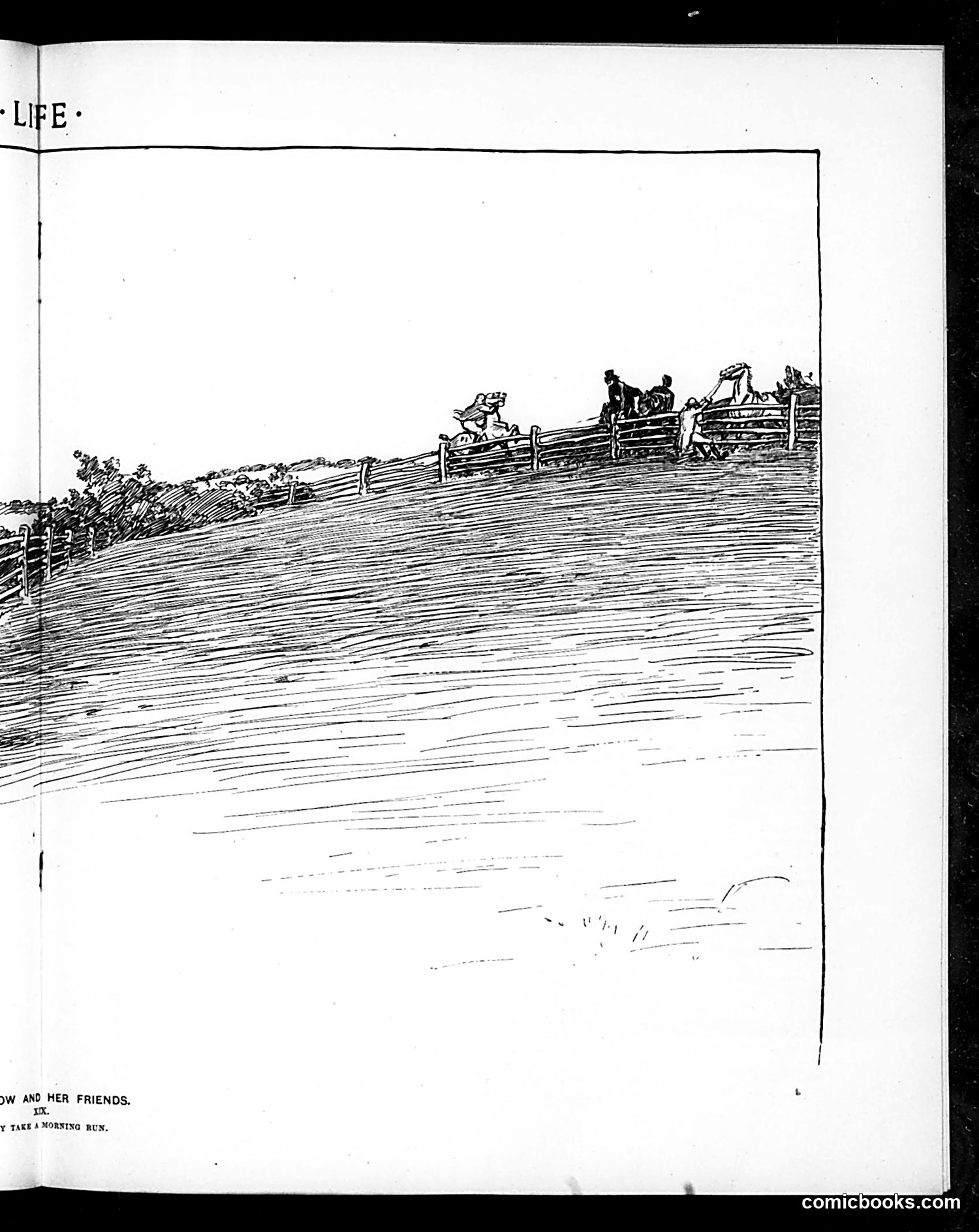
This appears to be an illustration from *Life* magazine titled "LIFE" at the top. The visible OCR text fragments reference "OW AND HER FRIENDS" and "Y TAKE A MORNING RUN," suggesting this is part of a serialized comic or illustrated story. The image shows a rural scene with a wooden fence along a waterside or sloped terrain. Several figures are depicted on or near the fence, appearing to be engaged in some form of activity or leisure pursuit. Without more complete text or clearer context, I cannot definitively identify the specific characters, social commentary, or satirical point being made. The style suggests early 20th-century American illustration, but the exact narrative and its intended satire remain unclear from this page fragment alone.
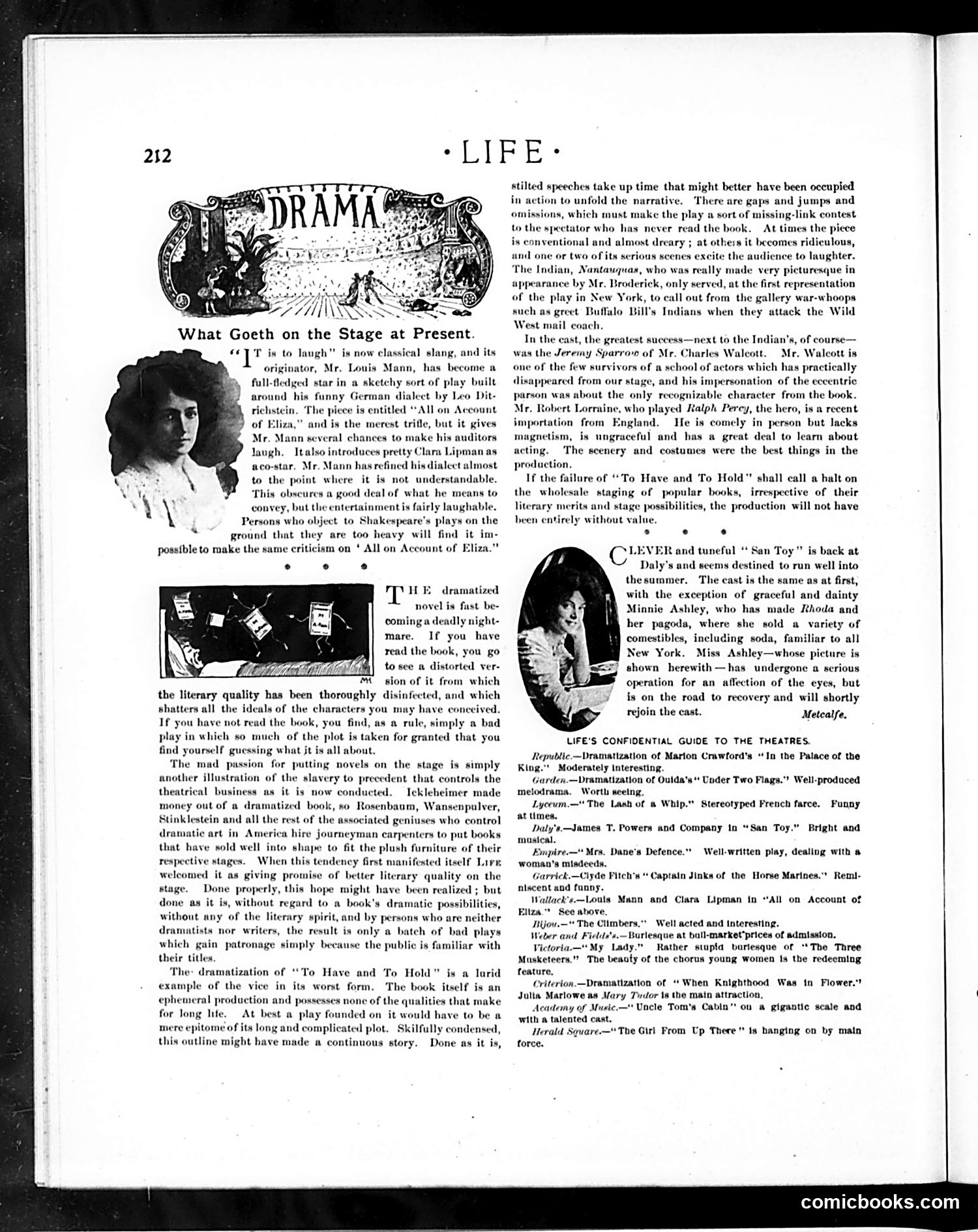
This is a theatrical criticism column reviewing recent stage productions. The main text critiques "To Have and To Hold," a play adapted from a novel, arguing that dramatizing books often fails because stage necessities clash with literary quality. The author (Louis Mann, per the text) contends the adaptation loses the novel's character depth and becomes a poorly constructed play. A photograph shows what appears to be a scene from the production featuring period costumes. The page includes "Life's Confidential Guide to the Theatres"—brief capsule reviews of current shows using satirical titles like "Stereotyped French farce" and "Well-written play, dealing with a woman's misdeeds." The satire targets the commercial practice of adapting successful novels into mediocre theatrical productions.
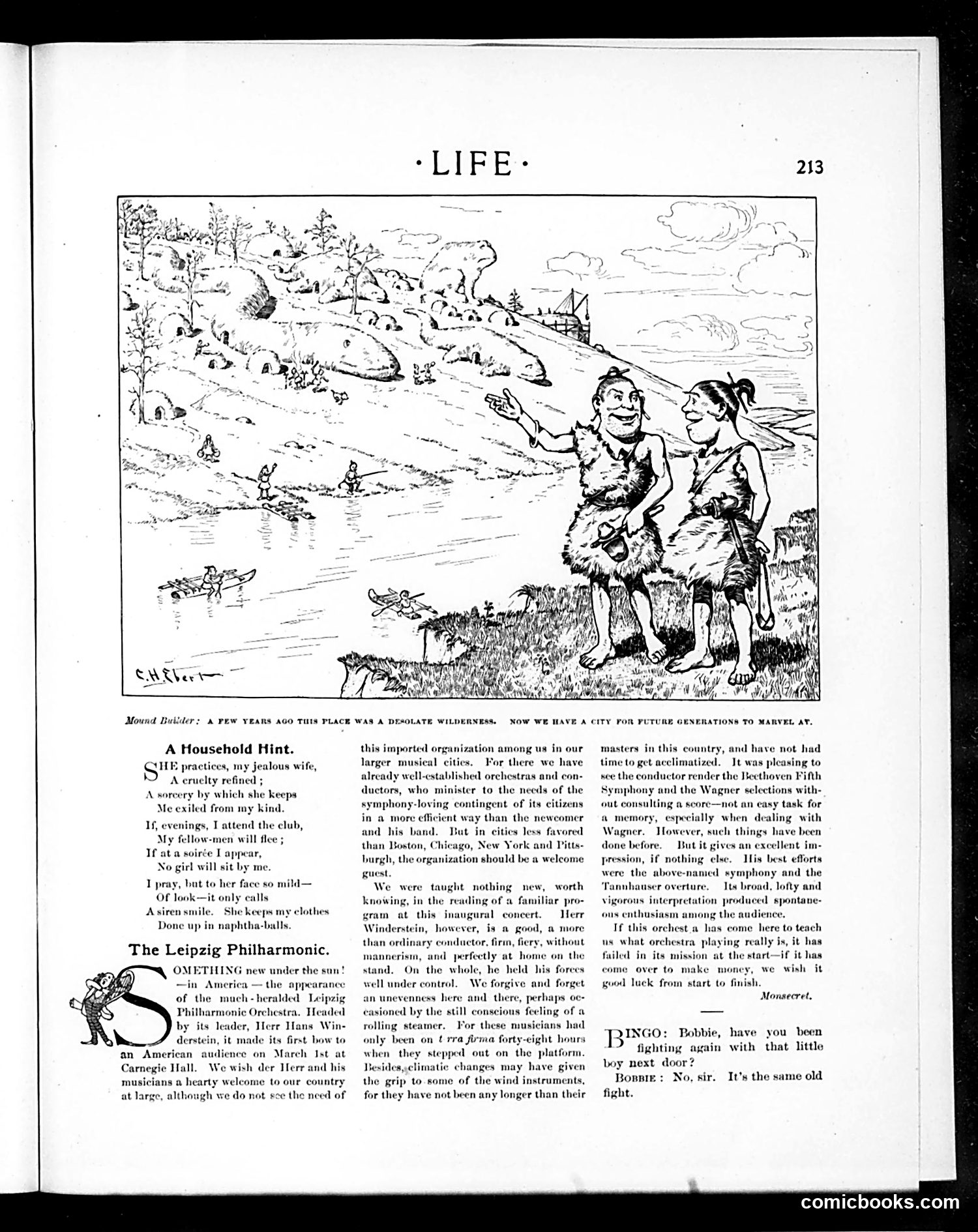
This page contains two satirical pieces typical of *Life* magazine's humor: **"Mound Builder" cartoon** (top): A crude joke about civilization's progress. Two primitive figures observe a developed landscape, with the caption claiming this wilderness has become a city. The satire mocks American boosterism—the tendency to celebrate development and "progress" uncritically, even when the results are merely ordinary urban sprawl. **"A Household Hint"** (poem): Satirizes a jealous wife who deliberately makes her husband socially undesirable by keeping his clothes in poor condition (naphtha-balls storage). The joke is on marital discord and domestic sabotage presented as "helpful" advice. **"The Leipzig Philharmonic"** (article): Reviews a German orchestra's American debut at Carnegie Hall. The critic welcomes them but questions their necessity in major cities already having orchestras, while suggesting they might serve smaller cities. It's social commentary on cultural hierarchy and provincial America's musical aspirations—gently mocking both European pretension and American self-consciousness about lacking cultural refinement.
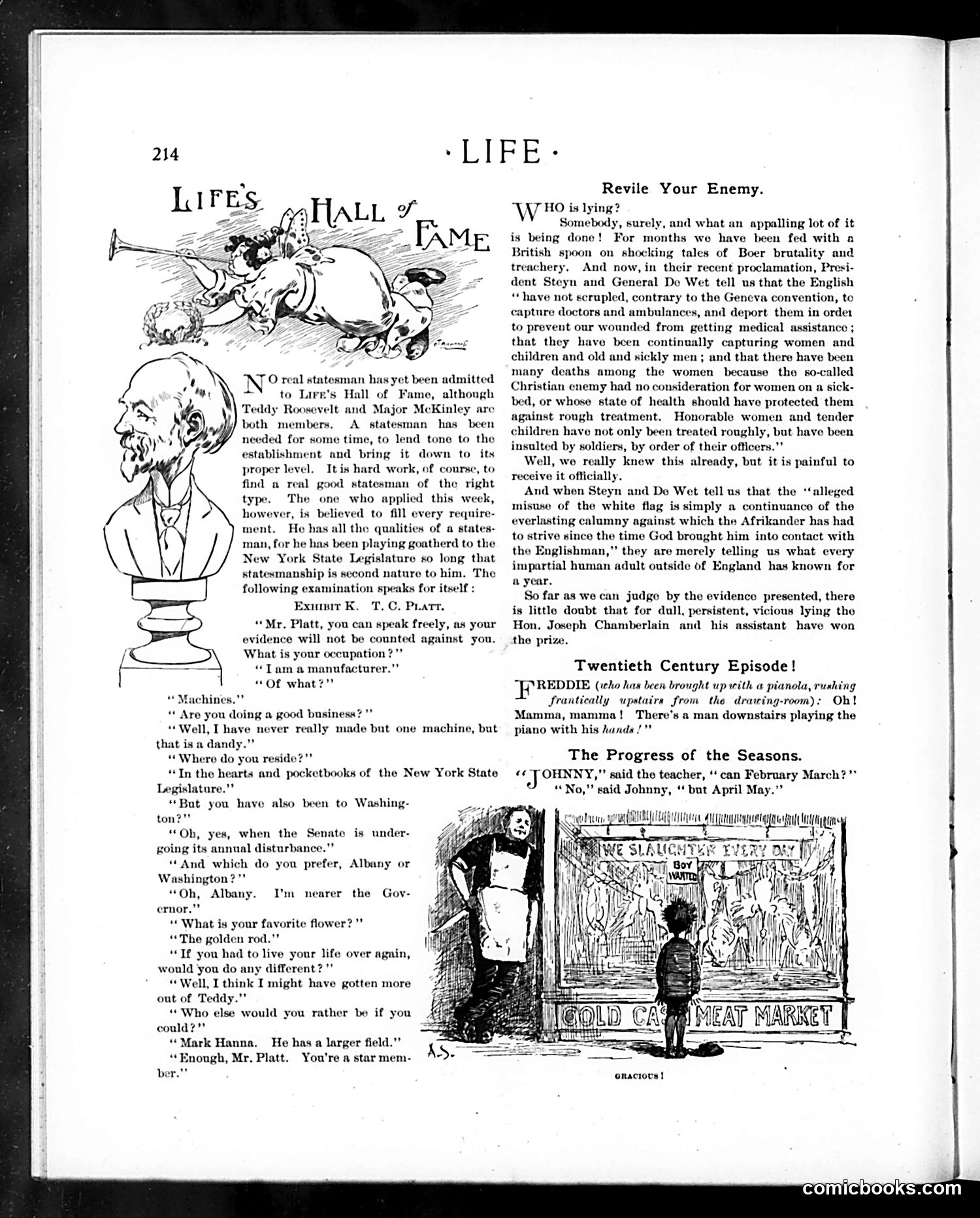
This page satirizes **Thomas C. Platt**, a powerful New York Republican politician who controlled the state legislature ("goatherd to the New York State Legislature"). The mock "examination" reveals his corruption: he manufactures nothing but "machines" (political manipulation), resides "in the hearts and pocketbooks" of legislators, and divides his time between Albany and Washington for influence-peddling. The satire suggests Platt is unfit for Life's "Hall of Fame" of statesmen—he's a political operative, not a statesman. The separate article attacks British conduct in the **Boer War** (South Africa), citing allegations of abuse against civilians by British forces and misuse of white flags. Life sarcastically notes that Joseph Chamberlain (British Colonial Secretary) and associates are winning for "vicious lying." Two lighter pieces follow: a joke about a child amazed by piano-playing hands (mocking mechanical player pianos), and a seasonal wordplay joke with a child.
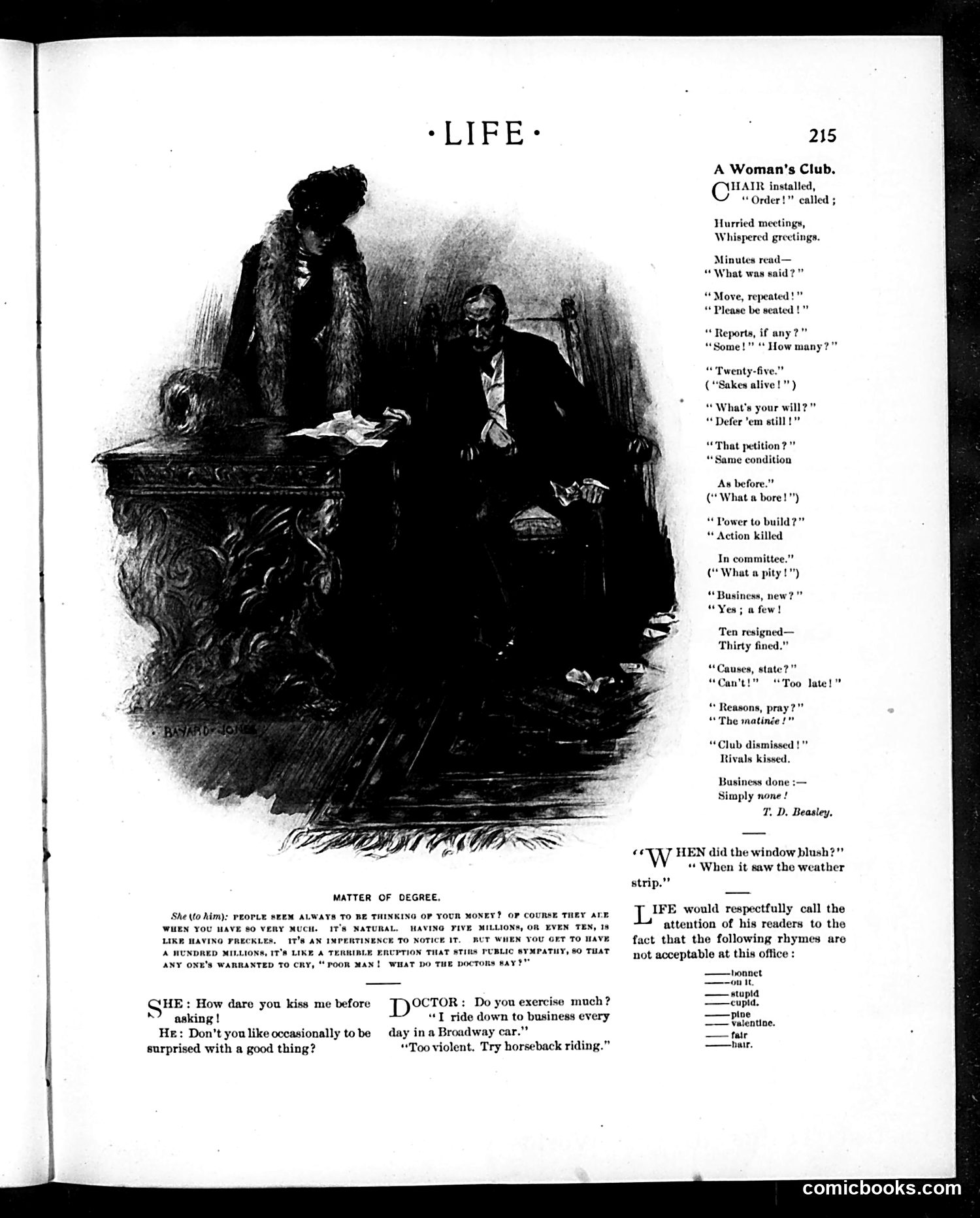
This page satirizes women's clubs, a widespread institution of the era. The main cartoon depicts a meeting plagued by procedural chaos and inefficiency: endless "orders," repeated motions, deferred petitions, and committees that kill initiatives. The punchline is that despite all this activity, "Business done: Simply none!" The satire targets both the clubs' bureaucratic dysfunction and, implicitly, questions about women's serious participation in civic organizations. The accompanying humor about a wealthy man (the "matter of degree" cartoon) and a doctor's exercise advice provides lighter filler content. The page concludes with a tongue-in-cheek editorial note: *Life* humorously rejects certain rhyme pairs (bonnet/on it, stupid/cupid, etc.) as unacceptable—a joke about overwrought romantic poetry submissions, likely parodying the magazine's readers' actual submissions.
This page contains three humorous short stories typical of early 20th-century American satire: 1. **"The Dyspeptic Cannibal"**: A cannibal complains he can digest any human—tribesmen, missionaries—except a missionary, whose indigestion troubles him. The joke satirizes the era's fascination with "exotic" cannibal stereotypes while poking fun at missionaries as particularly indigestible subjects. 2. **The automobile accident story**: A couple crashes while the young man makes a witty remark. The woman calls him out for engineering the disaster just to deliver a clever line—satire on masculine vanity and tendency toward showing off. 3. **The Colonel's romantic rejection**: An unmarried older gentleman laments losing a woman. When consoled that "there are as good fish in the sea," he replies "lots of fish, but so few mermaids"—meaning marriageable women are rare. Social commentary on marriage market dynamics. The page is primarily humorous fiction with period-appropriate advertising (Wilson Whiskey, dinner cards, pens).
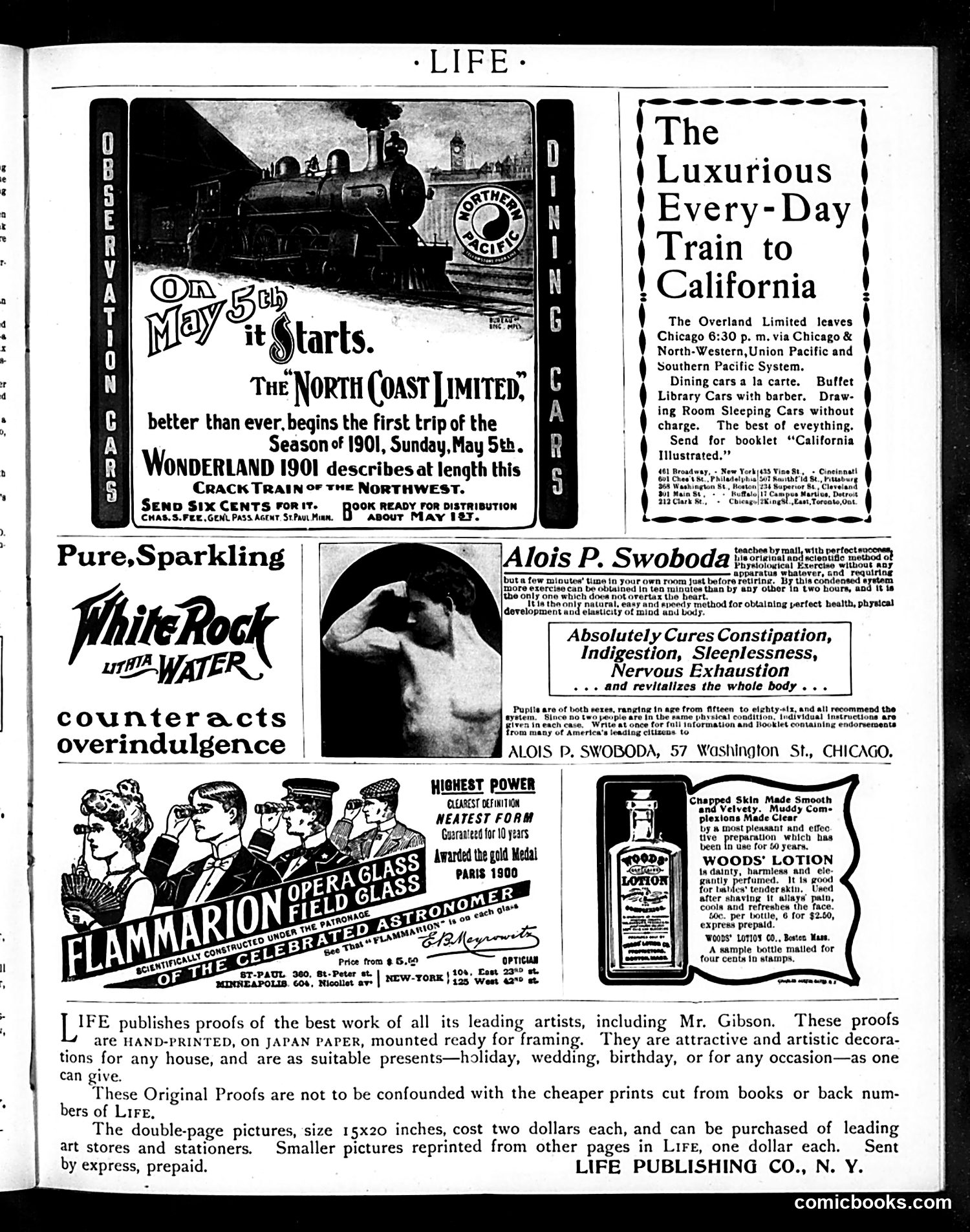
This page is primarily **advertising**, not satire or political commentary. It features: **Major Ads:** - **North Coast Limited train** (top): Announces the 1901 season opening of this luxury "Crack Train of the Northwest," promoting it as improved and better than ever. - **White Rock Lithia Water**: Claims to counteract overindulgence—a common health product pitch of the era. - **Alois P. Swoboda's physiological exercises**: Mail-order physical training promising to cure constipation, indigestion, and nervous exhaustion through brief home exercises. - **Flammarion Opera Glass**: Optical instrument marketed as scientifically superior; won a gold medal at Paris 1900. - **Woods' Lotion**: Skincare product for chapped skin and razor irritation. **Also included:** An advertisement for Life Publishing's art proofs available for purchase. The page reflects early-1900s consumer culture and patent medicine marketing typical of the period. There is no evident political satire or social commentary.
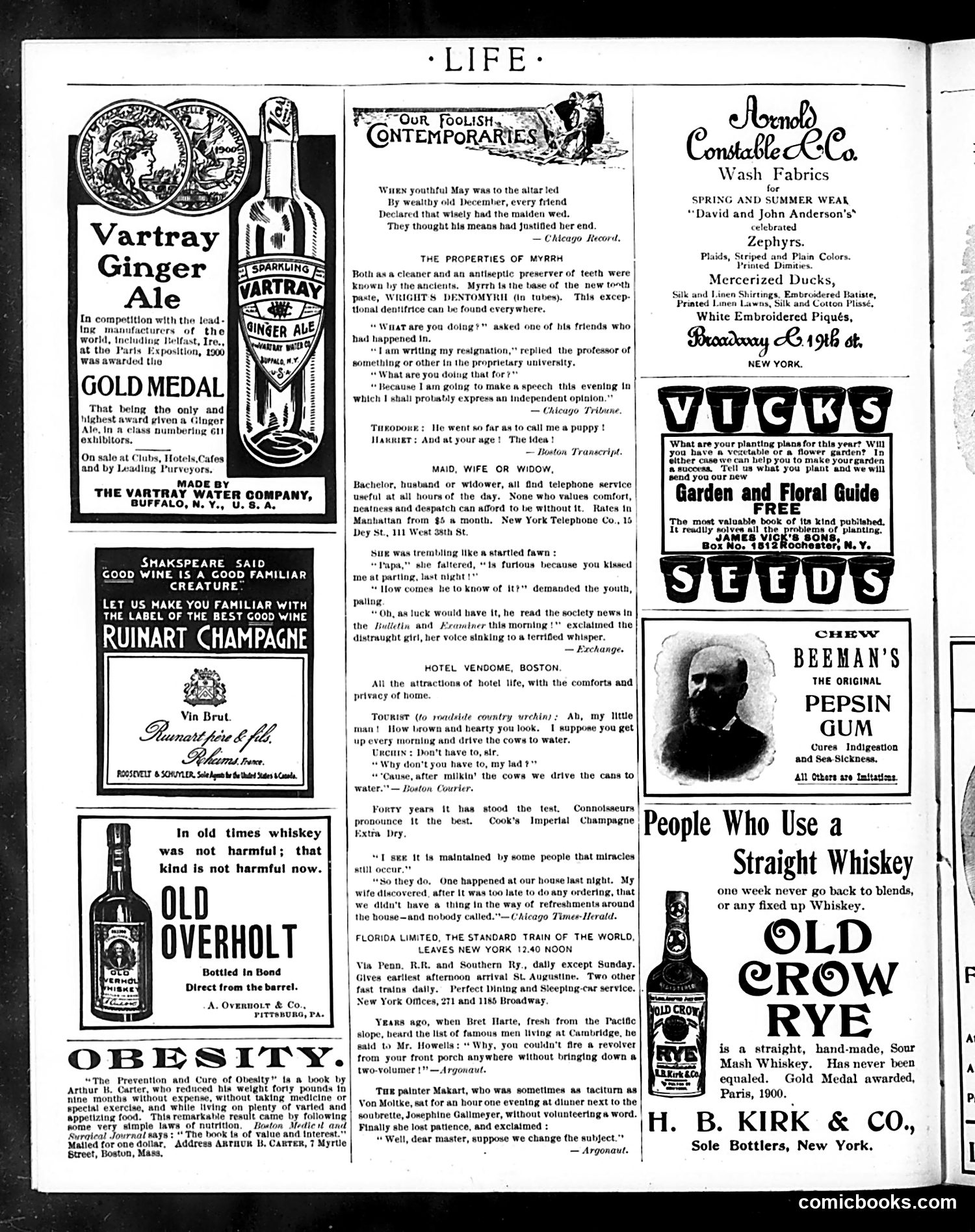
This page is primarily **advertising**, typical of Life magazine's revenue model. The satirical content appears in the center section titled "Our Foolish Contemporaries"—a regular Life feature mocking social absurdities. The cartoons mock: 1. **A professor's resignation** over inability to express independent opinions at a "proprietary university"—satirizing academic censorship and institutional control of thought. 2. **Gossip and newspapers**: A young woman's father discovers she was kissed goodnight only because society columns reported it—mocking the intrusive nature of newspaper coverage and social surveillance. 3. **Rural simplicity**: A tourist's assumption that a country boy drives cows to water; the boy reveals they drive the **cans** (milk cans) instead—gentle humor about modernization reaching rural areas. 4. **Miraculous domesticity**: A wife discovers too late she has no refreshments—but "miracles still occur," sardonically suggesting a woman forgetting household duties is supernatural. The surrounding ads (whiskey, ginger ale, seeds, pepsin gum) reflect early 1900s consumer culture. The overall tone is lighthearted social criticism typical of Life's satirical approach.
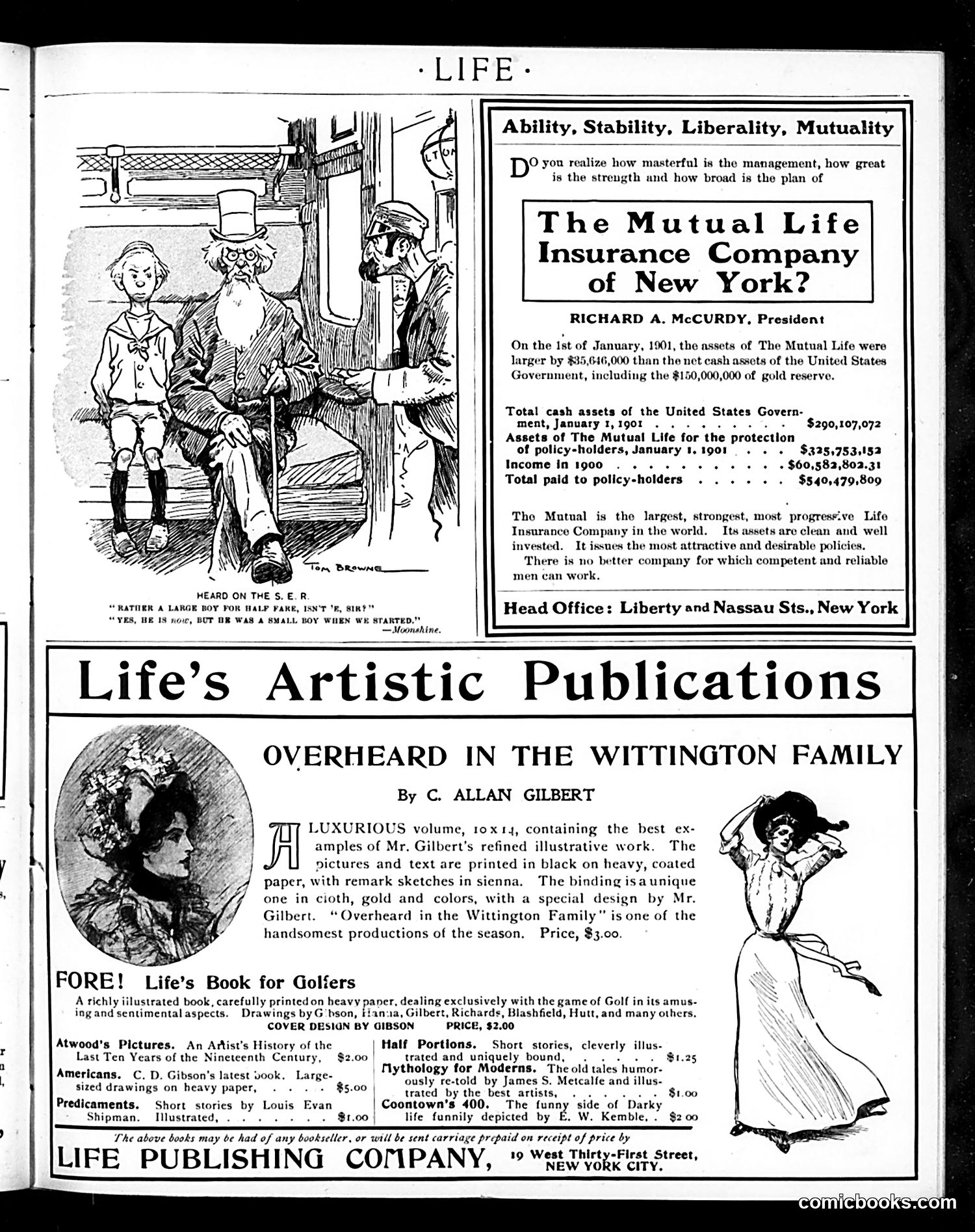
This page is primarily **advertising content** rather than satirical editorial material. The main cartoon (upper left) depicts a conversation on the S.E.R. (likely a railway), showing an adult and child. The caption's joke rests on wordplay: when asked if he's a "large boy for half fare," the adult responds "yes, he is now, but he was a small boy when we started"—implying the child has aged during their journey, a humorous exaggeration. The dominant content is a **full-page advertisement** for The Mutual Life Insurance Company of New York, touting its assets ($325 million) as exceeding U.S. Government reserves. This reflects turn-of-the-century corporate boasting about financial strength. Below is advertising for Life Publishing Company's books, including "Overheard in the Wittington Family" by illustrator C. Allan Gilbert and various gift volumes on golf, art, and humor. The page demonstrates how early *Life* magazine blended editorial satire with lucrative advertising.
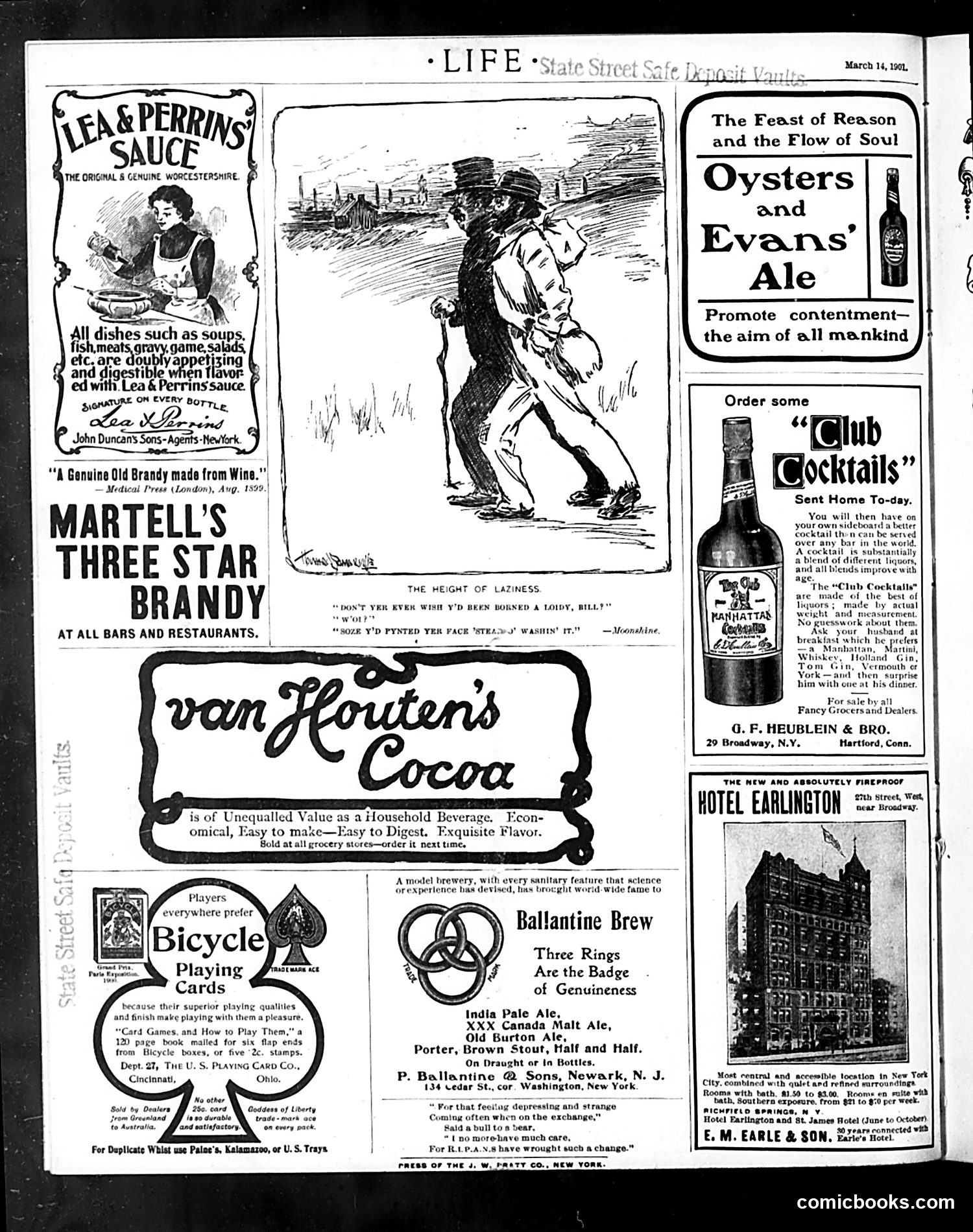
This is primarily an **advertising page** from Life's early 1900s era, with one cartoon and multiple product endorsements typical of the period. The central cartoon, titled "The Height of Laziness," depicts two working-class men discussing class aspiration. One wishes he'd been "born a lady" to avoid manual labor; his companion jokes he'd have painted his face instead of washing it. The humor mocks both the perceived idleness of the wealthy and the resigned acceptance of working-class drudgery—a common satirical theme in Edwardian Life. The surrounding advertisements reflect Gilded Age consumer culture: Lea & Perrins sauce, Martell's brandy, van Houten's cocoa, Bicycle playing cards, and Ballantine beer. A notable ad references stock-exchange anxiety ("feeling depressing and strange / Coming often when on the exchange"), suggesting fin-de-siècle economic anxieties among the magazine's middle-class readership. The page reflects Life's dual purpose: satirizing American society while profiting from advertising to that same society.