
Life, 1901-03-14 · page 4 of 20
Life — March 14, 1901 — page 4: what you’re looking at
What you’re looking at
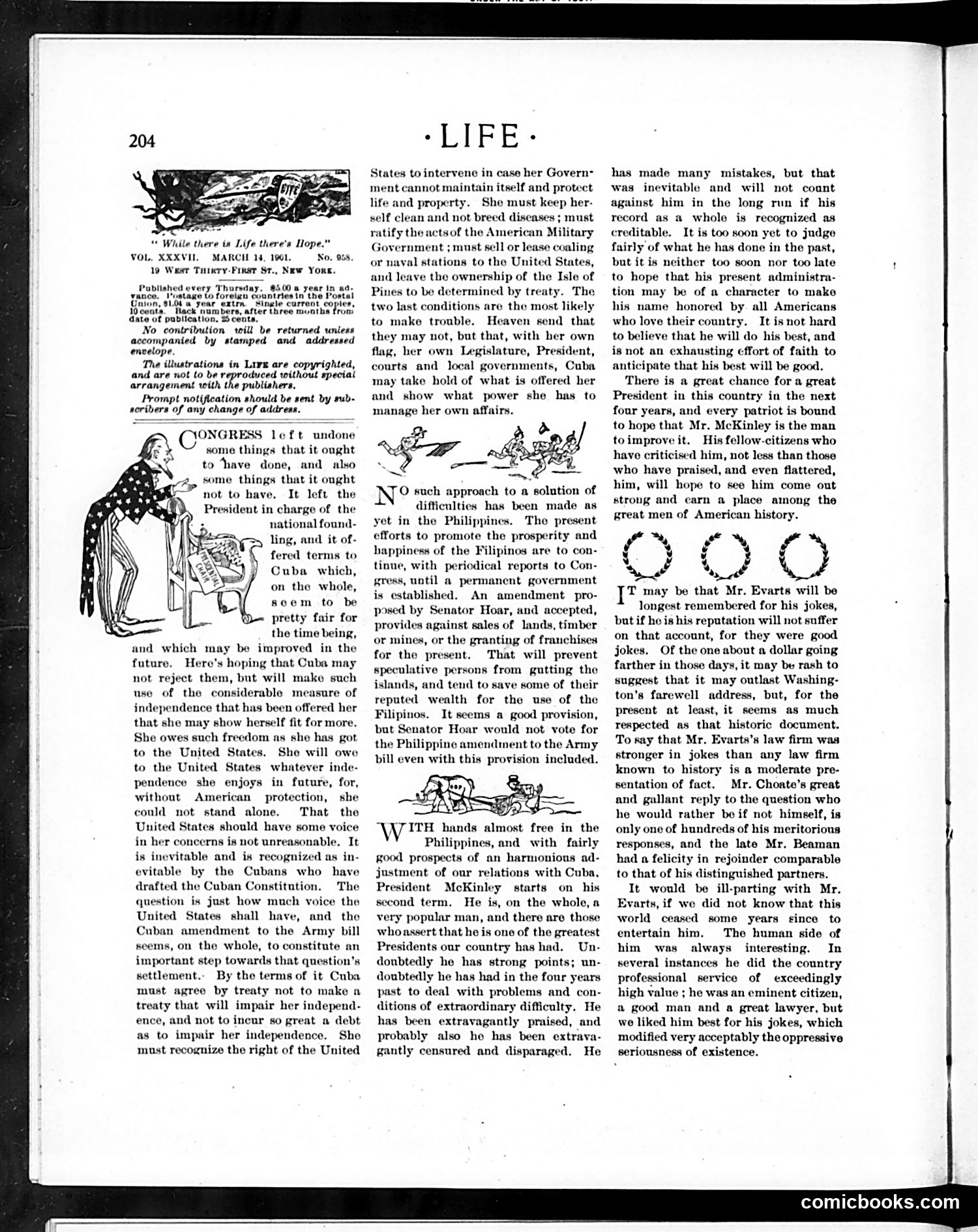
This page contains editorial commentary on President McKinley's second-term agenda, particularly regarding Cuba and the Philippines. The text discusses Congressional debate over Philippine policy and land sales, mentioning Senator Hoar's amendment protecting against land speculation. The two political cartoons appear to satirize Congressional dynamics: the first shows a figure (likely representing Congress) with Uncle Sam, commenting on Congressional power regarding Cuba policy and independence questions. The second cartoon depicts figures in discussion about Philippine affairs. The commentary praises McKinley as "popular" but notes criticism from both supporters and opponents. It also discusses lawyer David Evarts' reputation for jokes, suggesting his "law firm was stronger in jokes than any law firm known to history." The overall tone supports McKinley's administration while acknowledging legitimate policy debates within Congress.
📄 Transcribed text from this page (OCR, searchable)
Machine-transcribed from the original scan — historical spelling and the odd misread are preserved.
“While there is Life there's Hope: XXXVI. MARCI 14, 1901. 19 Weer Tu1ery-Finst St., New York. vou. Polished every 7 hureday. 85.000 year in ad. stage to foreign countries in the Post Sita year extra. Single current copies, ack numbers, after three munths froa 10 of publication, 2 cents. No contritution will be returned unless accompanied by stamped and addressed envelope. The illustrations in Live are copyrighted, and are not to be reproduced without special arrangement with the publishers, Prompt notification should be sent by sub- soribers of any change of address. GRESS| left undone some things that it ought to have done, and also 4. some things that it ought not to have, It left the rf ). President in charge of the national found- ling, and it of- fered terms to Cuba which, on the whole, seem to be pretty fair for the time being, and which may be improved in the future. Here's hoping that Cuba may not reject them, but will make such use of the considerable measure of independence that has been offered her that she may show herself fit for more. She owes such freedom as she has got to the United States. She will owe to the United States whatever inde- pendence she enjoys in future, for, without American protection, she could not stand alone. That the United States should have some voice in her concerns is not unreasonable, It is inevitable and is recognized as in- evitable by the Cubans who have drafted the Cuban Constitution. The question is just how much voice the United States shall have, and the Cuban amendment to the Army bill seems, on the whole, to constitute an important step towards that question's settlement.- By the terms of it Cuba must agree by treaty not to make a treaty that will impair her independ- ence, and not to incur so great a debt as to impair her independence. She must recognize the right of the United LIFE States to intervene in case her Govern- ment cannot maintain itself and protect life and property. She must keep her- self clean and not breed diseases ; must ify the actsof the American Military ernment ; must sell or lease coaling or naval stations to the United States, and leave the ownership of the Isle of Pines to be determined by treaty. The two last conditions are the most likely to make trouble. Heaven send that they may not, but that, with her own flag, her own Legislature, President, courts and local governments, Cuba may take hold of what is offered her and show what power she has to manage her own affairs. o Ss o——! > ™: N°? such approach to a solution of difficulties has been made as yet in the Philippines. Tho present efforts to promote the prosperity and happiness of the Filipinos are to con- tinue, with periodical reports to Con- gress, until a permanent government is established. An amendment pro- posed by Senator Hoar, and accepted, provides against sales of lands, timber or mines, or the granting of franchises for the present. That will prevent speculative persons from gutting the islands, and tend to save some of their reputed wealth for tho use of the Filipinos. It seems a good provision, but Senator Hoar would not vote for the Philippine amendment to the Army bill even with this provision included. “WITH hands almost free in the Philippines, and with fairly good prospects of an harmonions ad- justment of our relations with Cuba, President McKinley starts on his second term. He is, on the whole, a very popular man, and there are those who assert that he is one of the greatest Presidents our country has had. Un- donbtedly he has strong points; un- doubtedly he has had in the four years past to deal with problems and con- ditions of extraordinary difficulty. He has been extravagantly praised, and probably also he has been extrava- gantly censured and disparaged. He has made many mistakes, but that was inevitable and will not coant against him in the long run if his record as a whole is recognized as creditable. It is too soon yet to judge fairly of what he has done in the past, but it is neither too soon nor too late to hope that his present administra- tion may be of a character to make his name honored by. all Americans who love their country, It is not hard to believe that he will do his best, and is not an exhausting effort of faith to anticipate that his best will be good. There is a great chance fora great President in this country in the next four years, and every patriot is bound to hope that Mr. McKinley is the man toimproveit. His fellow-citizens who have criticised him, not less than those who have praised, and even flattered, him, will hope to see him come out strong and carn a place among the great men of American history. OO [rs may be that Mr. Evarts will be longest remembered for his jokes, but if he is his reputation will not suffer on that account, for they were good jokes. Of the one about a dollar going farther in those days, it may be rash to suggest that it may outlast Washing- ton’s farewell address, but, for the present at least, it seems as much respected as that historic document. To say that Mr. Evarts’s law firm was stronger in jokes than any law firm known to history is a moderate pre- sentation of fact. Mr. Choate’s great and gallant reply to the question who he would rather be if not himself, is only one of hundreds of his meritorious responses, and the late Mr. Beaman had a felicity in rejoinder comparable to that of his distinguished partners. It would be ill-parting with Mr, Evarts, if we did not know that this world ceased some years since to entertain him, The human side of him was always interesting. In several instances he did the country professional service of exceedingly high value ; he was an eminent citizen, a good man and a great lawyer, but we liked him best for his jokes, which modified very acceptably the oppressive seriousness of existence. comicbooks.com