
Life, 1901-03-14 · page 12 of 20
Life — March 14, 1901 — page 12: what you’re looking at
What you’re looking at
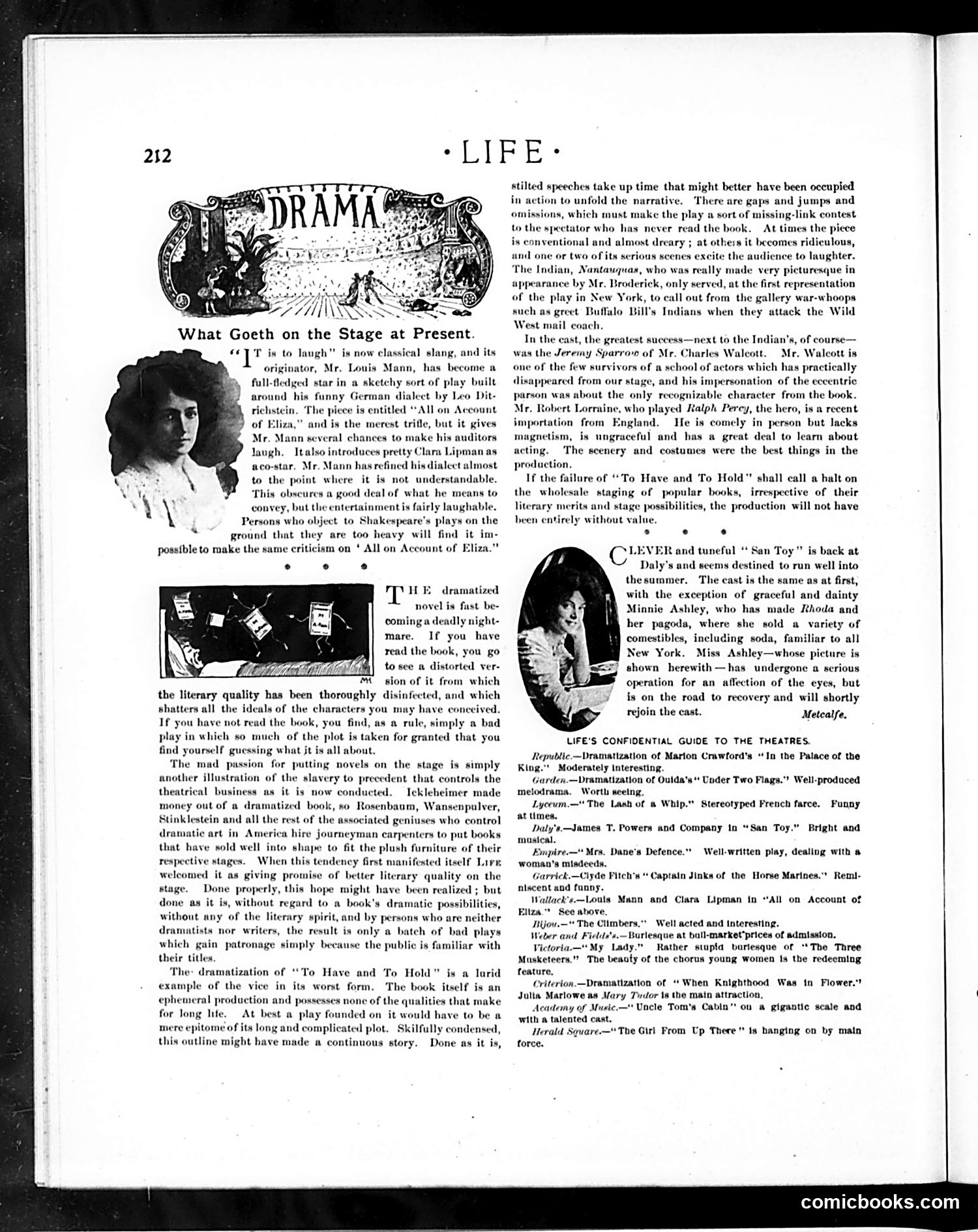
This is a theatrical criticism column reviewing recent stage productions. The main text critiques "To Have and To Hold," a play adapted from a novel, arguing that dramatizing books often fails because stage necessities clash with literary quality. The author (Louis Mann, per the text) contends the adaptation loses the novel's character depth and becomes a poorly constructed play. A photograph shows what appears to be a scene from the production featuring period costumes. The page includes "Life's Confidential Guide to the Theatres"—brief capsule reviews of current shows using satirical titles like "Stereotyped French farce" and "Well-written play, dealing with a woman's misdeeds." The satire targets the commercial practice of adapting successful novels into mediocre theatrical productions.
📄 Transcribed text from this page (OCR, searchable)
Machine-transcribed from the original scan — historical spelling and the odd misread are preserved.
* LIP E * a 777/\\ KS What Goeth on the Stage at Present. originator, Mr. Louis Mann, has become a full-fledged star in a sketchy sort of play built around his funny German dialect by Leo Dit- richstein. The is entitled “All on Account of Eliza,” and is the merest trifle, but it gives Mr. Mann several chances to make his auditors laugh. Italso introduces pretty Clara Lipman as aco-star. Mr. Mann has refined his dialect almost to the point where it is not understandable. This obscures a good deal of what he n convey, but the entertainments fairly laug Persons who object to Shakespeare's plays on the ground that they are too heavy will find it im- possible to make the same criticism on ‘ All on Account of Eliza.” (¢] 7 in to laugh” in now classical slang, and its HE dramatized novel is fust be- coming a deadly night- mare. If you have read the book, you go to see a distorted ver- sion of it from which the literary quality has been thoroughly disinfected, and which shatters all the ideals of the characters you may have conceived. If you have not read the book, you find, as a rule, simply a bad play in which so much of the plot is taken for granted that you find yourself guessing what jt is all about. ‘The mad passion for putting novels on the stage is simply another illustration of the slavery to precedent that controls the theatrical business as it is now conducted. Ickleheimer made money out of a dramatized book, so Rosenbaum, Wansenpulver, Stinklestein and all the rest of the associated geniuses who control dramatic art in America hire journeyman carpenters to put books that have sold well into shape to fit the plush furniture of their respective stages. When this tendency first manifested itself Lip welcomed it as giving promise of better literary quality on the stage. Done properly, this hope might have been realized ; but done as it is, without regard to a book's dramatic possibilities, without any of the literary spirit, and by persons who are neither dramatists nor write which g: their titles The dramatization of ‘To Have and To Hold" is a lurid example of the vice in its worst form. The book itself is an ephemeral production and possesses none of the qualities that make for long lite. At best a play founded on it would have to be a mere epitome of its long and complicated plot. Skilfully ¢ this outline might have made a continuous story. sult is only a batch of bad plays because the public is familiar with nsed, Done as it is, stilted speeches take up time that might better have been occupied in action to unfold the narrative. ‘There are gaps and jumps and omissions, which must make the play a sort of missing-link contest to the spectator who has never read the book. At times the piece is conventional and almost dreary ; at others it becomes ridiculous, and one or two of its serious scenes excite the audience The Indian, Nantauquas, who was really made very picturesque in appearance by Mr. Broderick, only served, at the first representation of the play in New York, to call out from the gallery war-whoops such as greet Buffalo Bill's Indians when they attack the Wild West mail coach. In the cast, the greatest success—next to the Indian's, of course— was the Jeremy Sparrow of Mr. Charles Walcott. Mr. Walcott is of the few survivors of a school of actors which has practically ppeared from our stage, and his impersonation of the eccentric parson was about the only recognizable character from the book. Mr. Robert Lorraine, who played Ralph Percy, the hero, is a recent importation from England. He is comely in person but lacks magnetism, is ungraceful and has a great deal to learn about acting. The scenery and costumes were the best things in the production. If the failure of “To Have and To Hold” shall call a halt on the wholesale staging of popular books, irrespective of their li its and stage possibilities, the production will not have been entirely without value. . ° . LEVER and tuneful “‘ San Toy” is back at Daly's and seems destined to run well into thesummer. The cast is the same as at first, with the exception of graceful and dainty Minnie Ashley, who has made Ihoda and her pagoda, where she sold a variety of comestibles, including soda, familiar to all New York. Miss Ashley—whose picture is shown herewith —has undergone a scrious operation for an affection of the eyes, but is on the road to recovery and will shortly rejoin the cast. Metcalfe. LIFE'S CONFIDENTIAL GUIDE TO THE THEATRES. Republic-—Vramatization of Marion Crawford's “In the Palace of the King." Moderately interesting. Garden.—Dramatization of Oulda's Under Two Flags." Well-produced melodrama, Worth seeing, Lyceum.—"The Lash of « Whip. at times, Daly's —James T. Powers and Company in “San Toy.” musical. Empire—* Mra. Dane's Defence. woman's misdeeds. Garrick.—Ciyde Fitch's * Captain Jinks of the Horse Marines." Reml- niscent and funny. Wallack’s—Louts Mann and Clara Lipman in “All on Account of Ellza.* See above. RYou.—" The Climbers," Well acted and interesting. Weber and Fiells's,—Burlesque at ball-market*prices of admission, Vietoria.—"My Lady.” Rather stupid burtesque of “The Three Musketeers.” The beauty of the chorus young women 1s the redeeming feature, Criterion. —Dramatization of When Knighthood Was in Flower.” Julia Marlowe as Mary Tudor ts the main attraction, Academy of Music.—" Uncle Tom's Cabin” ou a gigantic scale and with a talented cast. Herald Square-—"The Giri From Up There” ts hanging on by main force. Stereotyped French farce. Funny Bright and Well-written play, dealing with » comicbooks.com