
A complete issue · 20 pages · 1901
Life — February 28, 1901
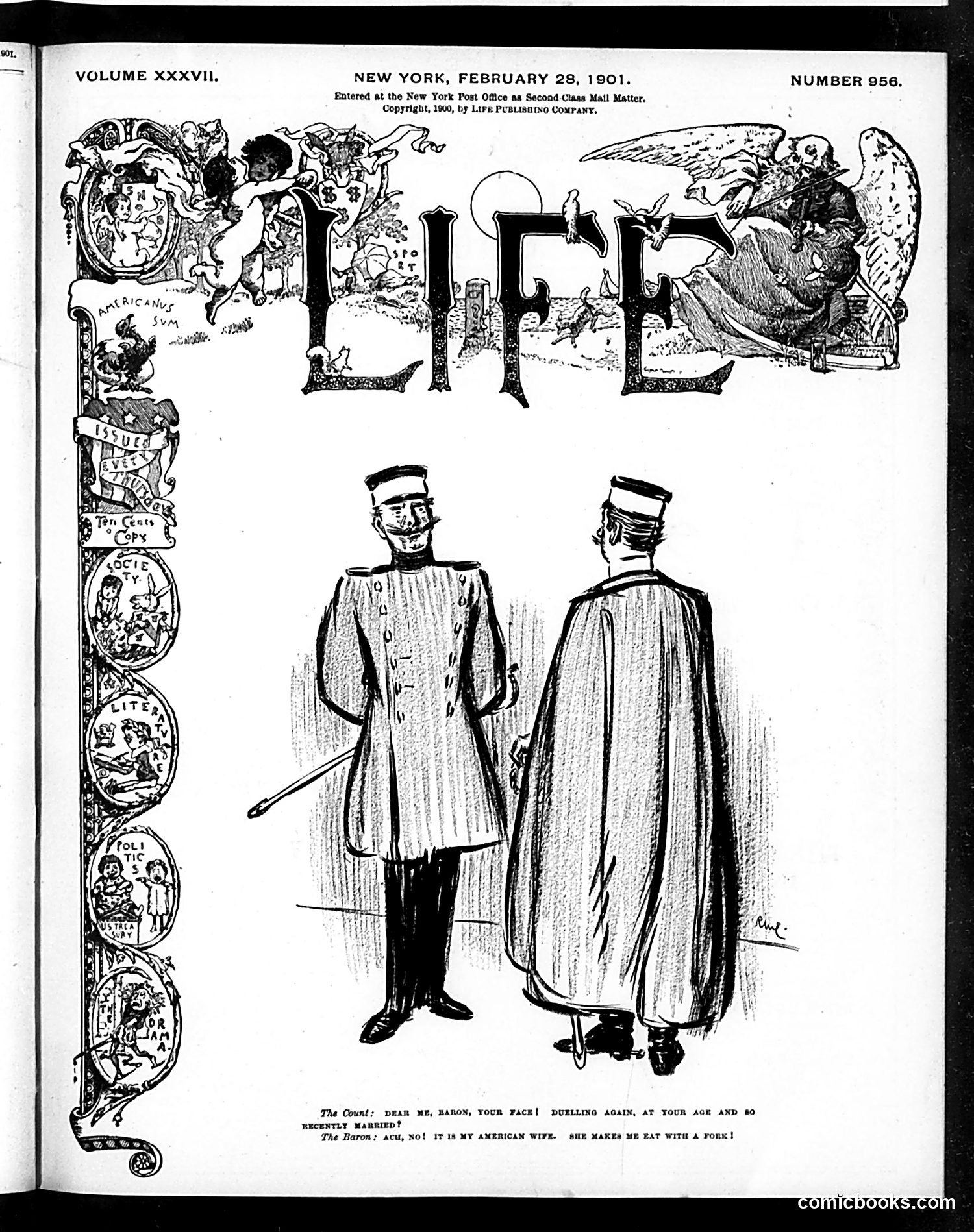
This cartoon satirizes international marriage customs, specifically the clash between European aristocratic traditions and American practices. Two military officers in formal dress appear to be dueling or discussing a duel scenario. The dialogue reveals the joke: a European Baron has married an American woman and is scandalized that she uses a fork while eating—apparently expecting different dining etiquette. The Baron proposes a duel over this breach of aristocratic propriety ("Your face! Dueling again, at your age and so recently married?"). The satire mocks both European pretentiousness about rigid social conventions and the contrast with more casual American habits. It reflects early 1900s American attitudes about the superiority of American practical customs over stuffy European formality, presented humorously through the absurdity of dueling over table manners.
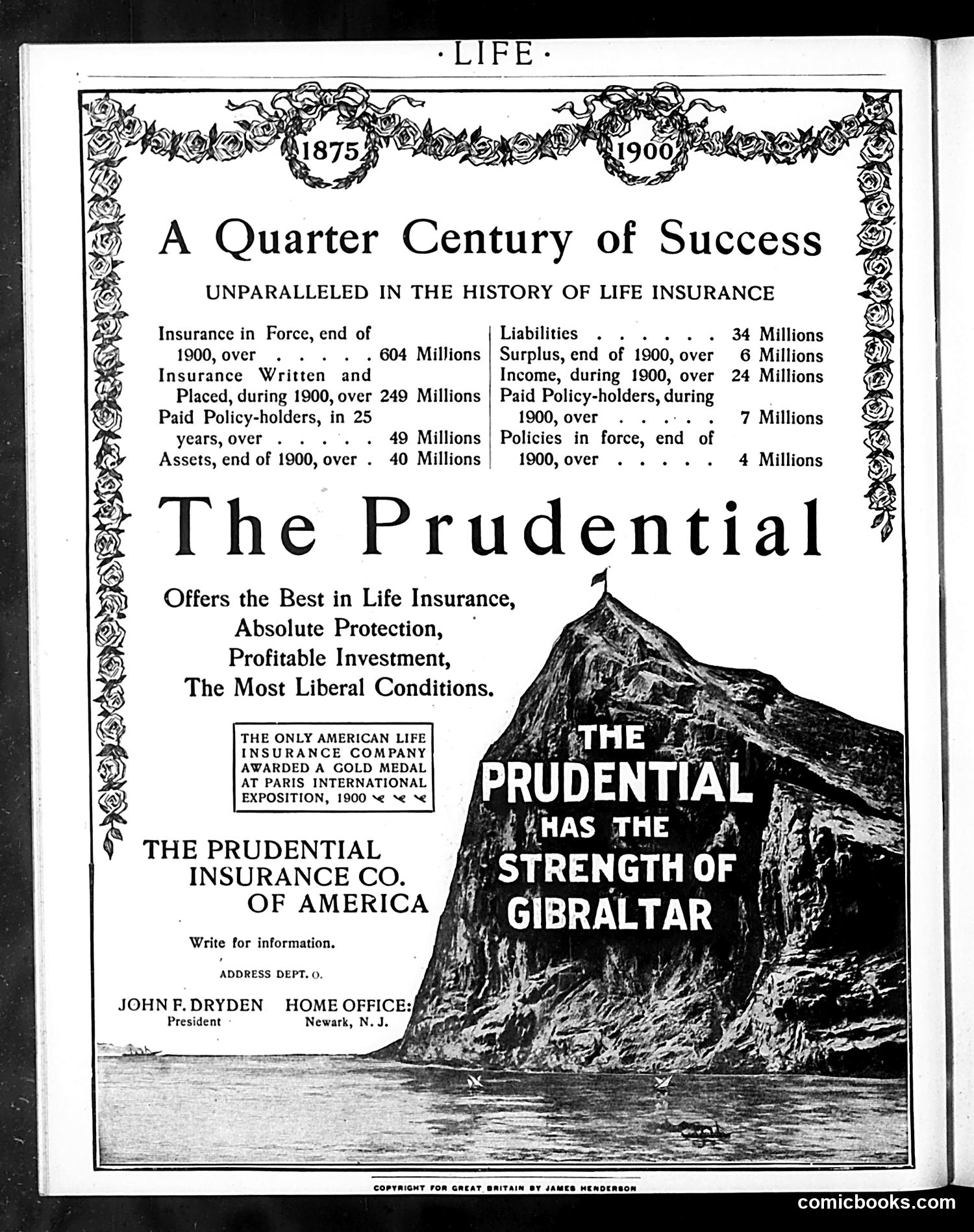
This page is primarily **advertising, not satire or political commentary**. It's a full-page advertisement for The Prudential Insurance Company of America, celebrating their business success from 1875-1900. The ad emphasizes financial stability through dramatic imagery—the Rock of Gibraltar—to suggest the company's unshakeable strength. The text boasts impressive statistics: over 604 million dollars in force, 249 million written in 1900, and substantial assets and surplus. The only noteworthy claim is a small box stating Prudential was "the only American life insurance company awarded a gold medal at Paris International Exposition, 1900." This represents early corporate image-building through Life magazine's respected platform. The Gibraltar metaphor was common insurance marketing—conveying permanence and reliability to potential customers.
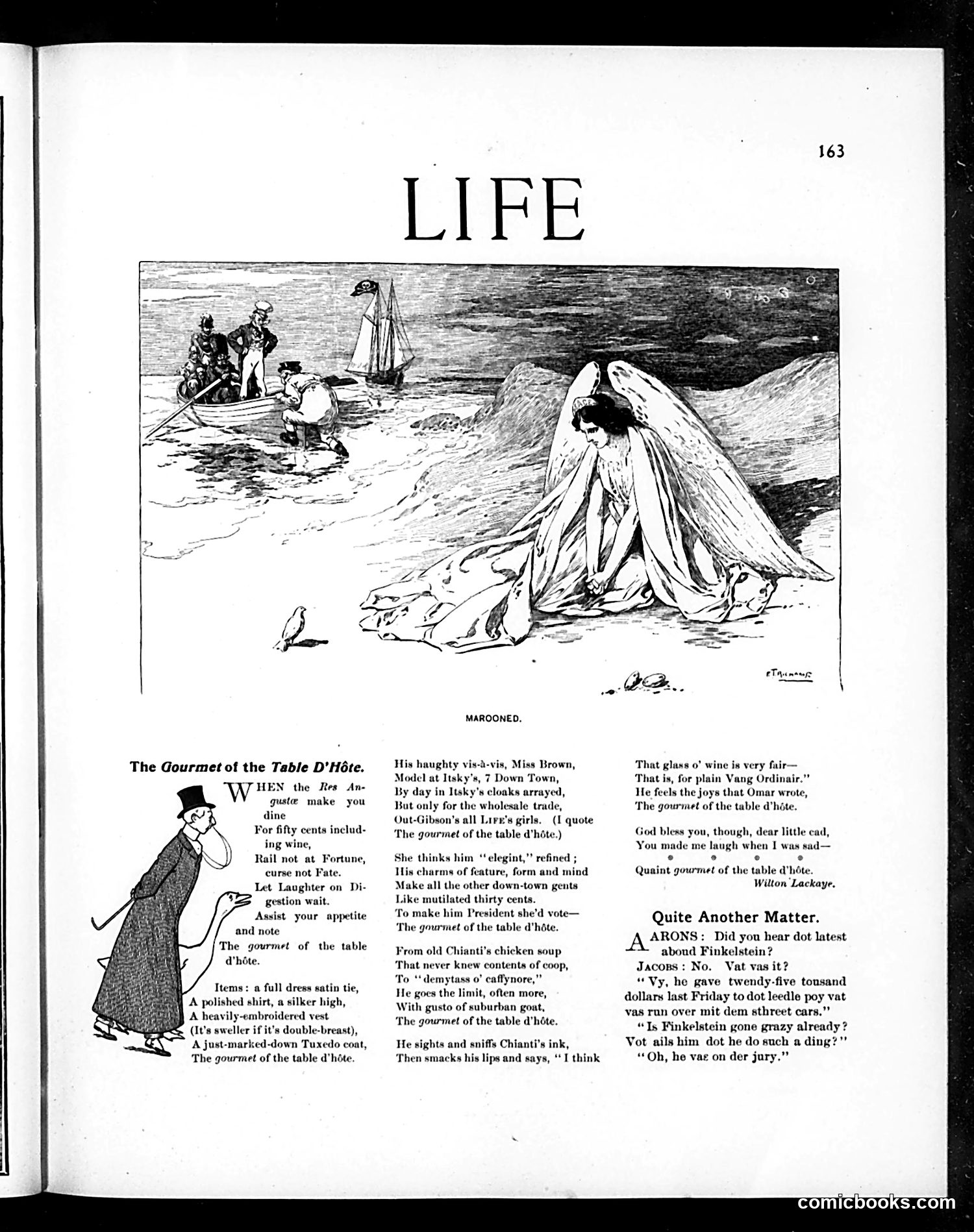
**Main Illustration**: "Marooned" depicts a woman in classical drapery stranded on a beach, watching a boat depart with sailors. The allegorical image suggests abandonment or being left behind. **"The Gourmet of the Table D'Hôte"**: A satirical poem about a well-dressed man dining at a fixed-price restaurant. The piece mocks pretentious dining culture—his refined tastes clash with cheap fare (chicken soup, suburban goat). The accompanying caricature shows a snobbish gentleman, likely ridiculing affectation among middle-class diners who adopt aristocratic airs while eating modest food. **"Quite Another Matter"**: A brief comic dialogue between Aarons and Jacob about Finkelstein, with an ethnic joke about financial irresponsibility and jury duty. The page targets class pretension and ethnic stereotypes typical of early 20th-century American satire.
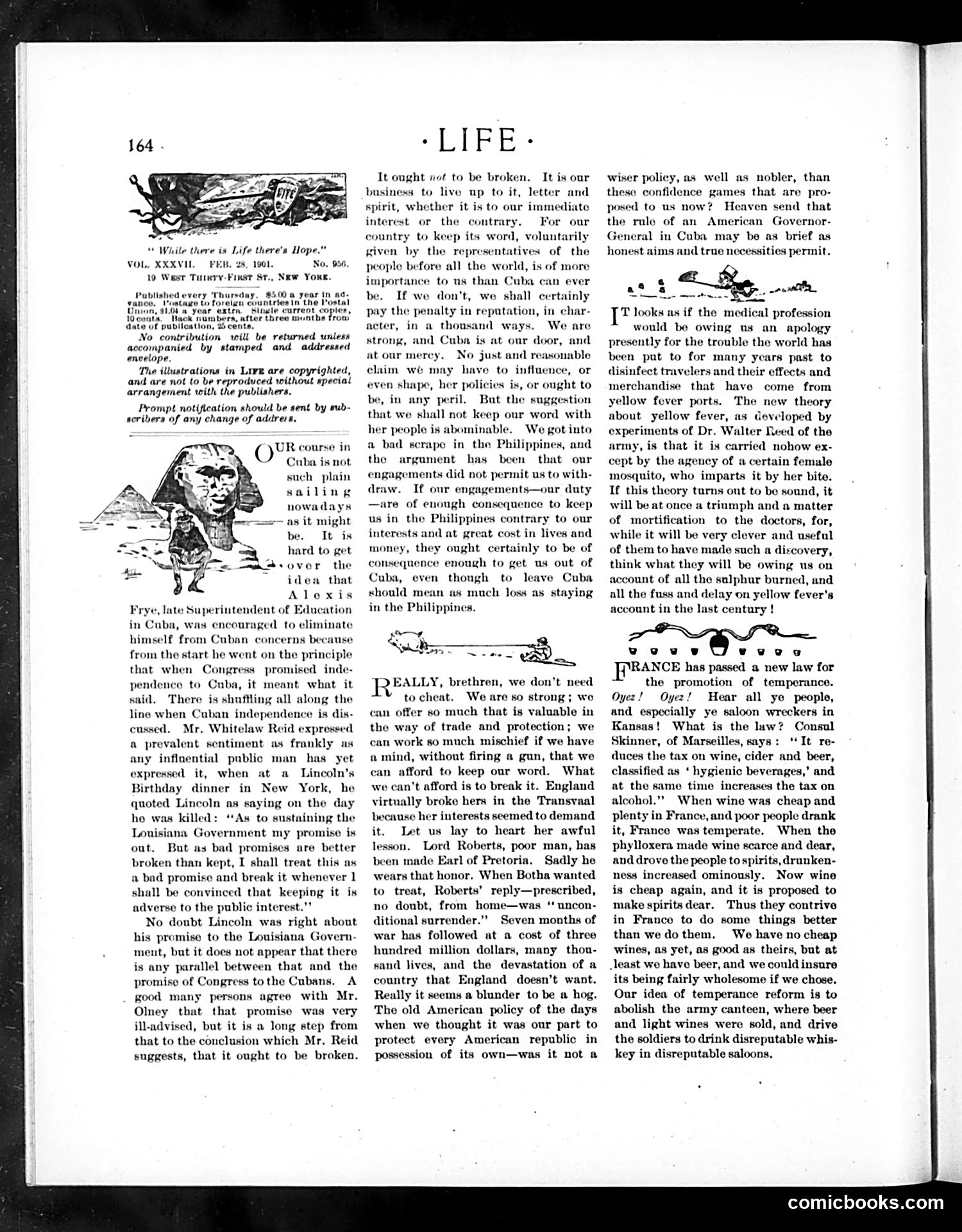
This page contains political commentary on American foreign policy, specifically debating whether the U.S. should maintain its involvement in Cuba and the Philippines. The left illustration shows a caricatured figure labeled as relating to Cuba policy debates. The text argues against breaking America's word to Cuba, citing honor and reputation while acknowledging the costly nature of such commitments. The right section discusses yellow fever research, appearing to reference Dr. Walter Reed's experiments with mosquito transmission of the disease. The bottom section satirizes temperance reform efforts, mocking Kansas's prohibition laws and their unintended consequences—creating more sophisticated drinking in saloons while increasing taxes on alcohol. The overall tone criticizes inconsistent American policies and their practical failures.
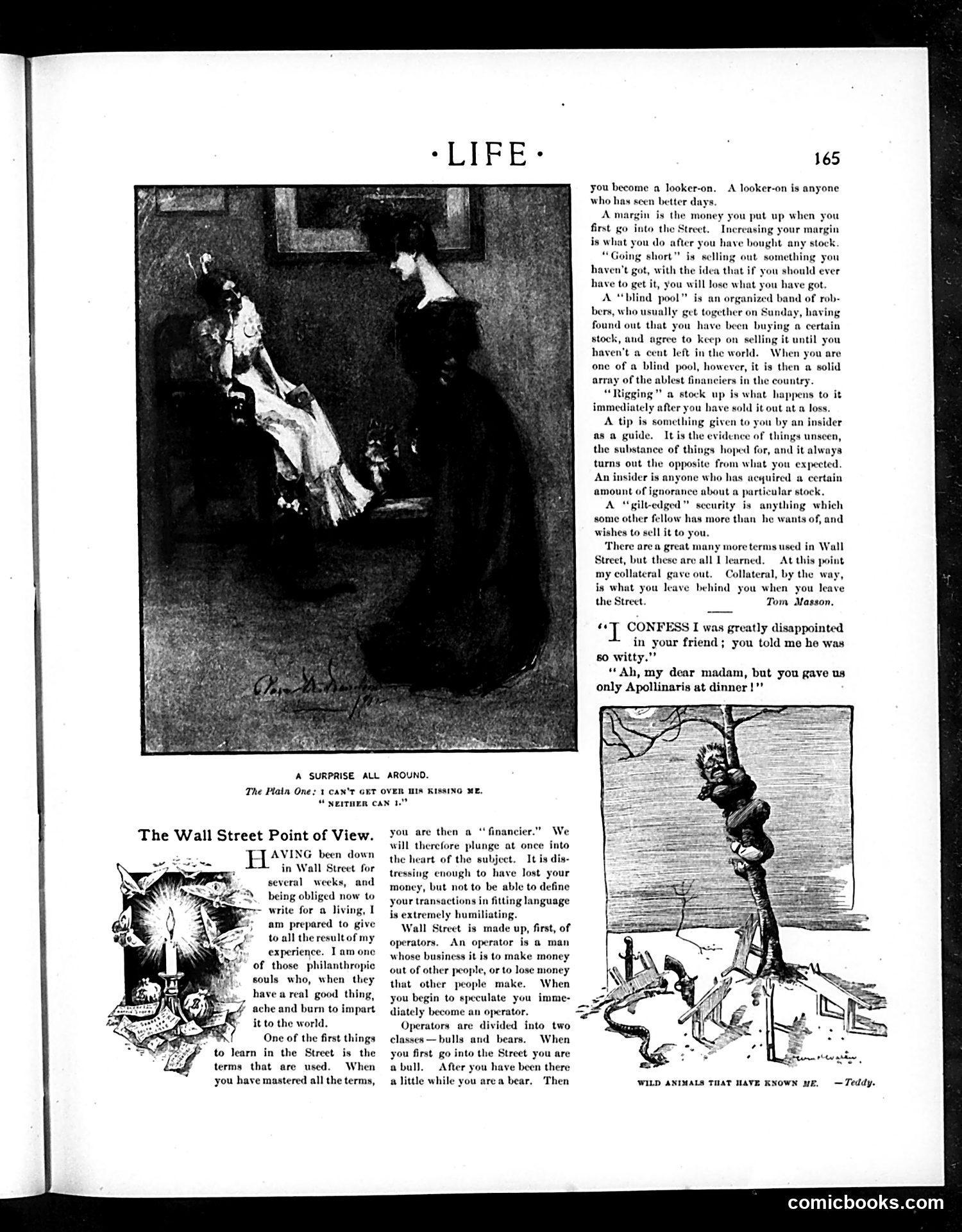
This page satirizes **Wall Street financial terminology and practices**. The main article, "The Wall Street Point of View," explains jargon to uninitiated readers—terms like "operator," "bull," "bear," "margin," "going short," "blind pool," "rigging," and "tip." The large illustration captioned "A Surprise All Around" appears to depict a domestic scene, likely satirizing how Wall Street speculation affects home life—the caption suggests romantic disappointment ("I can't get over his kissing me"). The smaller cartoon "Wild Animals That Have Known He" shows creatures in a natural setting, likely satirizing Wall Street operators as dangerous predators or wild animals. The overall thrust: Life ridicules Wall Street's opaque language and predatory financial culture, making it comprehensible (and contemptible) to ordinary Americans.
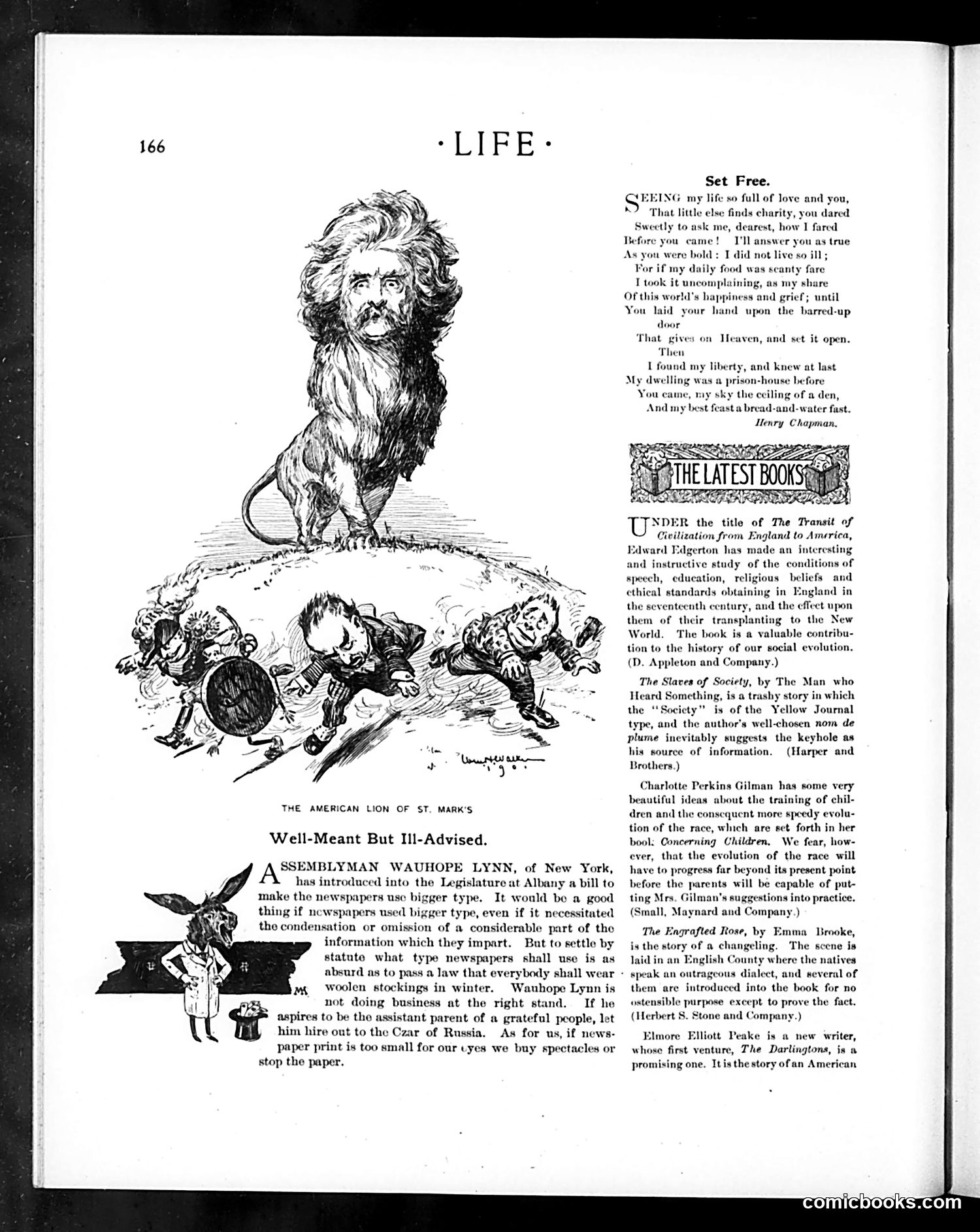
This satirical piece mocks Assemblyman Wauhope Lynn of New York, who introduced a bill requiring newspapers to use larger typeface. The cartoon depicts Lynn as "The American Lion of St. Mark's"—an ironic title suggesting grandiose pretension. The satire criticizes his proposal as well-intentioned but misguided. The editors argue that while larger type might help readers, it would waste newspaper space and increase costs unnecessarily. They suggest Lynn, despite good intentions, doesn't understand practical newspaper economics. The caricature with exaggerated features and the "lion" metaphor mock his self-importance regarding what the editors consider a minor, impractical legislative proposal.
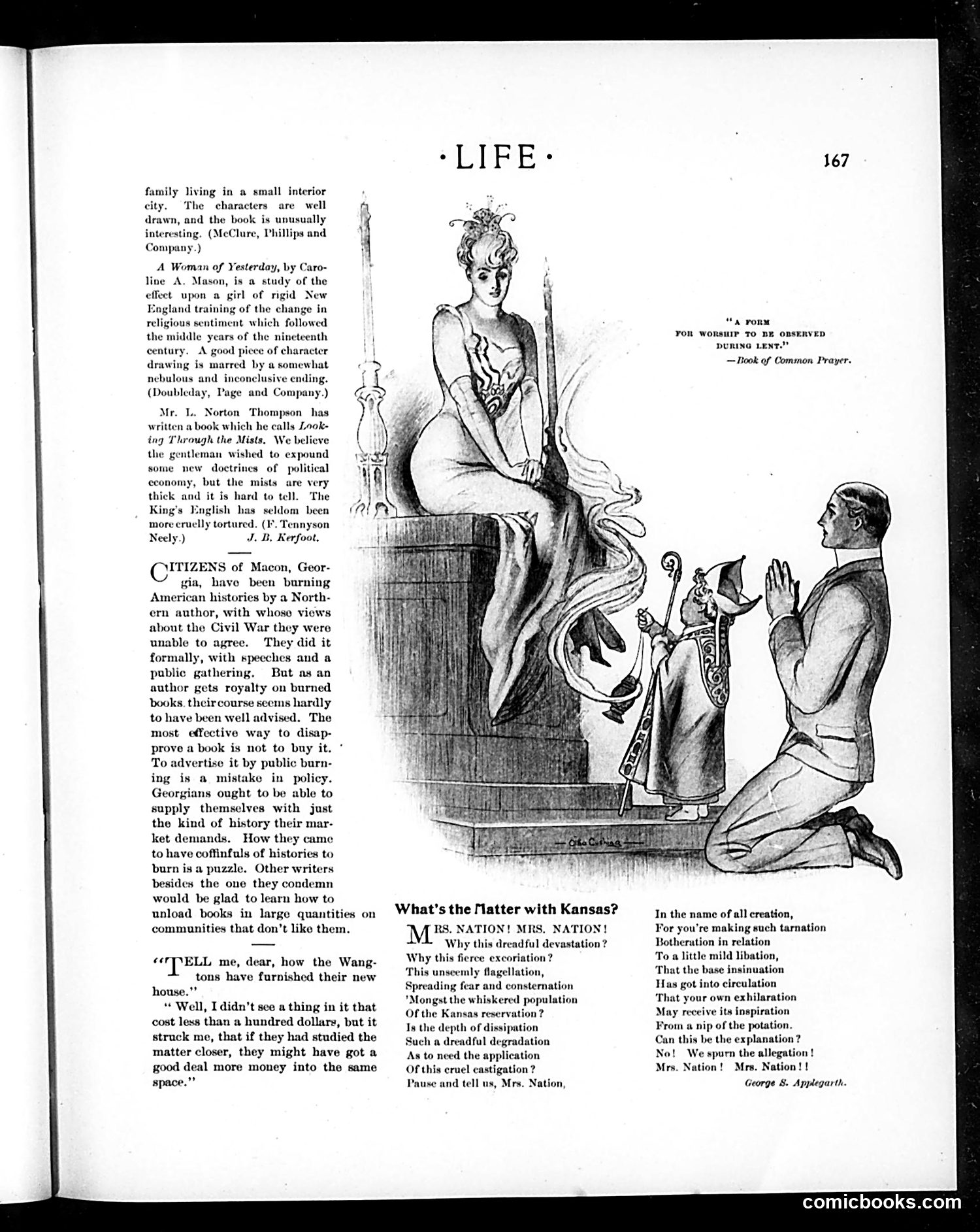
This page contains a satirical poem titled "What's the Matter with Kansas?" by George S. Ade. The accompanying illustration depicts a woman (representing Kansas) seated on a pedestal, appearing distressed or agitated, while a man kneels before her in a pleading or apologetic posture. The poem addresses Kansas as "Mrs. Nation," likely referencing Carrie Nation, the famous temperance activist and Kansas resident known for her militant anti-alcohol campaigns. The satire criticizes the "dreadful devastation" and "fierce execration" afflicting Kansas, suggesting the state's upheaval stems from Nation's prohibitionist crusade and its social consequences. The cartoon mocks both the activist and Kansas's turmoil through this personified, dramatic confrontation.
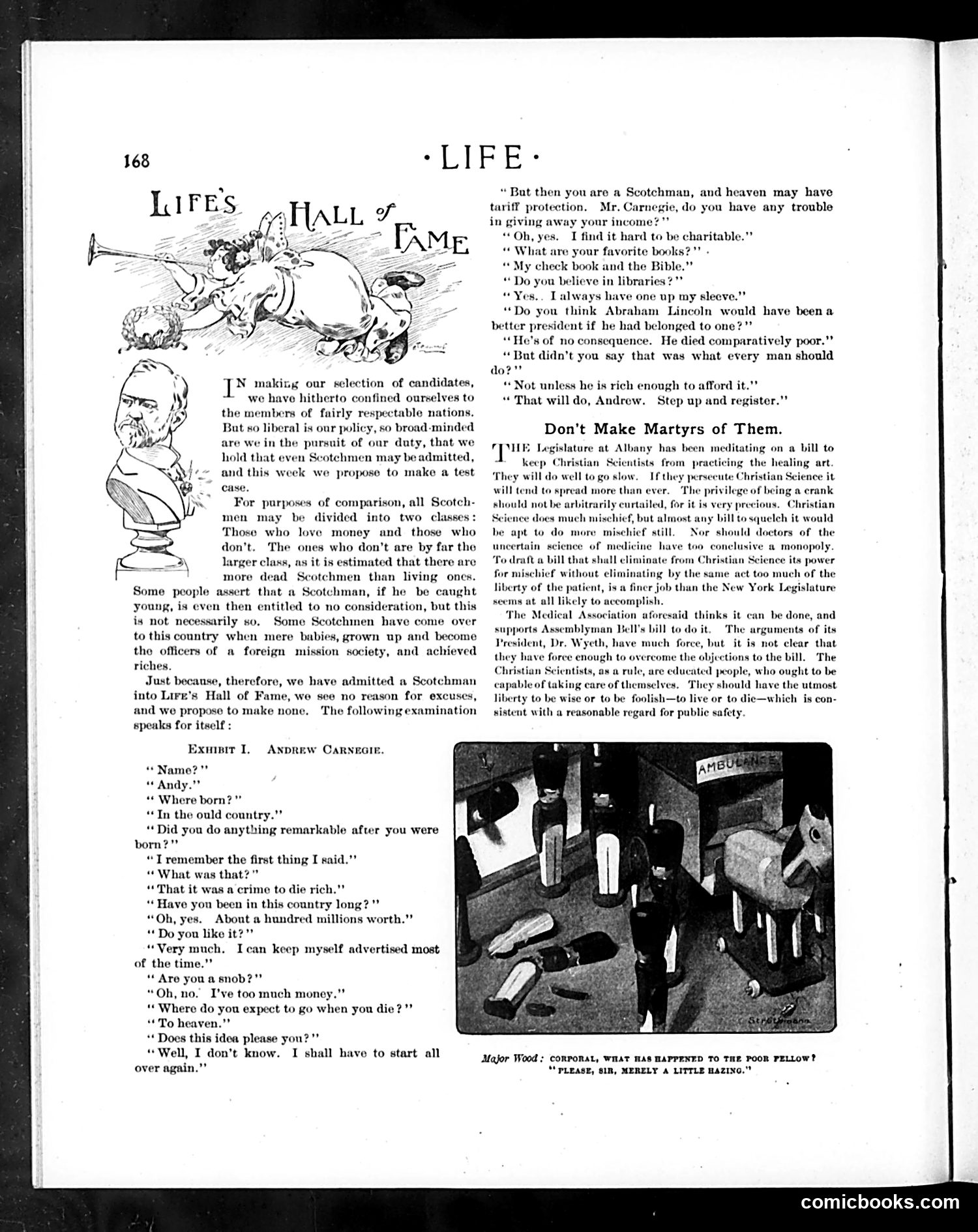
This page satirizes Andrew Carnegie's admission to Life's "Hall of Fame" despite being Scottish. The left side features a bust of Carnegie with text questioning whether wealthy Scottish immigrants should be considered respectable candidates for such honor. The accompanying "Examination" mocks Carnegie through a Q&A format, using his own stated philosophy against him—particularly his famous claim that "it was a crime to die rich," yet he accumulated vast wealth. The lower photograph shows what appears to be a medical or charitable scene, captioned with a joke about a "corporal" and "poor fellow," likely continuing commentary on Carnegie's wealth and philanthropic practices. The overall satire critiques the tension between Carnegie's professed ideals about wealth distribution and his actual accumulation of enormous fortune.
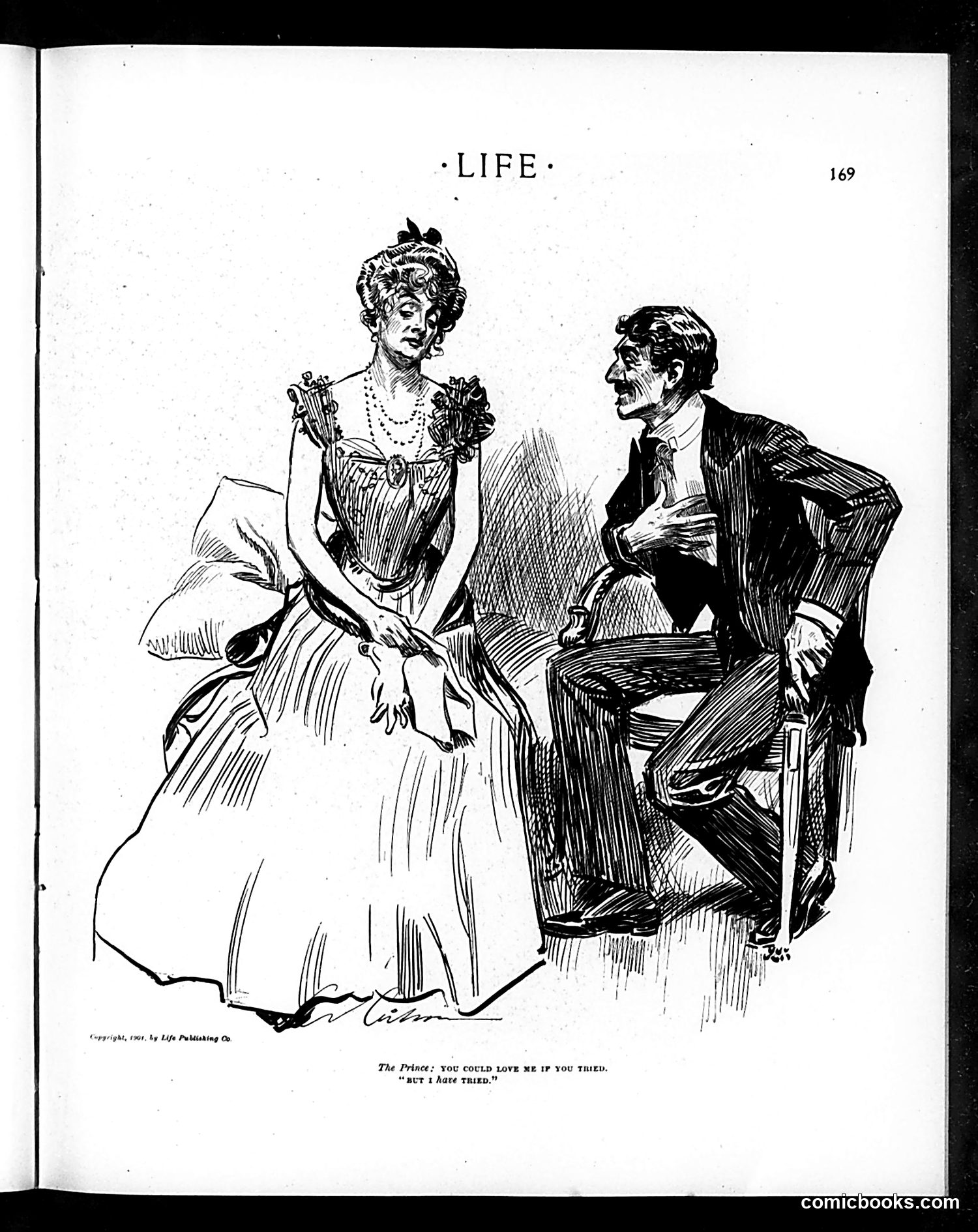
This is a satirical cartoon depicting a social interaction between a well-dressed man and an elegant woman. The caption reads: "The Prince: you could love me if you tried. 'But I hate tried.'" The humor relies on a play on words—the woman refuses the man's romantic advances by claiming to "hate tried" (past tense of try), rather than stating she dislikes *trying*. This linguistic joke suggests the woman is being deliberately obtuse or playfully evasive about his romantic proposal. The illustration shows typical early-20th-century upper-class fashion and deportment. The "Prince" reference likely indicates this depicts courtship among aristocratic or wealthy figures, making the absurdist wordplay a commentary on romantic conventions and the games played in high-society courtship.
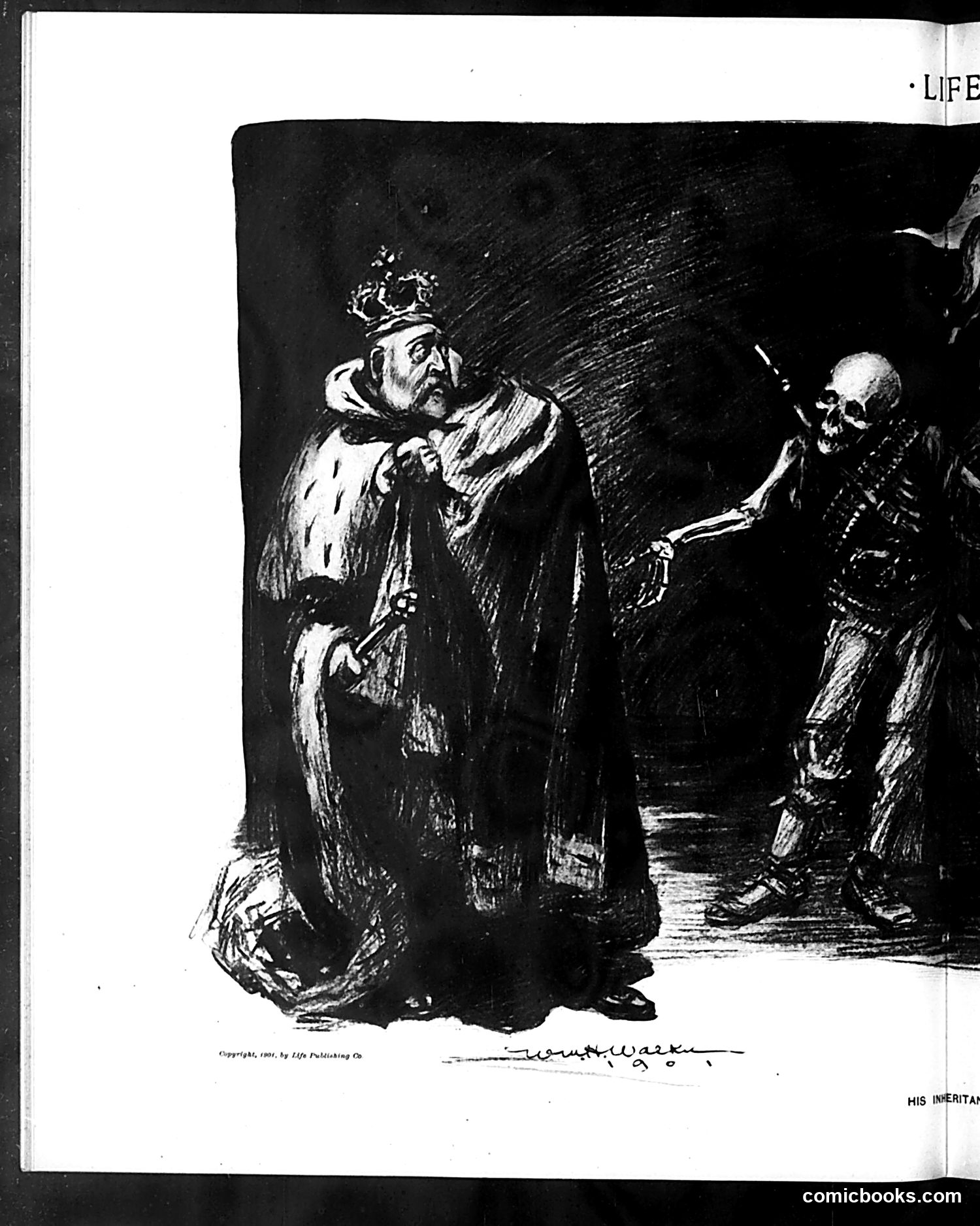
This is a satirical illustration signed by what appears to be "Norman Walker" (1901), published in Life magazine. The image depicts a crowned, robed figure (representing a king or monarch) confronted by a skeletal Death figure holding an hourglass—a classic "Danse Macabre" motif. The satire likely comments on **mortality and human vanity**: despite royal regalia, wealth, and power symbolized by the crown and ermine-trimmed robes, Death comes for everyone equally. This reflects turn-of-the-century satirical themes questioning aristocratic privilege and the ultimate futility of worldly status. The specific historical reference remains unclear without additional context or accompanying text, but the visual message is timeless: death is democracy's great equalizer.
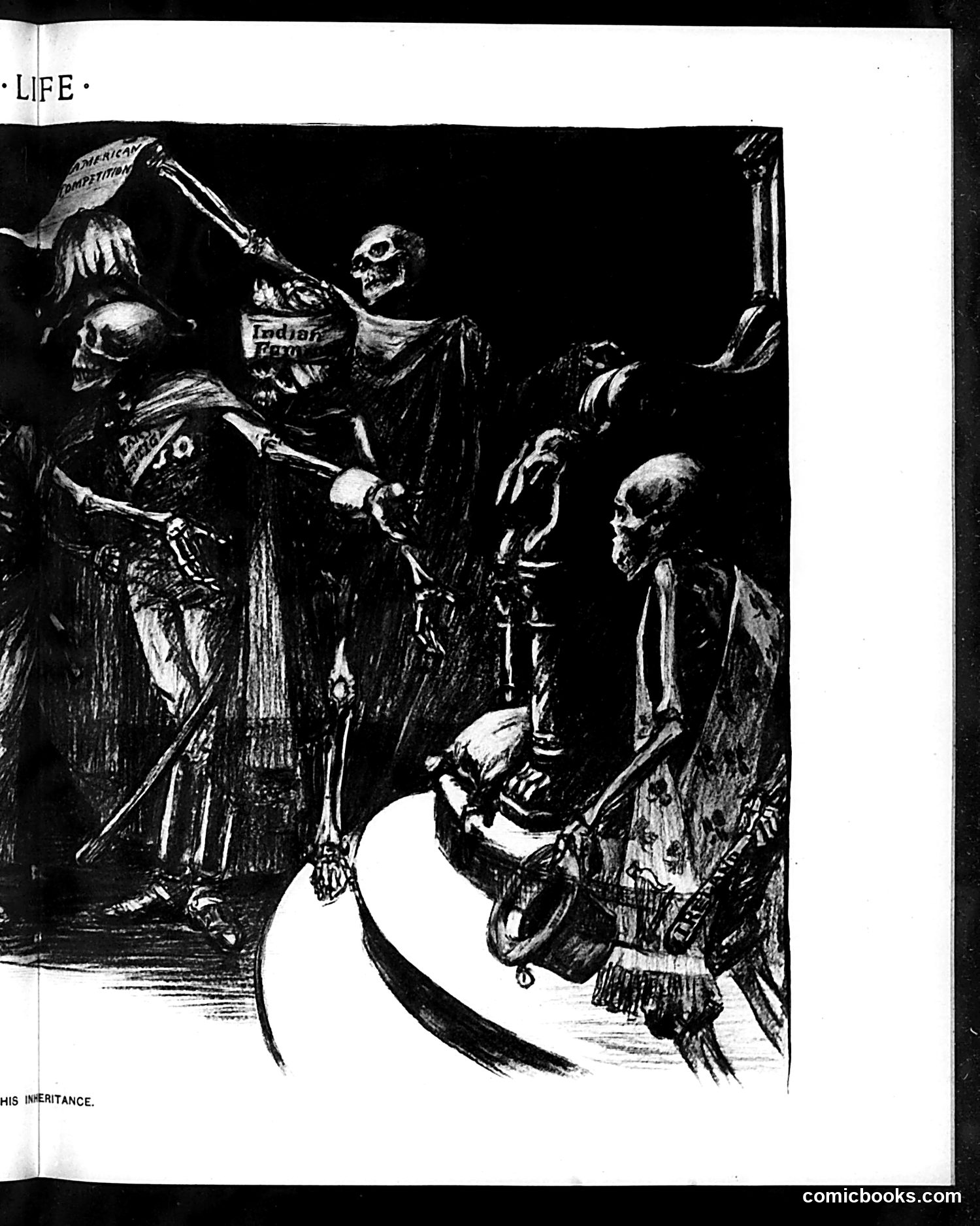
This satirical cartoon from *Life* magazine depicts skeletal figures representing Death and destruction confronting what appears to be a figure labeled "His Inheritance" (visible at bottom). The imagery is dark and memento mori in style, suggesting a commentary on legacy or succession passing to a new generation. The skull-faced figures wearing military dress and regalia likely represent war, militarism, or corrupt leadership. The prominent "American Competition" label visible on one figure suggests critique of American industrial or political practices. The central point appears to be sardonic commentary on what a heir or successor inherits—not wealth or honor, but death, destruction, and moral decay. Without knowing the specific date, the exact political targets remain unclear, though the anti-war or anti-corruption message is evident.
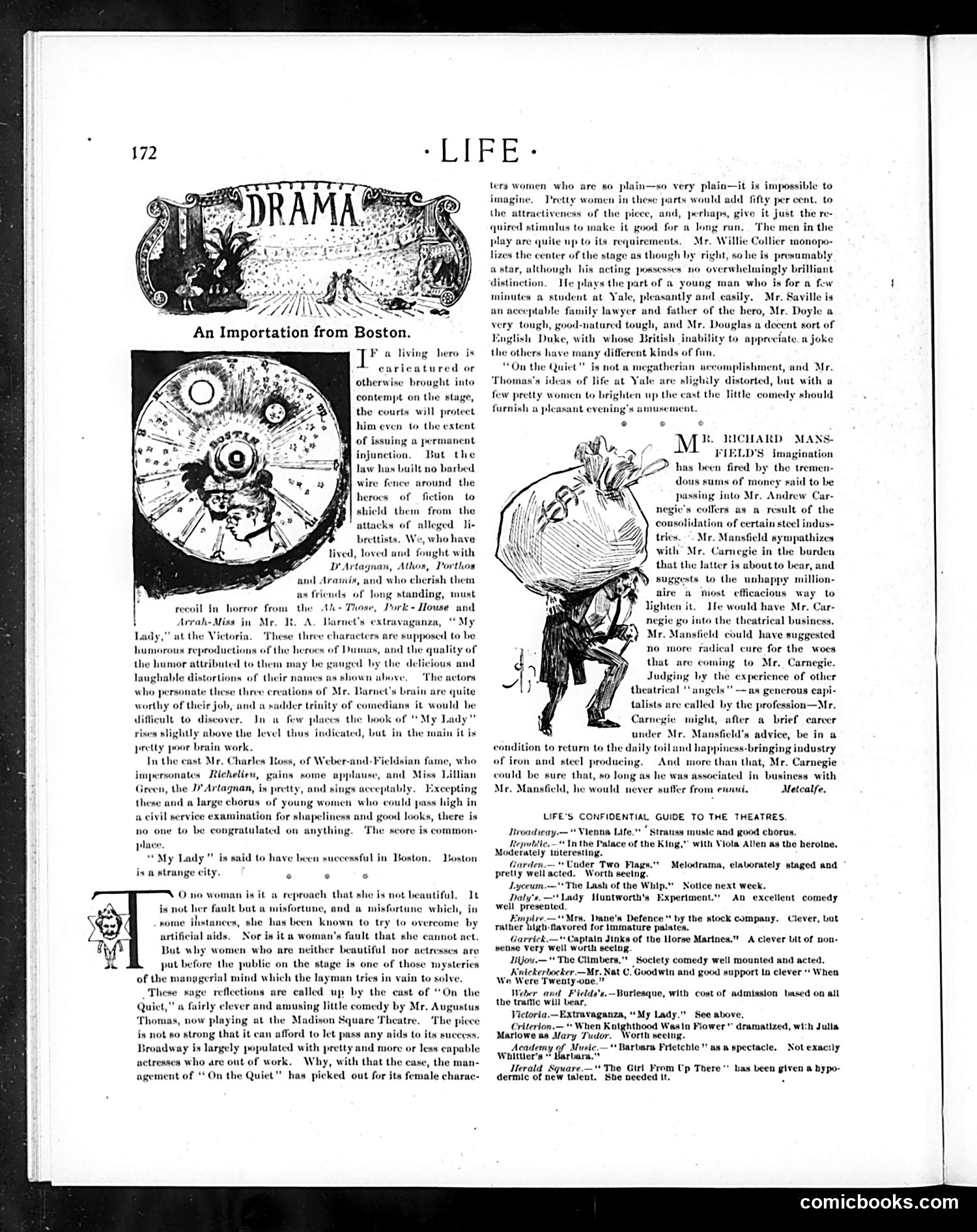
This page reviews theatrical productions, with particular focus on "An Importation from Boston." The main illustration depicts a large circular mechanical device—likely a theatrical set piece or prop—shown in detailed cross-section. The text critiques the play's cast and plot, mentioning characters like a Yale student and a lawyer. The reviewer notes that the dialogue and situations, though derived from established comedies (*Ariadne*, *Aladdin*, *Pork-House*), are executed competently by the actors. A secondary illustration shows a caricatured figure in an exaggerated pose, though the specific person satirized is unclear from context. The bottom section provides "Life's Confidential Guide to the Theatres," listing brief reviews of various productions, including *Melodia*, *The Lash of the Whip*, and others—typical theatrical coverage for a satirical magazine of this era.
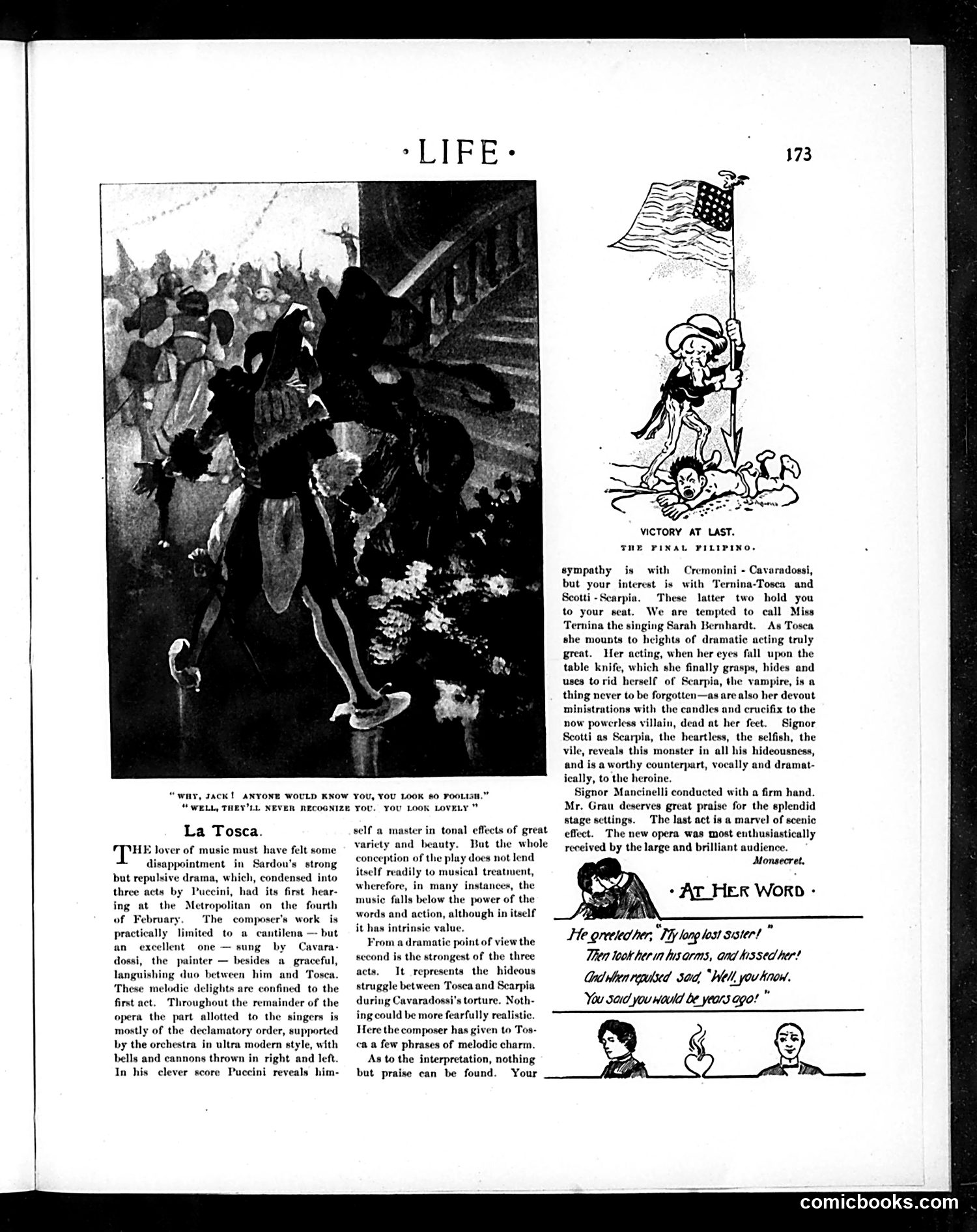
This page reviews Puccini's opera *La Tosca* at the Metropolitan Opera (premiere noted as February 4th). The large left image depicts a dramatic scene from the opera—likely Tosca's confrontation with Scarpia, the villain she ultimately kills. The dialogue caption quotes the opera's plot: a character warns another they look foolish and will be recognized, establishing the opera's themes of disguise and danger. The smaller right cartoon, "Victory at Last: The Final Filipino," appears to reference American colonial politics, likely satirizing U.S. involvement in the Philippines. The figure holding an American flag celebrates over defeated enemies—a commentary on military conquest presented as patriotic triumph. The bottom section "At Her Word" shows a domestic comedy: a man reunites with his "long lost sister," embraces and kisses her, only for her to remind him of an old promise he'd forgotten. The satire mocks male forgetfulness in romantic/marital obligations.
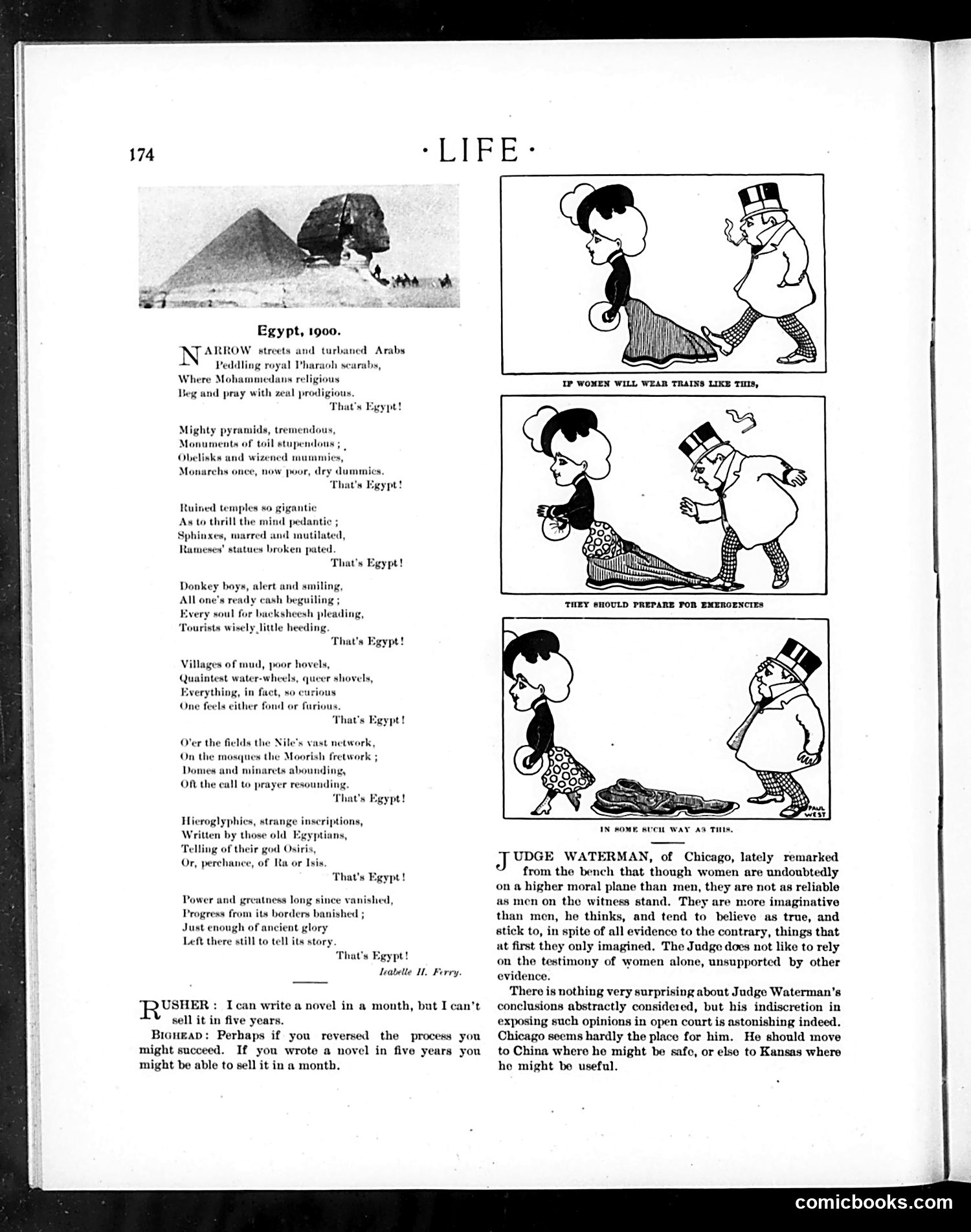
**The Egypt Poem:** Isabella H. Ferry's verses satirize American tourists' romanticized views of Egypt (circa 1900). The poem lists Egypt's famous attractions—pyramids, sphinxes, Nile networks—alongside the harsh reality: poverty, begging, decay, and lost glory. The repeated refrain "That's Egypt!" mocks the gap between tourist fantasy and grim reality. **The Three Cartoons:** These depict a woman and a man in a top hat preparing for travel. The captions suggest women should outfit themselves practically ("trains like this," "prepare for emergencies") rather than fashionably—satirizing women's impractical Victorian dress for travel. **Judge Waterman Editorial:** The piece mocks Chicago Judge Waterman's recent courtroom remarks that women are morally superior but unreliable witnesses due to imagination and susceptibility to false beliefs. The editorial ridicules his indiscretion in stating such views publicly, sarcastically suggesting he move to China or Kansas where such opinions might be "useful"—implying those places are backward.
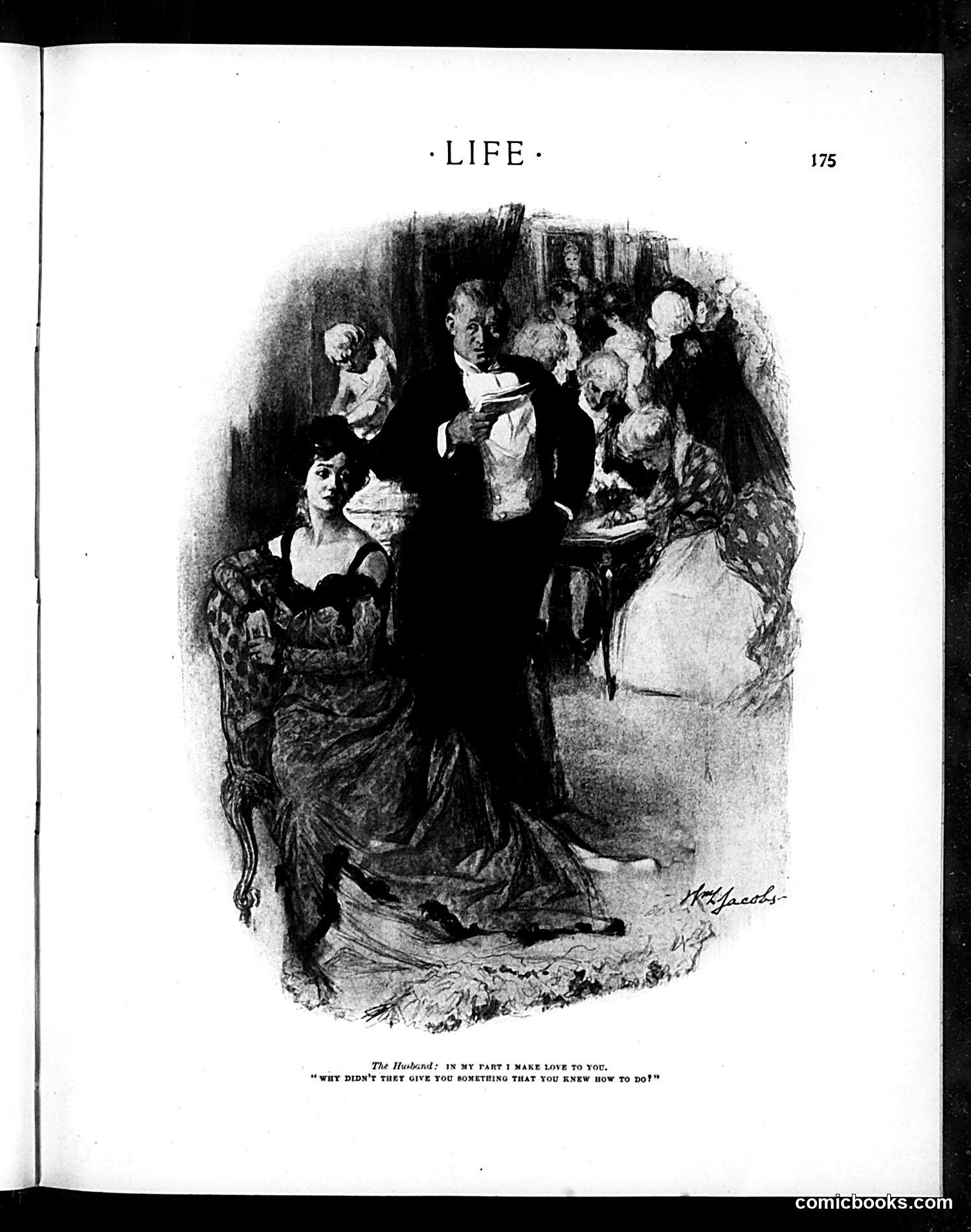
This is a satirical domestic scene from *Life* magazine depicting a marital dispute. A man in formal dress holds papers (likely a theatrical script or musical score), while a woman in elegant dress confronts him with visible frustration. The caption reveals the joke's critique: the husband claims he fulfills his marital duty by "making love," yet the wife sarcastically asks why he wasn't given "something that you knew how to do?" The humor targets masculine incompetence in intimate matters—a common trope in early 20th-century satire mocking men's sexual or romantic inadequacy. The formal setting and theatrical props suggest this may also reference amateur dramatics or social performance, adding layers to the critique of male pretense versus actual capability.
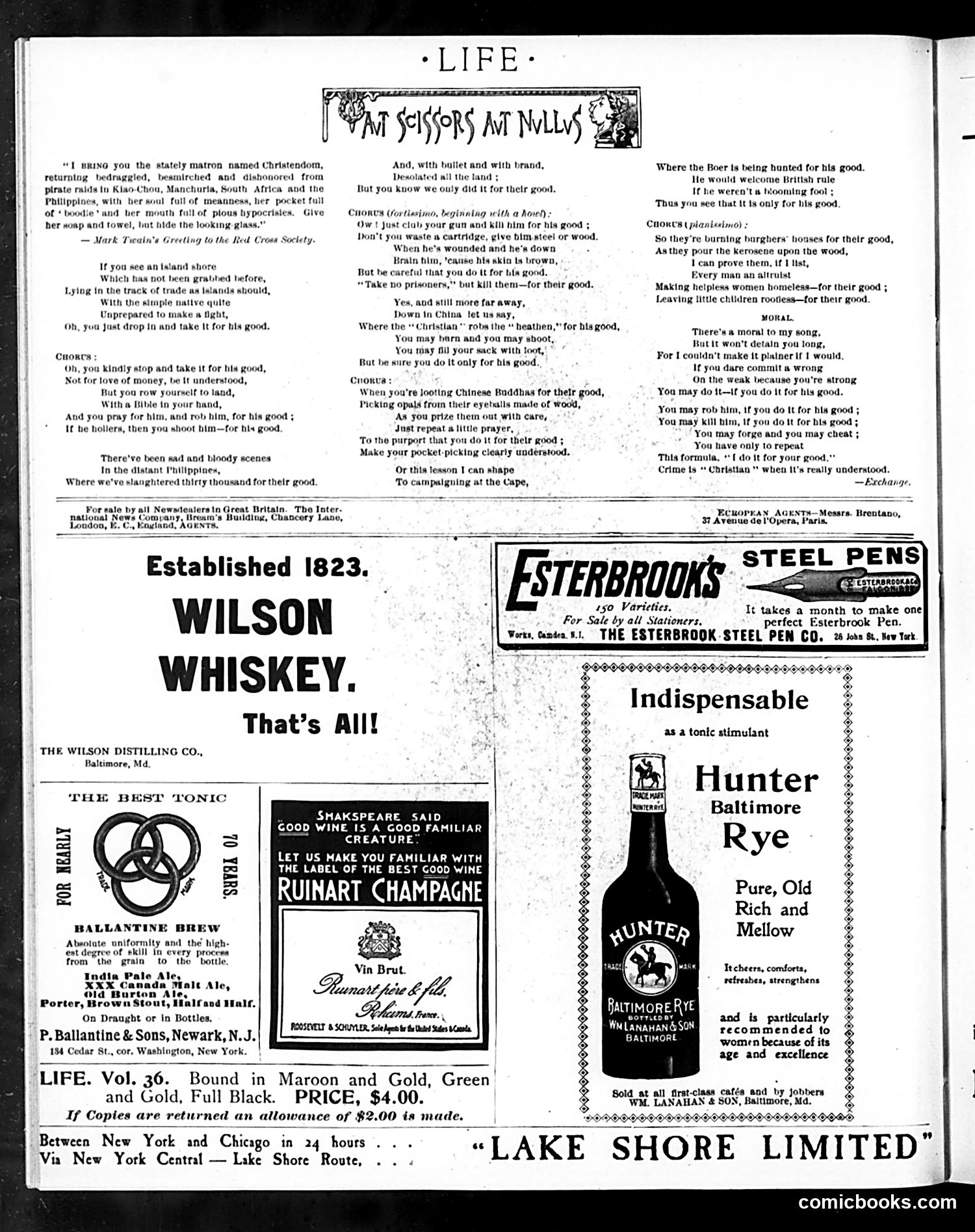
This is a satirical song, likely by Mark Twain (quoted at top), attacking European and American imperial expansion under the guise of "civilizing" conquest. The title references colonial land-grabbing ("scissors"—cutting territory). The song mocks the rhetorical justification of violent colonialism across multiple regions: the Philippines, China (Boxer Rebellion era), and the Boer War in South Africa. Each verse catalogs atrocities—massacre, arson, looting, religious desecration—while the chorus repeats the hypocritical refrain "for their good." The satire's sting lies in exposing how Western powers framed brutal imperialism as benevolent missionary work. The closing "moral" crystallizes the critique: call any crime "Christian" and it becomes justified. The opening Mark Twain epigraph about Christendom returning "bedraggled" and "dishonored" with "pious hypocrisies" frames this as anti-imperialist commentary contemporary to these conflicts (early 1900s). This is primarily satirical text; no political cartoons appear on this page.
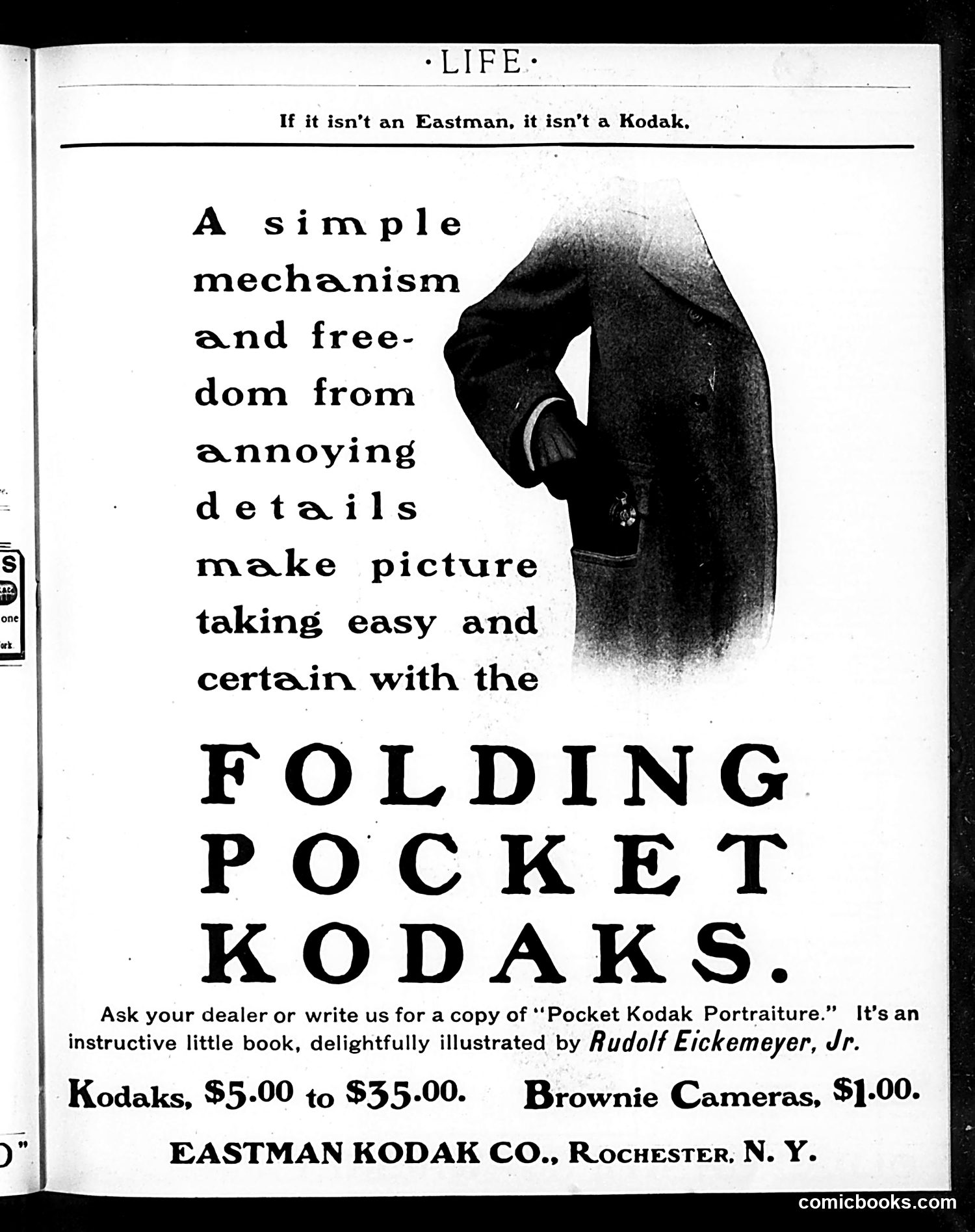
This is a **Kodak camera advertisement**, not political satire. The page promotes Eastman Kodak's "Folding Pocket Kodaks" by emphasizing their user-friendly design. The image shows a woman in early 20th-century dress holding a folding camera to her face, demonstrating ease of use. The advertisement's main pitch is that Kodak cameras require "a simple mechanism and freedom from annoying details"—meaning they're designed for ordinary people, not just professionals. The tagline "If it isn't an Eastman, it isn't a Kodak" is a corporate slogan asserting Kodak's market dominance. Prices range from $5 to $35; Brownie cameras cost $1. The ad references an instructional booklet illustrated by photographer Rudolf Eickemeyer Jr., lending artistic credibility. This represents early consumer marketing—positioning photography as accessible to amateurs, particularly women.
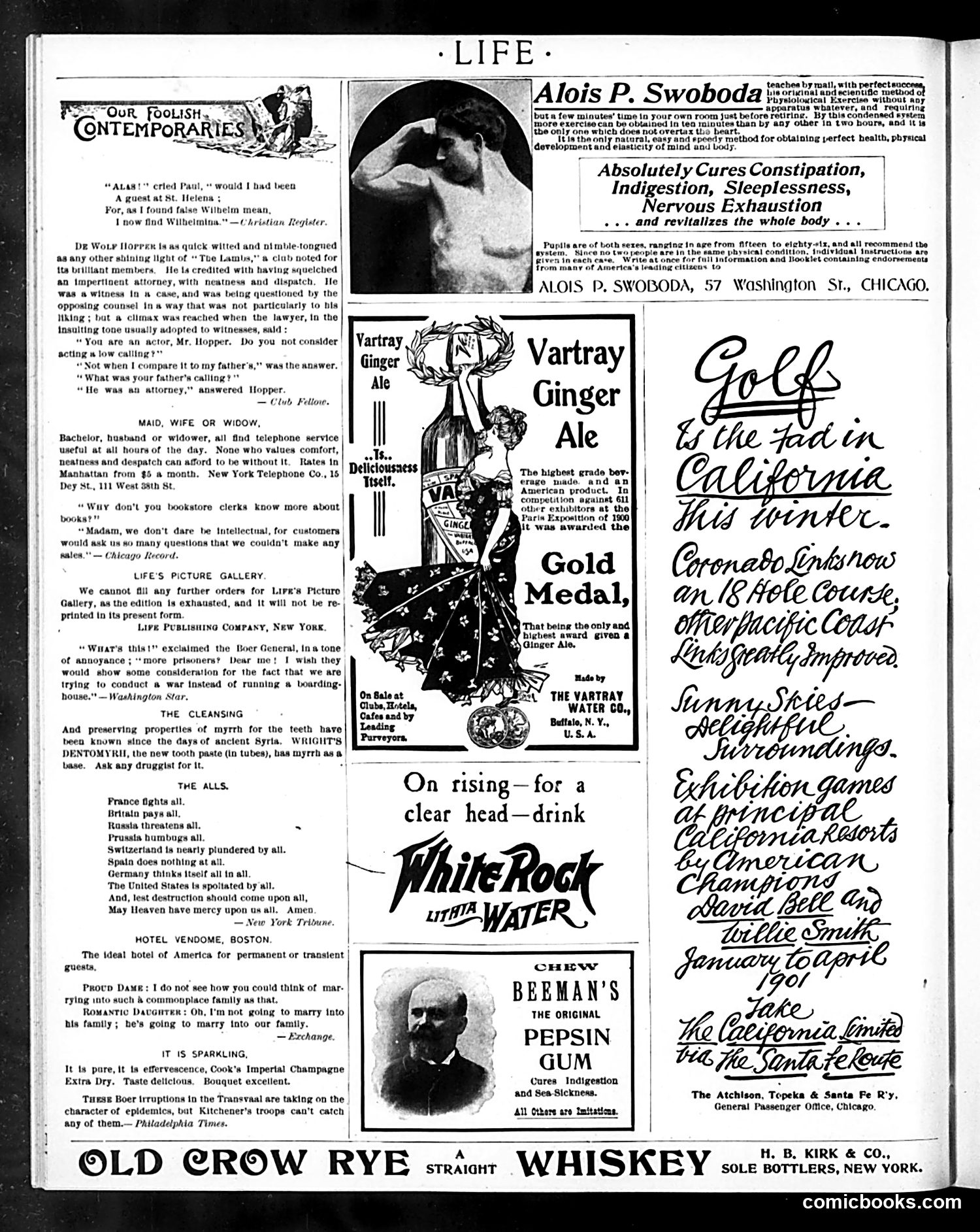
This page contains primarily **advertisements and humor pieces** rather than political cartoons. Key content: **Main Advertisement**: Alois P. Swoboda promotes a mail-order exercise method claiming to cure constipation, indigestion, and sleeplessness in minutes daily—typical of early 1900s dubious health claims with no scientific basis. **Humor Pieces**: Several short anecdotes, including one where actor De Wolf Hopper insults a lawyer by saying his father was "an attorney"—implying attorneys are lower status than actors. Another joke mocks bookstore clerks for feigning ignorance to avoid customer questions. **Brief Editorial Poem** ("The Alls"): Satirizes European powers during the Boer War era—France fights, Britain pays, Russia threatens, Germany is arrogant—reflecting American isolationism and skepticism of foreign entanglements. **Minor Content**: A quip about Boer War prisoners, ads for ginger ale and whiskey. The page reflects early 1900s American attitudes: skepticism of European politics, acceptance of dubious medical marketing, and genteel workplace humor.
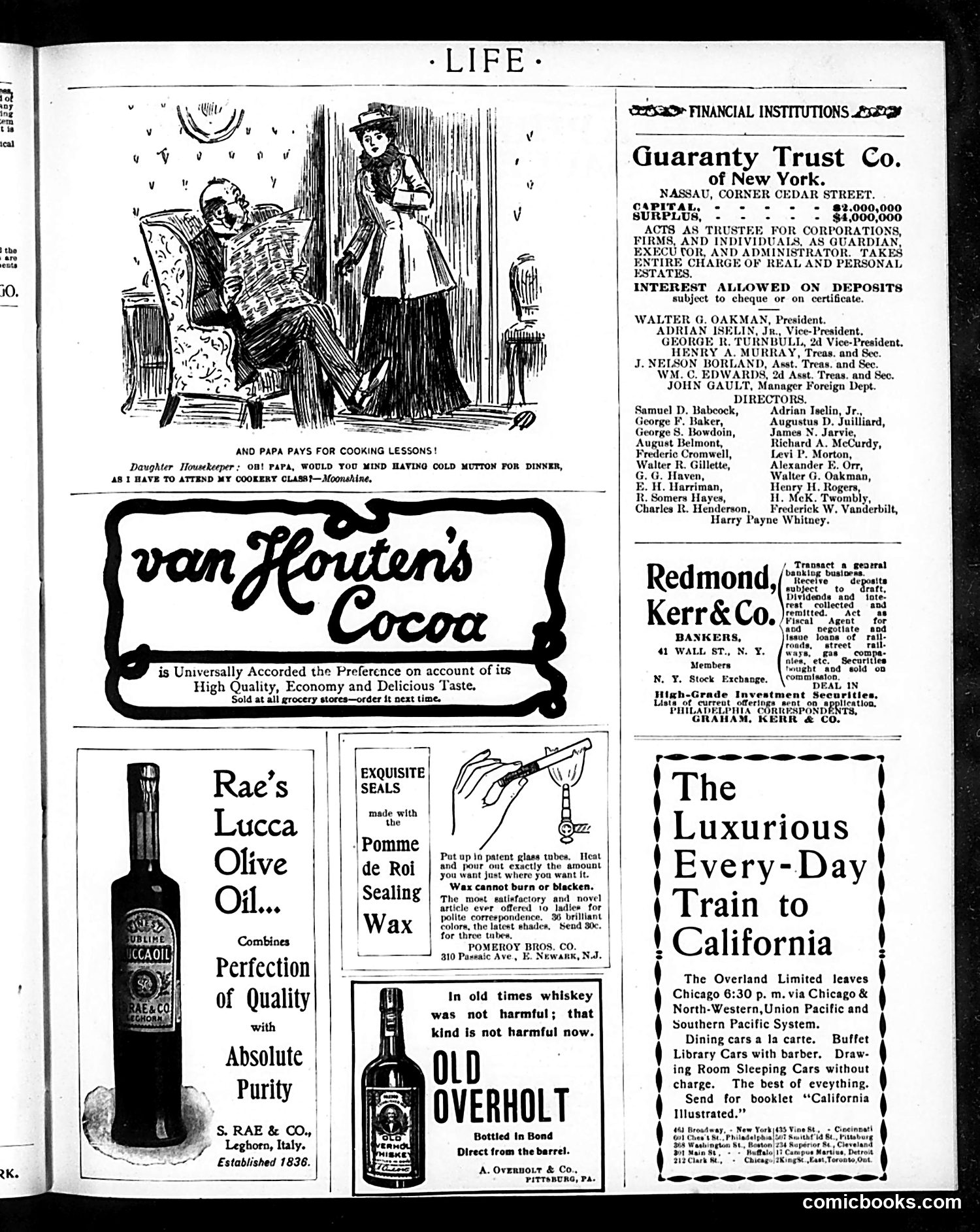
## Main Cartoon The top illustration satirizes the modern "New Woman" of the early 1900s. A daughter asks her father if he minds having cold mutton for dinner because she must attend cooking classes—the joke being the absurd contradiction: she needs lessons to cook, yet abandons actual cooking duties to attend them. The caption "AND PAPA PAYS FOR COOKING LESSONS!" mocks this waste of paternal money. This reflects contemporary anxieties about women's changing roles and education, suggesting that formal instruction was replacing traditional domestic competence. ## Context Early 20th-century America debated women's education and independence. The cartoon ridicules the idea that professional cooking instruction could justify household neglect—implying women were becoming impractically educated rather than practically skilled. The page is otherwise filled with period advertisements (olive oil, sealing wax, whiskey, trains, financial institutions), typical of Life's commercial-heavy editorial design.
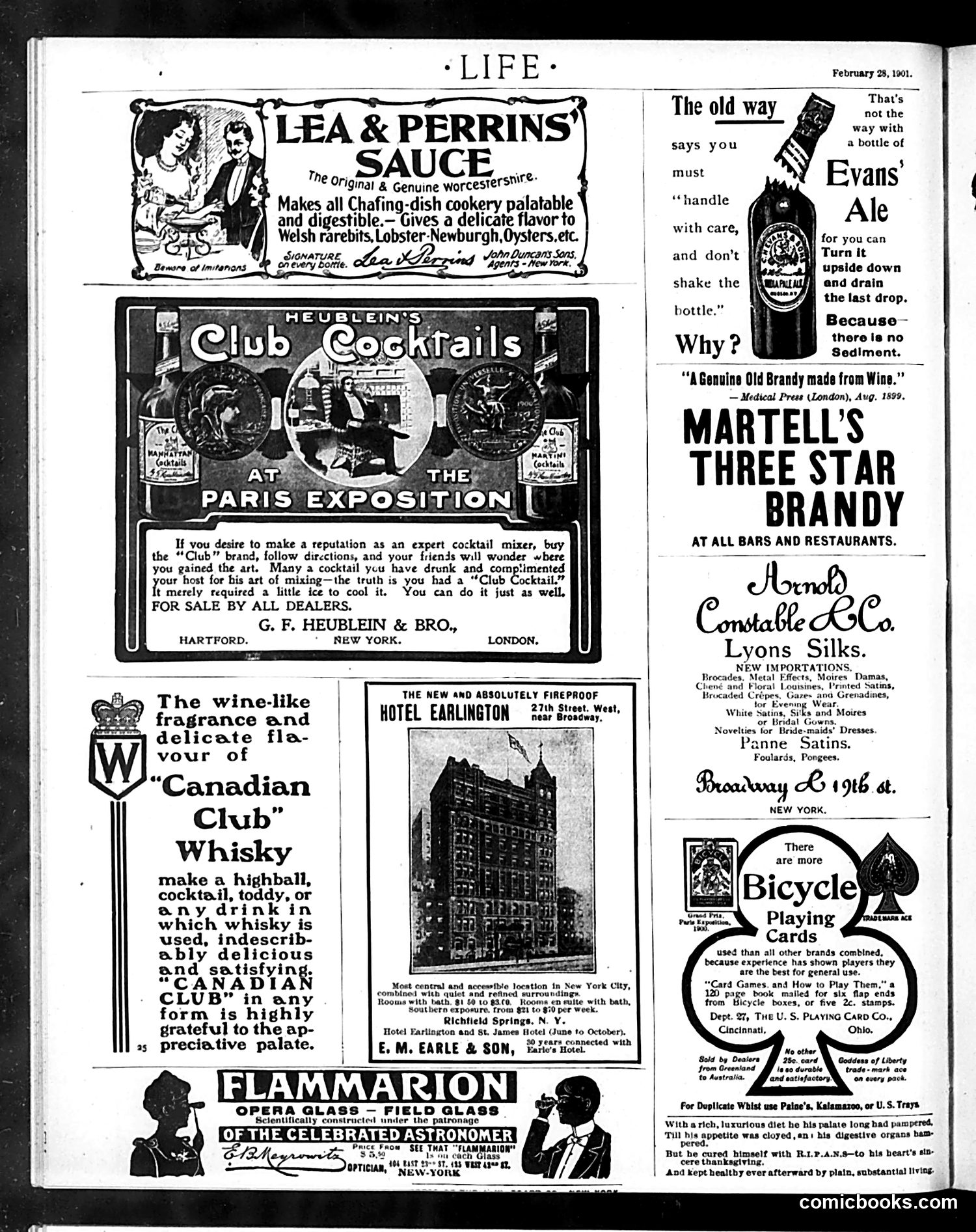
This page is **primarily advertising**, not editorial satire. It contains roughly a dozen product advertisements typical of the Gilded Age, targeting wealthy readers. Notable ads include: - **Lea & Perrins' Sauce** and **Evans' Ale**: Food/beverage products marketed with period illustrations - **Martell's Three Star Brandy** and **Canadian Club Whisky**: Spirits ads emphasizing quality and sophistication - **Hotel Earlington**: A New York hotel advertisement - **Bicycle Playing Cards**: Claims superiority over competitors - **Arnold Constable & Co.**: A department store advertising silk fabrics and women's clothing The **Flammarion** advertisement at bottom appears to reference a celebrated astronomer, though the text is partially illegible. The page reflects **early 1900s consumer culture** targeting affluent Americans: emphasis on imported European products, cocktail culture, refined dining, and luxury goods. There is **no political cartoon or satire** visible—this is straightforward commercial messaging dressed in period typography and illustration.