
Life, 1901-02-28 · page 6 of 20
Life — February 28, 1901 — page 6: what you’re looking at
What you’re looking at
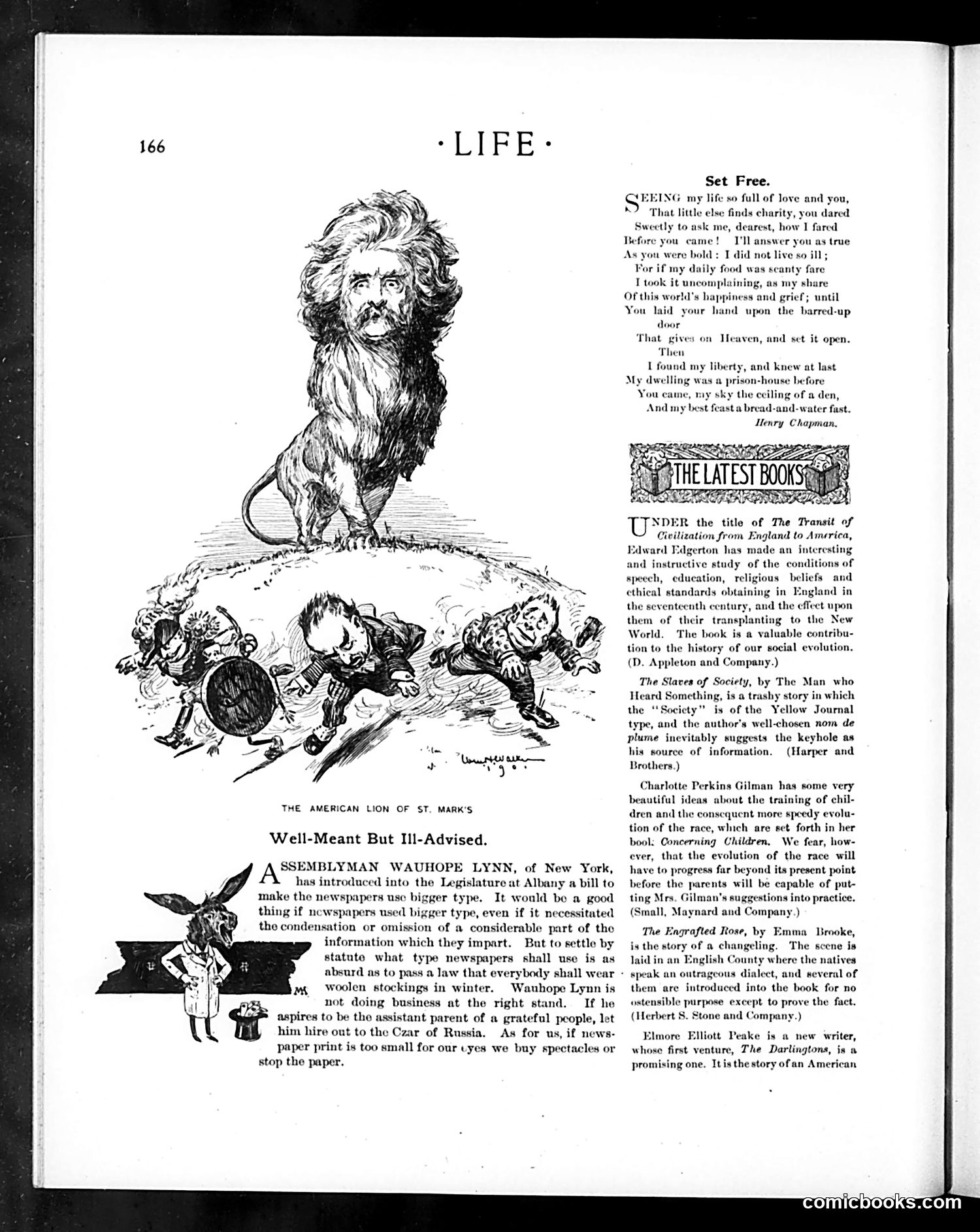
This satirical piece mocks Assemblyman Wauhope Lynn of New York, who introduced a bill requiring newspapers to use larger typeface. The cartoon depicts Lynn as "The American Lion of St. Mark's"—an ironic title suggesting grandiose pretension. The satire criticizes his proposal as well-intentioned but misguided. The editors argue that while larger type might help readers, it would waste newspaper space and increase costs unnecessarily. They suggest Lynn, despite good intentions, doesn't understand practical newspaper economics. The caricature with exaggerated features and the "lion" metaphor mock his self-importance regarding what the editors consider a minor, impractical legislative proposal.
📄 Transcribed text from this page (OCR, searchable)
Machine-transcribed from the original scan — historical spelling and the odd misread are preserved.
THE AMERICAN LION OF ST. MARK’S. Well-Meant But IIl-Advised. SSEMBLYMAN WAUHOPE LYNN, of New York, has introduced into the Legislature at Albany a bill to make the newspapers use bigger type. It would bo a good thing if newspapers used bigger type, even if it necessitated tho condensation or omission of a considerable part of the information which they impart. But to settle by statute what type newspapers shall use is as absurd as to pass a law that everybody shall wear - m Woolen stockings in winter. Wauhope Lynn is not doing business at the right da. If he w aspires to be the assistant parent of a grateful people, let him hire out to the Czar of Russia. As for us, if news- paper print is too small for our vyes we buy spectacles or stop the paper. Set Free. ING my life so full of love and you, That little else finds charii 1 dared Sweetly to ask me, dearest, how I fared Before you car T'll answer you as true As you were bold : I did not live so ill; I my daily was seanty fare I took it uncomplaining, as my share Of this world's bh: ess and grief; until You laid your hand upon the barred-up door That my sky the ceiling of a den, And hai best feast.a bread-and-water fast. Henry Chapman, all Ak CPLA ND NDER the title of The Transit of Civilization from England to America, Edward Edgerton has made an interesting and instructive study of the conditions of speech, education, religious beliefs and ethical standards obtaining in England in the seventeenth century, and the effvet upon them of their transplanting to the New World. The book is a valuable contribu- tion to the history of our social evolution. (D. Appleton and Company.) The Slaves of Society, by The Man who. Heard Something, is a trashy story in which the “Society” is of the Yellow Journal type, and the author's well-chosen nom de plume inevitably suggests the keyhole as his source of information. (Harper and Brothers.) Charlotte Perkins Gilman has some very beautiful ideas about the training of chil- dren and the consequent more speedy evolu- tion of the race, which are set forth in her bool: Concerning Children, We fear, how- ever, that the evolution of the race will have to progress far beyond its present point before the parents will be capable of put- ting Mrs. Gilman's suggestions into practice. (Small, Maynard and Company.) The Engrafted Rose, by Emma Lrooke, is the story of a changeling. The scene is laid in an English County where the natives speak an outrageous dialect, and several of them are introduced into the book for no ostensible purpose except to prove the fact. (Herbert 8. Stone and Company.) Elmore Elliott Peake is a new writer, whose first venture, The Darlingtons, is a promising one. Itisthestory ofan American