
Life, 1901-02-28 · page 13 of 20
Life — February 28, 1901 — page 13: what you’re looking at
What you’re looking at
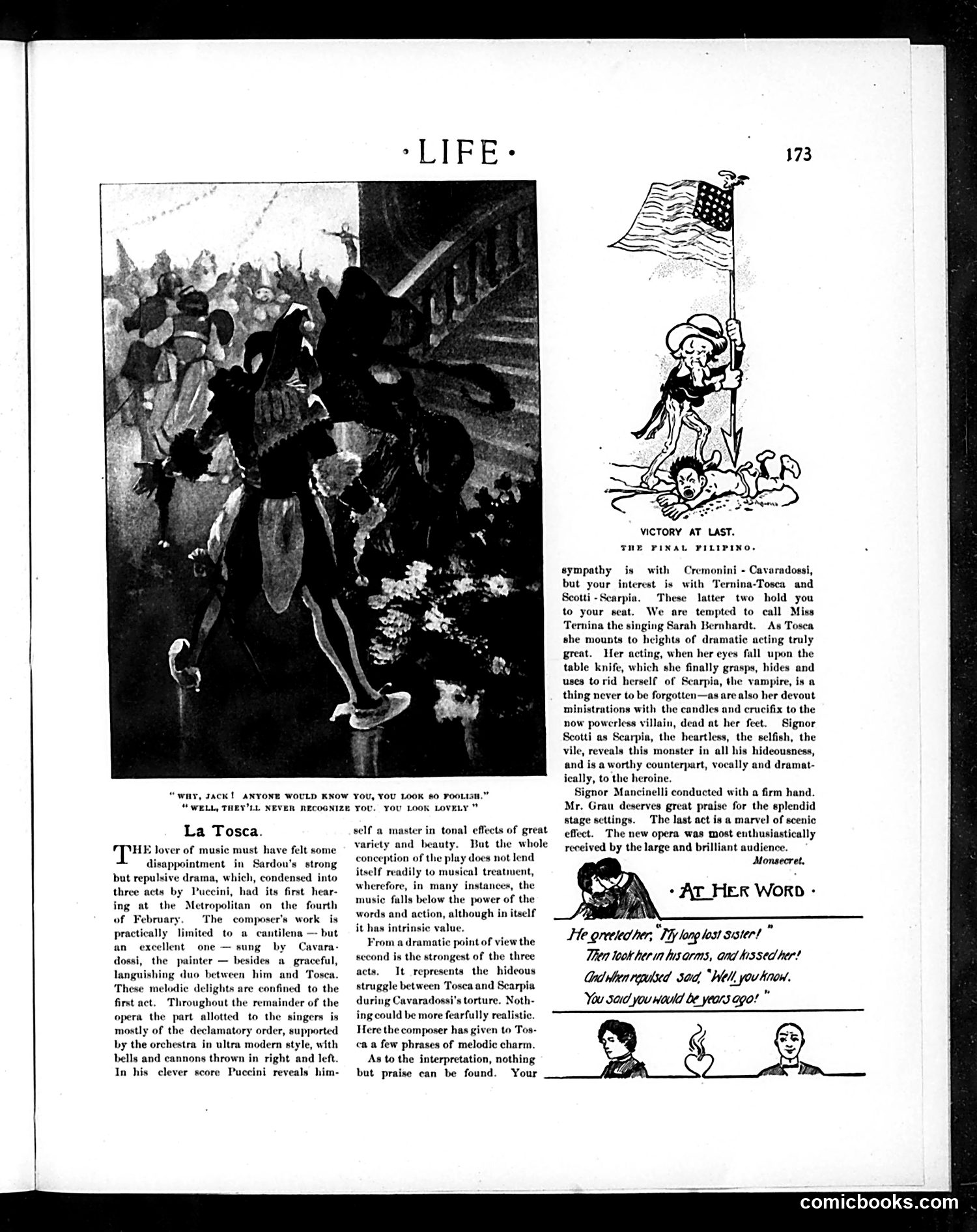
This page reviews Puccini's opera *La Tosca* at the Metropolitan Opera (premiere noted as February 4th). The large left image depicts a dramatic scene from the opera—likely Tosca's confrontation with Scarpia, the villain she ultimately kills. The dialogue caption quotes the opera's plot: a character warns another they look foolish and will be recognized, establishing the opera's themes of disguise and danger. The smaller right cartoon, "Victory at Last: The Final Filipino," appears to reference American colonial politics, likely satirizing U.S. involvement in the Philippines. The figure holding an American flag celebrates over defeated enemies—a commentary on military conquest presented as patriotic triumph. The bottom section "At Her Word" shows a domestic comedy: a man reunites with his "long lost sister," embraces and kisses her, only for her to remind him of an old promise he'd forgotten. The satire mocks male forgetfulness in romantic/marital obligations.
📄 Transcribed text from this page (OCR, searchable)
Machine-transcribed from the original scan — historical spelling and the odd misread are preserved.
+ JACK! ANYONE WOULD KNOW YOU, YOU LOOK 80 FOOLISH.” “WELL, THEY'LL NEVER RECOGNIZE YoU. La Tosca. HE lover of music must have felt some disappointment in Sardou's strong but repulsive dram: hich, condensed into three acts by Puccini, had its first hear- ing at the Metropolitan on the fourth of February. The composer's work is practically limited to a cantilena — but an excellent one — sung by Cavara- dossi, the painter — besides a graceful, languishing duo between him and Tosca. These melodic delights are confined to the first act. Throughout the remainder of the opera the part allotted to the singers is mostly of the declamatory order, supported by the orchestra in ultra modern style, with bells and cannons thrown in right and left. In his clever score Puccini reveals him- You LOOK LovELY self a master in tonal effects of great variety and beauty. But the whole ption of the play does not lend self readily to musical treatment, wherefore, in many instances, the music falls below the power of the words and action, although in itself it has intrinsic value. From a dramatic point of view the second is the strongest of the three acts, It represents the hideous struggle between Tosca and Scarpia during Cavaradossi's torture. Noth- ing could be more fearfully realistic. Here the composer has given to Tos- caa few phrases of melodic charm. As to the interpretation, nothing but praise can be found. Your VICTORY AT LAST. THE FINAL PILIPINO. sympathy is with Cremonini - Cavaradossi, but your interest is with Ternina-Tosca and Scotti-Scarpia. These latter two hold you to your seat. We are tempted to call Miss Ternina the singing Sarah Bernhardt. As Tosca she mounts to heights of dramatic acting truly great. Her acting, when her eyes fall upon the table knife, which she finally grasps, hides and uses torid herself of Scarpia, the vampire, is a thing never to be forgotten—as are also her devout ministrations with the candles and crucifix to the now powcrless villain, dead at her feet. Signor Scotti as Scarpia, the heartless, the selfish, the vile, reveals this monster in all his hideousness, and is a worthy counterpart, vocally and dramat- ically, to the heroine. Signor Mancinelli conducted with a firm hand. Mr. Grau deserves great praise for the splendid stage settings. The last act is a marvel of scenic effect. The new opera was most enthusiastically received by the large and brilliant audience. Monsecret, + AT_HER WokD - He greeted her, Thy long lost sister!” Tien took her in bus arms, and hissed her! Ord vhen rept sad, “Well you know, You said you would be years ago!" comicbooks.com